
The Behavior of Gases What is a gas
The Behavior of Gases
What is a gas? In a gas particles do not touch each other at all, but bump into each other constantly; n have no definite shape nor definite volume; n more affected by changed in temperature and pressure than the other physical states n
Quantities That Affect a Gas n There are four quantities needed to describe gases. 1. Temperature (T) 2. Pressure (P) 3. Volume (V) 4. Amount of gas – moles (n)
Temperature (T) Temperature is a measure of kinetic energy. n Faster particles = higher KE = higher temp n Temperature is: n n _______ proportional to pressure. (__T=__P) _______ proportional to volume. (__T=__V) _______ proportional to moles. (__T=__n)
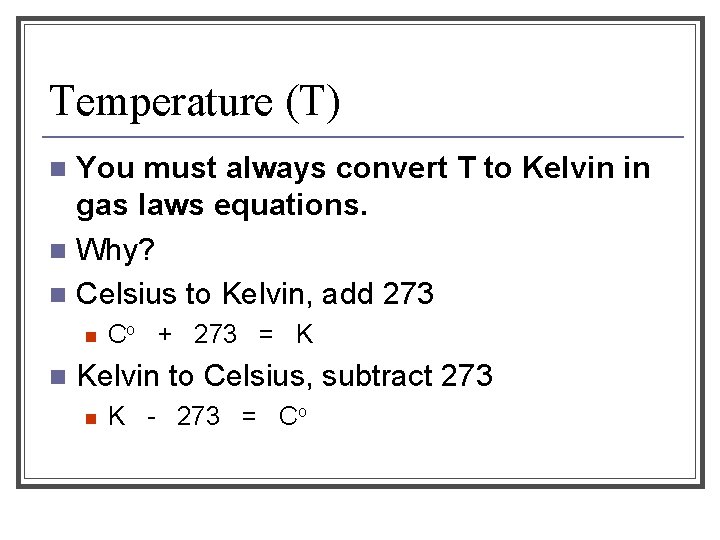
Temperature (T) You must always convert T to Kelvin in gas laws equations. n Why? n Celsius to Kelvin, add 273 n n n Co + 273 = K Kelvin to Celsius, subtract 273 n K - 273 = Co
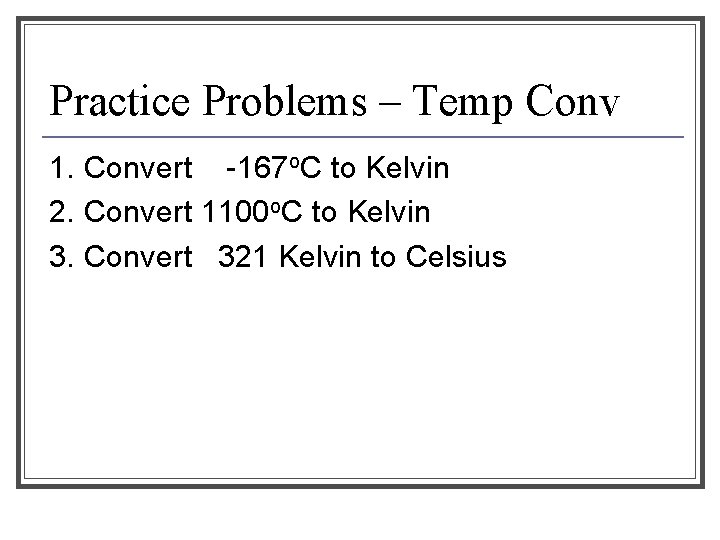
Practice Problems – Temp Conv 1. Convert -167 o. C to Kelvin 2. Convert 1100 o. C to Kelvin 3. Convert 321 Kelvin to Celsius
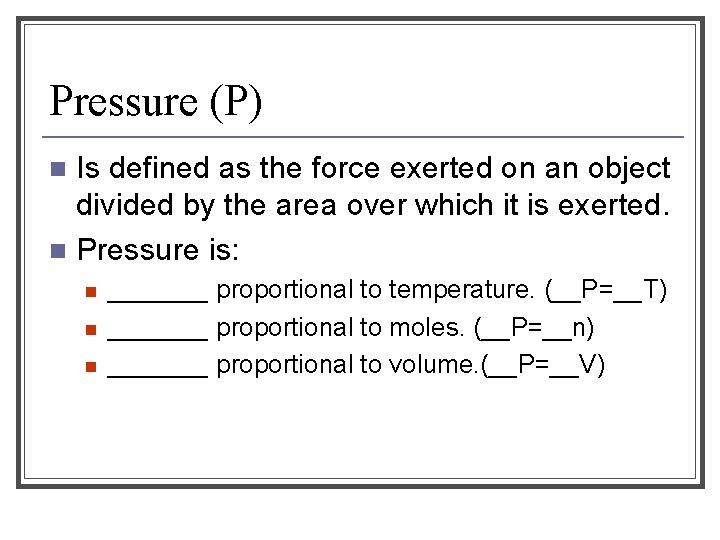
Pressure (P) Is defined as the force exerted on an object divided by the area over which it is exerted. n Pressure is: n n _______ proportional to temperature. (__P=__T) _______ proportional to moles. (__P=__n) _______ proportional to volume. (__P=__V)
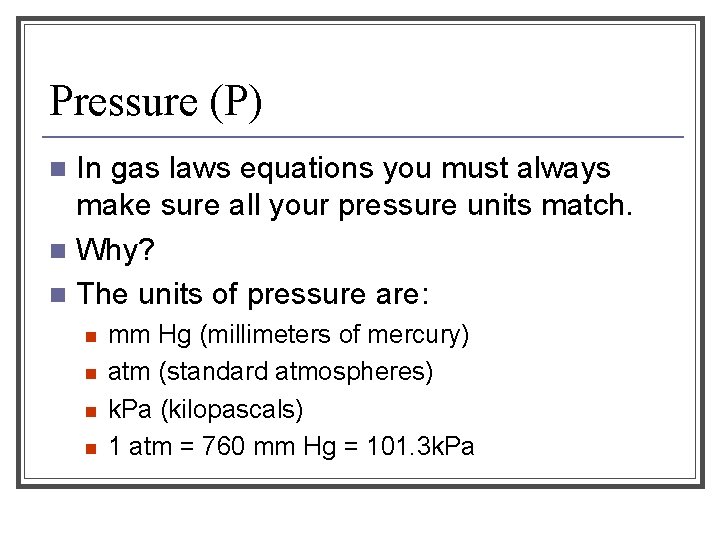
Pressure (P) In gas laws equations you must always make sure all your pressure units match. n Why? n The units of pressure are: n n n mm Hg (millimeters of mercury) atm (standard atmospheres) k. Pa (kilopascals) 1 atm = 760 mm Hg = 101. 3 k. Pa
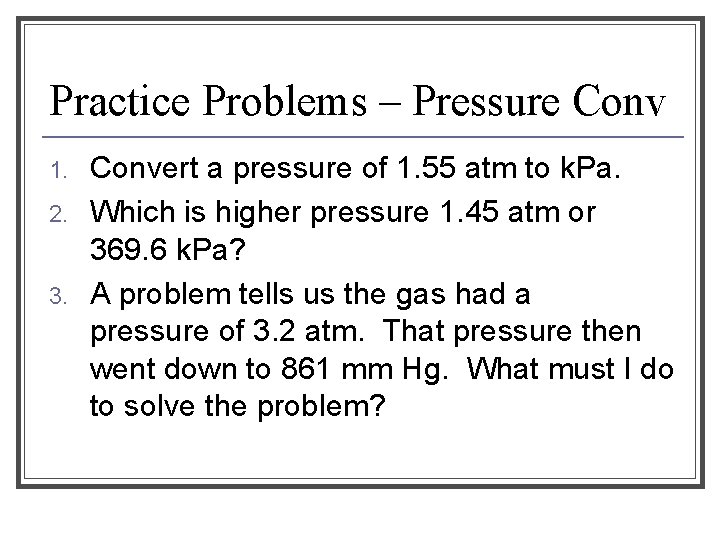
Practice Problems – Pressure Conv 1. 2. 3. Convert a pressure of 1. 55 atm to k. Pa. Which is higher pressure 1. 45 atm or 369. 6 k. Pa? A problem tells us the gas had a pressure of 3. 2 atm. That pressure then went down to 861 mm Hg. What must I do to solve the problem?
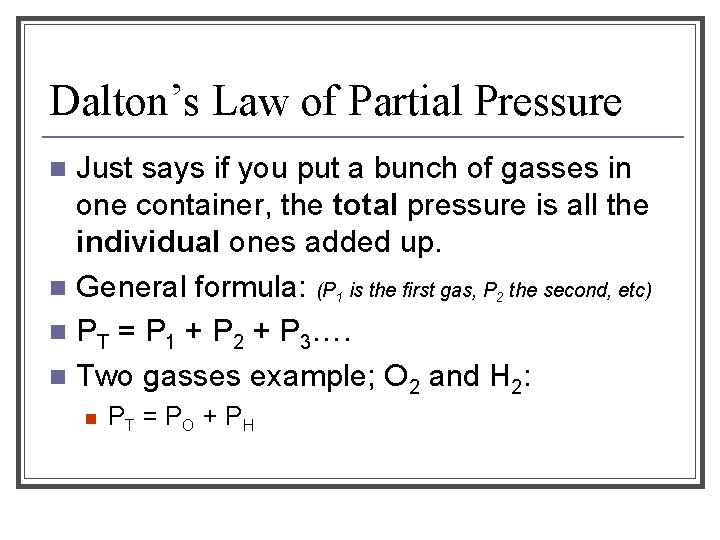
Dalton’s Law of Partial Pressure Just says if you put a bunch of gasses in one container, the total pressure is all the individual ones added up. n General formula: (P 1 is the first gas, P 2 the second, etc) n PT = P 1 + P 2 + P 3…. n Two gasses example; O 2 and H 2: n n PT = P O + P H
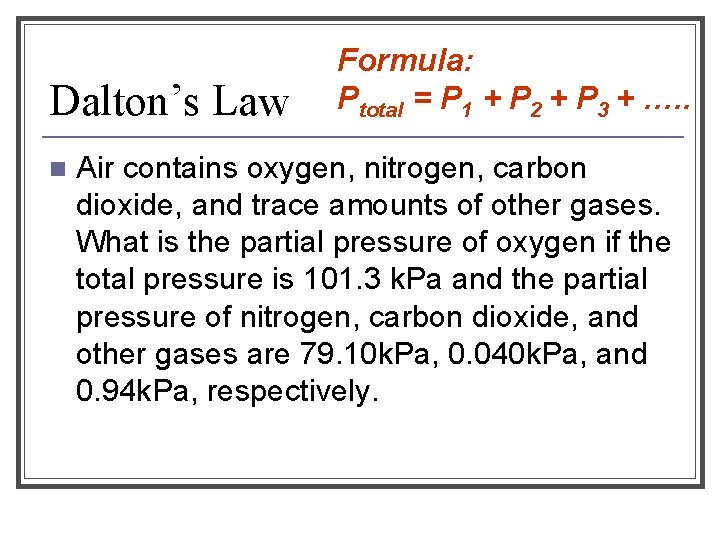
Dalton’s Law n Formula: Ptotal = P 1 + P 2 + P 3 + …. . Air contains oxygen, nitrogen, carbon dioxide, and trace amounts of other gases. What is the partial pressure of oxygen if the total pressure is 101. 3 k. Pa and the partial pressure of nitrogen, carbon dioxide, and other gases are 79. 10 k. Pa, 0. 040 k. Pa, and 0. 94 k. Pa, respectively.
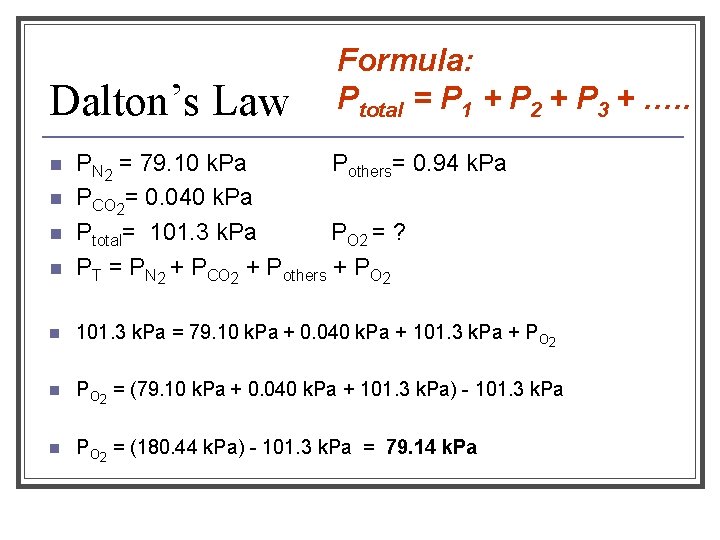
Dalton’s Law n n Formula: Ptotal = P 1 + P 2 + P 3 + …. . PN 2 = 79. 10 k. Pa Pothers= 0. 94 k. Pa PCO 2= 0. 040 k. Pa Ptotal= 101. 3 k. Pa PO 2 = ? PT = PN 2 + PCO 2 + Pothers + PO 2 n 101. 3 k. Pa = 79. 10 k. Pa + 0. 040 k. Pa + 101. 3 k. Pa + PO 2 n PO 2 = (79. 10 k. Pa + 0. 040 k. Pa + 101. 3 k. Pa) - 101. 3 k. Pa n PO 2 = (180. 44 k. Pa) - 101. 3 k. Pa = 79. 14 k. Pa
Volume (V) n Volume is how much space the gas has to move around in. n n n _______ proportional to temperature. (__V=__T) _______ proportional to moles. (__V=__n) _______ proportional to pressure. (__V=__P)
Volume (V) n Always in L (liters) or m. L (milliliters). n (Remember 1000 m. L = 1 L. ) They have to match! Why? ? ? n Mini-practice: n n n 458 m. L = ? L 1. 35 L = ? m. L
Amount of gas – moles (n) n The actual amount of gas particles in a sample. n n n _______ proportional to temperature. (__n=__T) _______ proportional to volume. (__n=__V) _______ proportional to pressure. (__n=__P)
Gas Laws
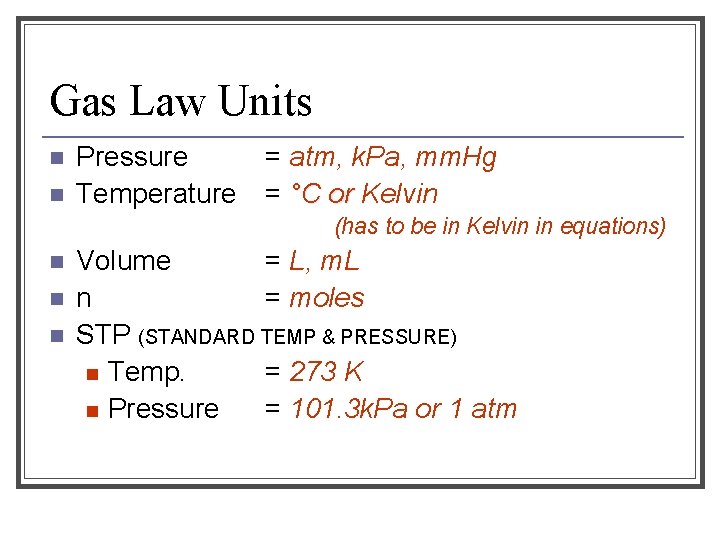
Gas Law Units n n Pressure Temperature = atm, k. Pa, mm. Hg = °C or Kelvin (has to be in Kelvin in equations) n n n Volume = L, m. L n = moles STP (STANDARD TEMP & PRESSURE) n Temp. = 273 K n Pressure = 101. 3 k. Pa or 1 atm
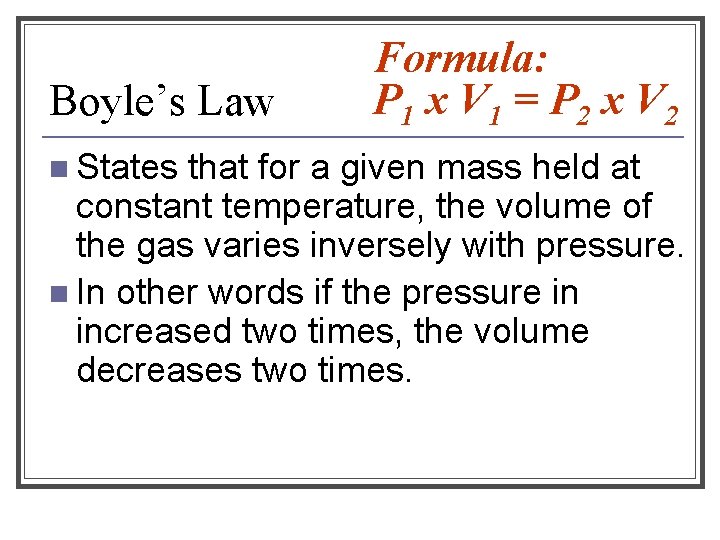
Boyle’s Law n States Formula: P 1 x V 1 = P 2 x V 2 that for a given mass held at constant temperature, the volume of the gas varies inversely with pressure. n In other words if the pressure in increased two times, the volume decreases two times.
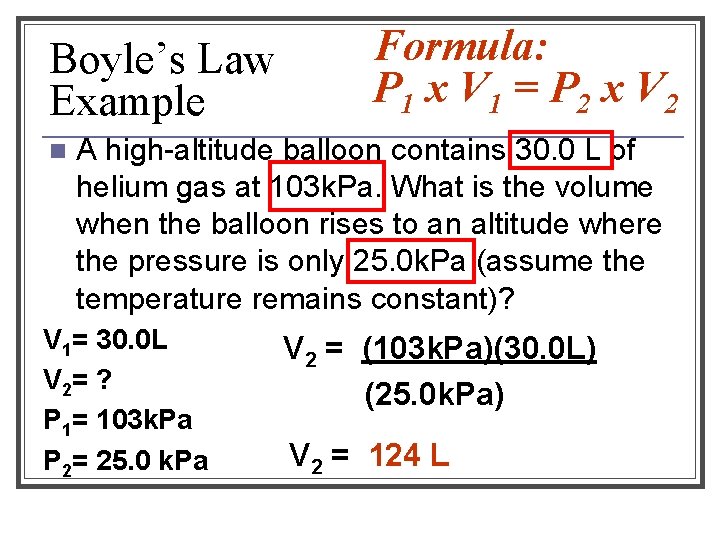
Boyle’s Law Example n Formula: P 1 x V 1 = P 2 x V 2 A high-altitude balloon contains 30. 0 L of helium gas at 103 k. Pa. What is the volume when the balloon rises to an altitude where the pressure is only 25. 0 k. Pa (assume the temperature remains constant)? V 1= 30. 0 L V 2= ? P 1= 103 k. Pa P 2= 25. 0 k. Pa V 2 = (103 k. Pa)(30. 0 L) (25. 0 k. Pa) V 2 = 124 L
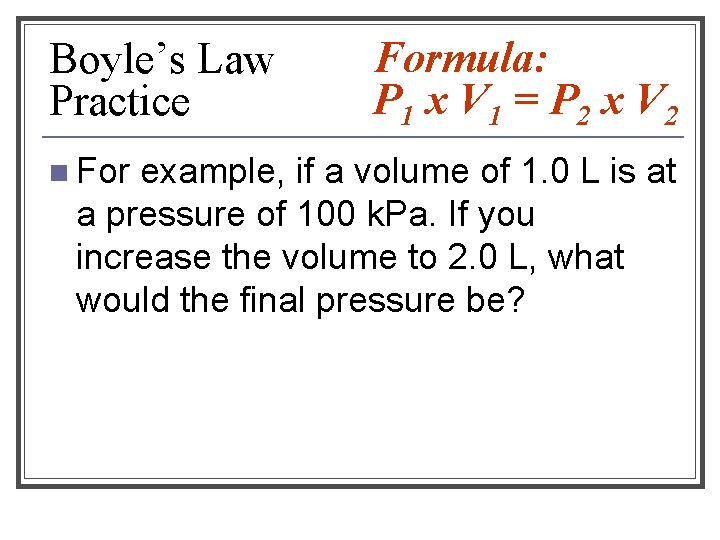
Boyle’s Law Practice n Formula: P 1 x V 1 = P 2 x V 2 example, if a volume of 1. 0 L is at a pressure of 100 k. Pa. If you increase the volume to 2. 0 L, what would the final pressure be?
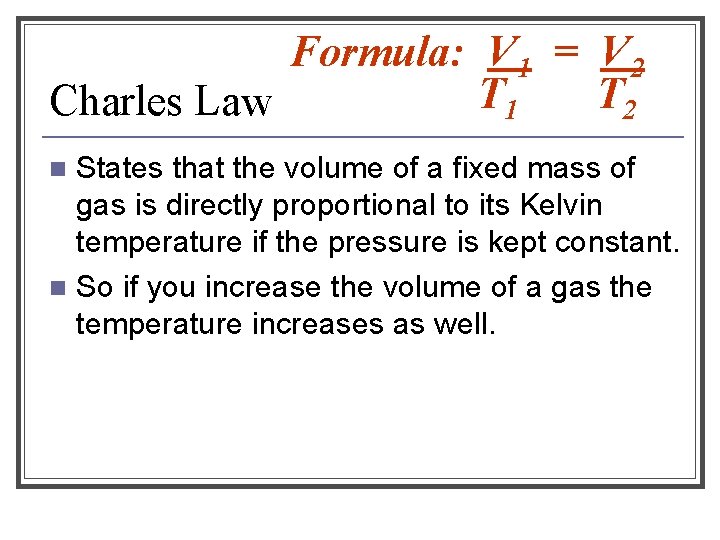
Formula: V 1 = V 2 T 1 T 2 Charles Law States that the volume of a fixed mass of gas is directly proportional to its Kelvin temperature if the pressure is kept constant. n So if you increase the volume of a gas the temperature increases as well. n
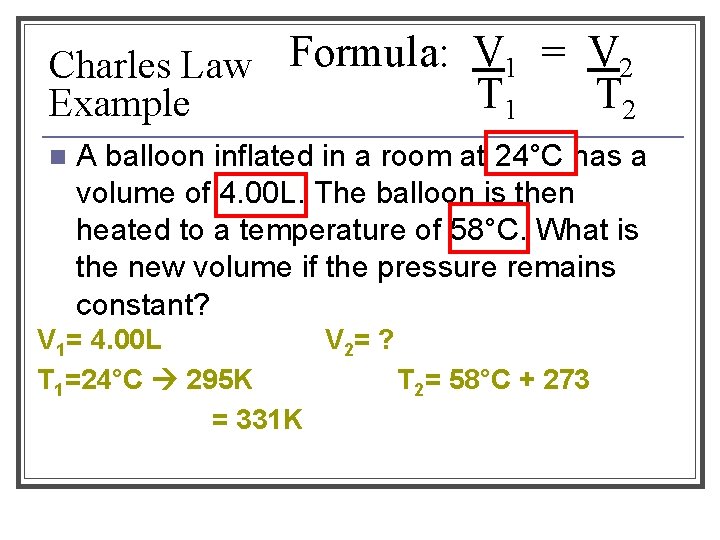
Charles Law Formula: V 1 = V 2 T 1 T 2 Example n A balloon inflated in a room at 24°C has a volume of 4. 00 L. The balloon is then heated to a temperature of 58°C. What is the new volume if the pressure remains constant? V 1= 4. 00 L V 2= ? T 1=24°C 295 K T 2= 58°C + 273 = 331 K
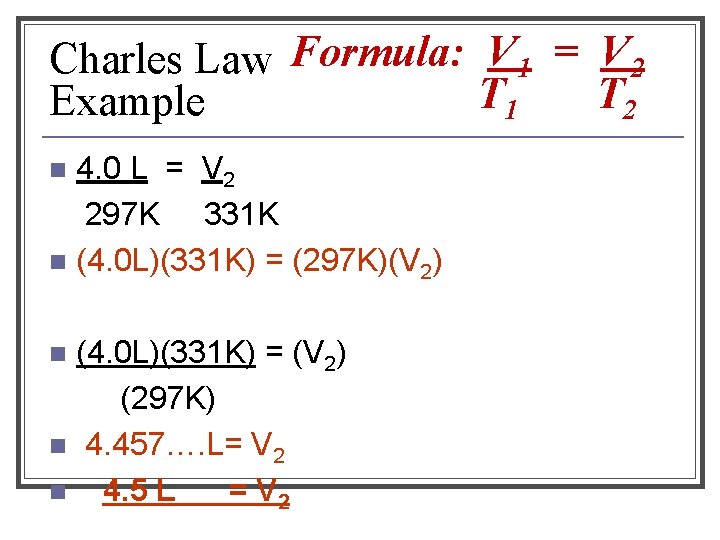
Charles Law Formula: V 1 = V 2 T 1 T 2 Example 4. 0 L = V 2 297 K 331 K n (4. 0 L)(331 K) = (297 K)(V 2) n (4. 0 L)(331 K) = (V 2) (297 K) n 4. 457…. L= V 2 n 4. 5 L = V 2 n
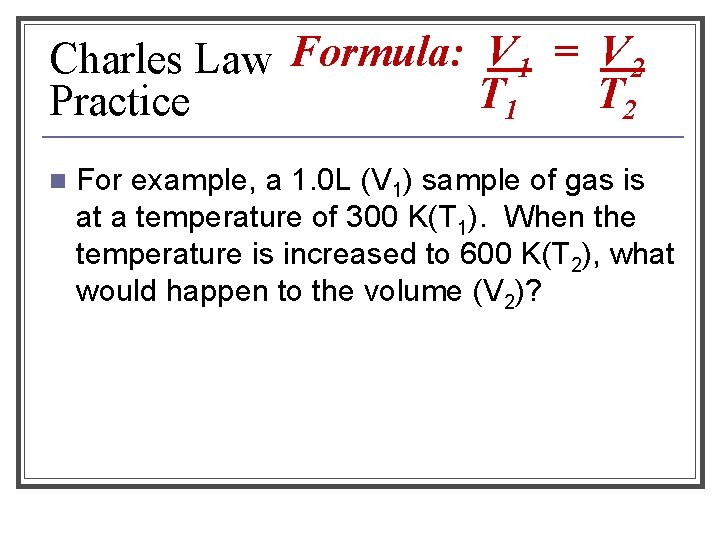
Charles Law Formula: V 1 = V 2 T 1 T 2 Practice n For example, a 1. 0 L (V 1) sample of gas is at a temperature of 300 K(T 1). When the temperature is increased to 600 K(T 2), what would happen to the volume (V 2)?
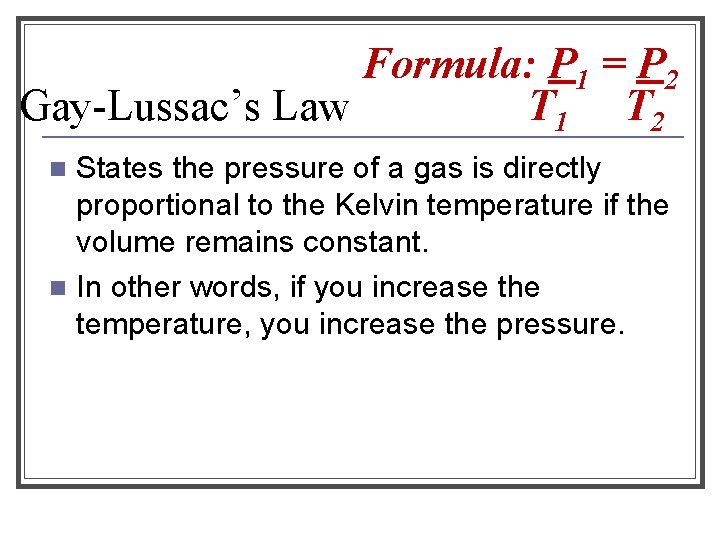
Formula: P 1 = P 2 T 1 T 2 Gay-Lussac’s Law States the pressure of a gas is directly proportional to the Kelvin temperature if the volume remains constant. n In other words, if you increase the temperature, you increase the pressure. n
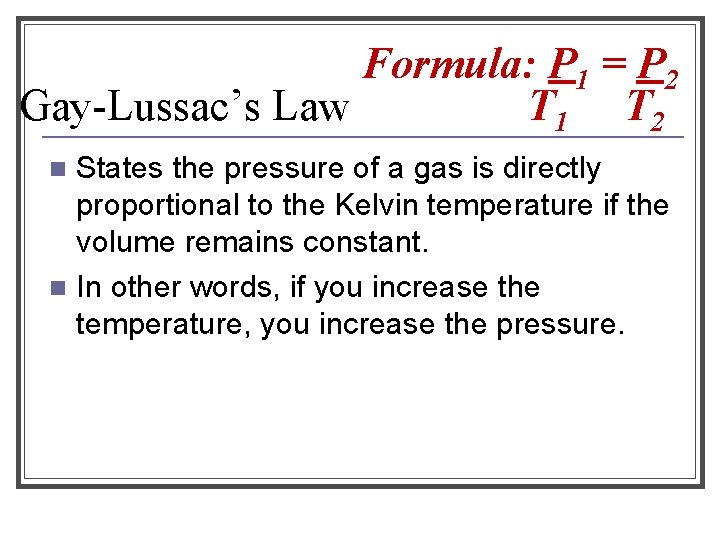
Formula: P 1 = P 2 T 1 T 2 Gay-Lussac’s Law States the pressure of a gas is directly proportional to the Kelvin temperature if the volume remains constant. n In other words, if you increase the temperature, you increase the pressure. n
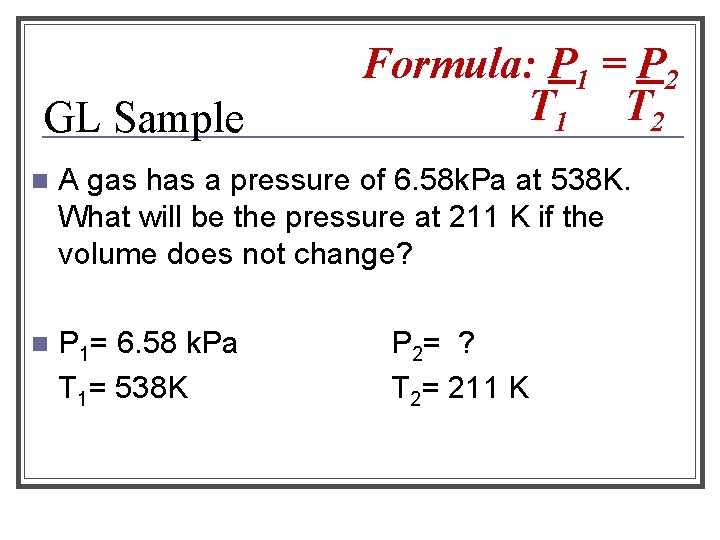
GL Sample Formula: P 1 = P 2 T 1 T 2 n A gas has a pressure of 6. 58 k. Pa at 538 K. What will be the pressure at 211 K if the volume does not change? n P 1= 6. 58 k. Pa T 1= 538 K P 2= ? T 2= 211 K
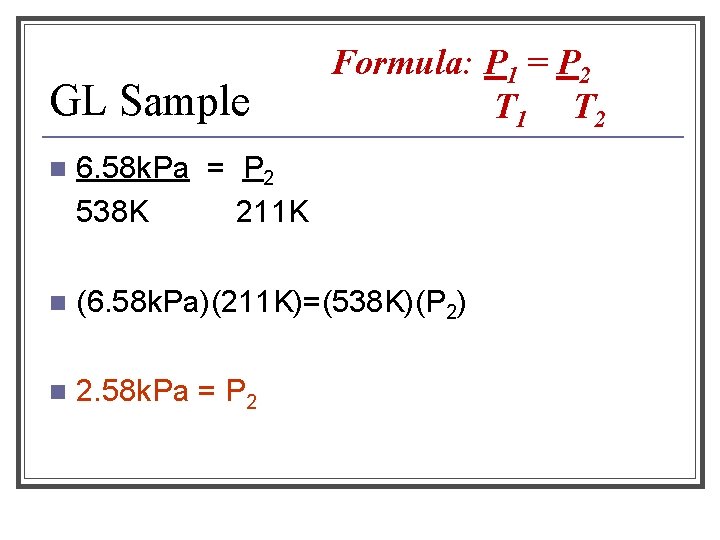
GL Sample Formula: P 1 = P 2 T 1 T 2 n 6. 58 k. Pa = P 2 538 K 211 K n (6. 58 k. Pa)(211 K)=(538 K)(P 2) n 2. 58 k. Pa = P 2
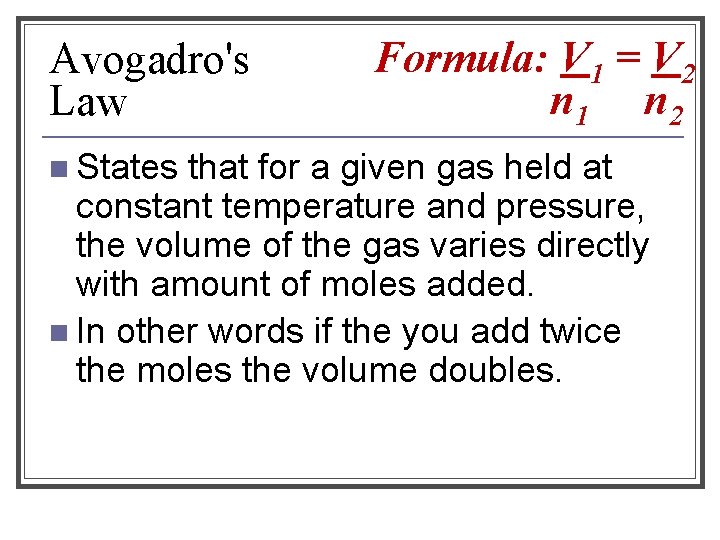
Avogadro's Law n States Formula: V 1 = V 2 n 1 n 2 that for a given gas held at constant temperature and pressure, the volume of the gas varies directly with amount of moles added. n In other words if the you add twice the moles the volume doubles.
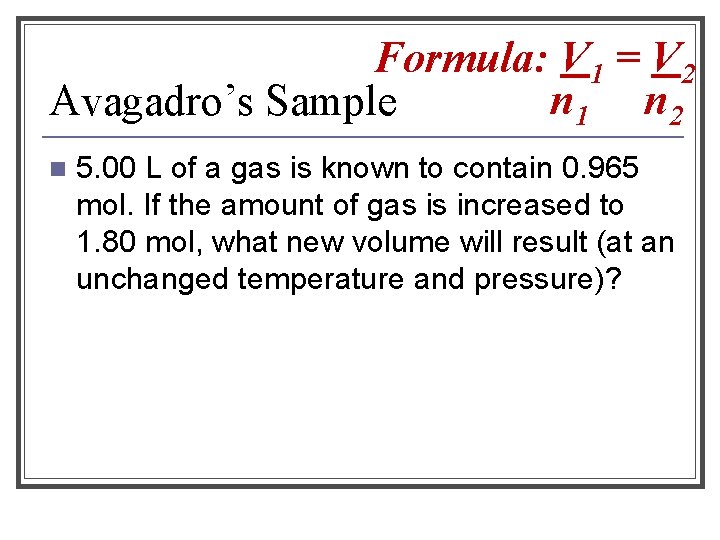
Formula: V 1 = V 2 n 1 n 2 Avagadro’s Sample n 5. 00 L of a gas is known to contain 0. 965 mol. If the amount of gas is increased to 1. 80 mol, what new volume will result (at an unchanged temperature and pressure)?
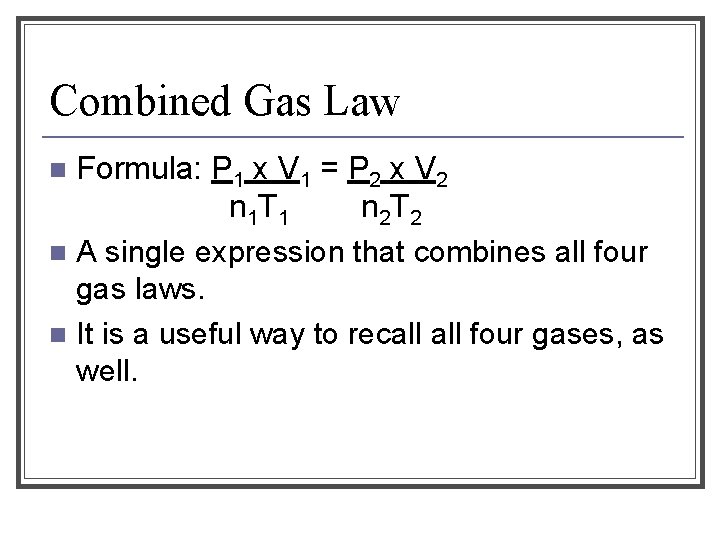
Combined Gas Law Formula: P 1 x V 1 = P 2 x V 2 n 1 T 1 n 2 T 2 n A single expression that combines all four gas laws. n It is a useful way to recall four gases, as well. n
Combined Sample 1
Combined Sample 2
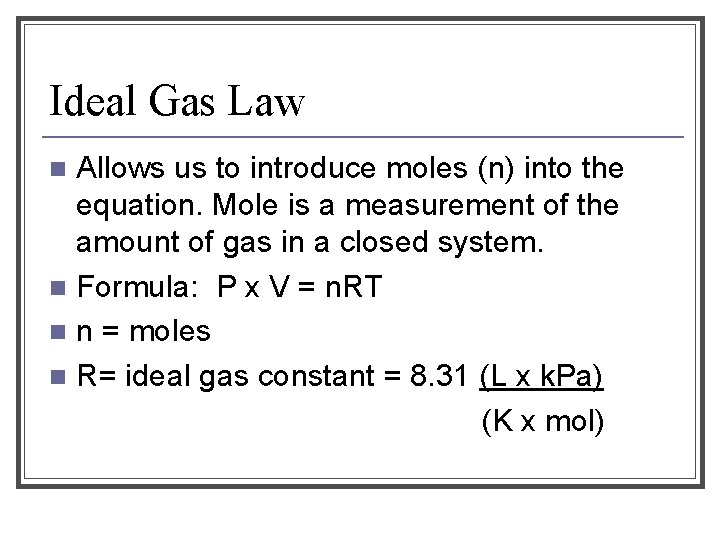
Ideal Gas Law Allows us to introduce moles (n) into the equation. Mole is a measurement of the amount of gas in a closed system. n Formula: P x V = n. RT n n = moles n R= ideal gas constant = 8. 31 (L x k. Pa) (K x mol) n
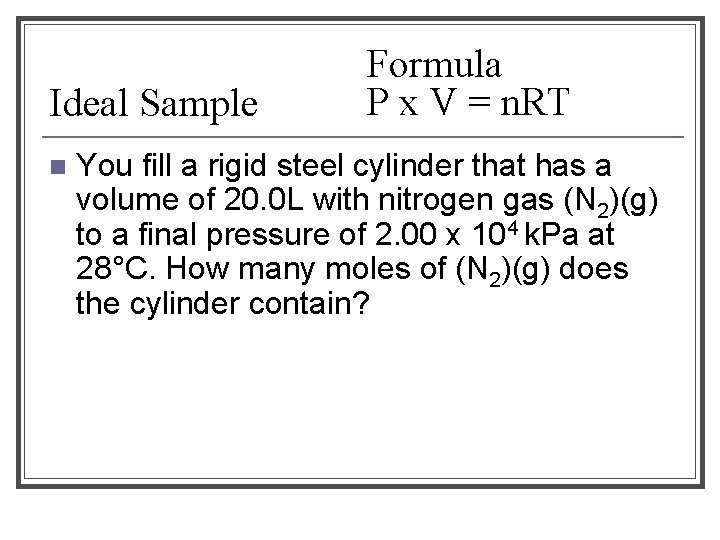
Ideal Sample n Formula P x V = n. RT You fill a rigid steel cylinder that has a volume of 20. 0 L with nitrogen gas (N 2)(g) to a final pressure of 2. 00 x 104 k. Pa at 28°C. How many moles of (N 2)(g) does the cylinder contain?
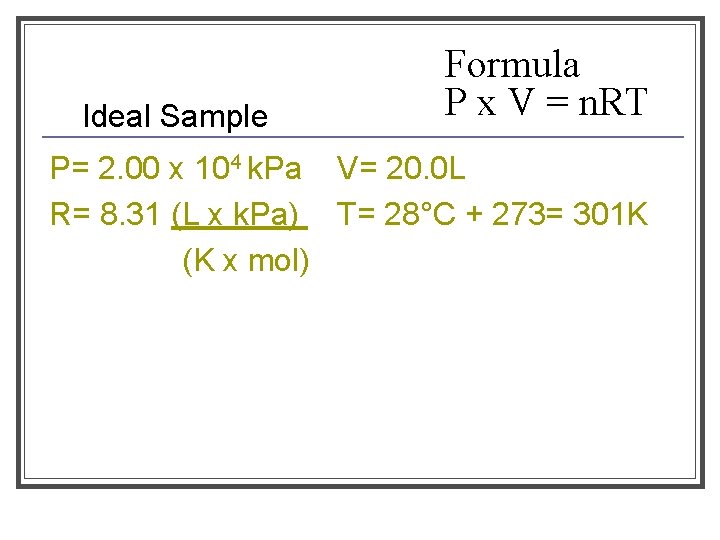
Ideal Sample Formula P x V = n. RT P= 2. 00 x 104 k. Pa V= 20. 0 L R= 8. 31 (L x k. Pa) T= 28°C + 273= 301 K (K x mol)
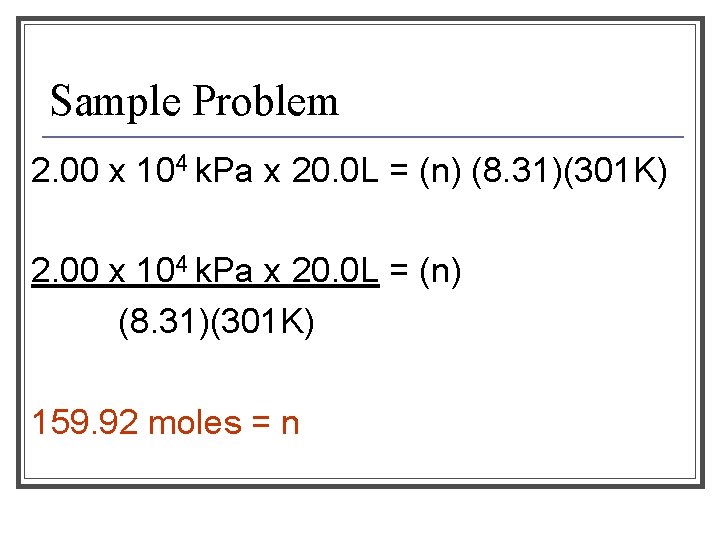
Sample Problem 2. 00 x 104 k. Pa x 20. 0 L = (n) (8. 31)(301 K) 159. 92 moles = n
- Slides: 37