
The Behavior of Gases Properties of Gases Review
The Behavior of Gases
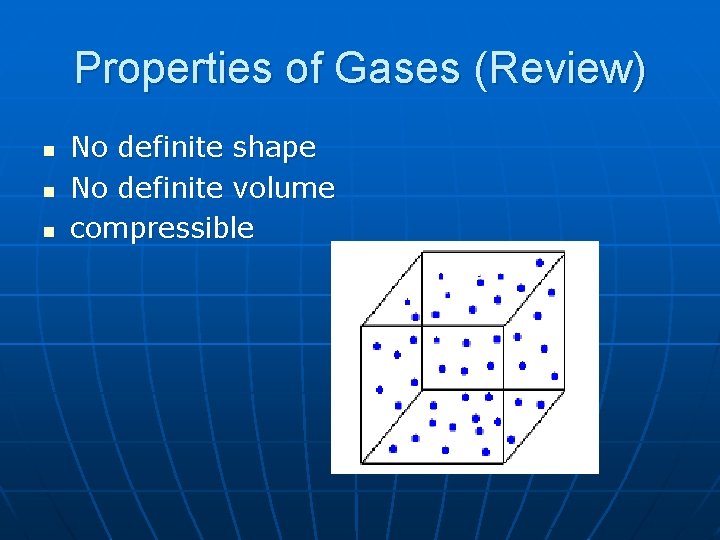
Properties of Gases (Review) n n n No definite shape No definite volume compressible
Kinetic Molecular Theory moving molecules well supported ideas
Basic Kinetic Theory of Gases 1. Composed of particles like atoms (ex: He) or molecules like (O 2 and CO 2) There are no attractive/repulsive forces. Lots of empty space!!

Basic Kinetic Theory of Gases 2. Particles move in random, constant, straight-line motion. Move independently of each other.
Basic Kinetic Theory of Gases 3. All collisions are elastic meaning that KE is transferred without loss of energy. Gases tend to diffuse towards areas of lower concentration.
Gas Pressure n n n Pressure- force exerted on container walls by particles in a gas Units used- k. Pa, atm, Torr, mm. Hg STP (Standard Temperature and Pressure) Table A 273 K or 0°C and 101. 3 k. Pa = 1 atm = 760 Torr (mm. Hg)
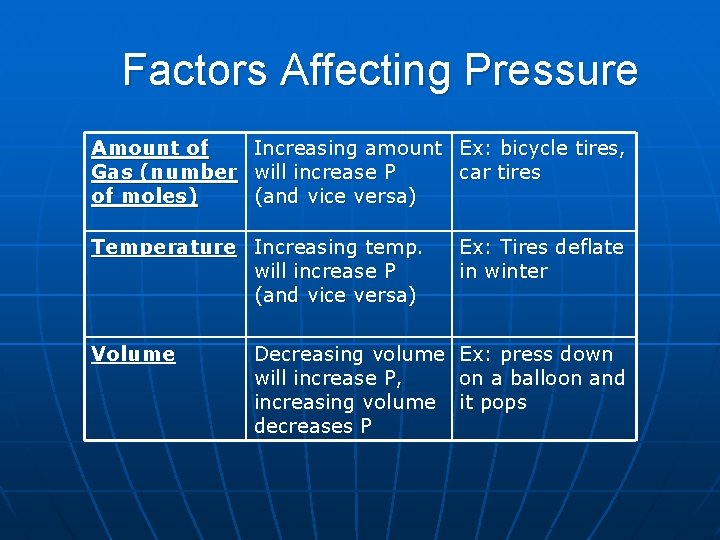
Factors Affecting Pressure Amount of Gas (number of moles) Increasing amount will increase P (and vice versa) Temperature Increasing temp. will increase P (and vice versa) Volume Ex: bicycle tires, car tires Ex: Tires deflate in winter Decreasing volume Ex: press down will increase P, on a balloon and increasing volume it pops decreases P
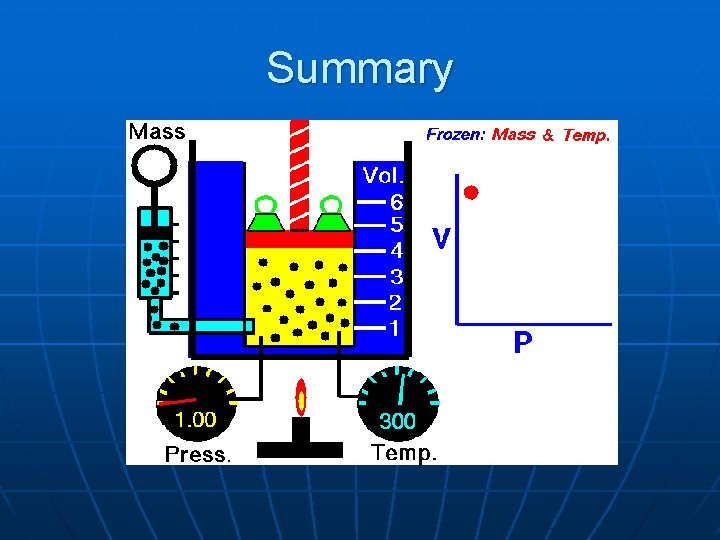
n n Pressure and volume have an inverse relationship, if temperature remains constant. If volume is increased, pressure is decreased by the same factor.
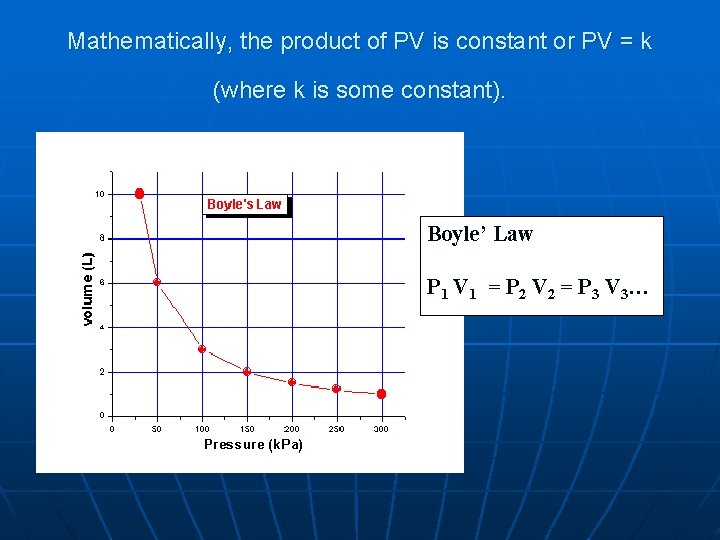
Mathematically, the product of PV is constant or PV = k (where k is some constant). Boyle’ Law P 1 V 1 = P 2 V 2 = P 3 V 3…
Summary
n n Volume and temperature have a direct relationship, if pressure is held constant. If temperature (K) is increased, volume is increased by the same factor.
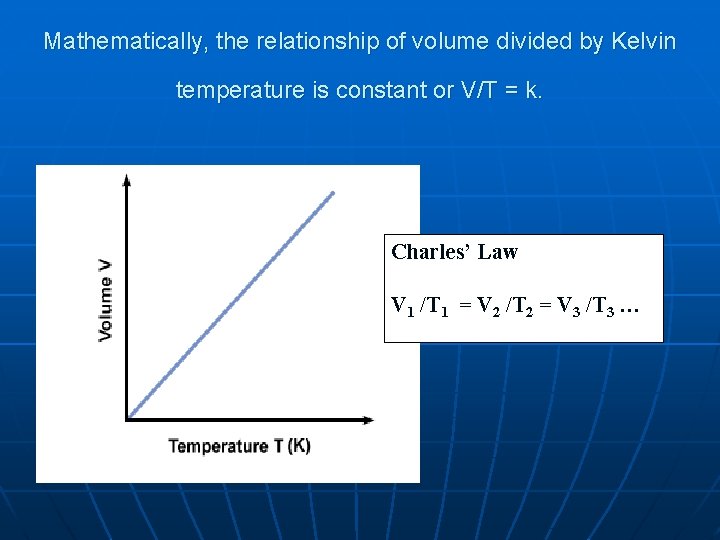
Mathematically, the relationship of volume divided by Kelvin temperature is constant or V/T = k. Charles’ Law V 1 /T 1 = V 2 /T 2 = V 3 /T 3 …
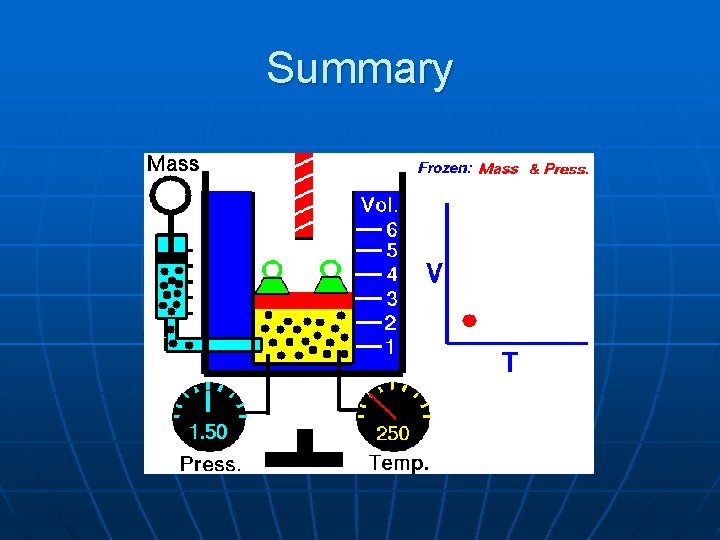
Summary
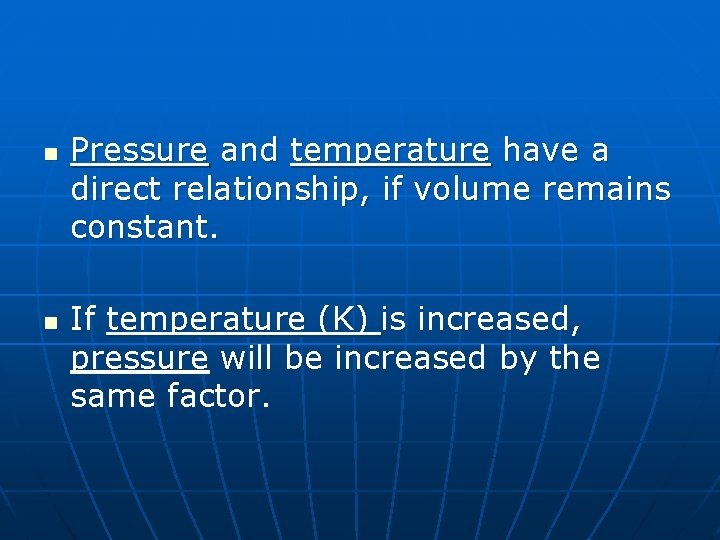
n n Pressure and temperature have a direct relationship, if volume remains constant. If temperature (K) is increased, pressure will be increased by the same factor.
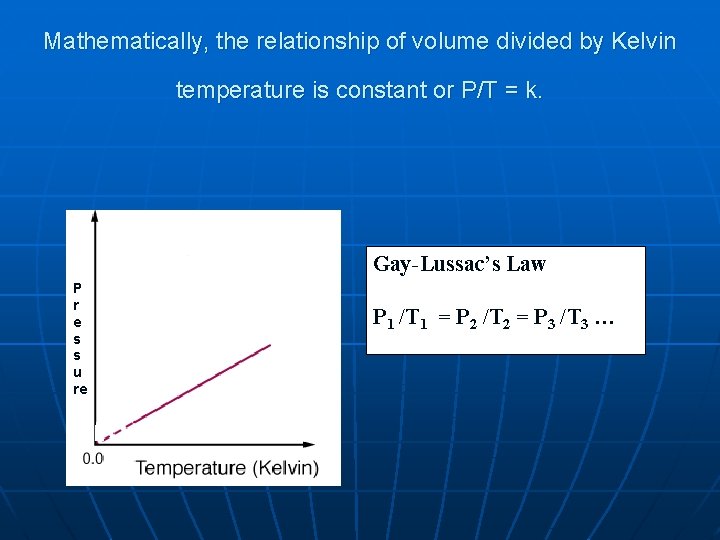
Mathematically, the relationship of volume divided by Kelvin temperature is constant or P/T = k. Gay-Lussac’s Law P r e s s u re P 1 /T 1 = P 2 /T 2 = P 3 /T 3 …
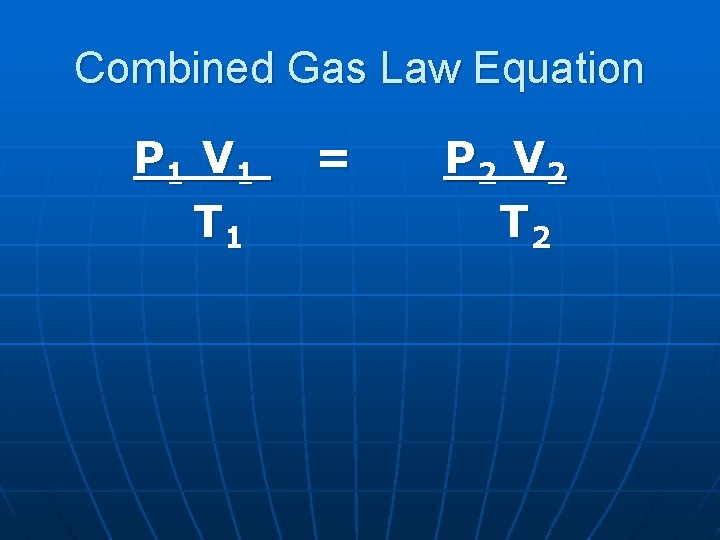
Combined Gas Law Equation P 1 V 1 T 1 = P 2 V 2 T 2
Combined Gas Law Equation n Steps: Determine which variable is kept constant (if any) n Cancel those terms and remove them from the equation n Plug in values that are given. n Solve for the unknown. n Be sure to always use temperature in Kelvins. n
Ideal Gases vs. Real Gases n n n “Ideal gases” behave as predicted by Kinetic Molecular Theory. Examples: H 2 and He Gases are most ideal at high temperature and low pressure.
n n “Real gases” deviate from ideal behavior. Why? At low temps, gas particles become attracted to each other (KMT says they are not). Under high pressure, gases occupy a specific volume (KMT says they don’t).
Avogadro’s Law n Avogadro’s number: 6. 02 x 1023 n Simply refers to the quantity of particles found in a mole. n At STP, 6. 02 x 1023 particles of a gas occupies 22. 4 L.
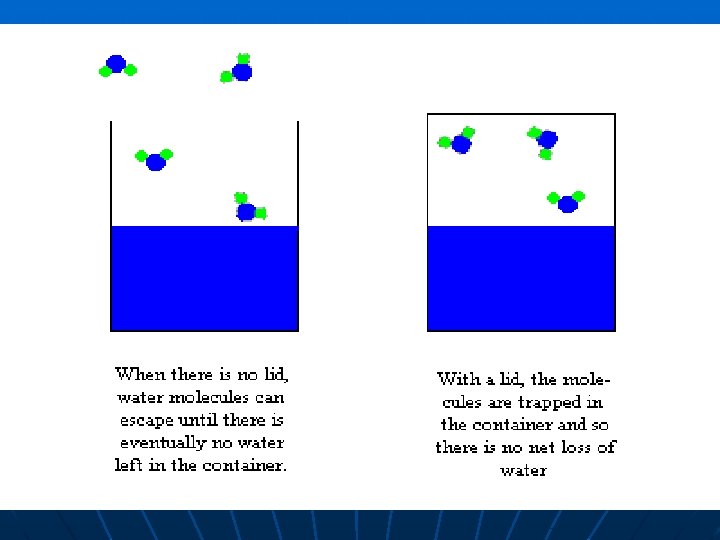
Vapor Pressure n n In a sealed container, vapor pressure can be measured above a liquid. Evaporation occurs when some particles from the surface of a liquid escape causing pressure to build up above the liquid
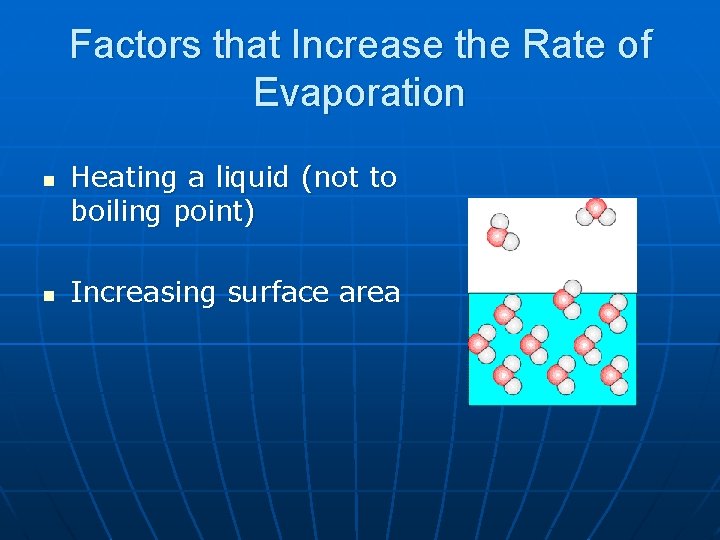
Factors that Increase the Rate of Evaporation n n Heating a liquid (not to boiling point) Increasing surface area
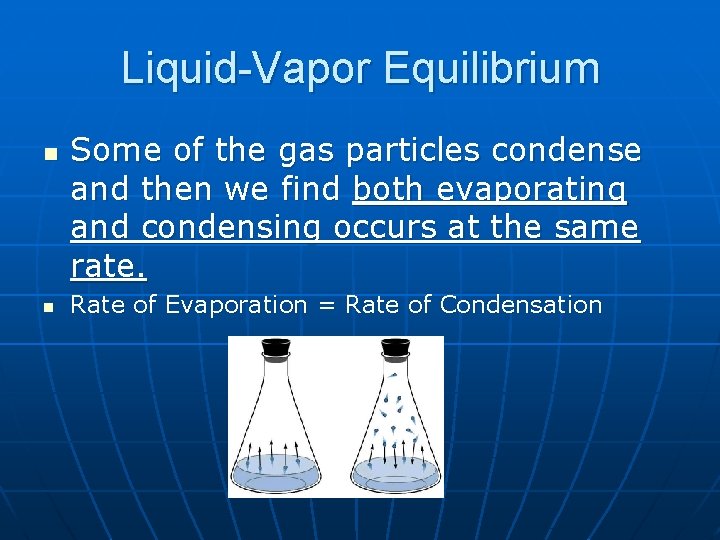
Liquid-Vapor Equilibrium n n Some of the gas particles condense and then we find both evaporating and condensing occurs at the same rate. Rate of Evaporation = Rate of Condensation
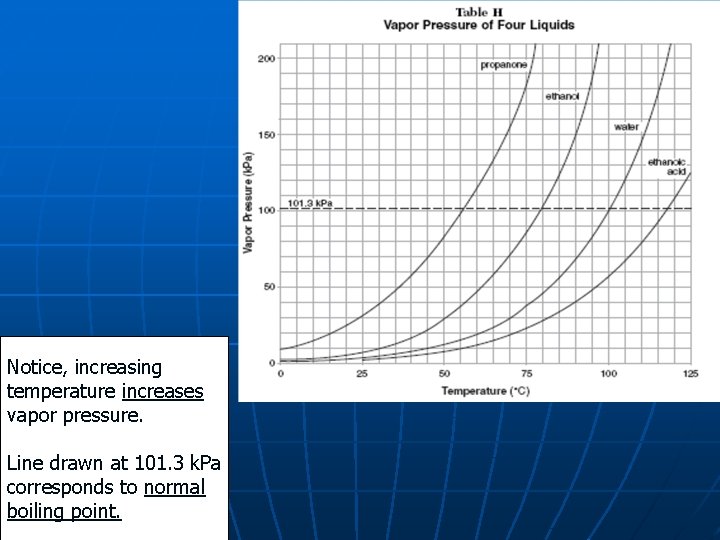
Table H Notice, increasing temperature increases vapor pressure. Line drawn at 101. 3 k. Pa corresponds to normal boiling point.
- Slides: 26