
The Behavior Education Program BEP An additional intervention
The Behavior Education Program (BEP): An additional intervention to complement school and classroom managment Crone, Horner, & Hawken (2004)
Behavior Education Program (BEP) Features: Students targeted based on behavior Improved adult relationships n Daily check-in and check-out daily with an adult Regular feedback and reinforcement from teachers Family component when possible Daily performance data used to evaluate progress © Leanne S. Hawken, Ph. D. 3

Student Meets BEP Criteria BEP Process Start BEP Coordinator Summarizes Data For Decision Making Morning Check-in Parent Feedback Regular Teacher Feedback Assess Student Progress Afternoon Check-out Revise Program Exit Program
Daily Progress Reports Use school-wide expectations n Expectations stated positively Range of scores (1 -4 rating) n Scale should be age appropriate Teacher friendly n n circling versus writing & place for teacher initials consistent expectations versus individual expectations Data easy to summarize and determine if goal is met © Leanne S. Hawken, Ph. D. 5
Daily Progress Report (DPR) Insert Examples Check in Y___N___ Check Out Y___N___ Teacher Initials_____ Parent Signature ______
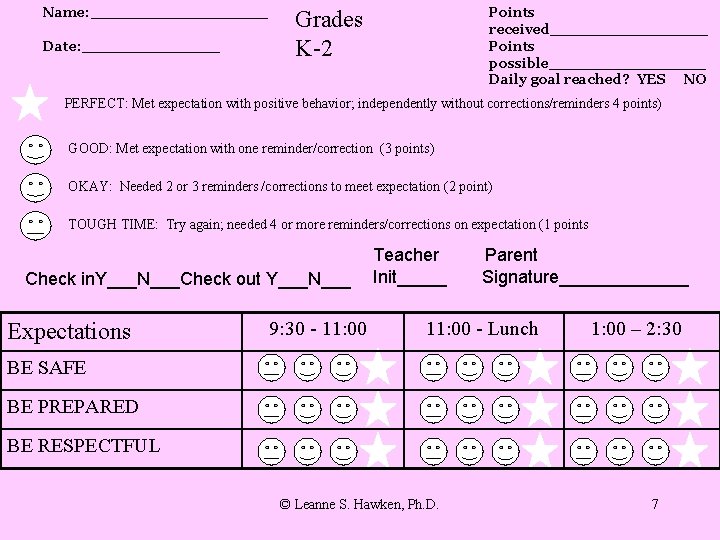
Name: _________ Date: _______ Points received________ Points possible________ Daily goal reached? YES NO Grades K-2 PERFECT: Met expectation with positive behavior; independently without corrections/reminders 4 points) GOOD: Met expectation with one reminder/correction (3 points) OKAY: Needed 2 or 3 reminders /corrections to meet expectation (2 point) TOUGH TIME: Try again; needed 4 or more reminders/corrections on expectation (1 points Check in. Y___N___Check out Y___N___ Expectations 9: 30 - 11: 00 Teacher Init_____ Parent Signature_______ 11: 00 - Lunch 1: 00 – 2: 30 BE SAFE BE PREPARED BE RESPECTFUL © Leanne S. Hawken, Ph. D. 7

Why does the BEP work? Improved Relationships Improved structure Prompts for correct behavior Links student with adult Increase in supervision, monitoring, & feedback Feedback occurs more often Feedback is tied to expectations & student behavior Increase adult and peer attention Linking school and home support Preparing for self-management system © Leanne S. Hawken, Ph. D. 8
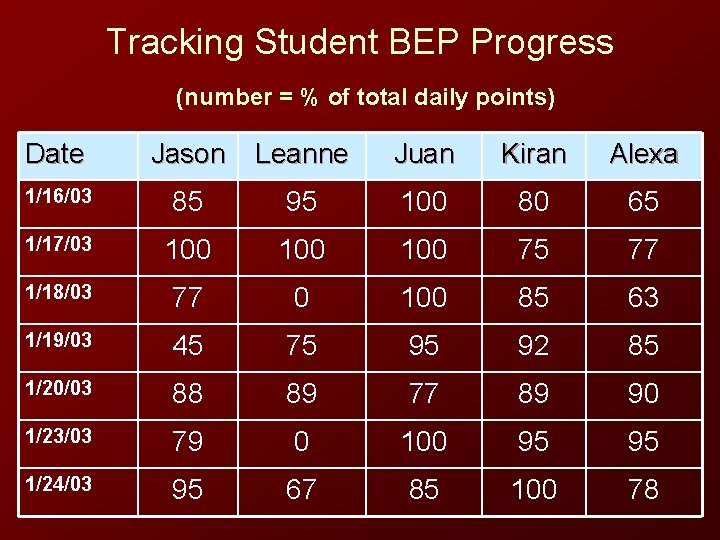
Tracking Student BEP Progress (number = % of total daily points) Date Jason Leanne Juan Kiran Alexa 1/16/03 85 95 100 80 65 1/17/03 100 100 75 77 1/18/03 77 0 100 85 63 1/19/03 45 75 95 92 85 1/20/03 88 89 77 89 90 1/23/03 79 0 100 95 95 1/24/03 95 67 85 100 78
Daily Data Used for Decision Making
Daily Data Used for Decision Making
Critical Features for Teachers Discuss & support the “spirit” of program supportive, not punitive n feedback on behavior (type of statements, what the ratings mean, examples of feedback) n individual coaching n © Leanne S. Hawken, Ph. D. 12
Training Students on BEP System Meet with students Model and Practice Accepting Feedback Goal-Setting © Leanne S. Hawken, Ph. D. 13
BEP Development & Implementation Guide Develop a Daily Progress Report (DPR) On the form provided, identify the period(s) to monitor and write your school expectations Make sure the DPR works for teacher and student (friendly language, correct periods, age appropriate). Identify reinforcement or acknowledgement for student meeting daily goals © Leanne S. Hawken, Ph. D. 14
BEP Development & Implementation Guide Ø Ø Discuss and agree with CT. Develop age appropriate DPR. Discuss and practice with student; OR begin simulation Develop & use data system daily Prepare the fields on the Website. Summarize daily data. Enter the daily data onto the Website. Review the charted data weekly. Ø Adjust program as needed for student © Leanne S. Hawken, Ph. D. 15
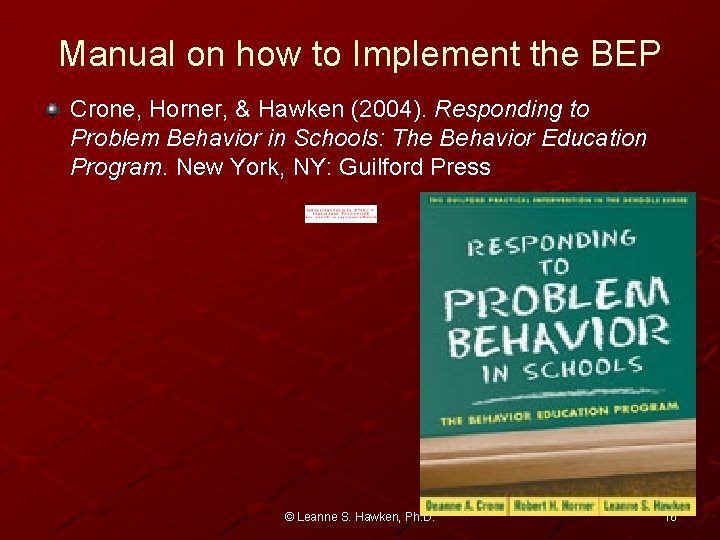
Manual on how to Implement the BEP Crone, Horner, & Hawken (2004). Responding to Problem Behavior in Schools: The Behavior Education Program. New York, NY: Guilford Press © Leanne S. Hawken, Ph. D. 16
- Slides: 15