
The Beginning of the Nuclear Age The Einstein
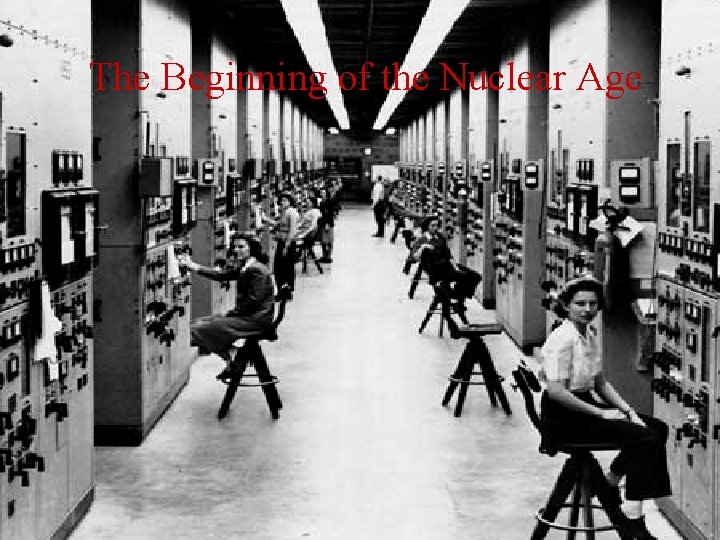
The Beginning of the Nuclear Age
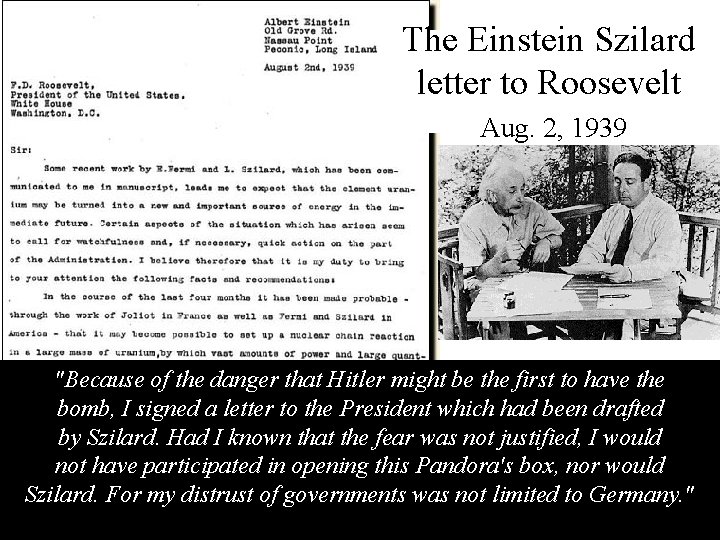
The Einstein Szilard letter to Roosevelt Aug. 2, 1939 "Because of the danger that Hitler might be the first to have the bomb, I signed a letter to the President which had been drafted by Szilard. Had I known that the fear was not justified, I would not have participated in opening this Pandora's box, nor would Szilard. For my distrust of governments was not limited to Germany. "
Rumors or Reality? American and British nuclear physicists felt they needed to start a A-bomb project to avoid falling behind their German counterparts. They feared Hitler's forces would be the first to have use of atomic arms. This evaluation was based on a number of considerations: • The pre-war stop of uranium export • The high caliber of German theoretical and experimental physicists like Otto Hahn, Paul Harteck, Werner Heisenberg, Fritz Strassmann, and Carl-Friedrich von Weizsäcker; • German control of Europe's only uranium mine after the conquest of Czechoslovakia; • German capture of the world's largest supply of imported uranium with the fall of Belgium; • German possession of Europe's only cyclotron with the fall of France; • German control of the world's only commercial source of heavy water after its occupation of Norway.

nuclear reaction processes A(a, a)A A(a, a’)A* (in-) elastic scattering particle energy X-ray radiation g-ray radiation A(a, b)B A(a, g)C A(a, C)D nuclear reaction processes g-radiation particle break-up fission
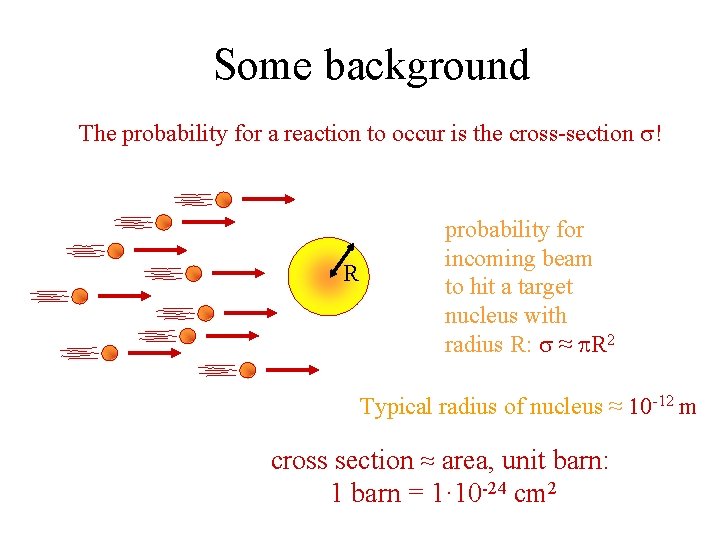
Some background The probability for a reaction to occur is the cross-section ! R probability for incoming beam to hit a target nucleus with radius R: ≈ p. R 2 Typical radius of nucleus ≈ 10 -12 m cross section ≈ area, unit barn: 1 barn = 1· 10 -24 cm 2
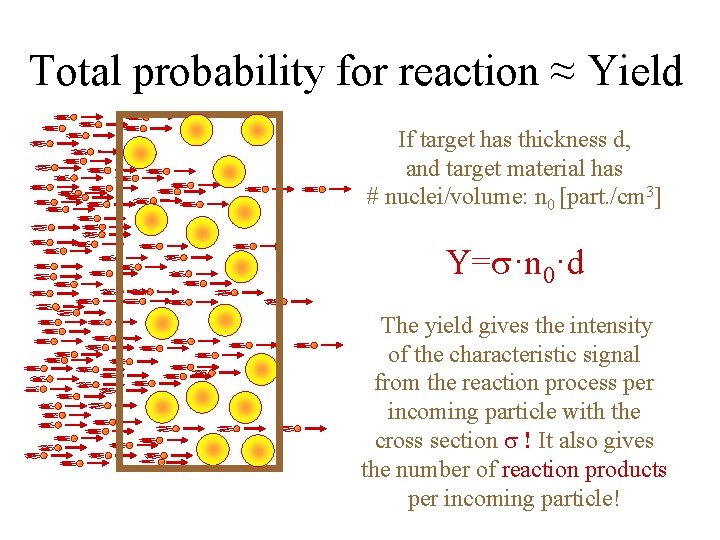
Total probability for reaction ≈ Yield If target has thickness d, and target material has # nuclei/volume: n 0 [part. /cm 3] Y= ·n 0·d The yield gives the intensity of the characteristic signal from the reaction process per incoming particle with the cross section ! It also gives the number of reaction products per incoming particle!
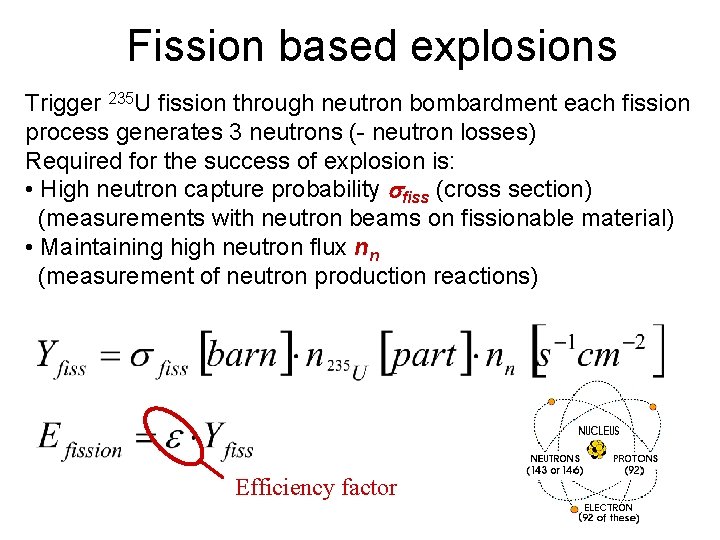
Fission based explosions Trigger 235 U fission through neutron bombardment each fission process generates 3 neutrons (- neutron losses) Required for the success of explosion is: • High neutron capture probability fiss (cross section) (measurements with neutron beams on fissionable material) • Maintaining high neutron flux nn (measurement of neutron production reactions) Efficiency factor
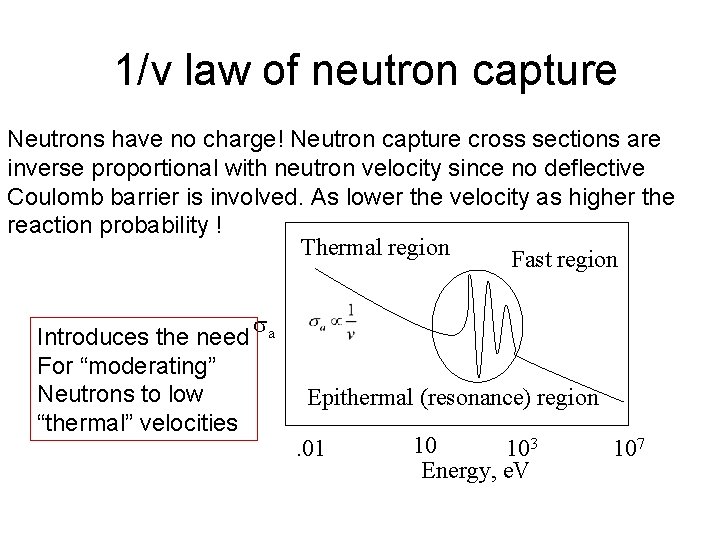
1/v law of neutron capture Neutrons have no charge! Neutron capture cross sections are inverse proportional with neutron velocity since no deflective Coulomb barrier is involved. As lower the velocity as higher the reaction probability ! Thermal region Fast region Introduces the need For “moderating” Neutrons to low “thermal” velocities a Epithermal (resonance) region. 01 10 103 Energy, e. V 107
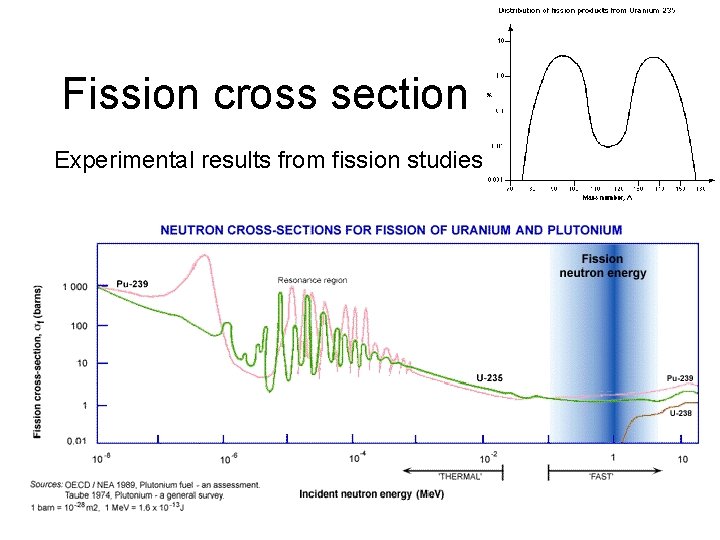
Fission cross section Experimental results from fission studies
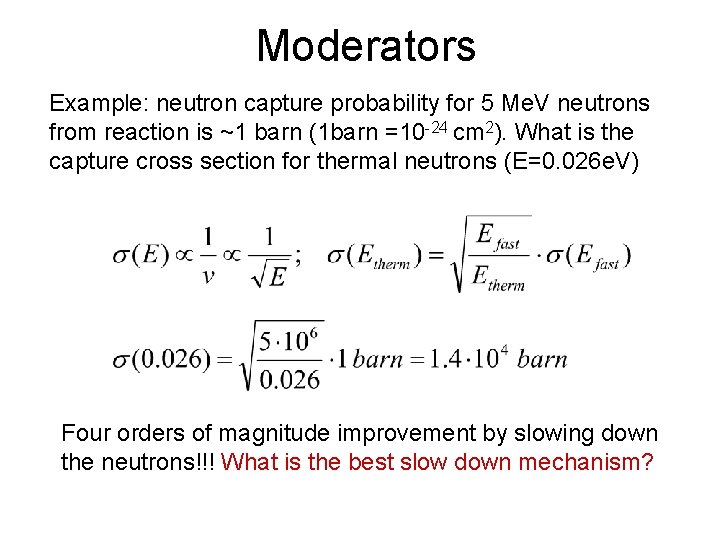
Moderators Example: neutron capture probability for 5 Me. V neutrons from reaction is ~1 barn (1 barn =10 -24 cm 2). What is the capture cross section for thermal neutrons (E=0. 026 e. V) Four orders of magnitude improvement by slowing down the neutrons!!! What is the best slow down mechanism?
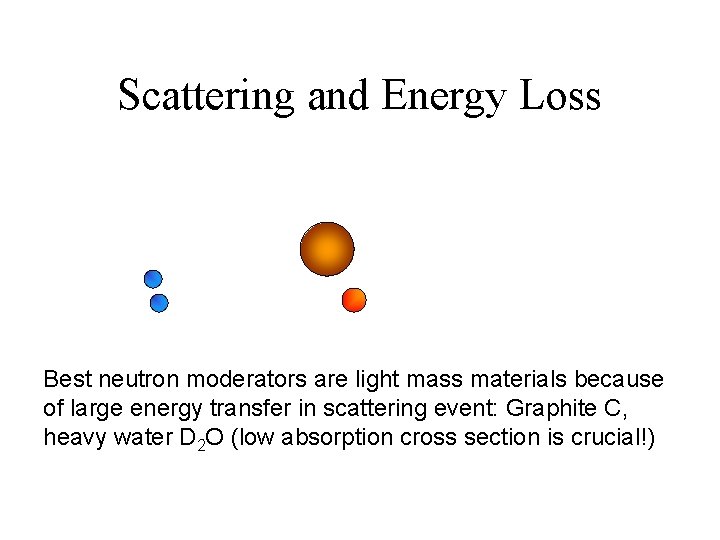
Scattering and Energy Loss Best neutron moderators are light mass materials because of large energy transfer in scattering event: Graphite C, heavy water D 2 O (low absorption cross section is crucial!)
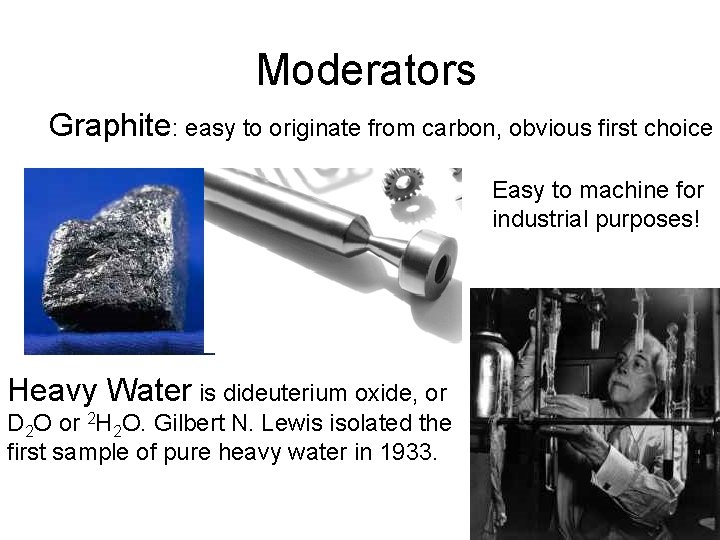
Moderators Graphite: easy to originate from carbon, obvious first choice Easy to machine for industrial purposes! Heavy Water is dideuterium oxide, or D 2 O or 2 H 2 O. Gilbert N. Lewis isolated the first sample of pure heavy water in 1933.
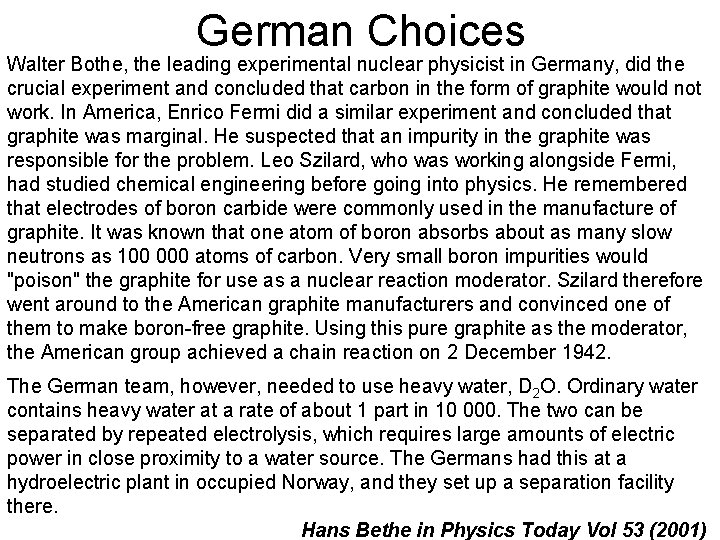
German Choices Walter Bothe, the leading experimental nuclear physicist in Germany, did the crucial experiment and concluded that carbon in the form of graphite would not work. In America, Enrico Fermi did a similar experiment and concluded that graphite was marginal. He suspected that an impurity in the graphite was responsible for the problem. Leo Szilard, who was working alongside Fermi, had studied chemical engineering before going into physics. He remembered that electrodes of boron carbide were commonly used in the manufacture of graphite. It was known that one atom of boron absorbs about as many slow neutrons as 100 000 atoms of carbon. Very small boron impurities would "poison" the graphite for use as a nuclear reaction moderator. Szilard therefore went around to the American graphite manufacturers and convinced one of them to make boron-free graphite. Using this pure graphite as the moderator, the American group achieved a chain reaction on 2 December 1942. The German team, however, needed to use heavy water, D 2 O. Ordinary water contains heavy water at a rate of about 1 part in 10 000. The two can be separated by repeated electrolysis, which requires large amounts of electric power in close proximity to a water source. The Germans had this at a hydroelectric plant in occupied Norway, and they set up a separation facility there. Hans Bethe in Physics Today Vol 53 (2001)
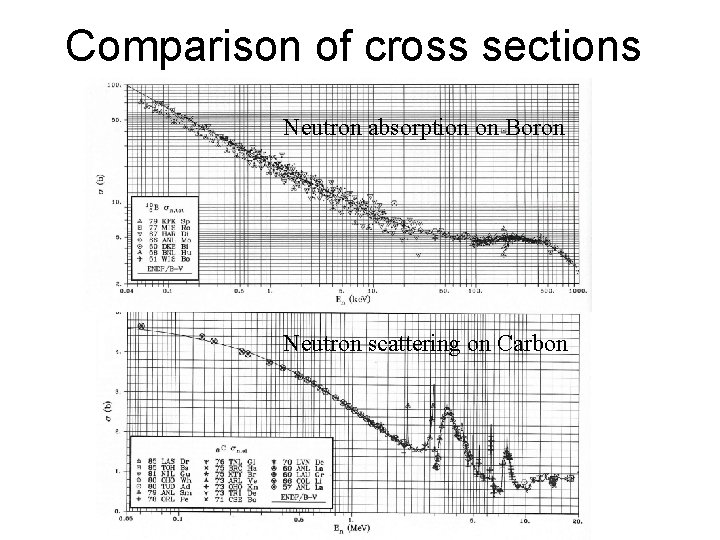
Comparison of cross sections Neutron absorption on Boron Neutron scattering on Carbon
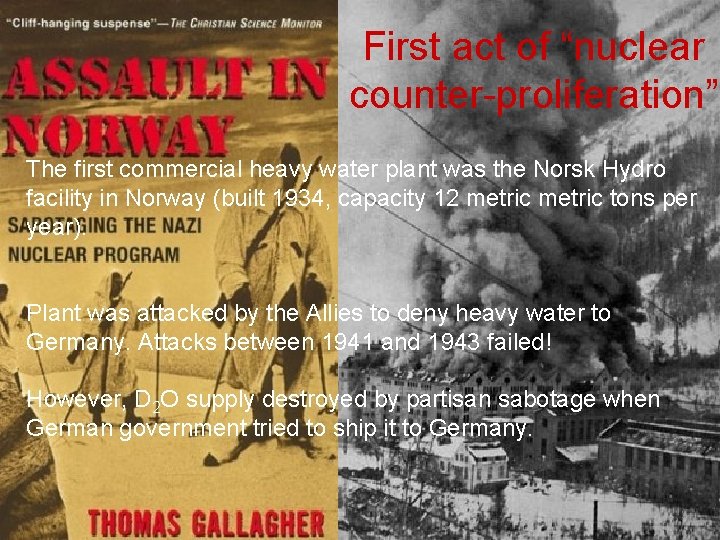
First act of “nuclear counter-proliferation” The first commercial heavy water plant was the Norsk Hydro facility in Norway (built 1934, capacity 12 metric tons per year). Plant was attacked by the Allies to deny heavy water to Germany. Attacks between 1941 and 1943 failed! However, D 2 O supply destroyed by partisan sabotage when German government tried to ship it to Germany.
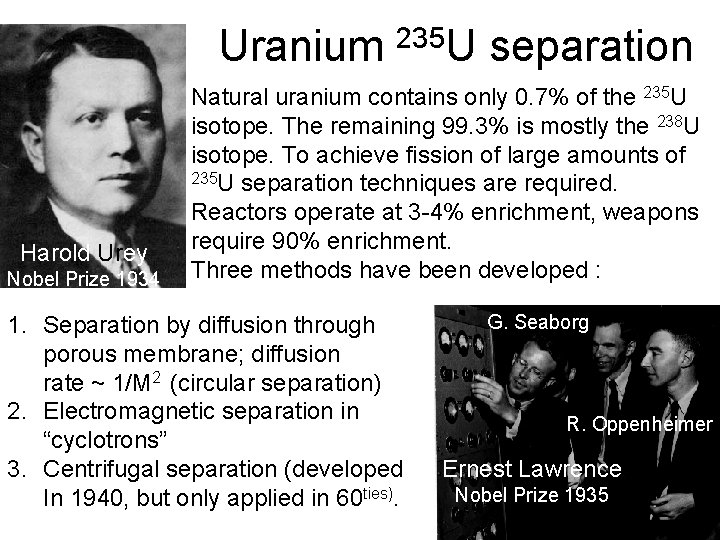
Uranium 235 U separation Harold Urey Nobel Prize 1934 Natural uranium contains only 0. 7% of the 235 U isotope. The remaining 99. 3% is mostly the 238 U isotope. To achieve fission of large amounts of 235 U separation techniques are required. Reactors operate at 3 -4% enrichment, weapons require 90% enrichment. Three methods have been developed : 1. Separation by diffusion through porous membrane; diffusion rate ~ 1/M 2 (circular separation) 2. Electromagnetic separation in “cyclotrons” 3. Centrifugal separation (developed In 1940, but only applied in 60 ties). G. Seaborg R. Oppenheimer Ernest Lawrence Nobel Prize 1935
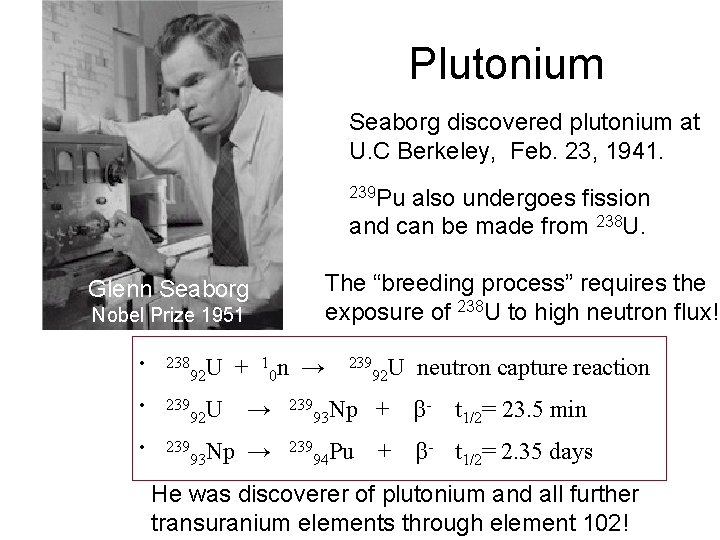
Plutonium Seaborg discovered plutonium at U. C Berkeley, Feb. 23, 1941. 239 Pu also undergoes fission and can be made from 238 U. Glenn Seaborg Nobel Prize 1951 The “breeding process” requires the exposure of 238 U to high neutron flux! • 238 U + 1 n → 239 U neutron capture reaction 92 0 92 • 239 U → 239 Np + β- t = 23. 5 min 92 93 1/2 • 239 Np → 239 Pu + β- t = 2. 35 days 93 94 1/2 He was discoverer of plutonium and all further transuranium elements through element 102!
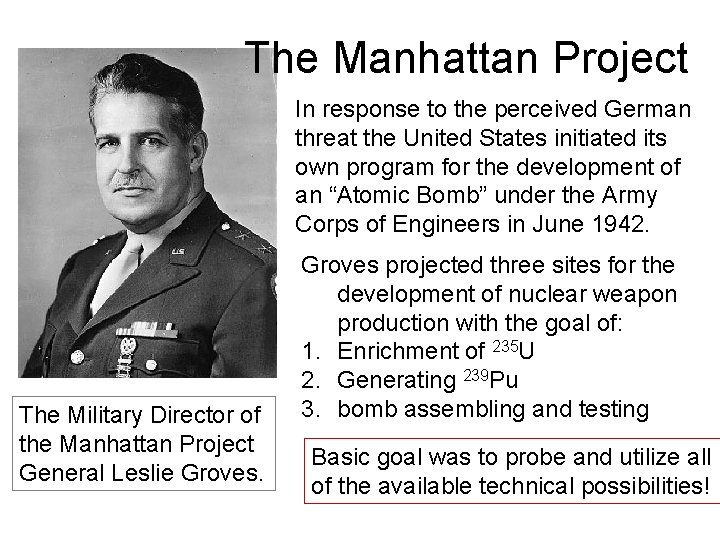
The Manhattan Project In response to the perceived German threat the United States initiated its own program for the development of an “Atomic Bomb” under the Army Corps of Engineers in June 1942. The Military Director of the Manhattan Project General Leslie Groves projected three sites for the development of nuclear weapon production with the goal of: 1. Enrichment of 235 U 2. Generating 239 Pu 3. bomb assembling and testing Basic goal was to probe and utilize all of the available technical possibilities!
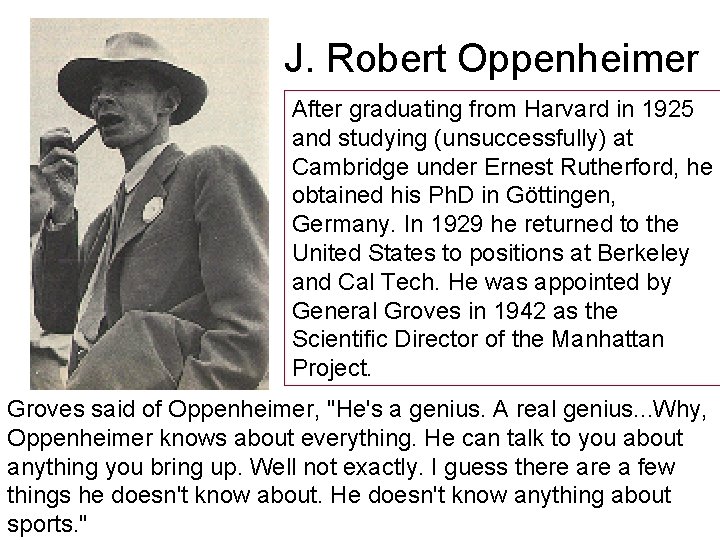
J. Robert Oppenheimer After graduating from Harvard in 1925 and studying (unsuccessfully) at Cambridge under Ernest Rutherford, he obtained his Ph. D in Göttingen, Germany. In 1929 he returned to the United States to positions at Berkeley and Cal Tech. He was appointed by General Groves in 1942 as the Scientific Director of the Manhattan Project. Groves said of Oppenheimer, "He's a genius. A real genius. . . Why, Oppenheimer knows about everything. He can talk to you about anything you bring up. Well not exactly. I guess there a few things he doesn't know about. He doesn't know anything about sports. "
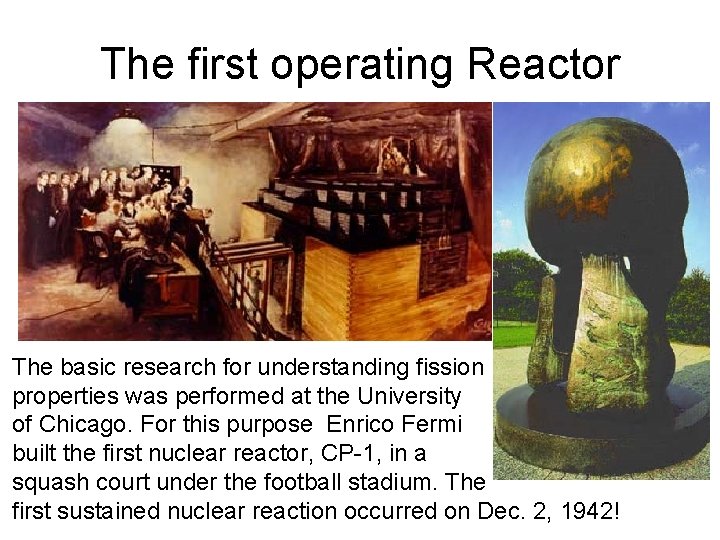
The first operating Reactor The basic research for understanding fission properties was performed at the University of Chicago. For this purpose Enrico Fermi built the first nuclear reactor, CP-1, in a squash court under the football stadium. The first sustained nuclear reaction occurred on Dec. 2, 1942!
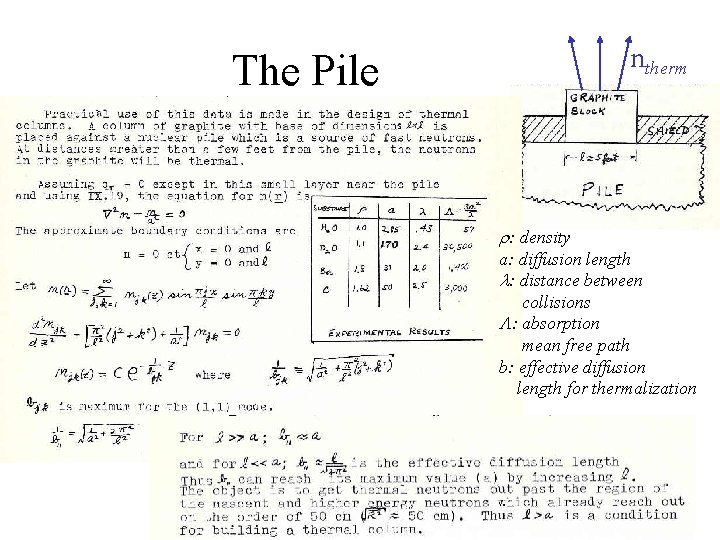
ntherm The Pile : density a: diffusion length : distance between collisions : absorption mean free path b: effective diffusion length for thermalization
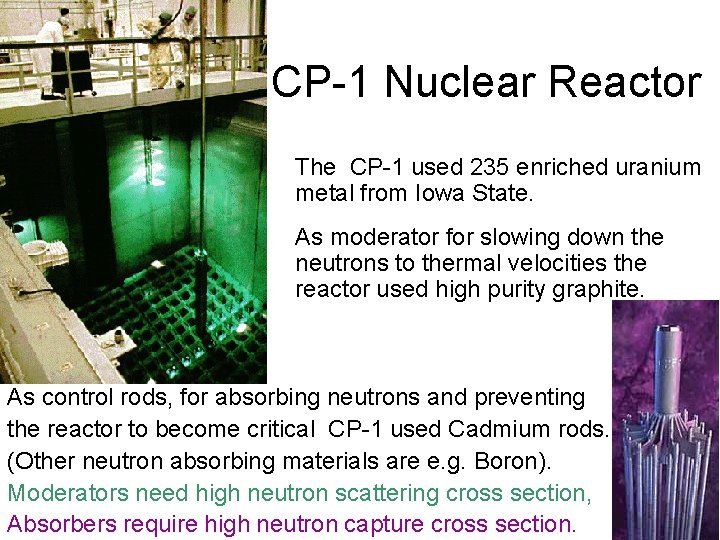
CP-1 Nuclear Reactor The CP-1 used 235 enriched uranium metal from Iowa State. As moderator for slowing down the neutrons to thermal velocities the reactor used high purity graphite. As control rods, for absorbing neutrons and preventing the reactor to become critical CP-1 used Cadmium rods. (Other neutron absorbing materials are e. g. Boron). Moderators need high neutron scattering cross section, Absorbers require high neutron capture cross section.
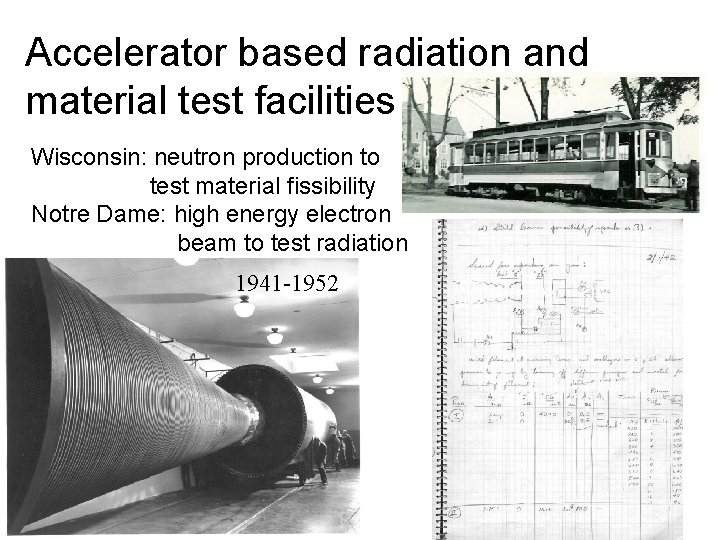
Accelerator based radiation and material test facilities Wisconsin: neutron production to test material fissibility Notre Dame: high energy electron beam to test radiation hardness 1941 -1952
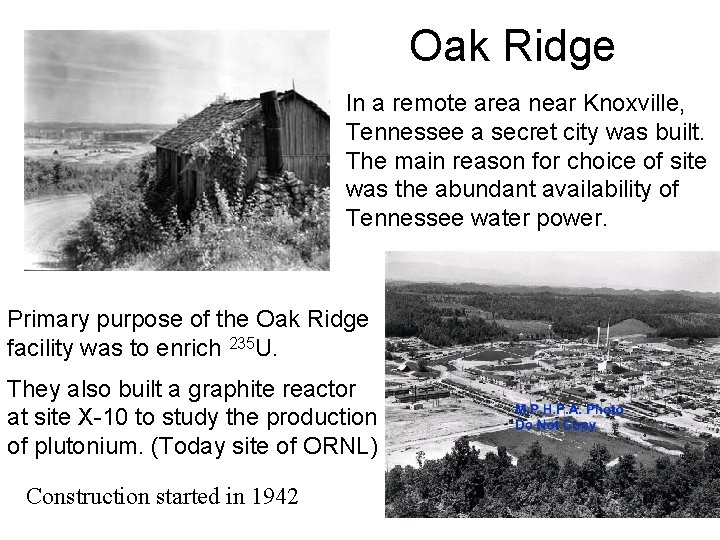
Oak Ridge In a remote area near Knoxville, Tennessee a secret city was built. The main reason for choice of site was the abundant availability of Tennessee water power. Primary purpose of the Oak Ridge facility was to enrich 235 U. They also built a graphite reactor at site X-10 to study the production X-10 of plutonium. (Today site of ORNL) Construction started in 1942
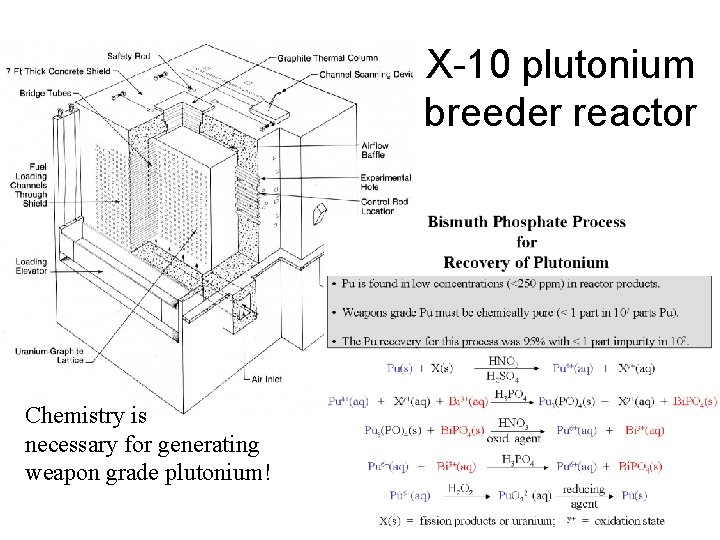
X-10 plutonium breeder reactor Chemistry is necessary for generating weapon grade plutonium!
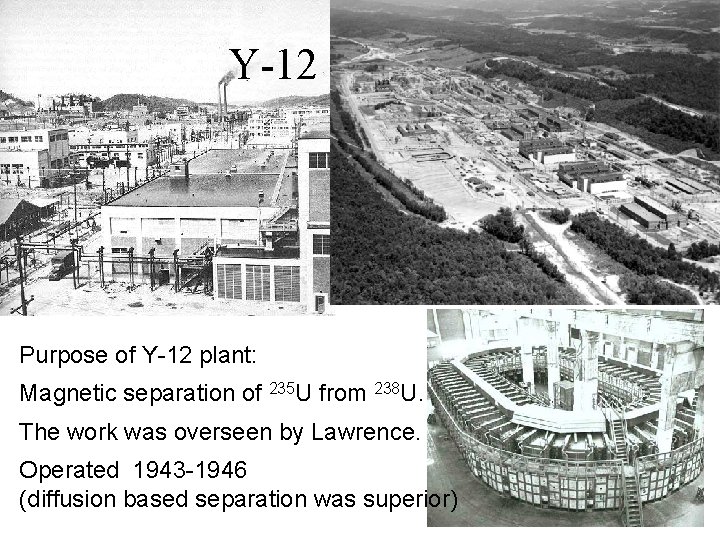
Y-12 Purpose of Y-12 plant: Magnetic separation of 235 U from 238 U. The work was overseen by Lawrence. Operated 1943 -1946 (diffusion based separation was superior)
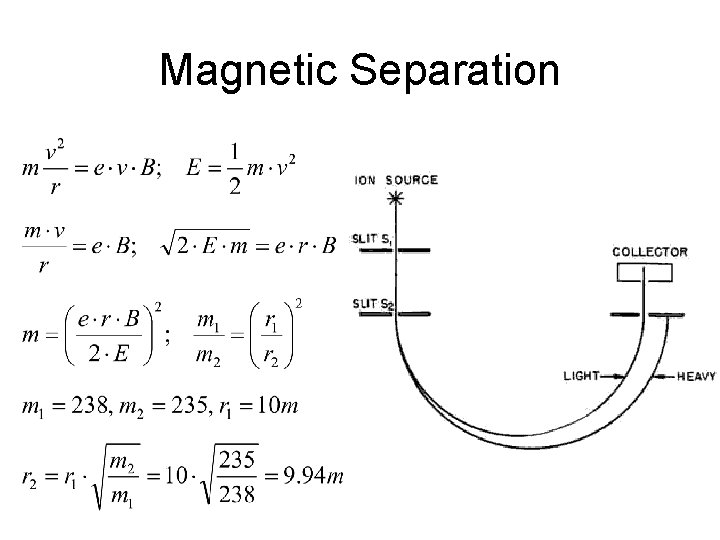
Magnetic Separation
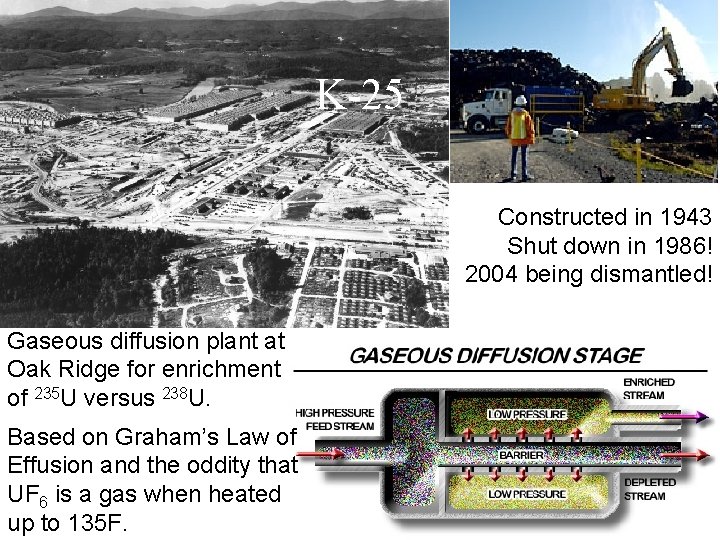
K-25 Constructed in 1943 Shut down in 1986! 2004 being dismantled! Gaseous diffusion plant at Oak Ridge for enrichment of 235 U versus 238 U. Based on Graham’s Law of Effusion and the oddity that UF 6 is a gas when heated up to 135 F.
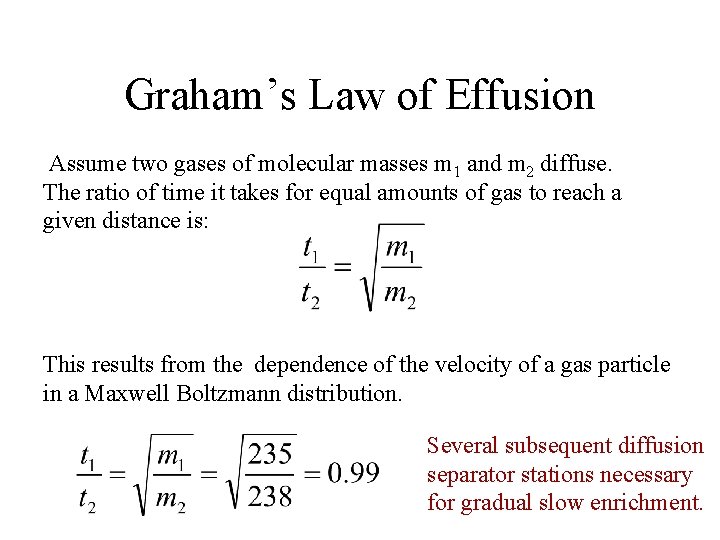
Graham’s Law of Effusion Assume two gases of molecular masses m 1 and m 2 diffuse. The ratio of time it takes for equal amounts of gas to reach a given distance is: This results from the dependence of the velocity of a gas particle in a Maxwell Boltzmann distribution. Several subsequent diffusion separator stations necessary for gradual slow enrichment.
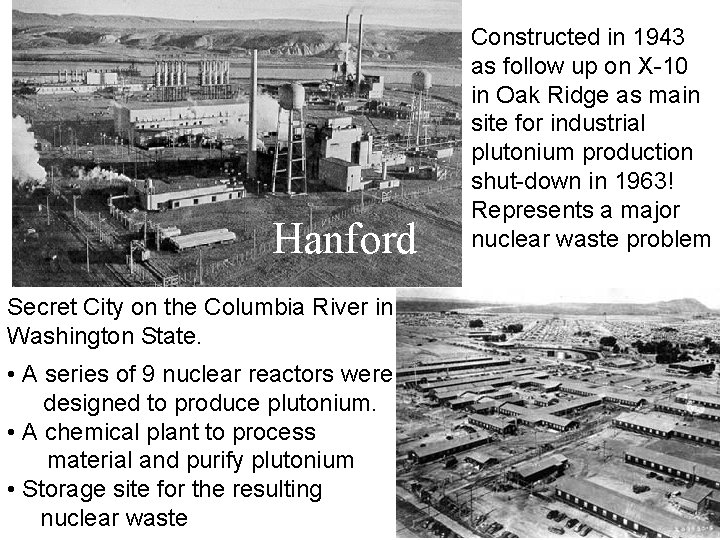
Hanford Secret City on the Columbia River in Washington State. • A series of 9 nuclear reactors were designed to produce plutonium. • A chemical plant to process material and purify plutonium • Storage site for the resulting nuclear waste Constructed in 1943 as follow up on X-10 in Oak Ridge as main site for industrial plutonium production shut-down in 1963! Represents a major nuclear waste problem
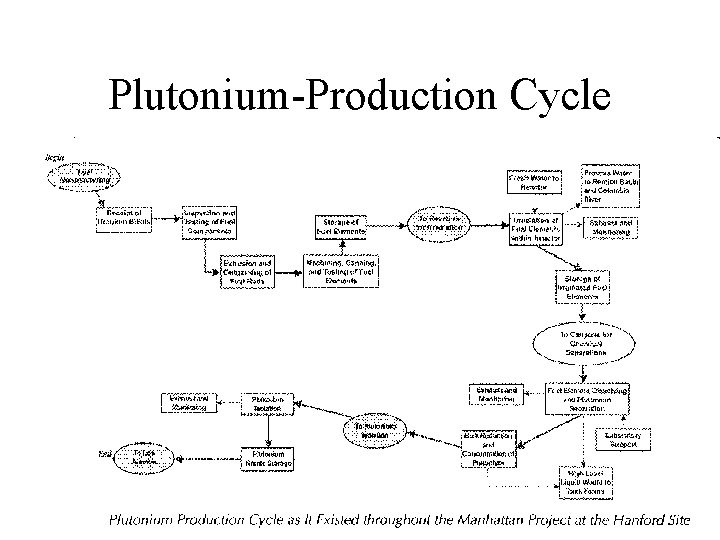
Plutonium-Production Cycle
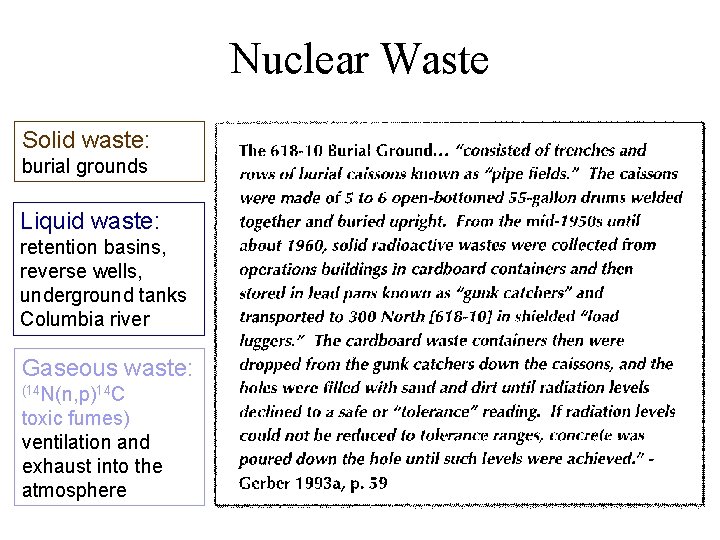
Nuclear Waste Solid waste: burial grounds Liquid waste: retention basins, reverse wells, underground tanks Columbia river Gaseous waste: (14 N(n, p)14 C toxic fumes) ventilation and exhaust into the atmosphere
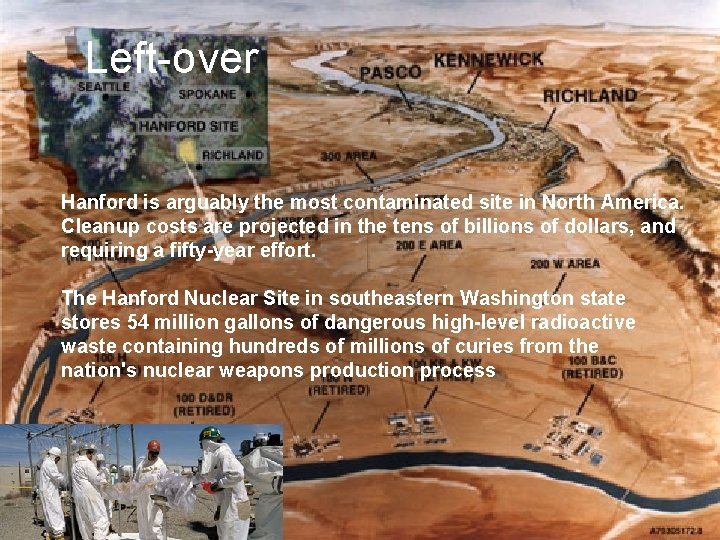
Left-over Hanford is arguably the most contaminated site in North America. Cleanup costs are projected in the tens of billions of dollars, and requiring a fifty-year effort. The Hanford Nuclear Site in southeastern Washington state stores 54 million gallons of dangerous high-level radioactive waste containing hundreds of millions of curies from the nation's nuclear weapons production process
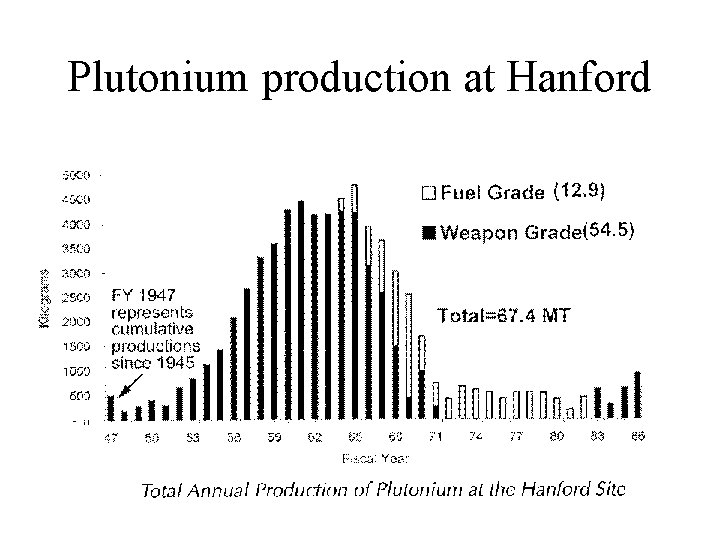
Plutonium production at Hanford
- Slides: 34