
The Beginning of Korean History Koreas Cultural History
The Beginning of Korean History Korea’s Cultural History KF-HYU Global e-School Course Professor Michelle Kwon October 18, 2012 1
Artifacts from Prehistoric Korea • 100, 000 BC: – Stone Hatchet – Yeokpo Child bone found near Pyeongyang • 50, 000 BC: Seungrisan Man • 4, 000 BC: – Comb-patterned pottery – Grinding stone board and grinding stone 2
Origins of Man on the Korean Peninsula • 4, 000 BC: People began settling down and farming from the Paleolithic Period. – Neolithic farming tools (photo link) – Cultivated land near rivers and made fires on hilltops. – Used stone plows to till the soil and stone sickles to reap their harvests 3
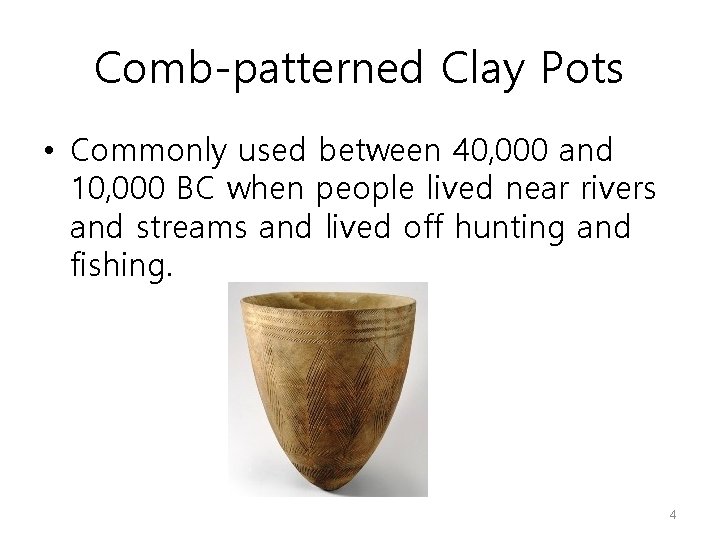
Comb-patterned Clay Pots • Commonly used between 40, 000 and 10, 000 BC when people lived near rivers and streams and lived off hunting and fishing. 4
Gojoseon: the First Kingdom • 2333 BC: Gojoseon founded by Dangun, which was recorded in the Samgukyusa written by Il-yeon in the 13 th century. • Dangun is a symbol of Korean independence • October 3 rd is National Foundation Day in South Korea 5
Gojoseon’s Development • Due to Han China’s encroachment east, Gojoseon grew to assimilate states near its border and developed into a confederate kingdom that ruled neighboring small states since 4, 000 BC • Accepted and embraced the advanced civilization of the Han race, including Chinese letters. • 2, 000 BC, Gojoseon had built its own economy and enhanced its military power with iron-based tools and weapons 6
Conflict with Han China • 109 BC: Han China sends 50, 000 of Wu Ti’s troops to Gojoseon • Even though Gojoseon stood its ground for a year, the capital city finally fell in 108 BC • Han China set up command posts in Gojoseon to rule from remote 7
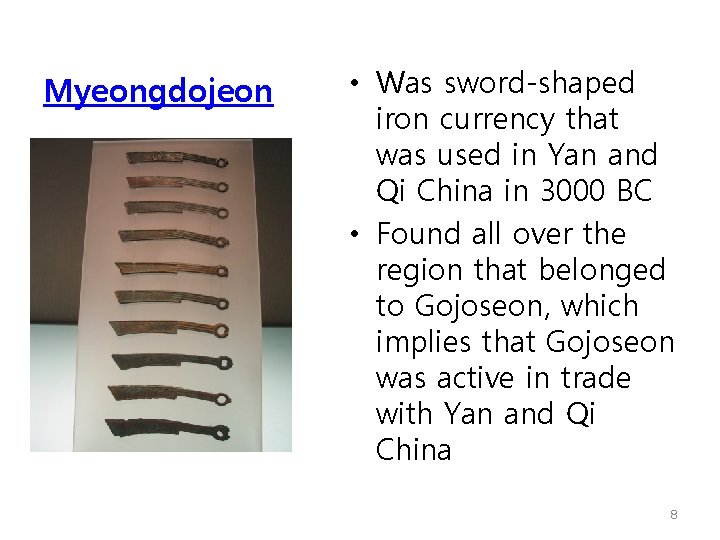
Myeongdojeon • Was sword-shaped iron currency that was used in Yan and Qi China in 3000 BC • Found all over the region that belonged to Gojoseon, which implies that Gojoseon was active in trade with Yan and Qi China 8
Iron Changes the World • In the Gojoseon region, Myeongdojeon was often discovered with iron tools, including agricultural/mechanical tools and weapons, such as spears and swords. • Replacing wood/stone tools and making more efficient weapons, iron tools increased agricultural productivity and military tactics. 9
Other States: Jin, Bueyo • 2 nd century BC: Gojoseon expanded its territories by uniting the political forces, and blocking others from trading with China directly • Jin: founded in the south of Gojoseon around 10 th century BC • Bueyo: at the basin of the Songhua River, based its economy on farming and animal breeding 10
Dolmen • Believed to have been built between the 15 th and 10 th centuries BC • North: dolmens resemble large tables • Central/southern areas: dolmens look like square 0 shaped game boards • Purpose of dolmens? – Bury people of significant importance? – Stone tombs/monuments for religious services? 11
Korean Chuseok • Harvest festival; ritual of thanksgiving • Considered to be the most important holiday in Korea: August 15 th (lunar calendar) • A time family gatherings 12
Beginning of the Three Kingdoms Period • Goguryeo, Baekje, and Shilla – All emerged in the 1 st century BC – Grew into centralized kingdoms between the 4 th and 5 th centuries • Goguryeo: fought off invading China • Baekje: traded with Japan • Shilla: expanded its power after the 6 th century BC and unified the three kingdoms 13
Buyeo • After Gojoseon’s collapse, Buyeo became the No. 1 power among the political forces in the north, advanced farming, and developed into a powerful state. 14
Goguryeo • Originated out of Buyeo and established by Jumong in 37 BC, Goguryeo remained a threat to Buyeo. • Assimilated minor tribes around it in order to take control of prairies near Buyeo and Han China, despite a good relationship between China and Buyeo 15
Baekje • 18 BC: Baekje, which was established earlier by those from Goguryeo, emerged near today’s Seoul as a confederated kingdom which incorporated various walled-town states of Mahan. • During the 3 rd century BC, it expanded its borders and grew large enough to occupy the entire Hangang region. 16
Shilla • The Shilla Kingdom, which would literally last for a millenium (57 BC – 935 AD)m was formed in Gyeongju in the southeast side of the Korean Peninsula. • In this area, many states called the Jinhan Alliance were established and prospered around the BC 2 nd and 1 st AD centuries. • The Saro state, which emerged in Gyeongju, developed into a leading force by assimilating surrounding political powers. 17
Gaya • On the west side of the Nakdong River, which passes through the southeastern part of the Korean Peninsula, there was the Gaya Alliance of six allied states led by the central state of Guya. • Farming and producing substantial amounts of iron, the state of Guya became the trade center with the NW region of Korea, as well as Japan. 18
Fall of Buyeo and Gaya • Buyeo was eventually destroyed by the attacks from nomadic tribes from the west – 4 th century, its capital was turned to ruins with more than 50, 000 people captured – Later, the royal lineage of Buyeo resurrected, but soon merged with Goguryeo • At the end of the 4 th century and early 5 th century, Gaya suffered a defeat by the allied forces of Goguryeo and Shilla and could barely maintain its state. 19
Goguryeo’s Rise • In 311, Goguryeo expanded its territory all the way south to the Amnokgang basins, and seized power throughout the NW region formerly the realm of the late Gojoseon. 20
Baekje and Goguryeo Conflict • In the middle of the 4 th century, Baekje and Gogureyo had frequent battles • In 369, the Baekje army defeated Goguryeo troops led by a king • In 371, Baekje even killed the king of Gogureyo at the battle of Pyeongyangseong • Baekje’s reach SW, threatened several states inside Gaya, located between Shilla and Baekje 21
Rise of Goguryeo • By adopting the political ruling system of China and implementing educational institutes to train political administrators, Goguryeo reinforced its centralized ruling power. • When Goguryeo sent 50, 000 troops to the south, Baekje lost the northern area of the Hangang, and the king of Shilla pledged its loyalty to Goguryeo. • King Jangsuwang moved the capital to Pyeongyang and engulfed more populated areas and fertile lands of the south. • Goguryeo’s army even attacked and occupied Baekje’s capital city of Hanseong, the Hanam Wiryeseong fortress, penetrating deep inside the inlands of the Hangang area. 22
Shaken Baekje and Shilla • After the capital fell, the king was executed by Gogureyo, Baekje moved its capital to Ungjin (today’s Gonju), maintaining a wartime ruling system for survival. • Shilla was also threatened by Goguryeo’s growing power. 23
Allied Baekje and Shilla • In response to Goguryeo’s southbound advance, Baekje and Shilla formed an alliance to protect themselves from Goguryeo by arranging a marriage between the two royal families. 24
Rise of Shilla • Beginning in the 4 th century, Shilla began to centralize the kings’ leadership and evade Goguryeo’s intrusions. • In the early 6 th century, Shilla was able to unite all the areas of the Nakdong River region and assimilate Ulleungdo Island of the East Sea into its territory. • During the reign of King Jinheungwang (540576), Shilla annexed Gaya, attacked Goguryeo, and fought with Baekje, as well as securing an independent diplomatic relationship with China. 25
Sui China and Shilla in the 7 th Century • After unifying China, the Sui Dynasty’s desire to expand outside of China helped Shilla put military pressure on Goguryeo. • Goguryeo allied with Dolgweol, as well as Baekje who was backed by Japan. 26
Goguryeo Wins Against Sui • Refusing to submit to the Sui’s order, Goguryeo mobilized for battle. • In 598, the first Sui emperor Munje attacked Goguryeo by both land sea, but was defeated. • In 612, the second Sui emperor Yange led an attack with 1. 13 million troops against a 3. 5 million population of Goguryeo, but was defeated then and again in 614. 27
Tang Dynasty and Goguryeo • In 645, Goguryeo was attacked by Tang troops led by Taizong, but once again, Tang’s troops were forced to withdraw. • Consecutive battles left irreparable damage on Gogureyo, and as a result, its power weakened substantially. 28
Korean Food • What do you know about Korean food? • Have you ever eaten kimchee? • What can you gather about Korean culture by the food Koreans eat? 29
- Slides: 29