
THE BEES ARE DYING Modern agriculture and urbanization
THE BEES ARE DYING
Modern agriculture and urbanization are directly linked to the decline of the bee population due to the use of pesticides, loss of habitat, and the loss of flowering plants. The decline in bees won’t just affect the production of honey but it will have a direct, negative impact on our food and environment, and we must take steps to reverse their decline. Pesticides Loss of habitat Loss of flowering plants
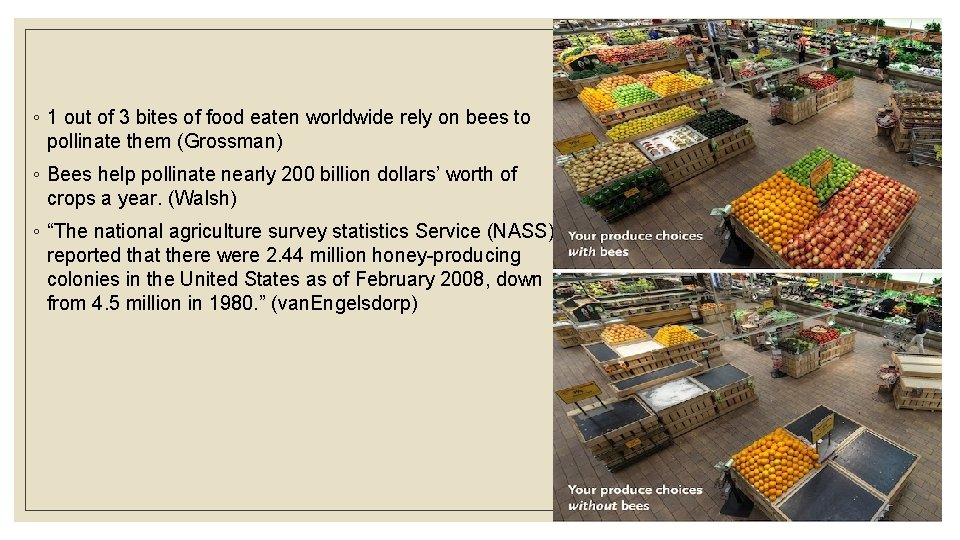
◦ 1 out of 3 bites of food eaten worldwide rely on bees to pollinate them (Grossman) ◦ Bees help pollinate nearly 200 billion dollars’ worth of crops a year. (Walsh) ◦ “The national agriculture survey statistics Service (NASS) reported that there were 2. 44 million honey-producing colonies in the United States as of February 2008, down from 4. 5 million in 1980. ” (van. Engelsdorp)
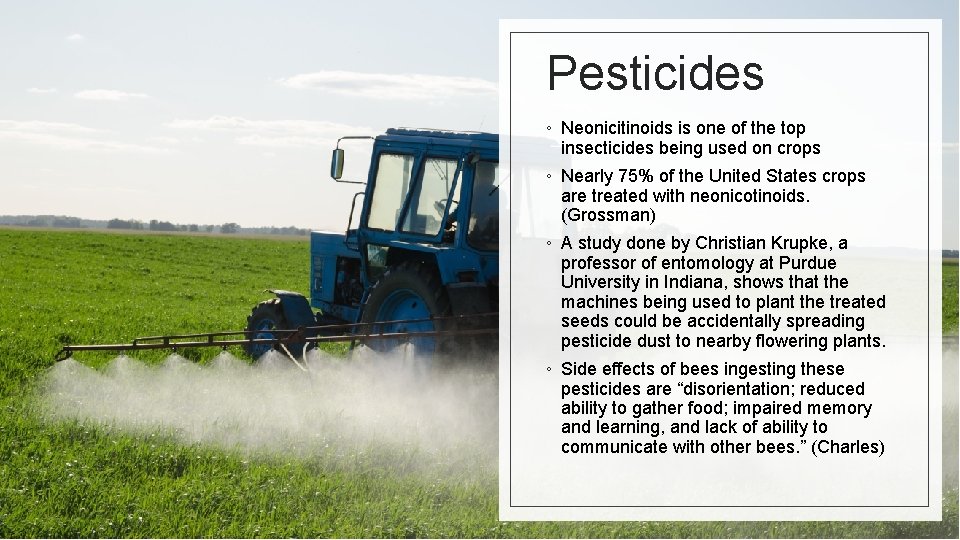
Pesticides ◦ Neonicitinoids is one of the top insecticides being used on crops ◦ Nearly 75% of the United States crops are treated with neonicotinoids. (Grossman) ◦ A study done by Christian Krupke, a professor of entomology at Purdue University in Indiana, shows that the machines being used to plant the treated seeds could be accidentally spreading pesticide dust to nearby flowering plants. ◦ Side effects of bees ingesting these pesticides are “disorientation; reduced ability to gather food; impaired memory and learning, and lack of ability to communicate with other bees. ” (Charles)
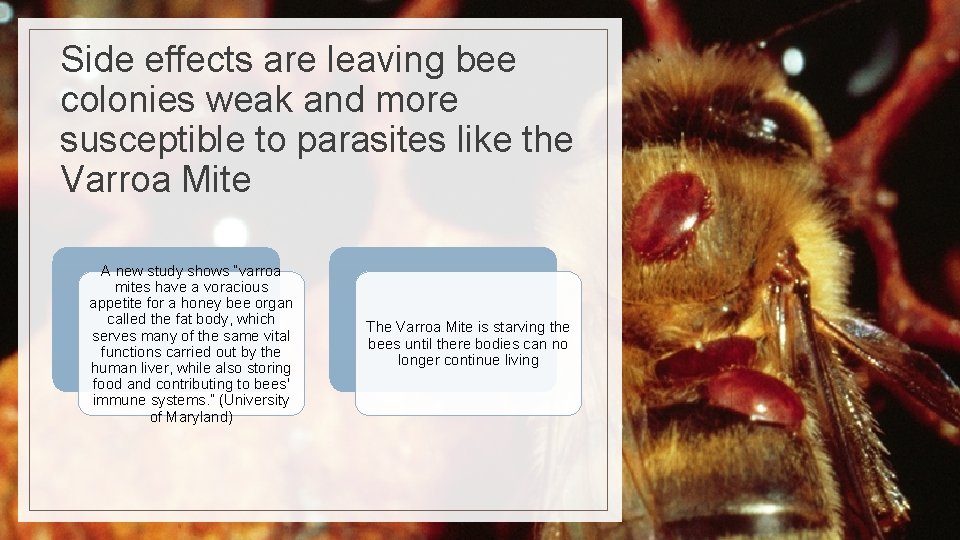
Side effects are leaving bee colonies weak and more susceptible to parasites like the Varroa Mite A new study shows “varroa mites have a voracious appetite for a honey bee organ called the fat body, which serves many of the same vital functions carried out by the human liver, while also storing food and contributing to bees' immune systems. ” (University of Maryland) The Varroa Mite is starving the bees until there bodies can no longer continue living
The Wilderness Society states that we have 109 million acres of wilderness, that is roughly less than 5% of the United States land. Loss of habitat As we divide up land, we are separating migration paths and decreasing the size of the habitat the bees are used to. Bees are forced to fly across roads and navigate around buildings and people. “The decline in habitat quality, is another serious concern. For example, the loose, friable soil required by ground-nesting bees may be trampled by heavy foot traffic or the use of off-road vehicles. ” (New York Bee Sanctuary)
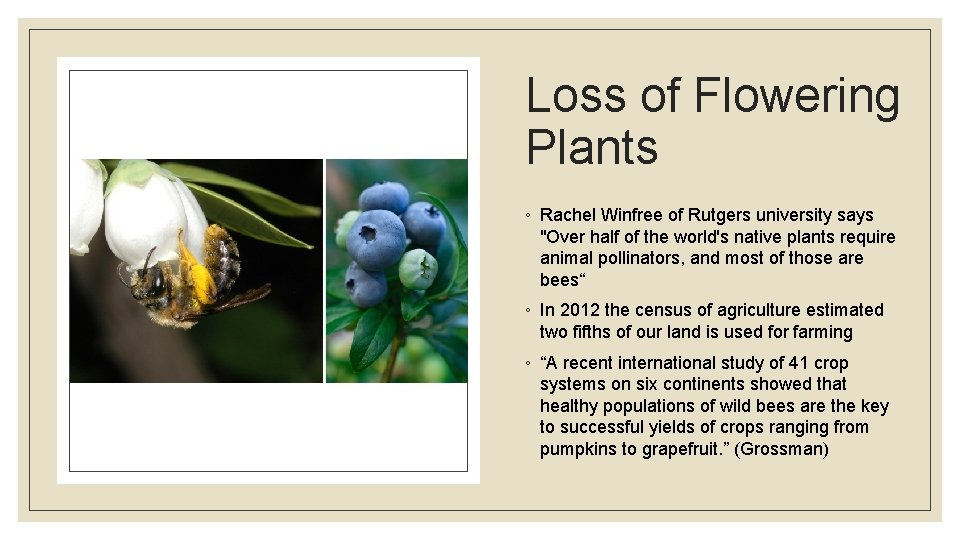
Loss of Flowering Plants ◦ Rachel Winfree of Rutgers university says "Over half of the world's native plants require animal pollinators, and most of those are bees“ ◦ In 2012 the census of agriculture estimated two fifths of our land is used for farming ◦ “A recent international study of 41 crop systems on six continents showed that healthy populations of wild bees are the key to successful yields of crops ranging from pumpkins to grapefruit. ” (Grossman)
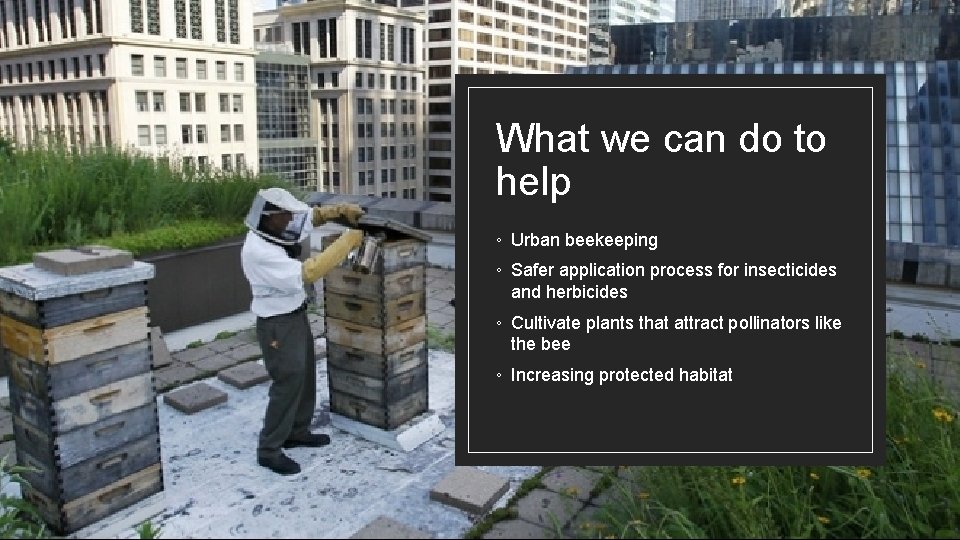
What we can do to help ◦ Urban beekeeping ◦ Safer application process for insecticides and herbicides ◦ Cultivate plants that attract pollinators like the bee ◦ Increasing protected habitat
Further Reading ◦ Two of the sources you should explore to learn more about the bee decline are Declining Bee Populations Pose a Threat to Global Agriculture by Elizabeth Grossman and The Rise of the City bee by Claire Cameron. The article by Elizabeth Grossman explains what the results of the bee decline will have on our agriculture. She goes into detail about all the main points I've made about the bee decline. It’s a short but very informative read. The article by Claire Cameron is a more uplifting article. She discusses what a lot of people are already doing to help out the bees. This article focuses mainly on urban beekeeping but she also discusses what has caused the decline. ◦ Here are the citations to both articles ◦ Grossman, Elizabeth. “Declining Bee Populations Pose a Threat to Global Agriculture. ” Yale E 360, 30 Apr. 2013, e 360. yale. edu/features/declining_bee_populations_pose_a_threat_to_global_agriculture ◦ Cameron, Claire. "The Rise of the City Bee—How Urbanites Built the 21 st-Century Apiculture. " JSTOR Daily. 7 Nov. 2017. <https: //daily. jstor. org/rise-city-bee-urbanites-built-21 st-centuryapiculture/.
Work Cited ◦ Barbière, Cécile. “France Weighs Complete Ban on Bee-Killing Pesticides. ” Euractiv. com, 2 Mar. 2016, www. euractiv. com/section/all/news/france-weighs-complete-ban-on-bee-killing-pesticides/. ◦ Charles, Dan. “Wild Bees Are Good For Crops, But Crops Are Bad For Bees. ” NPR, 1 Mar. 2013, www. npr. org/sections/thesalt/2013/03/01/173167125/wild-bees-are-good-for-crops-butcrops-are-bad-for-bees. ◦ Grossman, Elizabeth. “Declining Bee Populations Pose a Threat to Global Agriculture. ” Yale E 360, 30 Apr. 2013, e 360. yale. edu/features/declining_bee_populations_pose_a_threat_to_global_agriculture. ◦ “Habitat Loss. ” New York Bee Sanctuary, www. newyorkbeesanctuary. org/habitat-loss. ◦ Ohio, Denise, and Catherine Minden. “Just Mite Work!” Bee Culture -, 16 Feb. 2017, www. beeculture. com/just-mite-work/. ◦ University of Maryland. "Honey bee parasites, varroa mites, feed on fatty organs, not blood. " Science. Daily, 15 January 2019. www. sciencedaily. com/releases/2019/01/190114161137. htm. ◦ “Urban Beekeeping Keeps Cities Healthy. ” My. Bee. Line, www. mybeeline. co/en/p/urbanbeekeeping-keeps-cities-healthy. ◦ “Wilderness Designation FAQd. ” The Wilderness Society, www. wilderness. org/articles/article/wilderness-designation-faqs.
- Slides: 10