
The Beat Generation Circa 1940 s to 1950
The Beat Generation Circa 1940 s to 1950 s
The Beat Era • • • Post-WWII anti-conformist movement (1940 s-50 s) Originated in New York Beat Generation felt “beat down” by government Rejects formality and materialism Influenced by Romantics, drugs, Eastern religion, and jazz music Influenced later movements and musicians The so-called Beat Generation was a whole bunch of people, of all different nationalities, who came to the conclusion that society sucked. -Amiri Baraka
Techniques and Themes Techniques • • • Chaotic - all over the place structure o Highly individualistic styles o Spontaneous writing and free verse Popularized the “cut up” technique of Dadaism (William S. Burroughs) Storytelling narratives Themes • • • Rejection of social conformity and literary tradition Reject the mainstream Creativity, sexual freedom, drugs
Allen Ginsberg (1926 - 1997) • • Born June 3, 1926 into in NJ One of the original members of the Beat Generation Mom had a psychological illness Met Jack Kerouac and William S. Borroughs at Columbia university o o Start of the initial Beat group Eventually re-met in SF Practiced Buddhism and Krishnaism Social and political activist Died April 5, 1997 of liver cancer Wrote in an individualistic style o o Non-traditional, epic free verse Influenced by many topics and people “Poetry is the one place where people can speak their original human mind. It is the outlet for people to say in public what is known in private. ”
Notable Works • • • Howl America A Supermarket in California An Eastern Ballad Sunflower Sutra Cosmopolitan Greetings
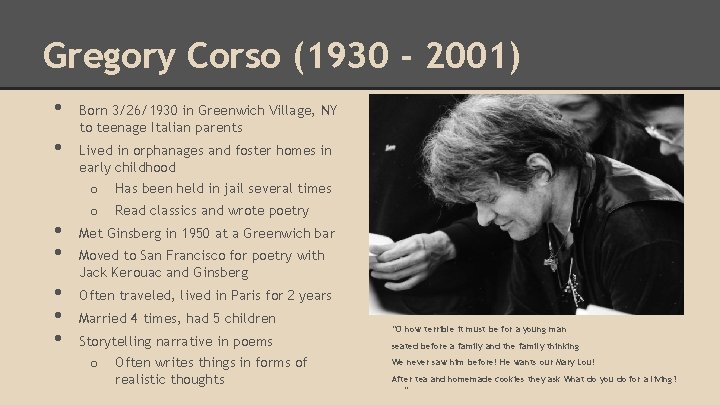
Gregory Corso (1930 - 2001) • • Born 3/26/1930 in Greenwich Village, NY to teenage Italian parents Lived in orphanages and foster homes in early childhood o o Has been held in jail several times Read classics and wrote poetry Met Ginsberg in 1950 at a Greenwich bar Moved to San Francisco for poetry with Jack Kerouac and Ginsberg Often traveled, lived in Paris for 2 years Married 4 times, had 5 children Storytelling narrative in poems o Often writes things in forms of realistic thoughts “O how terrible it must be for a young man seated before a family and the family thinking We never saw him before! He wants our Mary Lou! After tea and homemade cookies they ask What do you do for a living? “
Notable Works • • I am 25 The Mad Yak Birthplace Revisited Last Night I Drove a Car Humanity The American Way 1959
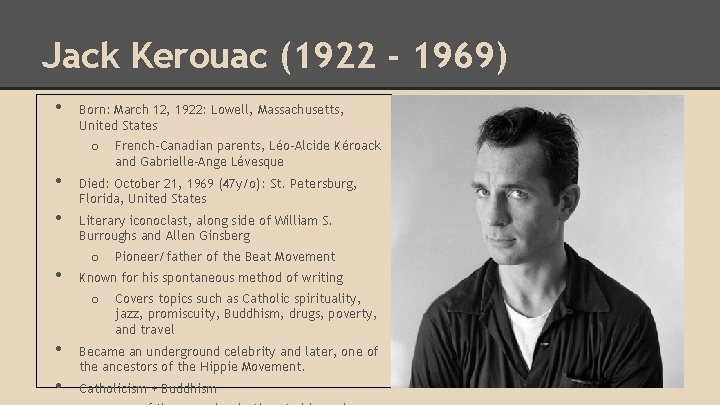
Jack Kerouac (1922 - 1969) • Born: March 12, 1922: Lowell, Massachusetts, United States o • • • Died: October 21, 1969 (47 y/o): St. Petersburg, Florida, United States Literary iconoclast, along side of William S. Burroughs and Allen Ginsberg o • Pioneer/father of the Beat Movement Known for his spontaneous method of writing o • French-Canadian parents, Léo-Alcide Kéroack and Gabrielle-Ange Lévesque Covers topics such as Catholic spirituality, jazz, promiscuity, Buddhism, drugs, poverty, and travel Became an underground celebrity and later, one of the ancestors of the Hippie Movement. Catholicism + Buddhism
Notable Works • • Taste On Tears How to Meditate Daydreams for Ginsberg
AP Style Writing Prompts 1. Beat poets often write about anti-conformity or otherwise being different from the masses. It is a pivotal moment in one’s life when he or she discovers oneself. Choose a character from a work of literary merit and describe the process of how he or she discovered himself or herself, and how it relates to people as a whole. 1. “The Mad Yak”(Gregory Corso) Read the poem. Write an essay that analyzes the symbolism of the yak and how it relates to society as a whole. Use specific references to the text and the author’s tone. 1. Beat poets garnered a movement from their feelings of being beat down from the government and a conformist society. Choose a character from a work of literary merit that experiences that same feeling and write about how it relates to current societies.

Beat Generation Art • 1950 s-60 s Art Movements o Abstract Expressionism, Gestural Abstraction, Chromatic Abstraction • Willem de Kooning (Woman III 1953), Jackson Pollock (Autumn Rhythm 1950), Mark Rothko (White Center 1957)
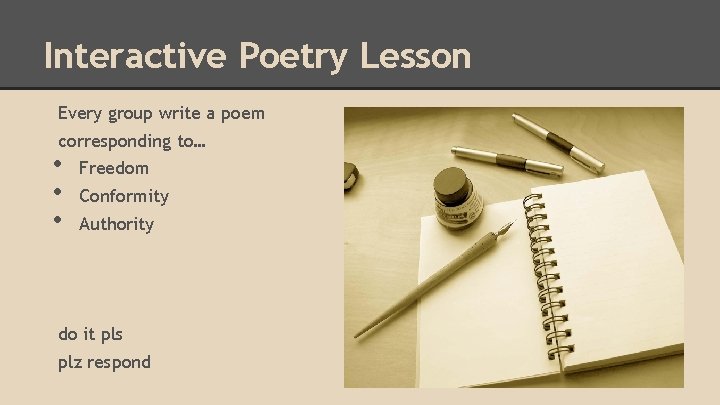
Interactive Poetry Lesson Every group write a poem corresponding to… • • • Freedom Conformity Authority do it pls plz respond
Custom Poems “Freedom” I woke up at 7 Went to work at 8 Came home at 4 Went to sleep at 9 Conformity They tell me to do this I choose not to do that They tell me not to do this I choose to do that They tell me not to not do this I choose to not do that It’s all a matter of time Before they get what they want When one thing is said Another thing is meant They told me not to conform So I chose to conform Authority The Man says, “take the pill” i deeply contemplate “you’re in for a thrill” i start to feel a pleasurable state when I satisfy my desire the shadows are my friend to find the goods I require through the “good” of the law I rend With their flashy cars Their job is to please yet after the bars i’m left on the streets i’m not harming anyone Why can’t they do the same?
Pop Quiz! 1. What are some techniques of Beat poetry? 2. What do Beat poets often write about? 3. How did Beat poets feel about society? 4. What is “A Supermarket in California” criticizing? 5. What does “The Mad Yak” reflect? How do you interpret that poem?
References "The Beat Generation: Characteristics of Beat Poetry. " Education Portal. N. p. , n. d. Web. 16 Dec. 2013. <http: //educationportal. com/academy/lesson/the-beat-generation-characteristics-of-beatpoetry. html> "A Brief Guide to the Beat Poets. " Poets. org. Academy of American Poets, n. d. Web. 15 Dec. 2013. <http: //www. poets. org/viewmedia. php/prm. MID/5646> "Beat Movement (American Literary and Social Movement). " Encyclopedia Britannica Online. Encyclopedia Britannica, n. d. Web. 15 Dec. 2013. <http: //www. britannica. com/EBchecked/topic/57467/Beat-movement>
- Slides: 15