
The Beam Gas Curtain as an instrument for
The Beam Gas Curtain as an instrument for HL-LHC Ray VENESS / CERN With thanks to: M. Ady, N. Chritin, J. Glutting, T. Marriott-Dodington, R. Jones, R. Kersevan, S. Mazzoni, A. Rossi, G. Schneider / CERN P. Forck, S. Udrea / GSI Darmstadt C. Welsch, H. Zhang / Cockcroft Institute and University of Liverpool P. Smakulski / Wroclow University of Science and Technology 8 th HL-LHC Collaboration Meeting, CERN, 15 -18 October 2018 logo area
Contents § § BGC project management Overview of recent progress for the project Gas jet formation simulations Technology development for a HL instrument § § Vacuum system Skimmer alignment Optical coatings for UHV Convergent-divergent nozzles § Status of preparations for the LHC prototype § Summary logo area Ray VENESS / BGC for HL-LHC / HL Collaboration Meeting 2018 2
BGC Project Management § § § Beam Gas Curtain (BGC) is the baseline instrument for on-line monitoring of the overlap between proton and electron beams in the hollow e-lens and as a general non-invasive profile measurement diagnostic BGC development is principally funded by HL-LHC collaboration KN 2970 (Cockcroft Institute), with participation of GSI experts under a separate agreement Prototypes extensively tested with electron gun sources, but there a number of performance criteria that can only be demonstrated by operation with 7 Te. V coasting proton beams § § If this instrument is to be operational post- LS 3, then some preliminary steps need to be taken in LS 2 to allow for prototype testing during Run 3 § § Operating scenarios in the LHC synchrotron light background Hadron shower noise background reduction due to reduction of length of the gas pressure bump Operations with VSC in the baked LHC vacuum environment This instrument includes a new vacuum sector and significant cabling, which would be difficult to implement outside of a long shutdown BGC prototype installation for HL-LHC is now a stand-alone task (13. 2) in HL-LHC WP 13 § Infrastructure for LHC installation directly added to WP 13 logo area
Overview - Recent Progress § Key decisions and results to define a baseline for a useable instrument § Selection of a baseline gas species and spectral line [see S. Mazzoni] § Combining high and low pressure gas flow calculations to produce a consistent value for the jet density in the interaction region § Design of an associated optical system with realistic parameters that can produce image integration times in the order of 1 second [see S. Mazzoni] § Commissioning and experimental programme on a new BGC experiment at Cockcroft [see H. Zhang] § Design, production, installation and test programme for fluorescence in the LHC [see S. Mazzoni] § Integration of a BGC prototype for installation in the LHC during LS 2 logo area Ray VENESS / BGC for HL-LHC / HL Collaboration Meeting 2018 4
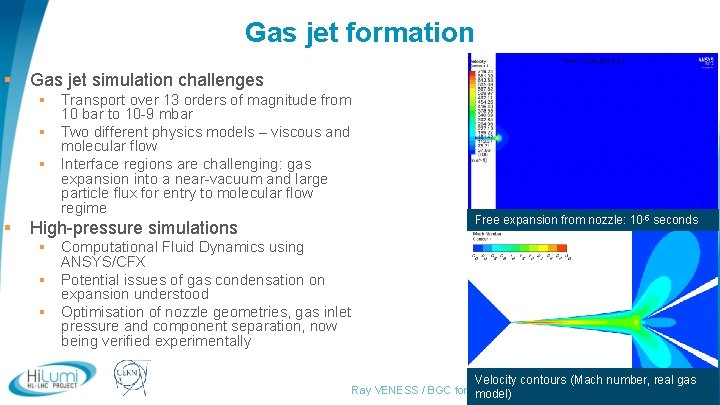
Gas jet formation § Gas jet simulation challenges § Transport over 13 orders of magnitude from 10 bar to 10 -9 mbar § Two different physics models – viscous and molecular flow § Interface regions are challenging: gas expansion into a near-vacuum and large particle flux for entry to molecular flow regime § High-pressure simulations Free expansion from nozzle: 10 -5 seconds § Computational Fluid Dynamics using ANSYS/CFX § Potential issues of gas condensation on expansion understood § Optimisation of nozzle geometries, gas inlet pressure and component separation, now being verified experimentally logo area Velocity contours (Mach number, real gas Ray VENESS / BGC for HL-LHC model) / HL Collaboration Meeting 2018 5

Low pressure (molecular flow) simulations § Complete Test-particle Monte Carlo simulation of the experimental set-up with Molflow+ § Virtual interface from first skimmer § Predicted forms and densities of gas curtain at interaction § Simulation-led optimisation leads to addition of baffle between interaction and exhaust pump logo area
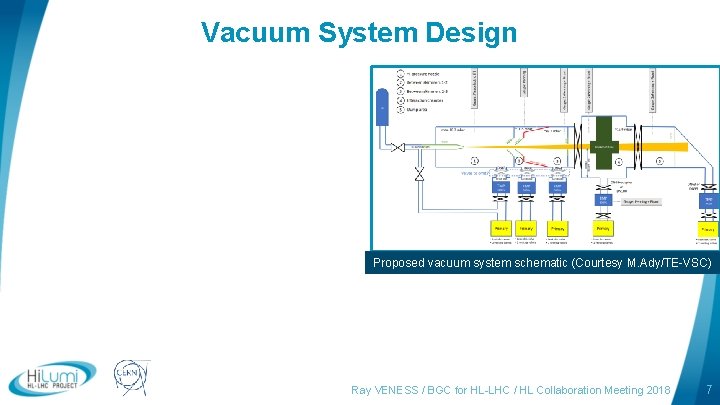
Vacuum System Design Proposed vacuum system schematic (Courtesy M. Ady/TE-VSC) logo area Ray VENESS / BGC for HL-LHC / HL Collaboration Meeting 2018 7
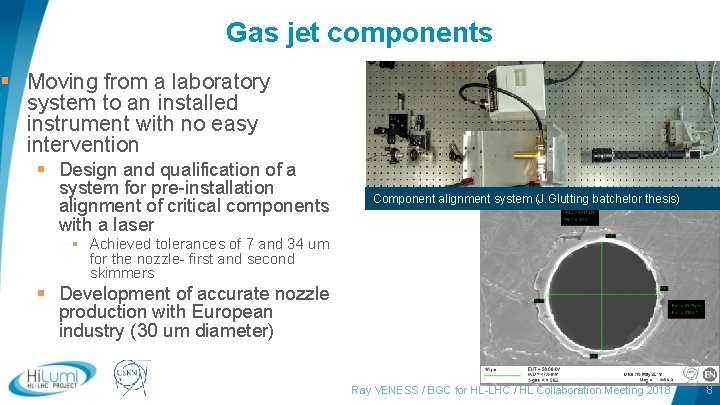
Gas jet components § Moving from a laboratory system to an installed instrument with no easy intervention § Design and qualification of a system for pre-installation alignment of critical components with a laser Component alignment system (J. Glutting batchelor thesis) § Achieved tolerances of 7 and 34 um for the nozzle- first and second skimmers § Development of accurate nozzle production with European industry (30 um diameter) logo area Ray VENESS / BGC for HL-LHC / HL Collaboration Meeting 2018 8
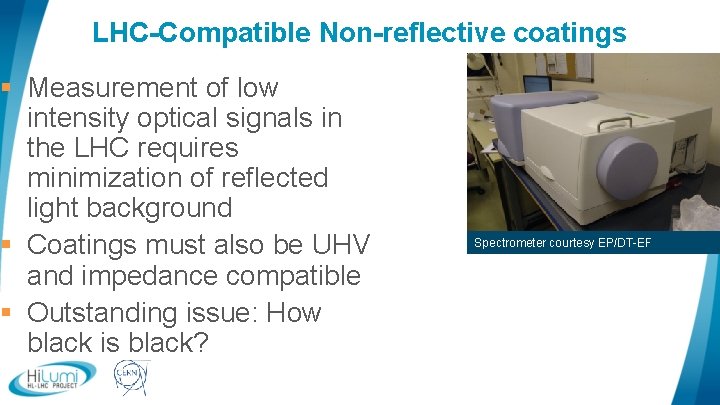
LHC-Compatible Non-reflective coatings § Measurement of low intensity optical signals in the LHC requires minimization of reflected light background § Coatings must also be UHV and impedance compatible § Outstanding issue: How black is black? logo area Spectrometer courtesy EP/DT-EF
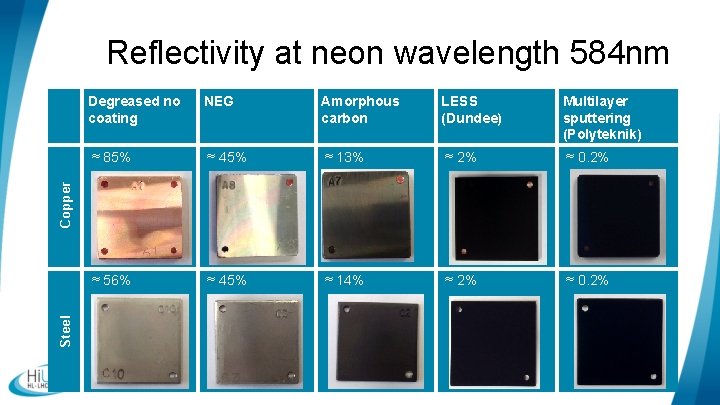
Reflectivity at neon wavelength 584 nm NEG Amorphous carbon LESS (Dundee) Multilayer sputtering (Polyteknik) ≈ 85% ≈ 45% ≈ 13% ≈ 2% ≈ 0. 2% ≈ 56% ≈ 45% ≈ 14% ≈ 2% ≈ 0. 2% Steel Copper Degreased no coating
Convergent-Divergent Nozzles § Studies show that CD nozzle makes a significant improvement to gas directionality and velocity out of nozzle § CERN has technology for making precision CD nozzles with definable geometries with 10 um+ diameters § Existing design will be tested ay Cockcroft § Collaboration to produce specific nozzle geometries once best solution is found logo area Ray VENESS / BGC for HL-LHC / HL Collaboration Meeting 2018 11
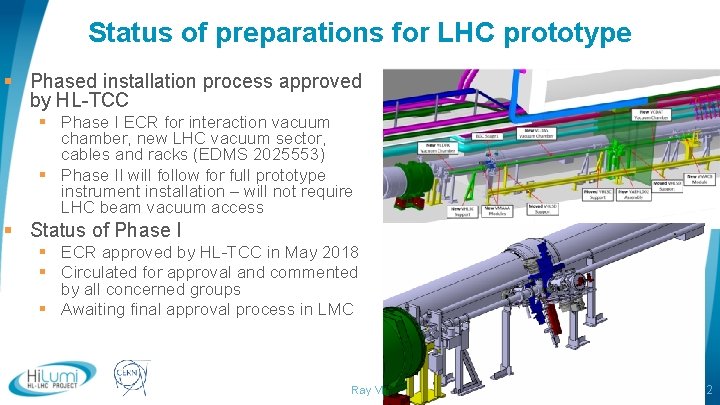
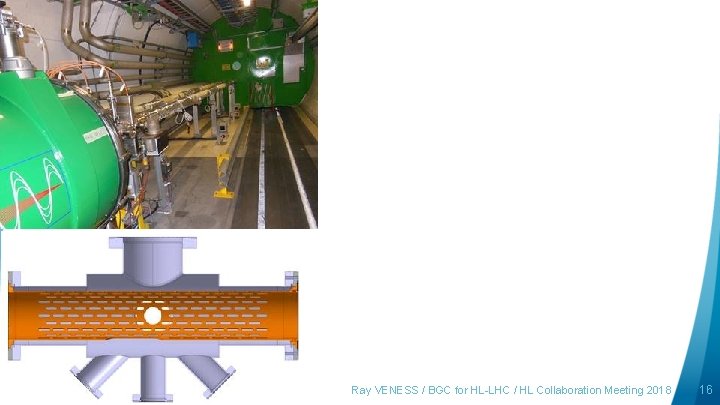
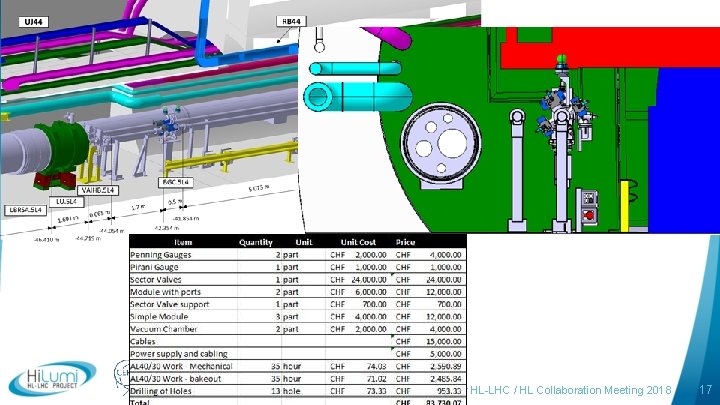
Status of preparations for LHC prototype § Phased installation process approved by HL-TCC § Phase I ECR for interaction vacuum chamber, new LHC vacuum sector, cables and racks (EDMS 2025553) § Phase II will follow for full prototype instrument installation – will not require LHC beam vacuum access § Status of Phase I § ECR approved by HL-TCC in May 2018 § Circulated for approval and commented by all concerned groups § Awaiting final approval process in LMC logo area Ray VENESS / BGC for HL-LHC / HL Collaboration Meeting 2018 12
Safety, impedance and documentation logo area Ray VENESS / BGC for HL-LHC / HL Collaboration Meeting 2018 13
Summary and Conclusions § Installation of a prototype BGC in the LHC, starting in LS 2 is now a funded baseline activity in WP 13 § Consistent simulations for the gas jet generation have provided input both for the system design and optical system simulation § Key technologies required to produce a working instrument in the LHC have been identified and development is well under-way § Good collaboration with key CERN partners (in particular vacuum, impedance, safety) is in place with detailed designs under discussion § Design and integration is well en-route for installation in the LHC in 2020 logo area Ray VENESS / BGC for HL-LHC / HL Collaboration Meeting 2018 14
Thanks for your attention BGC related publications in 2018 IPAC IBIC Marton’s paper on Mo. Flow Cockcroft? Johanna’s thesis logo area Ray VENESS / BGC for HL-LHC / HL Collaboration Meeting 2018 15
logo area Ray VENESS / BGC for HL-LHC / HL Collaboration Meeting 2018 16
logo area Ray VENESS / BGC for HL-LHC / HL Collaboration Meeting 2018 17
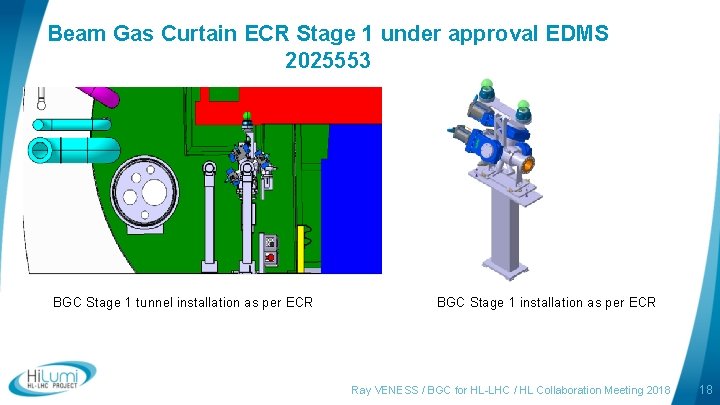
Beam Gas Curtain ECR Stage 1 under approval EDMS 2025553 BGC Stage 1 tunnel installation as per ECR BGC Stage 1 installation as per ECR Ray VENESS / BGC for HL-LHC / HL Collaboration Meeting 2018 18
- Slides: 18