
The BCM theory of synaptic plasticity Simple Model
The BCM theory of synaptic plasticity.
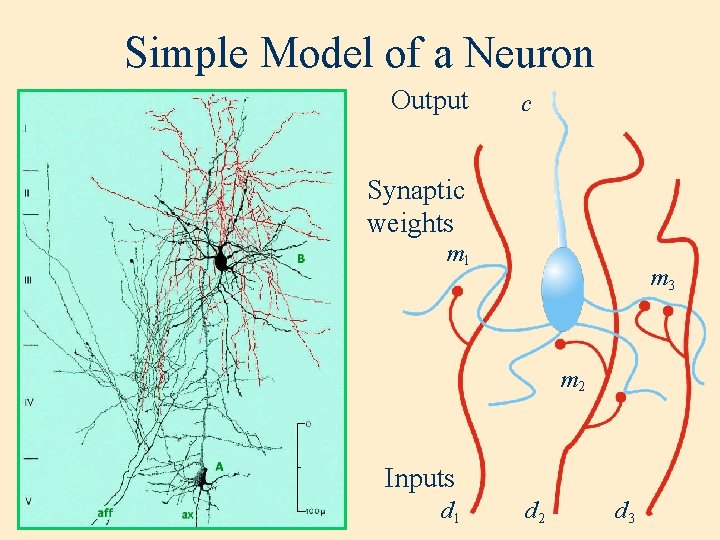
Simple Model of a Neuron Output c Synaptic weights m 1 m 3 m 2 Inputs d 1 d 2 d 3
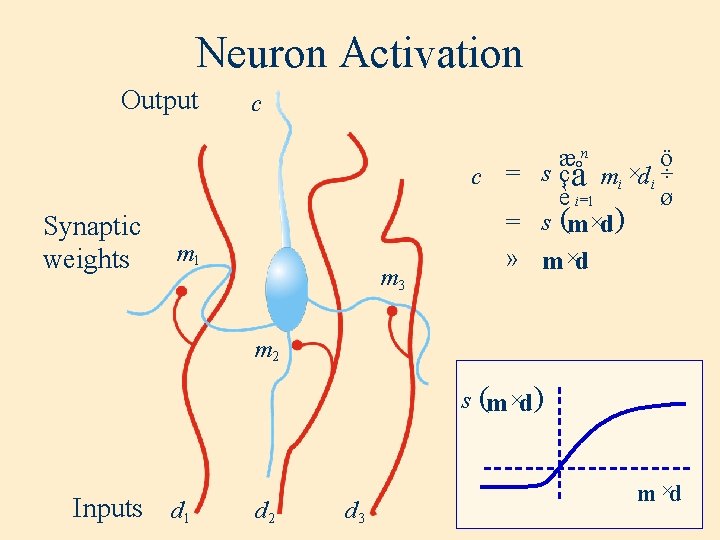
Neuron Activation Output Synaptic weights c m 1 m 3 æn ö c = s ç å mi ×d i ÷ è i =1 ø = s (m ×d ) » m ×d m 2 s (m ×d ) Inputs d 1 d 2 d 3 m ×d
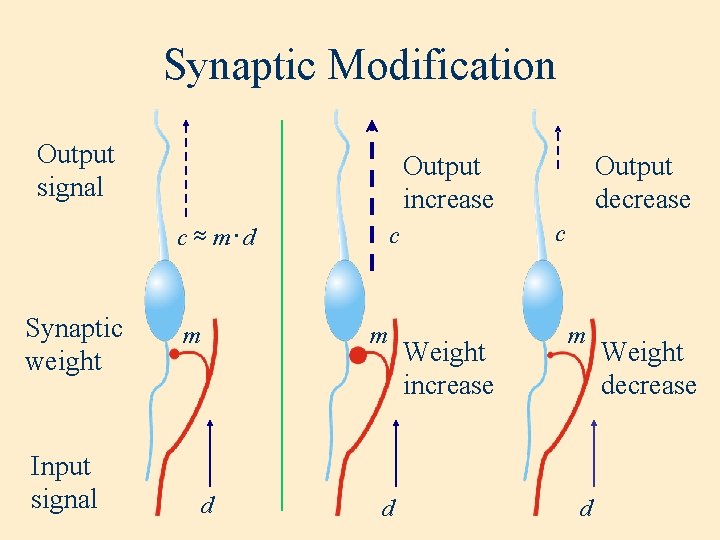
Synaptic Modification Output signal Output increase c » m×d Synaptic weight Input signal m d c c m d Output decrease Weight increase m d Weight decrease
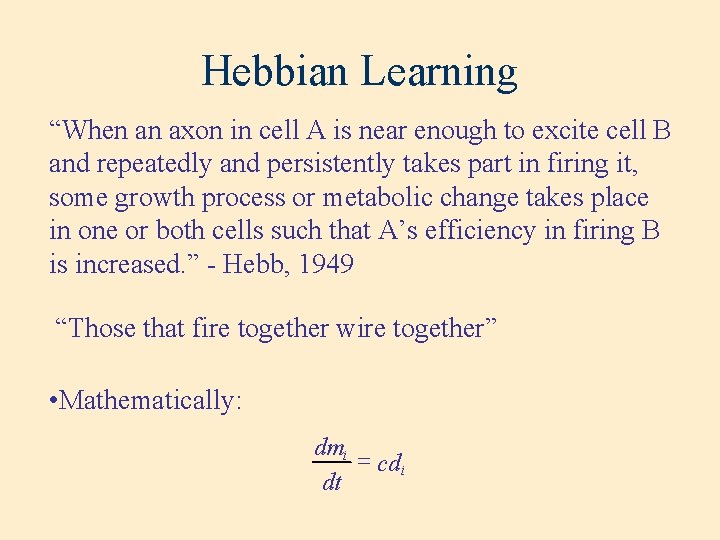
Hebbian Learning “When an axon in cell A is near enough to excite cell B and repeatedly and persistently takes part in firing it, some growth process or metabolic change takes place in one or both cells such that A’s efficiency in firing B is increased. ” - Hebb, 1949 “Those that fire together wire together” • Mathematically: dmi = cdi dt
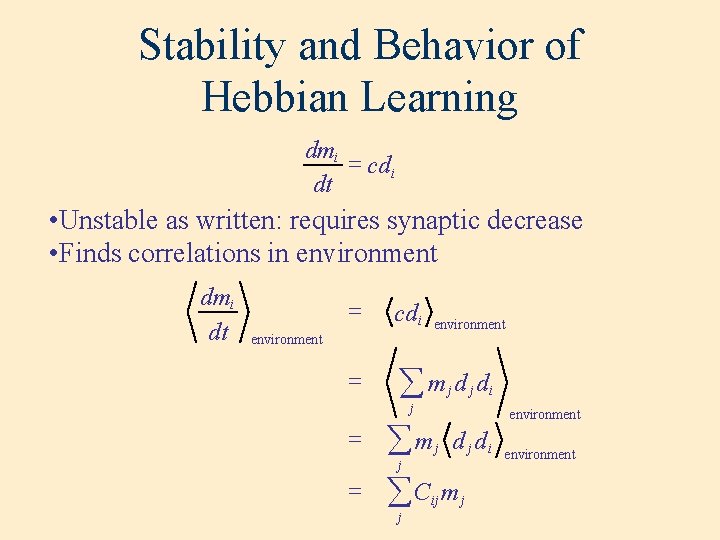
Stability and Behavior of Hebbian Learning dmi = cdi dt • Unstable as written: requires synaptic decrease • Finds correlations in environment dmi dt = cdi = åm d d environmen t j j j = = åm d d åC m j j j i environmen t
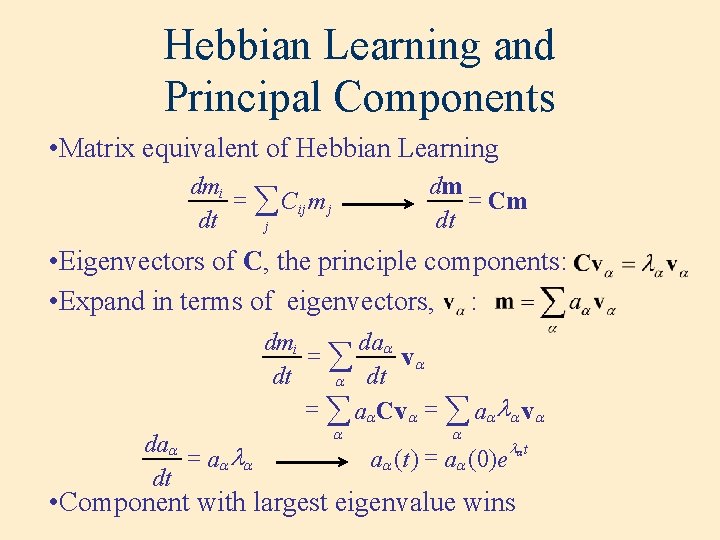
Hebbian Learning and Principal Components • Matrix equivalent of Hebbian Learning dmi = å Cij m j dt j dm = Cm dt • Eigenvectors of C, the principle components: • Expand in terms of eigenvectors, : daa = aa la dt dmi da = å a va dt dt a = å aa Cva = å aa la va a a aa (t ) = aa (0)e la t • Component with largest eigenvalue wins
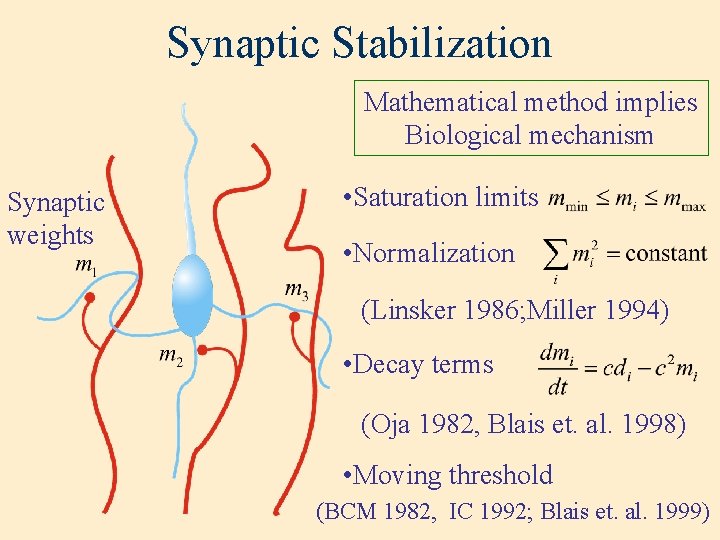
Synaptic Stabilization Mathematical method implies Biological mechanism Synaptic weights • Saturation limits • Normalization (Linsker 1986; Miller 1994) • Decay terms (Oja 1982, Blais et. al. 1998) • Moving threshold (BCM 1982, IC 1992; Blais et. al. 1999)
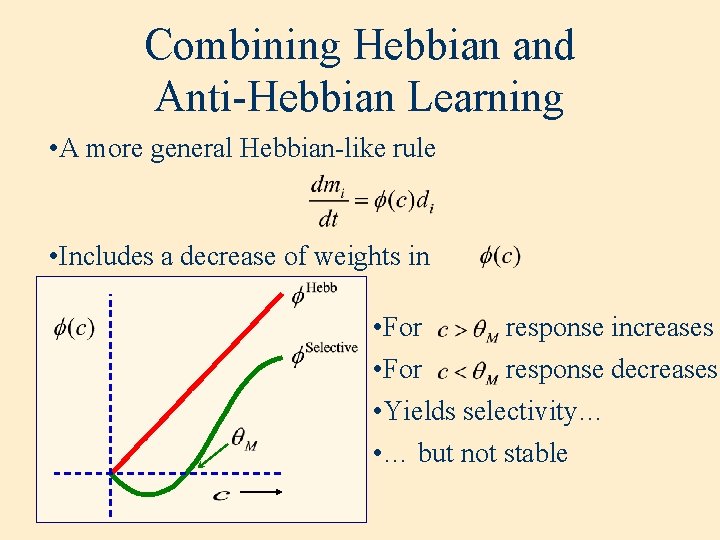
Combining Hebbian and Anti-Hebbian Learning • A more general Hebbian-like rule • Includes a decrease of weights in • For response increases • For response decreases • Yields selectivity… • … but not stable
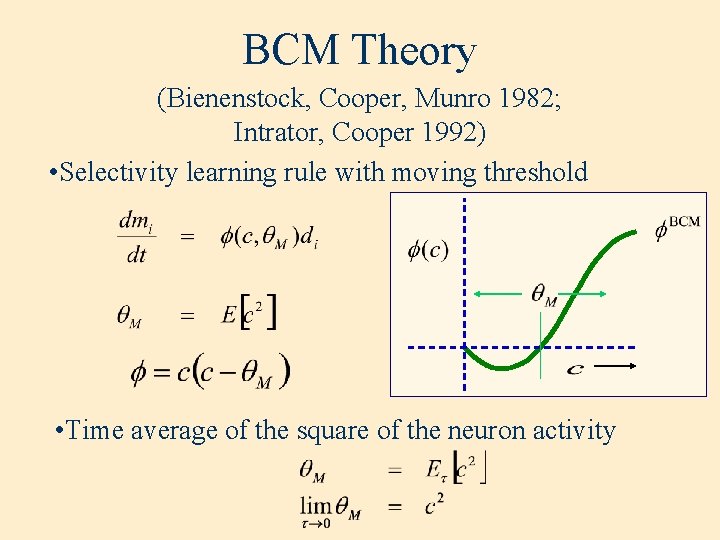
BCM Theory (Bienenstock, Cooper, Munro 1982; Intrator, Cooper 1992) • Selectivity learning rule with moving threshold • Time average of the square of the neuron activity
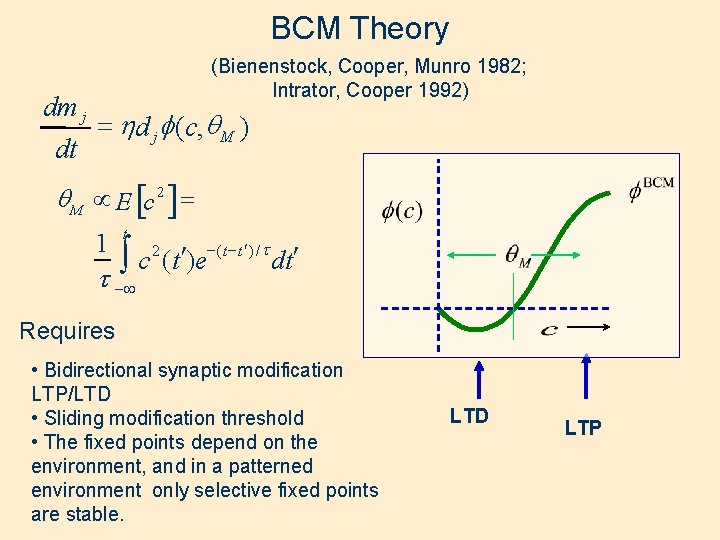
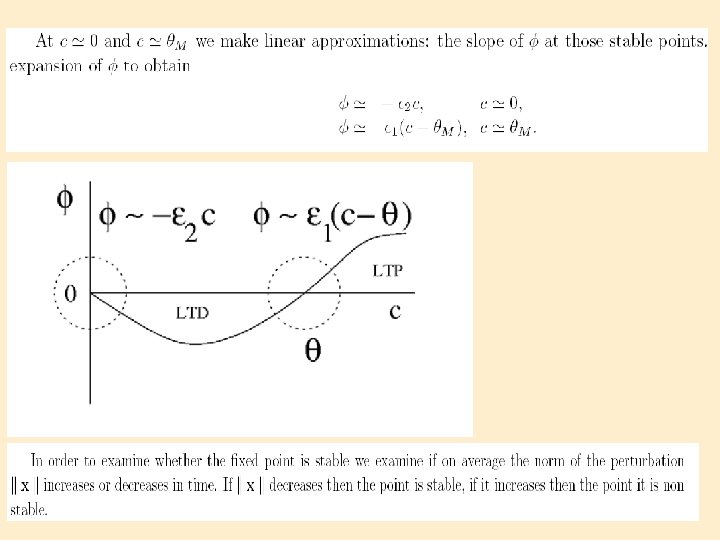
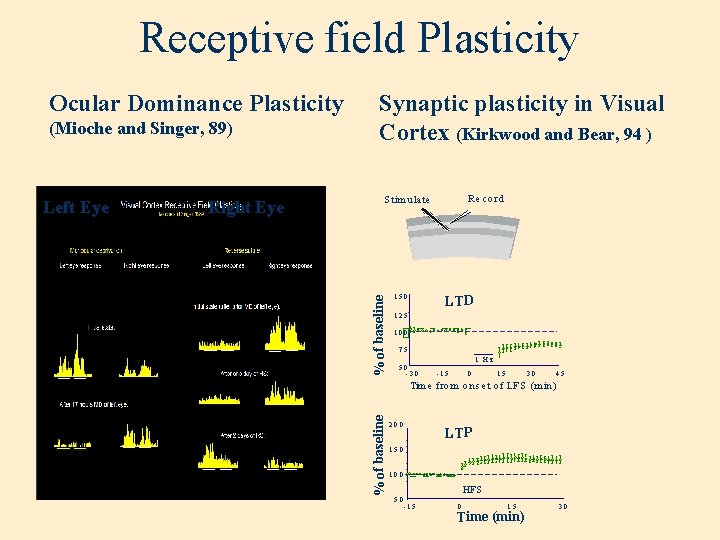
BCM Theory dm j dt (Bienenstock, Cooper, Munro 1982; Intrator, Cooper 1992) = hd j f (c, q M ) q. M µ E [c 2 ]= 1 t -(t - t ¢ )/ t ¢ dt ¢ ò c (t )e t -¥ 2 Requires • Bidirectional synaptic modification LTP/LTD • Sliding modification threshold • The fixed points depend on the environment, and in a patterned environment only selective fixed points are stable. LTD LTP
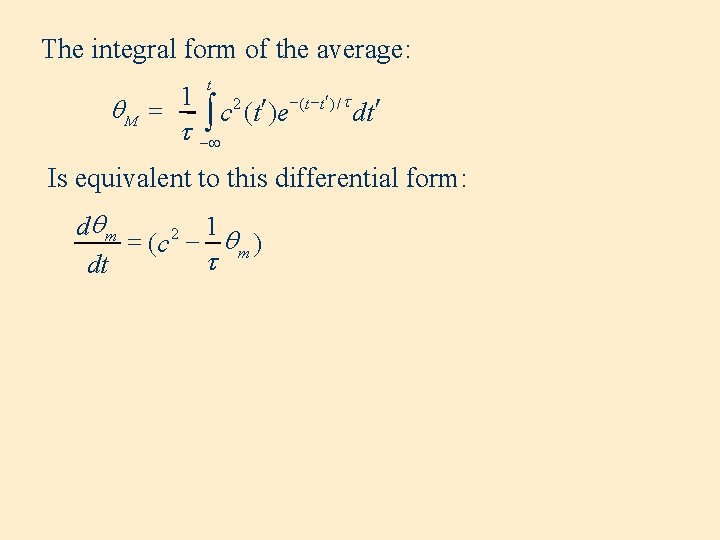
The integral form of the average: t q M = 1 ò c 2 (t ¢)e -(t -t¢) /t dt ¢ t -¥ Is equivalent to this differential form: dq m 1 2 = (c - q m ) t dt
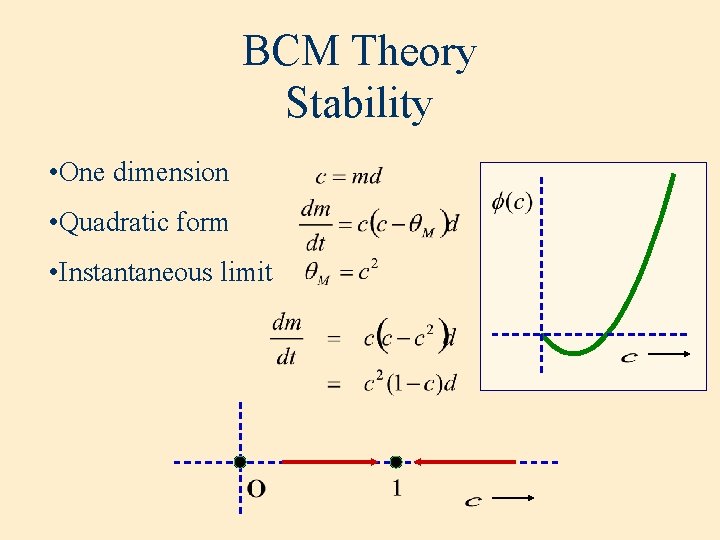
BCM Theory Stability • One dimension • Quadratic form • Instantaneous limit
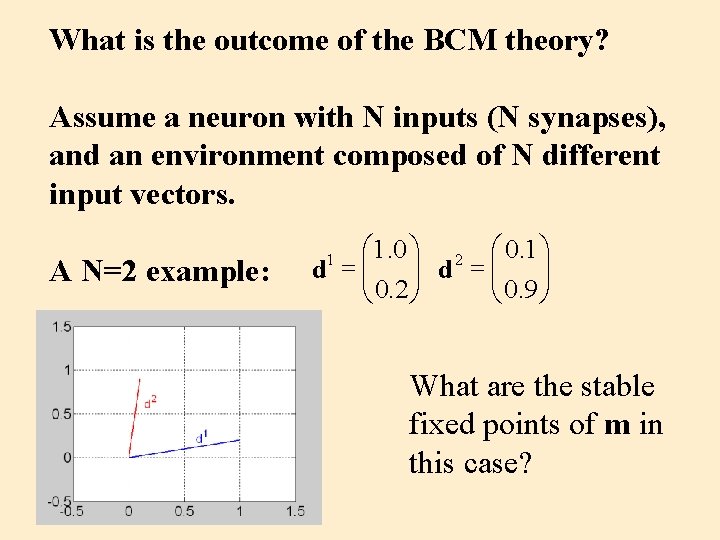
What is the outcome of the BCM theory? Assume a neuron with N inputs (N synapses), and an environment composed of N different input vectors. A N=2 example: æ 1. 0 ö 2 æ 0. 1 ö d = çç ÷÷ è 0. 2 ø è 0. 9 ø 1 What are the stable fixed points of m in this case?
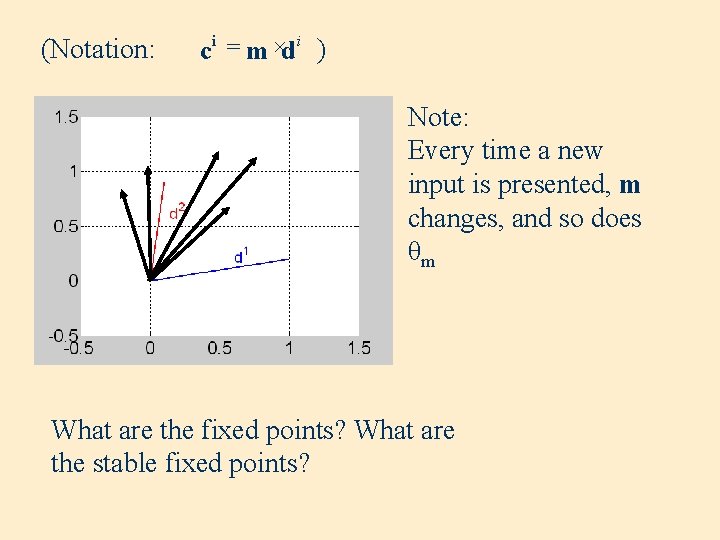
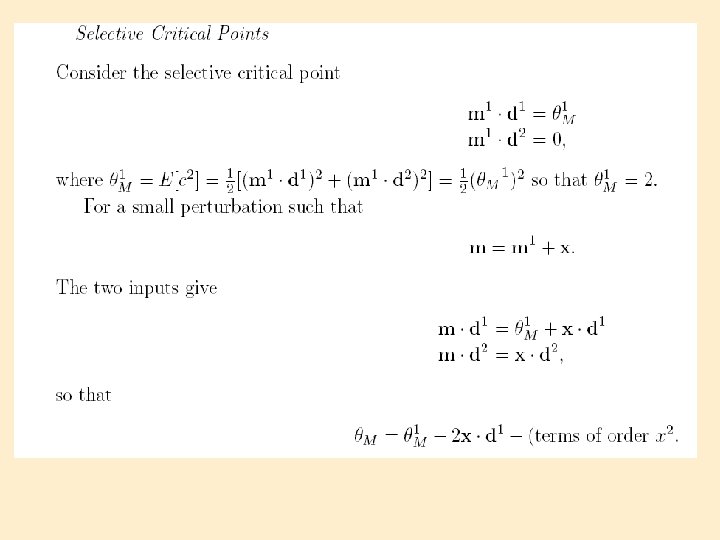
(Notation: ci = m ×d i ) Note: Every time a new input is presented, m changes, and so does θm What are the fixed points? What are the stable fixed points?
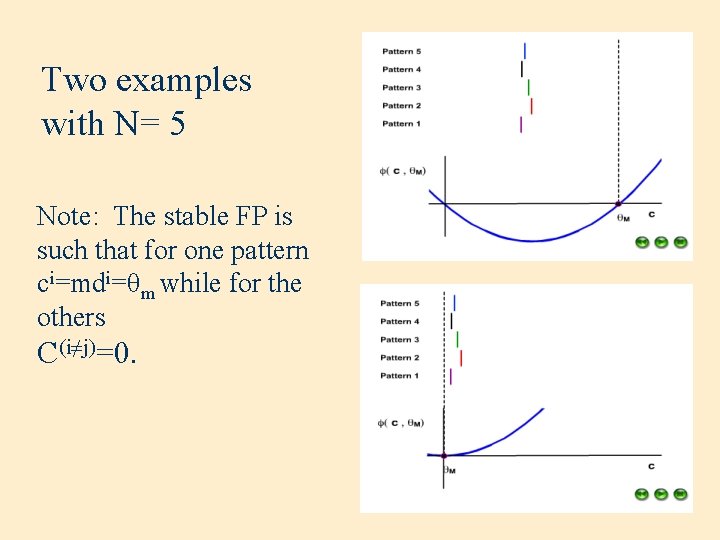
Two examples with N= 5 Note: The stable FP is such that for one pattern ci=mdi=θm while for the others C(i≠j)=0.
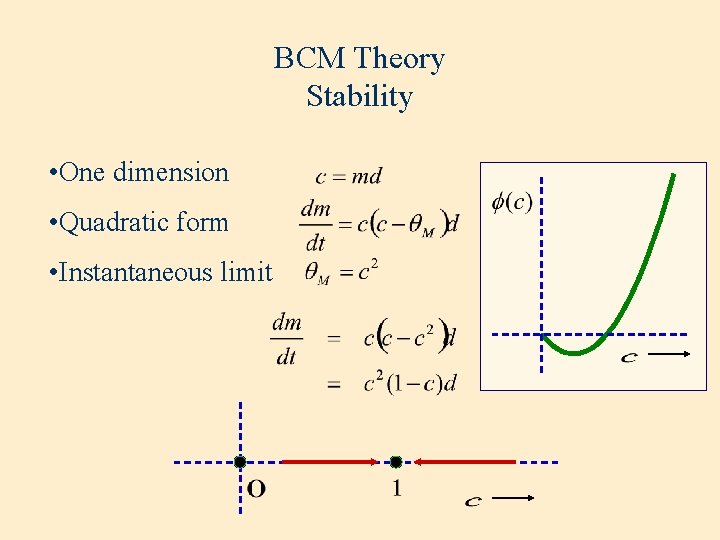
BCM Theory Stability • One dimension • Quadratic form • Instantaneous limit
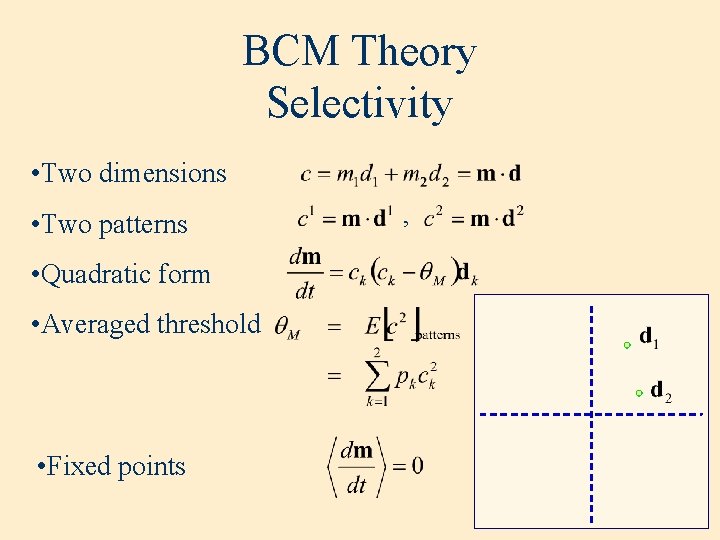
BCM Theory Selectivity • Two dimensions • Two patterns • Quadratic form • Averaged threshold • Fixed points ,
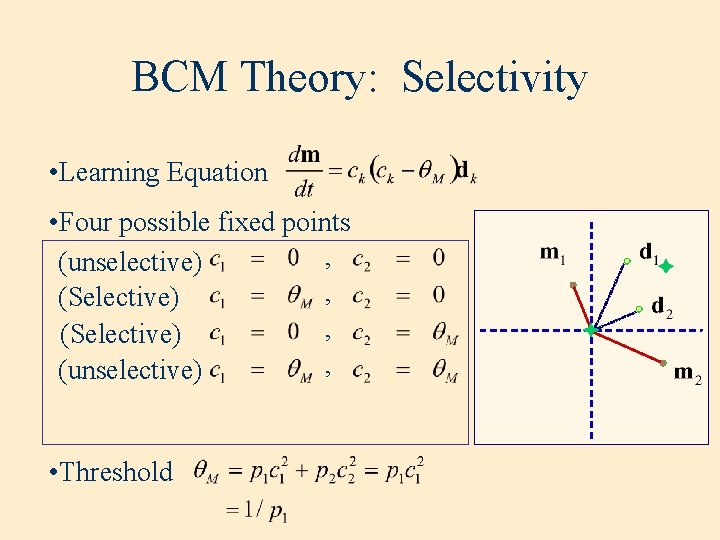
BCM Theory: Selectivity • Learning Equation • Four possible fixed points , (unselective) , (Selective) , (unselective) • Threshold
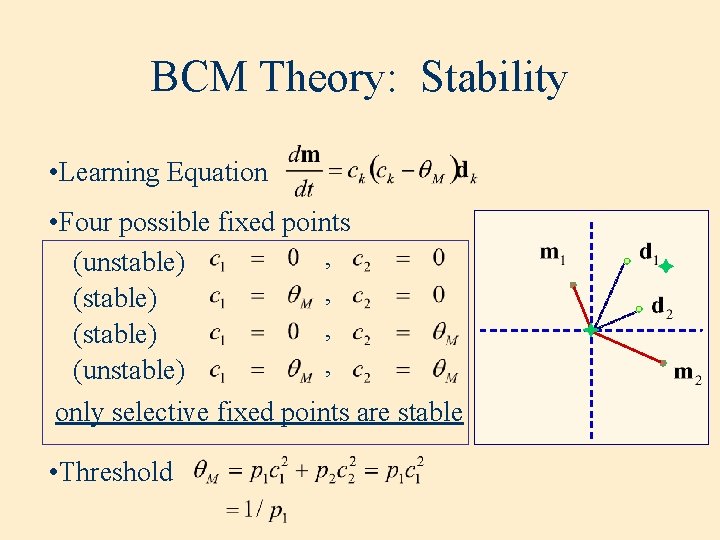
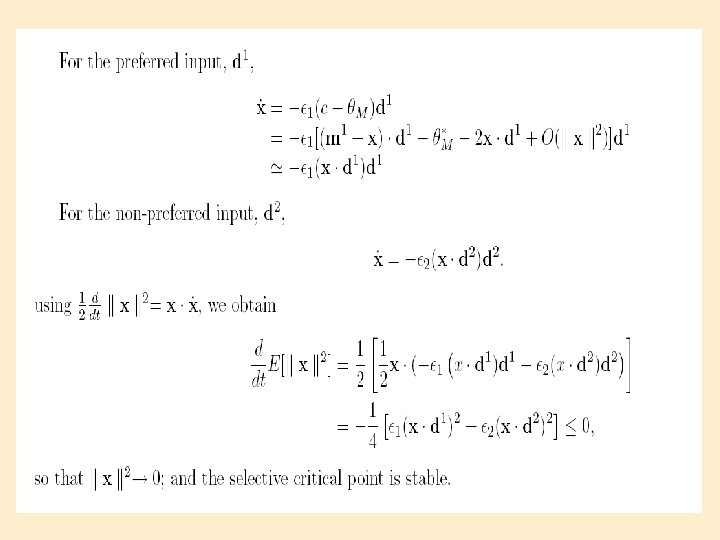
BCM Theory: Stability • Learning Equation • Four possible fixed points , (unstable) , (stable) , (unstable) only selective fixed points are stable • Threshold
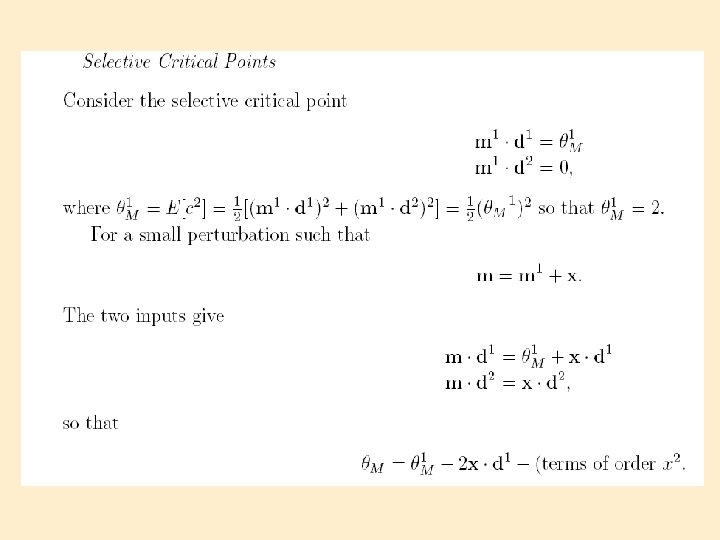
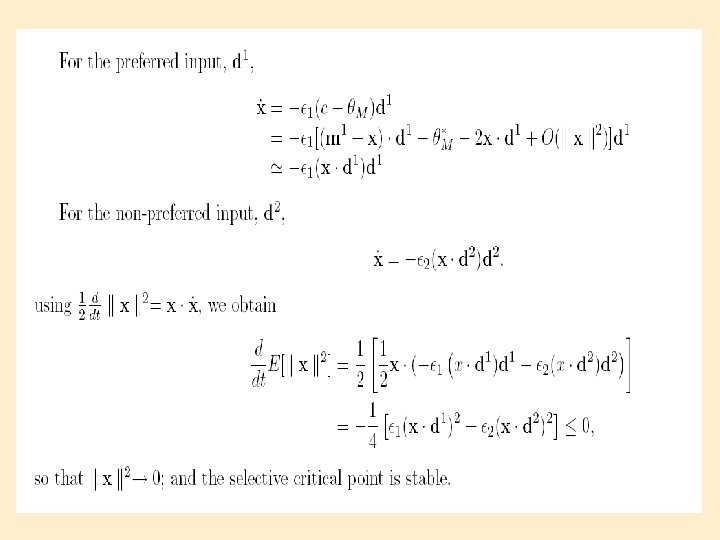
Ex 1 - Final Task • Create a BCM learning rule which can go into the Fast ICA algorithm of Hyvarinen. – Run it on multi modal distributions as well as other distributions. – Running should be as the regular fast ICA but with a new option for the BCM rule. – Demonstrate how down in Fisher score can you go to still get separation
Experimental vs. Theoretical Evidence
Right Response (spikes/sec) Left Tuning curves 0 90 180 270 360 Right
Receptive field Plasticity Left Eye Right Eye R e c o rd S tim u la te % of baseline (Mioche and Singer, 89) Synaptic plasticity in Visual Cortex (Kirkwood and Bear, 94 ) 150 LTD 125 100 75 1 Hz 50 -3 0 -1 5 0 15 30 45 Tim e fro m o n s e t o f LF S (m in ) % of baseline Ocular Dominance Plasticity 200 LTP 150 100 HFS 50 -1 5 0 15 Time (min) 30
Visual Pathway Visual Cortex Receptive fields are: • Binocular • Orientation Selective Area 17 LGN Receptive fields are: • Monocular • Radially Symmetric Retina light electrical signals
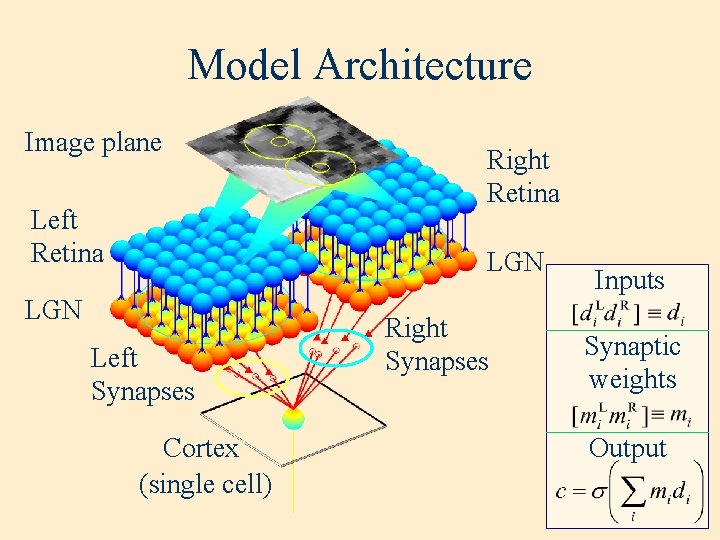
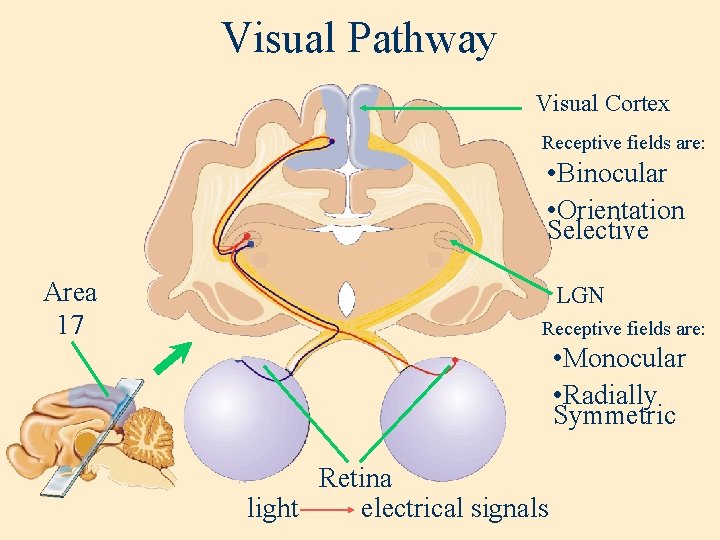
Model Architecture Image plane Left Retina Right Retina LGN Left Synapses Cortex (single cell) Right Synapses Inputs Synaptic weights Output
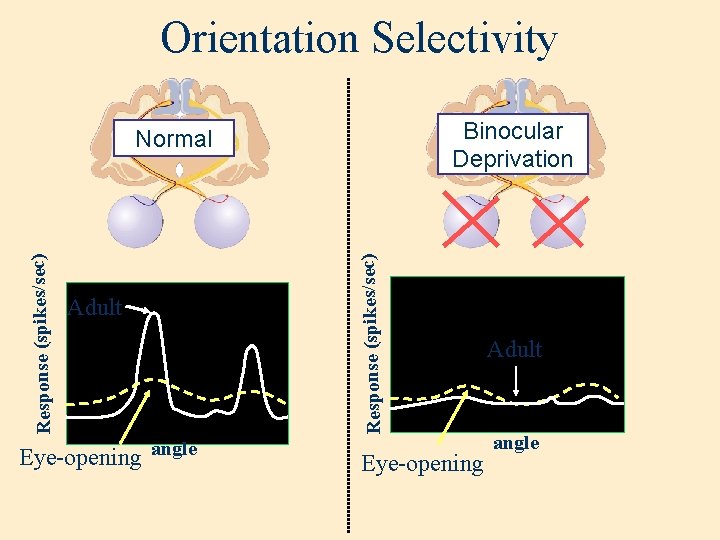
Orientation Selectivity Binocular Deprivation Response (spikes/sec) Normal Adult Eye-opening angle Eye-opening Adult angle
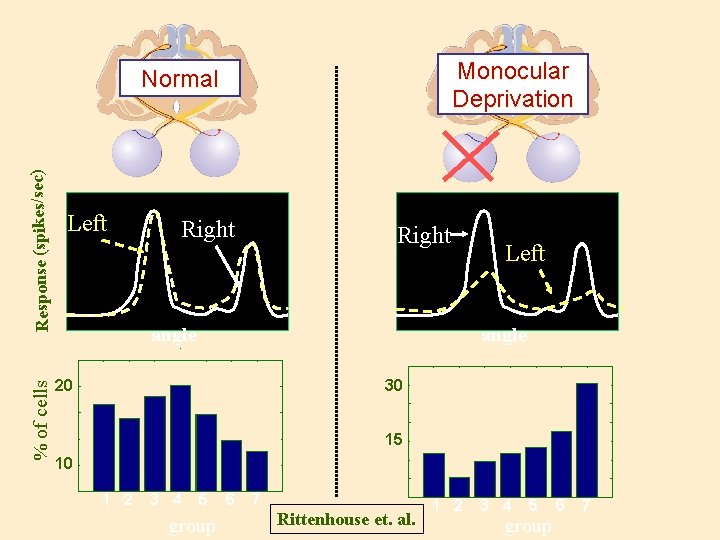
Monocular Deprivation % of cells Response (spikes/sec) Normal Left Right angle Left angle 20 30 15 10 1 2 3 4 5 group 6 7 Rittenhouse et. al. 1 2 3 4 5 group 6 7
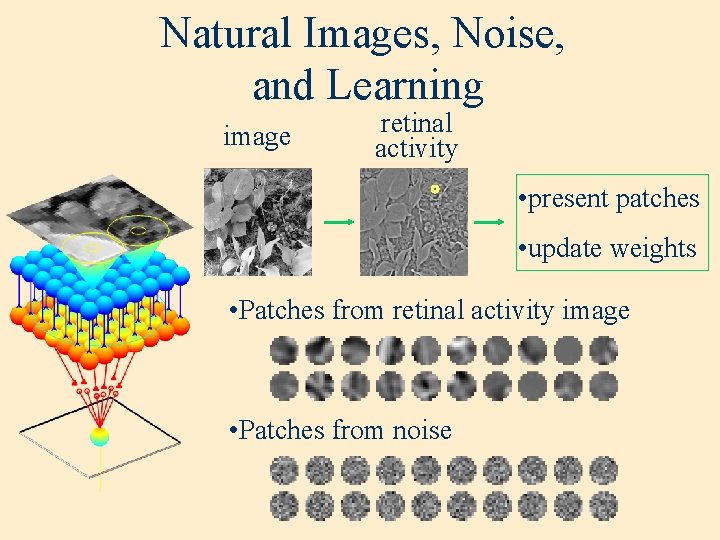
Natural Images, Noise, and Learning image retinal activity • present patches • update weights • Patches from retinal activity image • Patches from noise
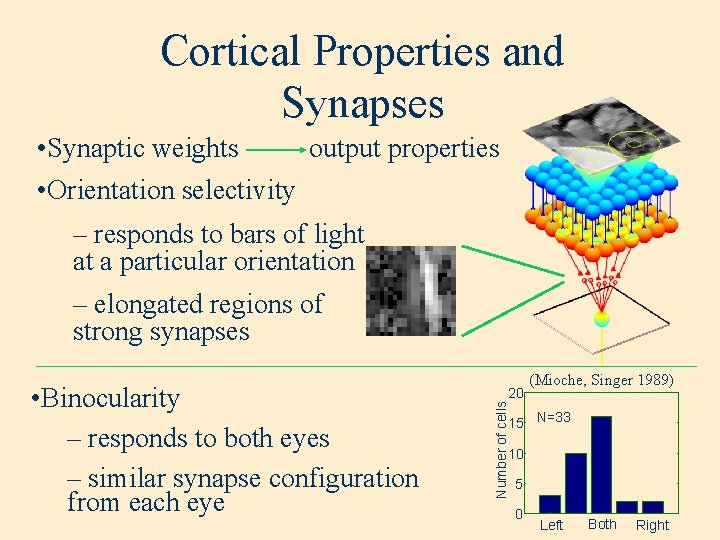
Cortical Properties and Synapses • Synaptic weights output properties • Orientation selectivity – responds to bars of light at a particular orientation – elongated regions of strong synapses Number of cells • Binocularity – responds to both eyes – similar synapse configuration from each eye 20 (Mioche, Singer 1989) 15 N=33 10 5 0 Left Both Right
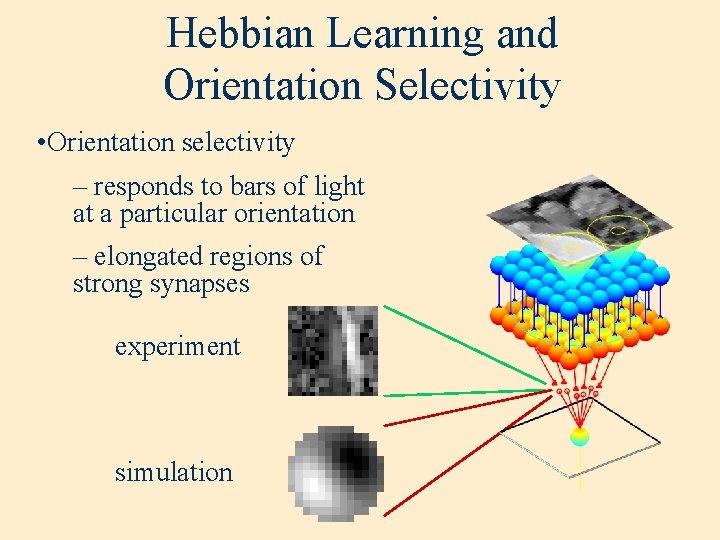
Hebbian Learning and Orientation Selectivity • Orientation selectivity – responds to bars of light at a particular orientation – elongated regions of strong synapses experiment simulation
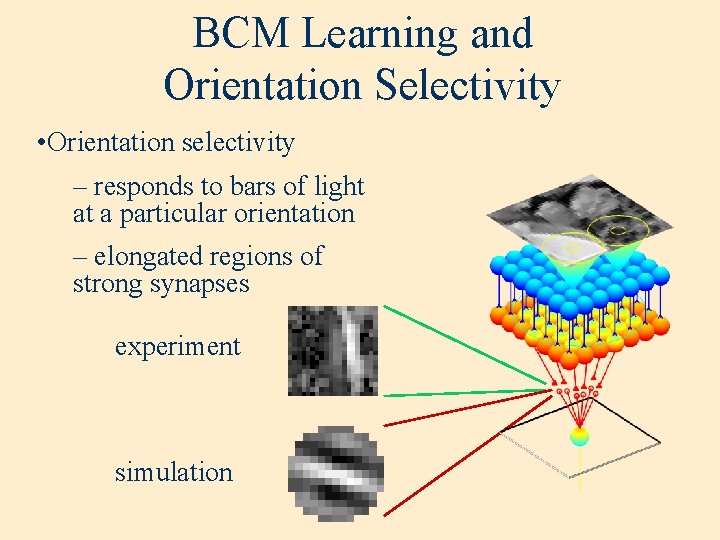
BCM Learning and Orientation Selectivity • Orientation selectivity – responds to bars of light at a particular orientation – elongated regions of strong synapses experiment simulation
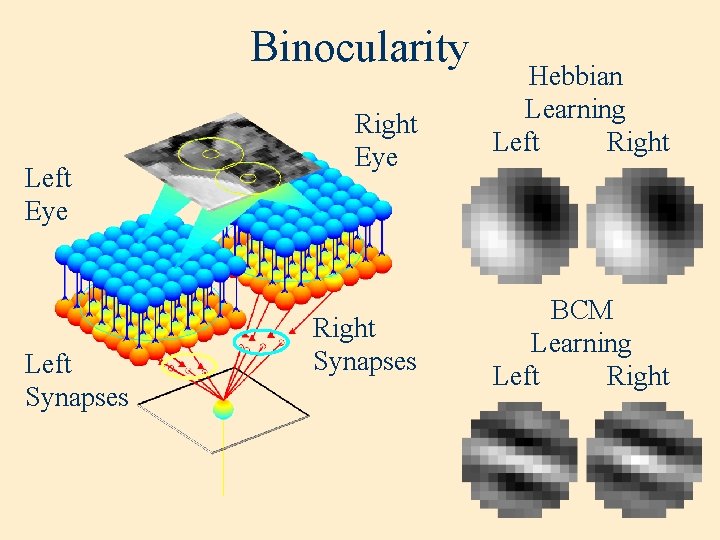
Binocularity Left Eye Left Synapses Right Eye Right Synapses Hebbian Learning Left Right BCM Learning Left Right
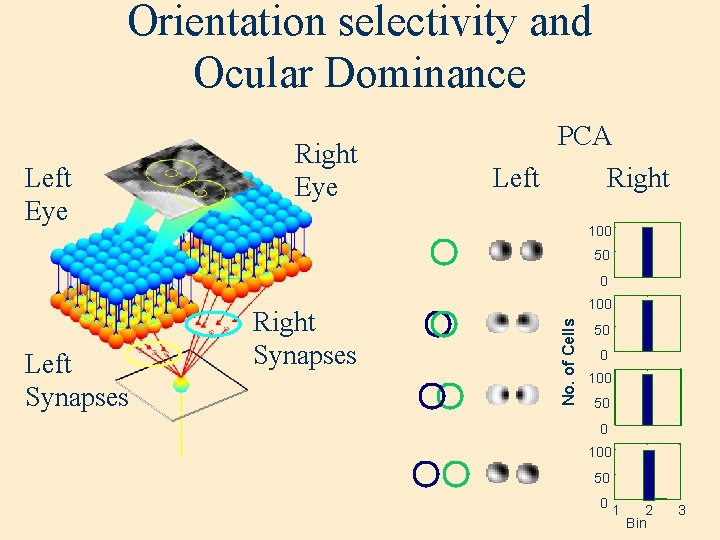
Orientation selectivity and Ocular Dominance Left Eye Right Eye PCA Left Right 100 50 0 No. of Cells Left Synapses Right Synapses 100 50 01 2 Bin 3
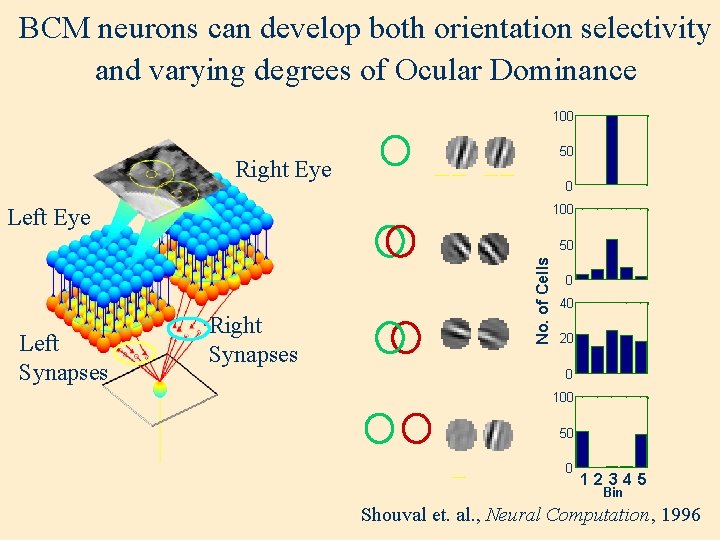
BCM neurons can develop both orientation selectivity and varying degrees of Ocular Dominance 100 50 Right Eye 0 100 Left Eye Left Synapses Right Synapses No. of Cells 50 0 40 20 0 100 50 0 12345 Bin Shouval et. al. , Neural Computation, 1996
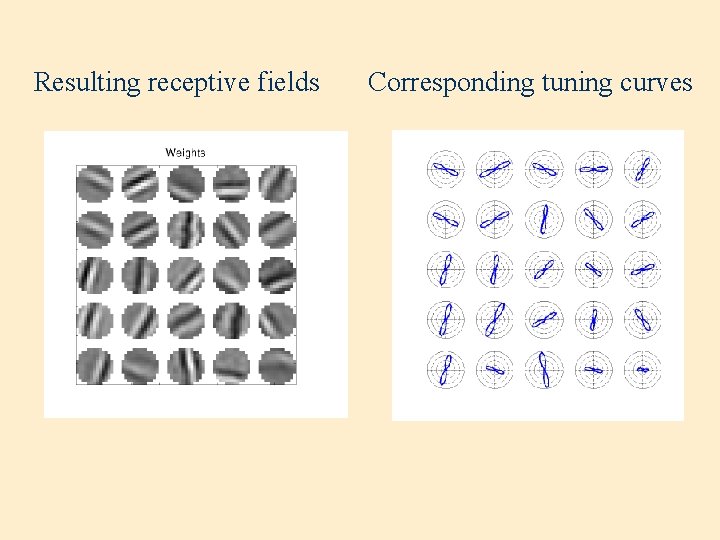
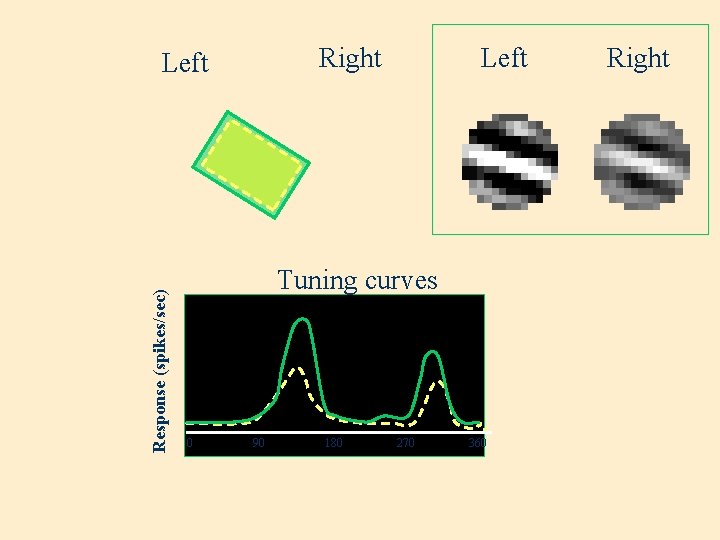
Resulting receptive fields Corresponding tuning curves
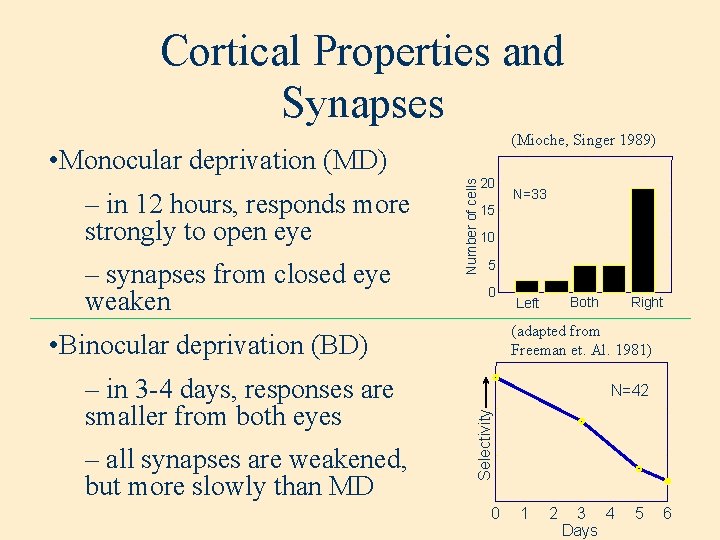
Cortical Properties and Synapses (Mioche, Singer 1989) – in 12 hours, responds more strongly to open eye – synapses from closed eye weaken Number of cells • Monocular deprivation (MD) 20 15 10 5 0 Right N=42 Selectivity – all synapses are weakened, but more slowly than MD Both Left (adapted from Freeman et. Al. 1981) • Binocular deprivation (BD) – in 3 -4 days, responses are smaller from both eyes N=33 0 1 2 3 4 Days 5 6
Observation • Loss of response during Monocular Deprivation is much more rapid than during Binocular Deprivation. (Hubel and Wiesel, 1963, 1965) • Therefore the two eyes compete for limited resources. • Mechanism: Synaptic competition.
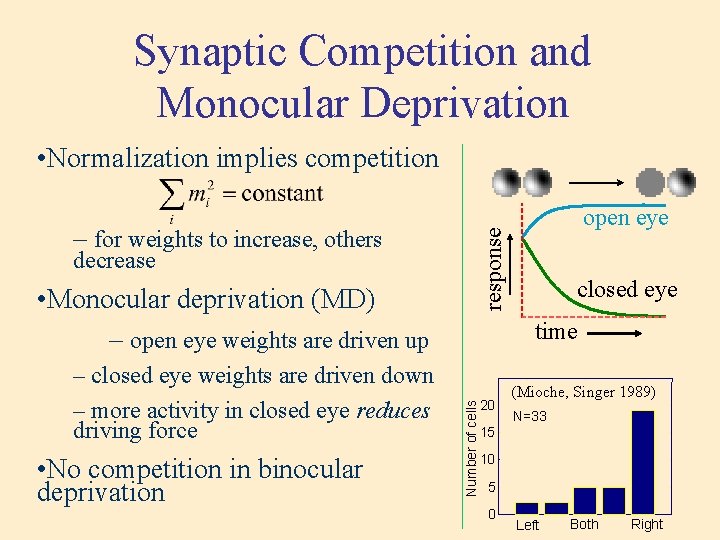
Synaptic Competition and Monocular Deprivation • Normalization implies competition response – for weights to increase, others decrease • Monocular deprivation (MD) – open eye weights are driven up • No competition in binocular deprivation closed eye time Number of cells – closed eye weights are driven down – more activity in closed eye reduces driving force open eye 20 (Mioche, Singer 1989) N=33 15 10 5 0 Left Both Right
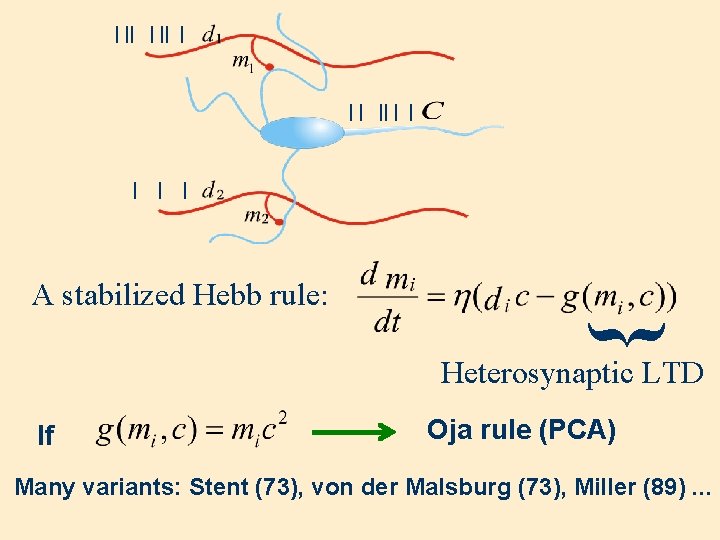
| || | | | { A stabilized Hebb rule: Heterosynaptic LTD If Oja rule (PCA) Many variants: Stent (73), von der Malsburg (73), Miller (89). . .
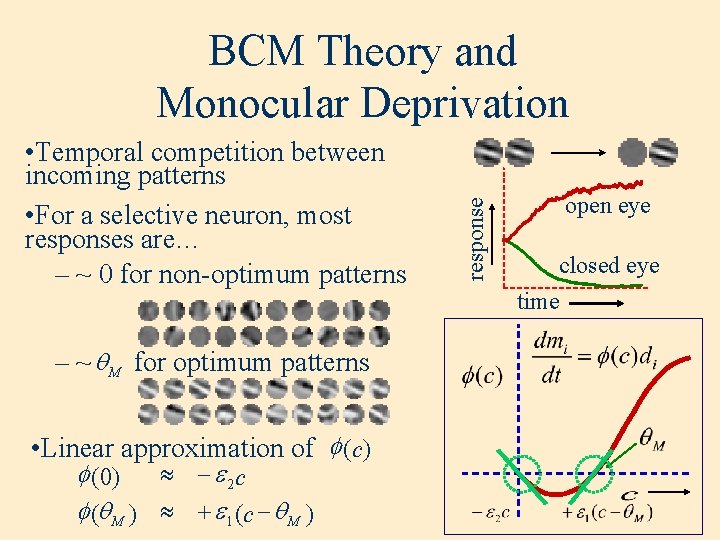
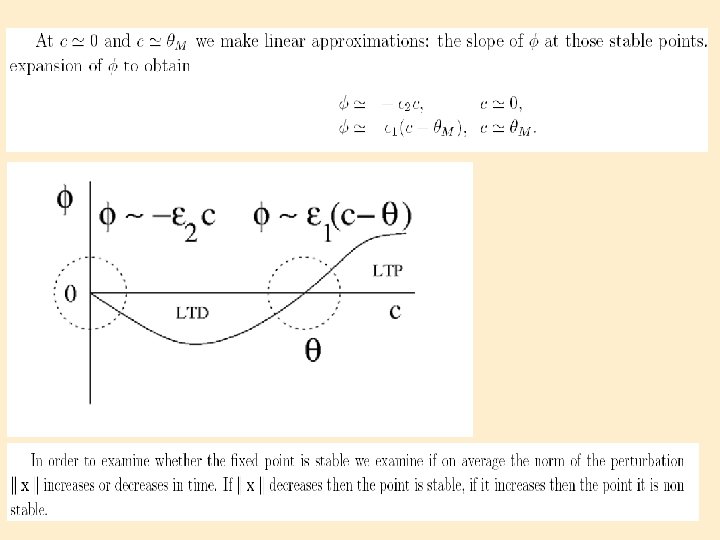
• Temporal competition between incoming patterns • For a selective neuron, most responses are… – ~ 0 for non-optimum patterns – ~ q M for optimum patterns • Linear approximation of f (c) f (0) » - e 2 c f (q M ) » + e 1 (c - q M ) response BCM Theory and Monocular Deprivation open eye closed eye time
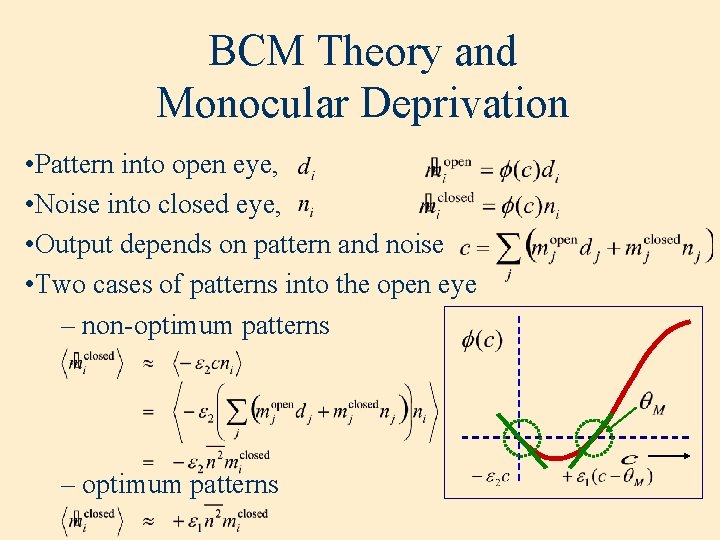
BCM Theory and Monocular Deprivation • Pattern into open eye, • Noise into closed eye, • Output depends on pattern and noise • Two cases of patterns into the open eye – non-optimum patterns – optimum patterns
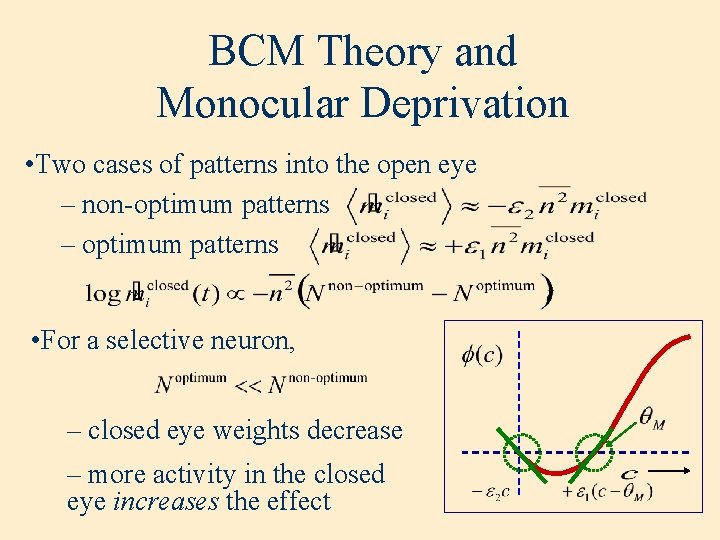
BCM Theory and Monocular Deprivation • Two cases of patterns into the open eye – non-optimum patterns – optimum patterns • For a selective neuron, – closed eye weights decrease – more activity in the closed eye increases the effect
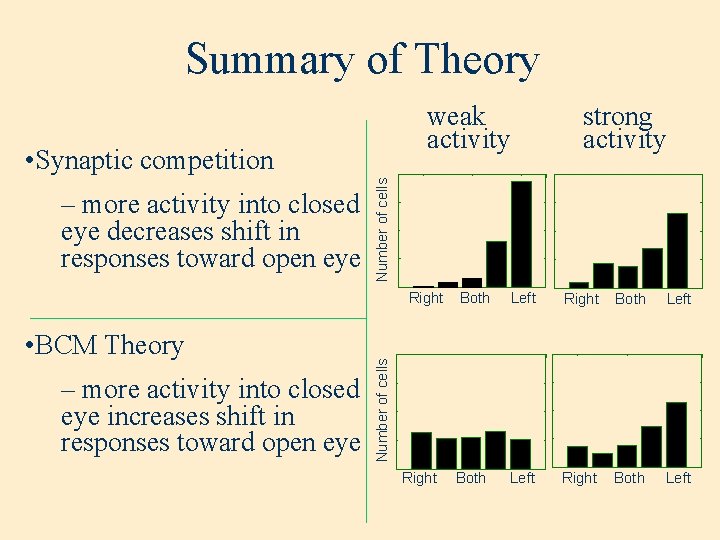
Summary of Theory weak activity – more activity into closed eye decreases shift in responses toward open eye Number of cells • Synaptic competition – more activity into closed eye increases shift in responses toward open eye Both Left Right Both Left Number of cells Right • BCM Theory strong activity Right
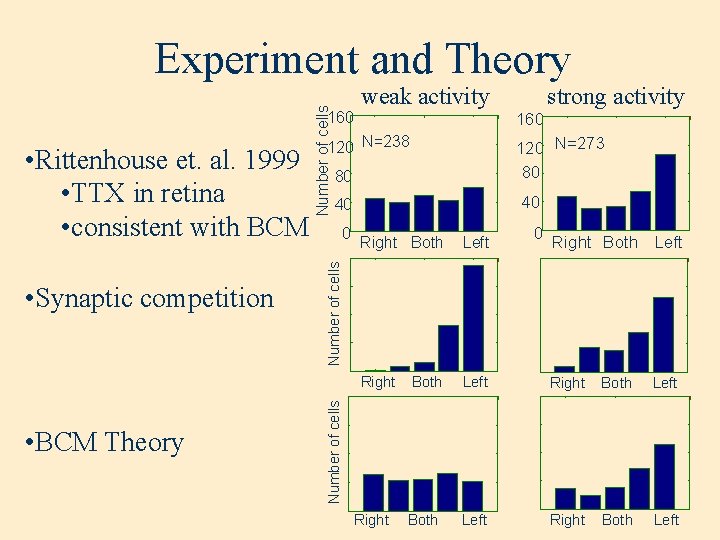
Number of cells Experiment and Theory 160 • BCM Theory 120 N=273 80 80 40 40 0 Right Both Left Both Left Right Both Left Number of cells • Synaptic competition 160 120 N=238 0 strong activity Number of cells • Rittenhouse et. al. 1999 • TTX in retina • consistent with BCM weak activity Right
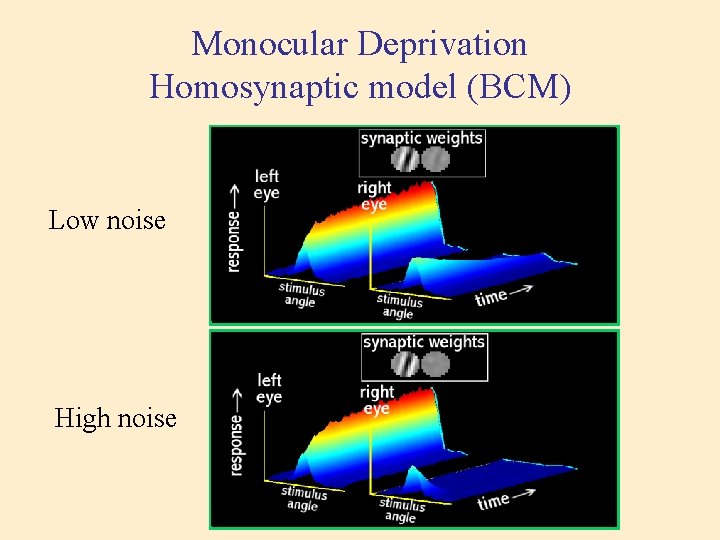
Monocular Deprivation Homosynaptic model (BCM) Low noise High noise
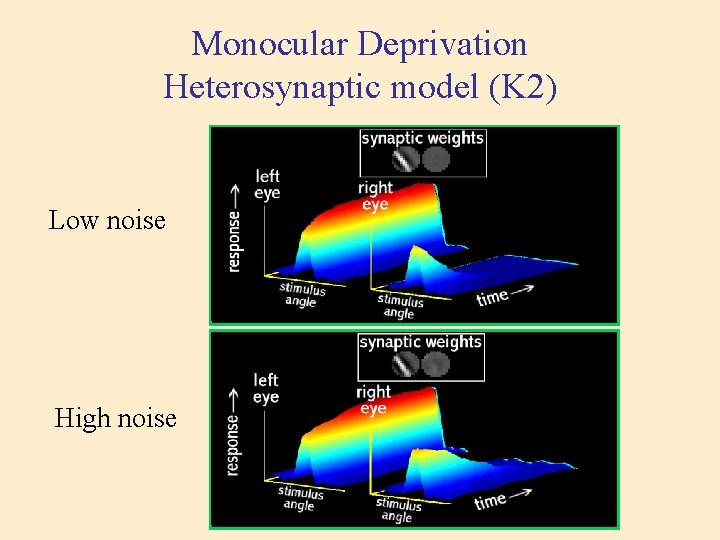
Monocular Deprivation Heterosynaptic model (K 2) Low noise High noise
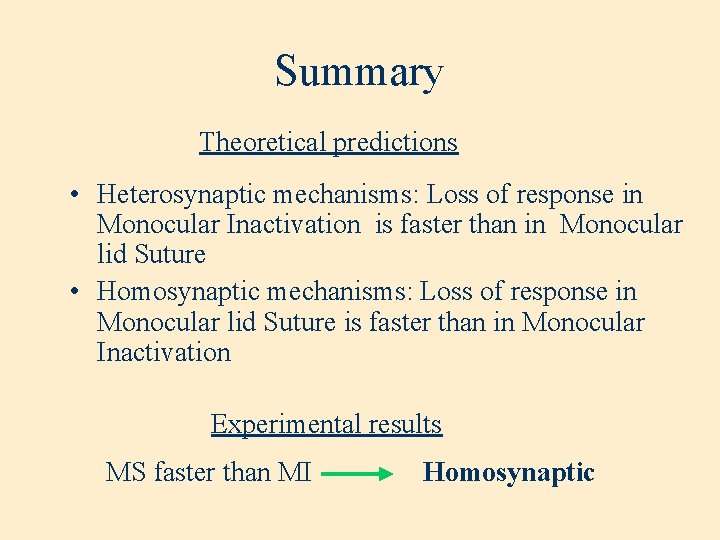
Summary Theoretical predictions • Heterosynaptic mechanisms: Loss of response in Monocular Inactivation is faster than in Monocular lid Suture • Homosynaptic mechanisms: Loss of response in Monocular lid Suture is faster than in Monocular Inactivation Experimental results MS faster than MI Homosynaptic
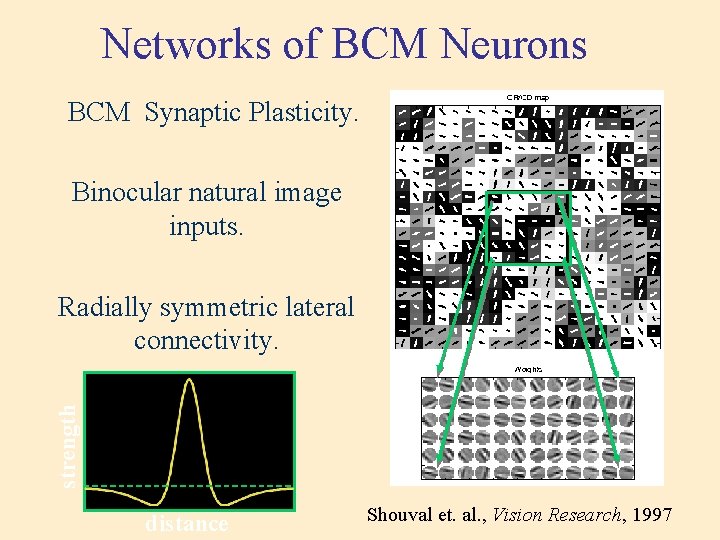
Networks of BCM Neurons BCM Synaptic Plasticity. Binocular natural image inputs. strength Radially symmetric lateral connectivity. distance Shouval et. al. , Vision Research, 1997
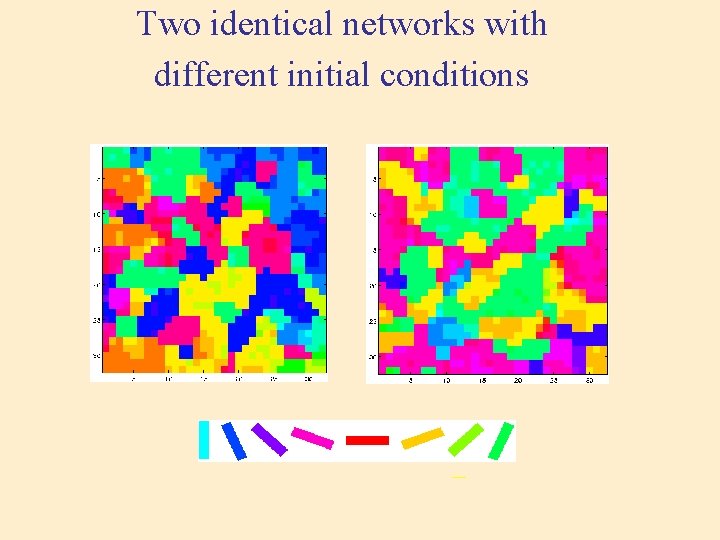
Two identical networks with different initial conditions
Summary • Both stabilized Hebb rules and BCM can account for orientation selectivity. • BCM neurons show varying degrees of Ocular Dominance. • Theoretical analysis and Experimental evidence indicate that Homosynaptic LTD is the mechanism of ocular dominance plasticity. • Structured long range connections, as observed in cortex, can account for the stability of orientation maps.
Conclusions • Models of Synaptic Modification – differ by methods of synaptic stabilization – synaptic competition – BCM theory: moving threshold • Reproduce deprivation experiments • Dynamics of monocular deprivation – experiment to distinguish learning rules – Rittenhouse et. al. 1999 consistent with BCM
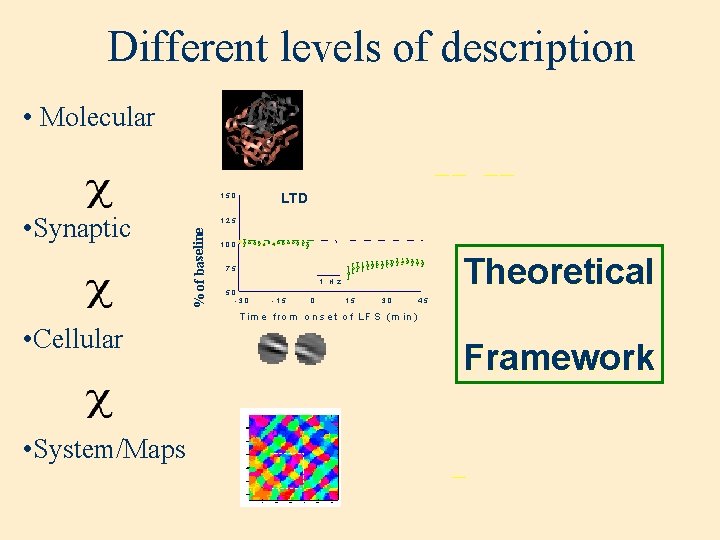
Different levels of description • Molecular LTD 150 • Cellular • System/Maps % of baseline • Synaptic 125 100 Theoretical 75 1 H z 50 -3 0 -1 5 0 15 30 45 T im e f r o m o n s e t o f L F S ( m in ) Framework
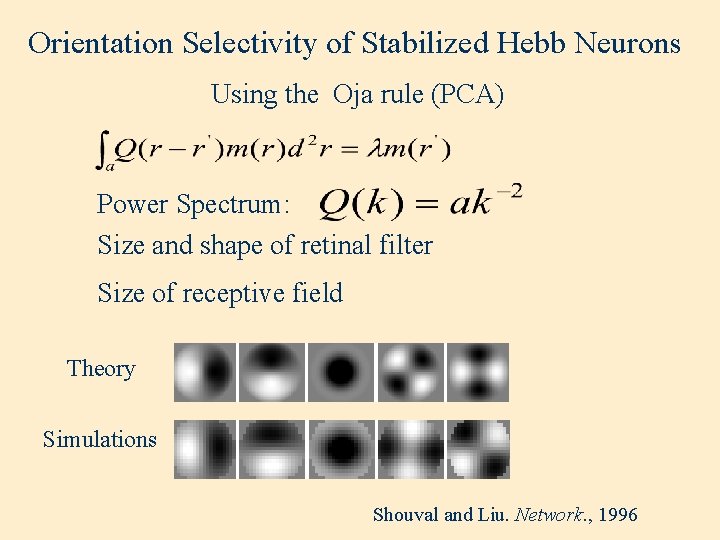
Orientation Selectivity of Stabilized Hebb Neurons Using the Oja rule (PCA) Power Spectrum: Size and shape of retinal filter Size of receptive field Theory Simulations Shouval and Liu. Network. , 1996
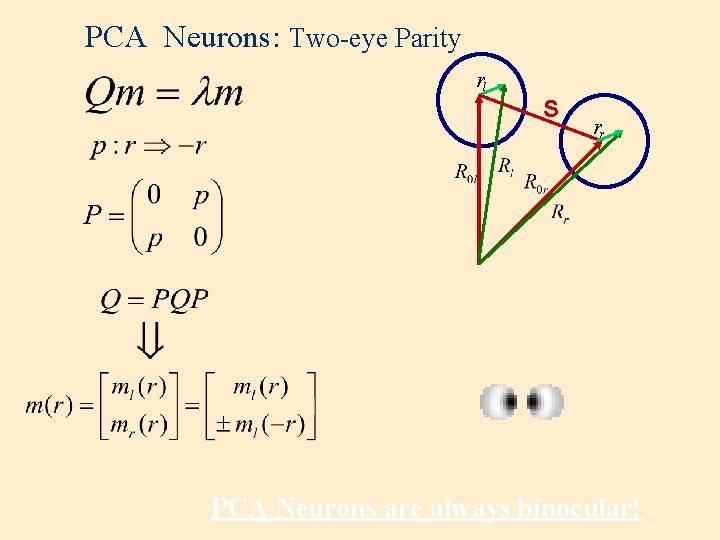
PCA Neurons: Two-eye Parity rl S rr PCA Neurons are always binocular!
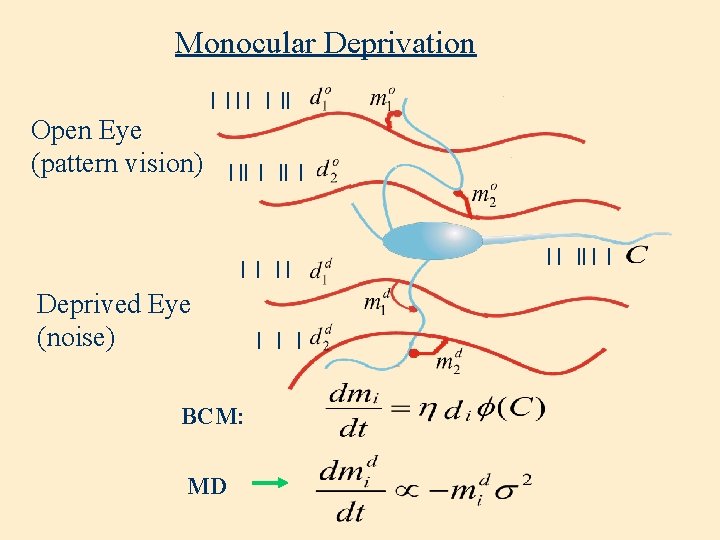
Monocular Deprivation | | || Open Eye (pattern vision) | || Deprived Eye (noise) BCM: MD | | || | |
- Slides: 62