
The Battle of Tannenberg On August 26 1914
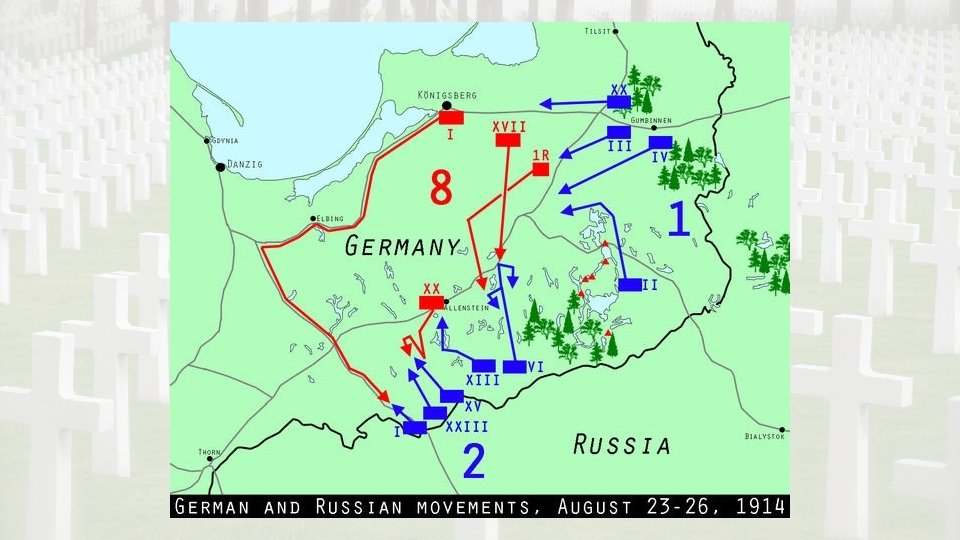
The Battle of Tannenberg • On August 26, 1914, the German 8 th Army, under the leadership of Paul von Hindenburg and Erich Ludendorff, strikes with lethal force against the advancing Russian 2 nd Army, led by General Aleksandr Samsonov, in East Prussia during the opening weeks of war. • Russia sent two armies into East Prussia, while Germany, according to its war strategy, had the bulk of its forces concentrated to the west, against France. The Russian 1 st Army, under General Pavel Rennenkampf, advanced to the northeastern corner of East Prussia, while Samsonov’s 2 nd Army made headway into the southwest, planning to join with Rennenkampf’s men and pin the outnumbered German 8 th Army between them.
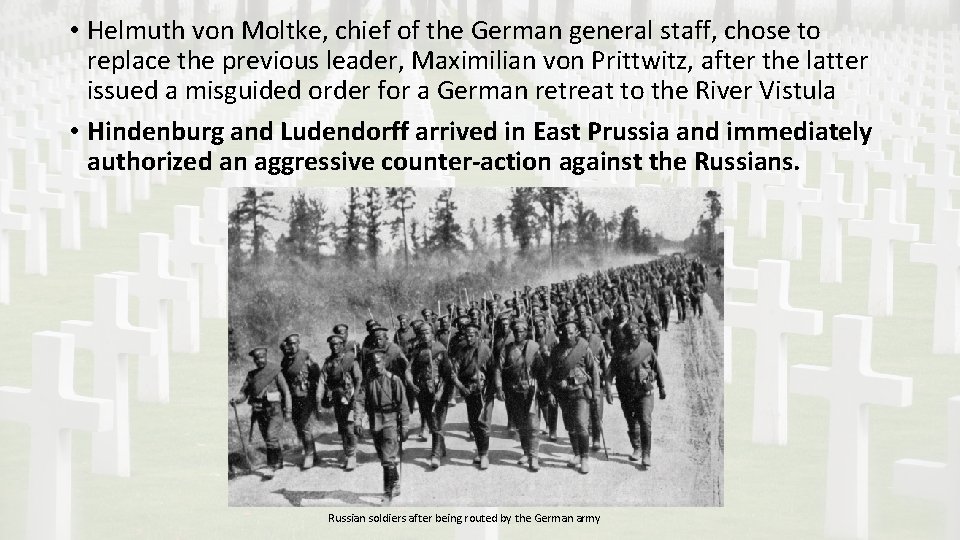
• Helmuth von Moltke, chief of the German general staff, chose to replace the previous leader, Maximilian von Prittwitz, after the latter issued a misguided order for a German retreat to the River Vistula • Hindenburg and Ludendorff arrived in East Prussia and immediately authorized an aggressive counter-action against the Russians. Russian soldiers after being routed by the German army
• Separated by the great Masurian Lakes, the two Russian armies were unable to effectively communicate with each other as to their movements, a circumstance that would prove deadly. • The German attack was delayed by one day • On August 26, after intercepting unencoded wireless messages from both Samsonov and Rennenkampf, the Germans were able to take Samsonov’s army by surprise with the force of their attack near the village of Tannenberg. • The delay in starting the attack had given Samsonov’s forces more time to advance deeper into the sack formed by the German divisions enveloping them from both sides, the strength of which Samsonov consistently underestimated. • After three days of battering by German artillery, Samsonov’s troops began their retreat; more German forces cut off their path and a massive slaughter ensued. In the first hours of August 30, confronting the reality of his army’s collapse, Samsonov went into the forest, away from his staff, and shot himself.
• In total, over 50, 000 Russian soldiers were killed and some 92, 000 taken as prisoners in the battle. • By the end of August, Russia’s ambitious advance in East Prussia in August 1914 had achieved at least one of its goals, albeit at a tremendous cost: two German corps had been removed from the Western to the Eastern Front in order to confront the Russian menace. • Though the two corps had not arrived in time to play a role in the Battle of Tannenberg—which would remain the greatest German triumph of the war against Russia on the Eastern Front— they would also be unable to aid their comrades at the Battle of the Marne.
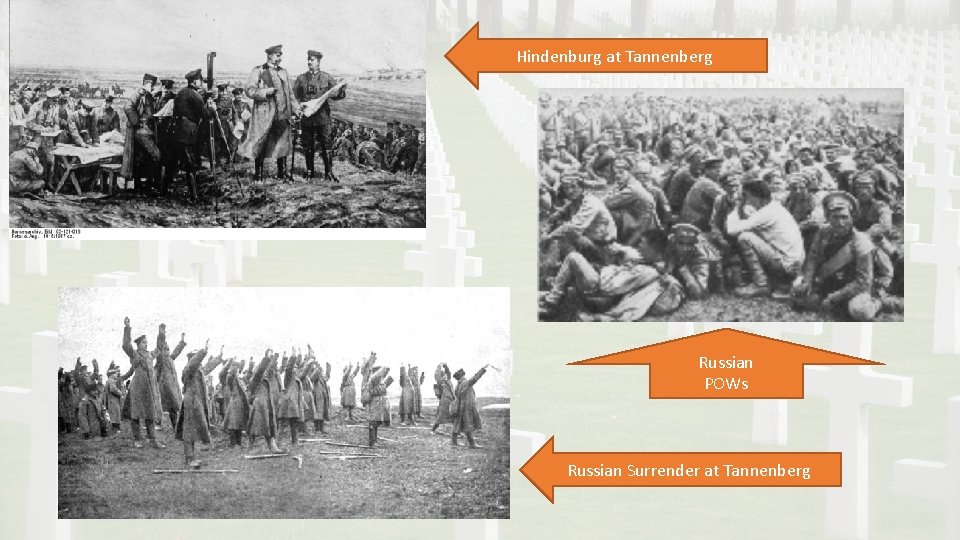
Hindenburg at Tannenberg Russian POWs Russian Surrender at Tannenberg
The Battle of Tannenberg
First Battle of Marne • The World War I First Battle of the Marne featured the first use of radio intercepts and automotive transport of troops in wartime. • After French commander in chief Joseph Joffre ordered an offensive in September 1914, General Michel-Joseph Maunoury’s French Sixth Army opened a gap between Germany’s First and Second Armies. • Maunoury exploited the gap with help from the French Fifth Army and British Expeditionary Force, while Ferdinand Foch’s Ninth Army thwarted the advances of the German Second and Third Armies. • By Sept. 10, the Germans embarked on a retreat that ended north of the Aisne River, beginning a phase of the war that would be marked by trench warfare.
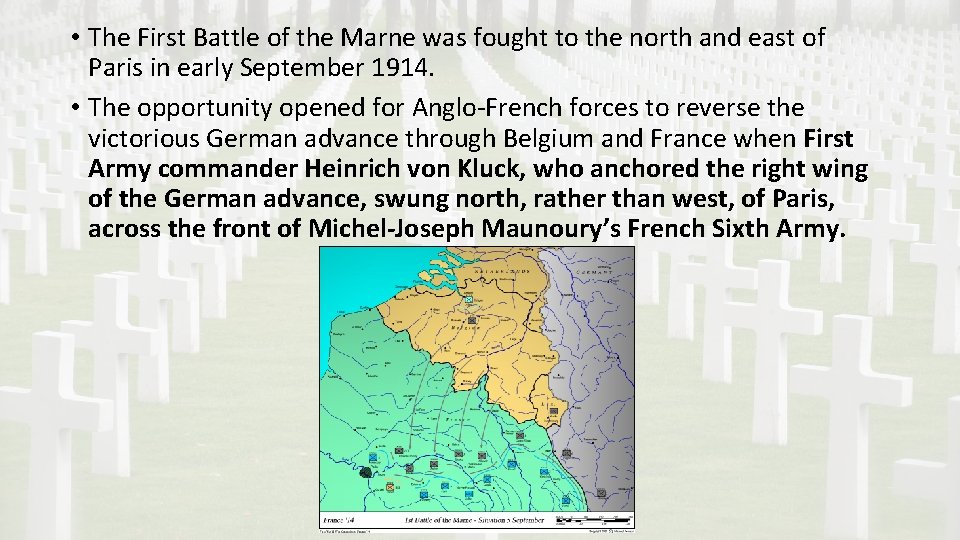
• The First Battle of the Marne was fought to the north and east of Paris in early September 1914. • The opportunity opened for Anglo-French forces to reverse the victorious German advance through Belgium and France when First Army commander Heinrich von Kluck, who anchored the right wing of the German advance, swung north, rather than west, of Paris, across the front of Michel-Joseph Maunoury’s French Sixth Army.
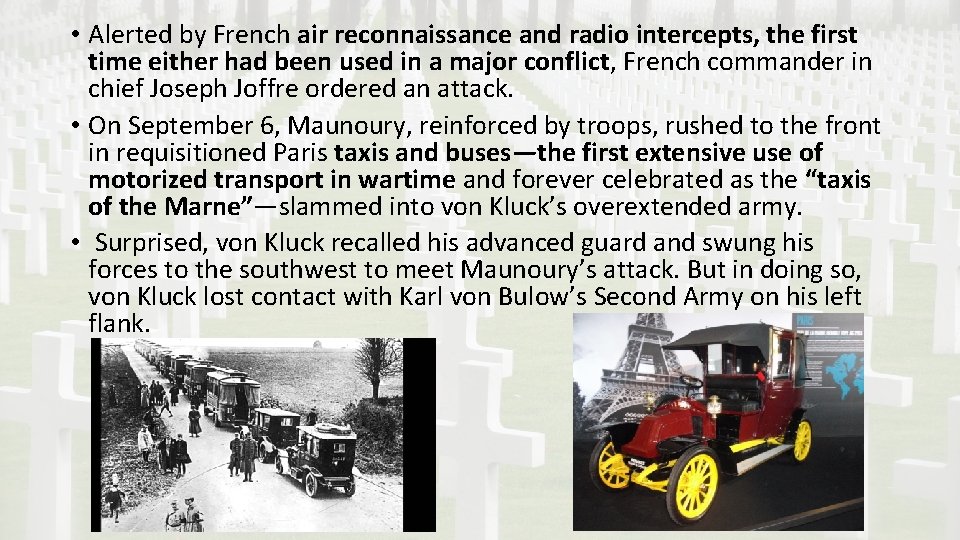
• Alerted by French air reconnaissance and radio intercepts, the first time either had been used in a major conflict, French commander in chief Joseph Joffre ordered an attack. • On September 6, Maunoury, reinforced by troops, rushed to the front in requisitioned Paris taxis and buses—the first extensive use of motorized transport in wartime and forever celebrated as the “taxis of the Marne”—slammed into von Kluck’s overextended army. • Surprised, von Kluck recalled his advanced guard and swung his forces to the southwest to meet Maunoury’s attack. But in doing so, von Kluck lost contact with Karl von Bulow’s Second Army on his left flank.
• The British Expeditionary Force (BEF) rallied together with elements of the French Fifth Army to surge into the breach von Kluck had opened in the German front. • The tenacious defense of Ferdinand Foch’s Ninth Army in the St. Gond marshes against repeated attacks of the German Second and Third Armies frustrated German attempts to dislocate the French thrust by collapsing Joffre’s right wing. • On September 10, German chief of staff Helmuth von Moltke the younger ordered his forces to regroup on a front between Soissons and Verdun. Joffre pursued into September 13, when French attacks failed to dislodge German positions north of the Aisne. • Each army then began a series of flanking maneuvers known as the “race to the sea, ” which left in its wake a system of linked trenches protected by barbed wire.
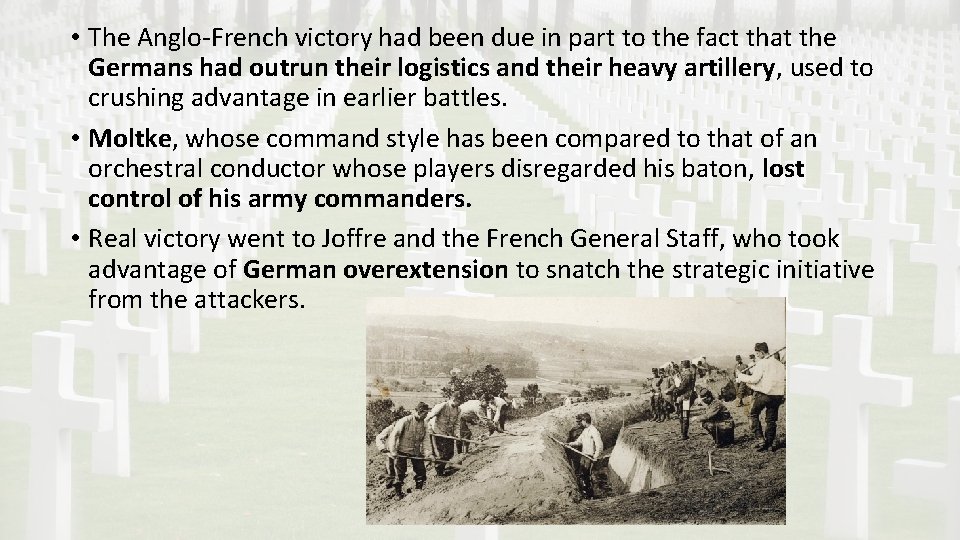
• The Anglo-French victory had been due in part to the fact that the Germans had outrun their logistics and their heavy artillery, used to crushing advantage in earlier battles. • Moltke, whose command style has been compared to that of an orchestral conductor whose players disregarded his baton, lost control of his army commanders. • Real victory went to Joffre and the French General Staff, who took advantage of German overextension to snatch the strategic initiative from the attackers.
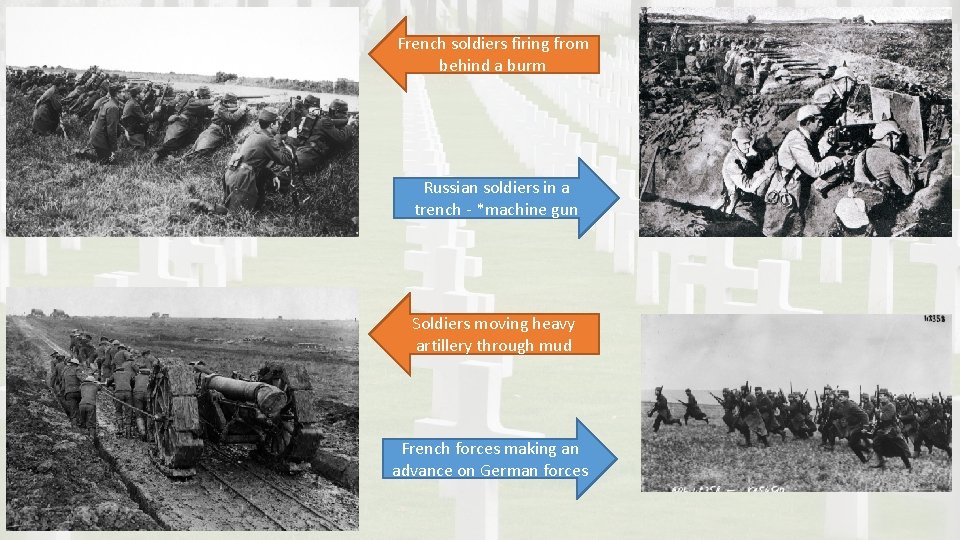
French soldiers firing from behind a burm Russian soldiers in a trench - *machine gun Soldiers moving heavy artillery through mud French forces making an advance on German forces
The Battle of Marne
- Slides: 15