
The Battle of Britain how did Britain win
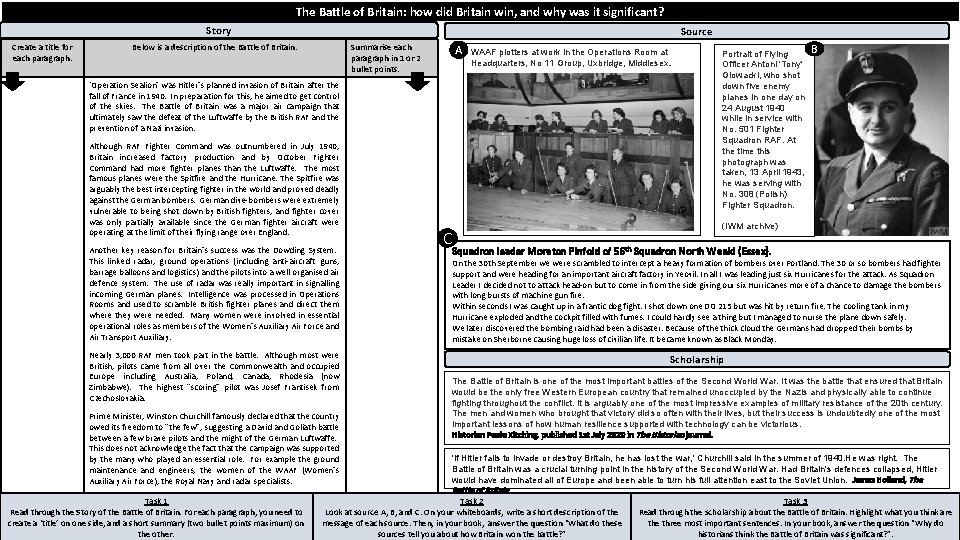
The Battle of Britain: how did Britain win, and why was it significant? Story Create a title for each paragraph. Source Below is a description of the Battle of Britain. Summarise each paragraph in 1 or 2 bullet points. A WAAF plotters at work in the Operations Room at Headquarters, No 11 Group, Uxbridge, Middlesex. ‘Operation Sealion’ was Hitler’s planned invasion of Britain after the fall of France in 1940. In preparation for this, he aimed to get control of the skies. The Battle of Britain was a major air campaign that ultimately saw the defeat of the Luftwaffe by the British RAF and the prevention of a Nazi invasion. Although RAF Fighter Command was outnumbered in July 1940, Britain increased factory production and by October Fighter Command had more fighter planes than the Luftwaffe. The most famous planes were the Spitfire and the Hurricane. The Spitfire was arguably the best intercepting fighter in the world and proved deadly against the German bombers. German dive-bombers were extremely vulnerable to being shot down by British fighters, and fighter cover was only partially available since the German fighter aircraft were operating at the limit of their flying range over England. Another key reason for Britain’s success was the Dowding System. This linked radar, ground operations (including anti-aircraft guns, barrage balloons and logistics) and the pilots into a well organised air defence system. The use of radar was really important in signalling incoming German planes. Intelligence was processed in Operations Rooms and used to scramble British fighter planes and direct them where they were needed. Many women were involved in essential operational roles as members of the Women’s Auxiliary Air Force and Air Transport Auxiliary. Nearly 3, 000 RAF men took part in the battle. Although most were British, pilots came from all over the Commonwealth and occupied Europe including Australia, Poland, Canada, Rhodesia (now Zimbabwe). The highest “scoring” pilot was Josef Frantisek from Czechoslovakia. Prime Minister, Winston Churchill famously declared that the country owed its freedom to “the few”, suggesting a David and Goliath battle between a few brave pilots and the might of the German Luftwaffe. This does not acknowledge the fact that the campaign was supported by the many who played an essential role. For example the ground maintenance and engineers, the women of the WAAF (Women’s Auxiliary Air Force), the Royal Navy and radar specialists. Task 1 Read through the Story of the Battle of Britain. For each paragraph, you need to create a ‘title’ on one side, and a short summary (two bullet points maximum) on the other. C Portrait of Flying Officer Antoni 'Tony' Glowacki, who shot down five enemy planes in one day on 24 August 1940 while in service with No. 501 Fighter Squadron RAF. At the time this photograph was taken, 13 April 1943, he was serving with No. 308 (Polish) Fighter Squadron. B (IWM archive) Squadron leader Moreton Pinfold of 56 th Squadron North Weald (Essex). On the 30 th September we were scrambled to intercept a heavy formation of bombers over Portland. The 30 or so bombers had fighter support and were heading for an important aircraft factory in Yeovil. In all I was leading just six Hurricanes for the attack. As Squadron Leader I decided not to attack head-on but to come in from the side giving our six Hurricanes more of a chance to damage the bombers with long bursts of machine gun fire. Within seconds I was caught up in a frantic dog fight. I shot down one DO 215 but was hit by return fire. The cooling tank in my Hurricane exploded and the cockpit filled with fumes. I could hardly see a thing but I managed to nurse the plane down safely. We later discovered the bombing raid had been a disaster. Because of the thick cloud the Germans had dropped their bombs by mistake on Sherborne causing huge loss of civilian life. It became known as Black Monday. Scholarship The Battle of Britain is one of the most important battles of the Second World War. It was the battle that ensured that Britain would be the only free Western European country that remained unoccupied by the Nazis and physically able to continue fighting throughout the conflict. It is arguably one of the most impressive examples of military resistance of the 20 th century. The men and women who brought that victory did so often with their lives, but their success is undoubtedly one of the most important lessons of how human resilience supported with technology can be victorious. Historian Paula Kitching, published 1 st July 2020 in The Historian journal. 'If Hitler fails to invade or destroy Britain, he has lost the war, ' Churchill said in the summer of 1940. He was right. The Battle of Britain was a crucial turning point in the history of the Second World War. Had Britain's defences collapsed, Hitler would have dominated all of Europe and been able to turn his full attention east to the Soviet Union. James Holland, The Battle of Britain. Task 2 Look at source A, B, and C. On your whiteboards, write a short description of the message of each source. Then, in your book, answer the question “What do these sources tell you about how Britain won the battle? ” Task 3 Read through the scholarship about the Battle of Britain. Highlight what you think are three most important sentences. In your book, answer the question “Why do historians think the Battle of Britain was significant? ”.
- Slides: 1