
THE BASIS of VACUUM G Vandoni CERN Physics
THE BASIS of VACUUM G. Vandoni, CERN Physics of gases Flow regimes Definitions The pumpdown process Conductance calculation LS 1 Training – Fall 2012 1
Physics of gases 2
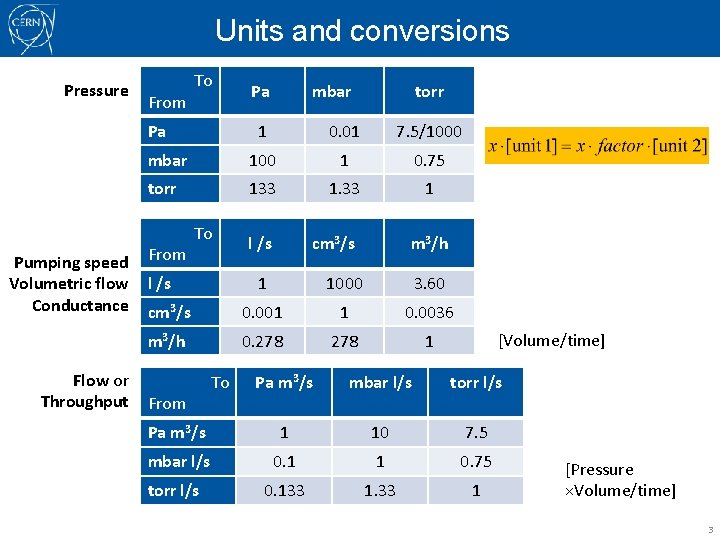
Units and conversions Pressure From To Pa Pa mbar torr 1 0. 01 7. 5/1000 mbar 100 1 0. 75 torr 133 1 l /s cm 3/s Pumping speed From Volumetric flow l /s Conductance cm 3/s To m 3/h Flow or Throughput From 1 1000 3. 60 0. 001 1 0. 0036 0. 278 1 [Volume/time] Pa m 3/s mbar l/s torr l/s Pa m 3/s 1 10 7. 5 mbar l/s 0. 1 1 0. 75 0. 133 1 torr l/s To m 3/h [Pressure ×Volume/time] 3

The physics of Gases The ideal gas law An ideal gas is composed of randomly-moving, non-interacting point particles. 1 dozen = pressure V = volume nm = amount of gas (number of moles) T = temperature R = general gas constant [8, 314 J/(mol K)] 1 mole = 12 units 6. 022 x 1023 units n = amount of gas (number of atoms or molecules) k. B = Boltzmann constant = R/6. 022 x 1023 4

The physics of Gases Useful forms of the ideal gas law In a closed volume, increasing temperature from T 1 to T 2 , pressure increases proportionally from p 1 to p 2 At constant temperature, the same number of molecules distribute in 2 volumes V 1 and V 2 at pressures p 1 and p 2 such that: V 1 V 2 5

Gas Mixtures and Partial Pressures n 1 n 3 DEFINITION Partial pressure is the pressure which a gas would exert if it occupied the volume of the mixture on its own n 2 Dalton law The total pressure exerted by a mixture of (non-reactive) gases is equal to the sum of the partial pressures of individual gases 6
Flow regimes 7
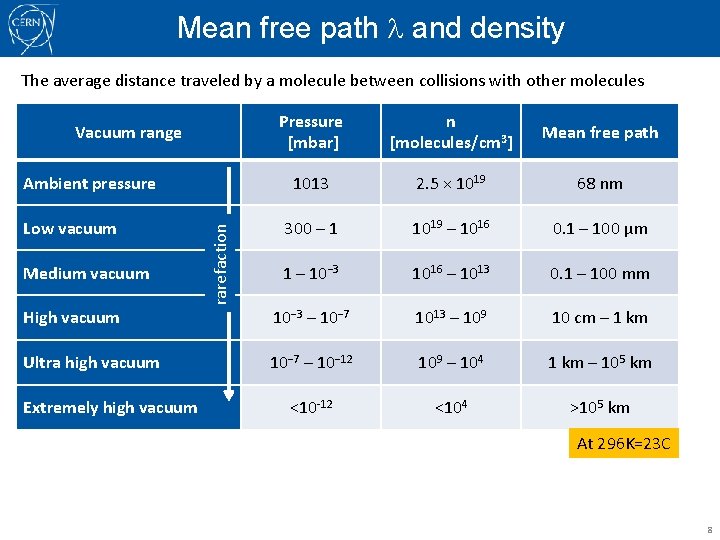
Mean free path and density The average distance traveled by a molecule between collisions with other molecules Vacuum range Low vacuum Medium vacuum rarefaction Ambient pressure Pressure [mbar] n [molecules/cm 3] Mean free path 1013 2. 5 × 10¹⁹ 68 nm 300 – 1 1019 – 1016 0. 1 – 100 μm 1 – 10− 3 1016 – 1013 0. 1 – 100 mm molecular chaos trajectory of a molecule High vacuum 10− 3 – 10− 7 1013 – 109 10 cm – 1 km Ultra high vacuum 10− 7 – 10− 12 109 – 104 1 km – 105 km <10 -12 <104 >105 km Extremely high vacuum At 296 K=23 C 8
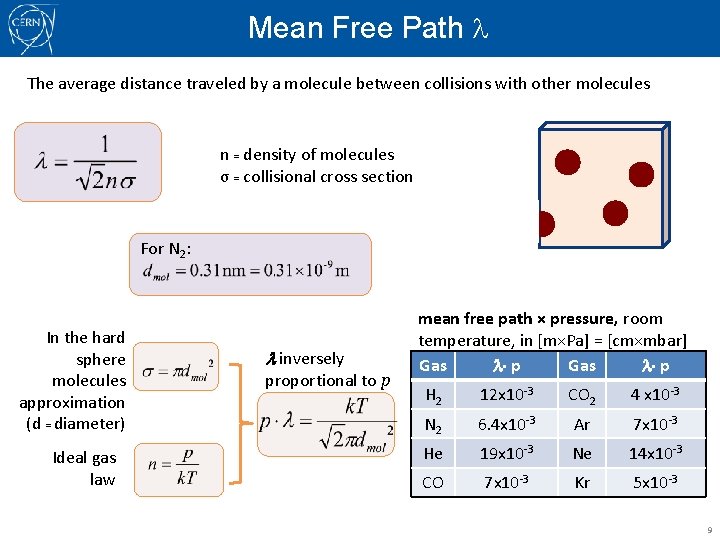
Mean Free Path The average distance traveled by a molecule between collisions with other molecules n = density of molecules σ = collisional cross section For N 2: In the hard sphere molecules approximation (d = diameter) Ideal gas law l inversely proportional to p mean free path × pressure, room temperature, in [m×Pa] = [cm×mbar] Gas p H 2 12 x 10 -3 CO 2 4 x 10 -3 N 2 6. 4 x 10 -3 Ar 7 x 10 -3 He 19 x 10 -3 Ne 14 x 10 -3 CO 7 x 10 -3 Kr 5 x 10 -3 9

Mean free path and flow regime The flow dynamics is characterized by the comparison of the mean free path to the dimension D of the vacuum vessel. Collisions with wall (much) more frequent than with molecules Knudsen number Kn >1 Free Molecular Flow >D Transitional (or intermediate) flow D/100< < D 0. 01< Kn< 1 Viscous (continuum) flow < D/100 Kn< 0. 01 Collisions with molecules dominate Applying the previous slide, we have a useful relation between pressure and dimension of the vessel to distinguish flow regimes: Molecular flow: Viscous flow: p D<0. 064 p D>6. 4 [mbar. mm] Room temperature, for N 2 molecular chaos trajectory of a molecule trajectory in a rarefied gas, >D 10

Definitions Throughput Pumping speed 11
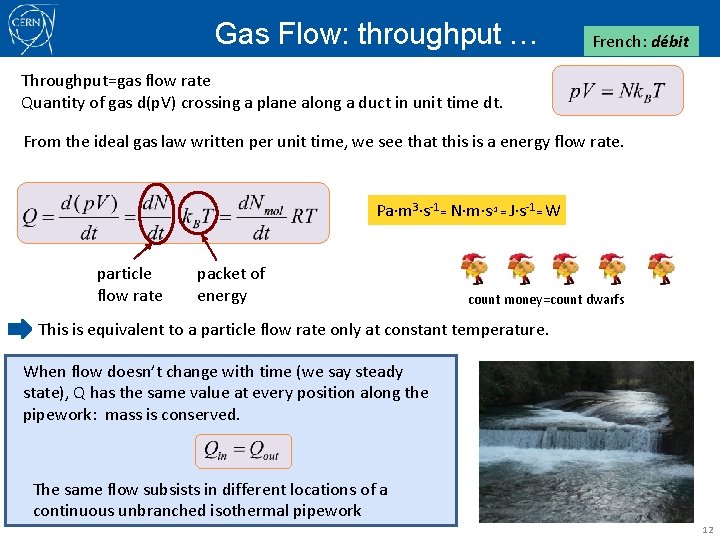
Gas Flow: throughput … French: débit Throughput=gas flow rate Quantity of gas d(p. V) crossing a plane along a duct in unit time dt. From the ideal gas law written per unit time, we see that this is a energy flow rate. Pa m 3 s-1= N m s-1 = J s-1= W particle flow rate packet of energy count money=count dwarfs This is equivalent to a particle flow rate only at constant temperature. When flow doesn’t change with time (we say steady state), Q has the same value at every position along the pipework: mass is conserved. The same flow subsists in different locations of a continuous unbranched isothermal pipework 12
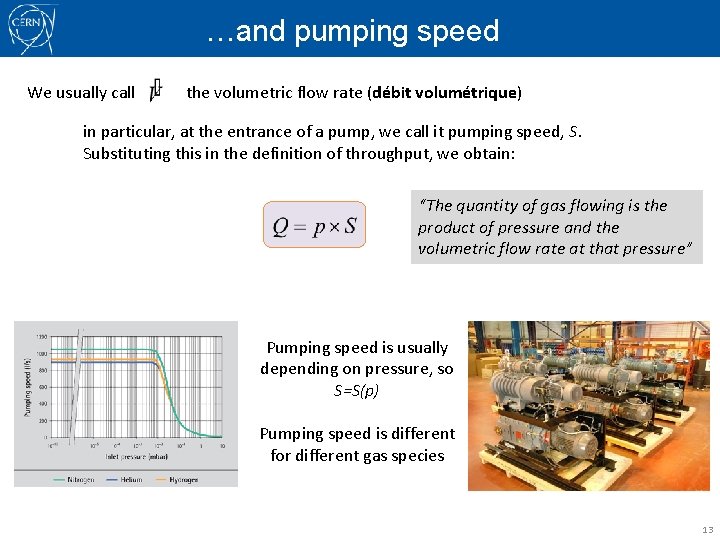
…and pumping speed We usually call the volumetric flow rate (débit volumétrique) in particular, at the entrance of a pump, we call it pumping speed, S. Substituting this in the definition of throughput, we obtain: “The quantity of gas flowing is the product of pressure and the volumetric flow rate at that pressure” Pumping speed is usually depending on pressure, so S=S(p) Pumping speed is different for different gas species 13
The pumpdown process 14
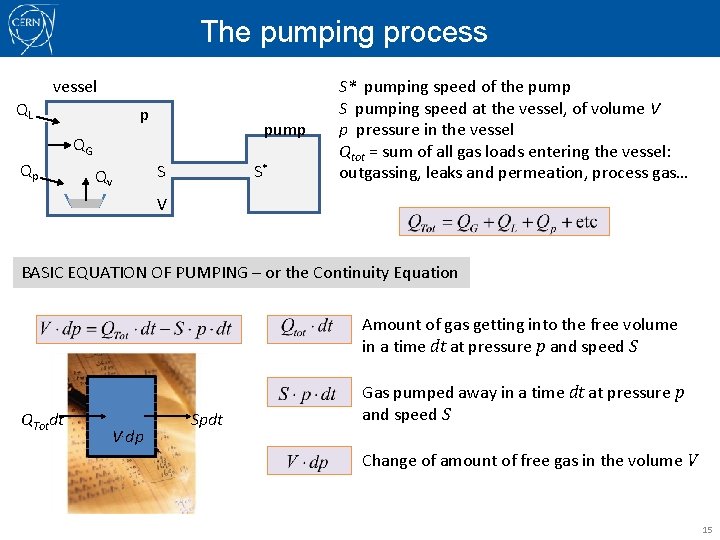
The pumping process vessel QL p pump QG Qp Qv S S* S* pumping speed of the pump S pumping speed at the vessel, of volume V p pressure in the vessel Qtot = sum of all gas loads entering the vessel: outgassing, leaks and permeation, process gas… V BASIC EQUATION OF PUMPING – or the Continuity Equation Amount of gas getting into the free volume in a time dt at pressure p and speed S QTotdt V. dp Spdt Gas pumped away in a time dt at pressure p and speed S Change of amount of free gas in the volume V 15
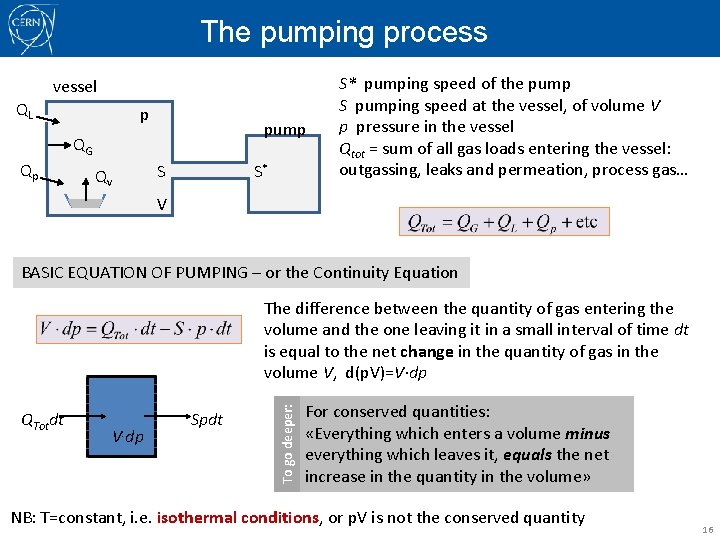
The pumping process vessel QL p pump QG Qp Qv S S* S* pumping speed of the pump S pumping speed at the vessel, of volume V p pressure in the vessel Qtot = sum of all gas loads entering the vessel: outgassing, leaks and permeation, process gas… V BASIC EQUATION OF PUMPING – or the Continuity Equation QTotdt V. dp Spdt To go deeper: The difference between the quantity of gas entering the volume and the one leaving it in a small interval of time dt is equal to the net change in the quantity of gas in the volume V, d(p. V)=V·dp For conserved quantities: «Everything which enters a volume minus everything which leaves it, equals the net increase in the quantity in the volume» NB: T=constant, i. e. isothermal conditions, or p. V is not the conserved quantity 16
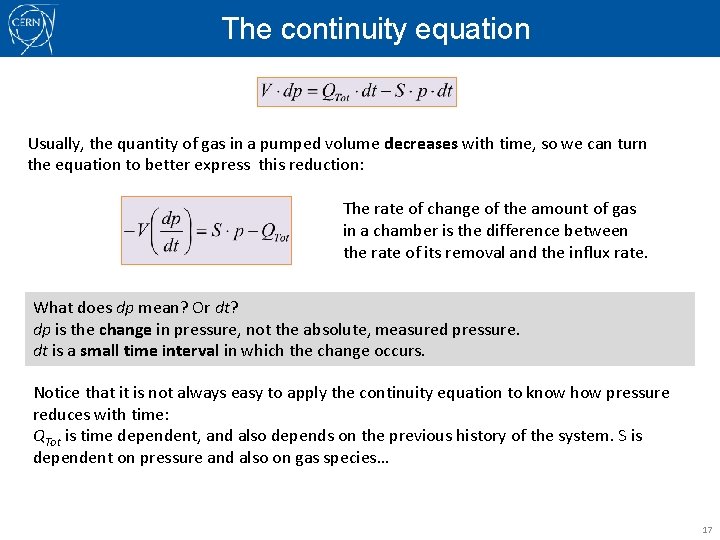
The continuity equation Usually, the quantity of gas in a pumped volume decreases with time, so we can turn the equation to better express this reduction: The rate of change of the amount of gas in a chamber is the difference between the rate of its removal and the influx rate. What does dp mean? Or dt? dp is the change in pressure, not the absolute, measured pressure. dt is a small time interval in which the change occurs. Notice that it is not always easy to apply the continuity equation to know how pressure reduces with time: QTot is time dependent, and also depends on the previous history of the system. S is dependent on pressure and also on gas species… 17

Example: continuity equation After 3 h pumping, pressure is presently 5. 10 -7 mbar. The pumping speed of the turbomolecular pump, including reduction by the conductance connecting it to the vessel, is 10 ls-1. The vessel is a tube, 1 m long and 400 mm in diameter. Chronometer in the hand, you notice that 40 s later pressure has decreased to 4. 10 -7 mbar. What is the rate of change of pressure in this moment? In absence of leaks, can you evaluate the total outgassing rate of the vacuum chamber in this moment? p=5· 10 -7 mbar dt =40 s, dp =1· 10 -7 mbar dp/dt=2. 5· 10 -9 mbar/s Seff =10 l/s d =400 mm, L=1000 mm Qoutg=(5· 10 -6 +3· 10 -7 ) mbar ·l·s-1 = 5. 3 · 10 -7 mbar ·l·s-1 18

Pumpdown: initial phase Qpumped Initially, the pumpdown process is dominated by evacuation of the free gas in the volume. Let’s write Qtot=0 and let’s call pinitial(t) the pressure decrease curve in the initial phase of pumpdown. Gas quantity present in the volume (p� V) decreases while gas is evacuated by the pump. Volume depletion Pressure po 103 102 101 1 2 3 4 time Characteristic time or time constant 5 6 7 ln p versus t Remember maths! A function which changes with a rate proportional to the function itself is an exponential… 19

Initial pumpdown time To make time appear alone, let’s rearrange by taking the natural logarithm on both sides: We obtain the time to lower the pressure from the initial value p 0 to some value p Example: A 50 l volume is pumped down with S=1 l. s-1, starting from 1000 mbar to 1 mbar. What is the value of the time constant t? How much time does it take per decade pressure lost? How much time in total? p 1000 What happens here? 100 t=V/S=50 s Time per decade=t. ln(10)=115 s Total time=3. 115 s=345 s 10 1 0. 01 2. 3 t t 20

Pumpdown: effect of outgassing on p(t) Below 1 Pa=10 -2 mbar, (~roughing), the curve p(t) starts to deviate from the “free volume” straight line. We cannot neglect outgassing Qout anymore. Pressure 10 -2 Volume depletion 10 -3 10 -4 1 2 3 4 time 5 6 7 ln p versus t with 0. 5� n� 1. 2 n ~1 for metallic unbaked surfaces ~0. 5 for elastomers, (for baked metallic surfaces) 21
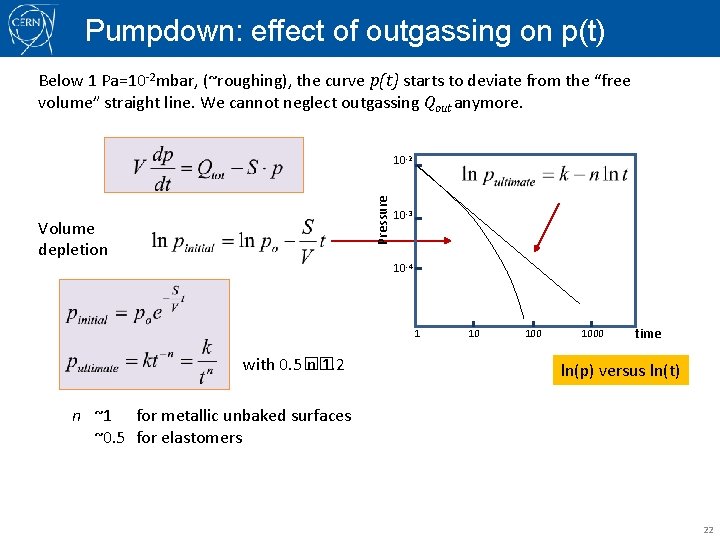
Pumpdown: effect of outgassing on p(t) Below 1 Pa=10 -2 mbar, (~roughing), the curve p(t) starts to deviate from the “free volume” straight line. We cannot neglect outgassing Qout anymore. Pressure 10 -2 Volume depletion 10 -3 10 -4 1 with 0. 5� n� 1. 2 10 1000 time ln(p) versus ln(t) n ~1 for metallic unbaked surfaces ~0. 5 for elastomers 22
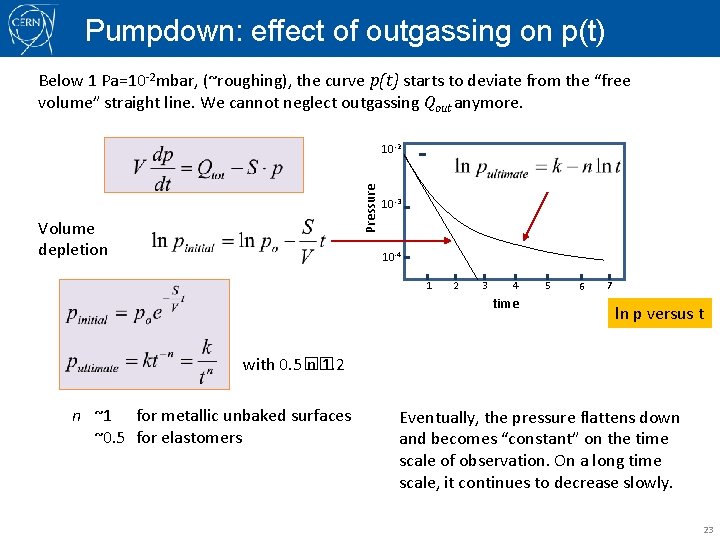
Pumpdown: effect of outgassing on p(t) Below 1 Pa=10 -2 mbar, (~roughing), the curve p(t) starts to deviate from the “free volume” straight line. We cannot neglect outgassing Qout anymore. Pressure 10 -2 Volume depletion 10 -3 10 -4 1 2 3 4 time 5 6 7 ln p versus t with 0. 5� n� 1. 2 n ~1 for metallic unbaked surfaces ~0. 5 for elastomers Eventually, the pressure flattens down and becomes “constant” on the time scale of observation. On a long time scale, it continues to decrease slowly. 23
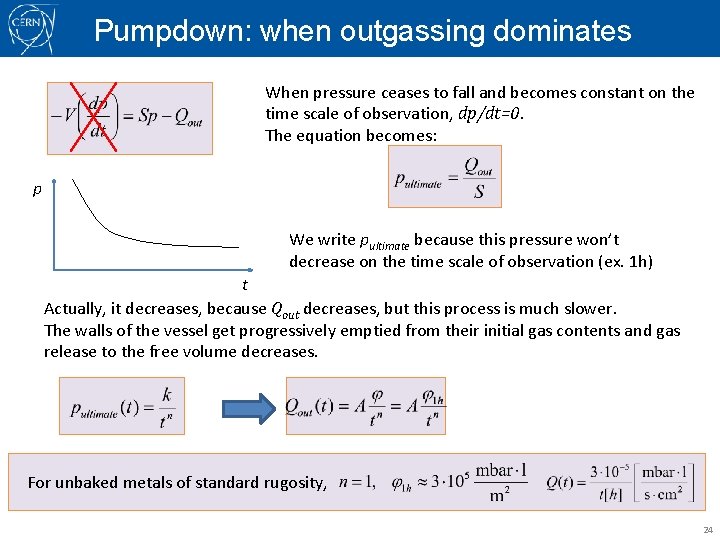
Pumpdown: when outgassing dominates When pressure ceases to fall and becomes constant on the time scale of observation, dp/dt=0. The equation becomes: p We write pultimate because this pressure won’t decrease on the time scale of observation (ex. 1 h) t Actually, it decreases, because Qout decreases, but this process is much slower. The walls of the vessel get progressively emptied from their initial gas contents and gas release to the free volume decreases. For unbaked metals of standard rugosity, 24
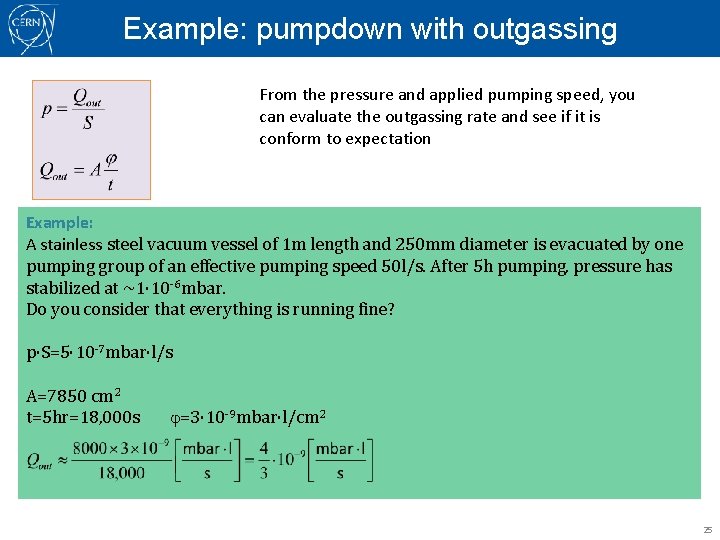
Example: pumpdown with outgassing From the pressure and applied pumping speed, you can evaluate the outgassing rate and see if it is conform to expectation Example: A stainless steel vacuum vessel of 1 m length and 250 mm diameter is evacuated by one pumping group of an effective pumping speed 50 l/s. After 5 h pumping, pressure has stabilized at ~1· 10 -6 mbar. Do you consider that everything is running fine? p·S=5· 10 -7 mbar·l/s A=7850 cm 2 t=5 hr=18, 000 s j=3· 10 -9 mbar·l/cm 2 25

Conductance 26

Conductance Q p. U C p. D The quantity of gas which is flowing across a given pressure difference depends on the ease of flow , described by CONDUCTANCE. Its reciprocal 1/C is a resistance to flow; i. e. , the opposition the system exerts to gas flow. This equation relates throughput (fr. débit) to the difference between upstream and downstream pressure. It is the DEFINITION of conductance. Useful (but approximate) analogy to electrical circuit Driving force: voltage drop or pressure difference Flowing quantity: electrical charge or molecules Flow: electrical current or throughput 27
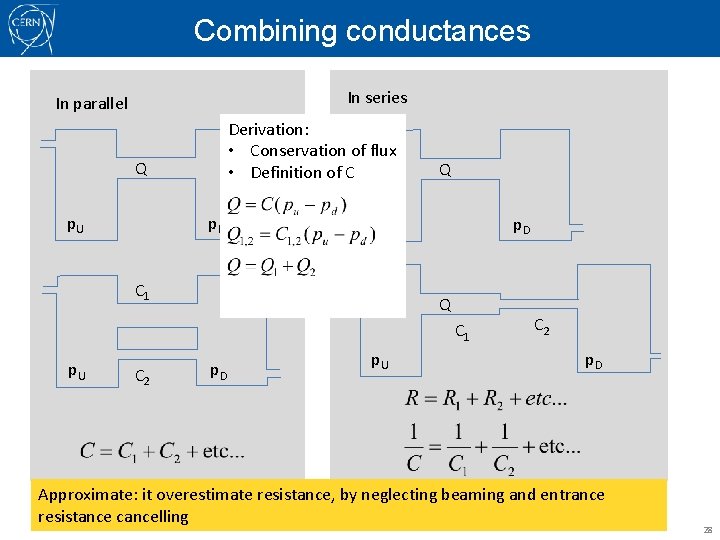
Combining conductances In series In parallel Derivation: • Conservation of flux • Definition of C Q p. U p. D Q p. U C 1 p. D Q C 1 p. U C 2 p. D Approximate: it overestimate resistance, by neglecting beaming and entrance resistance cancelling 28
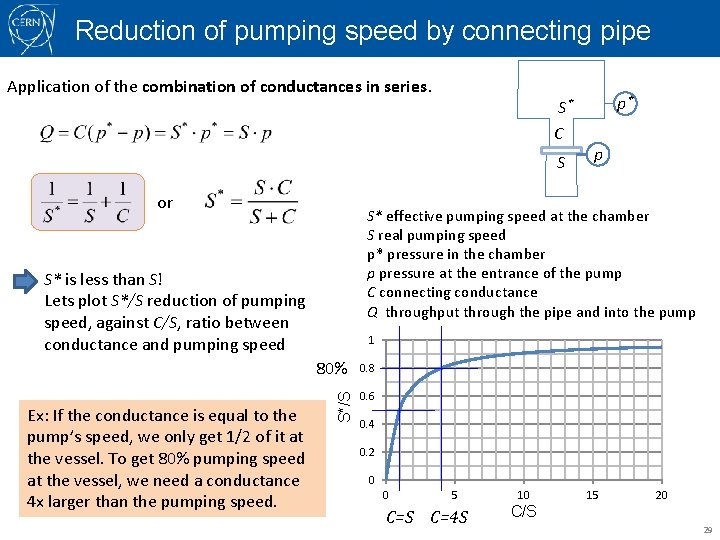
Reduction of pumping speed by connecting pipe Application of the combination of conductances in series. S* C S or p S* effective pumping speed at the chamber S real pumping speed p* pressure in the chamber p pressure at the entrance of the pump C connecting conductance Q throughput through the pipe and into the pump S* is less than S! Lets plot S*/S reduction of pumping speed, against C/S, ratio between conductance and pumping speed 1 S*/S 80% Ex: If the conductance is equal to the pump’s speed, we only get 1/2 of it at the vessel. To get 80% pumping speed at the vessel, we need a conductance 4 x larger than the pumping speed. p* 0. 8 0. 6 0. 4 0. 2 0 0 5 C=S C=4 S 10 15 20 C/S 29
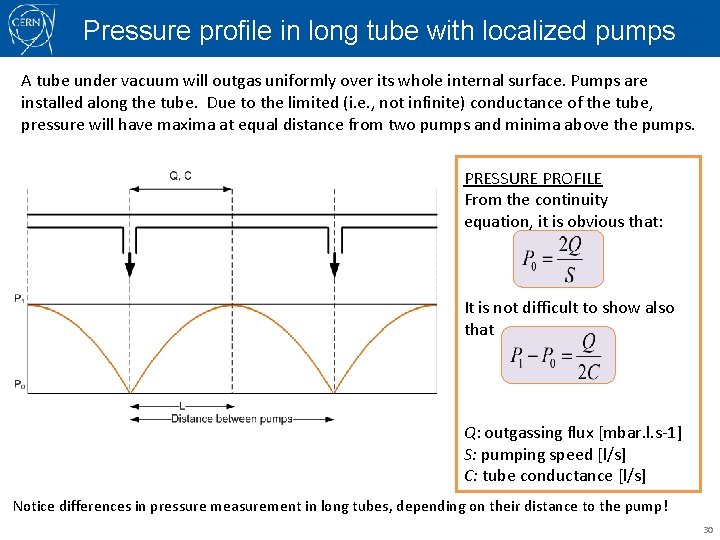
Pressure profile in long tube with localized pumps A tube under vacuum will outgas uniformly over its whole internal surface. Pumps are installed along the tube. Due to the limited (i. e. , not infinite) conductance of the tube, pressure will have maxima at equal distance from two pumps and minima above the pumps. PRESSURE PROFILE From the continuity equation, it is obvious that: It is not difficult to show also that Q: outgassing flux [mbar. l. s-1] S: pumping speed [l/s] C: tube conductance [l/s] Notice differences in pressure measurement in long tubes, depending on their distance to the pump! 30
Conductance calculation Conductance in viscous flow Conductance in molecular flow 31
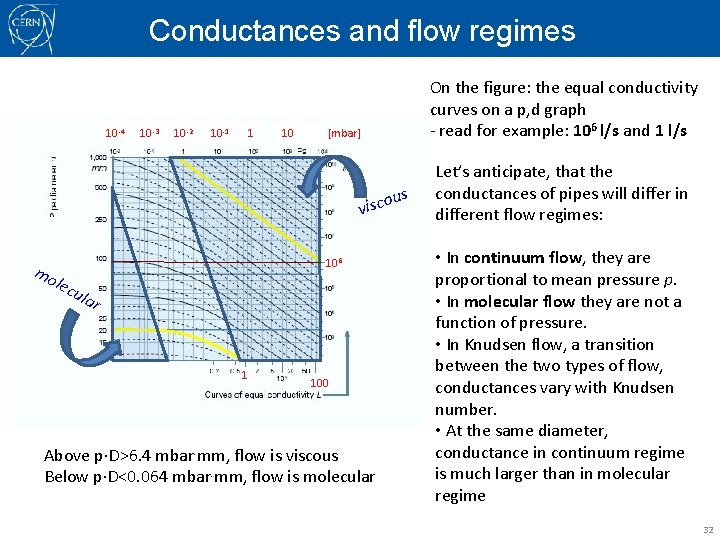
Conductances and flow regimes 10 -4 10 -3 10 -2 10 -1 1 10 [mbar] visco 106 mo lec ula r 1 On the figure: the equal conductivity curves on a p, d graph - read for example: 106 l/s and 1 l/s 100 Above p D>6. 4 mbar. mm, flow is viscous Below p D<0. 064 mbar. mm, flow is molecular us Let’s anticipate, that the conductances of pipes will differ in different flow regimes: • In continuum flow, they are proportional to mean pressure p. • In molecular flow they are not a function of pressure. • In Knudsen flow, a transition between the two types of flow, conductances vary with Knudsen number. • At the same diameter, conductance in continuum regime is much larger than in molecular regime 32
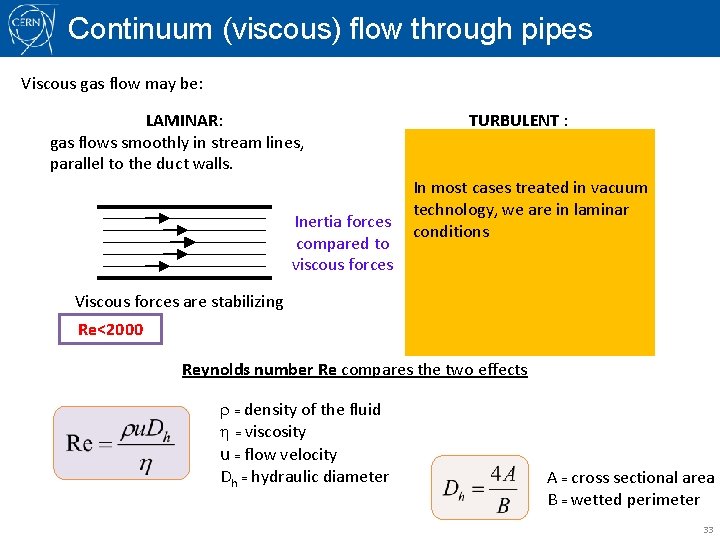
Continuum (viscous) flow through pipes Viscous gas flow may be: LAMINAR: gas flows smoothly in stream lines, parallel to the duct walls. TURBULENT : gas flows chaotically and irregularly brakes up into vortexes. In most cases treated in vacuum technology, we are in laminar Inertia forces conditions compared to viscous forces Viscous forces are stabilizing Re<2000 Inertial forces are destabilizing Re>2000 Reynolds number Re compares the two effects = density of the fluid = viscosity u = flow velocity Dh = hydraulic diameter A = cross sectional area B = wetted perimeter 33
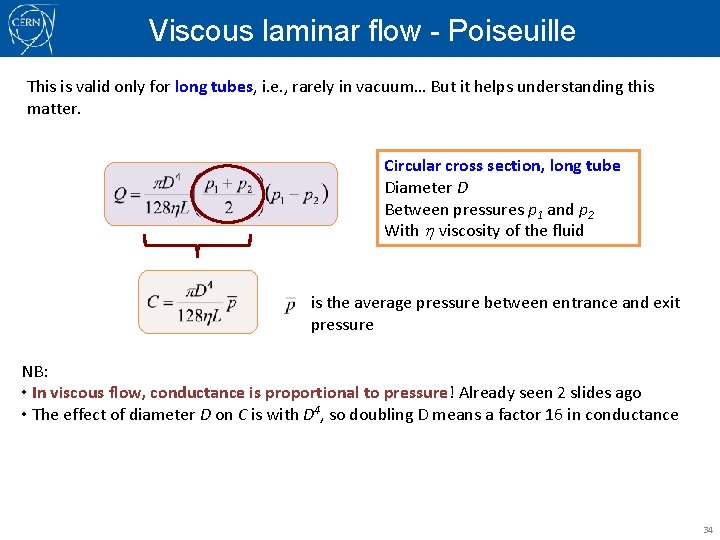
Viscous laminar flow - Poiseuille This is valid only for long tubes, i. e. , rarely in vacuum… But it helps understanding this matter. Circular cross section, long tube Diameter D Between pressures p 1 and p 2 With h viscosity of the fluid is the average pressure between entrance and exit pressure NB: • In viscous flow, conductance is proportional to pressure! Already seen 2 slides ago • The effect of diameter D on C is with D 4, so doubling D means a factor 16 in conductance 34
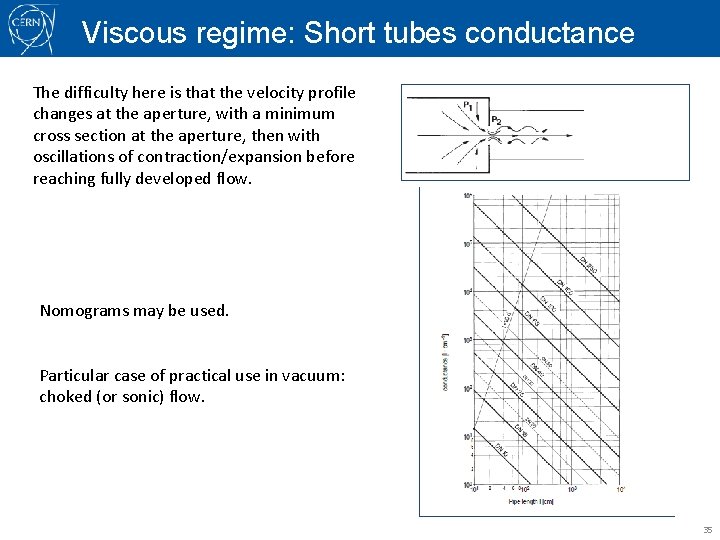
Viscous regime: Short tubes conductance The difficulty here is that the velocity profile changes at the aperture, with a minimum cross section at the aperture, then with oscillations of contraction/expansion before reaching fully developed flow. Nomograms may be used. Particular case of practical use in vacuum: choked (or sonic) flow. 35
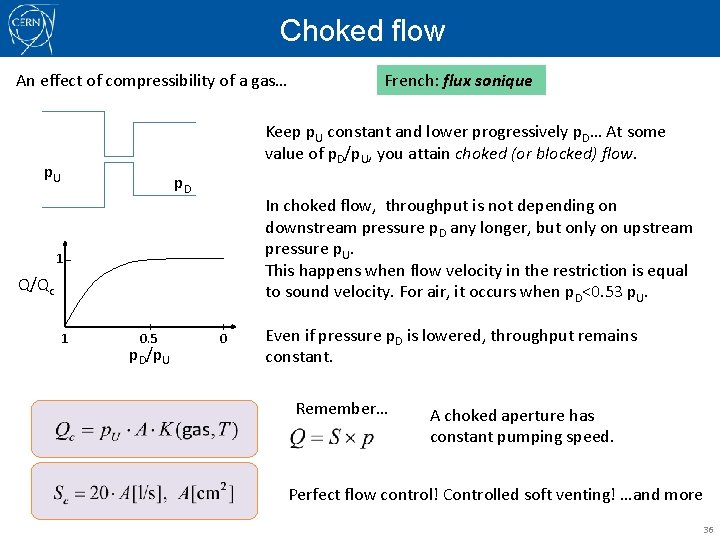
Choked flow An effect of compressibility of a gas… Keep p. U constant and lower progressively p. D… At some value of p. D/p. U, you attain choked (or blocked) flow. p. U p. D In choked flow, throughput is not depending on downstream pressure p. D any longer, but only on upstream pressure p. U. This happens when flow velocity in the restriction is equal to sound velocity. For air, it occurs when p. D<0. 53 p. U. 1 Q/Qc 1 French: flux sonique 0. 5 p. D/p. U 0 Even if pressure p. D is lowered, throughput remains constant. Remember… A choked aperture has constant pumping speed. Perfect flow control! Controlled soft venting! …and more 36
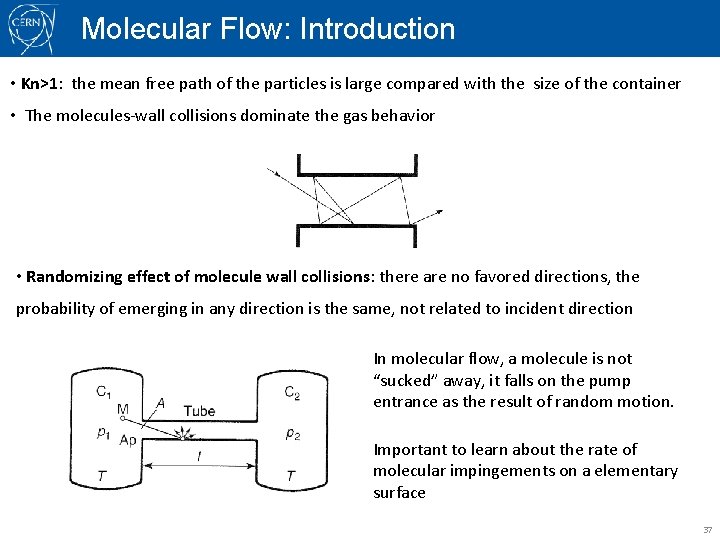
Molecular Flow: Introduction • Kn>1: the mean free path of the particles is large compared with the size of the container • The molecules-wall collisions dominate the gas behavior • Randomizing effect of molecule wall collisions: there are no favored directions, the probability of emerging in any direction is the same, not related to incident direction In molecular flow, a molecule is not “sucked” away, it falls on the pump entrance as the result of random motion. Important to learn about the rate of molecular impingements on a elementary surface 37
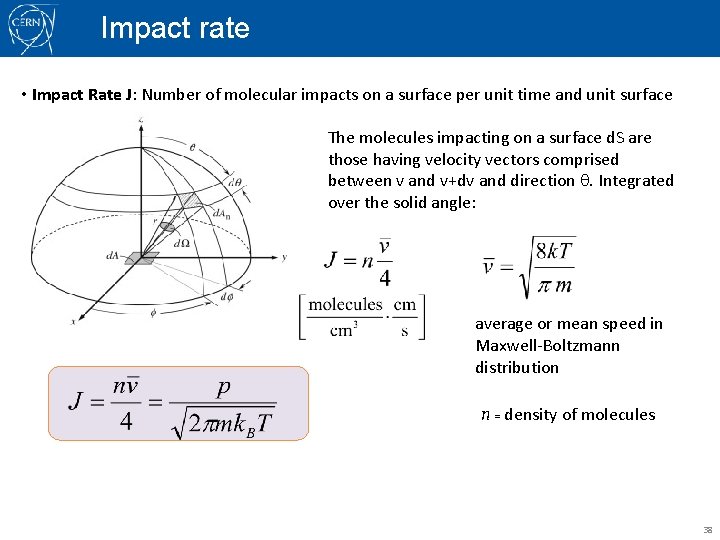
Impact rate • Impact Rate J: Number of molecular impacts on a surface per unit time and unit surface The molecules impacting on a surface d. S are those having velocity vectors comprised between v and v+dv and direction q. Integrated over the solid angle: average or mean speed in Maxwell-Boltzmann distribution n = density of molecules 38
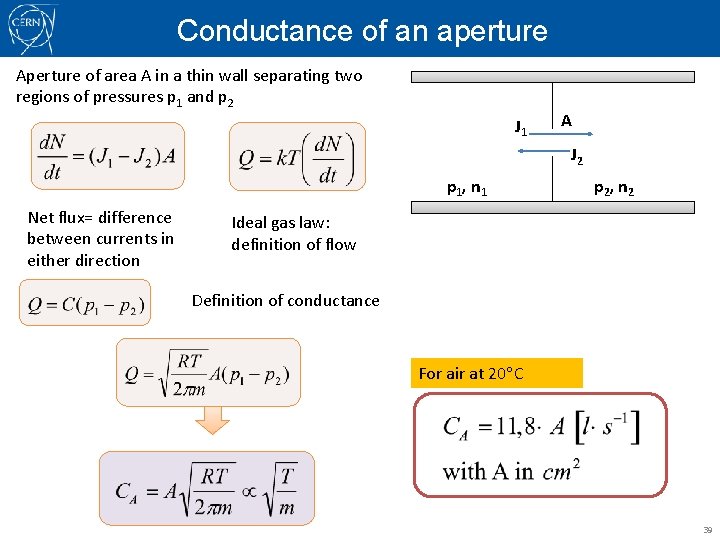
Conductance of an aperture Aperture of area A in a thin wall separating two regions of pressures p 1 and p 2 J 1 A J 2 p 1, n 1 Net flux= difference between currents in either direction p 2, n 2 Ideal gas law: definition of flow Definition of conductance For air at 20 C 39
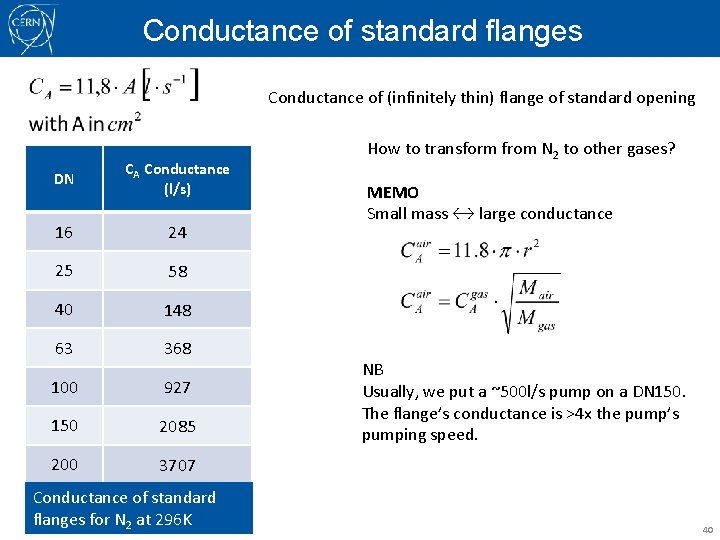
Conductance of standard flanges Conductance of (infinitely thin) flange of standard opening DN CA Conductance (l/s) 16 24 25 58 40 148 63 368 100 927 150 2085 200 3707 Conductance of standard flanges for N 2 at 296 K How to transform from N 2 to other gases? MEMO Small mass ↔ large conductance NB Usually, we put a ~500 l/s pump on a DN 150. The flange’s conductance is >4 x the pump’s pumping speed. 40
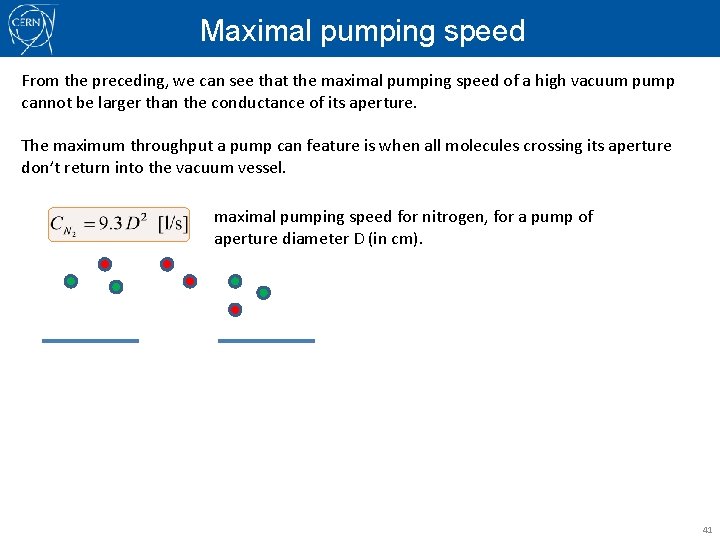
Maximal pumping speed From the preceding, we can see that the maximal pumping speed of a high vacuum pump cannot be larger than the conductance of its aperture. The maximum throughput a pump can feature is when all molecules crossing its aperture don’t return into the vacuum vessel. maximal pumping speed for nitrogen, for a pump of aperture diameter D (in cm). 41
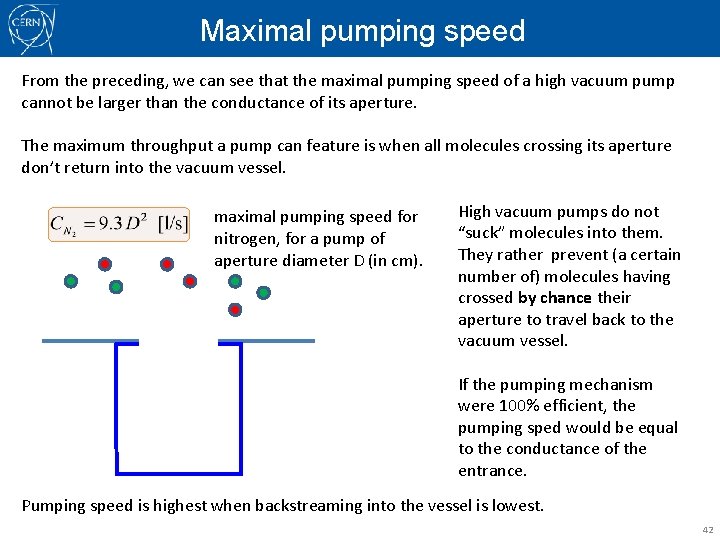
Maximal pumping speed From the preceding, we can see that the maximal pumping speed of a high vacuum pump cannot be larger than the conductance of its aperture. The maximum throughput a pump can feature is when all molecules crossing its aperture don’t return into the vacuum vessel. maximal pumping speed for nitrogen, for a pump of aperture diameter D (in cm). High vacuum pumps do not “suck” molecules into them. They rather prevent (a certain number of) molecules having crossed by chance their aperture to travel back to the vacuum vessel. If the pumping mechanism were 100% efficient, the pumping sped would be equal to the conductance of the entrance. Pumping speed is highest when backstreaming into the vessel is lowest. 42
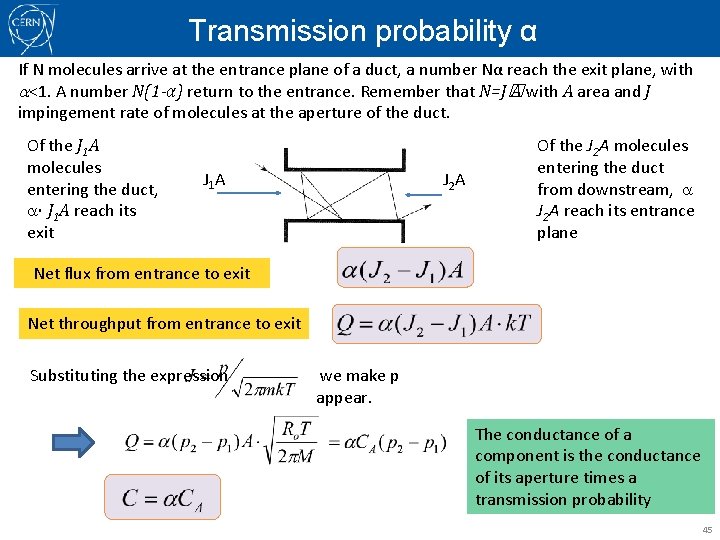
Transmission probability α If N molecules arrive at the entrance plane of a duct, a number Nα reach the exit plane, with a<1. A number N(1 -α) return to the entrance. Remember that N=J� A with A area and J impingement rate of molecules at the aperture of the duct. Of the J 1 A molecules entering the duct, a· J 1 A reach its exit J 1 A J 2 A Of the J 2 A molecules entering the duct from downstream, a J 2 A reach its entrance plane Net flux from entrance to exit Net throughput from entrance to exit Substituting the expression we make p appear. The conductance of a component is the conductance of its aperture times a transmission probability 45

Transmission probability calculations The concept of transmission probability was introduced by Clausing (1932). The values he has calculated by integrals (sometimes called Clausing factor) are still widely used for circular tubes and are accurate to ~ percent. Nomograms often use his values. Cole (1976) refined the same methods, his values are very accurate. Dushman (1992) has proposed an analytical formula (next slide) easy to apply, but not completely accurate. We use it for quick estimations. Livesey (1998 -2004) collected all transmission probability data, analyzed them and obtained analytical formulas (2004), very useful for computer calculation. For exotic forms, we have proposed his values, which are fairly simple and accurate to <1% over a wide L/D range. One of the best ways to calculate transmission probabilities is the statistical Monte. Carlo method, which can be applied with success to complicated shapes which escape from a simple geometrical treatment. 46
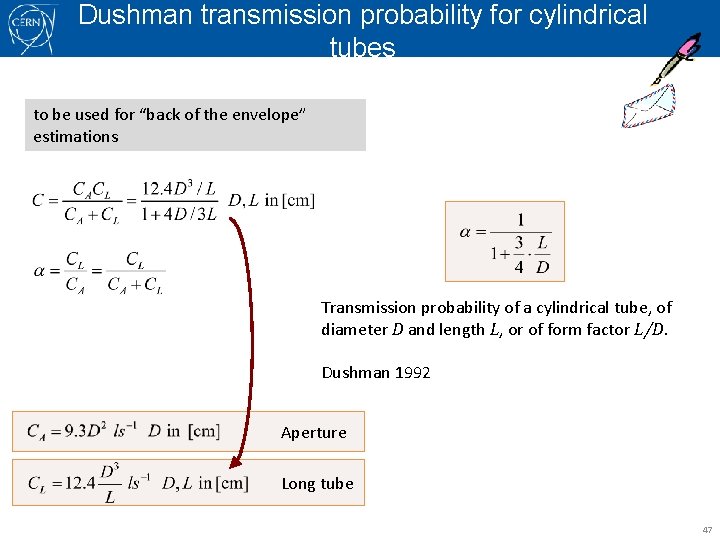
Dushman transmission probability for cylindrical tubes to be used for “back of the envelope” estimations Transmission probability of a cylindrical tube, of diameter D and length L, or of form factor L/D. Dushman 1992 Aperture Long tube 47
![Cylindrical ducts 0 2 4 6 8 10 30 40 50 a a [Cole]](http://slidetodoc.com/presentation_image_h/e99bee8e73c3b8878a1edbdbe4b67159/image-46.jpg "Cylindrical ducts 0 2 4 6 8 10 30 40 50 a a [Cole]")
Cylindrical ducts 0 2 4 6 8 10 30 40 50 a a [Cole] 0. 952399 0. 869928 0. 801271 0. 74341 0. 694044 0. 671984 0. 632228 0. 597364 0. 566507 0. 538975 0. 514231 0. 420055 0. 356572 0. 310525 0. 275438 0. 247735 0. 225263 0. 206641 0. 190941 0. 109304 0. 076912 0. 059422 0. 048448 0. 040913 0. 035415 0. 031225 0. 027925 0. 025258 0. 002646 l 0. 1 l/d 0 10 20 D a l/D 0. 05 0. 15 0. 25 0. 35 0. 45 0. 6 0. 7 0. 8 0. 9 1 1. 5 2 2. 5 3 3. 5 4 4. 5 5 10 15 20 25 30 35 40 45 50 500 0. 1 0. 01 l/d 48
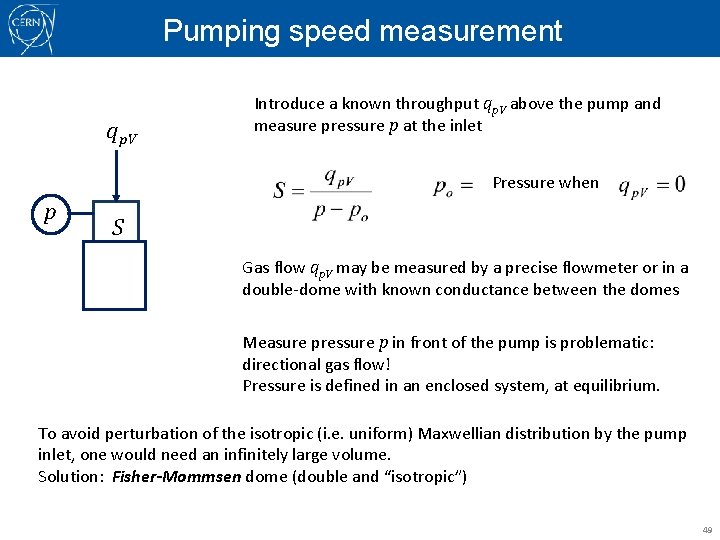
Pumping speed measurement qp. V Introduce a known throughput qp. V above the pump and measure pressure p at the inlet Pressure when p S Gas flow qp. V may be measured by a precise flowmeter or in a double-dome with known conductance between the domes Measure pressure p in front of the pump is problematic: directional gas flow! Pressure is defined in an enclosed system, at equilibrium. To avoid perturbation of the isotropic (i. e. uniform) Maxwellian distribution by the pump inlet, one would need an infinitely large volume. Solution: Fisher-Mommsen dome (double and “isotropic”) 49
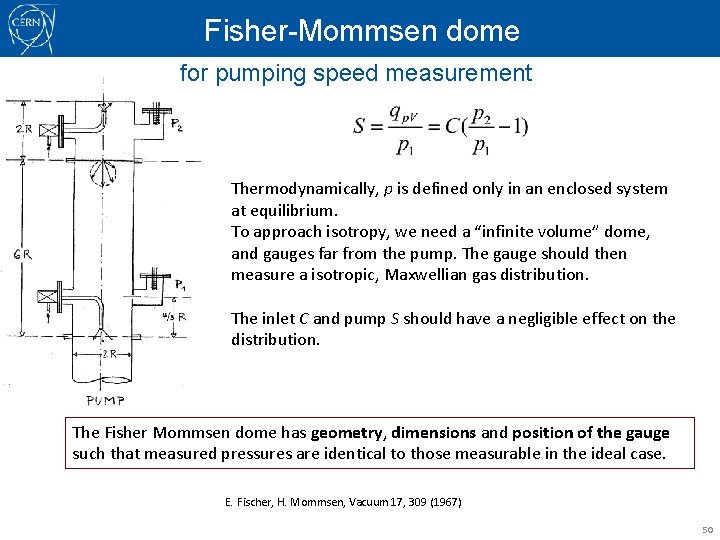
Fisher-Mommsen dome for pumping speed measurement Thermodynamically, p is defined only in an enclosed system at equilibrium. To approach isotropy, we need a “infinite volume” dome, and gauges far from the pump. The gauge should then measure a isotropic, Maxwellian gas distribution. The inlet C and pump S should have a negligible effect on the distribution. The Fisher Mommsen dome has geometry, dimensions and position of the gauge such that measured pressures are identical to those measurable in the ideal case. E. Fischer, H. Mommsen, Vacuum 17, 309 (1967) 50
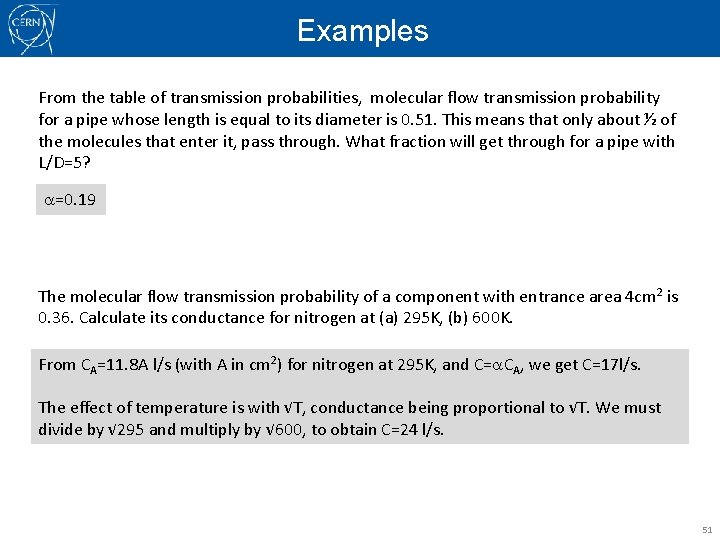
Examples From the table of transmission probabilities, molecular flow transmission probability for a pipe whose length is equal to its diameter is 0. 51. This means that only about ½ of the molecules that enter it, pass through. What fraction will get through for a pipe with L/D=5? a=0. 19 The molecular flow transmission probability of a component with entrance area 4 cm 2 is 0. 36. Calculate its conductance for nitrogen at (a) 295 K, (b) 600 K. From CA=11. 8 A l/s (with A in cm 2) for nitrogen at 295 K, and C=a. CA, we get C=17 l/s. The effect of temperature is with √T, conductance being proportional to √T. We must divide by √ 295 and multiply by √ 600, to obtain C=24 l/s. 51
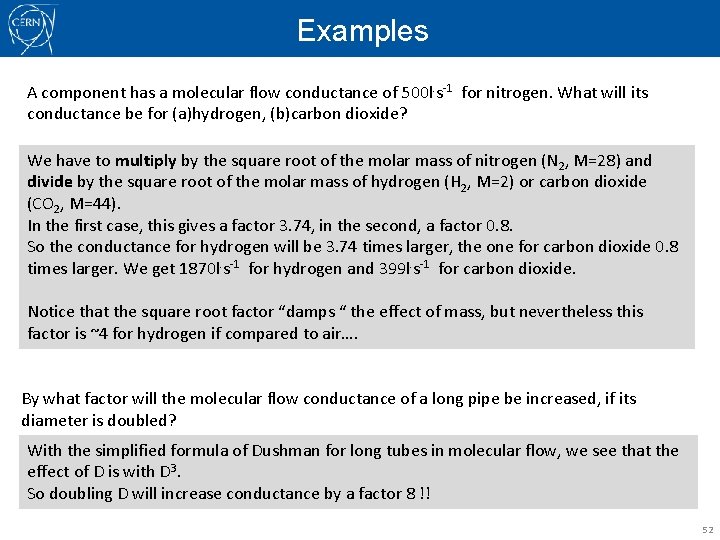
Examples A component has a molecular flow conductance of 500 l. s-1 for nitrogen. What will its conductance be for (a)hydrogen, (b)carbon dioxide? We have to multiply by the square root of the molar mass of nitrogen (N 2, M=28) and divide by the square root of the molar mass of hydrogen (H 2, M=2) or carbon dioxide (CO 2, M=44). In the first case, this gives a factor 3. 74, in the second, a factor 0. 8. So the conductance for hydrogen will be 3. 74 times larger, the one for carbon dioxide 0. 8 times larger. We get 1870 l. s-1 for hydrogen and 399 l. s-1 for carbon dioxide. Notice that the square root factor “damps “ the effect of mass, but nevertheless this factor is ~4 for hydrogen if compared to air…. By what factor will the molecular flow conductance of a long pipe be increased, if its diameter is doubled? With the simplified formula of Dushman for long tubes in molecular flow, we see that the effect of D is with D 3. So doubling D will increase conductance by a factor 8 !! 52
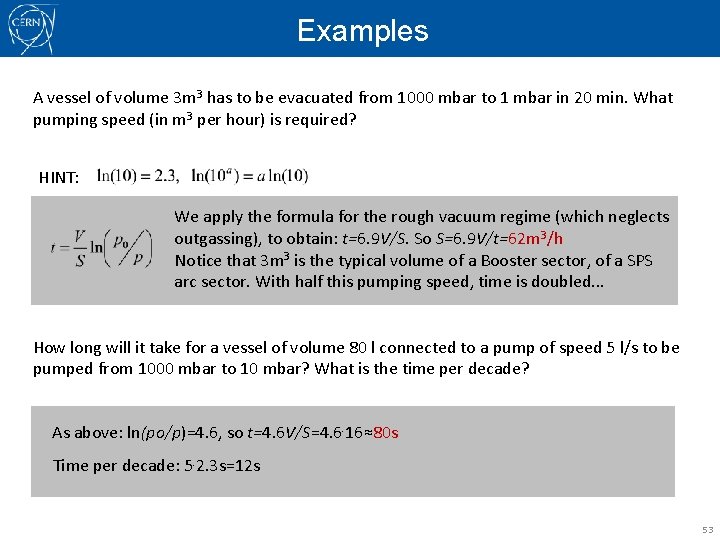
Examples A vessel of volume 3 m 3 has to be evacuated from 1000 mbar to 1 mbar in 20 min. What pumping speed (in m 3 per hour) is required? HINT: We apply the formula for the rough vacuum regime (which neglects outgassing), to obtain: t=6. 9 V/S. So S=6. 9 V/t=62 m 3/h Notice that 3 m 3 is the typical volume of a Booster sector, of a SPS arc sector. With half this pumping speed, time is doubled. . . How long will it take for a vessel of volume 80 l connected to a pump of speed 5 l/s to be pumped from 1000 mbar to 10 mbar? What is the time per decade? As above: ln(po/p)=4. 6, so t=4. 6 V/S=4. 6. 16≈80 s Time per decade: 5. 2. 3 s=12 s 53
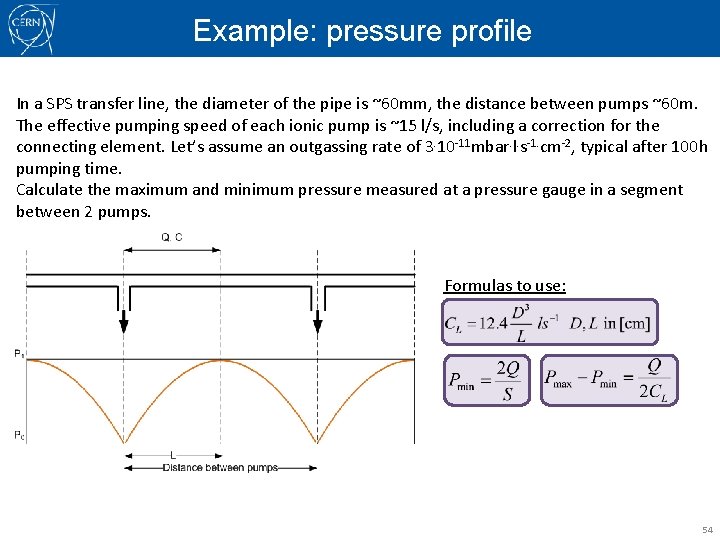
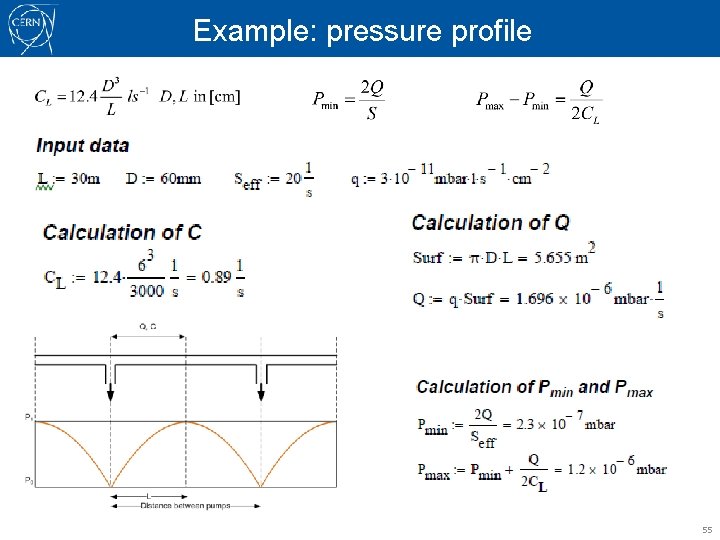
Example: pressure profile In a SPS transfer line, the diameter of the pipe is ~60 mm, the distance between pumps ~60 m. The effective pumping speed of each ionic pump is ~15 l/s, including a correction for the connecting element. Let’s assume an outgassing rate of 3. 10 -11 mbar. l. s-1. cm-2, typical after 100 h pumping time. Calculate the maximum and minimum pressure measured at a pressure gauge in a segment between 2 pumps. Formulas to use: 54
Example: pressure profile 55
- Slides: 53