
The Basics Orientation of the Learner Urban and
The Basics: Orientation of the Learner Urban and Rural Perspectives Medial Education Administrators and Coordinators (MEAC) Workshop Christie Legler, University of Wisconsin Pam Adams, University of Wisconsin Tania Anderson, Divine Savior Healthcare
University of WI School of Medicine and Public Health - Orientation for 3 rd Year Medical Students Christie Lelger, ACUME Primary Care Clerkship Coordinator Department of Family Medicine

UWSMPH Medical Students • 202 third year medical students 2015 -2016 • Multiple training sites across Wisconsin • Specialty training tracks ▫ ▫ ▫ WARM – rural TRIUMPH – urban MD/MPH MD/Ph. D Others
Transitional Clerkship • Orientation to the clinical years • Required for all 3 rd year medical students • Topics of learning include: ▫ ▫ ▫ How to learn in the clinical environment Compliance Patient safety Polices Use of electronic medical record 4 th year panels (tips for success)
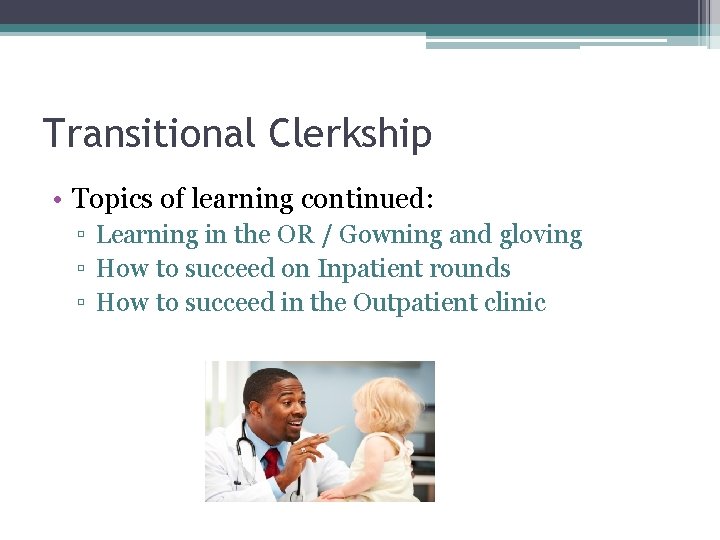
Transitional Clerkship • Topics of learning continued: ▫ Learning in the OR / Gowning and gloving ▫ How to succeed on Inpatient rounds ▫ How to succeed in the Outpatient clinic

Orientation to the 3 rd Year Clerkship • Attendance required, typically one half day in length • Comprehensive overview of the clerkship • Depth and breadth dependent on time of year – fall vs spring semester • Interactive – can be challenging with statewide campus
Orientation to the 3 rd Year Clerkship • What is Primary Care? (or Surgery, or Pediatrics……) • Resources • Expectations and policies • What students are expected to learn • How they learn it (how it will be taught) • How we will know they learned it • What is a typical day / week like • Evaluation and grading
Web Sites and Resources • Learn@UW ▫ Curriculum, forms • OASIS ▫ Evaluations and grades (also registration, schedules, student information ie immunizations, photos, contact information) • Primary Care Clerkship web site (Department of Family Medicine)
Review of Policies • • • Attendance Blood borne pathogen exposure Exam polices (release times, reschedule) Use of mobile devices Professionalism Social media and networking Academic misconduct and plagiarism Transportation Weather and safety emergencies Work hour limits/restrictions Other (OR access and policy)
Overarching Goals: • What students are expected to learn: ▫ ▫ ▫ Knowledge for Practice Problem Solving and Clinical Skills/Patient Care Practice Based Learning and Improvement Systems Based Practice Interpersonal and Communication Skills Professionalism
Activity Level Objectives: • For each activity: ▫ ▫ ▫ Outpatient clinic & medical conditions Small Group Learning Self directed learning Community engagement project Other clerkships (inpatient, OR, simulation center)
Expectations for Learning • Setting ▫ Outpatient clinic with preceptor ▫ Problem based learning sessions with motivational interviewing component ▫ Community engagement project ▫ Self directed learning ▫ Other clerkships: inpatient, OR, simulation center • Sample schedule, call, weekend responsibilities • Typical day/week
Documentation and Requirements • Required clinical experiences: Observation and feedback log (ED 2) • Mid rotation feedback forms (ED 31) • Clinical log • Project paper
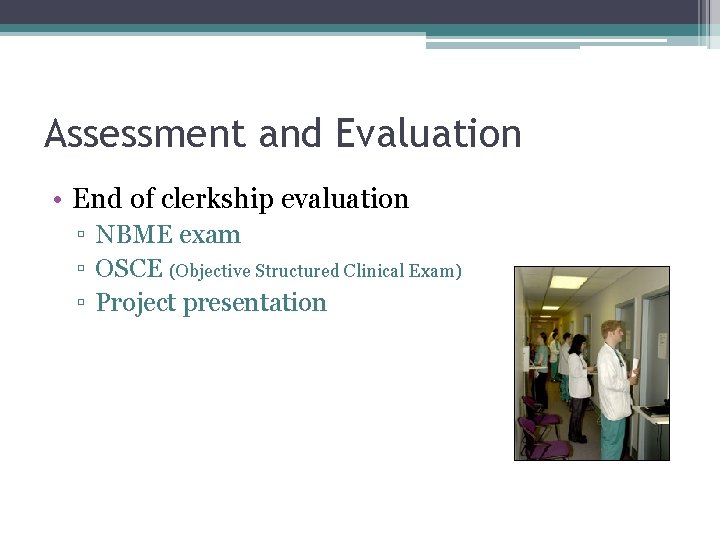
Assessment and Evaluation • End of clerkship evaluation ▫ NBME exam ▫ OSCE (Objective Structured Clinical Exam) ▫ Project presentation
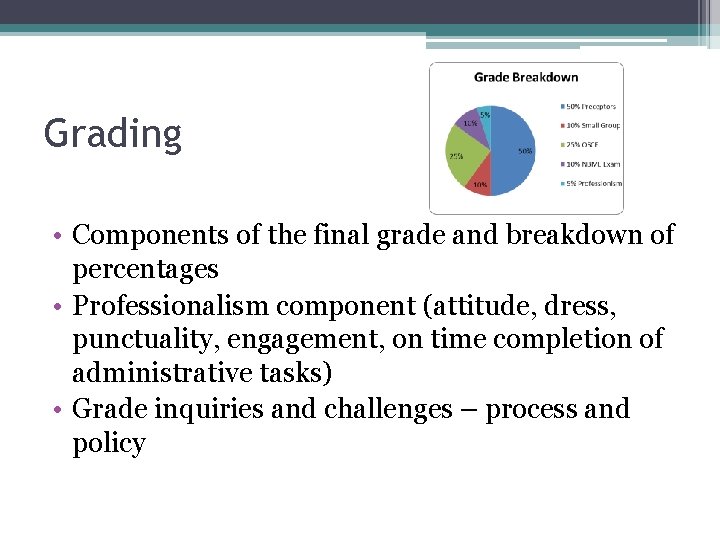
Grading • Components of the final grade and breakdown of percentages • Professionalism component (attitude, dress, punctuality, engagement, on time completion of administrative tasks) • Grade inquiries and challenges – process and policy
Problem Solving & Pearls • • Read emails from the coordinator Be on time and be prepared Ask for specific feedback Develop time management skills Complete tasks in a timely manner Treat all members of the team with respect Work to communicate effectively Behave professionally at all times
Orientation of the Learner – Rural Rotation Site Tania Anderson Resident & Medical Student Program Coordinator Divine Savior Healthcare tanderson@dshealthcare. com
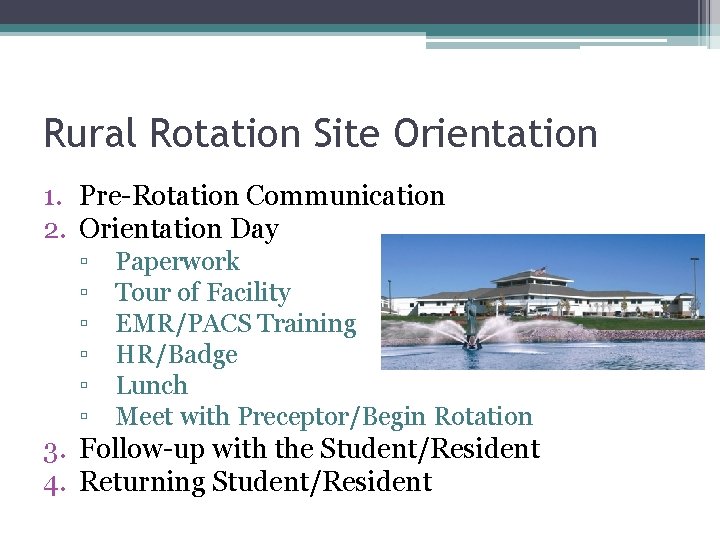
Rural Rotation Site Orientation 1. Pre-Rotation Communication 2. Orientation Day ▫ ▫ ▫ Paperwork Tour of Facility EMR/PACS Training HR/Badge Lunch Meet with Preceptor/Begin Rotation 3. Follow-up with the Student/Resident 4. Returning Student/Resident
University of Wisconsin GME and Surgery Resident Orientation Pam Adams, MS General Surgery Residency Coordinator University of WI, Department of Surgery
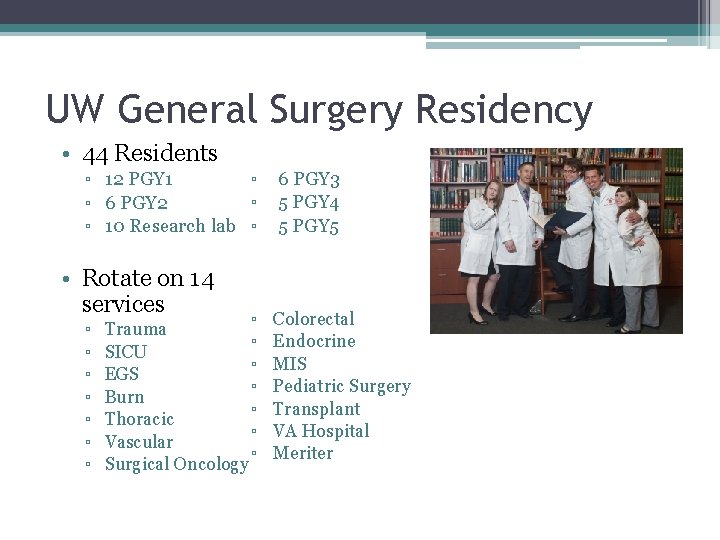
UW General Surgery Residency • 44 Residents ▫ ▫ 12 PGY 1 ▫ ▫ 6 PGY 2 ▫ 10 Research lab ▫ • Rotate on 14 services ▫ ▫ ▫ ▫ Trauma ▫ SICU ▫ EGS ▫ Burn ▫ Thoracic ▫ Vascular ▫ Surgical Oncology 6 PGY 3 5 PGY 4 5 PGY 5 Colorectal Endocrine MIS Pediatric Surgery Transplant VA Hospital Meriter
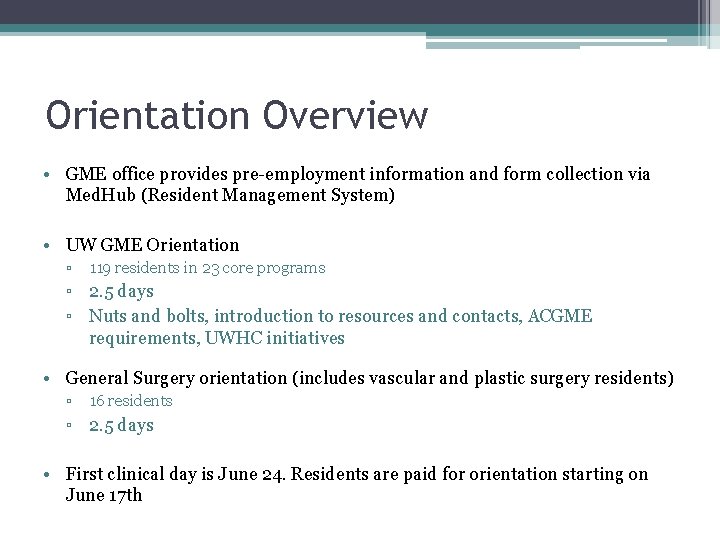
Orientation Overview • GME office provides pre-employment information and form collection via Med. Hub (Resident Management System) • UW GME Orientation ▫ 119 residents in 23 core programs ▫ 2. 5 days ▫ Nuts and bolts, introduction to resources and contacts, ACGME requirements, UWHC initiatives • General Surgery orientation (includes vascular and plastic surgery residents) ▫ 16 residents ▫ 2. 5 days • First clinical day is June 24. Residents are paid for orientation starting on June 17 th
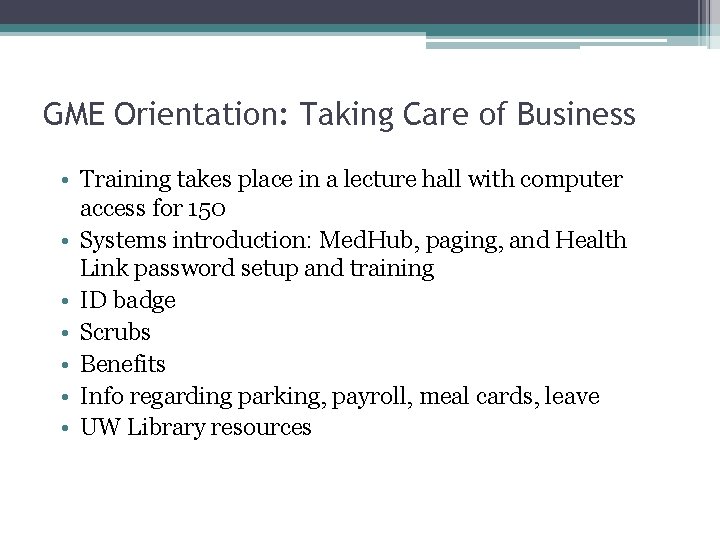
GME Orientation: Taking Care of Business • Training takes place in a lecture hall with computer access for 150 • Systems introduction: Med. Hub, paging, and Health Link password setup and training • ID badge • Scrubs • Benefits • Info regarding parking, payroll, meal cards, leave • UW Library resources
ACGME • Duty hours • Caring for LGBT patients and families ▫ Addresses ACGME/CLER requirements on training health care disparities • Residents as teachers ▫ How to give feedback and teach ▫ Medical school accreditation in 2017 • The Hidden Curriculum- Professionalism ▫ How behavior and words teach cultural norms to residents and medical students ▫ Who to talk in organization when having trouble with staff • Quality, Patient Safety and Handoffs – definitions, UWHC goals and procedures ▫ CLER requirement
UWHC Initiatives and policies • Documentation session- note writing, dictation and coding policies, and how-tos. • Patient & Family Centered Care – Information sharing, collaborations • Discharge and IMOC best practices/philosophy • Infection control and hygiene • Patient resources • Medication safety • New resident's legal survival guide ▫ Medical Ethics, e-risks, false claims and medical documentation
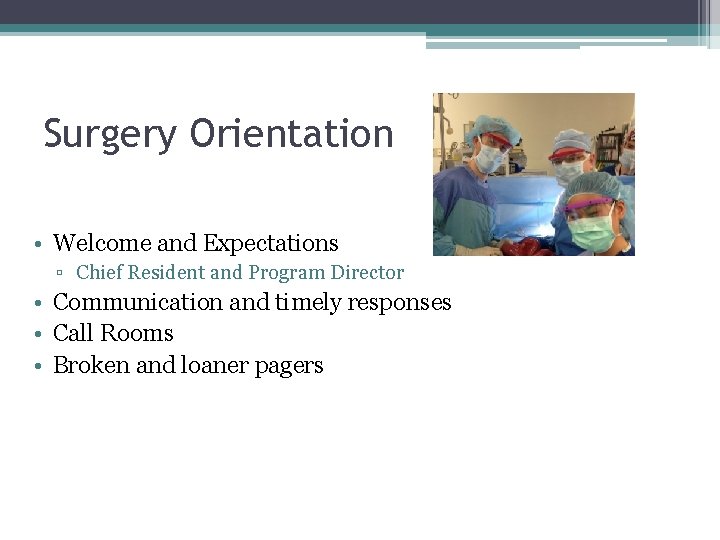
Surgery Orientation • Welcome and Expectations ▫ Chief Resident and Program Director • Communication and timely responses • Call Rooms • Broken and loaner pagers
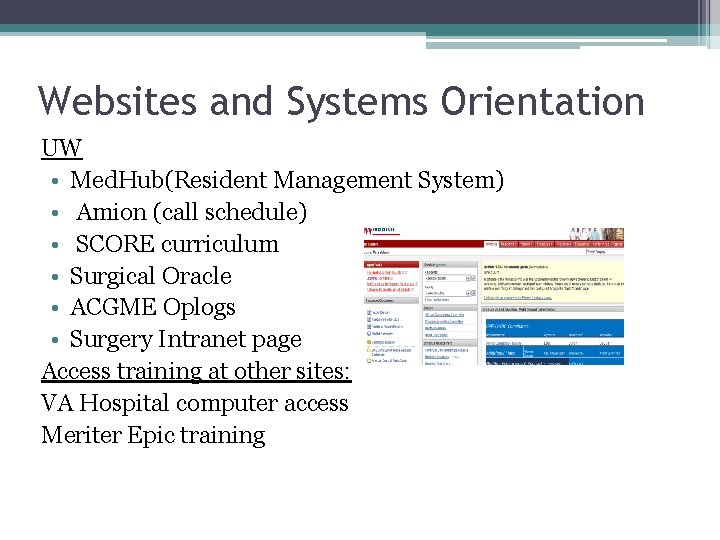
Websites and Systems Orientation UW • Med. Hub(Resident Management System) • Amion (call schedule) • SCORE curriculum • Surgical Oracle • ACGME Oplogs • Surgery Intranet page Access training at other sites: VA Hospital computer access Meriter Epic training
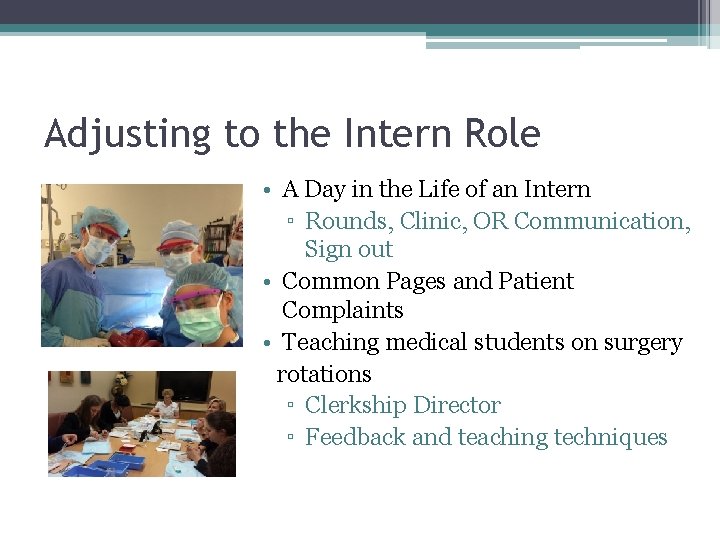
Adjusting to the Intern Role • A Day in the Life of an Intern ▫ Rounds, Clinic, OR Communication, Sign out • Common Pages and Patient Complaints • Teaching medical students on surgery rotations ▫ Clerkship Director ▫ Feedback and teaching techniques
Surgical Skills • Starting in 2012 America College of Surgeons/Association of Surgical Education created a pilot curriculum to provide a framework for training incoming interns • 4 week curriculum usually completed in med school • UW SMPH created a 2 week “boot camp” based on curriculum • This year UW created a simulation curriculum and will submit to the ACS for inclusion in the national curriculum • 2/3 of the 2015 incoming residents had 1 day to 1 week worth of resident preparation training
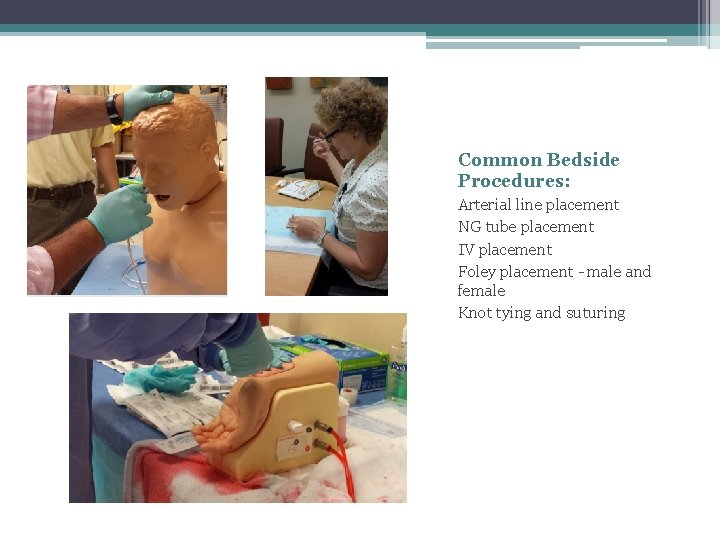
Common Bedside Procedures: Arterial line placement NG tube placement IV placement Foley placement - male and female Knot tying and suturing
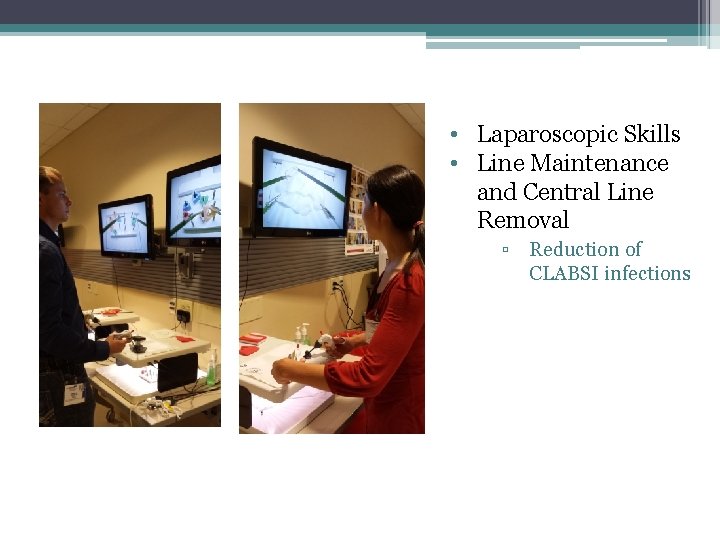
• Laparoscopic Skills • Line Maintenance and Central Line Removal ▫ Reduction of CLABSI infections
Orientation Evaluation • Traditionally have not done formal evaluation • Ask class later in year what was helpful and what was missing.
Resources ACS/ASE Surgical Prep Curriculum: https: //www. facs. org/education/program/resident-prep UW Simulation Center http: //www. med. wisc. edu/clinical-simulationprogram/main/27978
- Slides: 32