
The Basics of Trademarks An Administrators guide Bert
The Basics of Trademarks An Administrators guide Bert Black – Minnesota Carmen Flores – Texas Kathy Sachs - Kansas
What is the purpose of a Trademark/Service mark? Allow the public to make informed decisions and to differentiate between competing products and companies. To protect the providers’ investment in their reputation. The Supreme Court held in Qualitex Co. v. Jacobson Products Co (1995) that: "[T]rademark law, by preventing others from copying a source-identifying mark, 'reduce[s] the customer's costs of shopping and making purchasing decisions, ' for it quickly and easily assures a potential customer that … the item with this mark … is made by the same producer as other similarly marked items that he or she liked (or disliked) in the past. At the same time, the law helps assure a producer that it (and not an imitating competitor) will reap the financial, reputation related rewards associated with a desirable product. "
What is a Trademark? The term trademark is often used when referring to a service mark but the two words have different meanings and requirements. A Trademark is any word, name, symbol, or device or any combination used by a person To identify and distinguish the goods of such person, including a unique product, from those manufactured or sold by others To indicate the source of the goods, even if that source is unknown. A trademark isn’t a verb (or noun), it’s an intangible asset.
What is a Service Mark? A service mark is registered for a non tangible service. A Service mark is any word, name, symbol, or device or any combination thereof used by a person, To identify and distinguish the services of one person, including a unique service, from the services of others To indicate the source of the services, even if that source is unknown. Titles, character names used by a person, and other distinctive features of radio or television programs may be registered as service marks notwithstanding that they, or the programs, may advertise the goods of the sponsor.
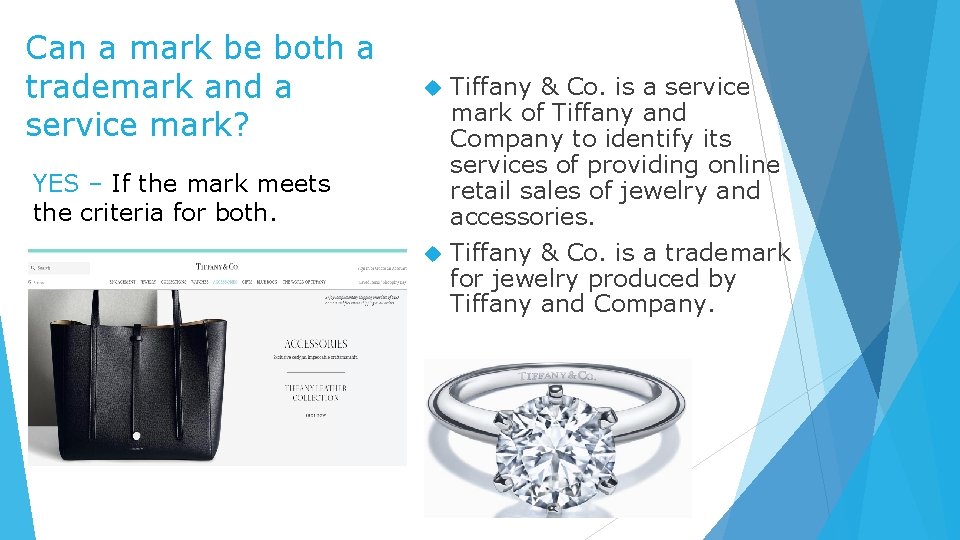
Can a mark be both a trademark and a service mark? YES – If the mark meets the criteria for both. Tiffany & Co. is a service mark of Tiffany and Company to identify its services of providing online retail sales of jewelry and accessories. Tiffany & Co. is a trademark for jewelry produced by Tiffany and Company.
What a trademark isn’t Trade name or DBA A trade name is “any name used by a person to identify a business or vocation of such person. ” A trade name is adopted and used for the purpose of identifying the company and distinguishing it from other companies. A trademark is adopted and used for the purpose of identifying the company’s goods/services and distinguishing the goods/services from those produced by others. Business Entity Name A trade name or business entity name does not necessarily qualify for Trademark or Service Mark registration.
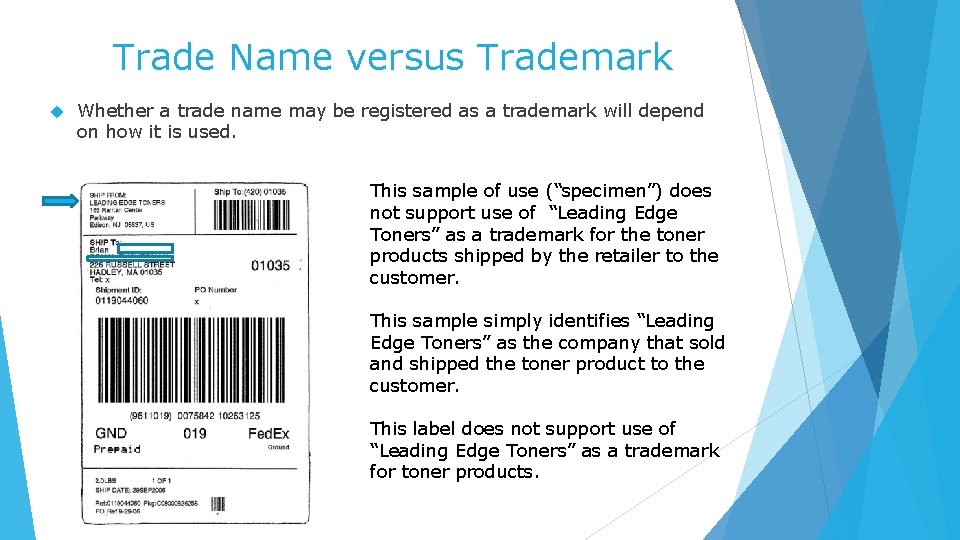
Trade Name versus Trademark Whether a trade name may be registered as a trademark will depend on how it is used. This sample of use (“specimen”) does not support use of “Leading Edge Toners” as a trademark for the toner products shipped by the retailer to the customer. This sample simply identifies “Leading Edge Toners” as the company that sold and shipped the toner product to the customer. This label does not support use of “Leading Edge Toners” as a trademark for toner products.
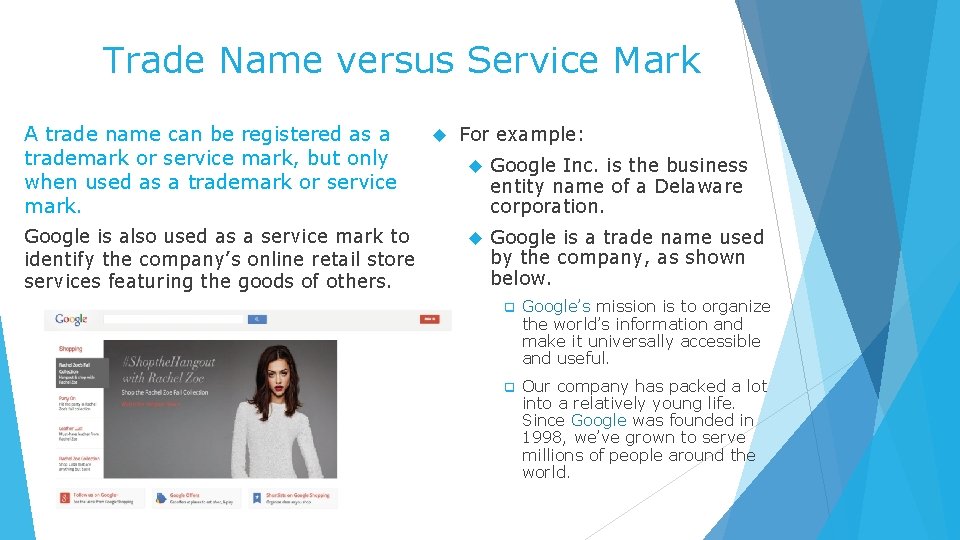
Trade Name versus Service Mark A trade name can be registered as a trademark or service mark, but only when used as a trademark or service mark. Google is also used as a service mark to identify the company’s online retail store services featuring the goods of others. For example: Google Inc. is the business entity name of a Delaware corporation. Google is a trade name used by the company, as shown below. q Google’s mission is to organize the world’s information and make it universally accessible and useful. q Our company has packed a lot into a relatively young life. Since Google was founded in 1998, we’ve grown to serve millions of people around the world.
Marks are Different Trade and Service Marks are not simply a filing. They are a registration conferring a status granted by Federal and State Governments. State Government actually has a public policy interest in the issuance and registration of a mark. The purpose of mark registration is to protect the public from being confused by similarly designated products.
Marks are Different Unlike situations involving the same or similar corporate names, the holders of a conflicting mark cannot simply consent to the use of a name by another. Prospective registrants must instead demonstrate that the public will not be confused by the registration of the similar and concurrent marks.
Can I register my mark? Is the mark: ü In use? ü Acceptable? ü Distinctive?
Is the Trademark in “Use”? In use means the bona fide use of a mark in the ordinary course of trade. Not made merely to reserve a right to a mark. It is not sufficient to say that you plan to launch the new product or start a business using the mark. For a Trademark The goods are sold or transported in commerce in the state AND The mark is placed in any manner on the goods or other containers; The mark is placed on displays associated with the goods; or The mark is affixed directly to the goods by means of tags or labels. If the nature of the goods makes such placement impracticable, then on documents associated with the goods or their sale. An airplane A prefabricated metal building A brand of veneer teeth
Is the Service Mark in “Use”? In use means the bona fide use of a mark in the ordinary course of trade. For a Service mark q Mark is used or displayed in the sale or advertising of the services AND q The services are rendered in the state of filing. Not made merely to reserve a right to a mark. It is not sufficient to say that you plan to start your business.
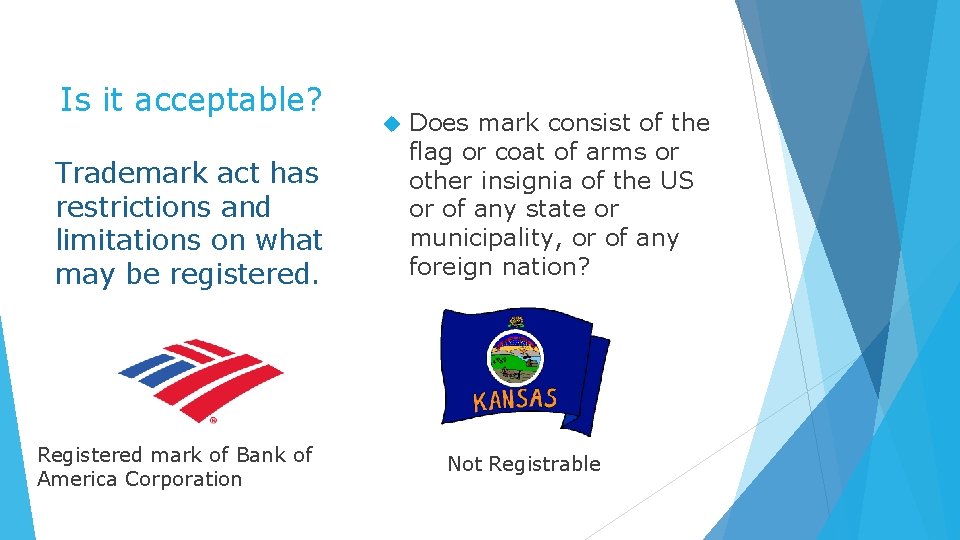
Is it acceptable? Trademark act has restrictions and limitations on what may be registered. Registered mark of Bank of America Corporation Does mark consist of the flag or coat of arms or other insignia of the US or of any state or municipality, or of any foreign nation? Not Registrable
Is it acceptable? Trademark act has restrictions and limitations on what may be registered. Does mark consist of the name, signature or portrait identifying a particular living individual, except by the individual's written consent?
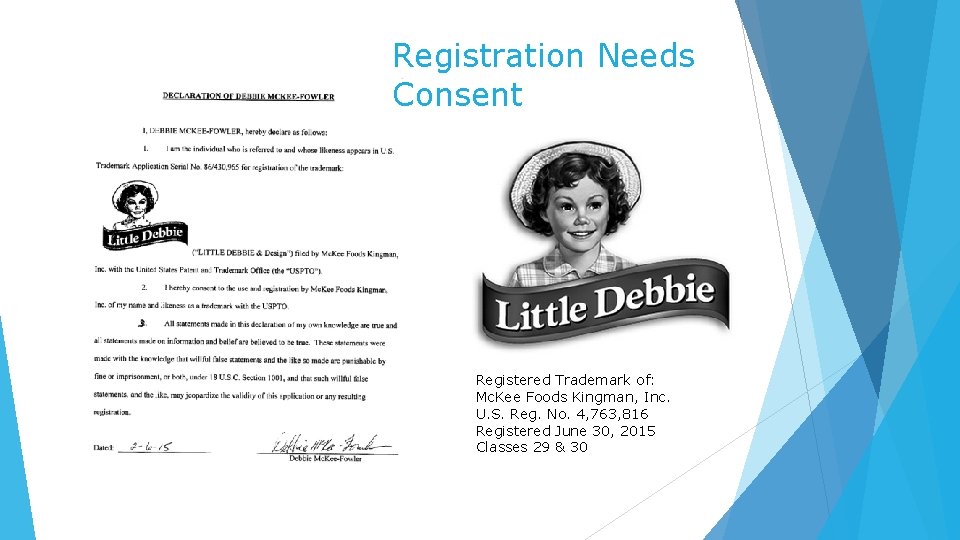
Registration Needs Consent Registered Trademark of: Mc. Kee Foods Kingman, Inc. U. S. Reg. No. 4, 763, 816 Registered June 30, 2015 Classes 29 & 30
Is it acceptable? Trademark act has restrictions and limitations on what may be registered. This determination may sometimes be subjective. Does mark consist of matter which may disparage or falsely suggest a connection with: Persons, living or dead, Institutions, Beliefs, National symbols, Or, bring them into contempt, or disrepute? Does mark consist of immoral, deceptive or scandalous matter?
Does mark disparage or bring into contempt a group of individuals ? The current attitudes of the day must be considered when determining the meaning imparted by the mark. Dykes on Bikes More than two dozen expert declarations from scholars, linguists, psychologists, and activists demonstrating how the word “dyke” has evolved to become a positive term and that lesbians view “DYKES ON BIKES” as a symbol of pride and empowerment.
Does mark consist of immoral, deceptive or scandalous matter? Applicants might be asked to “provide evidence that a substantial portion of the general public would consider the mark to be scandalous in the context of contemporary attitudes and the relevant marketplace. ” Evidence may include “dictionary definitions, newspaper articles, and magazine articles. ” What would the average person think? It is the responsibility of the applicant to prove mark is not immoral, deceptive, or scandalous. The applicant might have to take additional steps beyond “filing” to get a Mark registered.
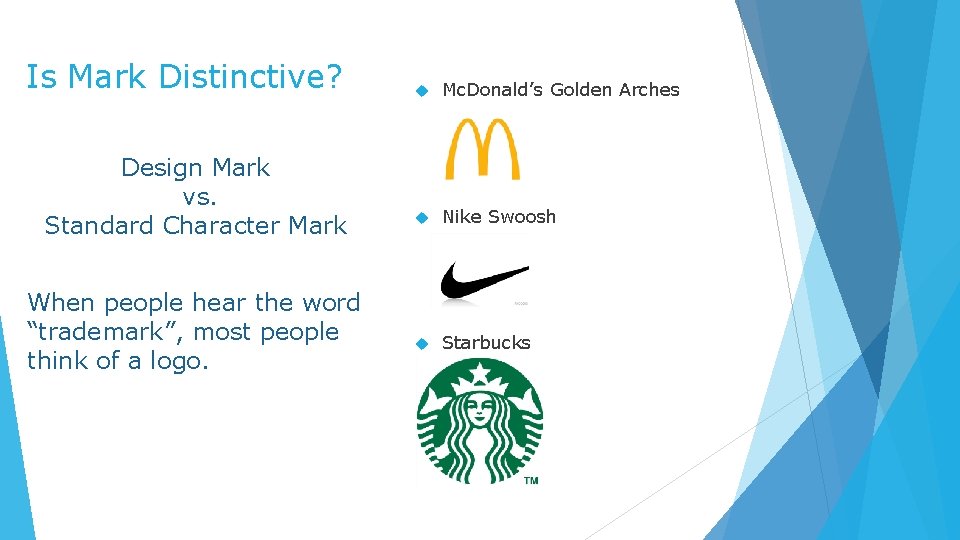
Is Mark Distinctive? Design Mark vs. Standard Character Mark When people hear the word “trademark”, most people think of a logo. Mc. Donald’s Golden Arches Nike Swoosh Starbucks
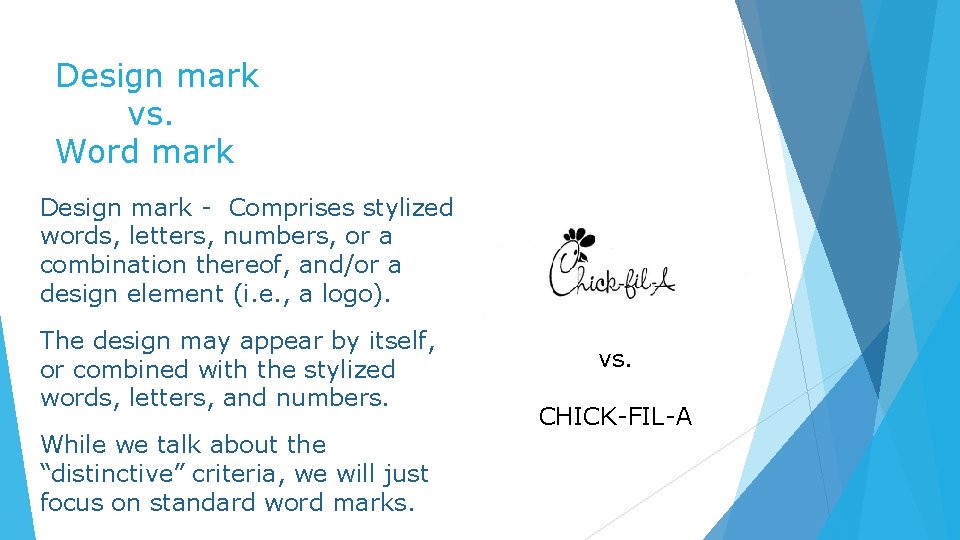
Design mark vs. Word mark Design mark - Comprises stylized words, letters, numbers, or a combination thereof, and/or a design element (i. e. , a logo). The design may appear by itself, or combined with the stylized words, letters, and numbers. While we talk about the “distinctive” criteria, we will just focus on standard word marks. vs. CHICK-FIL-A
Word Marks A standard character word mark makes no claim to design element, stylization of Standard Character the letters or numbers, and no claim to colors or size. Mark A distinct text-only A standard character typographic treatment of the name of a company, mark, also known as a institution, or product name “word mark, ” consists used for purposes of identification and branding. solely of words, letters, To keep things simple, in the numbers, or a next slides we will talk combination thereof. exclusively about standard character word marks.
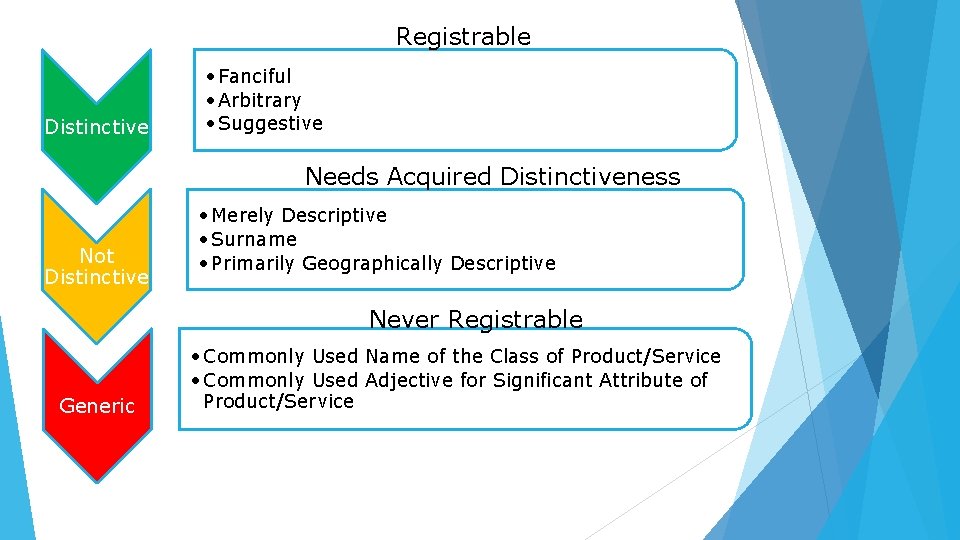
Registrable Distinctive • Fanciful • Arbitrary • Suggestive Needs Acquired Distinctiveness Not Distinctive • Merely Descriptive • Surname • Primarily Geographically Descriptive Never Registrable Generic • Commonly Used Name of the Class of Product/Service • Commonly Used Adjective for Significant Attribute of Product/Service
Distinctive Marks—Registrable Arbitrary or fanciful – arbitrary and fanciful marks are closely related in that they both are inherently distinctive and receive the highest degree of protection. q Arbitrary marks contain real words that are used arbitrarily with respect to the product or service. q Fanciful marks are completely made up terms. A fanciful mark has no other meaning other than its trademark significance. Suggestive – suggestive marks automatically receive protection and don’t require evidence of secondary meaning. A suggestive mark may imply something about the product/service without directly describing it.
Non-Distinctive Marks Ø Descriptive – descriptive terms, because they are not inherently distinctive, are not generally given trademark protection unless a secondary meaning due to the public association of the mark with the holder's product or service can be proven. Such secondary meanings can be found when a significant number of consumers and other companies associate the mark with the specific product or service. Ø Generic – generic or common descriptions receive no protection under the law of trademarks.
Types of Descriptiveness A mark is “merely descriptive” and not distinctive if: Mark immediately and directly conveys information about a function, characteristic, ingredient, or feature of the goods/services. Mark describes the class of users of the goods/services. Mark describes the products sold by the retailer. Mark describes the alleged merit of the goods/services.
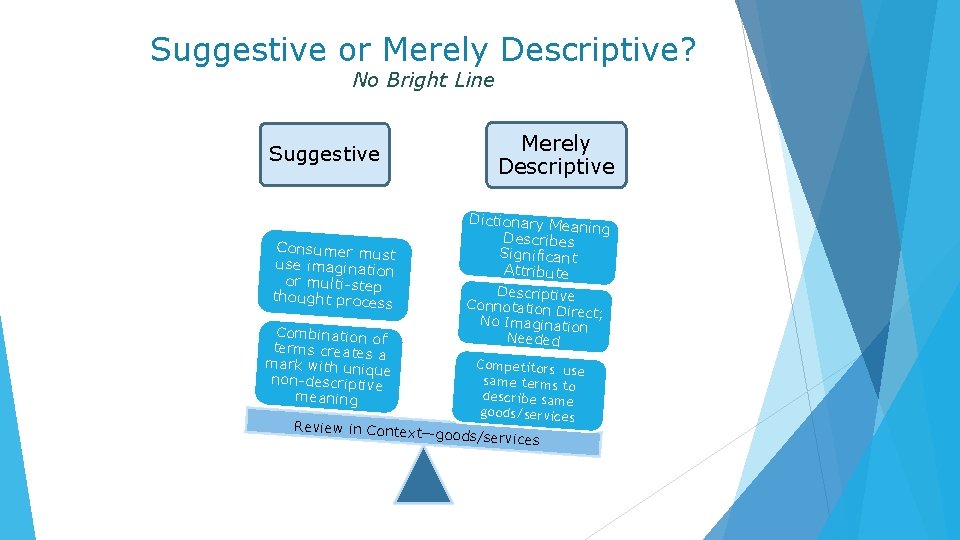
Suggestive or Merely Descriptive? No Bright Line Suggestive Consumer mus t use imaginatio n or multi-step thought proces s Combination o f terms creates a mark with uniq ue non-descriptive meaning Merely Descriptive Dictionary Mea ning Describes Significant Attribute Descriptive Connotation D irect; No Imagination Needed Competitors use same terms to describe same goods/services Review in Context —goods/services
Acquired Distinctiveness (aka Secondary Meaning) The crux of the secondary meaning doctrine is that the mark comes to identify not only the goods but a single source of those goods. The amount and character of evidence required to establish acquired distinctiveness depends on the facts of each case and particularly on the nature of the mark sought to be registered. Typically, more evidence is required where a mark is so highly descriptive that purchasers would be less likely to believe that the term indicates a single source. The burden of proving that a mark has acquired distinctiveness is on the applicant.
Acquired Distinctiveness Evidence of Acquired Distinctiveness Prior Registrations: A claim of ownership of one or more active prior registrations on the Principal Register of the same mark for goods or services that are sufficiently similar to those identified in the pending application. Five Years’ Use: A statement verified by the applicant that the mark has become distinctive of the applicant’s goods or services by reason of the applicant's substantially exclusive and continuous use of the mark in commerce for the five years before the date on which the claim of distinctiveness is made. Other Evidence: Other appropriate evidence of acquired distinctiveness (e. g. , surveys, customer affidavits, etc. )
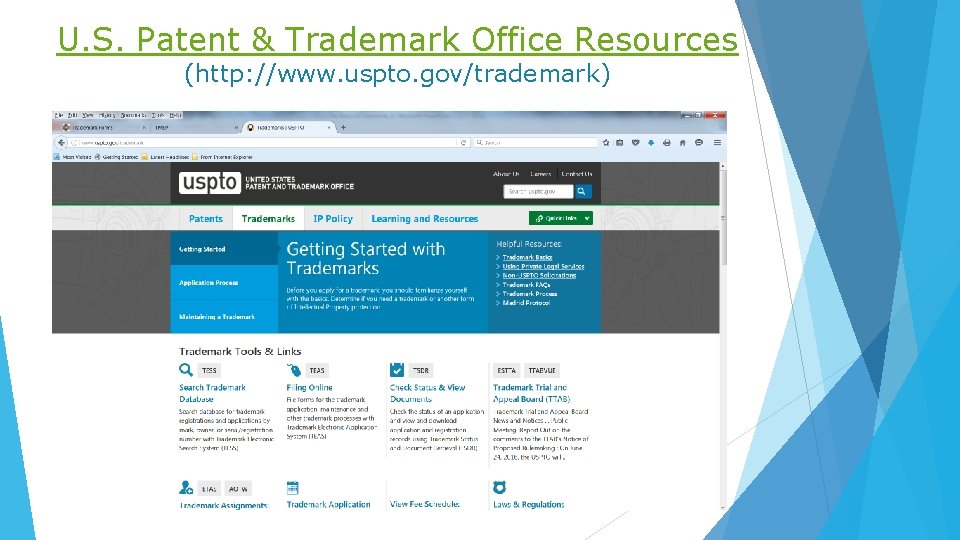
U. S. Patent & Trademark Office Resources (http: //www. uspto. gov/trademark)
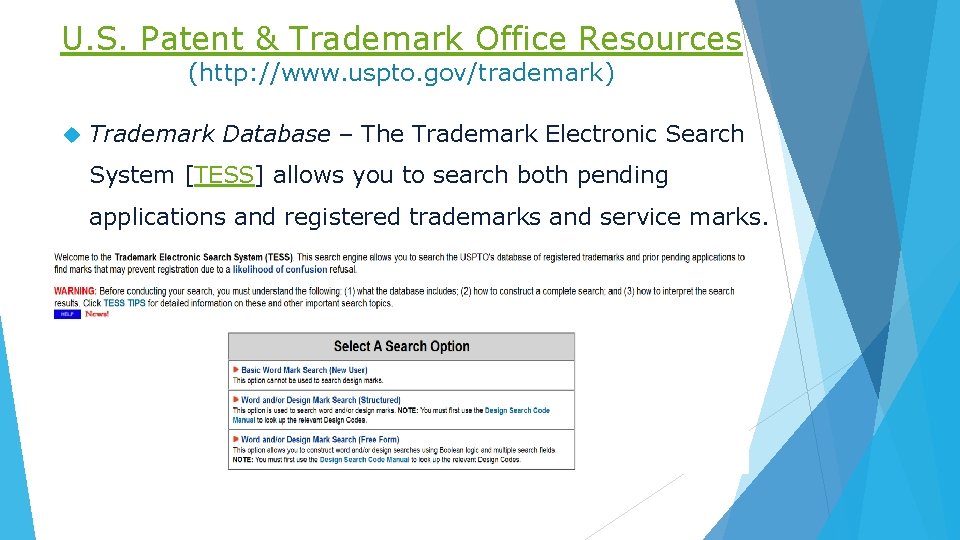
U. S. Patent & Trademark Office Resources (http: //www. uspto. gov/trademark) Trademark Database – The Trademark Electronic Search System [TESS] allows you to search both pending applications and registered trademarks and service marks.
U. S. Patent & Trademark Office Resources (http: //www. uspto. gov/trademark) Trademark ID Manual – The Acceptable Identification of Goods & Services Manual is helpful to applicants and examiners. Provides a means of identifying descriptions of goods or services that contain multiple classes. Helps applicant’s appropriately describe & classify their goods/services. Design Code Search Manual – The USPTO’s design code manual provides some uniformity for indexing and/or searching marks that are comprised of only a design/logo.
U. S. Patent & Trademark Office Resources Trademark Manual of Examining Procedure – The Trademark Manual of Examining Procedure (TMEP) provides federal examiners with guidelines and procedures to follow when examining federal applications for registration. Answers the question “WWFED? ” Very useful materials and information may be downloaded at: http: //www. uspto. gov/trademark/guides-andmanuals/tmep-archives

Questions?
- Slides: 35