
The Basics of Service Learning Student Ambassador Presentation
The Basics of Service Learning Student Ambassador Presentation Rachel Holmes, M. Ed. Faculty Service Learning Coordinator EMCC
Preview of Today’s Session • Key Components of Service Learning • Easy steps for implementation • Questions

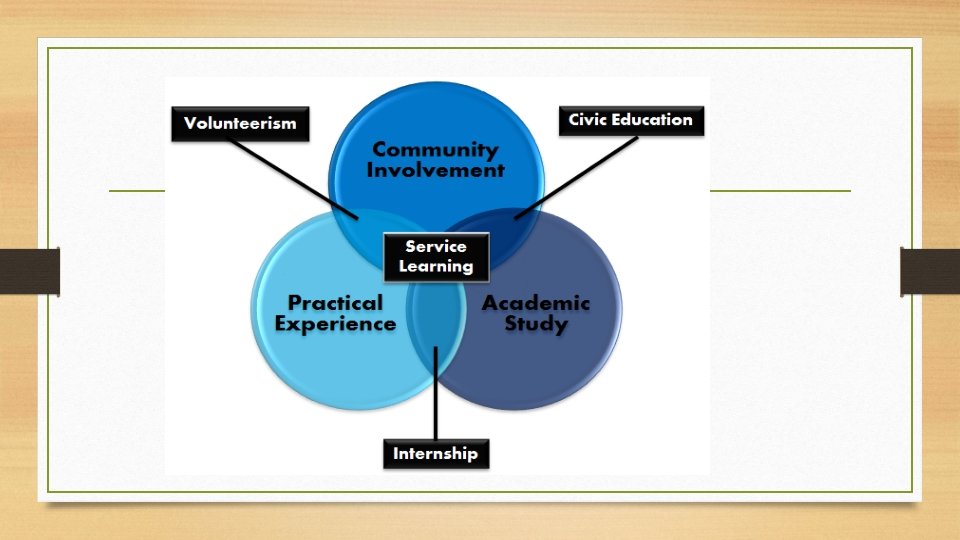
What is Service Learning? Service Learning • The combination of community service and classroom instruction, with a focus on critical, reflective thinking as well as personal and civic responsibility • May be community service, one or more volunteer events, donations Civic Engagement • Active participation in the public life of a community in an informed, committed, and constructive manner with a focus on the common good • Civic engagement provides students an opportunity to serve the community (the larger community or the college community) by working towards a long-term solution and/or awareness of an issue facing society • Working towards positive social change
Key Components of Service Learning Community Service (10 or more volunteer hours) OR participating in 2 SL events And Reflection/Final Assignment
Critical Thinking • Service Learning allows the students to learn, volunteer, and work on a project that can and should facilitate reflective and analytical thinking. • Project should be related to what you are learning in your class • i. e. Accounting students providing free tax services to low income families • i. e. Education students providing free tutoring to K-12 students
How Does It Work? Faculty-Directed Service Learning 1. Instructor either assigns a specific project OR 2. Instructor provides a list of projects to choose from 3. Instructor oversees the student and project to ensure students are making progress and meeting academic requirements

How Does It Work? Student-Directed Service Learning • The students do the research to identify a community need • Students develop their own project complete with goal/outcome statement, timeline, proposal (ex. Volunteering at food bank for 10 hours) • The instructor monitors student progress
Three Types of Service Learning • 1. ) Individual/Club Placements: Students/Clubs are placed at any of EMCC’s approved agencies. The student/club and agency will determine the goals of the service learning experience, number of hours and duration of the experience. • 2. ) Class Projects: May be whole-class, small group or individual project (ask your instructor for details) OR may be assigned as an extra credit assignment (10 hours or 2 events) • 3. ) One-Day Events: A one-day experience for students. This can be held on campus to benefit a specific agency/group of agencies or at the agency site. (2 of these are required in lieu of the 10 hours)
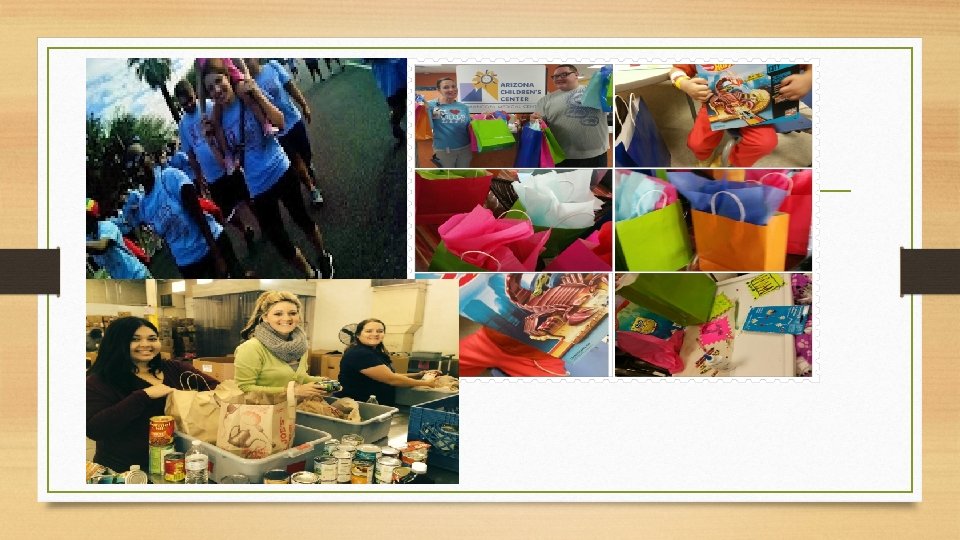
Sample Projects • Packing food at local • Teaching senior food bank citizens basic computer skills • Tutoring children • Reading to kids at a • Participate in onlocal shelter • Planning and facilitating a clothing drive • Organize and facilitate an informational table on domestic violence, women’s rights issues, etc. campus event such as the Career Fair, Billion Man Rising, or • Fundraising and participating in AIDS Health Fair Walk or Down Syndrome Walk
Do It Your Way! • • Find your passion! Determine how YOU would like to organize the SL projects Start small Don’t be afraid to try! (and learn from your mistakes)
Student Packet • Required Forms (liability release, time log with supervisor evaluation) • Proposal (submitted electronically) • Final Assignment Requirements (submitted to Canvas) • Reporting Your Hours to the Center for SL and CE online ***All forms can be found on the Center for Service Learning and Civic Engagement website
Any Questions?
For Additional Assistance • Center for Service Learning and Civic Engagement Located in the Career and Transfer Center Faculty SL Coordinator- Rachel Holmes x 58407 Rachel. Holmes@estrellamountain. edu MAR 108 SL Coordinator- Landis Elliott 623. 935. 8220 Landis. Elliott@estrellamountain. edu
- Slides: 15