
The Basics of Open Access and its Implications
The Basics of Open Access and its Implications for Libraries David Ruddy Cornell University Library September 2004
What does Open Access address? • Barriers to access – Barriers due to price (paid by user or user’s representative) • Subscriptions • Licensing fees • Per article fees • Barriers to use – Permissions restrictions imposed by copyright or license agreements
How does OA remove these barriers? • Different groups have proposed different solutions • Three well-known Open Access declarations: – The Budapest Initiative (February 2002) • http: //www. soros. org/openaccess/ – The Bethesda Statement (June 2003) • http: //www. earlham. edu/~peters/fos/bethesda. htm – The Berlin Declaration (October 2003) • http: //www. zim. mpg. de/openaccessberlin/berlindeclaration. html
The basic definition • Pay to publish, not to access – Costs are recovered from producers of scholarship (authors or institutions), or funding organizations, rather than from users/readers – Access is more democratic • Copyright is held by the author rather than the publisher – Permission is granted for unrestricted reading, downloading, copying, sharing, etc. – Some authors choose to block commercial re-use
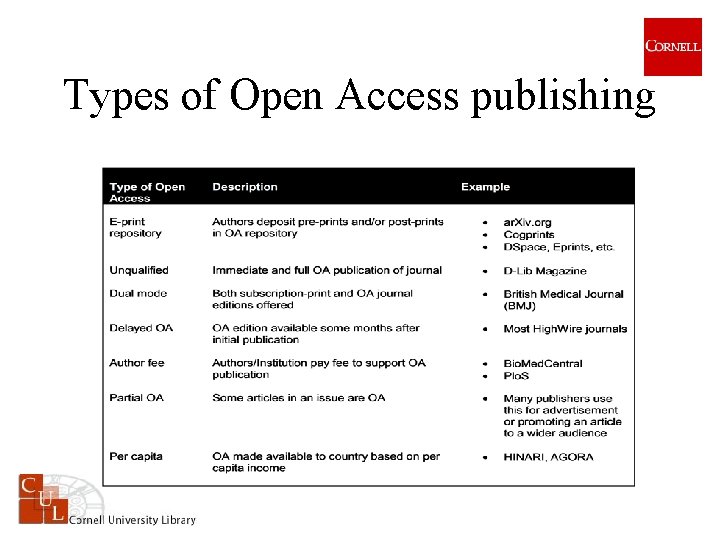
Types of Open Access publishing
Delivery of OA scholarship • Open Access journals – DLIB Magazine – Journals from Bio. Med. Central, PLo. S • Open Access repositories – E-print or pre-print servers • ar. Xiv. org, Cog. Prints, ADS, etc. – Institutional Repositories • Using software such as DSpace, Eprints, etc.
Open Access and costs • Open Access does not eliminate costs – Peer review, editorial, and production processes remain unchanged, and thus their associated costs remain – The difference is…who pays? – Under OA, the end user no longer pays (at least directly) – OA is not incompatible with peer review
Who should pay for OA? • Authors? – Most commonly implemented business model to support OA – Most adoption is in the biomedical sciences community, which tends to be well-funded – Essentially the same as “page charges” – Costs in the sciences can range from $500 to $1, 500 and higher per article • Departments? – Encourages price sensitivity – May be unpopular or rejected by faculty
Who should pay for OA? • Libraries? – A membership model – Promotes price insensitivity – Another name for a subscription model? • Institutional funds? – From a non-Library university fund – Would require regulation and oversight – May be judged as unfair or political by faculty
Libraries and Open Access • Many potential benefits for some libraries – Greater access, lower costs, etc. • For others, will OA merely shift materials budget to publishing fees? – Today, some libraries would be in a worse position – Year-to-year needs may be difficult to predict • As a trusted party, will libraries take on oversight roles in the allocation of publishing fees? – What are the costs of this?
Challenges facing Open Access • Requires difficult changes in academic culture – Faculty publication behavior and decision making – Academic credentialing processes • Development of a sustainable business model to support OA – One model will likely not fit all disciplines • Current OA discussions focus on STM publishing • How to negotiate a new set of inequities – Some institutions will pay more because they publish more
References • SPARC Open Access Newsletter (Peter Suber) – http: //www. earlham. edu/~peters/fos/ • Directory of Open Access Journals (DOAJ) – http: //www. doaj. org/ • “Nine Flavors of Open Access Scholarly Publishing, ” J. Willinsky. J Postgrad Med [serial online] 2003. – http: //www. jpgmonline. com
- Slides: 13