
The Basics of Network Analysis Kristina Lerman University
The Basics of Network Analysis Kristina Lerman University of Southern California CS 599: Social Media Analysis University of Southern California 1
Network analysis basics • What is a network? network – Social network – Information network • How is a network represented mathematically? mathematically • What properties do networks have? How are they measured? • How do we model networks to understand their properties? How are real networks different from the ones produced by a simple model?
Recommended readings • Barabasi, “Network Science” • Easley & Kleinberg, “Networks, Crowds, and Markets: Reasoning about a Highly Connected World” • Newman, “Networks”
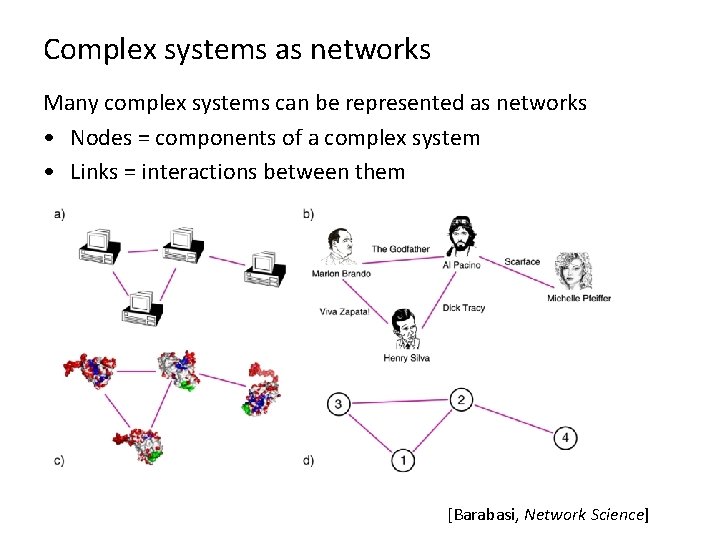
Complex systems as networks Many complex systems can be represented as networks • Nodes = components of a complex system • Links = interactions between them [Barabasi, Network Science]
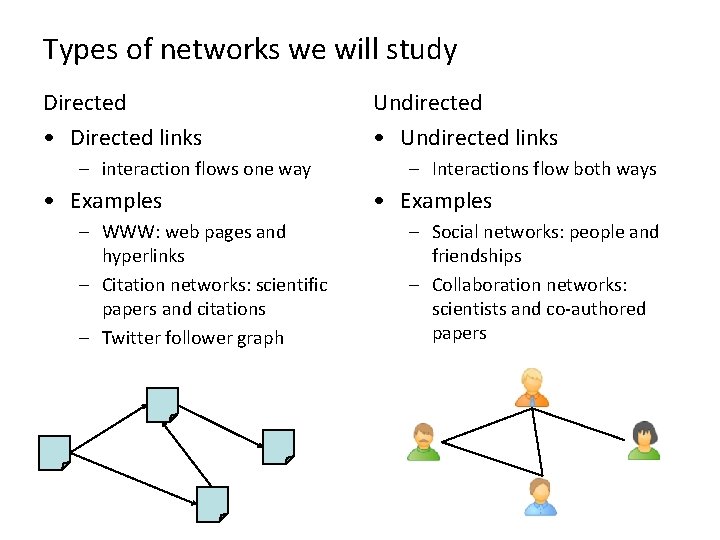
Types of networks we will study Directed • Directed links – interaction flows one way • Examples – WWW: web pages and hyperlinks – Citation networks: scientific papers and citations – Twitter follower graph Undirected • Undirected links – Interactions flow both ways • Examples – Social networks: people and friendships – Collaboration networks: scientists and co-authored papers
How do we characterize networks? • Size – Number of nodes – Number of links • Degree – Average degree – Degree distribution • Diameter • Clustering coefficient • …
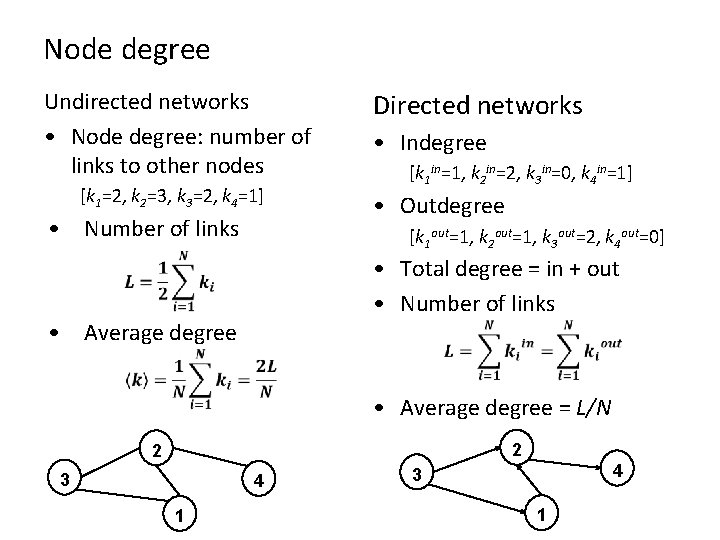
Node degree Undirected networks • Node degree: number of links to other nodes [k 1=2, k 2=3, k 3=2, k 4=1] • Number of links Directed networks • Indegree [k 1 in=1, k 2 in=2, k 3 in=0, k 4 in=1] • Outdegree [k 1 out=1, k 2 out=1, k 3 out=2, k 4 out=0] • Total degree = in + out • Number of links • Average degree = L/N 2 2 3 4 1 4 3 1
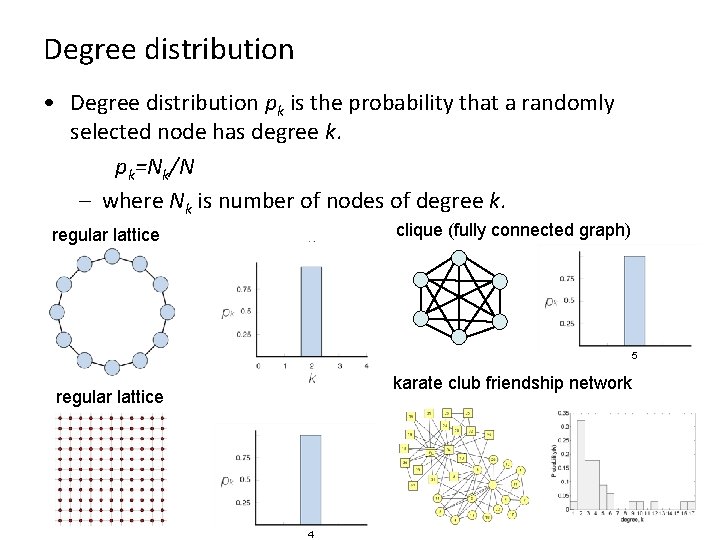
Degree distribution • Degree distribution pk is the probability that a randomly selected node has degree k. pk=Nk/N – where Nk is number of nodes of degree k. clique (fully connected graph) regular lattice 5 karate club friendship network regular lattice 4
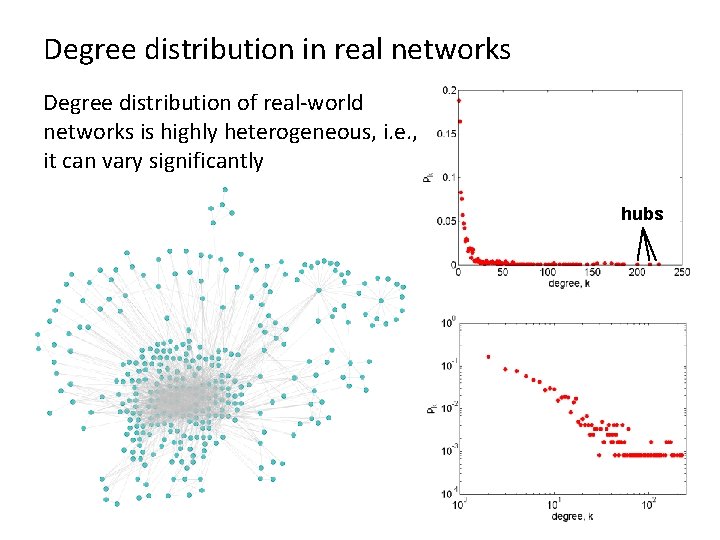
Degree distribution in real networks Degree distribution of real-world networks is highly heterogeneous, i. e. , it can vary significantly hubs
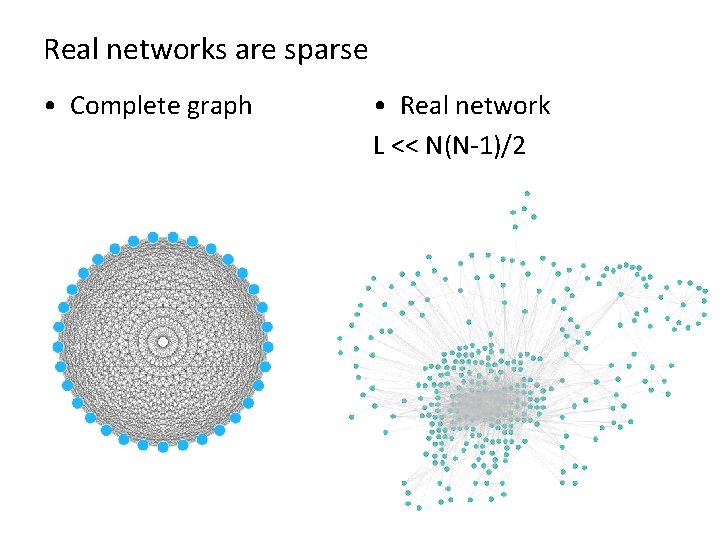
Real networks are sparse • Complete graph • Real network L << N(N-1)/2
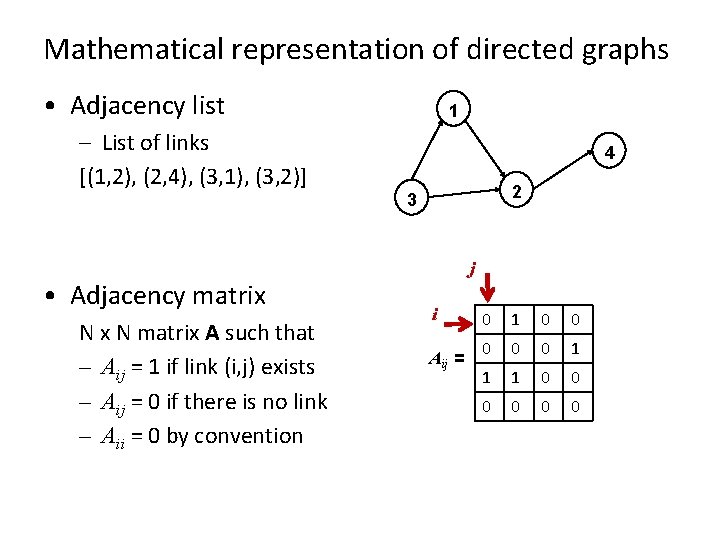
Mathematical representation of directed graphs • Adjacency list – List of links [(1, 2), (2, 4), (3, 1), (3, 2)] • Adjacency matrix N matrix A such that – Aij = 1 if link (i, j) exists – Aij = 0 if there is no link – Aii = 0 by convention 1 4 2 3 j i Aij = 0 1 0 0 0 1 1 1 0 0 0
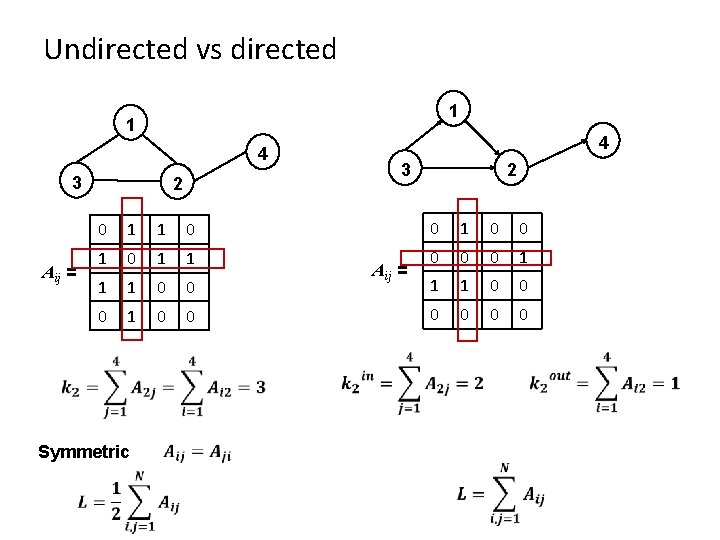
Undirected vs directed 1 1 4 3 Aij = 2 0 1 1 0 0 0 1 0 0 Symmetric 4 3 Aij = 2 0 1 0 0 0 1 1 1 0 0 0
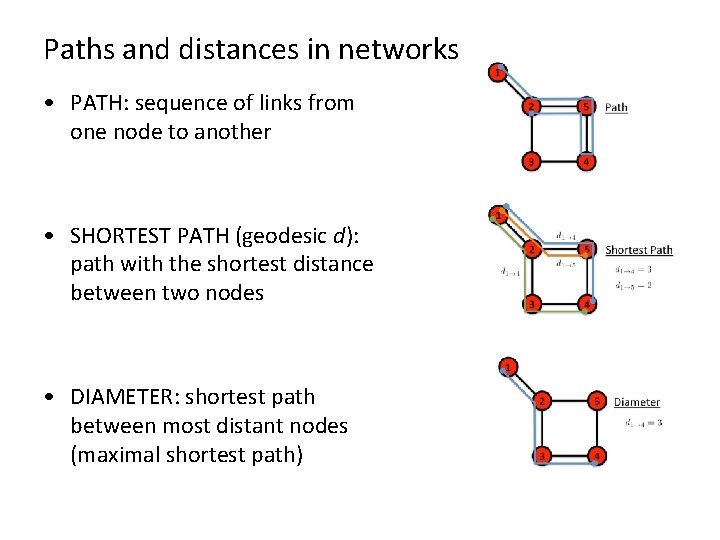
Paths and distances in networks • PATH: sequence of links from one node to another • SHORTEST PATH (geodesic d): path with the shortest distance between two nodes • DIAMETER: shortest path between most distant nodes (maximal shortest path)
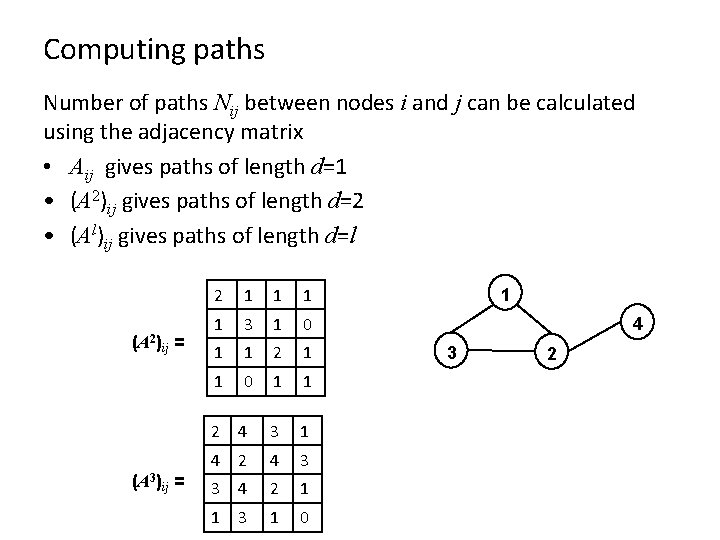
Computing paths Number of paths Nij between nodes i and j can be calculated using the adjacency matrix • Aij gives paths of length d=1 • (A 2)ij gives paths of length d=2 • (Al)ij gives paths of length d=l (A 2) ij = (A 3)ij = 2 1 1 3 1 0 1 1 2 1 1 0 1 1 2 4 3 1 4 2 4 3 3 4 2 1 1 3 1 0 1 4 3 2
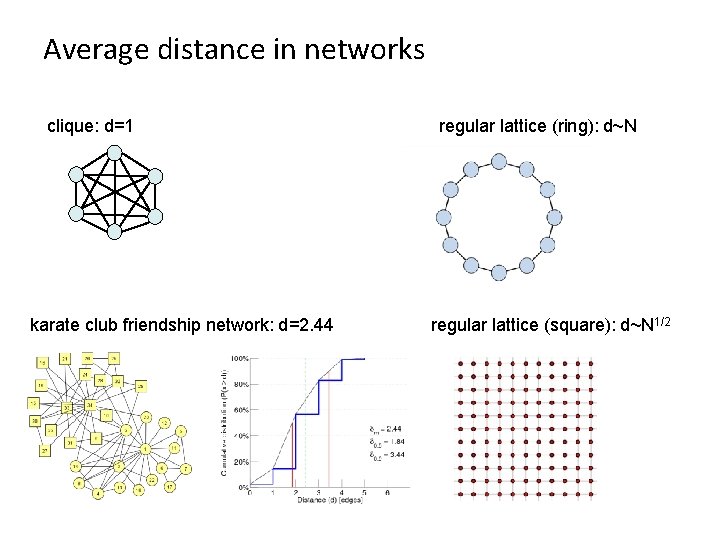
Average distance in networks clique: d=1 karate club friendship network: d=2. 44 regular lattice (ring): d~N regular lattice (square): d~N 1/2
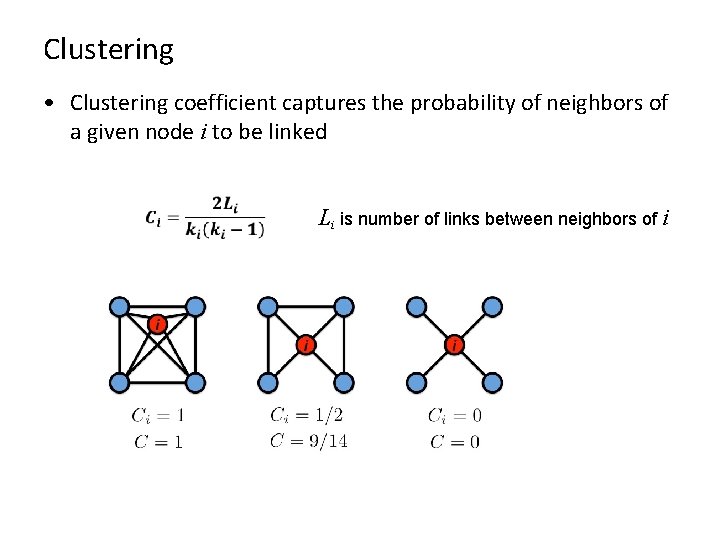
Clustering • Clustering coefficient captures the probability of neighbors of a given node i to be linked Li is number of links between neighbors of i
Properties of real world networks • Real networks are fundamentally different from what we’d expect – Degree distribution • Real networks are ‘scale-free’ – Average distance between nodes • Real networks are ‘small world’ – Clustering • Real networks are locally dense • What do we expect? – Create a model of a network. Useful for calculating network properties and thinking about networks.
Random network model • Networks do not have a regular structure • Given N nodes, how can we link them in a way that reproduces the observed complexity of real networks? • Let connect nodes at random! • Erdos-Renyi model of a random network – Given N isolated nodes – Select a pair of nodes. Pick a random number between 0 and 1. If the number > p, create a link – Repeat previous step for each remaining node pair • Easy to compute properties of random networks
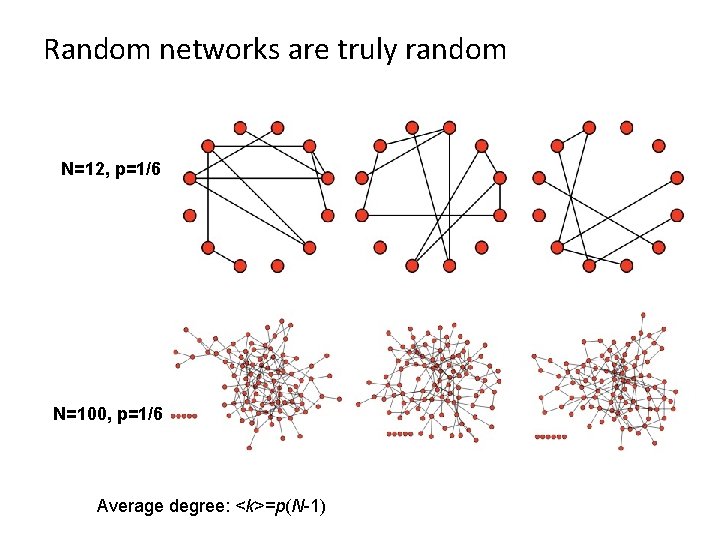
Random networks are truly random N=12, p=1/6 N=100, p=1/6 Average degree: <k>=p(N-1)
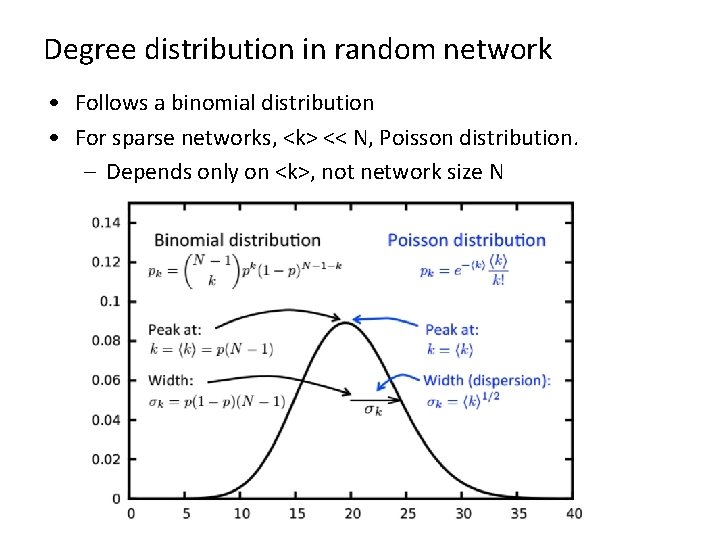
Degree distribution in random network • Follows a binomial distribution • For sparse networks, <k> << N, Poisson distribution. – Depends only on <k>, not network size N
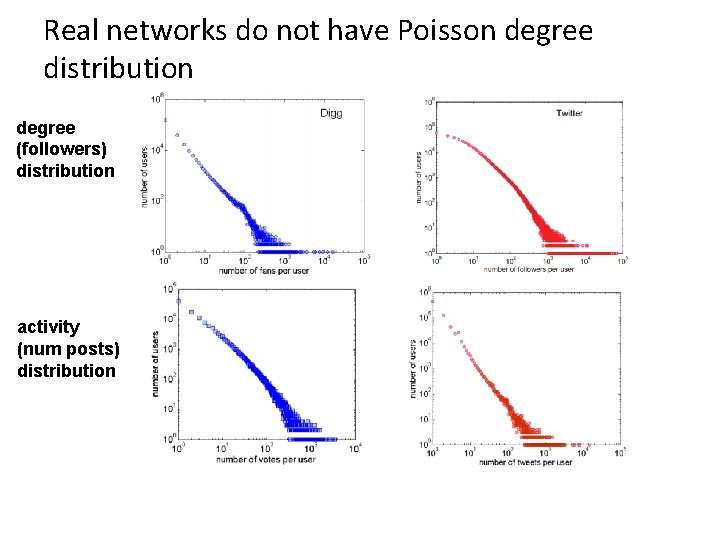
Real networks do not have Poisson degree distribution degree (followers) distribution activity (num posts) distribution
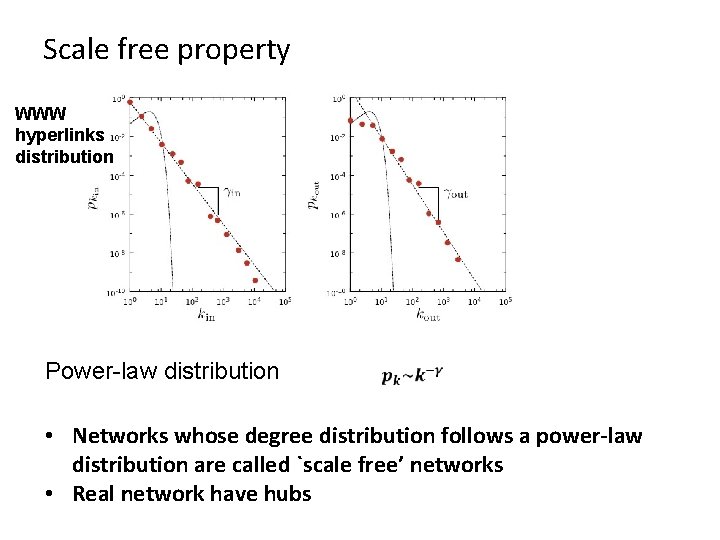
Scale free property WWW hyperlinks distribution Power-law distribution • Networks whose degree distribution follows a power-law distribution are called `scale free’ networks • Real network have hubs
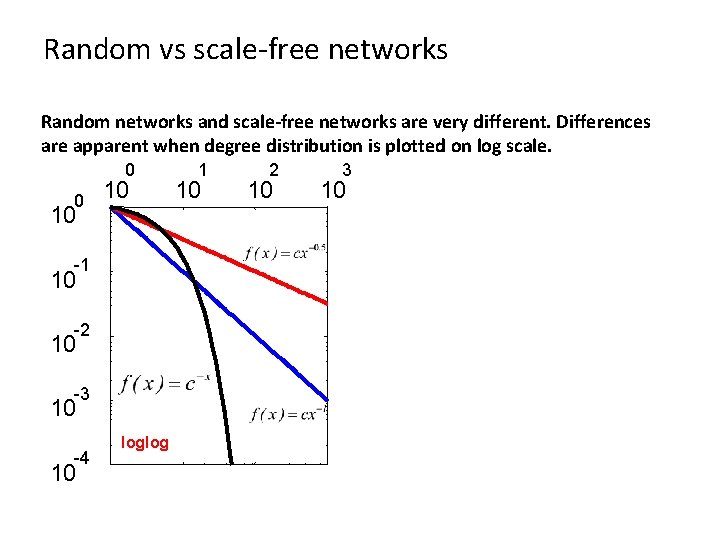
Random vs scale-free networks Random networks and scale-free networks are very different. Differences are apparent when degree distribution is plotted on log scale. 0 0 10 10 -1 10 -2 10 -3 10 -4 10 loglog 1 10 2 10 3 10
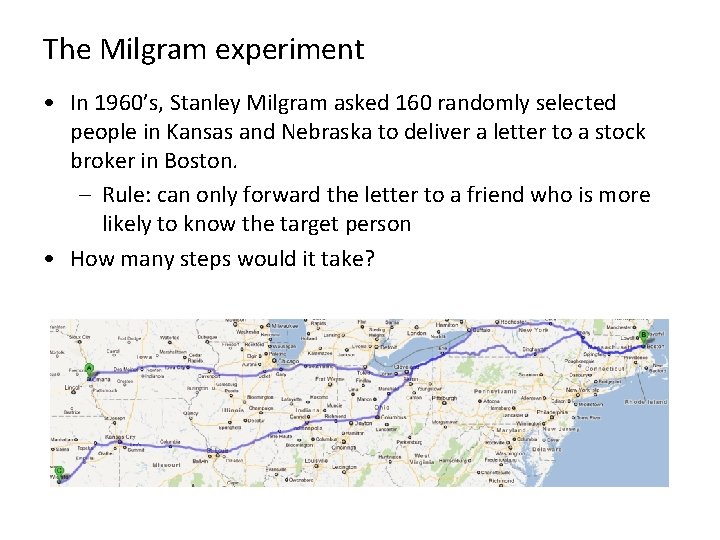
The Milgram experiment • In 1960’s, Stanley Milgram asked 160 randomly selected people in Kansas and Nebraska to deliver a letter to a stock broker in Boston. – Rule: can only forward the letter to a friend who is more likely to know the target person • How many steps would it take?
The Milgram experiment • Within a few days the first letter arrived, passing through only two links. • Eventually 42 of the 160 letters made it to the target, some requiring close to a dozen intermediates. • The median number of steps in completed chains was 5. 5 “six degrees of separation”
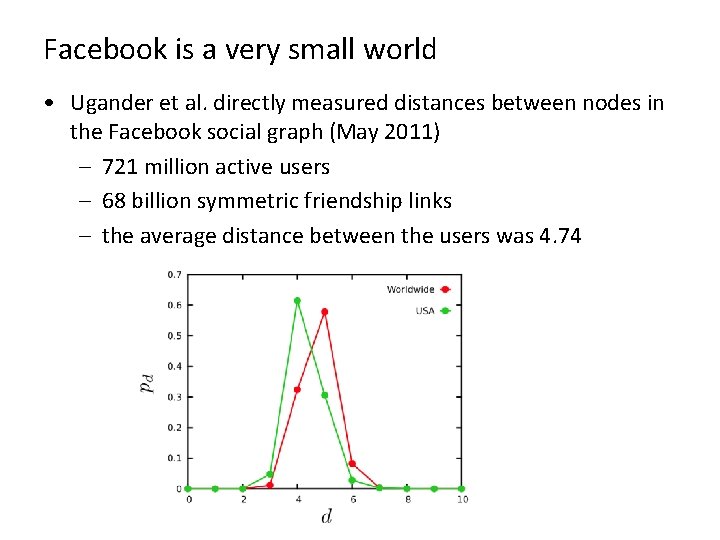
Facebook is a very small world • Ugander et al. directly measured distances between nodes in the Facebook social graph (May 2011) – 721 million active users – 68 billion symmetric friendship links – the average distance between the users was 4. 74
Small world property • Distance between any two nodes in a network is surprisingly short – “six degrees of separation”: you can reach any other individual in the world through a short sequence of intermediaries • What is small? – Consider a random network with average degree <k> – Expected number of nodes a distance d is N(d)~<k>d – Diameter dmax ~ log N/log <k> – Random networks are small
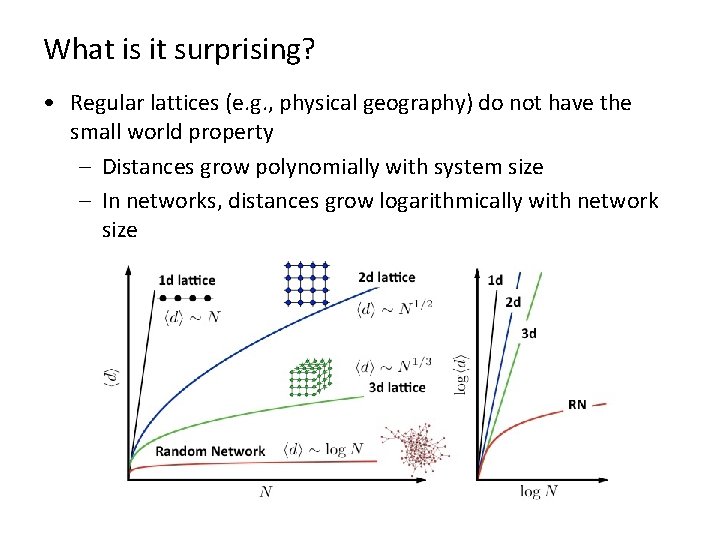
What is it surprising? • Regular lattices (e. g. , physical geography) do not have the small world property – Distances grow polynomially with system size – In networks, distances grow logarithmically with network size
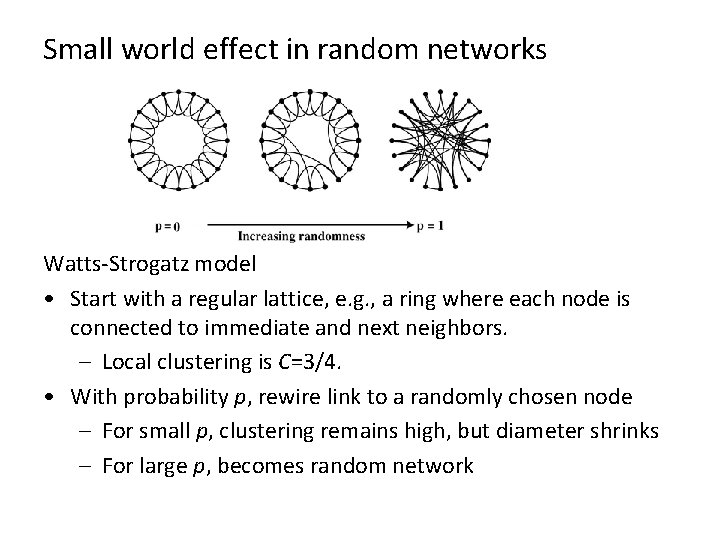
Small world effect in random networks Watts-Strogatz model • Start with a regular lattice, e. g. , a ring where each node is connected to immediate and next neighbors. – Local clustering is C=3/4. • With probability p, rewire link to a randomly chosen node – For small p, clustering remains high, but diameter shrinks – For large p, becomes random network
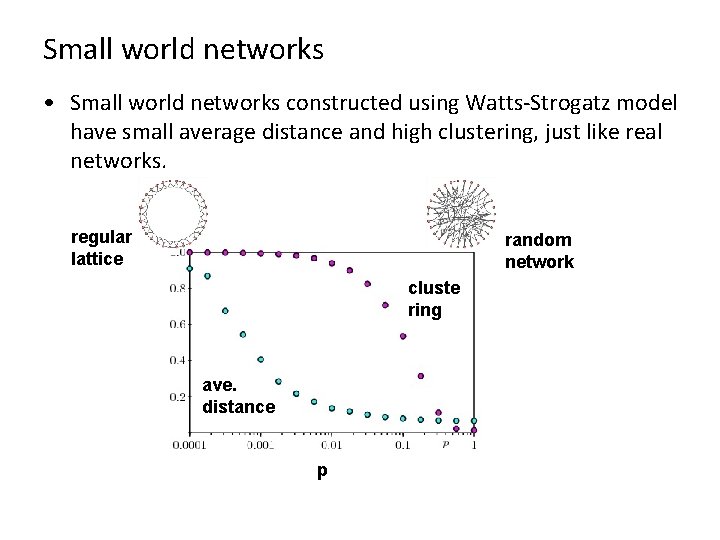
Small world networks • Small world networks constructed using Watts-Strogatz model have small average distance and high clustering, just like real networks. regular lattice random network cluste ring ave. distance p
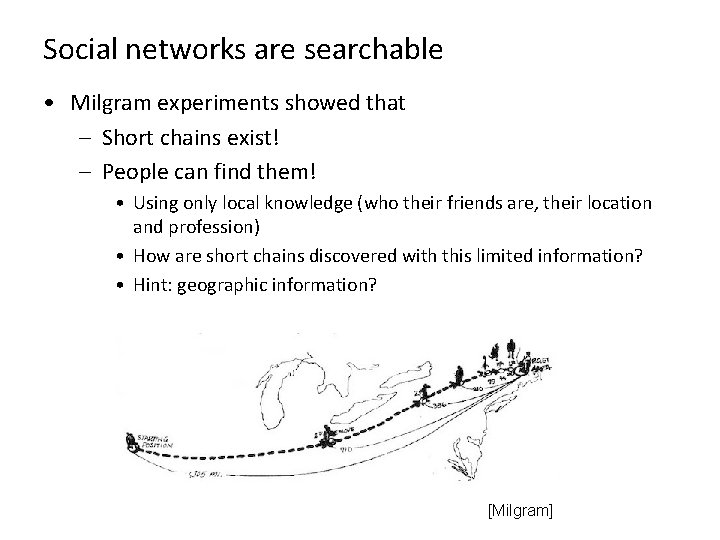
Social networks are searchable • Milgram experiments showed that – Short chains exist! – People can find them! • Using only local knowledge (who their friends are, their location and profession) • How are short chains discovered with this limited information? • Hint: geographic information? [Milgram]
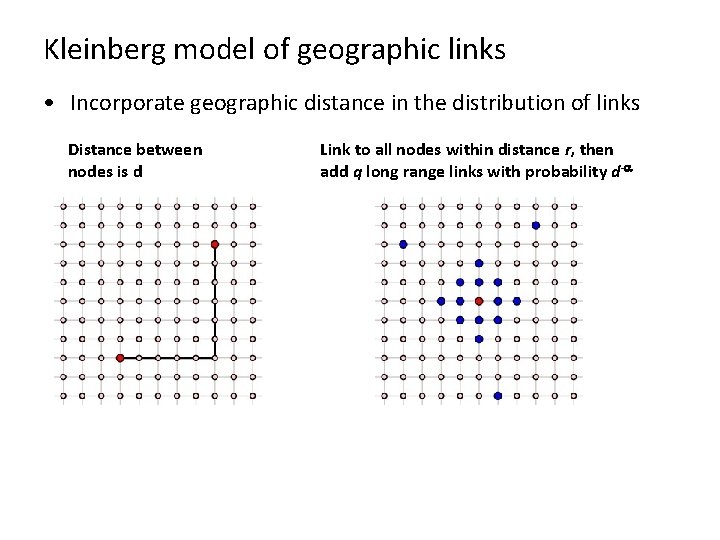
Kleinberg model of geographic links • Incorporate geographic distance in the distribution of links Distance between nodes is d Link to all nodes within distance r, then add q long range links with probability d-a
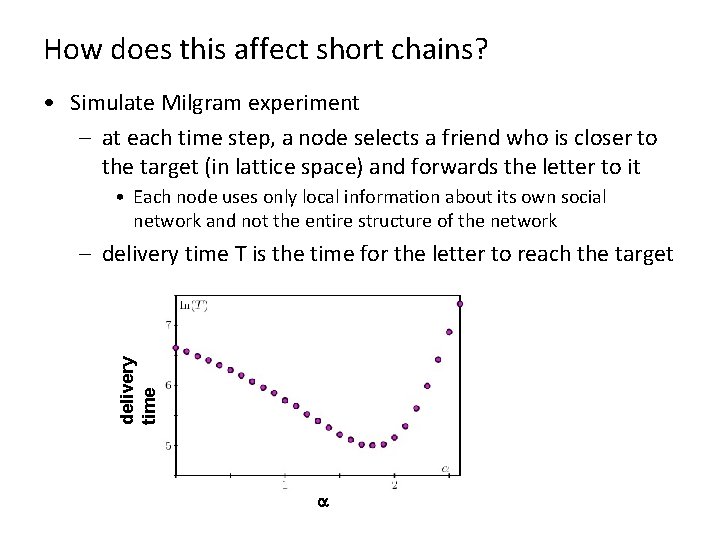
How does this affect short chains? • Simulate Milgram experiment – at each time step, a node selects a friend who is closer to the target (in lattice space) and forwards the letter to it • Each node uses only local information about its own social network and not the entire structure of the network delivery time – delivery time T is the time for the letter to reach the target a
Kleinberg’s analysis • Network is only searchable when a=2 – i. e. , probability to form a link drops as square of distance – Average delivery time is at most proportional to (log N)2 • For other values of a, the average chain length produced by search algorithm is at least Nb.
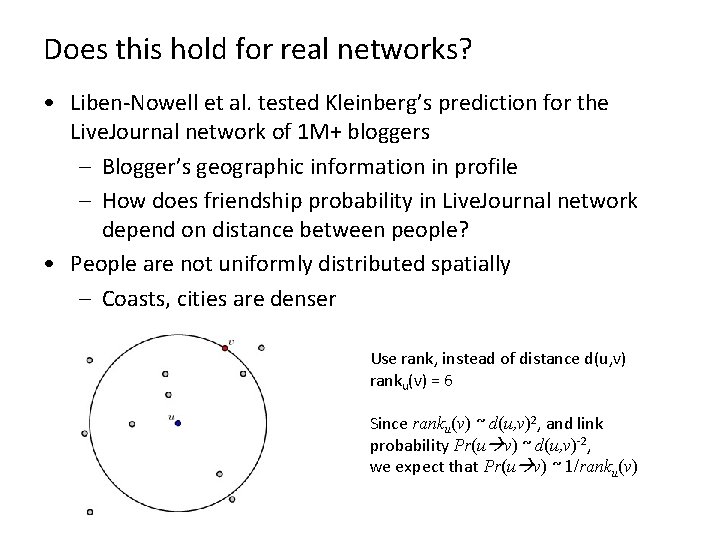
Does this hold for real networks? • Liben-Nowell et al. tested Kleinberg’s prediction for the Live. Journal network of 1 M+ bloggers – Blogger’s geographic information in profile – How does friendship probability in Live. Journal network depend on distance between people? • People are not uniformly distributed spatially – Coasts, cities are denser Use rank, instead of distance d(u, v) ranku(v) = 6 Since ranku(v) ~ d(u, v)2, and link probability Pr(u v) ~ d(u, v)-2, we expect that Pr(u v) ~ 1/ranku(v)
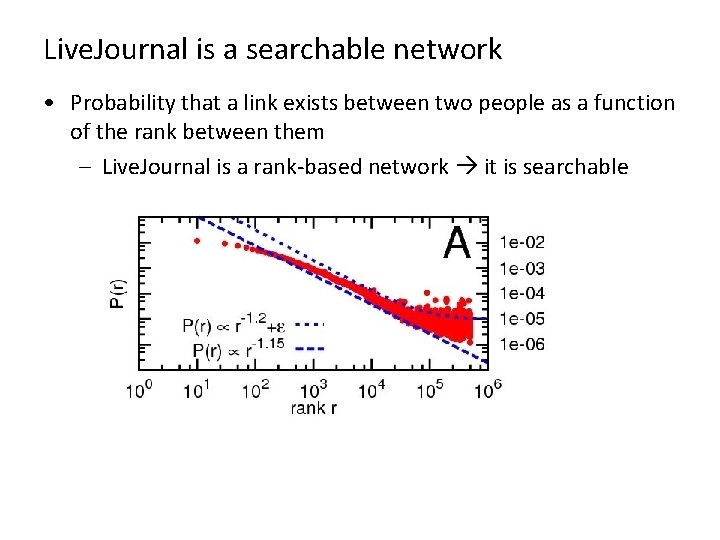
Live. Journal is a searchable network • Probability that a link exists between two people as a function of the rank between them – Live. Journal is a rank-based network it is searchable
- Slides: 36