
The Basics of Gene Expression By Sarina Lalla
The Basics of Gene Expression By Sarina Lalla B. Ed. Secondary Science Education Mc. Gill University
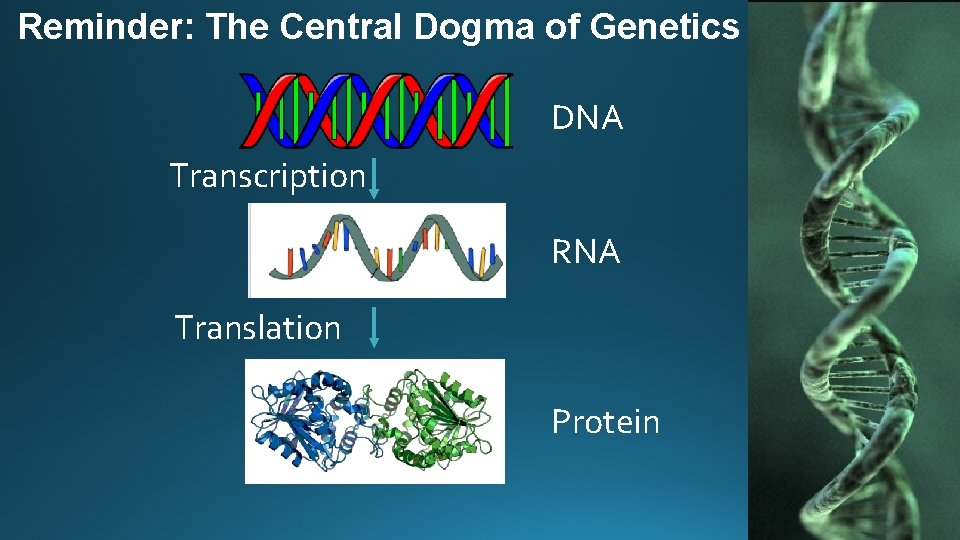
Reminder: The Central Dogma of Genetics DNA Transcription RNA Translation Protein
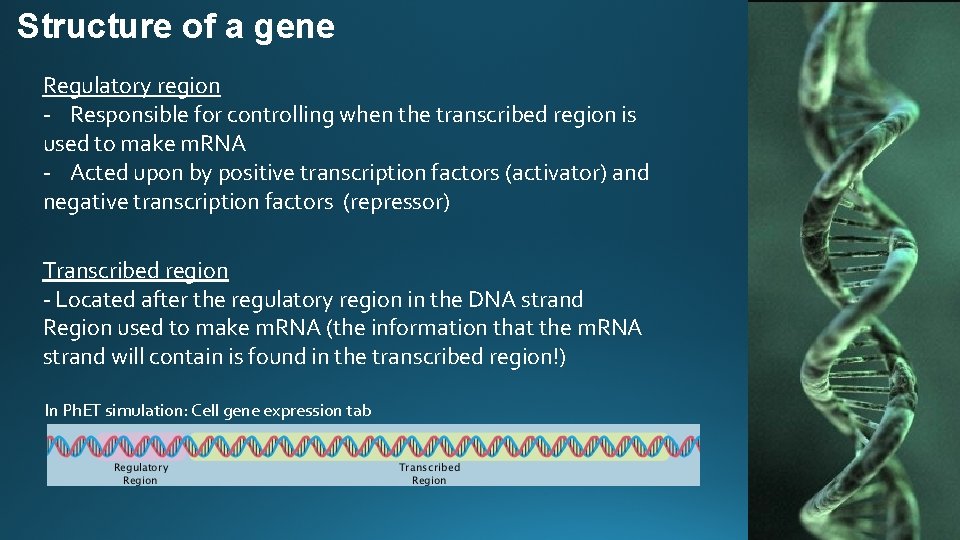
Structure of a gene Regulatory region - Responsible for controlling when the transcribed region is used to make m. RNA - Acted upon by positive transcription factors (activator) and negative transcription factors (repressor) Transcribed region - Located after the regulatory region in the DNA strand Region used to make m. RNA (the information that the m. RNA strand will contain is found in the transcribed region!) In Ph. ET simulation: Cell gene expression tab
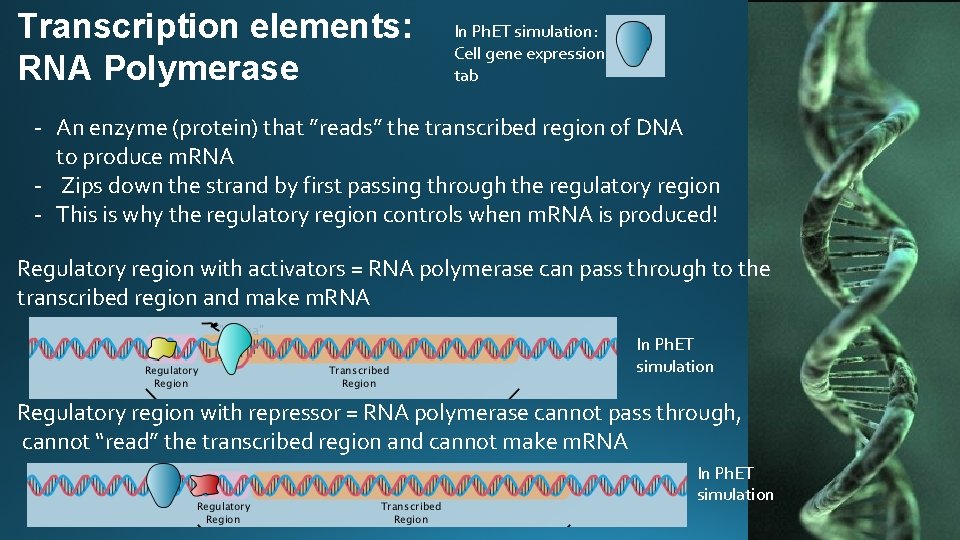
Transcription elements: RNA Polymerase In Ph. ET simulation: Cell gene expression tab - An enzyme (protein) that ”reads” the transcribed region of DNA to produce m. RNA - Zips down the strand by first passing through the regulatory region - This is why the regulatory region controls when m. RNA is produced! Regulatory region with activators = RNA polymerase can pass through to the transcribed region and make m. RNA In Ph. ET simulation Regulatory region with repressor = RNA polymerase cannot pass through, cannot “read” the transcribed region and cannot make m. RNA In Ph. ET simulation
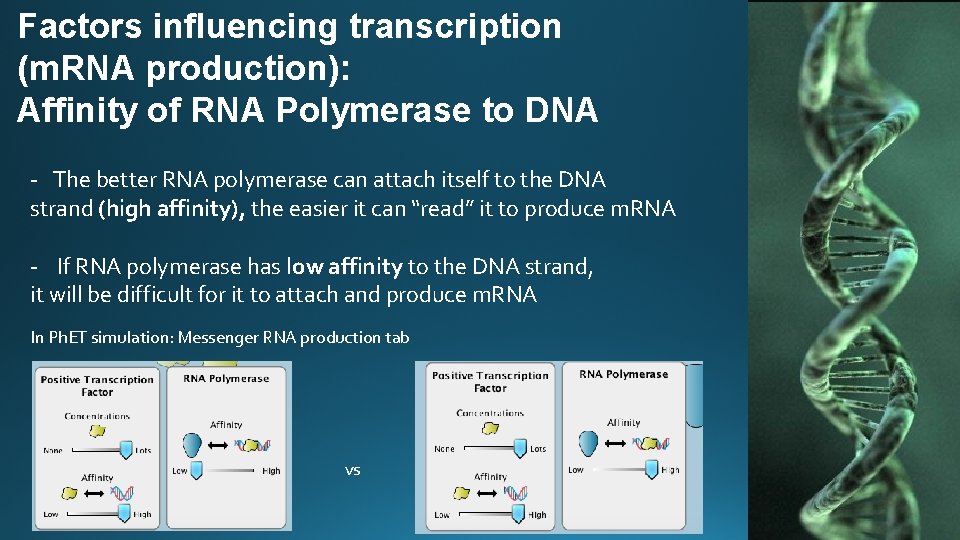
Factors influencing transcription (m. RNA production): Affinity of RNA Polymerase to DNA - The better RNA polymerase can attach itself to the DNA strand (high affinity), the easier it can “read” it to produce m. RNA - If RNA polymerase has low affinity to the DNA strand, it will be difficult for it to attach and produce m. RNA In Ph. ET simulation: Messenger RNA production tab vs
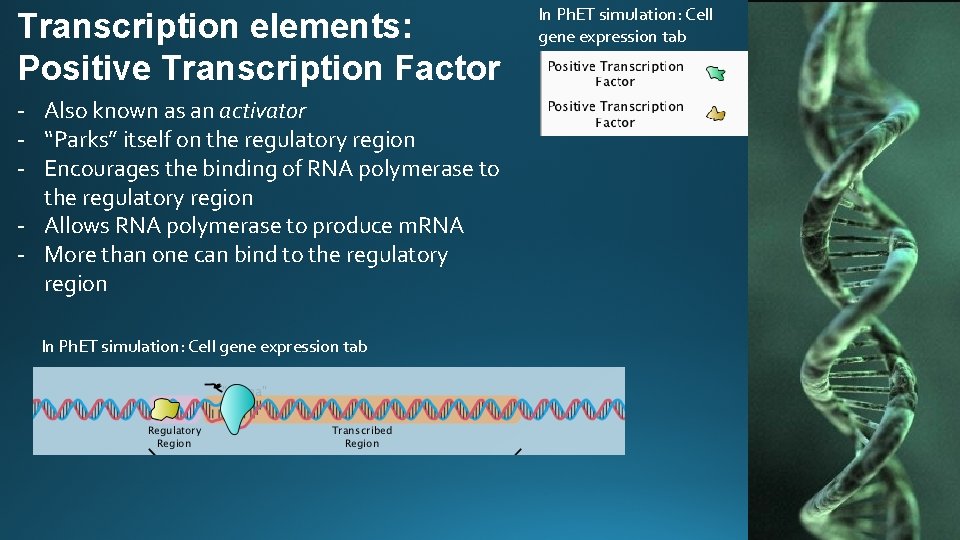
Transcription elements: Positive Transcription Factor - Also known as an activator - “Parks” itself on the regulatory region - Encourages the binding of RNA polymerase to the regulatory region - Allows RNA polymerase to produce m. RNA - More than one can bind to the regulatory region In Ph. ET simulation: Cell gene expression tab
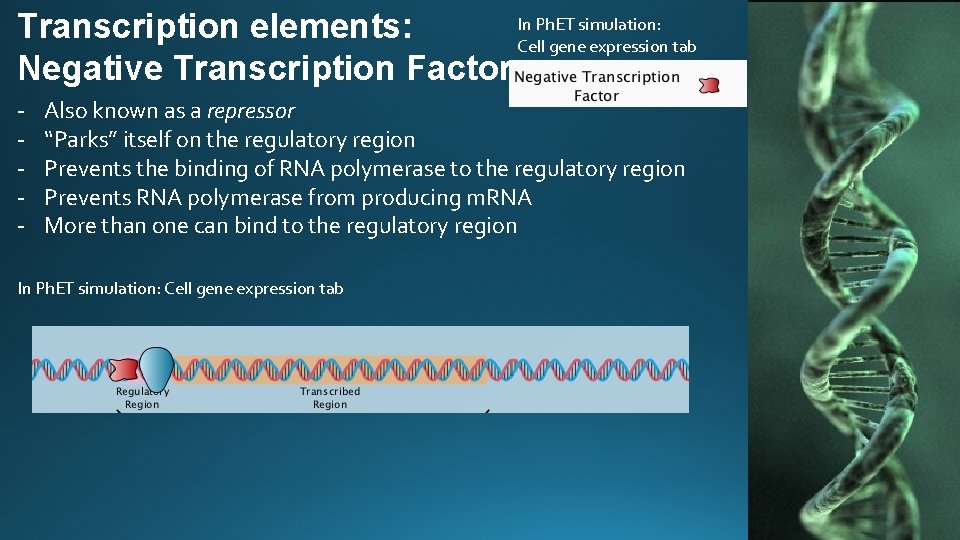
In Ph. ET simulation: Transcription elements: Cell gene expression tab Negative Transcription Factor - Also known as a repressor “Parks” itself on the regulatory region Prevents the binding of RNA polymerase to the regulatory region Prevents RNA polymerase from producing m. RNA More than one can bind to the regulatory region In Ph. ET simulation: Cell gene expression tab
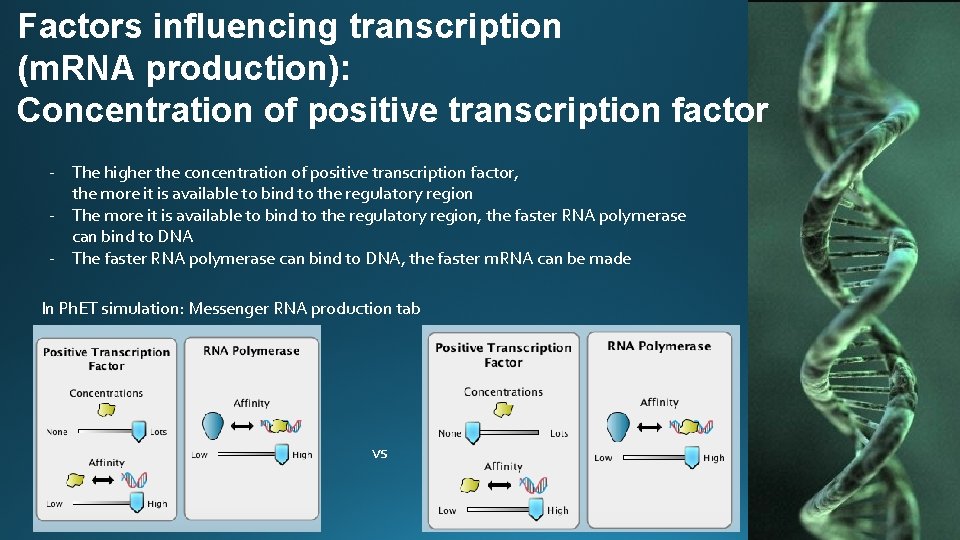
Factors influencing transcription (m. RNA production): Concentration of positive transcription factor - The higher the concentration of positive transcription factor, the more it is available to bind to the regulatory region - The more it is available to bind to the regulatory region, the faster RNA polymerase can bind to DNA - The faster RNA polymerase can bind to DNA, the faster m. RNA can be made In Ph. ET simulation: Messenger RNA production tab vs
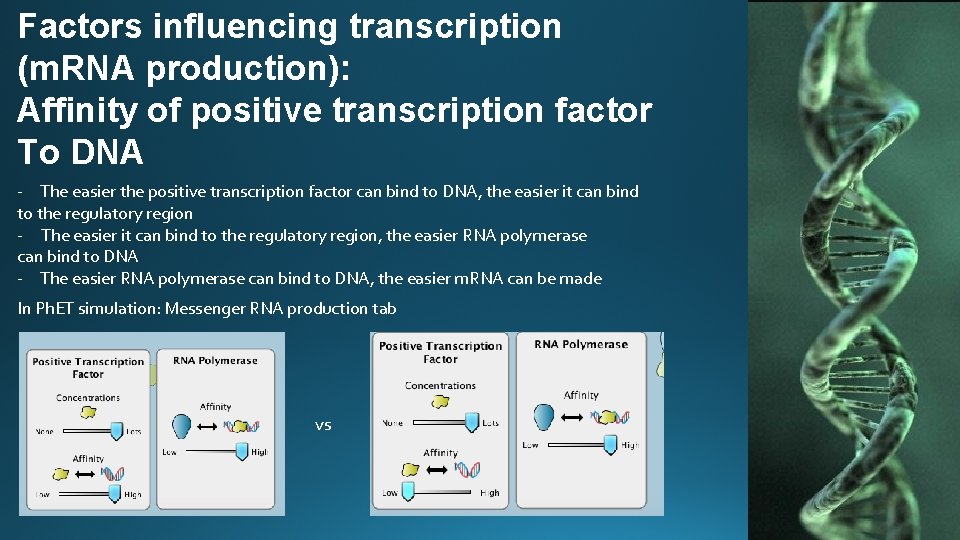
Factors influencing transcription (m. RNA production): Affinity of positive transcription factor To DNA - The easier the positive transcription factor can bind to DNA, the easier it can bind to the regulatory region - The easier it can bind to the regulatory region, the easier RNA polymerase can bind to DNA - The easier RNA polymerase can bind to DNA, the easier m. RNA can be made In Ph. ET simulation: Messenger RNA production tab vs
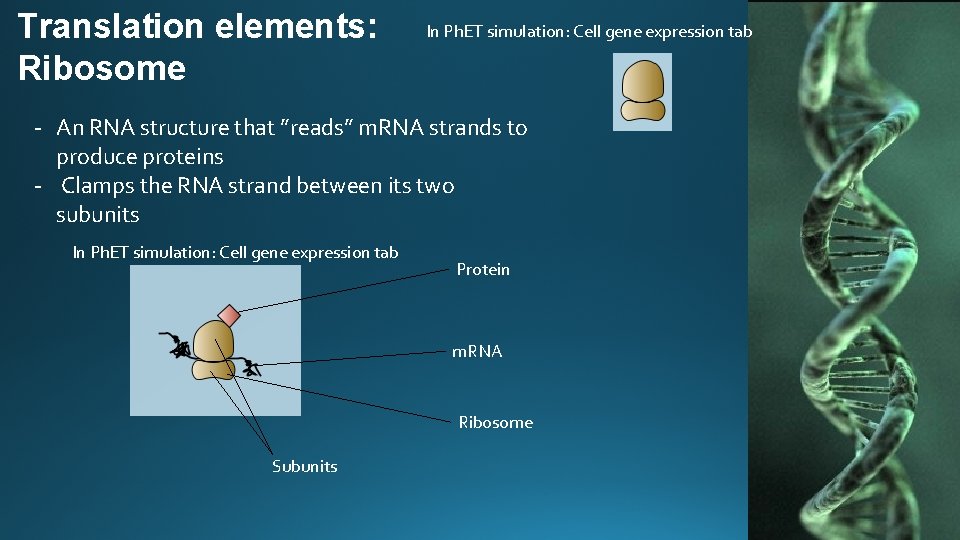
Translation elements: Ribosome In Ph. ET simulation: Cell gene expression tab - An RNA structure that ”reads” m. RNA strands to produce proteins - Clamps the RNA strand between its two subunits In Ph. ET simulation: Cell gene expression tab Protein m. RNA Ribosome Subunits
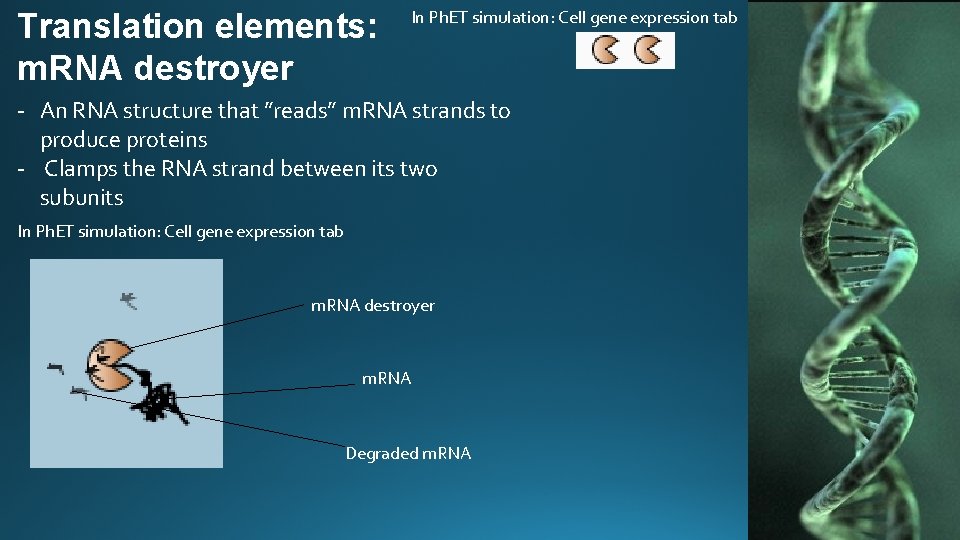
Translation elements: m. RNA destroyer In Ph. ET simulation: Cell gene expression tab - An RNA structure that ”reads” m. RNA strands to produce proteins - Clamps the RNA strand between its two subunits In Ph. ET simulation: Cell gene expression tab m. RNA destroyer m. RNA Degraded m. RNA
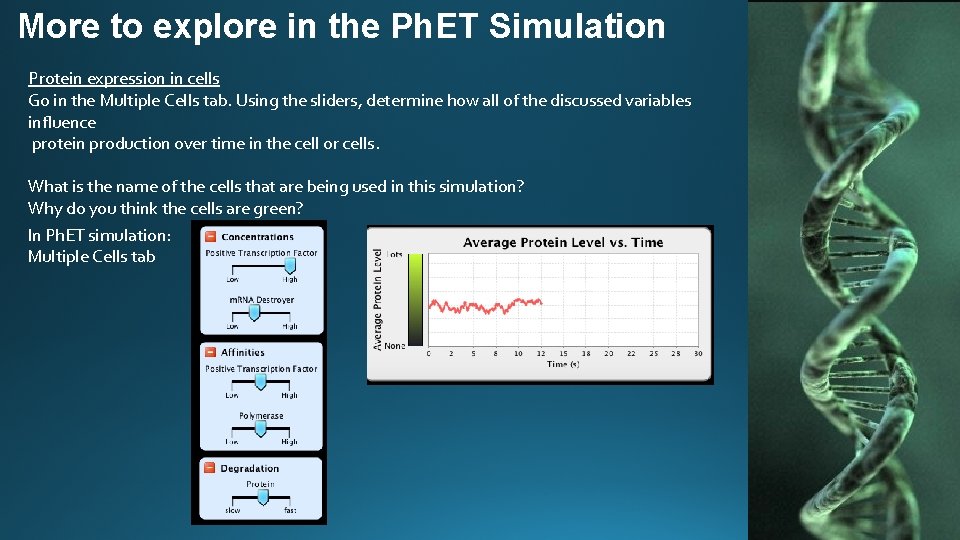
More to explore in the Ph. ET Simulation Protein expression in cells Go in the Multiple Cells tab. Using the sliders, determine how all of the discussed variables influence protein production over time in the cell or cells. What is the name of the cells that are being used in this simulation? Why do you think the cells are green? In Ph. ET simulation: Multiple Cells tab
B 0006092 DNA double helix illustration Spooky Pooka, Creative Commons Attribution-Non. Commercial-No. Derivs 2. 0 Generic Beaker DNA Open. Clipart-Vectors Clker-Free-Vector-Images, DNA vs RNA Mc. Gill Co. A Zappys Technology Solutions Waov 12
- Slides: 13