
The Basics of Digital Signal Processing Tth Lszl
The Basics of Digital Signal Processing Tóth László Számítógépes Algoritmusok és Mesterséges Intelligencia Tanszék
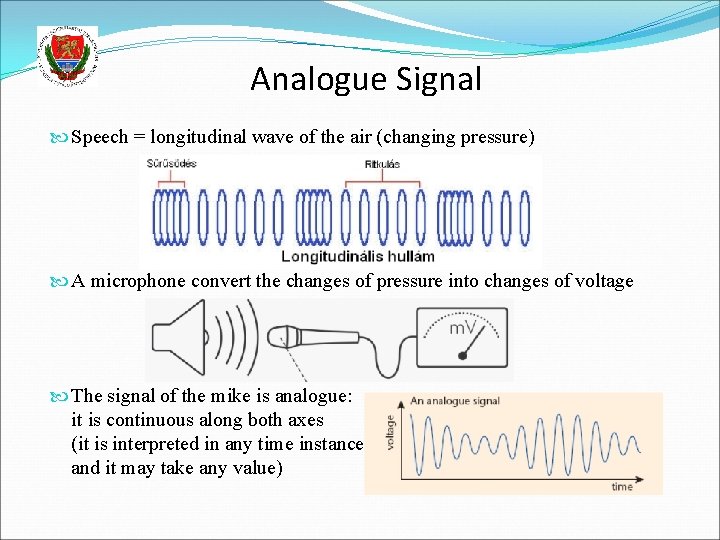
Analogue Signal Speech = longitudinal wave of the air (changing pressure) A microphone convert the changes of pressure into changes of voltage The signal of the mike is analogue: it is continuous along both axes (it is interpreted in any time instance and it may take any value)
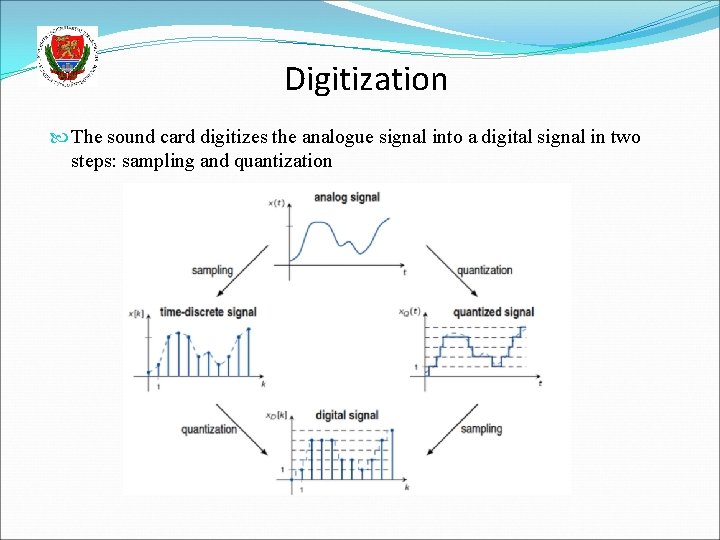
Digitization The sound card digitizes the analogue signal into a digital signal in two steps: sampling and quantization
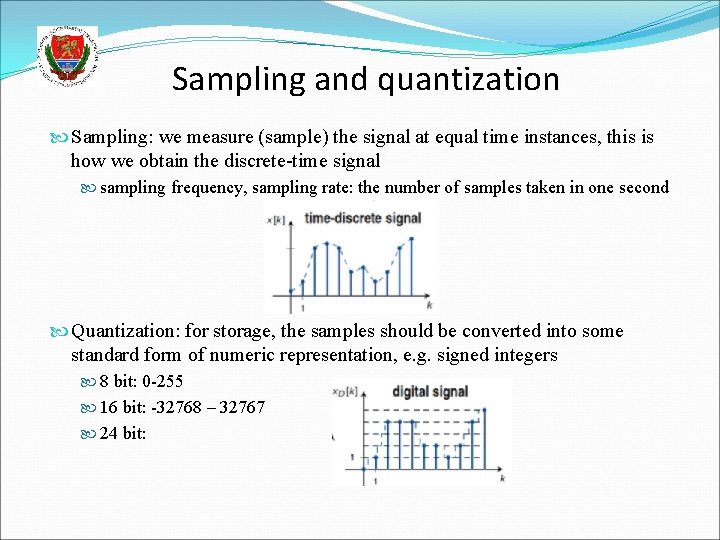
Sampling and quantization Sampling: we measure (sample) the signal at equal time instances, this is how we obtain the discrete-time signal sampling frequency, sampling rate: the number of samples taken in one second Quantization: for storage, the samples should be converted into some standard form of numeric representation, e. g. signed integers 8 bit: 0 -255 16 bit: -32768 – 32767 24 bit:
How many bits for quantization? The rounding error of quantiazion cannot be reconstructed But we can increase the resolution relatively cheaply: adding 1 bit increases doubles the number of different values that we can represent The number of quantization bits defines the dynamic range that we can represent (the difference between the loudest and softest sound we can store) If the sound is too soft 0 0 0 If teh sound is too loud max max (cutting occurs) Storing the softest sound that can be heard and the loudest that we can bear without injury would require 20 bits The dynamic range of speech is 11 -12 bits audio CD: 16 bits professional studio tools: 24 bits Remark: during signal processing we requentl apply a floating point representation (eg. 4 -byte float)
Sampling During the sampling process we lose the values that fall between samples Compared to quantization, saimpling is more „expensive”: if we double the sampling rate, the data amount also doubles Can the original continuous signal be reconstructed from the samples? How should we select the optimal sampling rate? The above two questions are answered by the sampling theorem But for that, we should first get familiar with the Fourier-transform
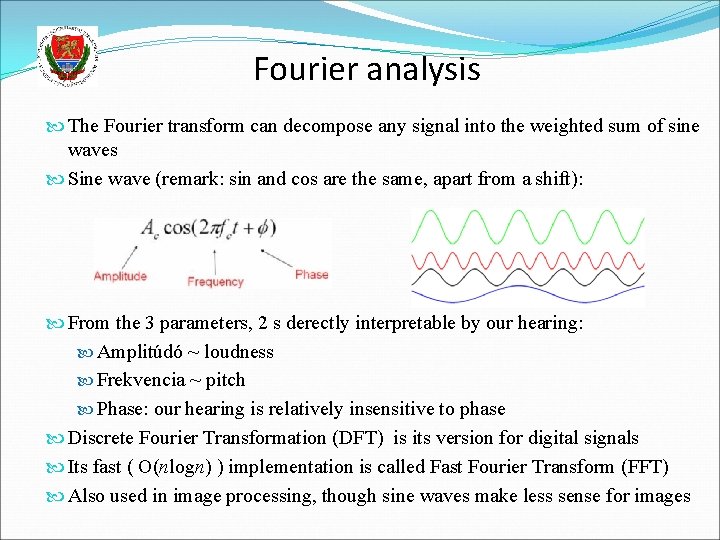
Fourier analysis The Fourier transform can decompose any signal into the weighted sum of sine waves Sine wave (remark: sin and cos are the same, apart from a shift): From the 3 parameters, 2 s derectly interpretable by our hearing: Amplitúdó ~ loudness Frekvencia ~ pitch Phase: our hearing is relatively insensitive to phase Discrete Fourier Transformation (DFT) is its version for digital signals Its fast ( O(nlogn) ) implementation is called Fast Fourier Transform (FFT) Also used in image processing, though sine waves make less sense for images
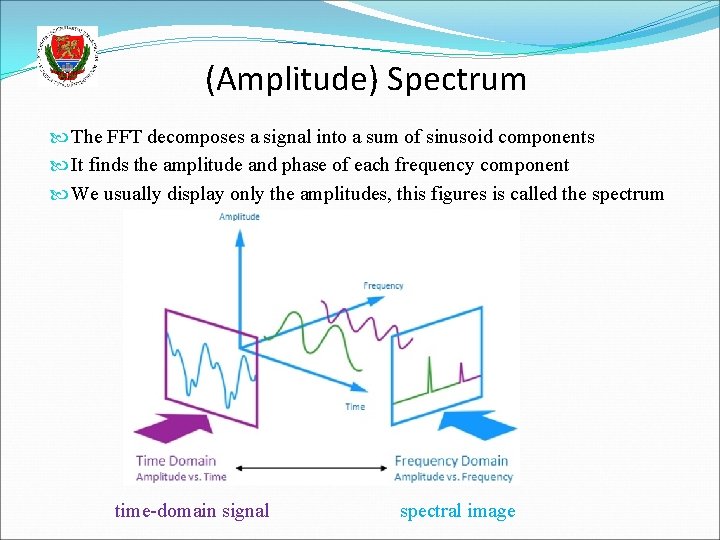
(Amplitude) Spectrum The FFT decomposes a signal into a sum of sinusoid components It finds the amplitude and phase of each frequency component We usually display only the amplitudes, this figures is called the spectrum time-domain signal spectral image
The sampling theorem A continuous signal can be reconstructed from the discrete samples, if The signal is bandlimited (taking its Fourier transform, the will be a frequency f c so that for all larges frequencies the amplitude is 0) The sampling frequency fs is selected so that fs>2 fc In practice theorem gives us two options: We indeed find the largest frequency component fc , and adjust fs accordingly If there is no such fc, or it is higher than fs /2 for the fs we intend to use , then we can still use it, but we should discard any component above fs /2 Selecting fs in the case of music or speech: The upper limit of human hearing is about 18000 -20000 Hz (worsens with age) Audio CDs use a sampling rate of 44100 Hz, studio tools use 48000 Hz (or even 96000 Hz) In speech, the highest frequency component is about 6 -8 k. Hz, sof for speech a sampling rate of 16 k. Hz is sufficient But we can also go lower, for example, phones use a sampling rate of 8 k. Hz, so they transfer only up to 4 k. Hz slightly distorted, but intelligible
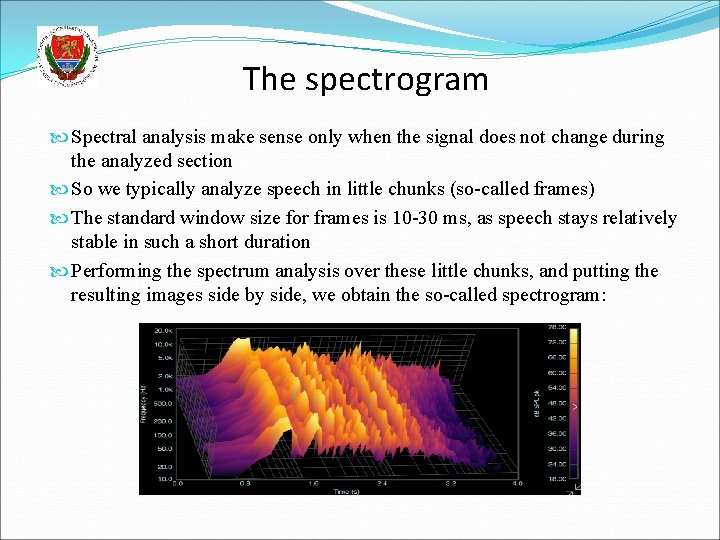
The spectrogram Spectral analysis make sense only when the signal does not change during the analyzed section So we typically analyze speech in little chunks (so-called frames) The standard window size for frames is 10 -30 ms, as speech stays relatively stable in such a short duration Performing the spectrum analysis over these little chunks, and putting the resulting images side by side, we obtain the so-called spectrogram:
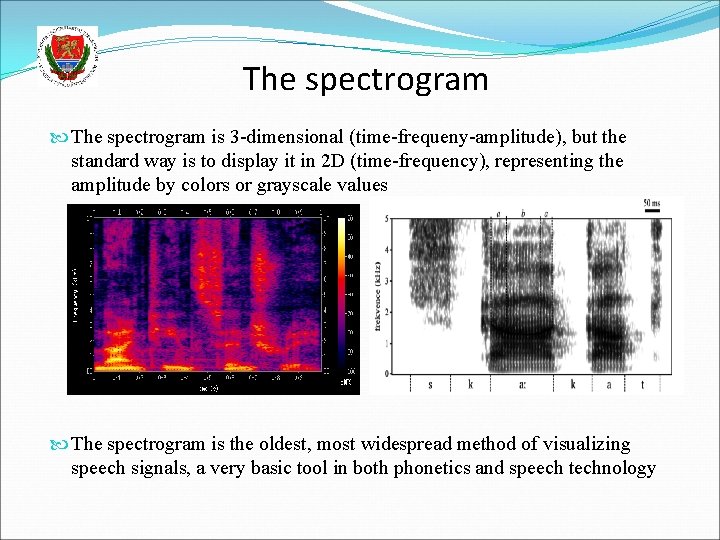
The spectrogram is 3 -dimensional (time-frequeny-amplitude), but the standard way is to display it in 2 D (time-frequency), representing the amplitude by colors or grayscale values The spectrogram is the oldest, most widespread method of visualizing speech signals, a very basic tool in both phonetics and speech technology
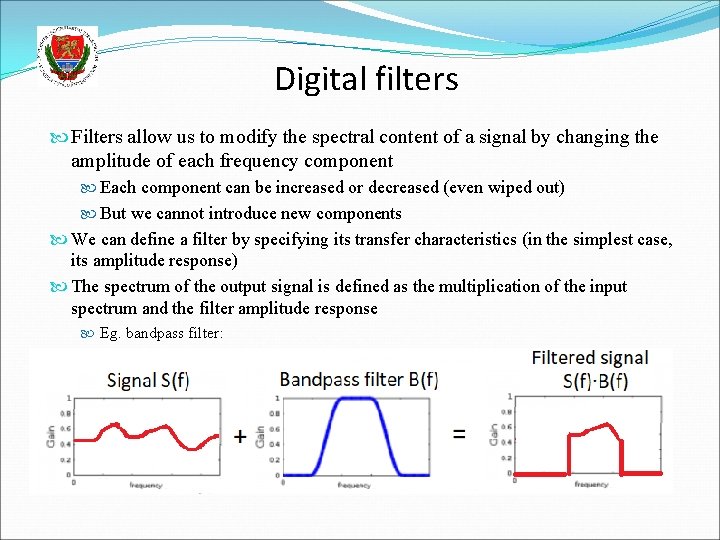
Digital filters Filters allow us to modify the spectral content of a signal by changing the amplitude of each frequency component Each component can be increased or decreased (even wiped out) But we cannot introduce new components We can define a filter by specifying its transfer characteristics (in the simplest case, its amplitude response) The spectrum of the output signal is defined as the multiplication of the input spectrum and the filter amplitude response Eg. bandpass filter:
- Slides: 12