
THE BASICS OF CREDIT WHAT IS CREDIT The
THE BASICS OF CREDIT

WHAT IS CREDIT? The dictionary defines credit as “confidence in a purchaser’s ability and intention to pay, displayed by entrusting the buyer with goods or services without immediate payment. ” But what does that really mean? Simply put, credit is a measure of how likely you are to pay something back. When you buy a car without paying for all of it at once, your credit tells the bank if you can be trusted with a loan. Good Credit = Easy to Trust Bad Credit = Hard to Trust

WHY CREDIT IS IMPORTANT FICO or credit score: Credit Card Issuers & Lenders Determine APR (Annual Percentage Rate) Auto Insurers Determine Premium Employers Are you a worthy hire? Landlords Are you a reliable tenant?
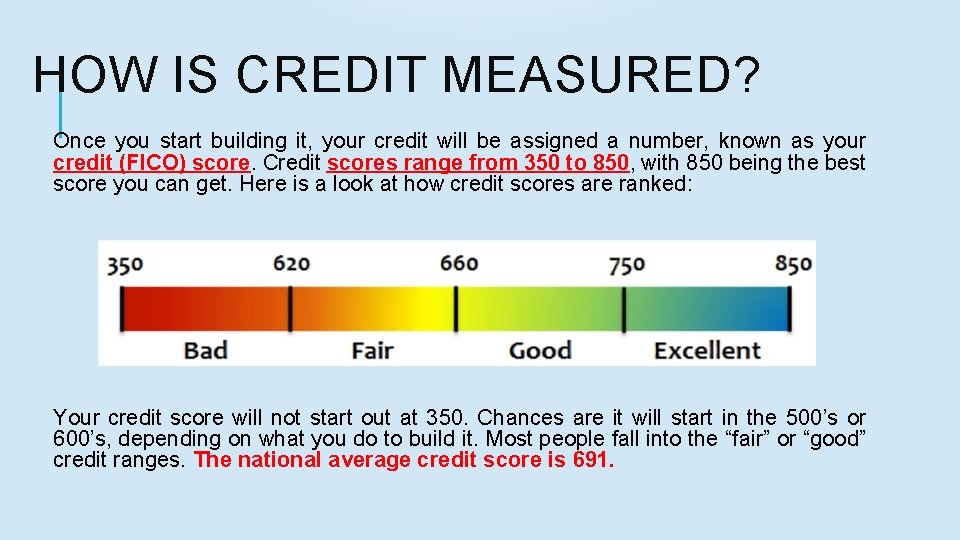
HOW IS CREDIT MEASURED? Once you start building it, your credit will be assigned a number, known as your credit (FICO) score. Credit scores range from 350 to 850, with 850 being the best score you can get. Here is a look at how credit scores are ranked: Your credit score will not start out at 350. Chances are it will start in the 500’s or 600’s, depending on what you do to build it. Most people fall into the “fair” or “good” credit ranges. The national average credit score is 691.
HOW CAN I BUILD GOOD CREDIT? Building good credit is an important part of being an adult. Even if you never need to get a loan, you can use a good credit score to get discounts on phones, clothing, electronics, and more. There are several ways to build good credit, and one is no better than the others. You could… – Make payments on a credit card. – Make payments on a small loan. – Make payments on a piece of furniture. – Make payments on a house (not in rent). You get the idea. Everything revolves around paying someone for something. In order to build credit, you have to find people that will trust you with a small amount of money. If you pay that back on time, you will get a good mark and a higher score.
WHY DO SOME PEOPLE HAVE BAD CREDIT? Bad credit comes from not making payments on time. It has nothing to do with how much money you owe in loans and credit cards. You can be in a lot of debt and still have a good credit score if you are making all of your payments on time. Factors that lead to bad credit include: – Missed payments – Payments that are too low – Outstanding debts (Those that you have not paid for a long time) – Excessive credit inquiries (Too many people looking at your credit) – Car repossessions (You lost your car because you couldn’t pay for it) – Home foreclosures (You lost your house because you couldn’t pay for it)
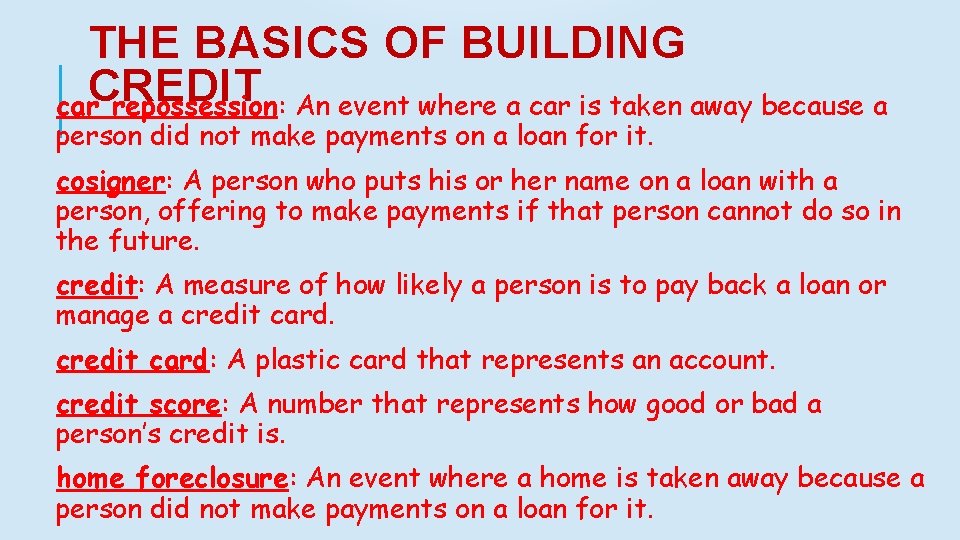
THE BASICS OF BUILDING CREDIT car repossession: An event where a car is taken away because a person did not make payments on a loan for it. cosigner: A person who puts his or her name on a loan with a person, offering to make payments if that person cannot do so in the future. credit: A measure of how likely a person is to pay back a loan or manage a credit card: A plastic card that represents an account. credit score: A number that represents how good or bad a person’s credit is. home foreclosure: An event where a home is taken away because a person did not make payments on a loan for it.

THE THREE CS OF CREDIT WORTHINESS character—will you repay the debt? From your credit history, does it look like you possess the honesty and reliability to pay credit debts? Have you used credit before? capital—what if you don’t capacity—can you repay the debt? Do you have any valuable assets such as real estate, savings, or investments that could be used to repay credit debts if income is unavailable? What property do you own that can secure the loan? Do you have a good credit report? Do you have a savings account? Can you provide Do you pay your bills on time? character references? How long have you lived at your present address? How long have you been at your present job? Do you have investments to use as collateral? Have you been working regularly in an occupation that is likely to provide enough income to support your credit use? Do you have a steady job? What is your salary? How many other loan payments do you have? What are your current living expenses? What are your current debts? How many dependents do you have?
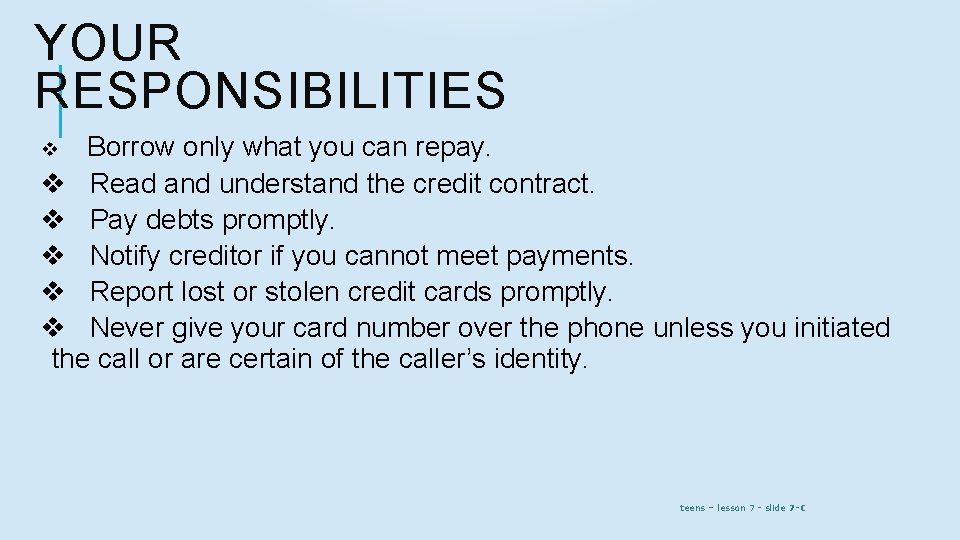
YOUR RESPONSIBILITIES Borrow only what you can repay. v Read and understand the credit contract. v Pay debts promptly. v Notify creditor if you cannot meet payments. v Report lost or stolen credit cards promptly. v Never give your card number over the phone unless you initiated the call or are certain of the caller’s identity. v teens – lesson 7 - slide 7 -C
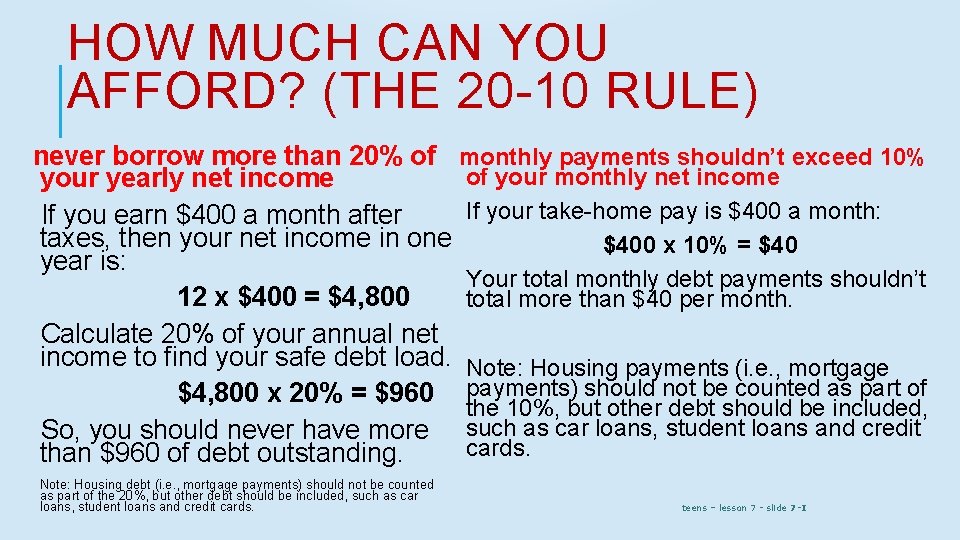
HOW MUCH CAN YOU AFFORD? (THE 20 -10 RULE) never borrow more than 20% of monthly payments shouldn’t exceed 10% of your monthly net income your yearly net income If your take-home pay is $400 a month: If you earn $400 a month after taxes, then your net income in one $400 x 10% = $40 year is: Your total monthly debt payments shouldn’t 12 x $400 = $4, 800 total more than $40 per month. Calculate 20% of your annual net income to find your safe debt load. Note: Housing payments (i. e. , mortgage $4, 800 x 20% = $960 payments) should not be counted as part of the 10%, but other debt should be included, So, you should never have more such as car loans, student loans and credit cards. than $960 of debt outstanding. Note: Housing debt (i. e. , mortgage payments) should not be counted as part of the 20%, but other debt should be included, such as car loans, student loans and credit cards. teens – lesson 7 - slide 7 -I
WHAT NOT TO USE CREDIT FOR: PAY DAY LOANS
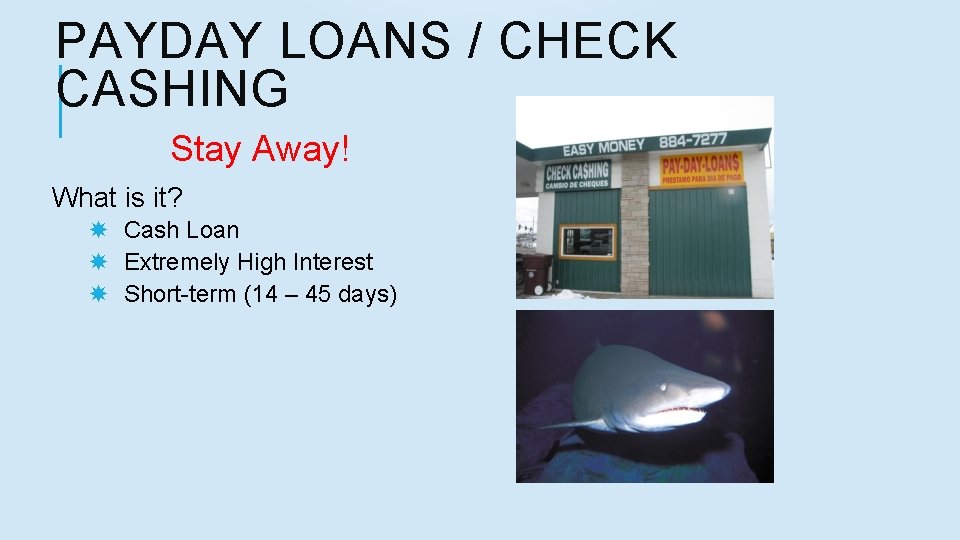
PAYDAY LOANS / CHECK CASHING Stay Away! What is it? Cash Loan Extremely High Interest Short-term (14 – 45 days)
HOW DO THEY WORK? You postdate a check They give you a loan Loan last for 2 weeks They charge you a fee for borrowing the money— equivalent APR can be over 300%.
RISKS OF PAYDAY LOANS Not a long-term cash solution Borrowers get trapped in a payday loan cycle of debt Take out loan after loan
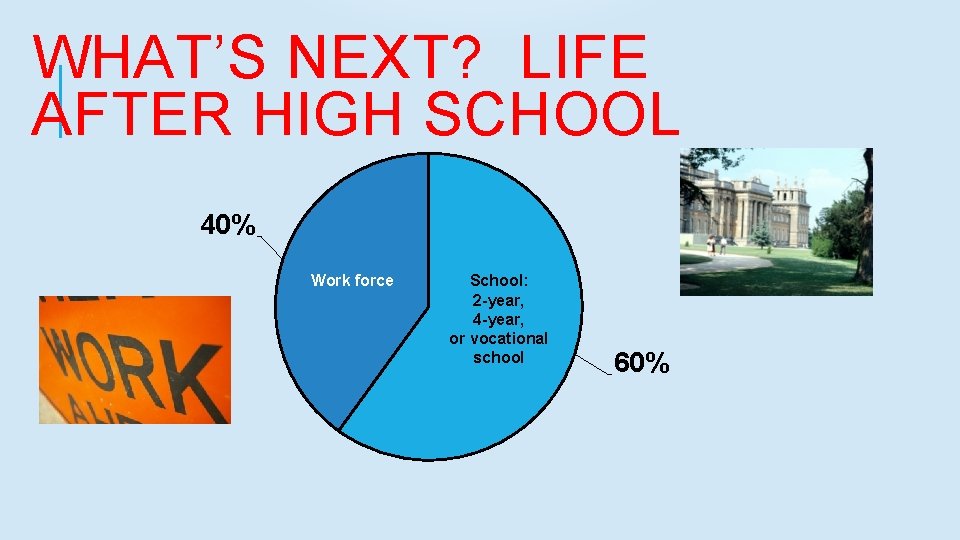
WHAT’S NEXT? LIFE AFTER HIGH SCHOOL 40% Work force School: 2 -year, 4 -year, or vocational school 60%
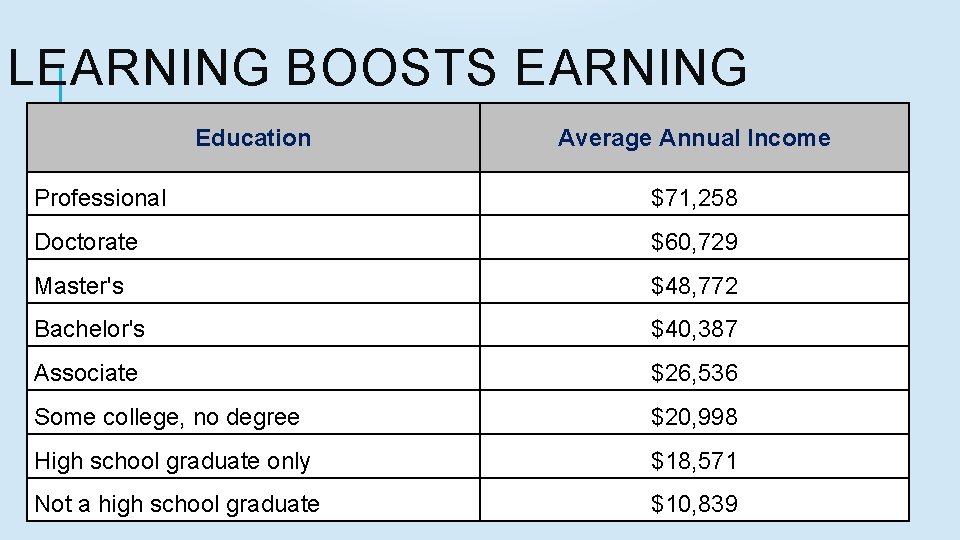
LEARNING BOOSTS EARNING Education Average Annual Income Professional $71, 258 Doctorate $60, 729 Master's $48, 772 Bachelor's $40, 387 Associate $26, 536 Some college, no degree $20, 998 High school graduate only $18, 571 Not a high school graduate $10, 839
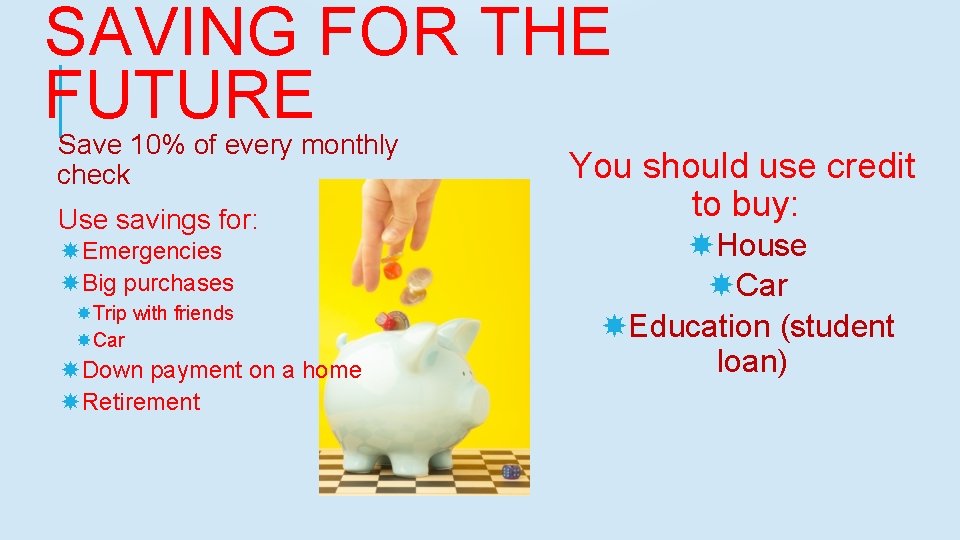
SAVING FOR THE FUTURE Save 10% of every monthly check Use savings for: Emergencies Big purchases Trip with friends Car Down payment on a home Retirement You should use credit to buy: House Car Education (student loan)
SHOPPING FOR A CREDIT CARD
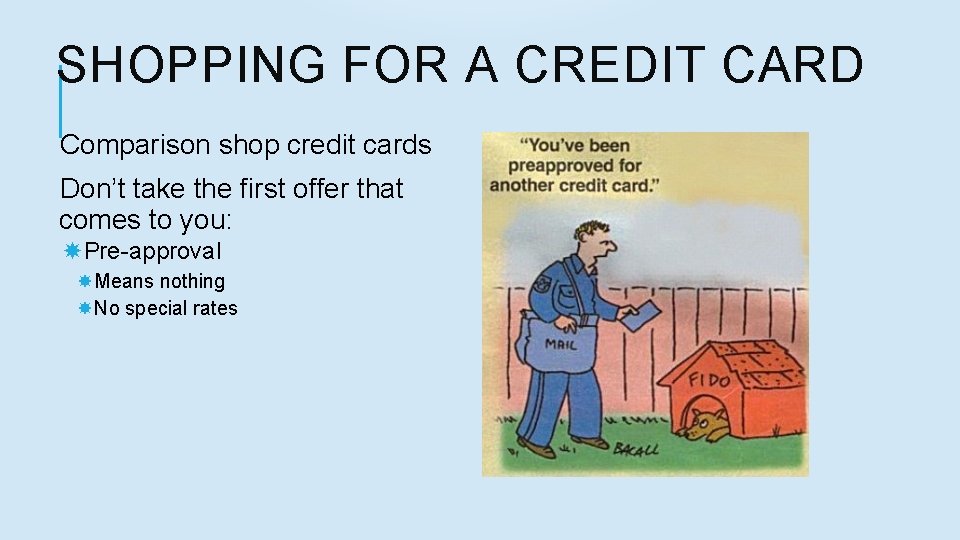
SHOPPING FOR A CREDIT CARD Comparison shop credit cards Don’t take the first offer that comes to you: Pre-approval Means nothing No special rates
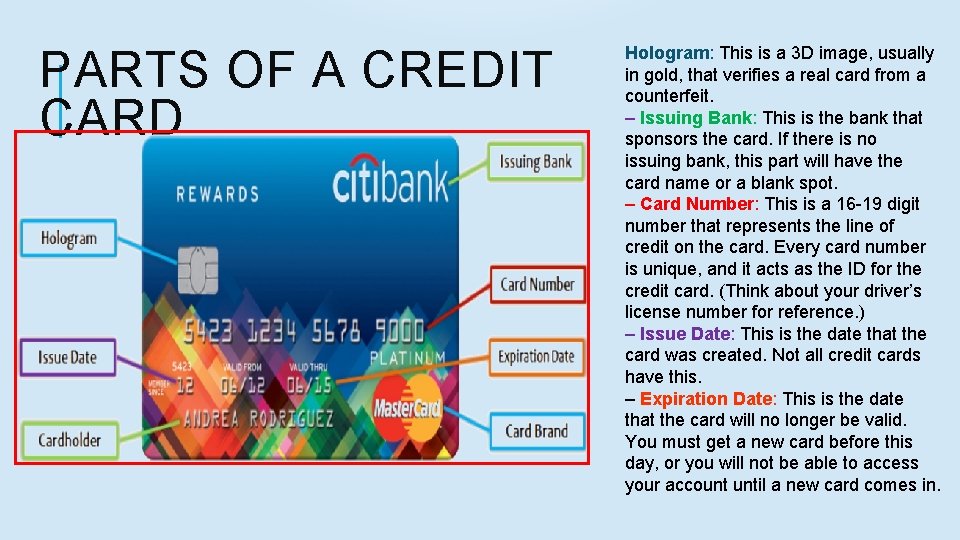
PARTS OF A CREDIT CARD Hologram: This is a 3 D image, usually in gold, that verifies a real card from a counterfeit. – Issuing Bank: This is the bank that sponsors the card. If there is no issuing bank, this part will have the card name or a blank spot. – Card Number: This is a 16 -19 digit number that represents the line of credit on the card. Every card number is unique, and it acts as the ID for the credit card. (Think about your driver’s license number for reference. ) – Issue Date: This is the date that the card was created. Not all credit cards have this. – Expiration Date: This is the date that the card will no longer be valid. You must get a new card before this day, or you will not be able to access your account until a new card comes in.
ADVANTAGES AND DISADVANTAGES OF CREDIT advantages: CARDS disadvantages: Able to buy needed items now Don’t have to carry cash Creates a record of purchases More convenient than writing checks Consolidates bills into one payment On-line purchases Kick-backs i. e. cash, airline miles, etc. Can rent a car Americans have an average of 8 credit cards Interest (higher cost of items) May require additional fees Financial difficulties may arise if one loses track of how much has been spent each month Increased impulse buying may occur 2/3 of credit card users don’t pay off their balance teens – lesson 7 - slide 7 -A
CARD HOLDER AGREEMENT Written statement that gives the terms and conditions of a credit card account. Look here for all info before signing up Required by Federal Reserve Card issuers can change terms at any time with 15 days notice
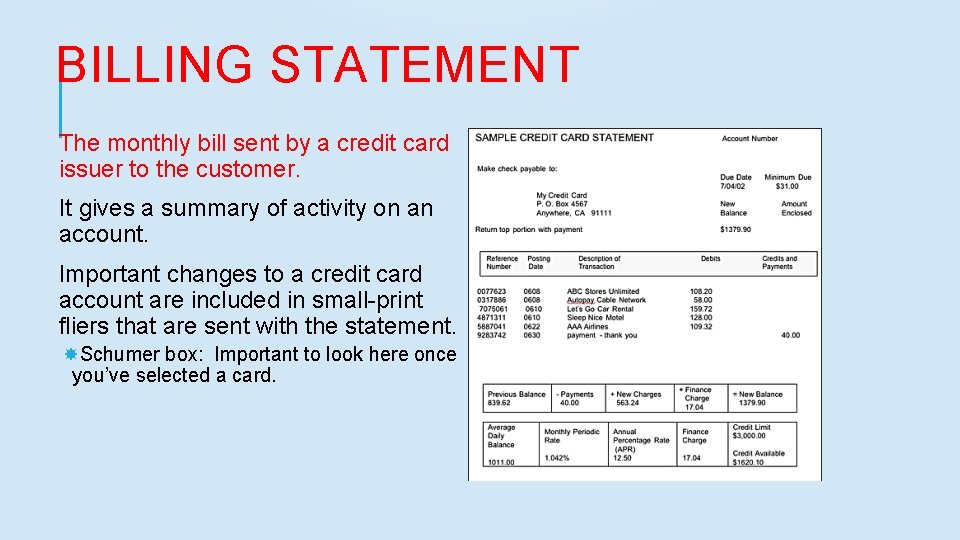
BILLING STATEMENT The monthly bill sent by a credit card issuer to the customer. It gives a summary of activity on an account. Important changes to a credit card account are included in small-print fliers that are sent with the statement. Schumer box: Important to look here once you’ve selected a card.
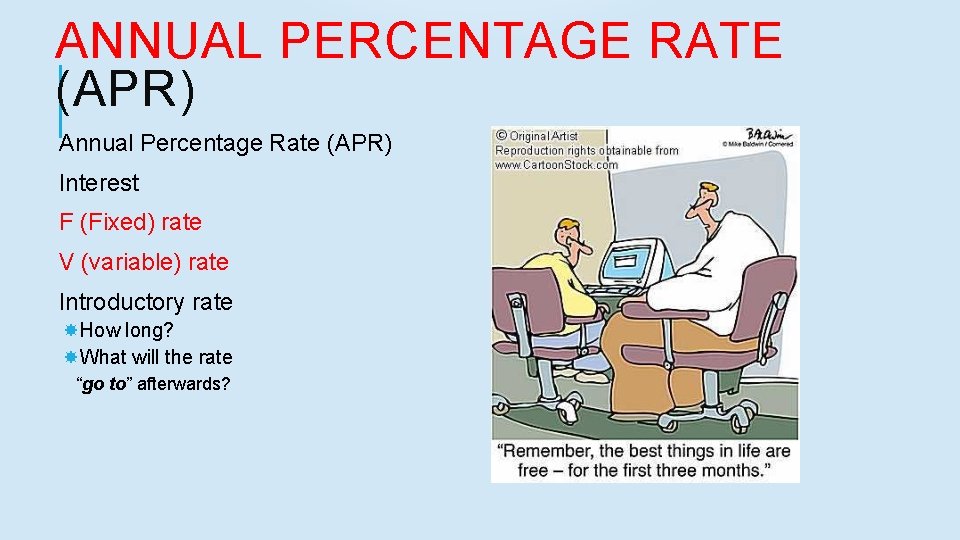
ANNUAL PERCENTAGE RATE (APR) Annual Percentage Rate (APR) Interest F (Fixed) rate V (variable) rate Introductory rate How long? What will the rate “go to” afterwards?
GRACE PERIOD Interest-free time between: Transaction date Billing date Usually 20 – 30 days No grace period if: Carry a balance No stated grace period
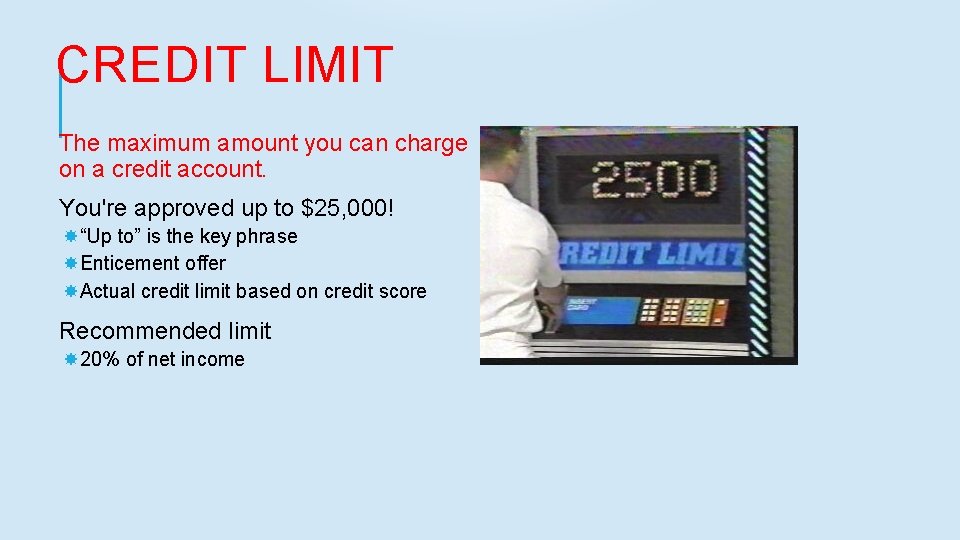
CREDIT LIMIT The maximum amount you can charge on a credit account. You're approved up to $25, 000! “Up to” is the key phrase Enticement offer Actual credit limit based on credit score Recommended limit 20% of net income
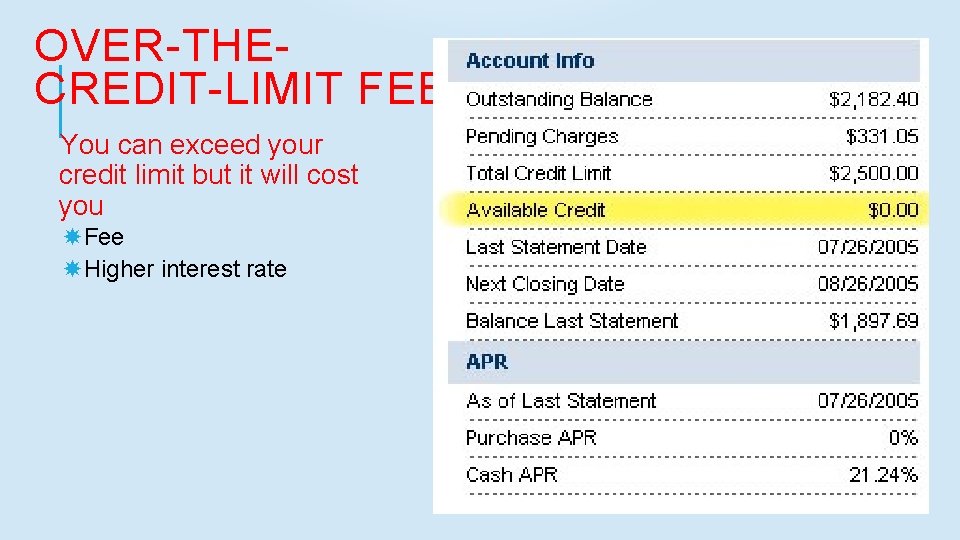
OVER-THECREDIT-LIMIT FEE You can exceed your credit limit but it will cost you Fee Higher interest rate
ANNUAL FEES ON REWARD CARDS Paying for the privilege of using a credit card Many cards offer rewards without an annual fee Weigh cost of annual fee to value of reward Mileage Avoid annual fees
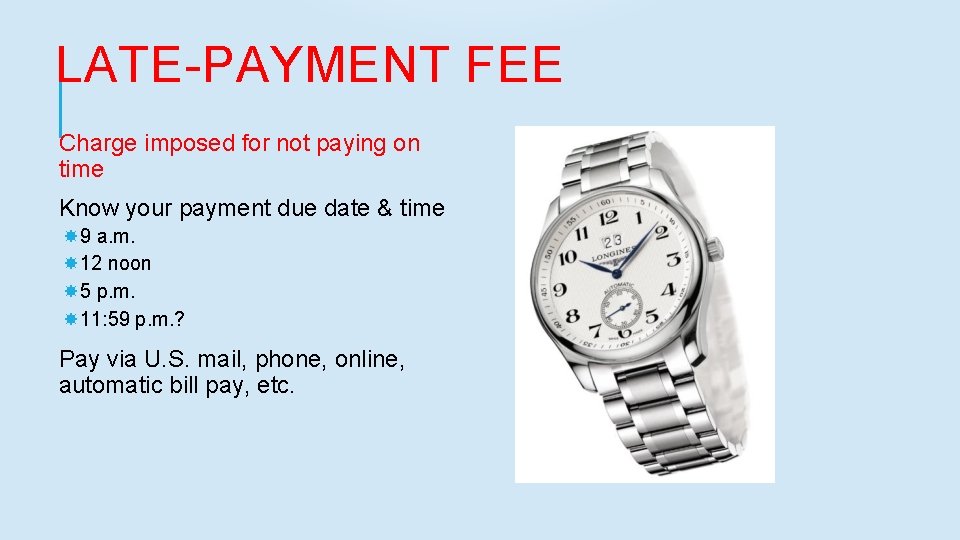
LATE-PAYMENT FEE Charge imposed for not paying on time Know your payment due date & time 9 a. m. 12 noon 5 p. m. 11: 59 p. m. ? Pay via U. S. mail, phone, online, automatic bill pay, etc.
BALANCE-TRANSFER FEE Balance Transfer The process of moving an unpaid credit card debt from one issuer to another Cards charge to transfer balance to or from one card to another.
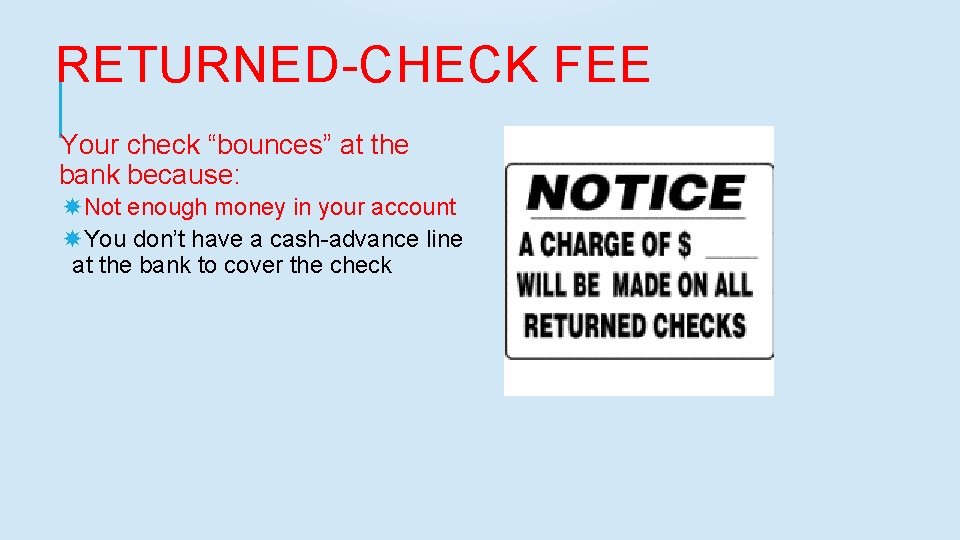
RETURNED-CHECK FEE Your check “bounces” at the bank because: Not enough money in your account You don’t have a cash-advance line at the bank to cover the check
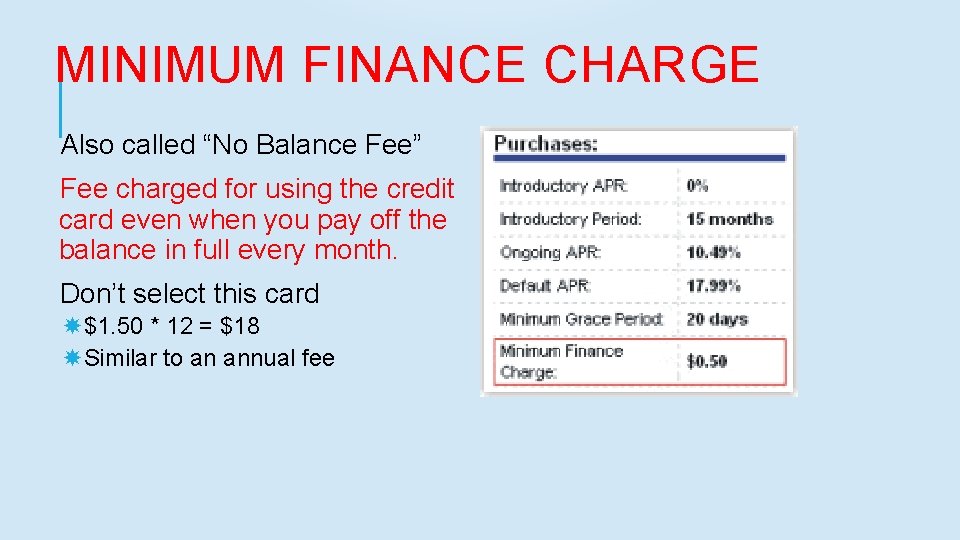
MINIMUM FINANCE CHARGE Also called “No Balance Fee” Fee charged for using the credit card even when you pay off the balance in full every month. Don’t select this card $1. 50 * 12 = $18 Similar to an annual fee
CASH-ADVANCE FEE & INTEREST Don’t take cash advances Fee Flat amount Percentage of withdrawal Cash advance interest rate is always higher and has no grace period Payments are applied to lower-interest balance first
BILLING METHODS: AVERAGE DAILY BALANCE Determined by: Adding each day’s balance Dividing by total number of days in the billing cycle. Multiplying by monthly periodic rate (APR/12) Example Day 1: Charge $100 Day 2: Charge $200 Avg. Daily Bal $150 30 days in billing cycle = $5 average daily balance Card with 15% APR has a 1. 25% monthly periodic rate (15% / 12 months) $5 daily balance = $6. 25 finance charge
BILLING METHODS: TWOCYCLE BILLING If you don’t pay your balance off it: Charges you interest based off of the current and previous month Interest starts the day you make the purchase.
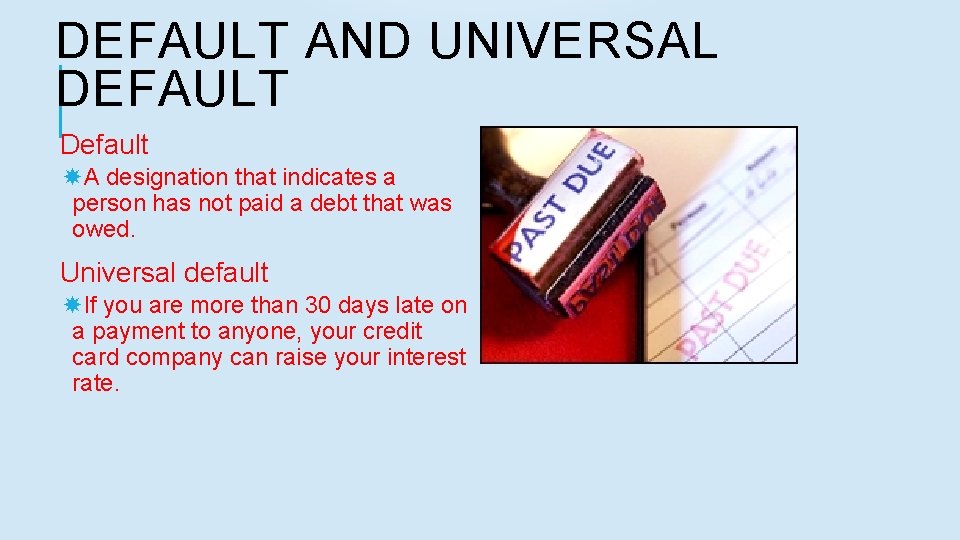
DEFAULT AND UNIVERSAL DEFAULT Default A designation that indicates a person has not paid a debt that was owed. Universal default If you are more than 30 days late on a payment to anyone, your credit card company can raise your interest rate.
WHAT YOU DON’T NEED IN A CREDIT CARD OFFER
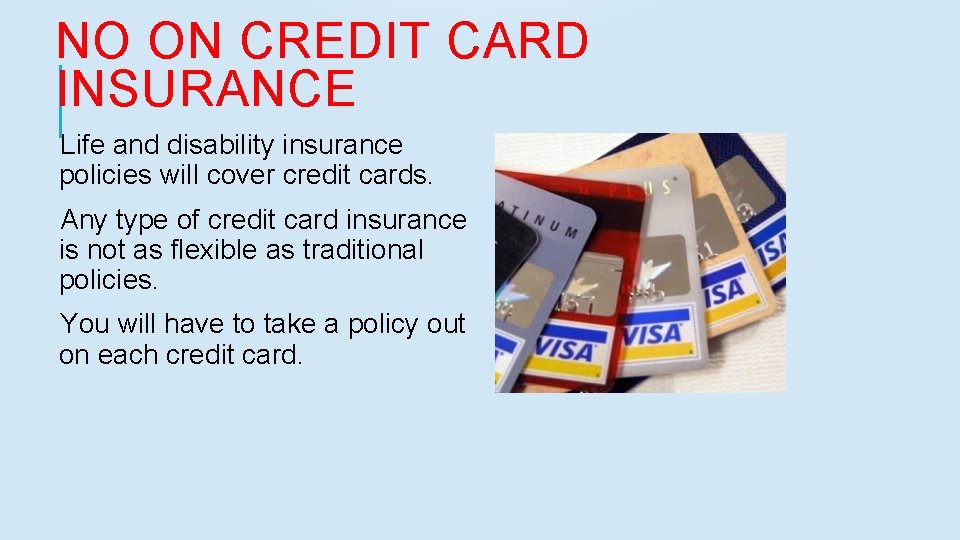
NO ON CREDIT CARD INSURANCE Life and disability insurance policies will cover credit cards. Any type of credit card insurance is not as flexible as traditional policies. You will have to take a policy out on each credit card.
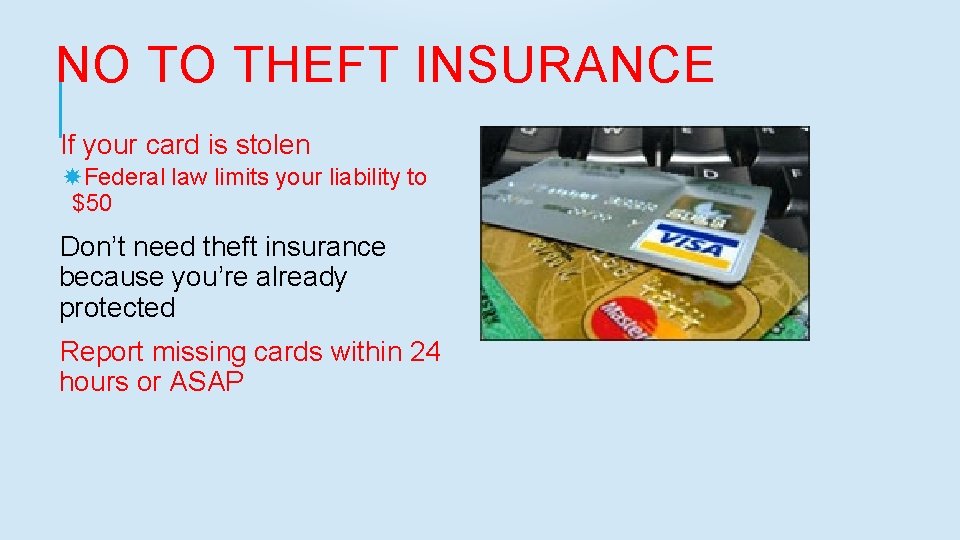
NO TO THEFT INSURANCE If your card is stolen Federal law limits your liability to $50 Don’t need theft insurance because you’re already protected Report missing cards within 24 hours or ASAP
- Slides: 39