
The Basics Data teams Trent Sherman Principal Trey
The Basics Data teams Trent Sherman Principal Trey Arvon Asst. Principal Martinsburg High School Samantha Veights Teacher
Objectives �Teams: What are the roles? Trent Sherman �Data: What do we have? Trey Arvon �Data Team Process: How do we use what we have? Samantha Veights
Agenda � 12: 30 – 12: 40 Introductions � 12: 40 Teams: Building a dynasty! � 1: 05 Data: Crunching the numbers! � 1: 25 Break � 1: 40 Data Team Process � 2: 30 Once Upon A Time: Excellence in Assessment � 3: 15 Motivation

“A Professional Learning Community is what we are… Data Teams is what we do!” Pages 2 -3
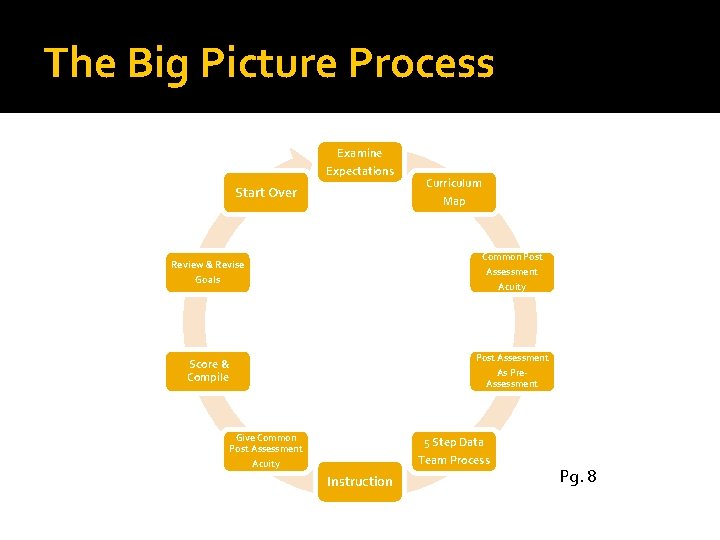
The Big Picture Process Examine Expectations Start Over Curriculum Map Common Post Review & Revise Goals Assessment Acuity Post Assessment Score & Compile As Pre. Assessment Give Common Post Assessment 5 Step Data Team Process Acuity Instruction Pg. 8
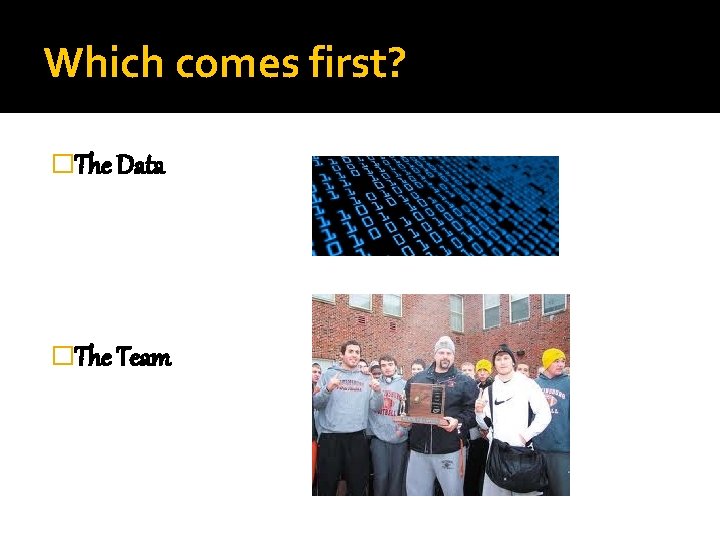
Which comes first? �The Data �The Team
Which do you feel is the most important? Team Data
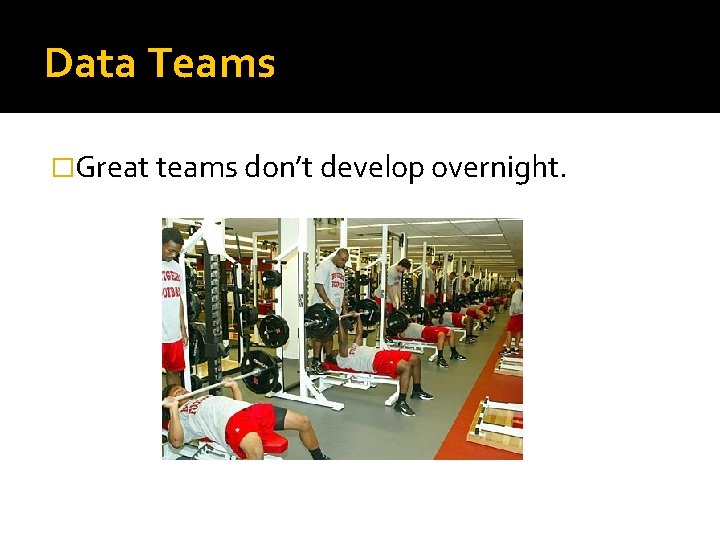
Data Teams �Great teams don’t develop overnight.

Teams - Expectations or Norms
Norms & Expectations Be on time Be prepared Participate Respect others opinions Have an agenda
Data Teams have a common focus or common standard, a common formative assessment, and a common scoring guide.
Data Team meetings must be scheduled.
What do you need? �Instructional calendar �Data �Curriculum Map �The Process
Roles �Captain or Leader �Secretary �Time Keeper �Data Technician or Data Wall Curator Pg. 157

What do you discuss? �What effects student performance? 5 minutes – List it. �Which of these can you control? Two columns We can impact. We have no control.

Data
A Hard Fact: The Importance of a Results Orientation • The key to the effectiveness of organizations is the degree to which it uses evidence to drive decision-making. • Professional Learning Communities are hungry for evidence of results - tangible proof students are acquiring the intended knowledge, skills, and dispositions. Members of PLCs use that evidence to inform their practice and drive the continuous improvement process of their team and their school. Rick Dufour
Converting a Hard Fact into a Half-Truth • Schools need to be more data driven • In fact, schools have never suffered from a lack of data. Data will never improve schools or the individuals within them unless data are used to inform individual and collective practice. Rick Dufour
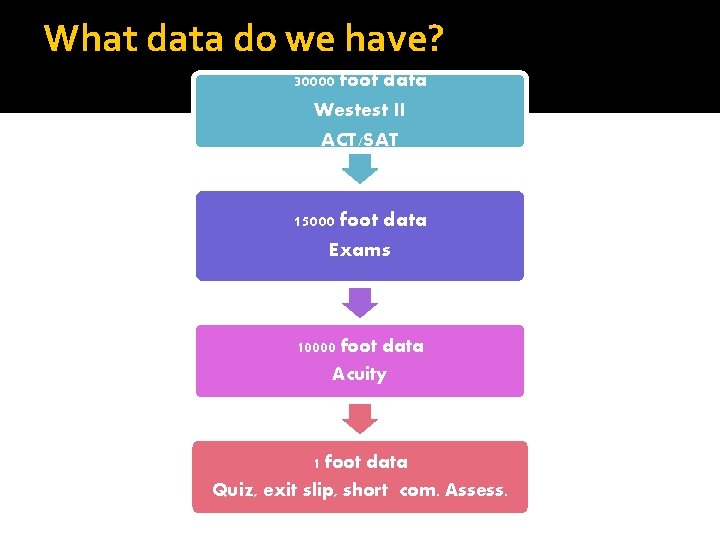
What data do we have? 30000 foot data Westest II ACT/SAT 15000 foot data Exams 10000 foot data Acuity 1 foot data Quiz, exit slip, short com. Assess.
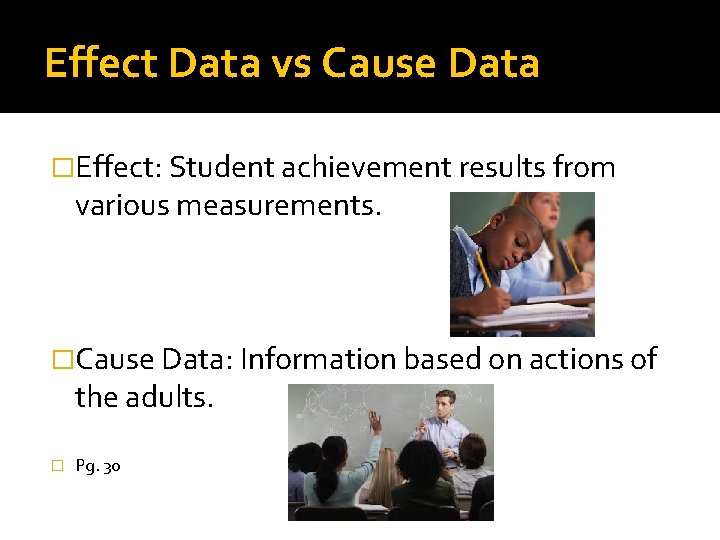
Effect Data vs Cause Data �Effect: Student achievement results from various measurements. �Cause Data: Information based on actions of the adults. � Pg. 30
3 -4 Minutes �What CURRENT effect data (student achievement) sources are you currently using in your school? �What CURRENT CAUSE data (adult actions) sources are you currently using in your school? �Pg 157
Doug Reeves “Only by evaluating both causes and effects in a comprehensive accountability system can leaders, teachers, and policymakers understand the complexities of student achievement and the efficacy of teaching and leadership practices. ” Reeves, 2006
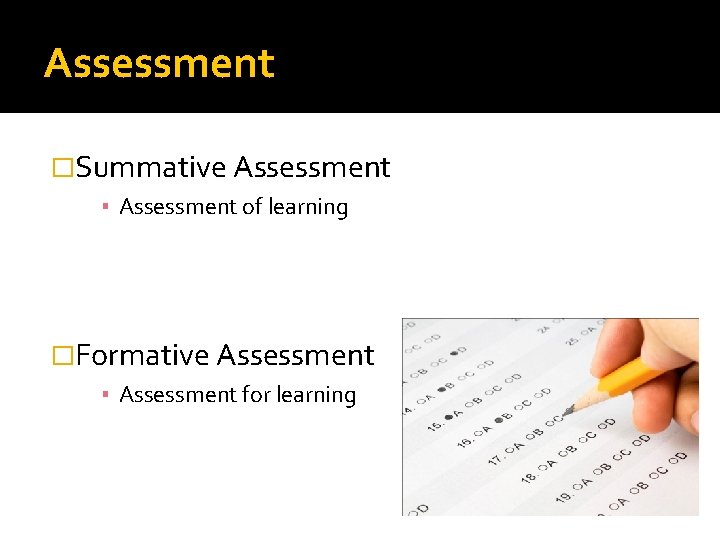
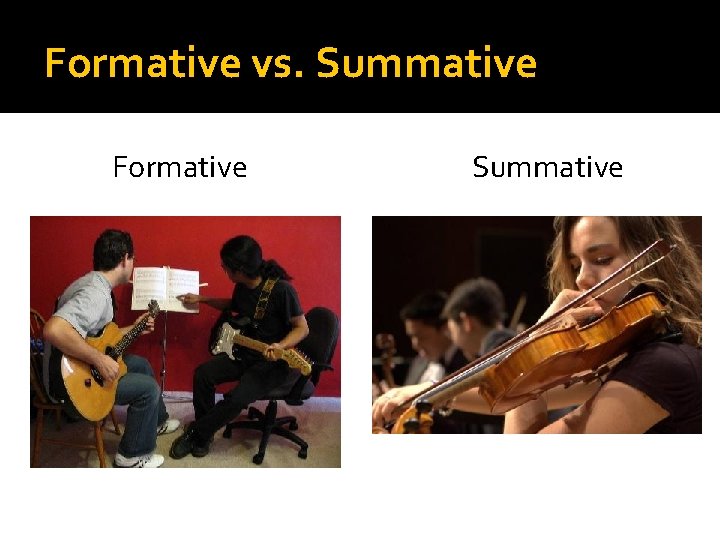
Assessment �Summative Assessment ▪ Assessment of learning �Formative Assessment ▪ Assessment for learning
Common Formative Assessments �STAR �Acuity �Data Team must formulate
Why Common Assessments? • Efficiency - by sharing the load, teachers save time. • Fairness - promotes common goals, similar pacing, and consistent standards for assessing student proficiency • Effective monitoring - provides timely evidence of whether the guaranteed and viable curriculum is being taught and learned • Informs individual teacher practice - provides teachers with a basis of comparison regarding the achievement of their students so they can see strengths and weaknesses of their teaching • Team capacity - collaborative teacher teams are able to identify and address problem areas in their program • Collective response - helps teams and the school create timely, systematic interventions for students
Total Nonsense We don’t have time to assess our students because we are too busy teaching them. We must cover too much content in too little time, so we can’t assess students more frequently because we can’t afford the loss of instructional time. Rick Dufour
Hard Facts • Frequent and timely monitoring of student learning is an essential part of effective teaching. • Good teachers are assessing all the time. • Students and teachers benefit if periodically formative assessments are created by a collaborative team of teachers (rather than an individual) and given to all the students for whom that team is responsible. Rick Dufour
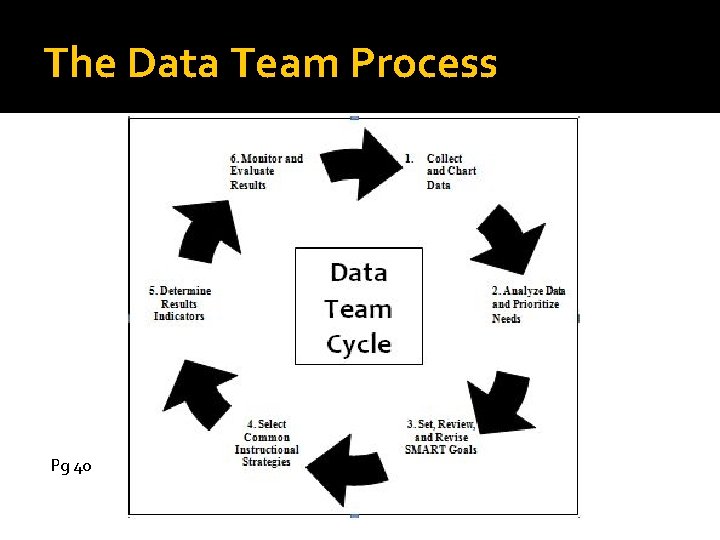
The Data Team Process Pg 40
Pair Activity: What do you already know? �Did you meet your goal? �Do you continue with the curriculum or spend time on measurement? Why? �If you were to spend more time on measurement, what additional data/information would you want to know to enhance your instruction? �What might be a better goal to have besides looking at a class average of 80%
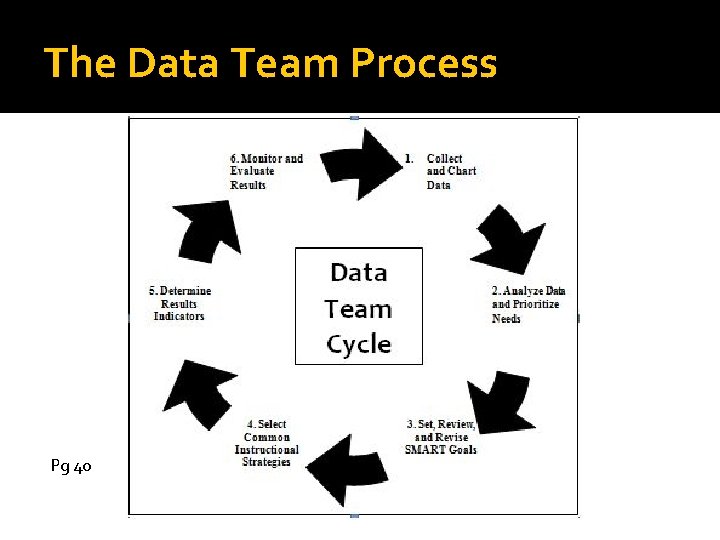
The Data Team Process Pg 40
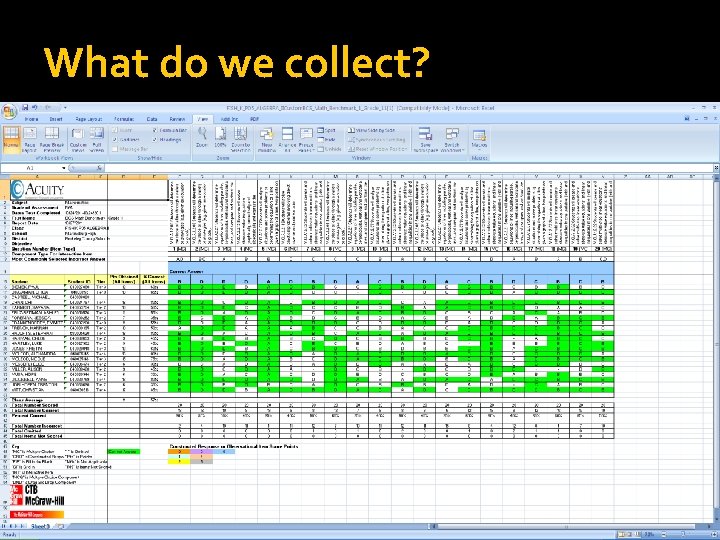
Step 1: Collect and Chart Data Where does the data come from? ? � ACUITY BENCHMARK ASSESSMENTS Math, English, Social Studies, Science � PRE-ASSESSMENTS Same as Post-Assessment � COMMON FORMATIVE ASSESSMENTS Bell Ringers, Short Quizzes, Worksheets, Homework, Class Activities, etc.
Common Formative Assessment We use Common Formative Assessments to: �Give timely and specific feedback to students �Improve professional practice �Identify student educational needs �Evaluate teaching
Formative vs. Summative Formative Summative
What do we collect?
Step 2: Analyze Strengths & Obstacles Proficient Close to Proficient Far to go In need
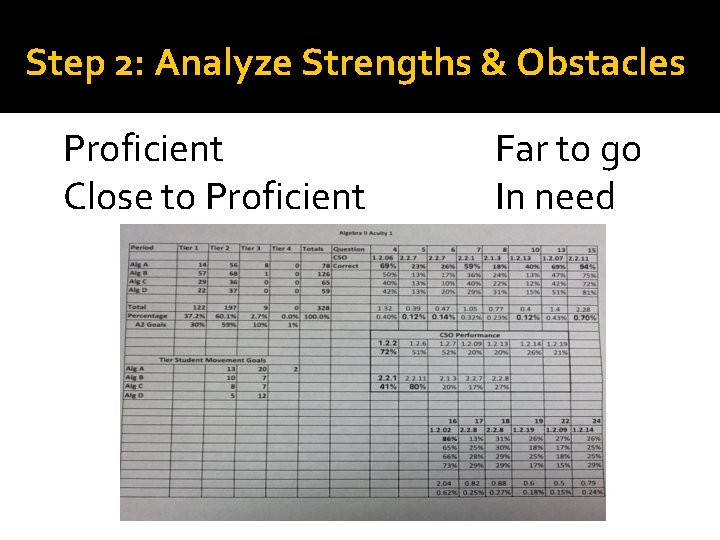
Ask the right questions. �We don’t want your opinion; what does the data say? �Why did the students not achieve proficiency? �Where were the errors? �What were the errors? �Are there common errors? �Is there a trend? �What is preventing these students from being proficient? �Are there misconceptions about concepts or skills?
Ask the right questions. �Use the answers to these and other questions to develop a … SMART Goal Specific Measurable Attainable Results Timely
Step 3 �Establish goals: set, review, revise �Establish goals for different students Honors vs. Academic vs. Inclusion Proficient vs. Close to Proficient vs. Far to go vs. In need
SMART Goal �Specific: What will the goal accomplish? How and why will it be accomplished? �Measurable: How will you measure whether or not the goal has been reached? �Achievable: Is it possible? Have others done it successfully? Will meeting the goal challenge you without defeating you? �Results: What is the reason, purpose, or benefit of accomplishing the goal? �Timely: What is the established completion date and does that completion date create a practical sense of urgency?
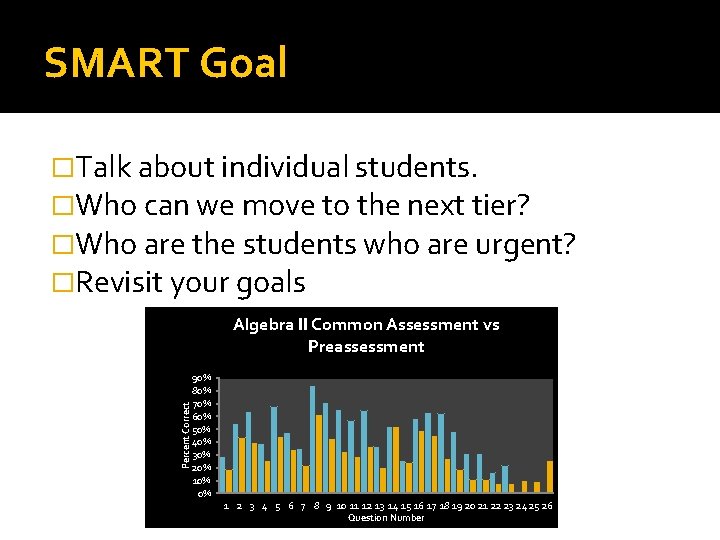
SMART Goal �Talk about individual students. �Who can we move to the next tier? �Who are the students who are urgent? �Revisit your goals Percent Correct Algebra II Common Assessment vs Preassessment 90% 80% 70% 60% 50% 40% 30% 20% 10% 0% 1 2 3 4 5 6 7 8 9 10 11 12 13 14 15 16 17 18 19 20 21 22 23 24 25 26 Question Number
SMART Goal �Broad Goal: I want at least 85% of my students to score proficient on the measurement test
SMART Goal � Specific: I will implement collaborative group work in my classroom � Measurable: I will measure their progress through weekly mini quizzes, homework examples, and bell ringers. � Attainable: I will research best practices and find relevant hands on activities. � Results: Having at lest 85% of my students score proficient will greatly improve their chances of scoring well on the measurement section of the state test � Timely: I will have at least 85% of my students score proficient on the measurement test by _____
SMART Goal �SMART Goal: I will research best practices and find relevant hands on activities that can be implement through collaborative group work in my classroom, while monitoring their progress through mini quizzes, homework, and bell ringers in order to have at least 85% of my students score proficient on the measurement test by ____ so that they may be adequately prepared for the measurement section on the state test.
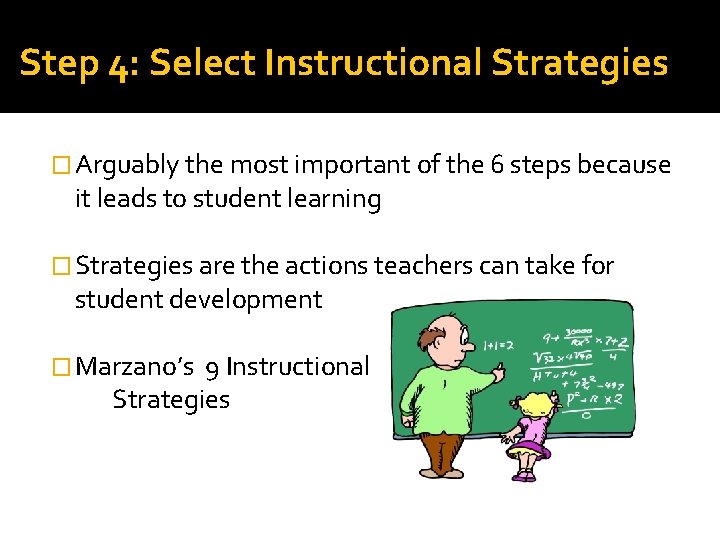
Step 4: Select Instructional Strategies � Arguably the most important of the 6 steps because it leads to student learning � Strategies are the actions teachers can take for student development � Marzano’s 9 Instructional Strategies
1. Similarities and Differences �The ability to break a concept into similar and dissimilar characteristics allows students to understand/solve complex problems in a more simple way �Venn Diagram �Flow Charts �Metaphors �Analogies
2. Summarizing and Note Taking �Promotes greater comprehension by asking students to analyze what’s important and put in own words �More notes are better than fewer BUT verbatim note taking is ineffective because it does not allow time to process information �Guided notes �Interactive student notebook �Cornell notes �Frayer Models
3. Reinforcing Effort and Providing Recognition �Teacher’s responsibility to show the connection between student effort and student achievement �Have students make individual goals �Have student track their own progress �Have individual conferences with students
4. Homework and Practice �Recommended amount of homework varies between grade levels and subject material �Establish homework policies �Try to give feedback on homework �Always review homework in class
5. Nonlinguistic Representatives �Students are multi-learners … reach them on all levels! �Incorporate words and images �Use physical models and movements to represent information
6. Cooperative Learning �Positive effort on overall learning �Large vs. small groups �Interests vs. abilities �Always have individual AND group accountability
7. Setting Objective and Provide Feedback �Objectives provide direction of learning �Post objectives and goals so students are aware �Keep feedback timely and specific (corrective in nature) �Rubrics
8. Generating and Test Hypotheses �Have students explain their hypotheses and conclusions �What would happen if �What do you think? �Projects/Labs …. ?
9. Cues, Questions, Advance Organizers �Pause after asking a question �Challenging questions �Differentiate instruction
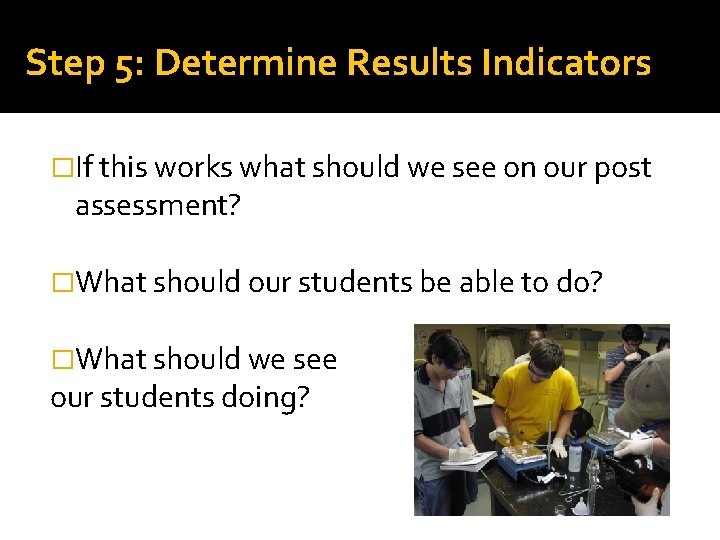
Step 5: Determine Results Indicators �If this works what should we see on our post assessment? �What should our students be able to do? �What should we see our students doing?
Result Indicators � If we use this strategy/activity …. . Then we can expect _____this______ from our students � Observing students more involved than usual Data Teams 56
Step 6 Monitor �Administer Post-Test and analyze/compare results �Report results to principal �What if the results weren’t what we were looking for? What if we didn’t reach our goal? �What should we still focus on? �How do we do that? Reteach/Remidiation Bell Ringers Homework
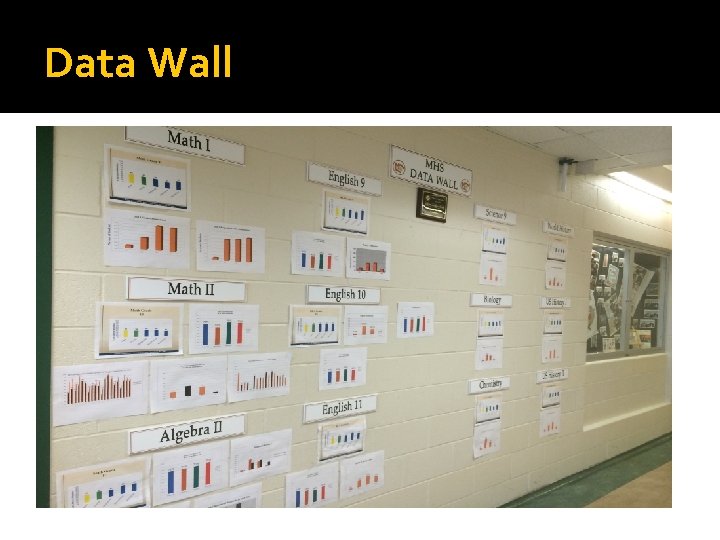
Data Wall
Activity-Rate your Data Team �Scale of 1 to 5 �Sticky Note � 1 = lowest � 5 = Highest
Epilogue “Once Upon a Time: A Tale of Excellence in Assessment” By: Rick Du. Four Berkeley County Schools. 401 South Queen Street. Martinsburg, WV 25401
A Tale of Excellence…. Group 1 Collaborative culture Teachers work together to help all students learn “Essential learning” – curriculum stressed only 10 key concepts each semester Created curriculum pacing guide Made an assessment calendar Developed pre-assessments Developed common assessments with rubrics Berkeley County Schools. 401 South Queen Street. Martinsburg, WV 25401 61
A Tale of Excellence…. Group 1 • Team studied results from state assessment • Reviewed a correlation with their common assessment and state assessment • If students are successful on common assessments then they will be successful on state assessments • Identify weaknesses on common assessments Berkeley County Schools. 401 South Queen Street. Martinsburg, WV 25401 62
A Tale of Excellence…. Group 1 • Share instructional and assessment strategies • Strive to be better • Mindset – by identifying effective strategies for areas of need, it will help students achieve at higher levels “It’s just what we do here. ” Berkeley County Schools. 401 South Queen Street. Martinsburg, WV 25401 63
A Tale of Excellence…. Group 2 • Established proficiency scores on assessments • Shift from a general performance to more skill analysis in order to determine areas of proficiency and non proficiency • Reviewed components of test and offer ideas for teaching and assessing the concepts and skills • Discuss prerequisite skill needed to be successful Berkeley County Schools. 401 South Queen Street. Martinsburg, WV 25401 64
A Tale of Excellence…. Group 2 • All teach same essential learning and administer common assessment on the same day • Debrief on how they thought the unit was going • Practiced collectively scoring essays for consistency – set guidelines for scoring “His colleagues were supportive” Berkeley County Schools. 401 South Queen Street. Martinsburg, WV 25401 65
A Tale of Excellence…. Group 3 • Created rubrics and taught them to the students • Checking for understanding on an ongoing basis • Question, dialogue, clarify thoughts • Goal setting for students • Provide specific feedback • Teachers shared scores – open and transparent Berkeley County Schools. 401 South Queen Street. Martinsburg, WV 25401 66
A Tale of Excellence…. Group 3 • Shared strategies and techniques • Reviewed student performance • Engage in lively dialogue about strategies for teaching concepts more effectively “Teachers were extremely open with their results. ” Berkeley County Schools. 401 South Queen Street. Martinsburg, WV 25401 67
A Tale of Excellence…. Group 4 • Celebrate successes • Implement improvement strategies • There will always be the lowest 10% items – attack them – mindset of continuous improvement • Provide feedback and allow students to redo until they reach achievement Berkeley County Schools. 401 South Queen Street. Martinsburg, WV 25401 68
A Tale of Excellence…. Group 4 • Provide time and support for learning during the day • Clear expectation that all students can demonstrate they have learned the essential skills • Steps: -work in teams -develop common formative assessments -align assessments with state/national assessments Berkeley County Schools. 401 South Queen Street. Martinsburg, WV 25401 69
A Tale of Excellence…. Group 4 • Steps: -Use results to guide instruction -Identify what skills are needed for success -Regroup students -Provide specific feedback -Give additional opportunities to demonstrate proficiency • Clear message to students – “They are required to learn rather than invited to learn. ” Berkeley County Schools. 401 South Queen Street. Martinsburg, WV 25401 70
A Tale of Excellence…. Group 5 • More efficient time to work collaboratively together to plan, gather materials and develop assessments • All students have access to the same curriculum, same assessments of equal rigor, evaluate uniformly • Self evaluative of one’s own strengths and weaknesses Berkeley County Schools. 401 South Queen Street. Martinsburg, WV 25401 71
A Tale of Excellence…. Group 5 • Shift in mindset…assessment enhances learning • Shift in mindset…there are school cultures and structures that are more effective for helping students learn • Willingness to change the assumption and practices that have characterized public education for years • Assessment can help build a collaborative culture Berkeley County Schools. 401 South Queen Street. Martinsburg, WV 25401 72
A Tale of Excellence…. Group 5 • “All kids can learn” • Schools can be a place where even the adults could learn “Assessment can fuel continuous improvement and serve as the driving engine for transforming a school. ” Berkeley County Schools. 401 South Queen Street. Martinsburg, WV 25401 73
- Slides: 73