
THE BASICS Crime Scene Any physical location in
THE BASICS
Crime Scene: Any physical location in which a crime has occurred or is suspected of having occurred Primary Crime Scene: The original location of a crime or accident. Secondary Crime Scene: An alternate location where additional evidence may be found. Suspect: Person thought to be capable of committing a crime Accomplice: Person associated with someone suspected of committing a crime Alibi: Statement of where a suspect was at the time if a crime.
Evidence Testimonial evidence: includes oral or written statements given to police as well as court testimony by people who witnessed an event. Physical evidence: refers to any material items that would be present at the scene, on the victims, or found in a suspect’s possessions. Trace evidence: refers to physical evidence that is found in a small but measurable amounts, such as strands of hair, fibers, or skin cells.
What will evidence collected at a scene do for the investigation? May prove that a crime has been committed Establish key elements of a crime Link a suspect with a crime scene or a victim Establish the identity of a victim or suspect Corroborate verbal witness testimony Exonerate the innocent Give detectives leads to work in the case
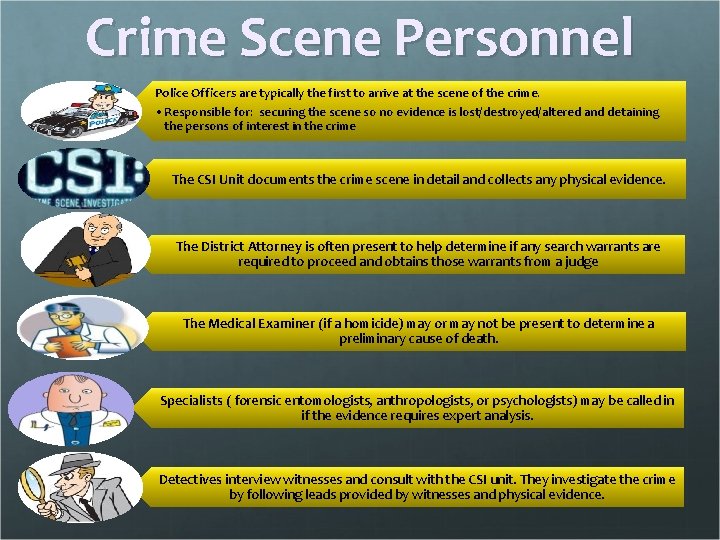
Crime Scene Personnel Police Officers are typically the first to arrive at the scene of the crime. • Responsible for: securing the scene so no evidence is lost/destroyed/altered and detaining the persons of interest in the crime The CSI Unit documents the crime scene in detail and collects any physical evidence. The District Attorney is often present to help determine if any search warrants are required to proceed and obtains those warrants from a judge The Medical Examiner (if a homicide) may or may not be present to determine a preliminary cause of death. Specialists ( forensic entomologists, anthropologists, or psychologists) may be called in if the evidence requires expert analysis. Detectives interview witnesses and consult with the CSI unit. They investigate the crime by following leads provided by witnesses and physical evidence.
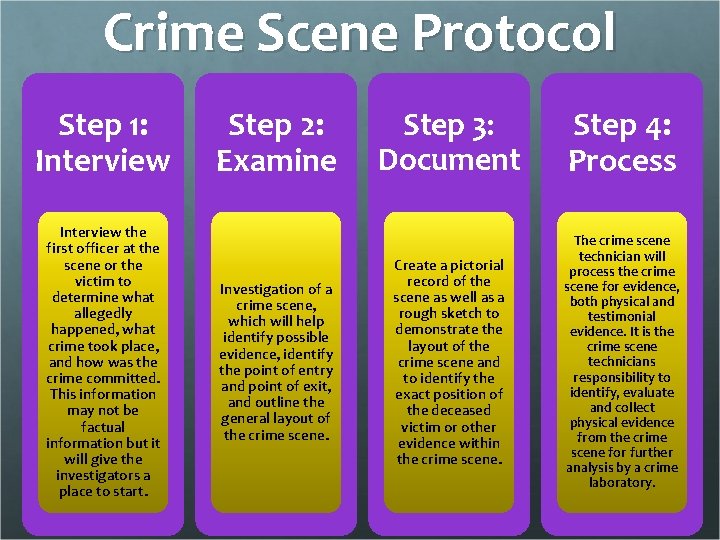
Crime Scene Protocol Step 1: Interview the first officer at the scene or the victim to determine what allegedly happened, what crime took place, and how was the crime committed. This information may not be factual information but it will give the investigators a place to start. Step 2: Examine Investigation of a crime scene, which will help identify possible evidence, identify the point of entry and point of exit, and outline the general layout of the crime scene. Step 3: Document Step 4: Process Create a pictorial record of the scene as well as a rough sketch to demonstrate the layout of the crime scene and to identify the exact position of the deceased victim or other evidence within the crime scene. The crime scene technician will process the crime scene for evidence, both physical and testimonial evidence. It is the crime scene technicians responsibility to identify, evaluate and collect physical evidence from the crime scene for further analysis by a crime laboratory.
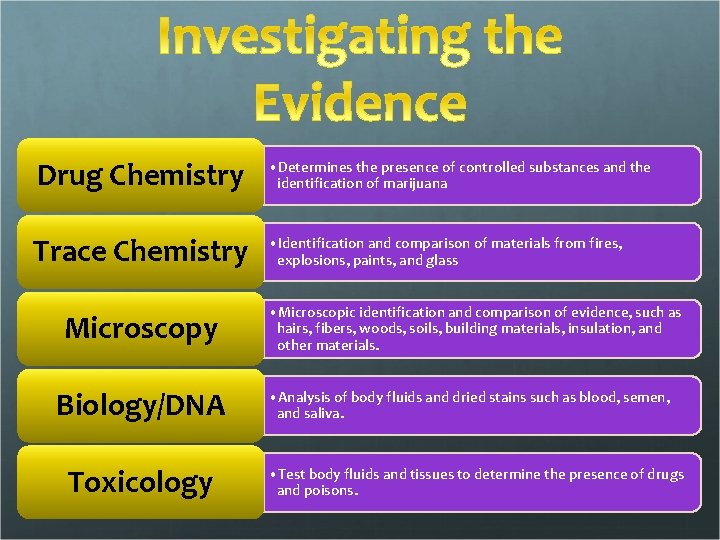
Drug Chemistry • Determines the presence of controlled substances and the identification of marijuana Trace Chemistry • Identification and comparison of materials from fires, explosions, paints, and glass Microscopy Biology/DNA Toxicology • Microscopic identification and comparison of evidence, such as hairs, fibers, woods, soils, building materials, insulation, and other materials. • Analysis of body fluids and dried stains such as blood, semen, and saliva. • Test body fluids and tissues to determine the presence of drugs and poisons.
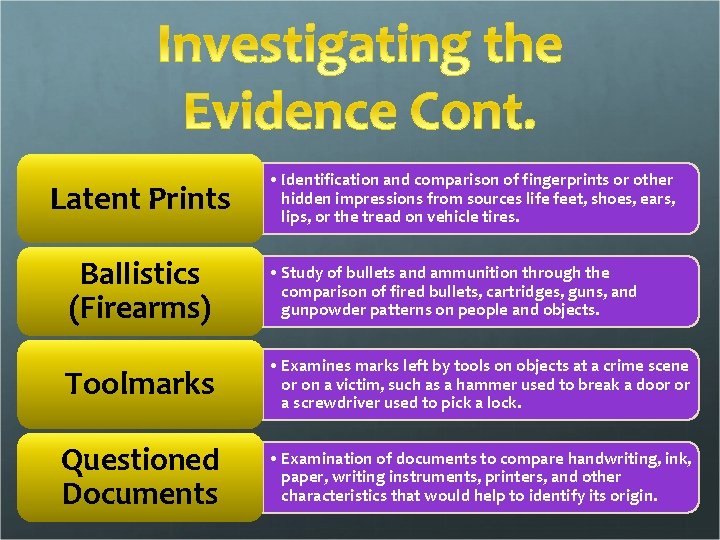
Latent Prints • Identification and comparison of fingerprints or other hidden impressions from sources life feet, shoes, ears, lips, or the tread on vehicle tires. Ballistics (Firearms) • Study of bullets and ammunition through the comparison of fired bullets, cartridges, guns, and gunpowder patterns on people and objects. Toolmarks • Examines marks left by tools on objects at a crime scene or on a victim, such as a hammer used to break a door or a screwdriver used to pick a lock. Questioned Documents • Examination of documents to compare handwriting, ink, paper, writing instruments, printers, and other characteristics that would help to identify its origin.
- Slides: 8