
The basic principles of investigation The basic principles
The basic principles of investigation
The basic principles of investigation Without communication – No investigation is possible – No assessment is possible The communication is allowed by non-influence attitudes (investigation comprehension…), To Respect the basic principles of interview. Page 2
Essential conditions Take care of the environmental conditions, Make your self being listened, Make your self being understood, Use techniques of investigation, To know listening, To know looking, To master the subject. Page 3
Environmental conditions Premises, Acoustics Luminosity Climatic conditions The interruptions (visitors, telephone, etc…) Page 4
Being listened Your voice range, Distance between the auditor and the audited, To master the rhythm (simulate, temperate), Articulation. Page 5
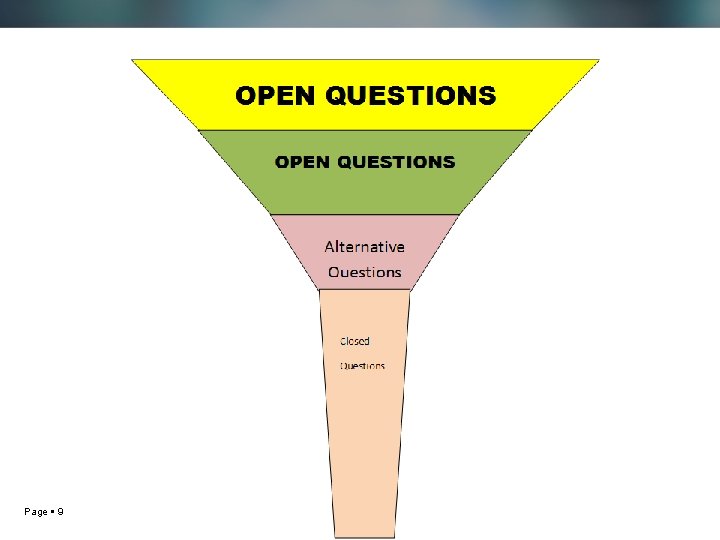
Being understood Ask clear questions using comprehensible terms Ask only one question at a time. Use questions of the kind: – Open (panoramic response), – Closed (answer yes or no), – Oriented (demands a choice) Reformulate the non-understood questions in an other form. Page 6
Techniques of investigation Explain me how…? – Open question permitting to establish conversations. Can you show me an example…? – Requires a demonstration Can we now take such example…. . ? – Asks a proof concerning an example chosen by the assessor. Page 7
Funnel questioning You can use questions to find out increasing detail about some particular topic of interest. This narrows the funnel, giving you more information about a smaller area. Increasing detail is similar to deductive reasoning, where thinking goes from general to more specific. Say 'Tell me more about' Asking 'tell me more' is a very open and general question that also focuses the other person on a particular area, giving you more information about this. As an open question it allows the other person more leeway in what they say and gets you more detail. This causes a slower convergence (but this may not be a bad thing). Use precision words Using words like 'specifically', 'actually' or 'particularly' gives the person subtle direction to give you more detail in a particular direction. Use these alongside Kipling questions such as 'What', 'How' and 'When'. Page 8
Page 9
To know listening Separate facts from opinions Discern between the important and the secondary things To stay at the level of facts Ask for explanations when answers or terms are not well understood. Don’t get ahead the answers of the assessed. Page 10
To know looking The observation of the facts concerns: – The actor – The act itself – The consequences – The frame in which all that occurred The assessor have to make a statement and memorize it. Page 11
To master the subject On the level of conducting the interview: – Follow a chain of events – Order of subjects (chronology, localization…) – Recentralize on the subject if conversation deviates (by purpose or not). – Use: • The deductive way (from general to particular) • The inductive way (from particular to general) – Think who, what, where, when, why, how – Conclude with an agreeable note. Page 12
To master the subject On the level of the attitude of the auditor: – Attitude of investigation and comprehension, – Depersonalization and removing of guiltiness (we search for facts not for guilty persons), – Help the assessed to get out of deadlocked reflections, – Clearly summarize the answers of the assessed, – Relax the atmosphere if necessary, – The auditor have to left his feelings at home, – Avoid conflicts, – Encourage the constructive way. Page 13
Listening Don’t we all have the same problems for listing to our different interlocutors? , In front of some one who is talking to us, we can have very different “listing quality levels”. Page 14
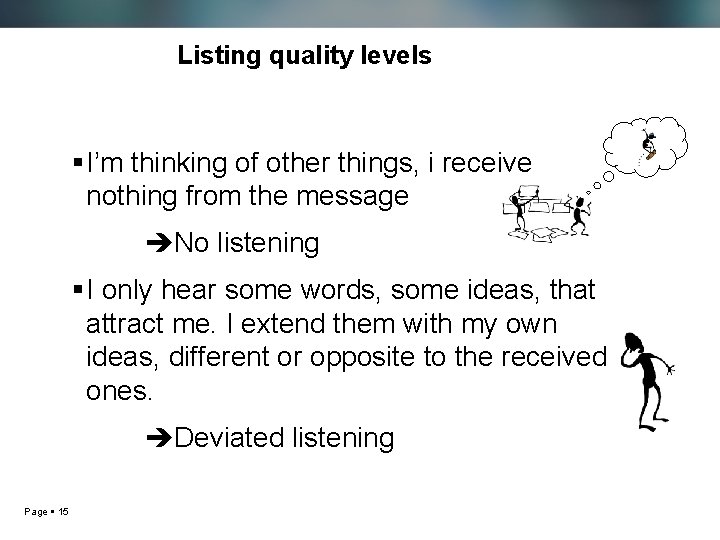
Listing quality levels I’m thinking of other things, i receive nothing from the message No listening I only hear some words, some ideas, that attract me. I extend them with my own ideas, different or opposite to the received ones. Deviated listening Page 15
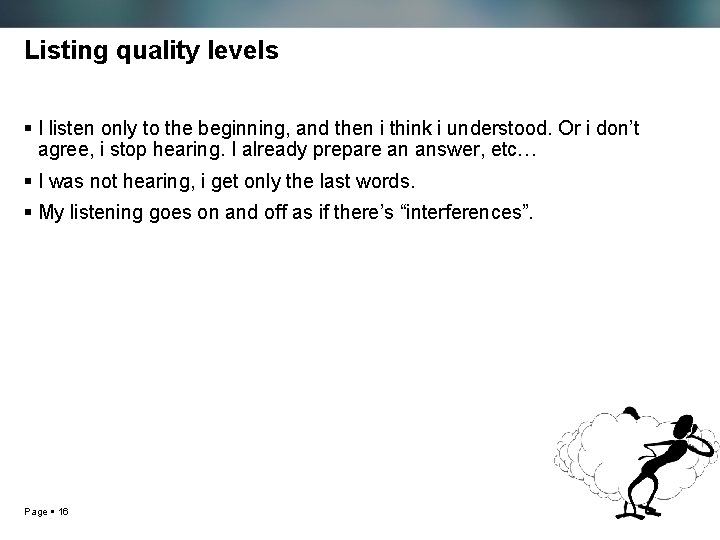
Listing quality levels I listen only to the beginning, and then i think i understood. Or i don’t agree, i stop hearing. I already prepare an answer, etc… I was not hearing, i get only the last words. My listening goes on and off as if there’s “interferences”. Page 16
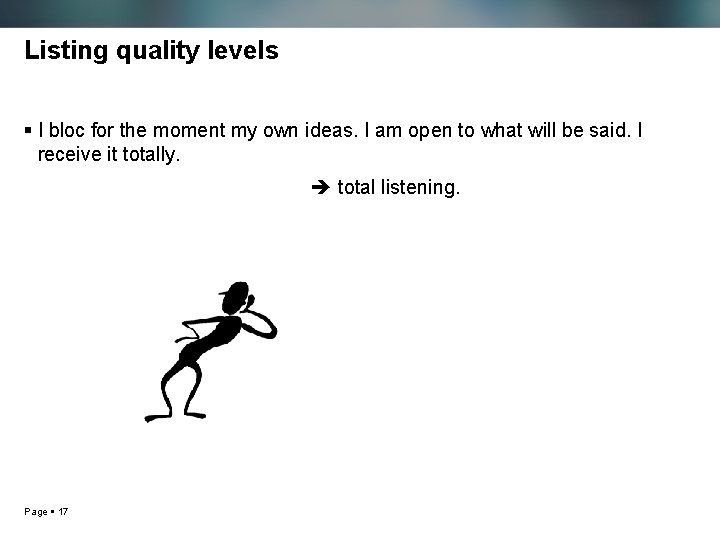
Listing quality levels I bloc for the moment my own ideas. I am open to what will be said. I receive it totally. total listening. Page 17
Context of the assessment The assessed Feels the audit as an overload and as a constraint, A calling into question of his authority, Afraid of change, He did not wish to have the audit Doesn’t like that we meddle in his business, A different language (quality/technique). Page 18
Context of the assessment The auditor Un unknown terrain Responsible of the progress of the audit Responsible of the program Doesn’t know the language of the technician Have to adapt his comportment to his interlocutors Must find proofs based on facts Page 19
Golden tricks Don’t make of it a trial by expressing one’s feeling on the other’s acts and gesture. Always give him a honorable exit. To abstain from giving a value judgment or to categorize by making a personnel reaction. Search more the “what” than “ why did he do it? ” Don’t contradict what is said by a mimic or an intonation opposing the talking. Page 20
Golden tricks Describe his own reactions rather than evaluating others actions: say ‘i’ rather than ‘you’, Have a positive expression form and avoid the devaluation, judgment, critics, making shy, ridicule, play the psychoanalyst, etc… Facilitate the expression of feelings of the others by avoiding the blocking attitudes : orders, threatening, ready solutions, etc… Page 21
Auditor, who are you? Curious Objective Discrete Precise Competent sympathy Page 22 Educationist Courtesy
- Slides: 22