
The Basic PANSOPS Procedure Design Training Vientiane 12
The Basic PANS-OPS Procedure Design Training Vientiane, 12 - 30 September 2011 OPENING 09: 45 -10: 00, 12 September The Project for Capacity Development for Transition to the New CNS/ATM Systems in Cambodia, Lao PDR, and Vietnam 1
PROCEEDING ✈ Opening Remarks by JICA Lao Office ✈ Welcome Remarks by DCA ✈ Introduction of Japanese Experts & Counterparts ✈ Schedule of Lectures and Exercise ✈ Others The Project for Capacity Development for Transition to the New CNS/ATM Systems in Cambodia, Lao PDR, and Vietnam 2
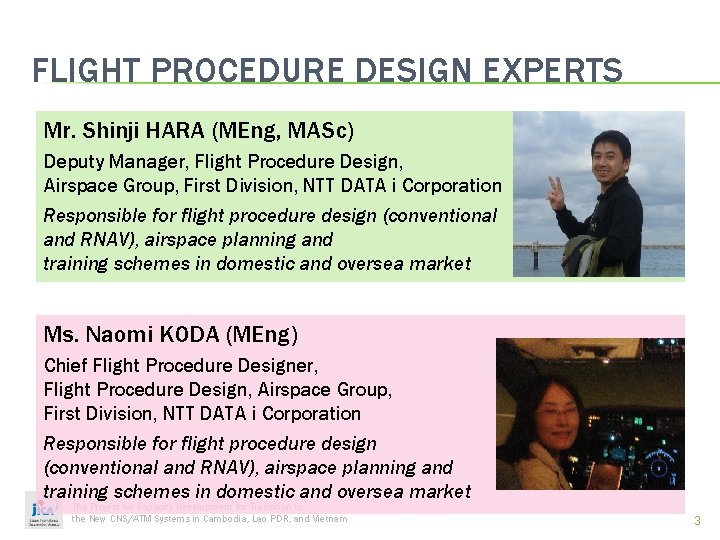
FLIGHT PROCEDURE DESIGN EXPERTS Mr. Shinji HARA (MEng, MASc) Deputy Manager, Flight Procedure Design, Airspace Group, First Division, NTT DATA i Corporation Responsible for flight procedure design (conventional and RNAV), airspace planning and training schemes in domestic and oversea market Ms. Naomi KODA (MEng) Chief Flight Procedure Designer, Flight Procedure Design, Airspace Group, First Division, NTT DATA i Corporation Responsible for flight procedure design (conventional and RNAV), airspace planning and training schemes in domestic and oversea market The Project for Capacity Development for Transition to the New CNS/ATM Systems in Cambodia, Lao PDR, and Vietnam 3
OBJECTIVES OF THE TRAINING Objective 1 To acquire Basic knowledge on PANS-OPS for Flight Procedure Design Objective 2 To ensure that the participants get sufficient skill and knowledge to join the next Training for PBN Flight Procedure Design Please keep these OBJECTIVES in mind during the training program The Project for Capacity Development for Transition to the New CNS/ATM Systems in Cambodia, Lao PDR, and Vietnam 4
COURSE CONTAINS ✈ Lecture & desk exercises ü PANS-OPS as a main textbook ü Power. Point to indicate right part of PANS-OPS ✈ Overall exercise ü Design a series of Approach and Departure Procedures of an airport ü Group Work The Project for Capacity Development for Transition to the New CNS/ATM Systems in Cambodia, Lao PDR, and Vietnam 5
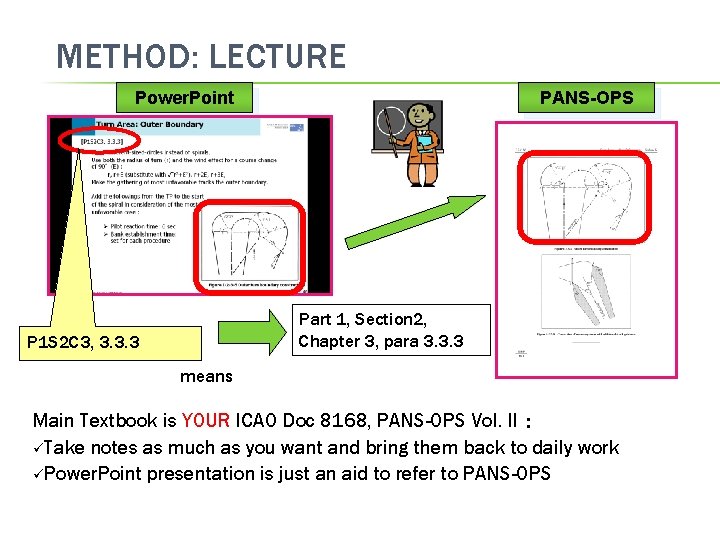
METHOD: LECTURE Power. Point PANS-OPS Part 1, Section 2, Chapter 3, para 3. 3. 3 P 1 S 2 C 3, 3. 3. 3 means Main Textbook is YOUR ICAO Doc 8168, PANS-OPS Vol. II: üTake notes as much as you want and bring them back to daily work üPower. Point presentation is just an aid to refer to PANS-OPS
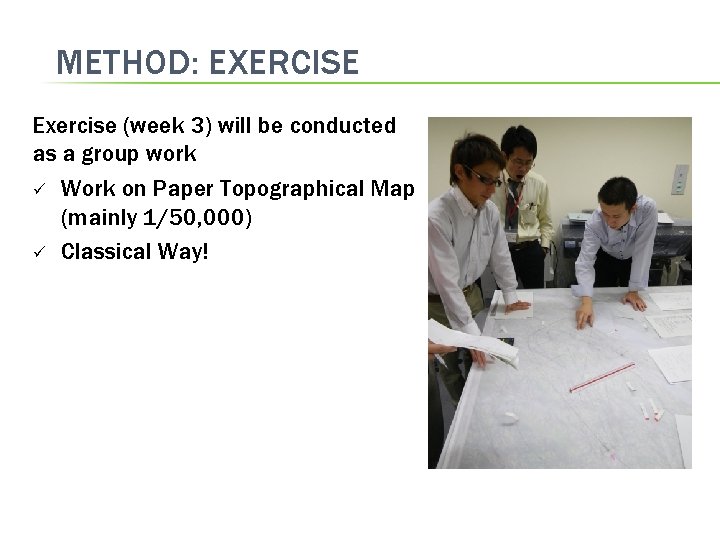
METHOD: EXERCISE Exercise (week 3) will be conducted as a group work ü Work on Paper Topographical Map (mainly 1/50, 000) ü Classical Way!
SCHEDULE OF THE TRAINING (1) DAY 1: Monday, 12 September 09: 45 -10: 00: Opening ü Introduction of Japanese Experts & Counterparts ü Schedule of Lectures and Exercise 10: 00 -12: 00: Session 1 – Approach Procedures (General) 13: 30 -16: 30: Session 2 – Approach Procedures (General) DAY 2 and beyond 09: 00 -12: 00 & 13: 30 -16: 30 Any change to schedule and administrative matters will be advised to participants by JICA Experts The Project for Capacity Development for Transition to the New CNS/ATM Systems in Cambodia, Lao PDR, and Vietnam 8
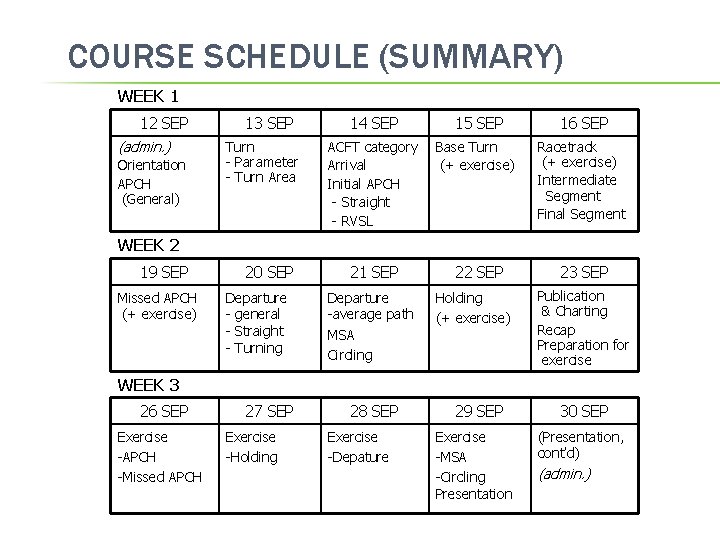
COURSE SCHEDULE (SUMMARY) WEEK 1 12 SEP (admin. ) Orientation APCH (General) 13 SEP Turn - Parameter - Turn Area 14 SEP 15 SEP 16 SEP ACFT category Arrival Initial APCH - Straight - RVSL Base Turn (+ exercise) Racetrack (+ exercise) Intermediate Segment Final Segment 21 SEP 22 SEP 23 SEP WEEK 2 19 SEP Missed APCH (+ exercise) 20 SEP Departure - general - Straight - Turning Departure -average path MSA Circling Holding (+ exercise) Publication & Charting Recap Preparation for exercise WEEK 3 26 SEP Exercise -APCH -Missed APCH 27 SEP Exercise -Holding 28 SEP Exercise -Depature 29 SEP Exercise -MSA -Circling Presentation 30 SEP (Presentation, cont’d) (admin. )
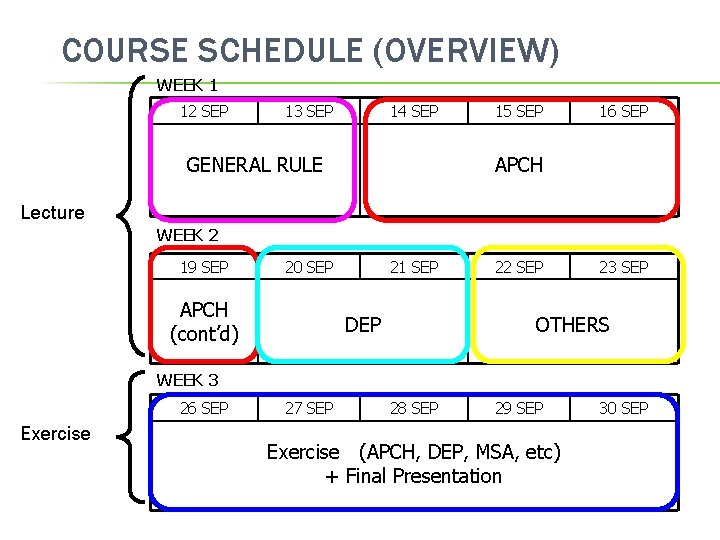
COURSE SCHEDULE (OVERVIEW) WEEK 1 12 SEP 13 SEP 14 SEP GENERAL RULE 15 SEP 16 SEP APCH Lecture WEEK 2 19 SEP 20 SEP APCH (cont’d) 21 SEP DEP 22 SEP 23 SEP OTHERS WEEK 3 26 SEP Exercise 27 SEP 28 SEP 29 SEP Exercise (APCH, DEP, MSA, etc) + Final Presentation 30 SEP
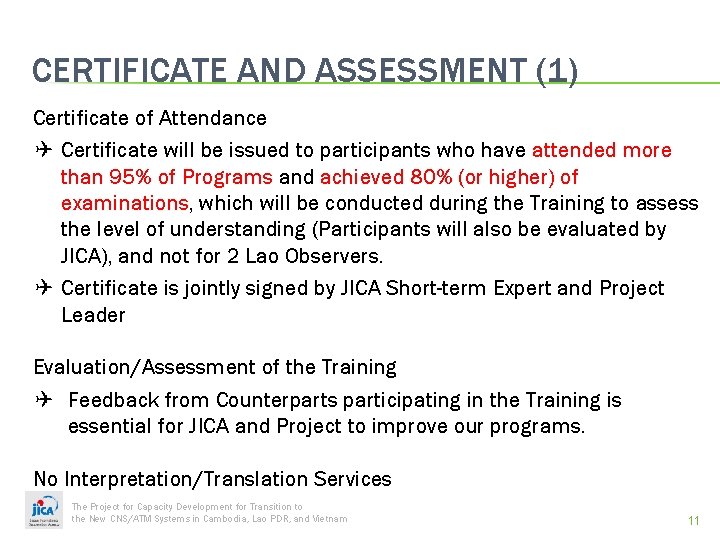
CERTIFICATE AND ASSESSMENT (1) Certificate of Attendance ✈ Certificate will be issued to participants who have attended more than 95% of Programs and achieved 80% (or higher) of examinations, which will be conducted during the Training to assess the level of understanding (Participants will also be evaluated by JICA), and not for 2 Lao Observers. ✈ Certificate is jointly signed by JICA Short-term Expert and Project Leader Evaluation/Assessment of the Training ✈ Feedback from Counterparts participating in the Training is essential for JICA and Project to improve our programs. No Interpretation/Translation Services The Project for Capacity Development for Transition to the New CNS/ATM Systems in Cambodia, Lao PDR, and Vietnam 11
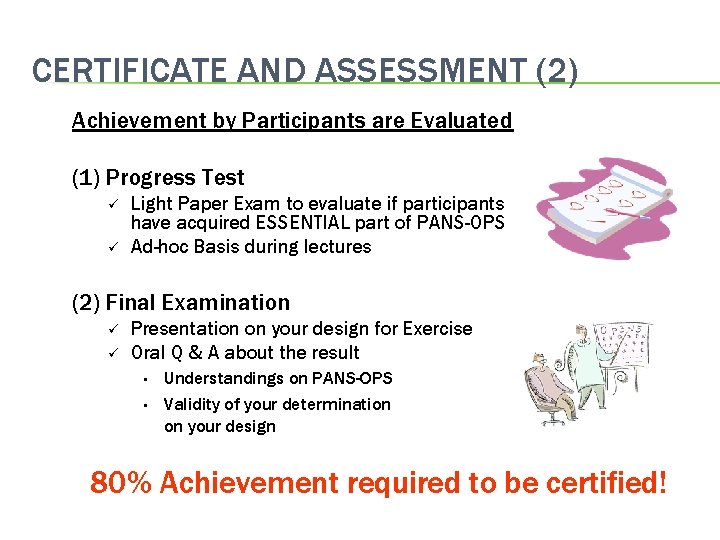
CERTIFICATE AND ASSESSMENT (2) Achievement by Participants are Evaluated (1) Progress Test ü ü Light Paper Exam to evaluate if participants have acquired ESSENTIAL part of PANS-OPS Ad-hoc Basis during lectures (2) Final Examination ü ü Presentation on your design for Exercise Oral Q & A about the result • • Understandings on PANS-OPS Validity of your determination on your design 80% Achievement required to be certified!
CERTIFICATE AND ASSESSMENT (3) Counterparts are requested to provide their Feedback by ✈ Submitting Group Evaluation/Assessment (in Lao) everyday after Lectures/Workshop (Group Leader summarize feedback of all participants). Group Evaluation Form will be provided to the Group Leader every morning. ✈ Submitting Individual Evaluation/Assessment (in Lao) after Session 9 on Day 5. Individual Evaluation Form will be provided to the Participants morning of Day 5. ✈ Copy of Group Evaluation and Individual Evaluation Forms submitted will be made available to DCA for records. The Project for Capacity Development for Transition to the New CNS/ATM Systems in Cambodia, Lao PDR, and Vietnam 13

Do not be an observer! Participate actively!! Get involved!!! The Project for Capacity Development for Transition to the New CNS/ATM Systems in Cambodia, Lao PDR, and Vietnam 14
- Slides: 14