
The Basic Elements of a Dramatic Production AND
The Basic Elements of a Dramatic Production AND An Introduction to Our Town

Terms of a Dramatic Production n Drama n n n A story told by means of a dialogue and action which presents a single and simple problem that is settled during the play – a few characters. It is divided into acts which are divided into scenes which are made up of actions and words. Purposes are: (1) to instruct n (2) to protest n (3) to amuse n (4) to appease the gods n (5) to show what people are like n
n Plot – the action of the play, what happens; three parts n Exposition – the opening part of the play n n n n Sets the action in time and place Acquaints the audience with the characters Reveals and begins the conflict May foreshadow the end of the play Complication – the development of conflict; climax Denouement – the falling action – the resolution, it follows the climax. At this point, all loose ends are tied up and the play is “rounded out and finished. ” Climax – the point in the play where the outcome becomes inevitable. The highest point of action. The most exciting part of the action or the most important. The particular moment where the antagonist and the protagonist finally dash for the last time.
Characters n Protagonist n n Antagonist n n The main character The character representing the conflict Motivation n The reasons for the actions in the play. It is expected to be logical, the actor is expected to be “in character. ”
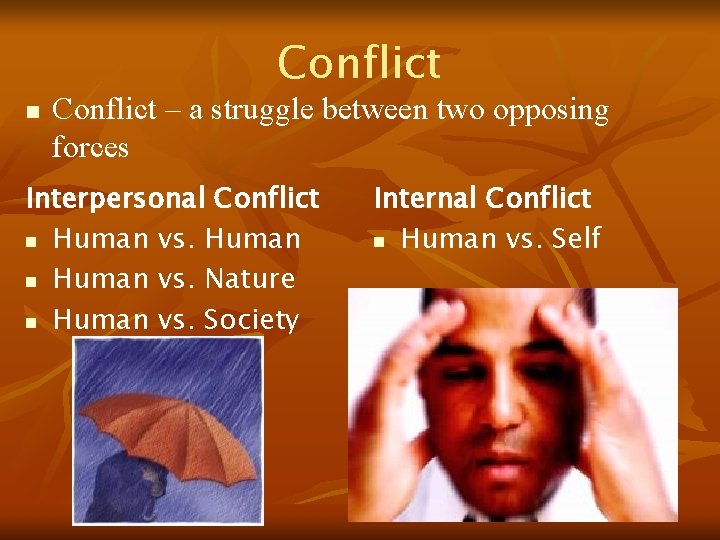
Conflict n Conflict – a struggle between two opposing forces Interpersonal Conflict n Human vs. Human n Human vs. Nature n Human vs. Society Internal Conflict n Human vs. Self
Man v. Man n Involves conflict between people Man v. Nature • Involves conflict between an individual and the natural world
Man v. Society • Involves conflict between an individual and larger groups Man v. Self n Involves characters’ psychological conflicts with themselves
Types of Drama n Two main categories are: n n Comedy – in which the characters undergo embarrassments or discomfitures which are on the whole so managed that they interest and amuse without engaging our profoundest sympathy, and in which the action turns out well for the chief characters Tragedy – generally applied to the representation of serious actions (Romeo & Juliet) which turn out disastrously for the chief character(s).
n Melodrama n Characters act with very little motivation (1) has too many ups and downs n (2) contains no transitions n (3) characters are too one dimensional --- bearing little relationship with each other n (4) situations are highly impossible; solutions are incredible or conflicts are overemphasized (You Can’t Take it With You) n
Setting n The scenery or location of the action: n It can: Reveal n Provide atmosphere n Influence actions of the characters n Or symbolize what is going on n

Characters/Characterization n The people in the play n We get to know them: Through the actions of other characters n By their speech, what they say and how they say it n By the setting or surroundings in which we see them n Their actions and reactions n Through their thoughts if they have a soliloquy n
Soliloquy & Dialogue n n Soliloquy – a situation in which the audience “overhears” a character speaking to himself Dialogue – what we read, the speech of characters. It does several things: n n It must advance the action of the play, it must have relevance to the action It can reveal past events, predict coming events, given information, give hints, reveal character. It should be distinct from that of other characters. You should be able to tell who is talking without having to look at the name. The speech should be life-like and convincing. It shouldn’t sound put-on or fake.

The Stage BACKSTAGE WALL Upstage Right Upstage Center Upstage Left Right Center Left Downstage Right Downstage Center Downstage Left AUDIENCE
Terms concerned with dramatic production n n n Backer – one who finances a production Props – personal effects and movable property Producer – in complete charge of everything Director – guides actors in their performances Critic – evaluates play against other works Billing – place of name on marquee
Terms concerned with dramatic production (cont’d) n n n Cast – group of actors SRO – Standing room only Dramaturgy – the art of writing plays Stage space – the cubic volume of stage area Farce – a satirical play in which the manners and customs of a period are held up to ridicule
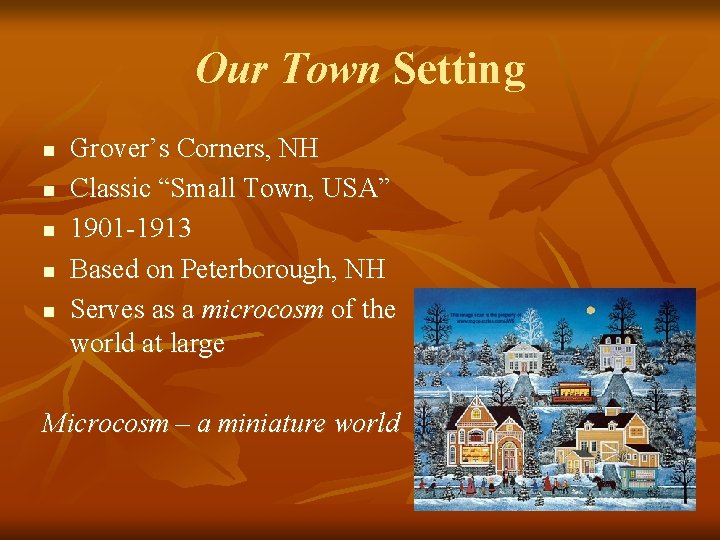
Our Town Setting n n n Grover’s Corners, NH Classic “Small Town, USA” 1901 -1913 Based on Peterborough, NH Serves as a microcosm of the world at large Microcosm – a miniature world
Themes n n Life is Precious and Should Be Cherished Death Gives Meaning to Life Nature Is the Force that Controls the Destiny of Humanity Immortality Is Gained Through Union with That Which Is Eternal in Every Individual
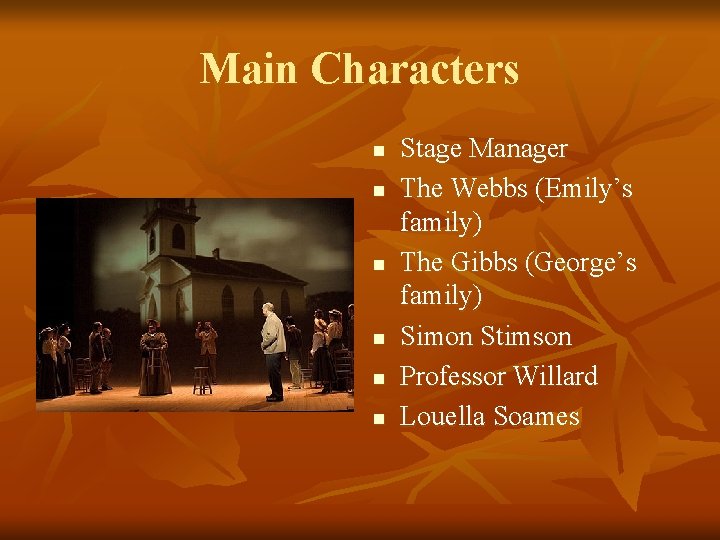
Main Characters n n n Stage Manager The Webbs (Emily’s family) The Gibbs (George’s family) Simon Stimson Professor Willard Louella Soames
Literary Elements & Techniques n n n n Antirealism Dramatic irony Narrator Pantomime Staging Style Symbol
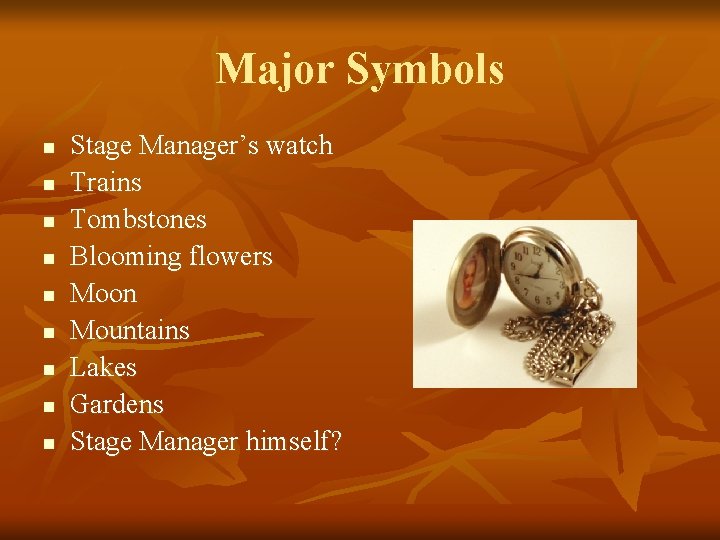
Major Symbols n n n n n Stage Manager’s watch Trains Tombstones Blooming flowers Moon Mountains Lakes Gardens Stage Manager himself?
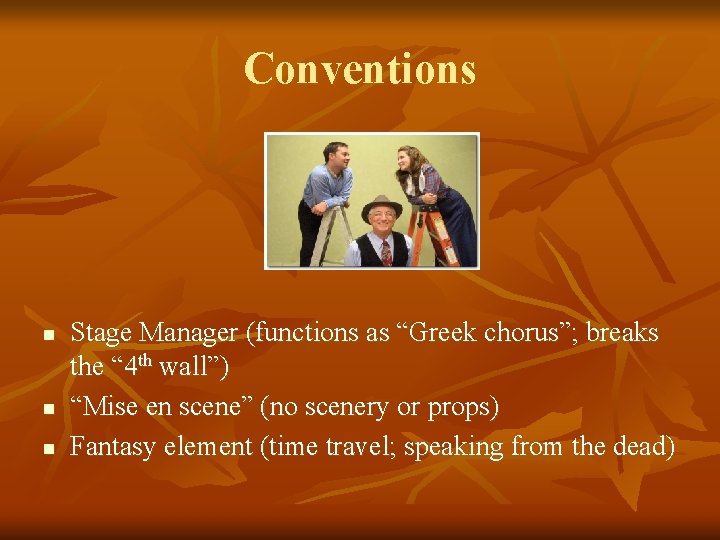
Conventions n n n Stage Manager (functions as “Greek chorus”; breaks the “ 4 th wall”) “Mise en scene” (no scenery or props) Fantasy element (time travel; speaking from the dead)
- Slides: 21