
The Basic Concepts of Solar Cells YingYing Chen
The Basic Concepts of Solar Cells Ying-Ying Chen
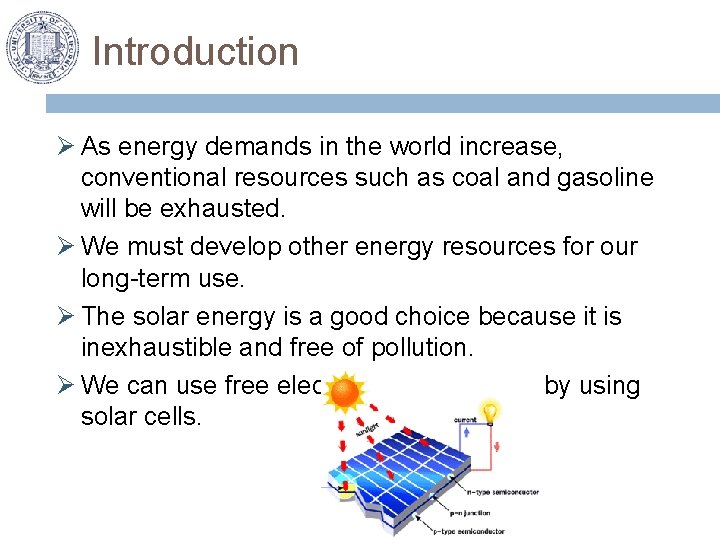
Introduction Ø As energy demands in the world increase, conventional resources such as coal and gasoline will be exhausted. Ø We must develop other energy resources for our long-term use. Ø The solar energy is a good choice because it is inexhaustible and free of pollution. Ø We can use free electricity from the sun by using solar cells.
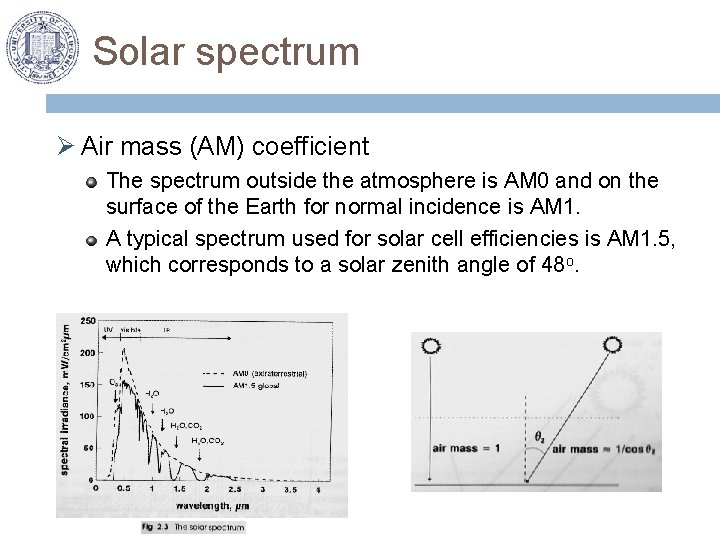
Solar spectrum Ø Air mass (AM) coefficient The spectrum outside the atmosphere is AM 0 and on the surface of the Earth for normal incidence is AM 1. A typical spectrum used for solar cell efficiencies is AM 1. 5, which corresponds to a solar zenith angle of 48 o.
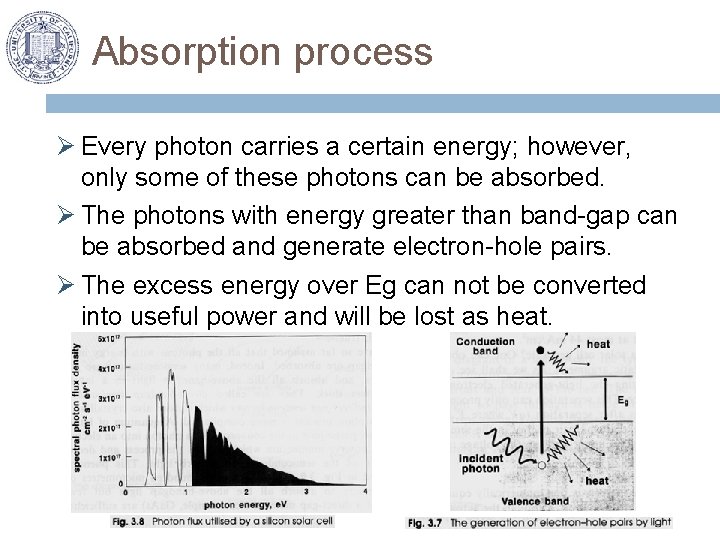
Absorption process Ø Every photon carries a certain energy; however, only some of these photons can be absorbed. Ø The photons with energy greater than band-gap can be absorbed and generate electron-hole pairs. Ø The excess energy over Eg can not be converted into useful power and will be lost as heat.
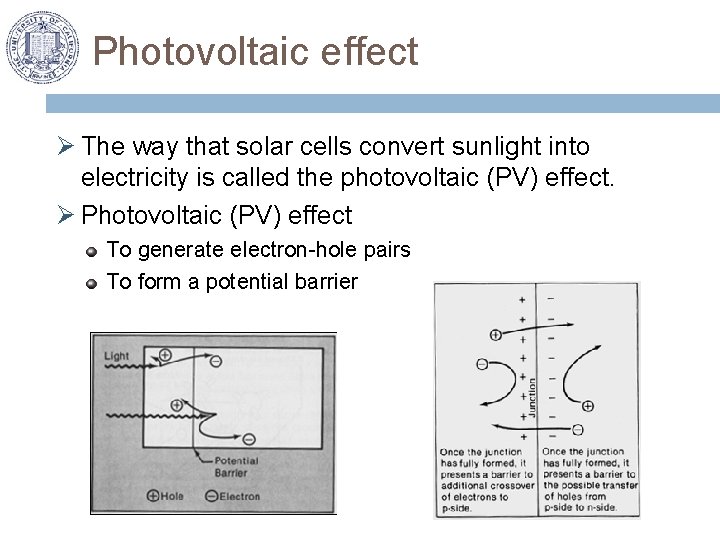
Photovoltaic effect Ø The way that solar cells convert sunlight into electricity is called the photovoltaic (PV) effect. Ø Photovoltaic (PV) effect To generate electron-hole pairs To form a potential barrier
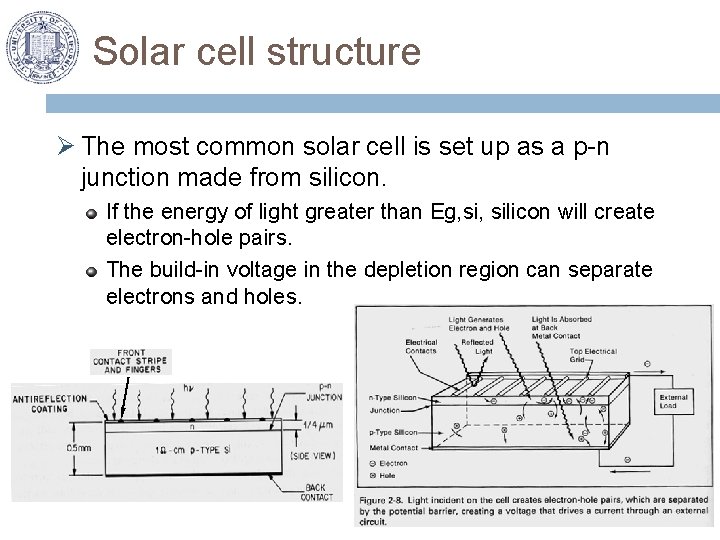
Solar cell structure Ø The most common solar cell is set up as a p-n junction made from silicon. If the energy of light greater than Eg, silicon will create electron-hole pairs. The build-in voltage in the depletion region can separate electrons and holes.
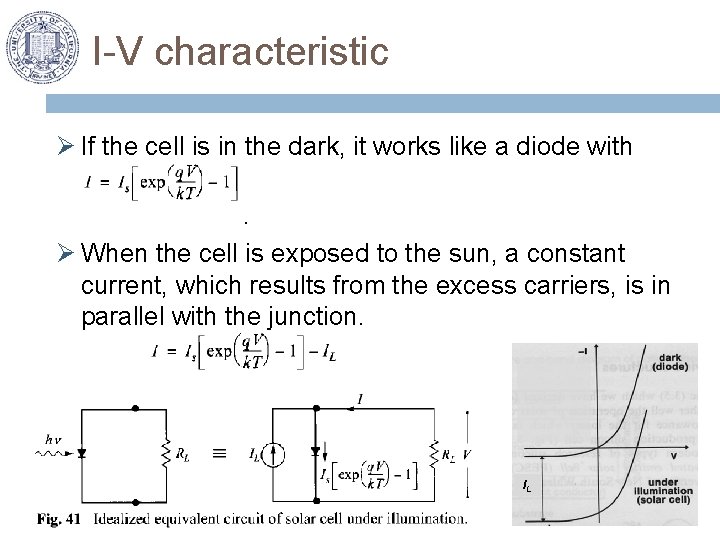
I-V characteristic Ø If the cell is in the dark, it works like a diode with current. Ø When the cell is exposed to the sun, a constant current, which results from the excess carriers, is in parallel with the junction. IL
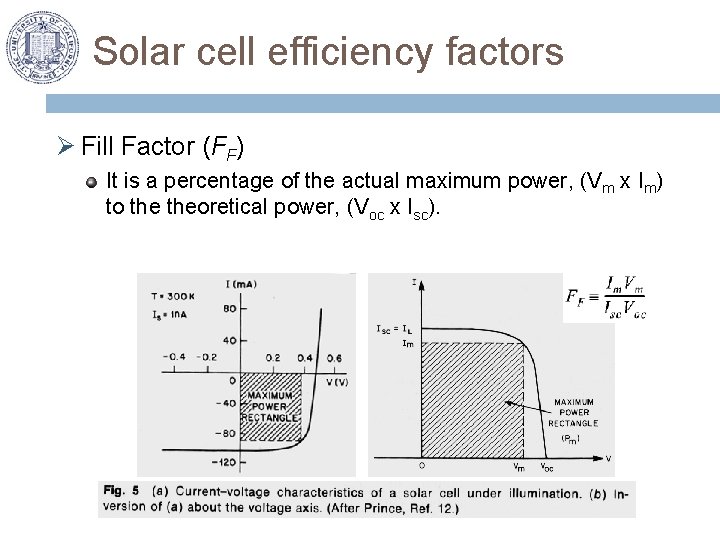
Solar cell efficiency factors Ø Fill Factor (FF) It is a percentage of the actual maximum power, (Vm x Im) to theoretical power, (Voc x Isc).
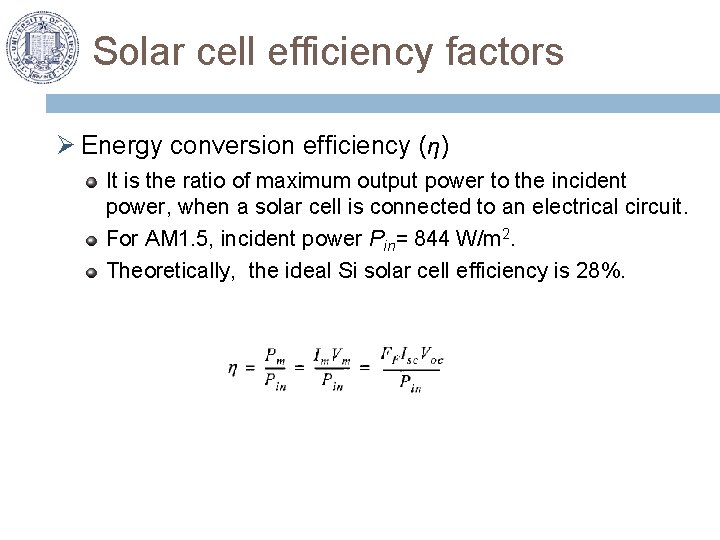
Solar cell efficiency factors Ø Energy conversion efficiency (η) It is the ratio of maximum output power to the incident power, when a solar cell is connected to an electrical circuit. For AM 1. 5, incident power Pin= 844 W/m 2. Theoretically, the ideal Si solar cell efficiency is 28%.
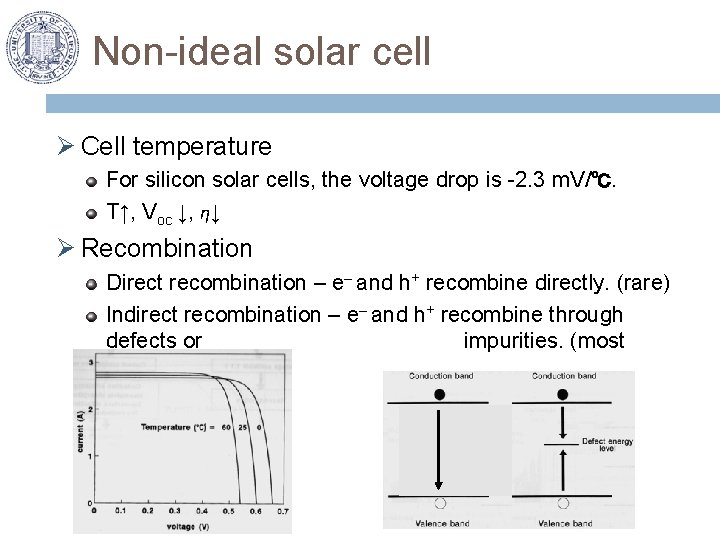
Non-ideal solar cell Ø Cell temperature For silicon solar cells, the voltage drop is -2. 3 m. V/℃. T↑, Voc ↓, η↓ Ø Recombination Direct recombination – e– and h+ recombine directly. (rare) Indirect recombination – e– and h+ recombine through defects or impurities. (most common)
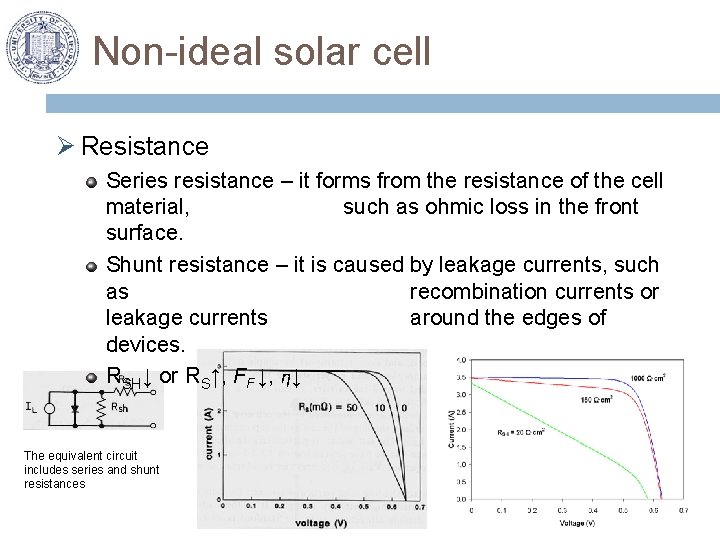
Non-ideal solar cell Ø Resistance Series resistance – it forms from the resistance of the cell material, such as ohmic loss in the front surface. Shunt resistance – it is caused by leakage currents, such as recombination currents or leakage currents around the edges of devices. RSH↓ or RS↑, FF ↓, η↓ The equivalent circuit includes series and shunt resistances
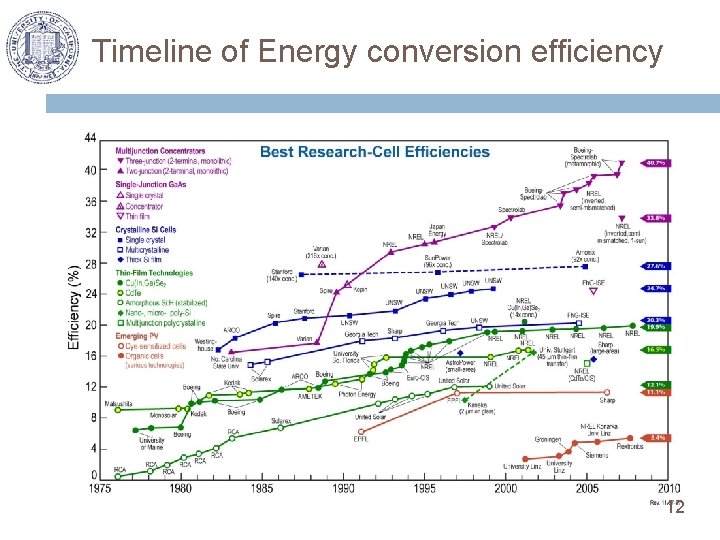
Timeline of Energy conversion efficiency 12
Summary Ø The idea of solar cell is that we can convert sunlight into free electricity. Ø There are two key points for photovoltaic effect: to generate electron-hole pairs and to form a potential barrier. Ø Solar cell efficiency can be determined by fill factor (FF) and energy conversion efficiency (η). Ø Cell temperature, recombination and resistances cause power losses in solar cells.
Reference Ø Solar electricity by Tomas Markvart Ø Basic photovoltaic principles and methods by Kenneth Zweibel , Paul Hersch Ø Physics of semiconductor devices by S. M. Sze Ø National Renewable Energy Laboratory (USA) Ø Wikipedia http: //en. wikipedia. org/wiki/Solar_cell#Silicon_solar_ cell_device_manufacture
- Slides: 14