
The BAME Attainment Gap and Developing Student Confidence
The BAME Attainment Gap and Developing Student Confidence: Challenging the Deficit Model Dr Melanie Crofts BAL Fair Outcomes Champion
Introduction - Background and Context The Deficit Model Critical Race Theory What can we do? Discussion
Background and Context - BAME attainment gap – BAME (not homogenous) Student experiences of race and racism Cumulative effect of micro aggressions Decolonising the curriculum BUT - Only one element of addressing the attainment gap - Holistic approach needed - institutional processes and structures - “it’s cultural”, “don’t have the confidence”, “lack understanding of what HE is about”, “parents are not interested” OR “parents are too pushy”, “they’re lazy”, “they prefer to party”…
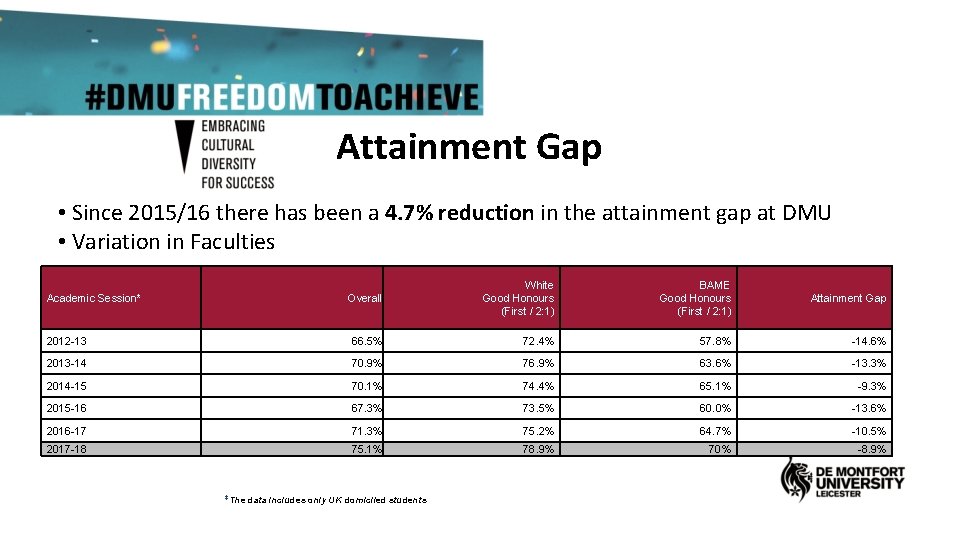
Attainment Gap • Since 2015/16 there has been a 4. 7% reduction in the attainment gap at DMU • Variation in Faculties Overall White Good Honours (First / 2: 1) BAME Good Honours (First / 2: 1) Attainment Gap 2012 -13 66. 5% 72. 4% 57. 8% -14. 6% 2013 -14 70. 9% 76. 9% 63. 6% -13. 3% 2014 -15 70. 1% 74. 4% 65. 1% -9. 3% 2015 -16 67. 3% 73. 5% 60. 0% -13. 6% 2016 -17 71. 3% 75. 2% 64. 7% -10. 5% 2017 -18 75. 1% 78. 9% 70% -8. 9% Academic Session* *The data includes only UK domiciled students
The Deficit Model 2 Main types of deficit model: - Genetic – Internal shortcoming - Black people did not possess the ability to think abstractly and were intellectually inferior (Soloranzo, D and Yosso, T (2001). Eugenics. - Cultural – External weakness linked to the individual e. g. familial background (Solorzano, D and Yosso, T (2001))
The Deficit Model in HE • “a view that the problem lies with the students and that it is some attribute of the student that means they attain less well, rather than because of an institutional factor such as curriculum design/development” (Millar, M. (2016)) • “…deficit understandings of students persist in some areas. ” (NUS and UUK Report 2019) • Lack “cultural capital” – but who determines what is important? Who determines this cultural capital?
The Deficit Model in HE - Focus on inadequacies of the student, and tries to ‘fix’ them. - Structural issues are ignored or minimised. Self Fulfilling Prophecy.
Critical Race Theory “CRT is a body of scholarship steeped in radical activism that seeks to explore and challenge the prevalence of racial inequality in society. It is based on the understanding that race and racism are the product of social thought and power relations; CRT theorists endeavour to expose the way in which racial inequality is maintained through the operation of structures and assumptions that appear normal and unremarkable” (Gillborn and Rollock (2011))
Critical Race Theory - Race as primary mode of oppression (although intersects with others) - Interest Convergence - Contradiction Closing Case - The importance of narratives and voices of oppressed minorities

Institutional Discrimination - Macpherson Report 1999 - "The collective failure of an organization to provide an appropriate and professional service to people because of their colour, culture, or ethnic origin. It can be seen or detected in processes, attitudes and behaviour which amount to discrimination through unwitting prejudice, ignorance, thoughtlessness and racist stereotyping which disadvantage minority ethnic people. “
What can we do? (Adapted from Solorzano, Daniel G; Yosso, Tara J (2001)) - Define, analyse and give examples of race, racism and racial stereotypes, considering individual & institutional forms of racism; macro & micro; conscious & unconscious – have the conversation. - Consider issues around decolonising the curriculum, both in terms of content & resources. This is possible in most subject areas, although clearly easier in some than others.
What can we do? (Adapted from Solorzano, Daniel G; Yosso, Tara J (2001)) - Identify racial stereotypes in your own areas & engage students in the discussion e. g. – why is decolonising the curriculum challenging in your area? - Find examples within & about marginalised and BAME communities that challenge & transform stereotypes. - Consider ways in which to incorporate the ‘voice’ of BAME students into teaching & assessments.
Discussion - Could you incorporate some of the alternative approaches into your own teaching and practice? - Should we be ‘telling’ students from BAME backgrounds to “play the game” i. e. how far do we suggest Black students should conform to the dominant (white) standards in order to succeed, and how far should we encourage them to challenge them? What are the ethics around this? - Any other suggestions as to how we can avoid deficit model thinking?
References • UUK and NUS (May 2019) Black, Asian and Minority Ethnic Student Attainment at UK Universities. UUK/NUS Available online at https: //www. universitiesuk. ac. uk/policy-and-analysis/reports/Documents/2019/bame-student-attainment-ukuniversities-closing-the-gap. pdf Last accessed 16/06/19 • Millar, M. (2016) The Ethnicity Attainment Gap: literature review https: //www. sheffield. ac. uk/polopoly_fs/1. 661523!/file/BME_Attainment_Gap_Literature_Review_EXTERNAL__Miriam_Miller. pdf Last accessed 16/06/19 • Solorzano, Daniel G; Yosso, Tara J (2001) From racial stereotyping and deficit discourse toward a critical race theory in teacher education Multicultural Education; Fall 2001; 9, 1; Pro. Quest • Race for Equality (2011) A Report on the Experiences of Black Students in Further and Higher Education: National Union of Students. • Rollock, N. and Gillborn, D. (2011) Critical Race Theory (CRT), British Educational Research Association online resource. Available online at https: //www. bera. ac. uk/wp-content/uploads/2014/03/Critical-Race-Theory-CRT-. pdf? noredirect=1 Last accessed 16/06/19
- Slides: 14