
The Balance Scorecard versus Quality Award Models as
The Balance Scorecard versus Quality Award Models as Strategic Frameworks Dr. Shuki Dror Head, Department of Industrial Engineering and Management ORT Braude College
Agenda n Paper objectives n Strategic frameworks for performance management n Comparison between organizational performance management frameworks n QFD Balanced Scorecard Construction Map n Illustrative Example n Conclusions
Paper objectives n This paper extends the comparison presented by Wongrassamee et al. , by using Otley's five points for comparing three performance management frameworks, i. e. MBNQA, EFQM, and the Balanced Scorecard. n A structured methodological approach based on the Quality Function Deployment (QFD) for implementing the Balanced Scorecard in an individual organization is presented.
Strategic frameworks for performance management Malcolm Baldrige National Quality Award (MBNQA) (1987 -2008) European Foundation for Quality Management (EFQM) (1988 -2008) Balanced Scorecard (BSC) (1992, 1996, 2001)

MBNQA profile Strategic planning Human resources Business results Leadership Customer focus Process management Measurement, analysis, and knowledge management
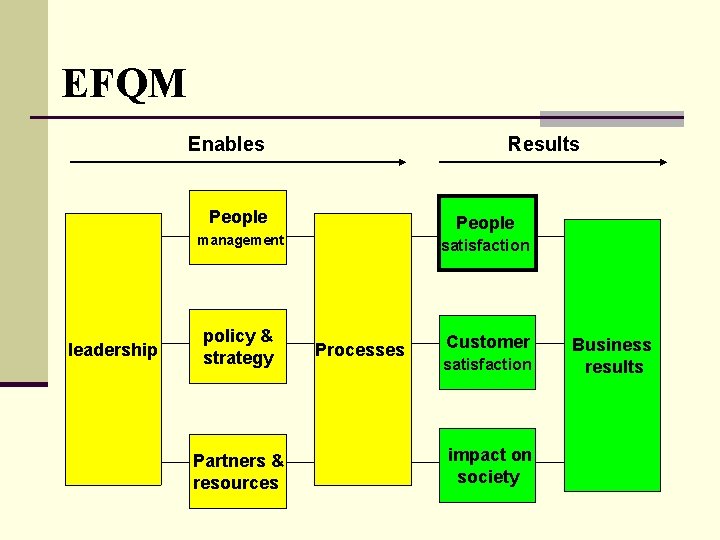
EFQM Enables Results People management leadership policy & strategy Partners & resources satisfaction Processes Customer satisfaction impact on society Business results
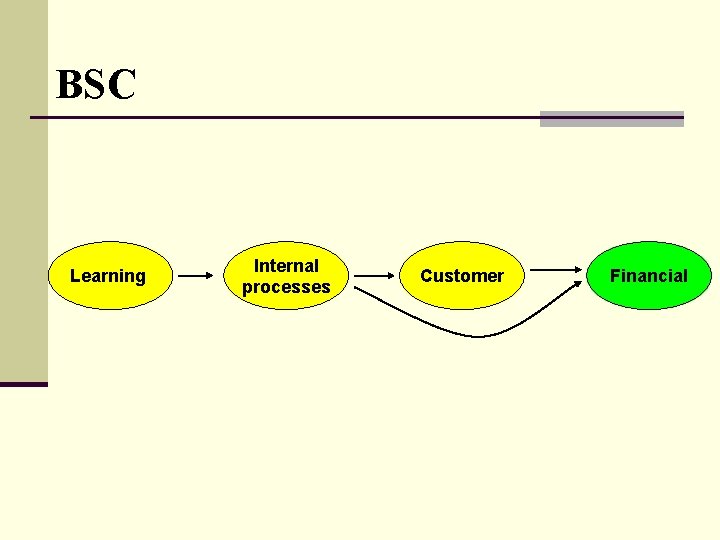
BSC Learning Internal processes Customer Financial
Comparison between organizational performance management frameworks n Otley (1999) suggested several topics that have to be considered in the development of an organizational performance management framework: (1) High level objectives (2) Long term programs (3) Processes (4) Targets and performance measures (5) Feedback
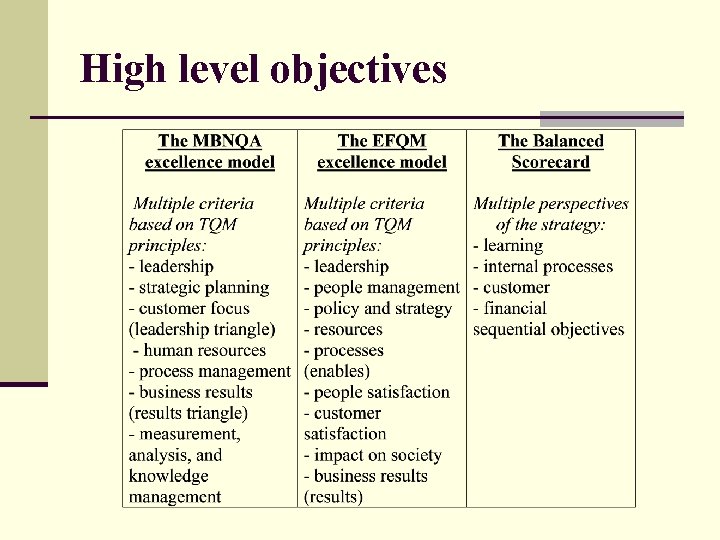
High level objectives

Long term programs
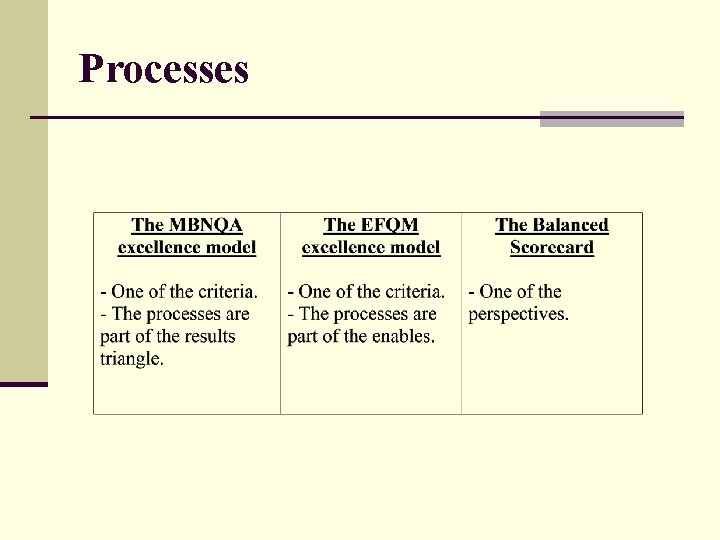
Processes
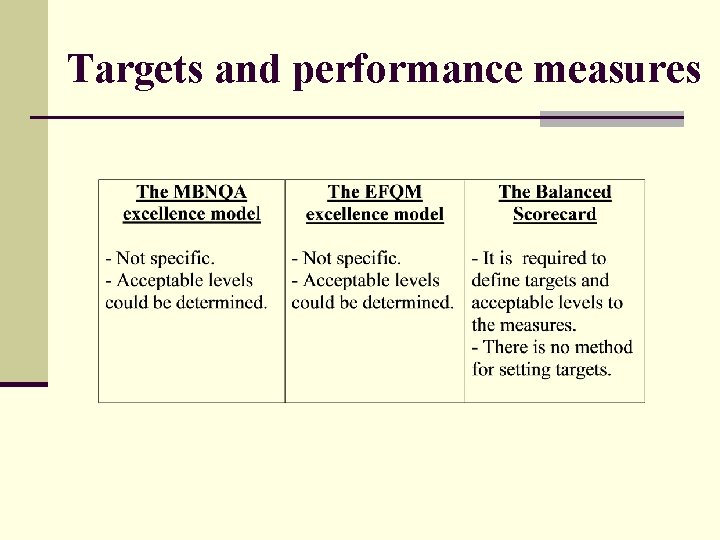
Targets and performance measures
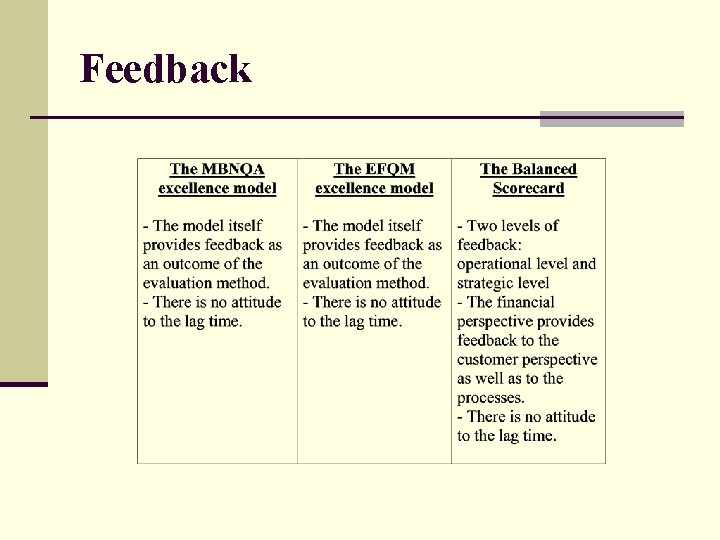
Feedback
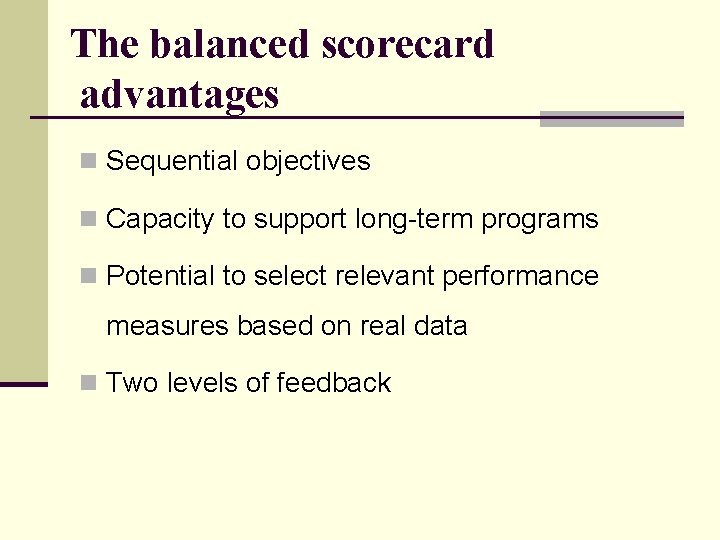
The balanced scorecard advantages n Sequential objectives n Capacity to support long-term programs n Potential to select relevant performance measures based on real data n Two levels of feedback
The balanced scorecard limitations n Focusing on learning as the only source for causality n No basic guidelines for selecting performance measures n No method for setting targets to measures n Complex feedback from the financial perspective to the customer perspective and to the process perspective n Lack of lag time consideration between causes and its effects
QFD To improve the implementation of the balanced scorecard The QFD helps to overcome the two of the limitations: (1) No basic guidelines for selecting performance measures (2) Complex feedback from the financial perspective to the customer perspective and to the process perspective
Quality Function Deployment (QFD) n Product quality design methodology. n The QFD technique was developed in 1972 at Mitsubishi and during the 80's and the 90’s has been gradually and successfully adopted by U. S. and Japanese firms.
Quality Function Deployment (QFD) n Extract the customers' needs or desires and translate them into demands on technical product characteristics, engineering parameters and ultimately into production systems.
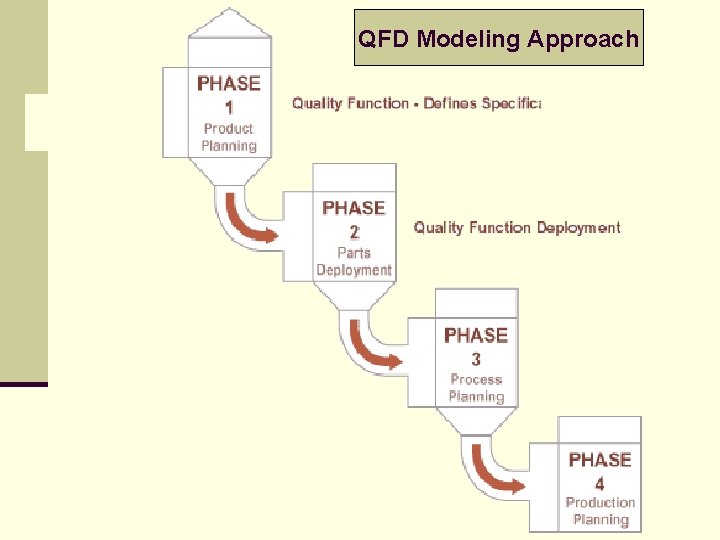
QFD Modeling Approach
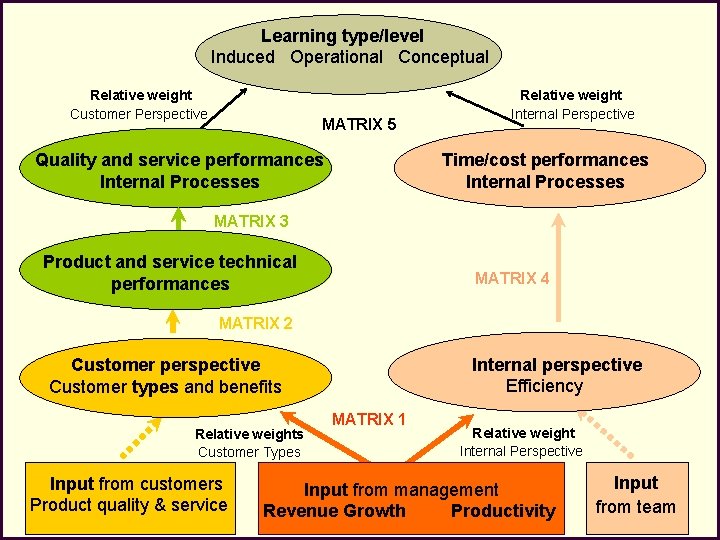
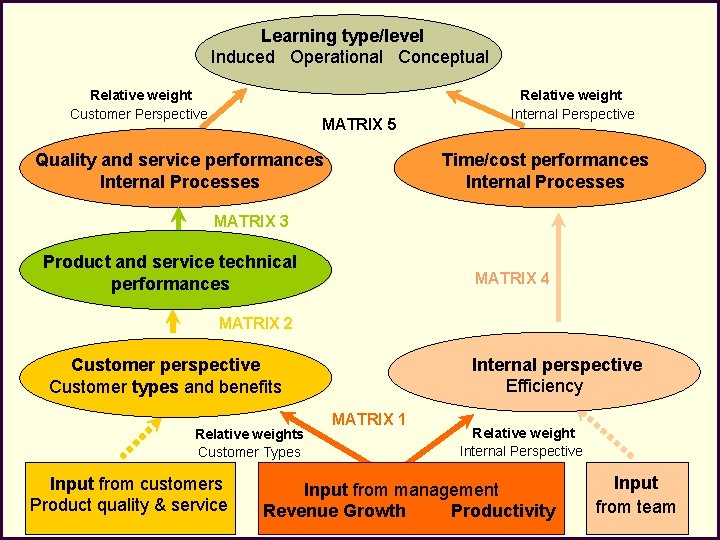
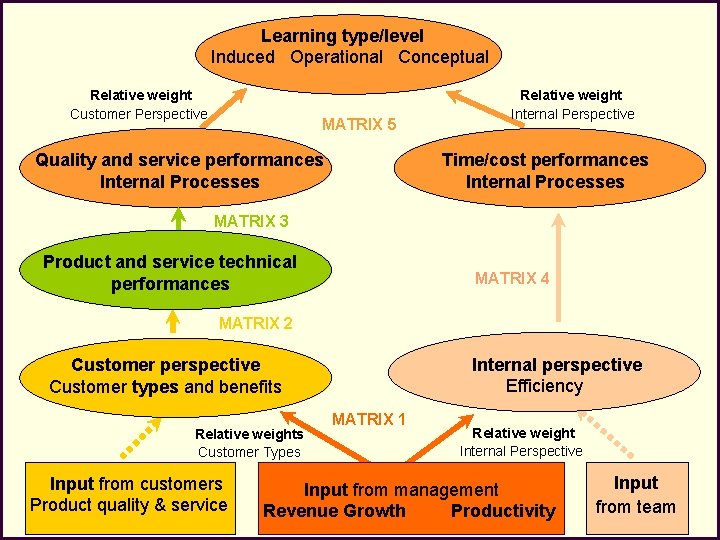
Balanced Scorecard Construction Map
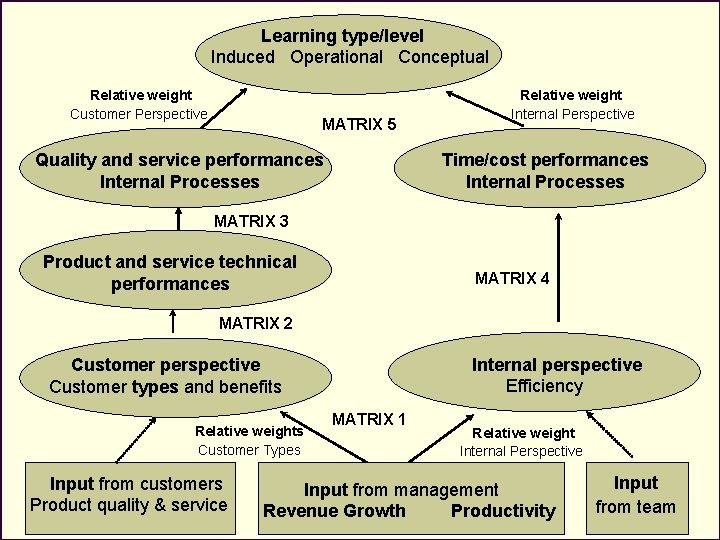
Learning type/level Induced Operational Conceptual Relative weight Customer Perspective MATRIX 5 Quality and service performances Internal Processes Relative weight Internal Perspective Time/cost performances Internal Processes MATRIX 3 Product and service technical performances MATRIX 4 MATRIX 2 Internal perspective Efficiency Customer perspective Customer types and benefits Relative weights Customer Types Input from customers Product quality & service MATRIX 1 Relative weight Internal Perspective Input from management Revenue Growth Productivity Input from team
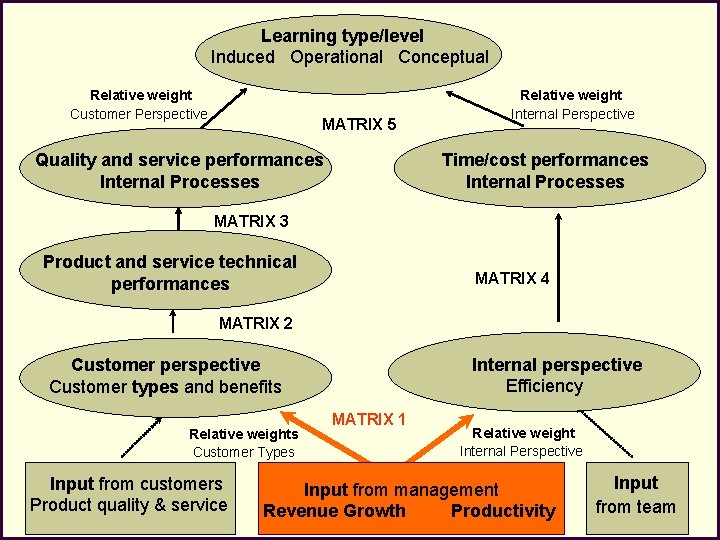
Learning type/level Induced Operational Conceptual Relative weight Customer Perspective MATRIX 5 Quality and service performances Internal Processes Relative weight Internal Perspective Time/cost performances Internal Processes MATRIX 3 Product and service technical performances MATRIX 4 MATRIX 2 Internal perspective Efficiency Customer perspective Customer types and benefits Relative weights Customer Types Input from customers Product quality & service MATRIX 1 Relative weight Internal Perspective Input from management Revenue Growth Productivity Input from team
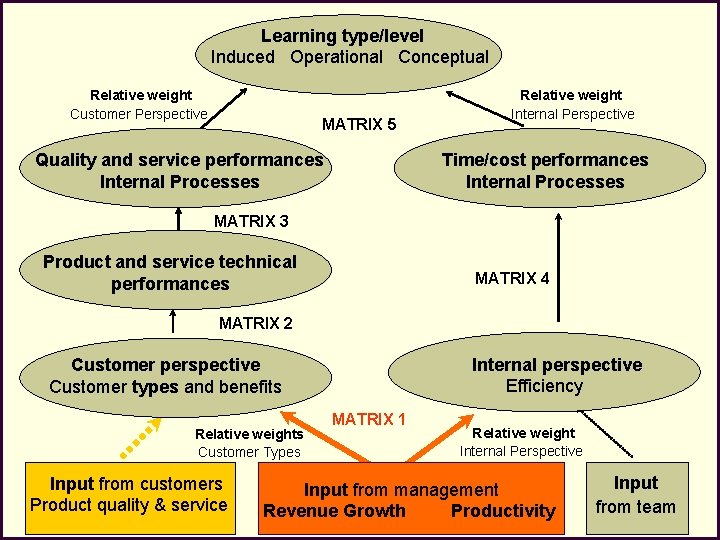
Learning type/level Induced Operational Conceptual Relative weight Customer Perspective MATRIX 5 Quality and service performances Internal Processes Relative weight Internal Perspective Time/cost performances Internal Processes MATRIX 3 Product and service technical performances MATRIX 4 MATRIX 2 Internal perspective Efficiency Customer perspective Customer types and benefits Relative weights Customer Types Input from customers Product quality & service MATRIX 1 Relative weight Internal Perspective Input from management Revenue Growth Productivity Input from team
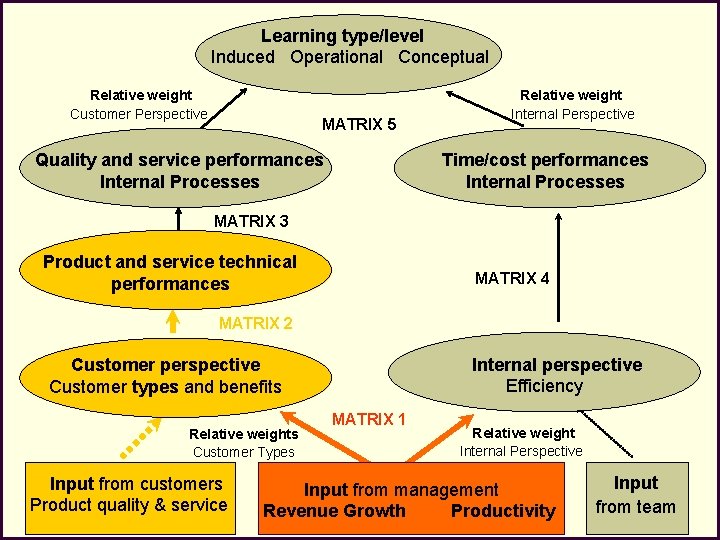
Learning type/level Induced Operational Conceptual Relative weight Customer Perspective MATRIX 5 Quality and service performances Internal Processes Relative weight Internal Perspective Time/cost performances Internal Processes MATRIX 3 Product and service technical performances MATRIX 4 MATRIX 2 Internal perspective Efficiency Customer perspective Customer types and benefits Relative weights Customer Types Input from customers Product quality & service MATRIX 1 Relative weight Internal Perspective Input from management Revenue Growth Productivity Input from team
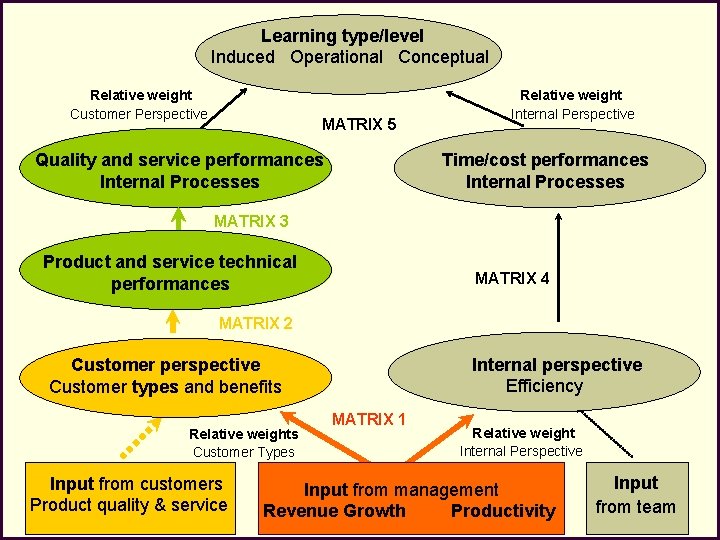
Learning type/level Induced Operational Conceptual Relative weight Customer Perspective MATRIX 5 Relative weight Internal Perspective Time/cost performances Internal Processes Quality and service performances Internal Processes MATRIX 3 Product and service technical performances MATRIX 4 MATRIX 2 Internal perspective Efficiency Customer perspective Customer types and benefits Relative weights Customer Types Input from customers Product quality & service MATRIX 1 Relative weight Internal Perspective Input from management Revenue Growth Productivity Input from team
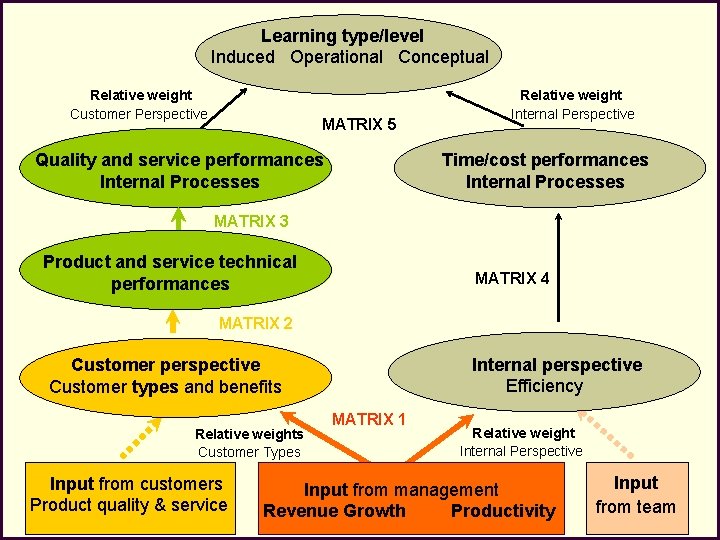
Learning type/level Induced Operational Conceptual Relative weight Customer Perspective MATRIX 5 Relative weight Internal Perspective Time/cost performances Internal Processes Quality and service performances Internal Processes MATRIX 3 Product and service technical performances MATRIX 4 MATRIX 2 Internal perspective Efficiency Customer perspective Customer types and benefits Relative weights Customer Types Input from customers Product quality & service MATRIX 1 Relative weight Internal Perspective Input from management Revenue Growth Productivity Input from team
Learning type/level Induced Operational Conceptual Relative weight Customer Perspective MATRIX 5 Relative weight Internal Perspective Time/cost performances Internal Processes Quality and service performances Internal Processes MATRIX 3 Product and service technical performances MATRIX 4 MATRIX 2 Internal perspective Efficiency Customer perspective Customer types and benefits Relative weights Customer Types Input from customers Product quality & service MATRIX 1 Relative weight Internal Perspective Input from management Revenue Growth Productivity Input from team
Learning type/level Induced Operational Conceptual Relative weight Customer Perspective MATRIX 5 Relative weight Internal Perspective Time/cost performances Internal Processes Quality and service performances Internal Processes MATRIX 3 Product and service technical performances MATRIX 4 MATRIX 2 Internal perspective Efficiency Customer perspective Customer types and benefits Relative weights Customer Types Input from customers Product quality & service MATRIX 1 Relative weight Internal Perspective Input from management Revenue Growth Productivity Input from team
Learning type/level Induced Operational Conceptual Relative weight Customer Perspective MATRIX 5 Relative weight Internal Perspective Time/cost performances Internal Processes Quality and service performances Internal Processes MATRIX 3 Product and service technical performances MATRIX 4 MATRIX 2 Internal perspective Efficiency Customer perspective Customer types and benefits Relative weights Customer Types Input from customers Product quality & service MATRIX 1 Relative weight Internal Perspective Input from management Revenue Growth Productivity Input from team
Induced Learning n Induced learning is training at the individual level and developing/enhancing Information Systems/Technology.
Operational & Conceptual Learning n Operational learning and conceptual learning are viewed here as combinations of organizational structures and improvement tools. n Both operational learning and conceptual learning involve teams.
Operational Learning n Operational learning as being achieved by means of local teams using rather basic tools such as the seven basic graphical tools or SPC.
Conceptual Learning n Conceptual learning has a wider scope and as such has to rely on cross functional teams applying more sophisticated tools such as enhanced QFD and advanced statistical tools such as Design of Experiments (DOE).

Illustrative Example
Cross Functional Team n Finance n Market oriented n Information systems n Human resource members n Industrial engineers n R&D representatives
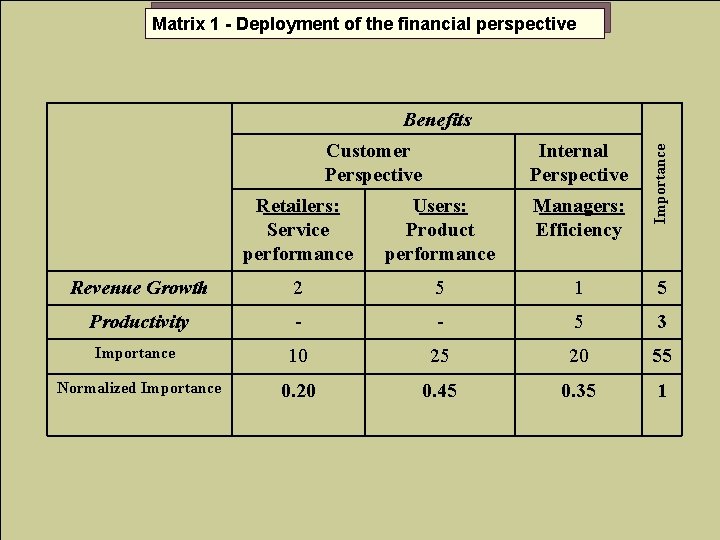
Matrix 1 - Deployment of the financial perspective Customer Perspective Internal Perspective Importance Benefits Retailers: Service performance Users: Product performance Managers: Efficiency Revenue Growth 2 5 1 5 Productivity - - 5 3 Importance 10 25 20 55 Normalized Importance 0. 20 0. 45 0. 35 1
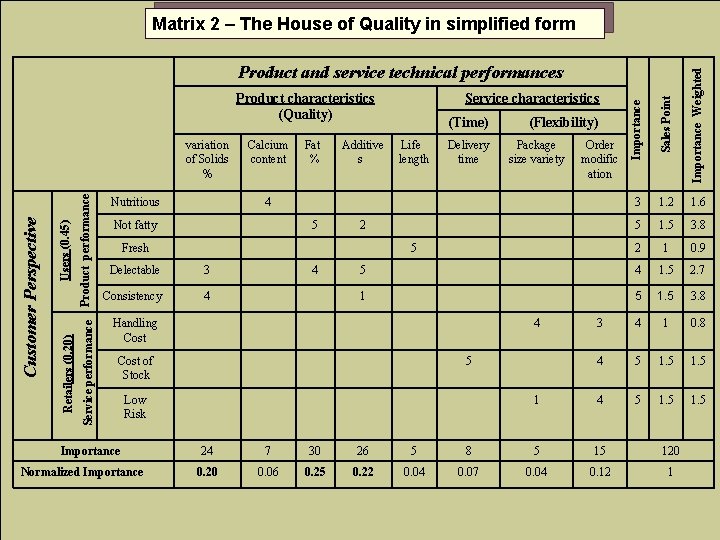
Matrix 2 – The House of Quality in simplified form Importance Sales Point Importance Weighted Product and service technical performances 3 1. 2 1. 6 5 1. 5 3. 8 2 1 0. 9 5 4 1. 5 2. 7 1 5 1. 5 3. 8 3 4 1 0. 8 4 5 1 4 5 1. 5 Product characteristics (Quality) Product performance Service performance Users (0. 45) Retailers (0. 20) Customer Perspective variation of Solids % Nutritious Calcium content Fat % Additive s Service characteristics (Time) Life length Delivery time 5 Order modific ation 2 Fresh 5 Delectable 3 Consistency 4 4 Handling Cost 4 Cost of Stock 5 Low Risk Normalized Importance Package size variety 4 Not fatty Importance (Flexibility) 24 7 30 26 5 8 5 15 120 0. 06 0. 25 0. 22 0. 04 0. 07 0. 04 0. 12 1
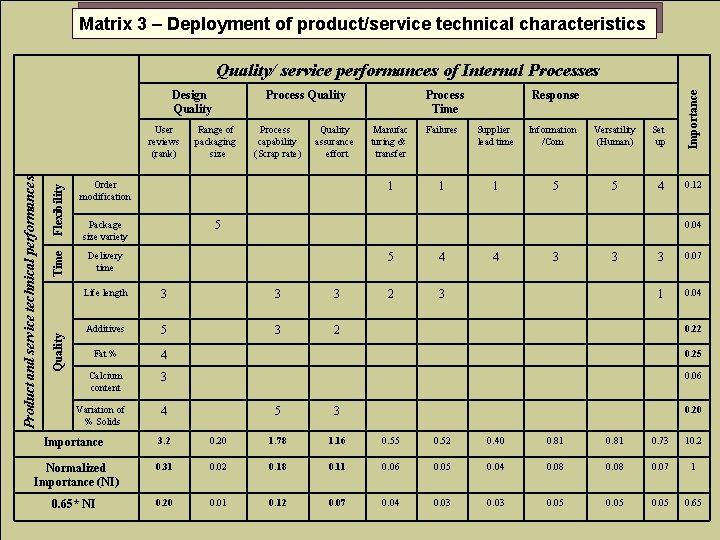
Matrix 3 – Deployment of product/service technical characteristics Quality/ service performances of Internal Processes Flexibility Order modification Time Delivery time Quality Product and service technical performances User reviews (rank) Package size variety Process Quality Range of packaging size Process capability (Scrap rate) Quality assurance effort Process Time Response Manufac turing & transfer Failures Supplier lead time Information /Com Versatility (Human) Set up Importance Design Quality 1 1 1 5 5 4 0. 12 0. 04 5 5 4 2 3 4 3 3 3 0. 07 1 0. 04 Life length 3 3 3 Additives 5 3 2 Fat % 4 0. 25 Calcium content 3 0. 06 Variation of % Solids 4 5 3 0. 22 0. 20 3. 2 0. 20 1. 78 1. 16 0. 55 0. 52 0. 40 0. 81 0. 73 10. 2 Normalized Importance (NI) 0. 31 0. 02 0. 18 0. 11 0. 06 0. 05 0. 04 0. 08 0. 07 1 0. 65* NI 0. 20 0. 01 0. 12 0. 07 0. 04 0. 03 0. 05 0. 65 Importance
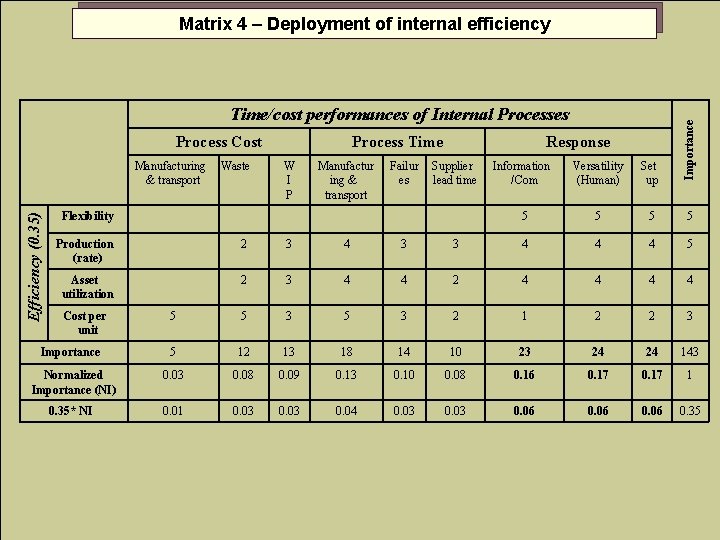
Time/cost performances of Internal Processes Process Cost Efficiency (0. 35) Manufacturing & transport Waste Process Time W I P Manufactur ing & transport Failur es Response Supplier lead time Flexibility Importance Matrix 4 – Deployment of internal efficiency Information /Com Versatility (Human) Set up 5 5 Production (rate) 2 3 4 3 3 4 4 4 5 Asset utilization 2 3 4 4 2 4 4 5 5 3 2 1 2 2 3 Importance 5 12 13 18 14 10 23 24 24 143 Normalized Importance (NI) 0. 03 0. 08 0. 09 0. 13 0. 10 0. 08 0. 16 0. 17 1 0. 35* NI 0. 01 0. 03 0. 04 0. 03 0. 06 0. 35 Cost per unit
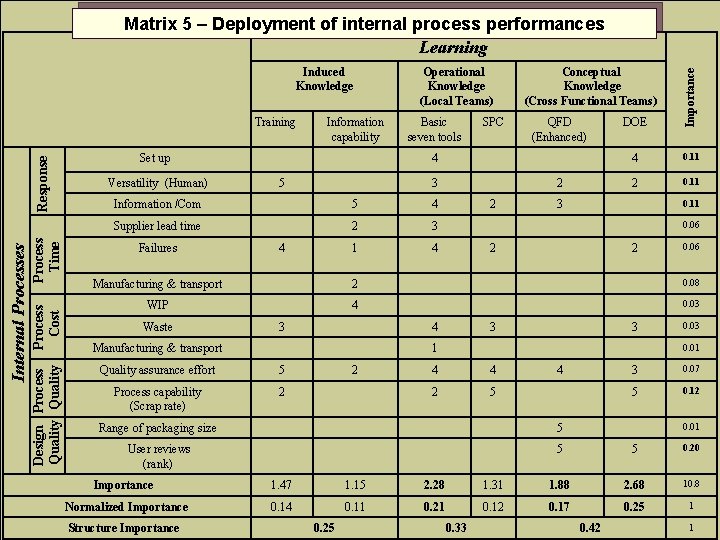
Matrix 5 – Deployment of internal process performances Learning Process Time Process Cost Design Process Quality Internal Processes Response Training Information capability Set up Versatility (Human) Operational Knowledge (Local Teams) Basic seven tools QFD (Enhanced) 4 5 3 Information /Com 5 4 Supplier lead time 2 3 1 4 Failures SPC Conceptual Knowledge (Cross Functional Teams) 4 2 2 DOE Importance Induced Knowledge 4 0. 11 2 0. 11 3 0. 06 2 2 0. 06 Manufacturing & transport 2 0. 08 WIP 4 0. 03 Waste 3 4 Manufacturing & transport 3 3 0. 01 1 Quality assurance effort 5 Process capability (Scrap rate) 2 2 0. 03 4 4 2 5 4 3 0. 07 5 0. 12 0. 01 Range of packaging size 5 User reviews (rank) 5 5 0. 20 Importance 1. 47 1. 15 2. 28 1. 31 1. 88 2. 68 10. 8 Normalized Importance 0. 14 0. 11 0. 21 0. 12 0. 17 0. 25 1 Structure Importance 0. 25 0. 33 0. 42 1
Conclusions n It is shown that among the three frameworks the balanced scorecard has important advantages. Hence, it is selected here as a 'fundamental' strategic framework of an individual organization. n However, the balanced scorecard has some essential limitations. n To improve the implementation of the balanced scorecard in an individual organization a structured methodological approach based on the Quality Function Deployment (QFD) is presented.
Conclusions n The QFD matrices ensure that every financial performance defined by the enterprise strategy is linked to a set of performance measures in the relevant domains that may eventually influence its future results. n Through QFD, priorities for improving performance measures in each of the three other domains are determined.
Conclusions n The QFD matrices warrant that proposed learning actions are consistent with eventual financial results. n The QFD systematic approach assists in organizing the balanced scorecard thus promoting continuous improvement for achieving strategic goals.
Reference n Dror, S. The Balance Scorecard versus Quality Award Models as Strategic frameworks, Total Quality Management and Business Excellence, 19, 6: 583 -593, 2008. n Dror, S. and Barad, M. Utilizing Quality Function Deployment to Construct a Balanced Scorecard Map, In Proceedings of the Performance Measurement and Management Conference, Boston, USA, 165 -172, 2002.

E N D
- Slides: 45