
The BAHA System Types of hearing loss the
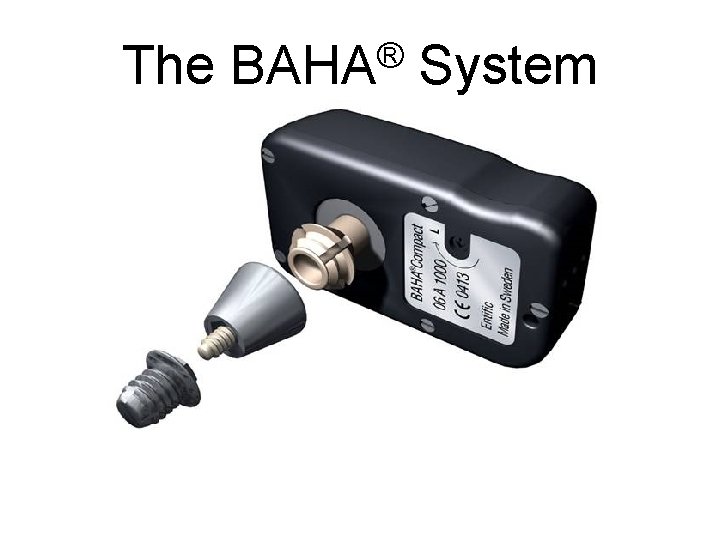
The ® BAHA System


Types of hearing loss the ® BAHA System can help • Unilateral sensori-neural hearing loss/Single Sided Deafness – Due to examples such as: • • Acoustic neuroma tumors Sudden deafness Neurological degenerative disease Trauma Ototoxic treatments Inner ear malformation Genetics Meniere’s Disease

® BAHA Candidate Single Sided Deafness • > 5 years of age • Intended to improve speech recognition • Intended for patients with SSD (unilateral sensori-neural hearing loss) when the other ear is normal • Normal hearing is defined as PTA AC threshold equal to or better than 20 d. B at. 5, 1, 2 and 3 k. Hz • For patients who cannot or will not use AC CROS HA • Functions by transcranial routing of the signal

® BAHA How does the System work for SSD?
Head-shadow Effect Review • For speech the overall reduction of effective intensity is approximately 6 d. B (Tillman etal. , 1963) • Its effect on speech intelligibility is approximately a reduction of 23% when sound is coming directly from the ‘bad’ ear side • Binaural amplification in eliminating the head shadow effect can be about 25% or 6 d. B improvement Minimal effect at 1500 Hz, but continues upward to approximately 15 d. B at 5000 Hz (Staab 1988 b) • in the S/N ratio (from the Handbook of Clinical Audiology, Katz)
Initial findings Unilateral Deafness • Handicap of unilateral deafness was UNDERESTIMATED • Complaints of unilateral deafness: – Difficulty understanding speech in noise – Difficulty hearing sounds presented on the deaf side – Unbalanced environment From Wazen et al. presented at AAO-HNS Meeting, San Diego, September 2002
SSD Questionnaire Results from BAHA® System Wearers • • 70% wearing the BAHA® 7 days per week 94% used the device > 8 hours per day 70% improvement in quality of life 88% better performance at a dinner table, when a person sitting on their deaf side • 88% better performance while talking to one person among a group of people. • Average satisfaction score = 8 / 10 point scale From Wazen et al. presented at AAO-HNS Meeting, San Diego, September 2002
- Slides: 9