
The Background of Nominal Unit shear strengthVs for
The Background of Nominal Unit shear strength(Vs) for shear wall in US standard Li Rui & Zhao Jianchi
Content Introduction Specimen Test setup Test Procedure Calculation Reference

Introduction 1 plf(pound per linear foot)→ 14. 59 N/m Vs : Tabulated Nominal Unit Shear strength Determine allowable unit shear strength Use in Allowable Stress Design method(ASD) and Load Resistance Factor Design method(LRFD)
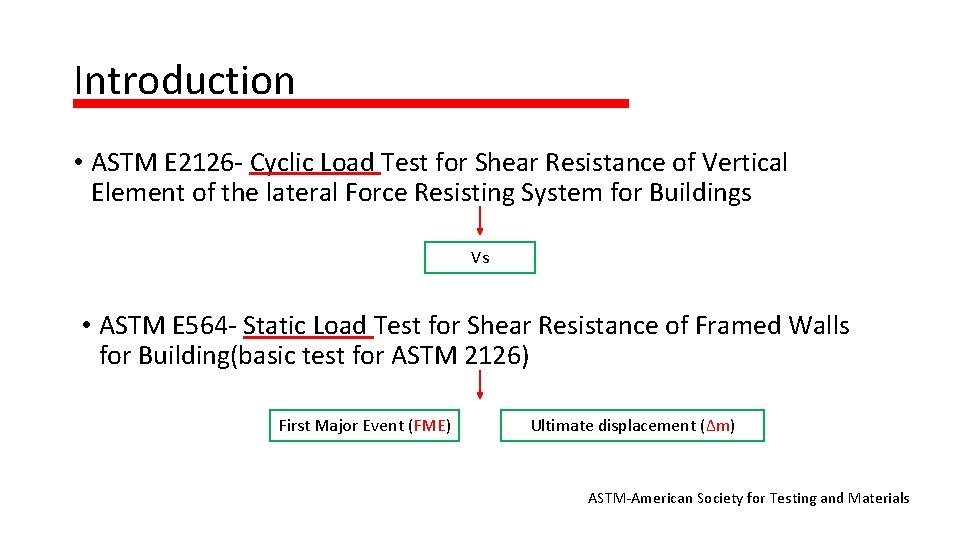
Introduction • ASTM E 2126 - Cyclic Load Test for Shear Resistance of Vertical Element of the lateral Force Resisting System for Buildings Vs • ASTM E 564 - Static Load Test for Shear Resistance of Framed Walls for Building(basic test for ASTM 2126) First Major Event (FME) Ultimate displacement (Δm) ASTM-American Society for Testing and Materials
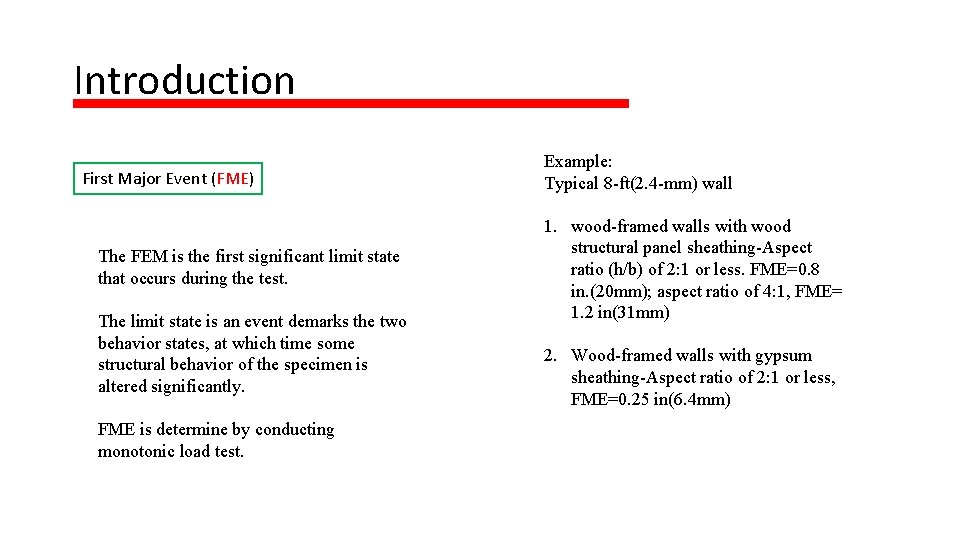
Introduction First Major Event (FME) The FEM is the first significant limit state that occurs during the test. The limit state is an event demarks the two behavior states, at which time some structural behavior of the specimen is altered significantly. FME is determine by conducting monotonic load test. Example: Typical 8 -ft(2. 4 -mm) wall 1. wood-framed walls with wood structural panel sheathing-Aspect ratio (h/b) of 2: 1 or less. FME=0. 8 in. (20 mm); aspect ratio of 4: 1, FME= 1. 2 in(31 mm) 2. Wood-framed walls with gypsum sheathing-Aspect ratio of 2: 1 or less, FME=0. 25 in(6. 4 mm)
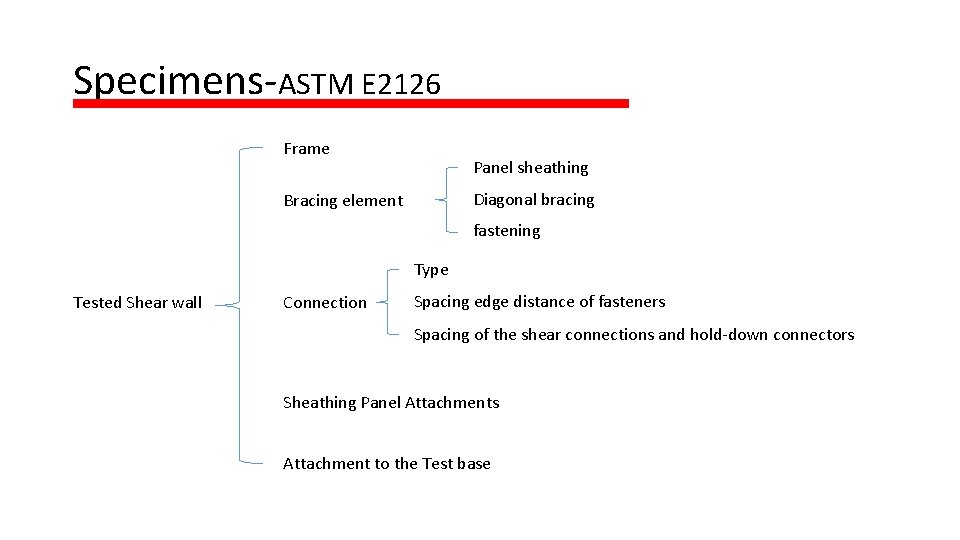
Specimens-ASTM E 2126 Frame Panel sheathing Diagonal bracing Bracing element fastening Type Tested Shear wall Connection Spacing edge distance of fasteners Spacing of the shear connections and hold-down connectors Sheathing Panel Attachments Attachment to the Test base
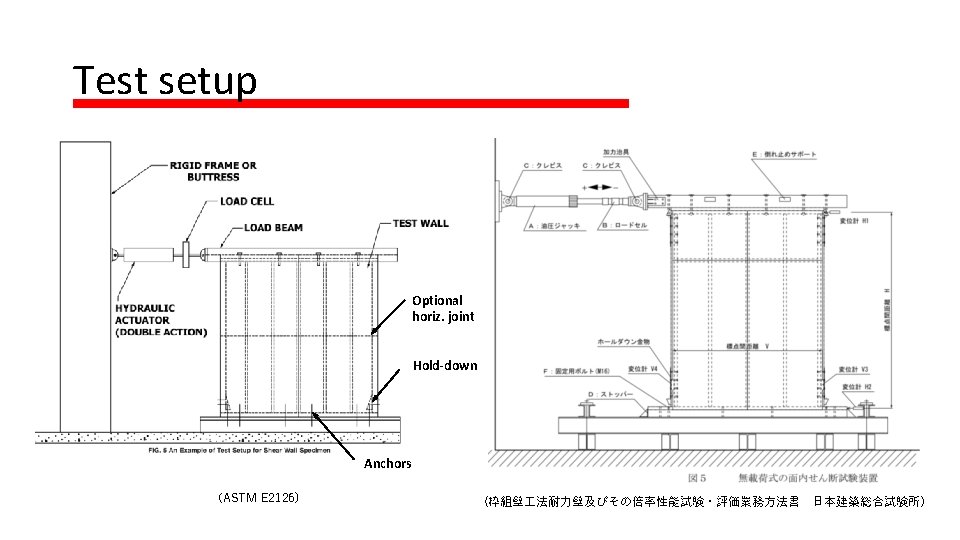
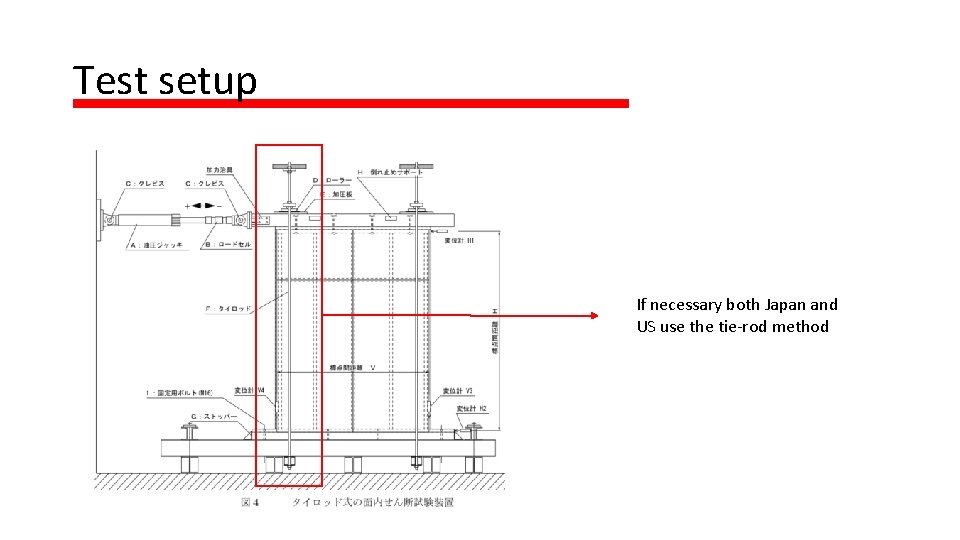
Test setup If necessary both Japan and US use the tie-rod method

Test procedure-loading method Method-A SPD method (Sequential-phased Displacement Procedure) Consists of two pattern. The first pattern consists of three phase, at displacements representing 25%, 50%, 75% of anticipated FME.

Test procedure-loading method Method-A SPD method (Sequential-phased Displacement Procedure) Each phase of the second pattern contains one initial cycle, three decay cycles, and a number of stabilization cycles. For nailed wood frame walls, three stabilization cycles is enough. The amplitude of each decay cycle decreases by 25% of initial displacement.
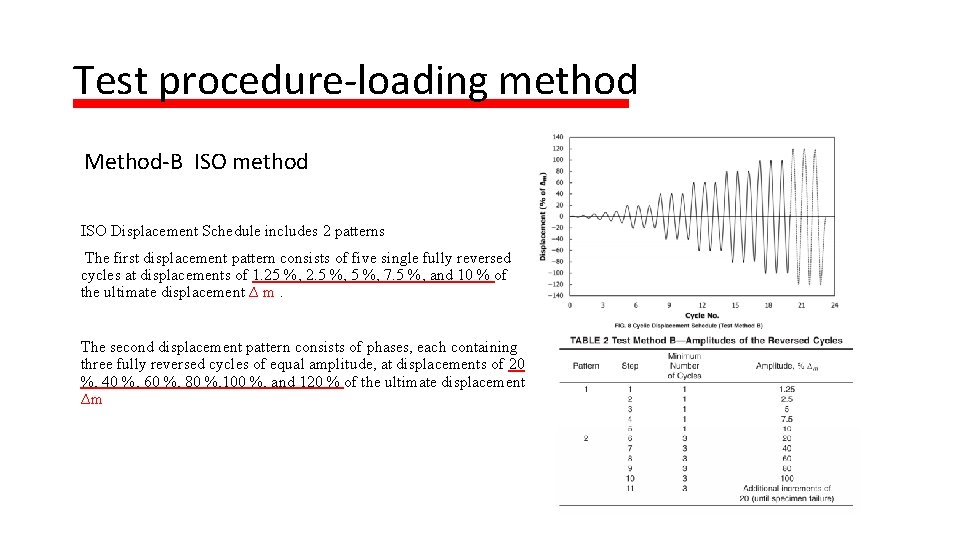
Test procedure-loading method Method-B ISO method ISO Displacement Schedule includes 2 patterns The first displacement pattern consists of five single fully reversed cycles at displacements of 1. 25 %, 2. 5 %, 7. 5 %, and 10 % of the ultimate displacement ∆ m. The second displacement pattern consists of phases, each containing three fully reversed cycles of equal amplitude, at displacements of 20 %, 40 %, 60 %, 80 %, 100 %, and 120 % of the ultimate displacement ∆m
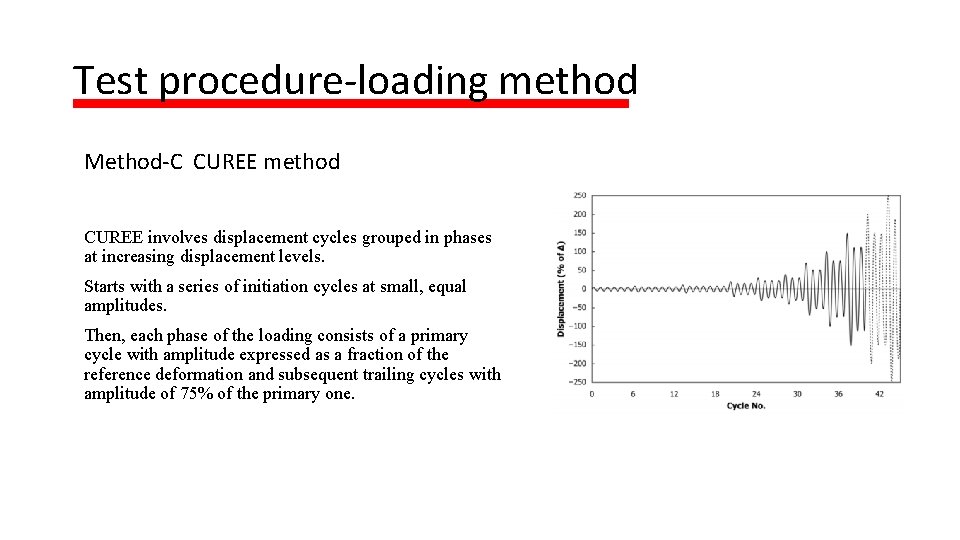
Test procedure-loading method Method-C CUREE method CUREE involves displacement cycles grouped in phases at increasing displacement levels. Starts with a series of initiation cycles at small, equal amplitudes. Then, each phase of the loading consists of a primary cycle with amplitude expressed as a fraction of the reference deformation and subsequent trailing cycles with amplitude of 75% of the primary one.
Test procedure-loading method • Method A vs Method B • Method C • Method A maybe applicable when Fme is the yield limit state or for testing slack systems to determine a lower bound displacement causing hysteretic energy dissipation • The latest method。 • Method B may be more applicable to systems that exhibit linear elastic behavior where FME is the strength limit state. If the ratio of Δm and FME is less than three, Method B may be preferable • For me now is a mystery
Test procedure-loading method There are two loading methods in Japanese standard. First one is used in tie-rot type. Each phase of that procedure consists of three fully reversed cycles, associating with a respective displacement level of 1/600, 1/450, 1/300, 1/200, 1/150, 1/100, 1/75, 1/50 rad. When it comes to the maximum load stress , continue loading until deformation angle comes to 1/15 or load stress decrease to 80% of the max load stress. The second method is for no tie-rot type. Each phase of this method also consists of three fully reversed cycles, and associates with a respective displacement level of 1/450, 1/300, 1/200, 1/150, 1/100, 1/75, 1/50 rad. When it comes to the maximum load stress , continue loading until deformation angle comes to 1/15 or load stress decrease to 80% of the max load stress.
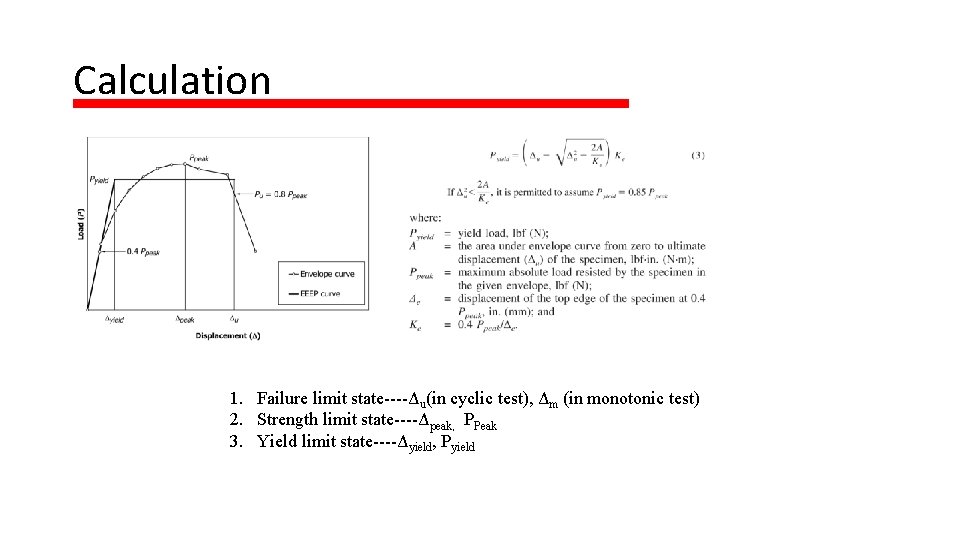
Calculation 1. Failure limit state----Δu(in cyclic test), Δm (in monotonic test) 2. Strength limit state----Δpeak,PPeak 3. Yield limit state----Δyield, Pyield
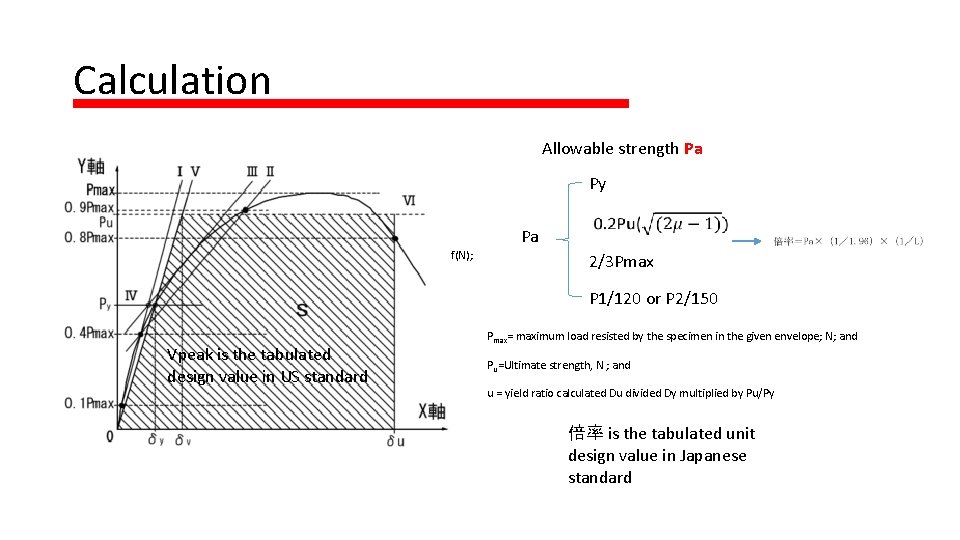
Calculation Allowable strength Pa Shear strength(Vpeak) Py Pa Ppeak= maximum load resisted by the specimen in the given envelope, lbf(N); and 2/3 Pmax L = length of specimen, ft(m) P 1/120 or P 2/150 unite ----- lbf/ft or N/m Vpeak is the tabulated design value in US standard Pmax= maximum load resisted by the specimen in the given envelope; N; and Pu=Ultimate strength, N ; and u = yield ratio calculated Du divided Dy multiplied by Pu/Py 倍率 is the tabulated unit design value in Japanese standard
Reference • ASTM E 2126 -11 Standard Test Method for Cyclic (Reversed) Load Test for Shear Resistance of Vertical Elements of the Lateral Force Resisting Systems of Buildings • 木造軸組 法住宅の許容応力度設計(2008年版) • 枠組壁 法耐力壁及びその倍率性能試験・評価業務方法書
- Slides: 17