
The Ba Barians are coming Neil Geddes Standard
The Ba. Barians are coming Neil Geddes • • Standard Model CP violation Ba. Bar Sin 2 The future
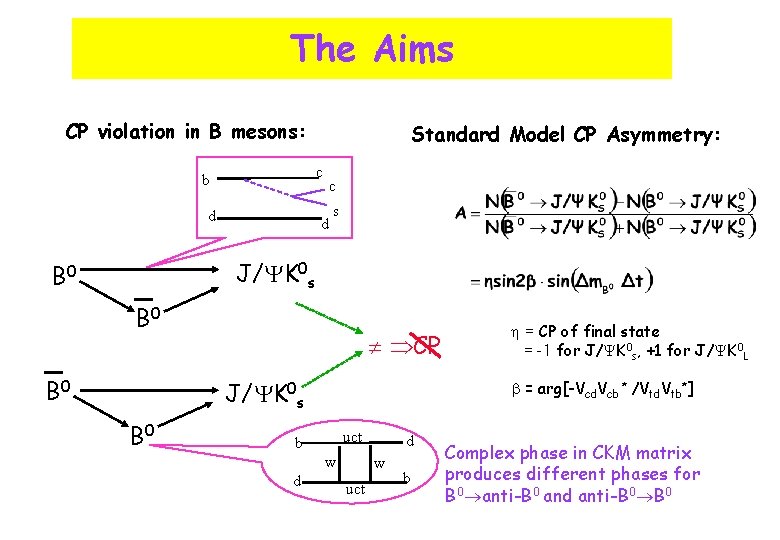
The Aims CP violation in B mesons: Standard Model CP Asymmetry: c b d c d s J/YK 0 s B 0 B 0 CP J/YK 0 s B 0 = arg[-Vcd. Vcb * /Vtd. Vtb*] uct b w d = CP of final state = -1 for J/YK 0 s, +1 for J/YK 0 L d w uct b Complex phase in CKM matrix produces different phases for B 0 anti-B 0 and anti-B 0
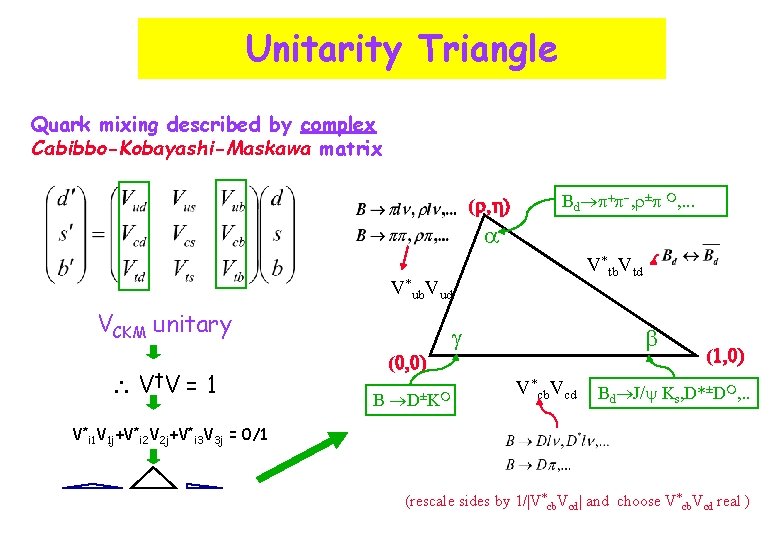
Unitarity Triangle Quark mixing described by complex Cabibbo-Kobayashi-Maskawa matrix (r, h) Bd + -, r± , . . . a V*tb. Vtd V*ub. Vud VCKM unitary V †V = 1 g (0, 0) B D±K V*cb. Vcd (1, 0) Bd J/ Ks, D*±D , . . V*i 1 V 1 j+V*i 2 V 2 j+V*i 3 V 3 j = 0/1 (rescale sides by 1/|V*cb. Vcd| and choose V*cb. Vcd real )
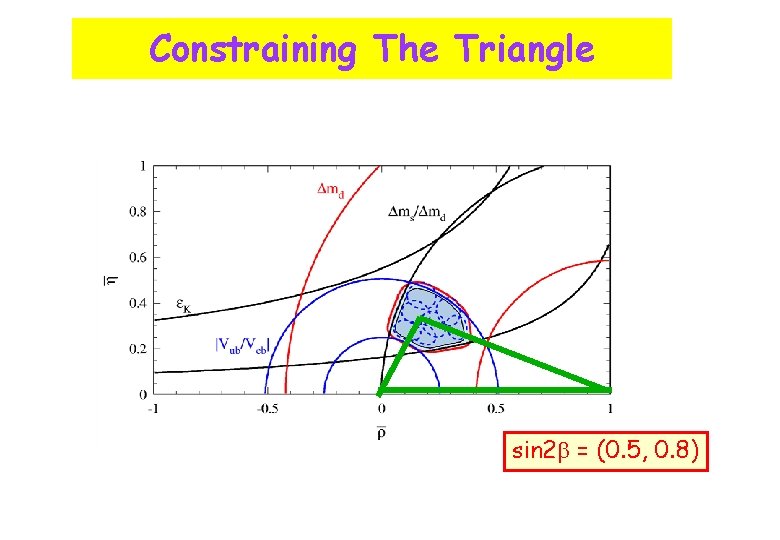
Constraining The Triangle sin 2 = (0. 5, 0. 8)
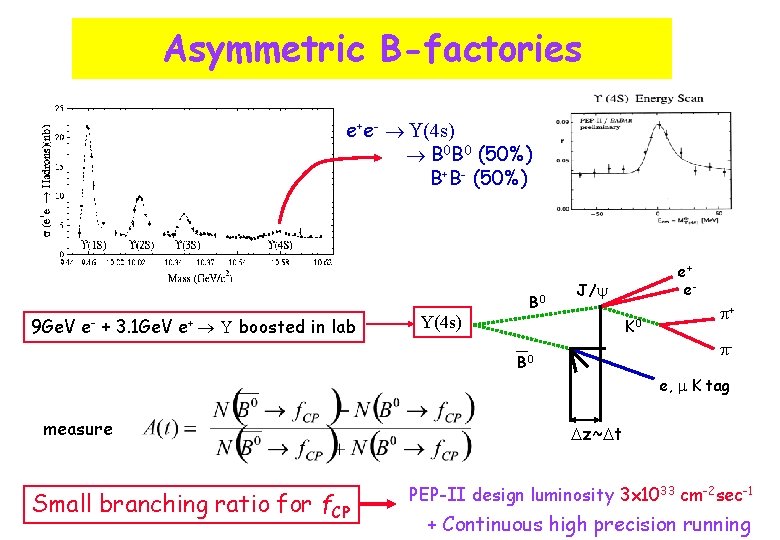
Asymmetric B-factories e+e- (4 s) B 0 B 0 (50%) B+B- (50%) 9 Ge. V e- + 3. 1 Ge. V e+ boosted in lab Y(4 s) B 0 e+ e- J/ K 0 _ B 0 + e, m K tag measure Small branching ratio for f. CP Dz~Dt PEP-II design luminosity 3 x 1033 cm-2 sec-1 + Continuous high precision running
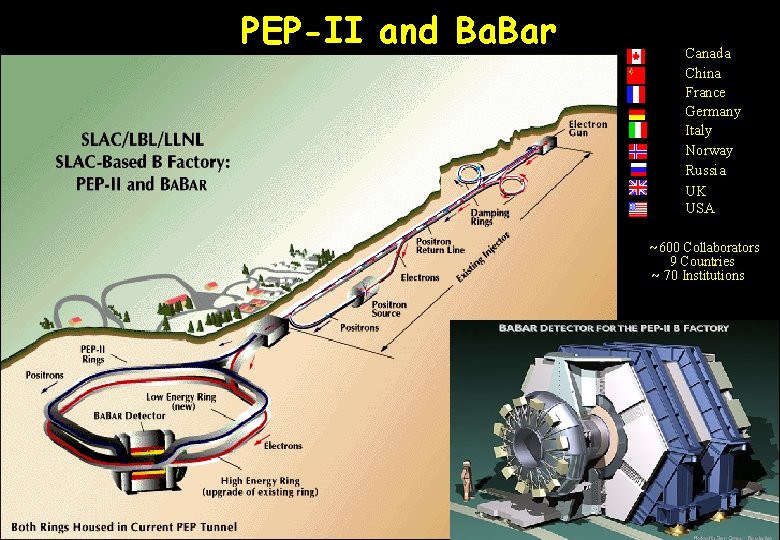
PEP-II and Ba. Bar Canada China France Germany Italy Norway Russia UK USA ~600 Collaborators 9 Countries ~ 70 Institutions
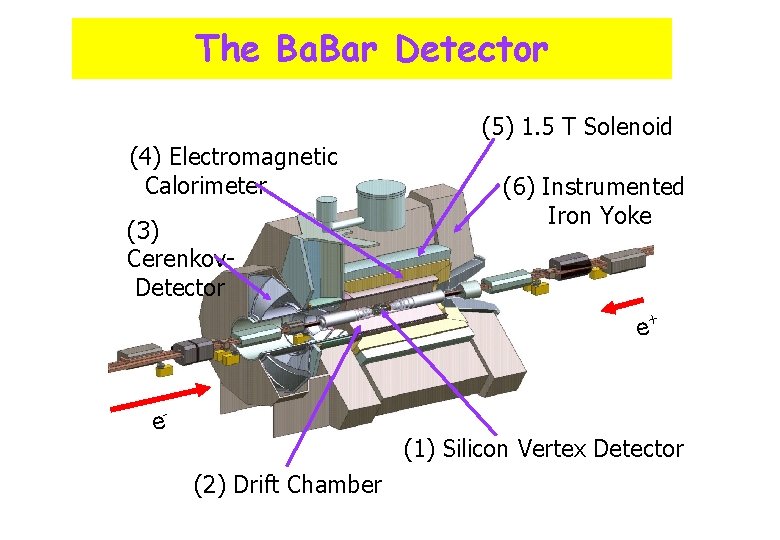
The Ba. Bar Detector (5) 1. 5 T Solenoid (4) Electromagnetic Calorimeter (3) Cerenkov. Detector (6) Instrumented Iron Yoke e+ e- (1) Silicon Vertex Detector (2) Drift Chamber

Chronology 1995 - Approval 1998 - Construction completed 1999 - Started taking data - events !! 2000 - Taking data first measurements 2001 - Taking data first results 2, 000 events per day, 20, 000 Bs per day 20, 000 events per day 100, 000 Bs per day 2002 - “Results” 120, 000 Bs 2002 -2005 - Detailed results 1, 000 Bs per day
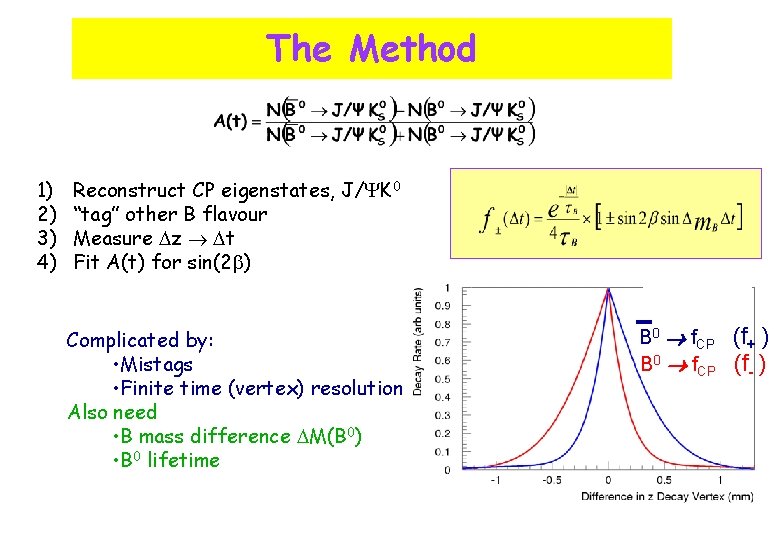
The Method 1) 2) 3) 4) Reconstruct CP eigenstates, J/YK 0 “tag” other B flavour Measure Dz Dt Fit A(t) for sin(2 ) Complicated by: • Mistags • Finite time (vertex) resolution Also need • B mass difference DM(B 0) • B 0 lifetime B 0 f. CP (f+ ) (f- )
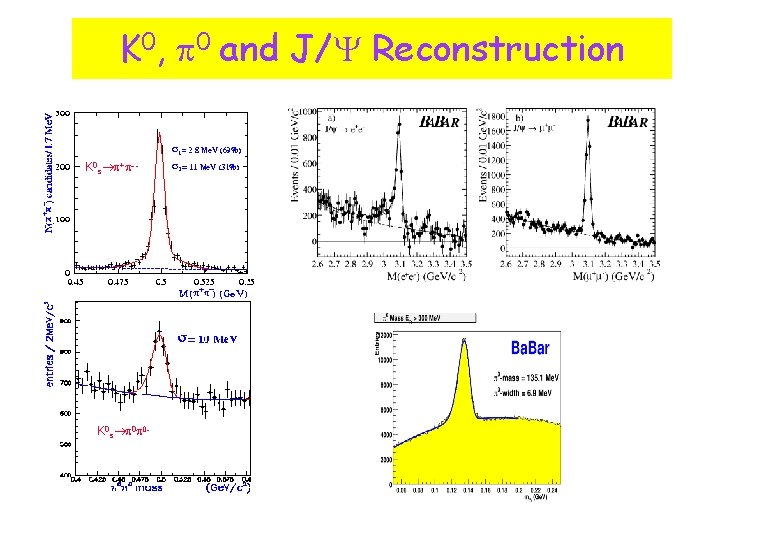
K 0, 0 and J/Y Reconstruction K 0 s + -- K 0 s 0 0 -
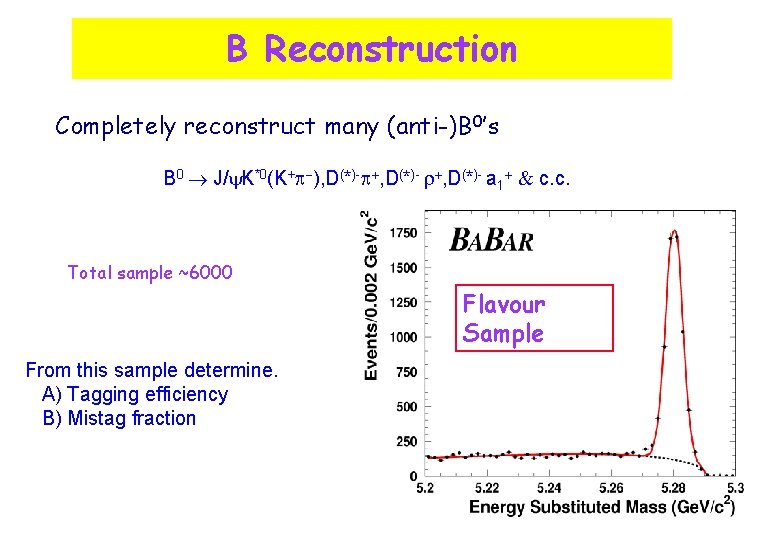
B Reconstruction Completely reconstruct many (anti-)B 0’s B 0 J/ K*0(K+ -), D(*)- +, D(*)- r+, D(*)- a 1+ & c. c. Total sample ~6000 Flavour Sample From this sample determine. A) Tagging efficiency B) Mistag fraction
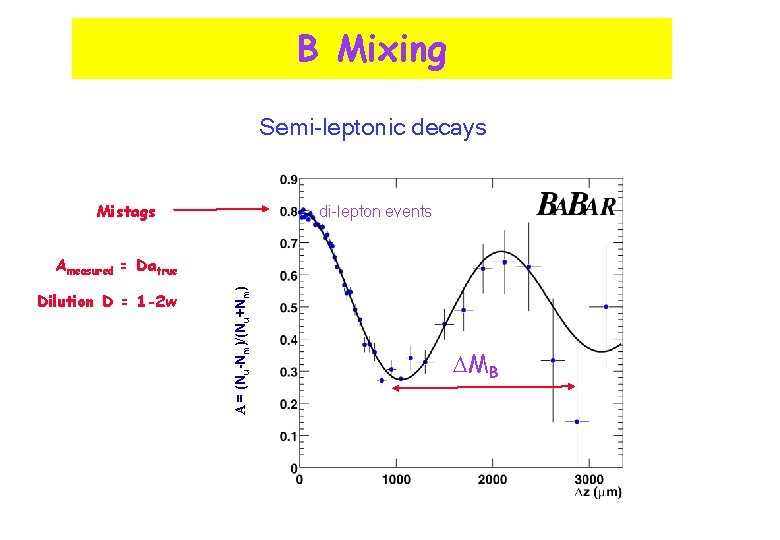
B Mixing Semi-leptonic decays Mistags di-lepton events Dilution D = 1 -2 w A = (Nu-Nm)/(Nu+Nm) Ameasured = Datrue DMB
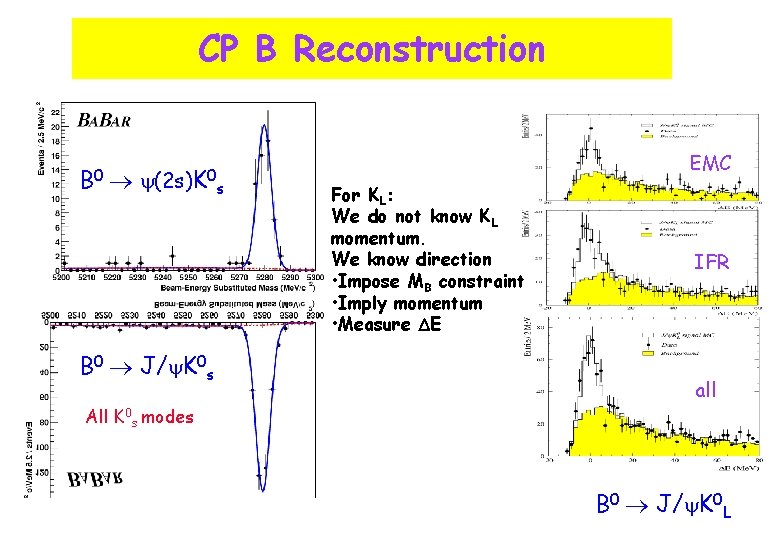
CP B Reconstruction B 0 (2 s)K 0 B 0 J/ K 0 s All K 0 s modes EMC s For KL: We do not know KL momentum. We know direction • Impose MB constraint • Imply momentum • Measure DE IFR all B 0 J/ K 0 L
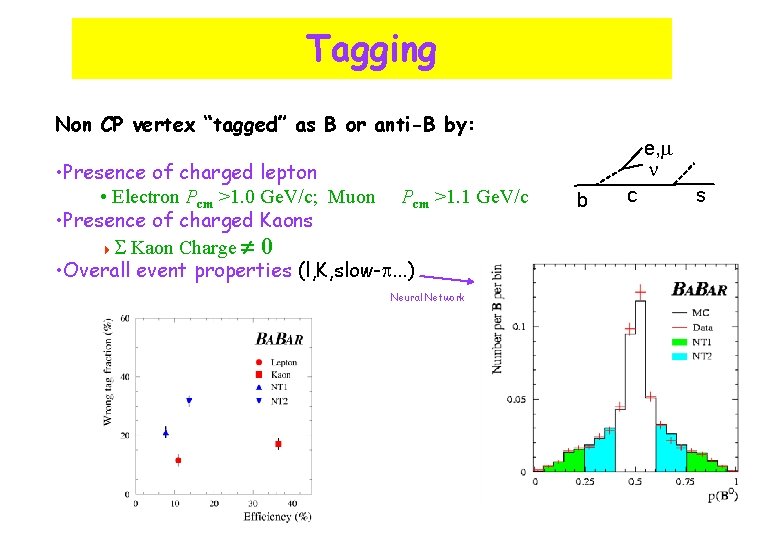
Tagging Non CP vertex “tagged” as B or anti-B by: • Presence of charged lepton • Electron Pcm >1. 0 Ge. V/c; Muon Pcm >1. 1 Ge. V/c • Presence of charged Kaons 4 Kaon Charge 0 • Overall event properties (l, K, slow-. . . ) Neural Network e, m n b c s
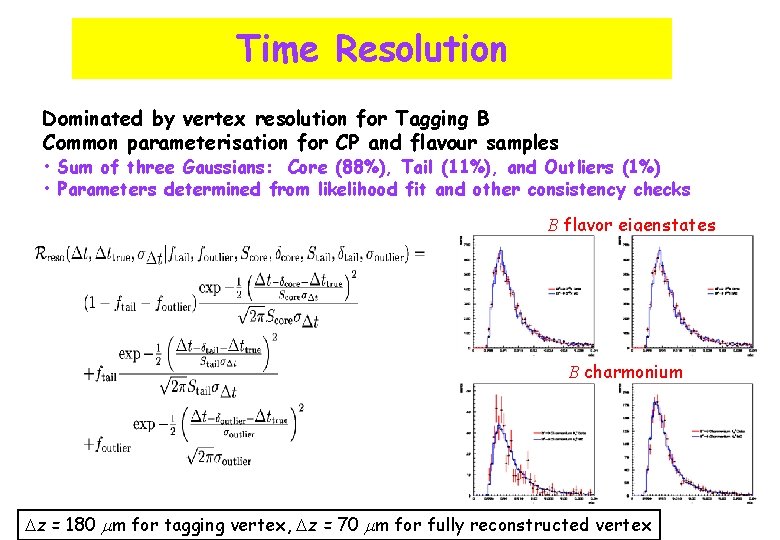
Time Resolution Dominated by vertex resolution for Tagging B Common parameterisation for CP and flavour samples • Sum of three Gaussians: Core (88%), Tail (11%), and Outliers (1%) • Parameters determined from likelihood fit and other consistency checks B flavor eigenstates B charmonium Dz = 180 mm for tagging vertex, Dz = 70 mm for fully reconstructed vertex
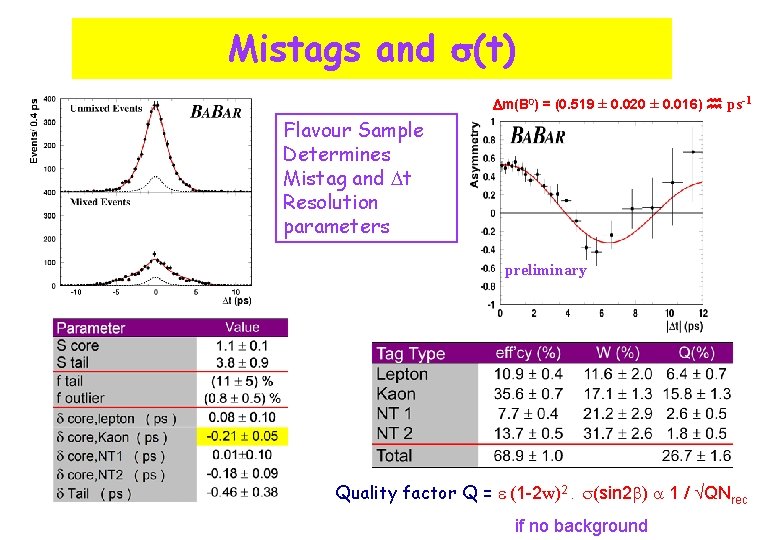
Mistags and s(t) Dm(B 0) = (0. 519 ± 0. 020 ± 0. 016) ps-1 Flavour Sample Determines Mistag and Dt Resolution parameters preliminary Quality factor Q = e (1 -2 w)2. s(sin 2 ) a 1 / QNrec if no background
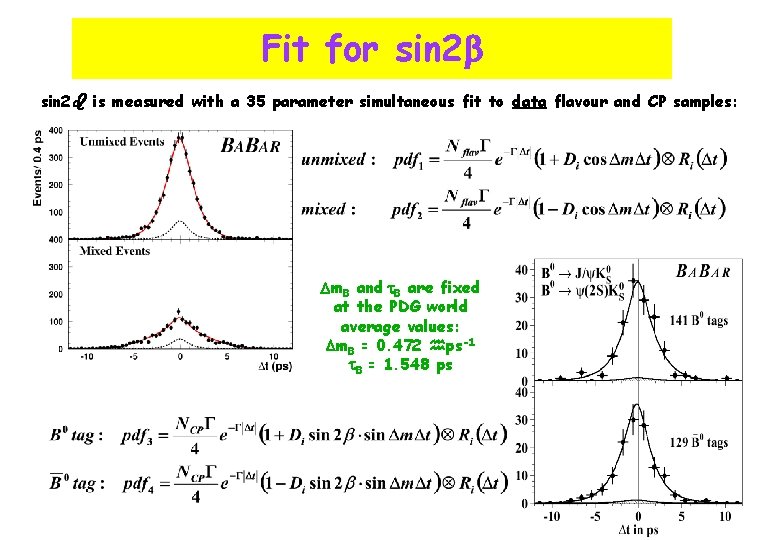
Fit for sin 2 b is measured with a 35 parameter simultaneous fit to data flavour and CP samples: Dm. B and t. B are fixed at the PDG world average values: Dm. B = 0. 472 ps-1 t. B = 1. 548 ps
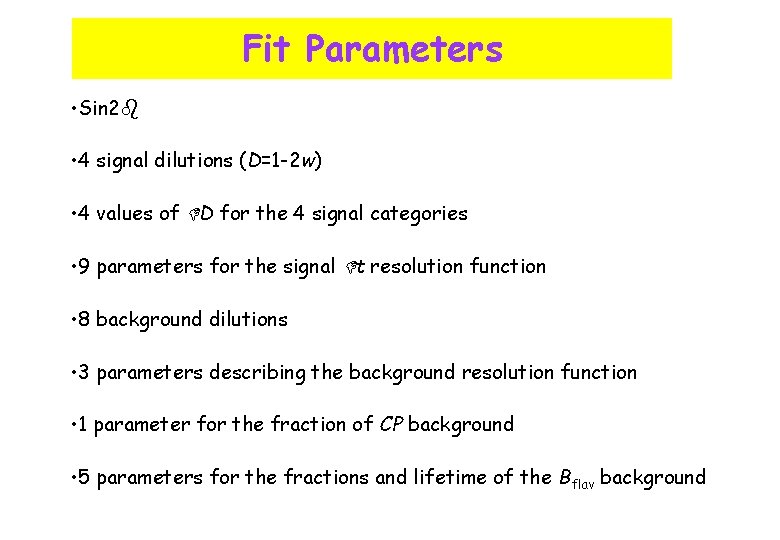
Fit Parameters • Sin 2 b • 4 signal dilutions (D=1 -2 w) • 4 values of DD for the 4 signal categories • 9 parameters for the signal Dt resolution function • 8 background dilutions • 3 parameters describing the background resolution function • 1 parameter for the fraction of CP background • 5 parameters for the fractions and lifetime of the Bflav background
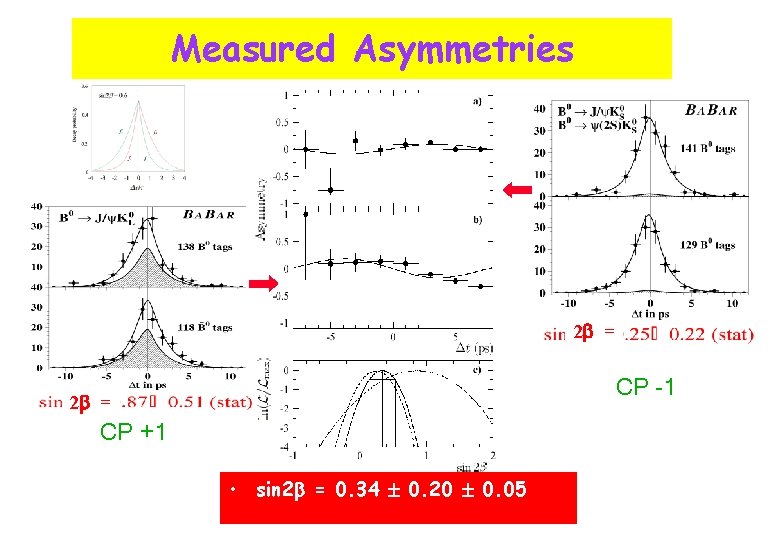
Measured Asymmetries 2 = CP -1 2 = CP +1 • sin 2 = 0. 34 0. 20 0. 05
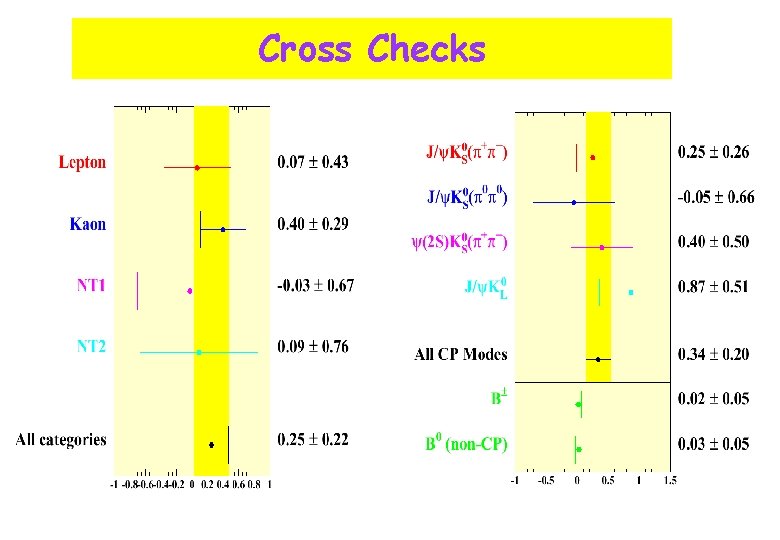
Cross Checks
Systematic Errors
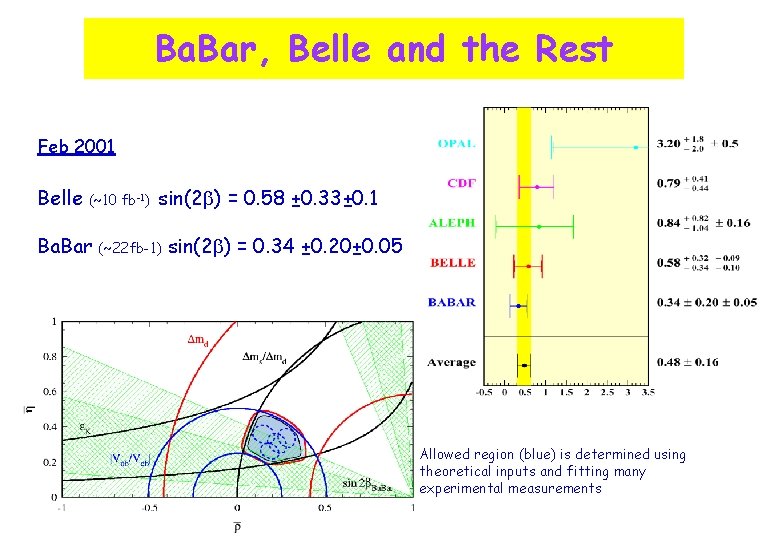
Ba. Bar, Belle and the Rest Feb 2001 Belle (~10 fb-1) Ba. Bar sin(2 ) = 0. 58 ± 0. 33± 0. 1 (~22 fb-1) sin(2 ) = 0. 34 ± 0. 20± 0. 05 Allowed region (blue) is determined using theoretical inputs and fitting many experimental measurements
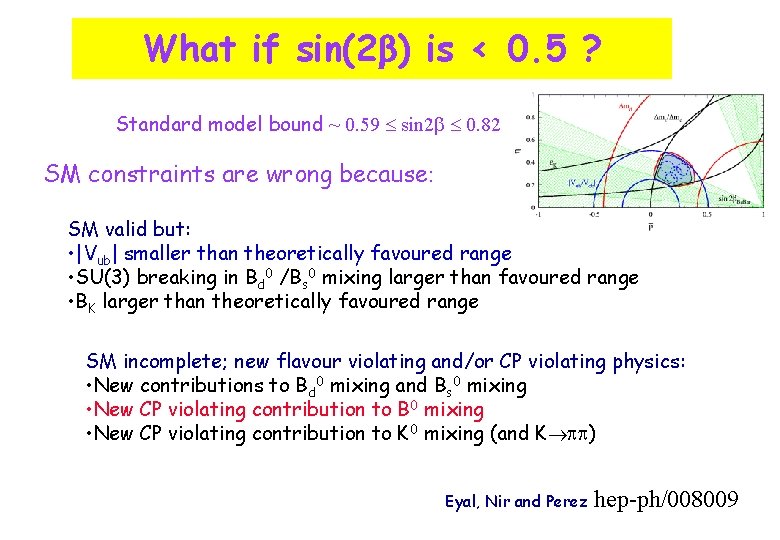
What if sin(2 ) is < 0. 5 ? Standard model bound ~ 0. 59 sin 2 0. 82 SM constraints are wrong because: SM valid but: • |Vub| smaller than theoretically favoured range • SU(3) breaking in Bd 0 /Bs 0 mixing larger than favoured range • BK larger than theoretically favoured range SM incomplete; new flavour violating and/or CP violating physics: • New contributions to Bd 0 mixing and Bs 0 mixing • New CP violating contribution to B 0 mixing • New CP violating contribution to K 0 mixing (and K ) Eyal, Nir and Perez hep-ph/008009
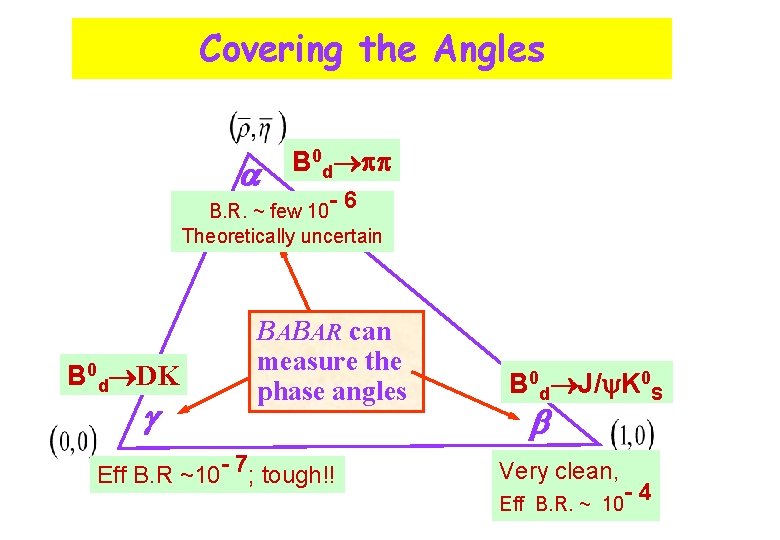
Covering the Angles a B 0 d -6 B. R. ~ few 10 Theoretically uncertain B 0 d DK g BABAR can measure the phase angles Eff B. R ~10 - 7; tough!! B 0 d J/ K 0 S Very clean, Eff B. R. ~ 10 -4
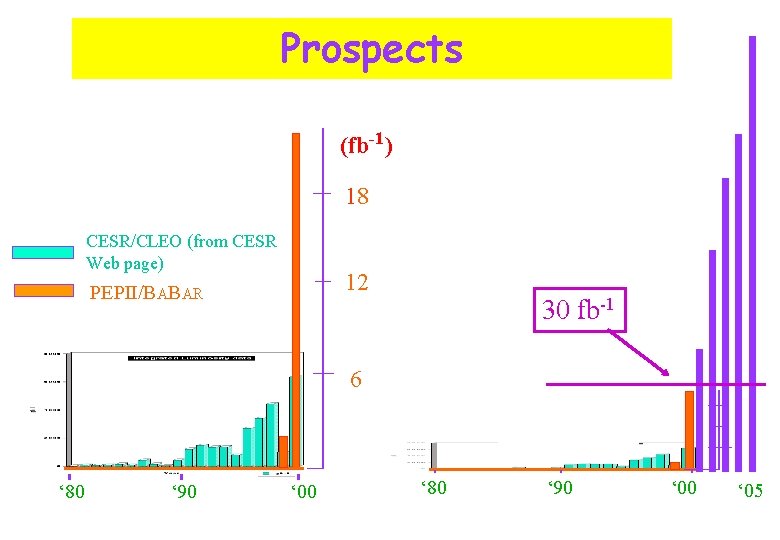
Prospects (fb-1) 18 CESR/CLEO (from CESR Web page) 12 PEPII/BABAR 30 fb-1 6 ‘ 80 ‘ 90 ‘ 00 ‘ 05
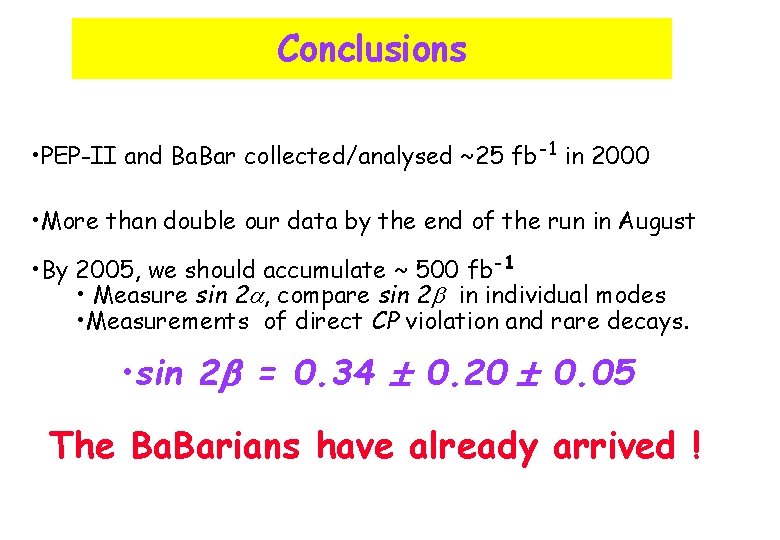
Conclusions • PEP-II and Ba. Bar collected/analysed ~25 fb-1 in 2000 • More than double our data by the end of the run in August • By 2005, we should accumulate ~ 500 fb-1 • Measure sin 2 , compare sin 2 in individual modes • Measurements of direct CP violation and rare decays. • sin 2 = 0. 34 0. 20 0. 05 The Ba. Barians have already arrived !
- Slides: 26