
The Aztec Calendar Fabiola CortesVillena Literature and Science
The Aztec Calendar Fabiola Cortes-Villena Literature and Science April 29 th, 2002 (Also available on the web at http: //fabiolacortes. tripod. com/calendar. html)
Sun Stone • Weighs 25 tons, has a diameter of just under 12 feet, and a thickness of 3 feet. • Carved in 1479. • Discovered on December 17 th, 1760 – Buried under the zocalo, or main square in Mexico city. • Embedded into a wall inside the metropolitan cathedral. • Moved to the National museum of Anthropology and History in 1885. (Montalvo)
What the sun stone represents • • It represents how the Aztec world began, how it would continue and when it would reach its inevitable end. The Aztec were living in 5 th and last creation of the world. Each creation was a “sun” because movement of the sun maintained human life. The four previous suns and the dates they perished surround the Sun God: Tonatiuh
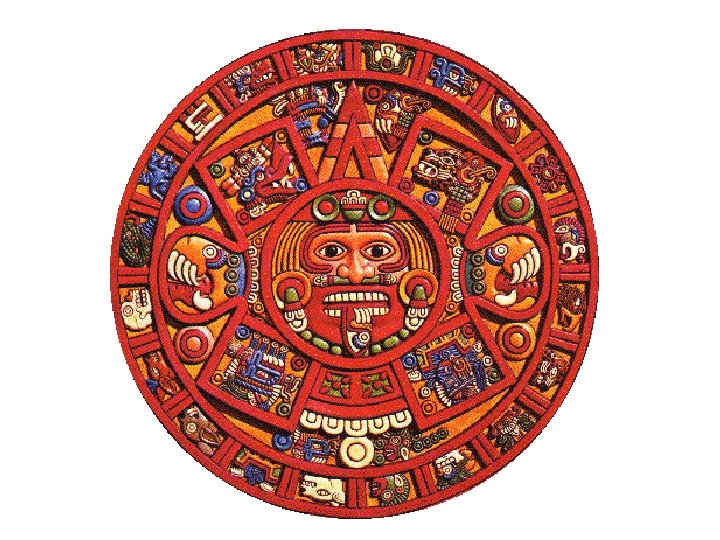
The Center of the Sun Stone
Aztec Calendar • Based on the early Maya Calendar System. • Apparently was developed following cues and astronomic observations. • Exactly how they came up with it, remains a puzzle.
Maya Vs. Aztec Calendar • The Maya had three different calendars in their system, whereas the Aztec only adopted two of them: – – • Xiupohualli or year-count Tonalpohualli or day-count The Aztec had a more primitive numeric system and less precise way of recording dates: – Aztec event recording only included the day and name of the year. This was ambiguous because: 1. The same day can occur twice in a year 2. Years with the same name occur every 52 years
Xiupohualli (year count) • Also called the solar calendar. • Used to determine many ceremonies and rituals linked to agricultural cycles. • 18 20 -day months + 5 -day period = 365 days (like the Maya Haab). • Each month had 4 5 -day weeks.
Tonalpohualli (day count) • Also called the sacred calendar. • Used for divinatory purposes by a priest who would cast horoscopes and predict favorable and unfavorable days. • 20 13 -day weeks = 260 days (like the Maya Tzolkin). • “A day (tonalli) in the Tenalpohualli consist of a number and a symbol or day sign, each daysign is dedicated to a God. The twenty days and their Gods are successively. ” (The system of the Tonalpohualli) • Crucial to the balance of the universe.
Tonalpohualli (cont. ) • According to the Aztecs, the universe is in a very delicate equilibrium: – The world is always on the edge of a war of gods, who are constantly competing for supreme power. • Gods need to have their own space, rituals, social groups, and of course their own sacrifices. • The Tonalpohualli tells how time is to be divided among the gods. (Voorburg)
Aztec “Century” • Every 52 years both calendars meet, and a new “century” in the Aztec calendar cycle begins. • 12 -day Celebration – Fasting – Human Sacrifices
Today • The sun stone representing the Aztec calendar is perhaps the most famous symbol of Mexico, besides the flag. • Parts and bits of the “Sun Stone” can also be found on Mexican currency. • “In general, the uses and meaning of the sunstone is ignored and a completely agreed-upon interpretation has not been reached for this magnific monument. ” (Mexica Sunstone) • The Tonalpohualli is still in use among the presentday inhabitants of native regions in Mexico. (Richards, 187)
References Mexica Sunstone. 1996. http: //www. geocities. com/a 1 ma_mia/sunstone/ Montalvo, Fanya S. The Aztec Calendar. 1995. http: //www. ai. mit. edu/people/montalvo/Hotlist/aztec. html Richards, E. G. Mapping Time: The Calendar and its History. Oxford University Press: New York, 1998. 186 -195 The system of the Tonalpohualli. http: //www. artcamp. com. mx/AZ/9. html Voorburg, René. The Aztec Calendar. http: //www. azteccalendar. com/
- Slides: 12