
The AZ of Competency Modeling For Integrated Talent


- Slides: 38
The A-Z of Competency Modeling For Integrated Talent Management HR. com Feb 2012 Leanne Markus Registered Psychologist, Managing Director Performance Group International Ltd. Consulting Organisational Psychologists Centranum Group Talent Management Systems © Centranum Group 2012 1
Agenda q q q q The use of competency models Promise and reality Major issues - the research The historical background What is a competency? Matching model to purpose Practical definitions, measurement & evaluation Using competencies successfully in Talent Management © Centranum Group 2012 2
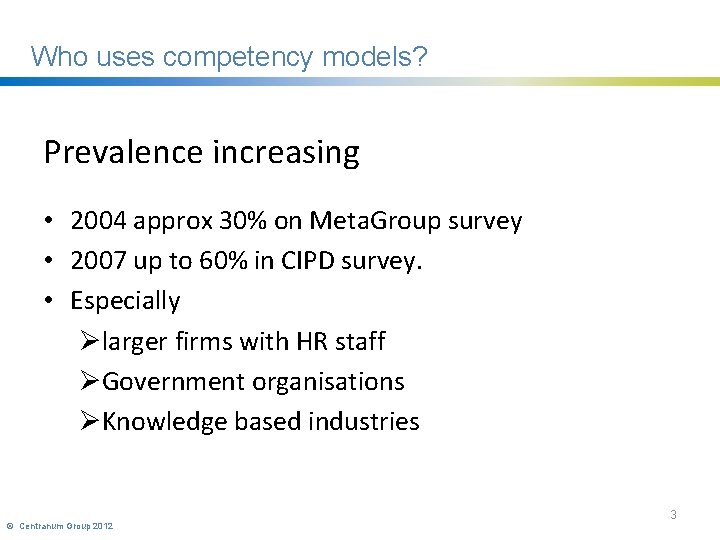
Who uses competency models? Prevalence increasing • 2004 approx 30% on Meta. Group survey • 2007 up to 60% in CIPD survey. • Especially Ølarger firms with HR staff ØGovernment organisations ØKnowledge based industries © Centranum Group 2012 3
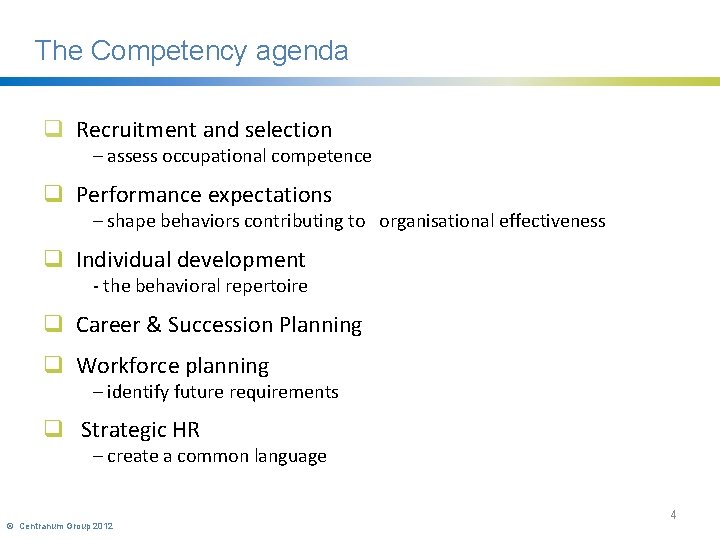
The Competency agenda q Recruitment and selection – assess occupational competence q Performance expectations – shape behaviors contributing to organisational effectiveness q Individual development - the behavioral repertoire q Career & Succession Planning q Workforce planning – identify future requirements q Strategic HR – create a common language © Centranum Group 2012 4
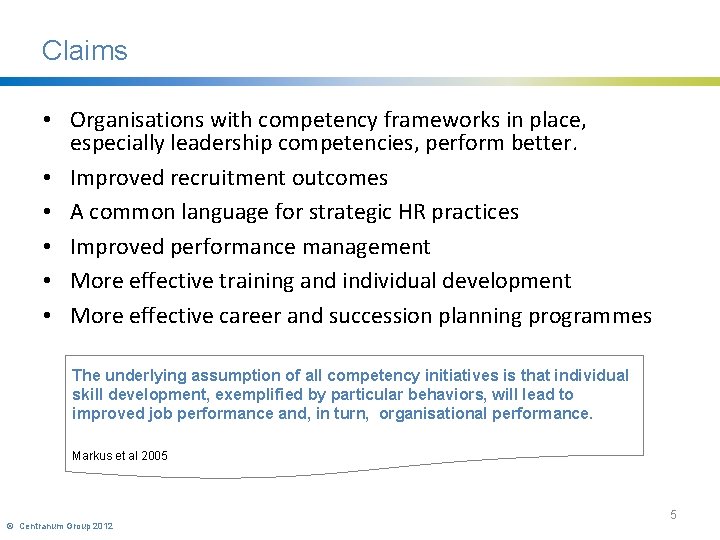
Claims • Organisations with competency frameworks in place, especially leadership competencies, perform better. • Improved recruitment outcomes • A common language for strategic HR practices • Improved performance management • More effective training and individual development • More effective career and succession planning programmes The underlying assumption of all competency initiatives is that individual skill development, exemplified by particular behaviors, will lead to improved job performance and, in turn, organisational performance. Markus et al 2005 © Centranum Group 2012 5
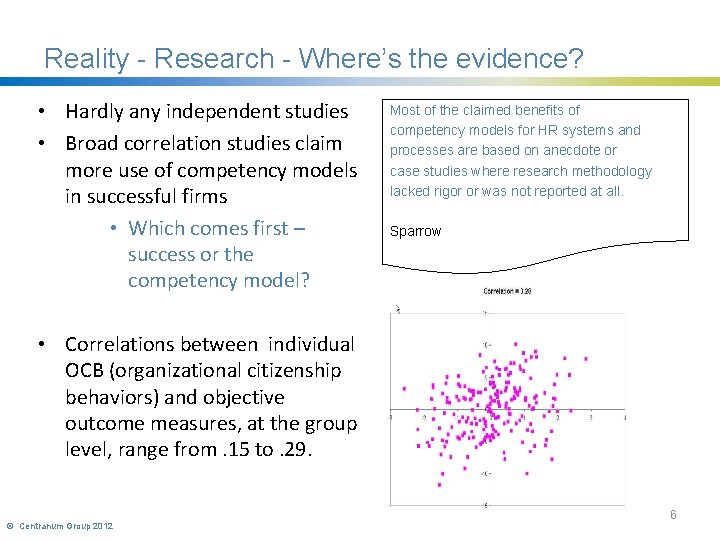
Reality - Research - Where’s the evidence? • Hardly any independent studies • Broad correlation studies claim more use of competency models in successful firms • Which comes first – success or the competency model? Most of the claimed benefits of competency models for HR systems and processes are based on anecdote or case studies where research methodology lacked rigor or was not reported at all. Sparrow • Correlations between individual OCB (organizational citizenship behaviors) and objective outcome measures, at the group level, range from. 15 to. 29. © Centranum Group 2012 6
Do competencies predict success? At the individual level different competencies predict success • Surveys of top performing salespeople, assessed on performance outputs - sales results, show that most rate highly on only one or two generic sales competencies, which are not the same for all successful salespeople. • In fact some successful salespeople rated very poorly on some sales competencies. Smith and Rutigliano (2003) © Centranum Group 2012 7
In summary - what doesn’t work well • Recruitment and selection – Most competency frameworks too high level to enable effective assessment – Trait based competencies do not add much to the predictive power of general mental ability for job success • Performance expectations – Values as competencies – little evidence of impact on organisational outcomes. • Common language for Strategic HR – Diverse interpretations due to lack of precision in ‘operational’ definitions and terminology © Centranum Group 2012 8
What does work? • Individual development – Competency based training – effective for technical competencies – not for trait based competencies. • Career & Succession Planning – Development of Leadership practices – Development of skills for technical career pathways • Workforce Planning – Identification of future knowledge and skill requirements © Centranum Group 2012 9
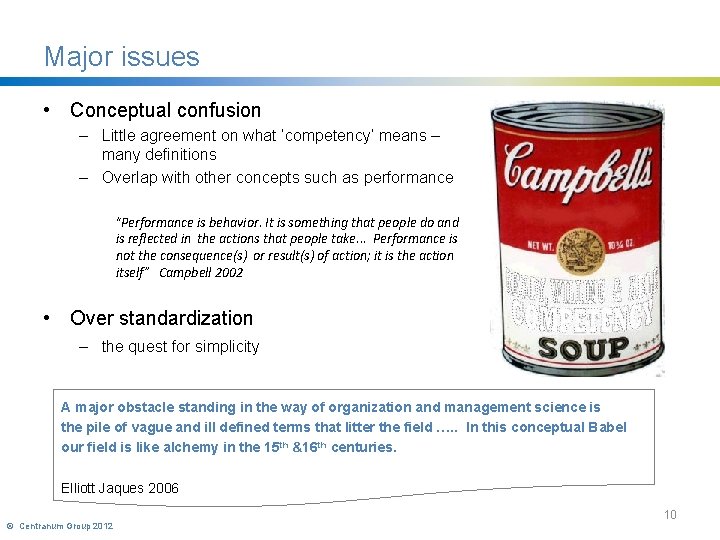
Major issues • Conceptual confusion – Little agreement on what ‘competency’ means – many definitions – Overlap with other concepts such as performance “Performance is behavior. It is something that people do and is reflected in the actions that people take. . . Performance is not the consequence(s) or result(s) of action; it is the action itself” Campbell 2002 • Over standardization – the quest for simplicity A major obstacle standing in the way of organization and management science is the pile of vague and ill defined terms that litter the field …. . In this conceptual Babel our field is like alchemy in the 15 th &16 th centuries. Elliott Jaques 2006 © Centranum Group 2012 10
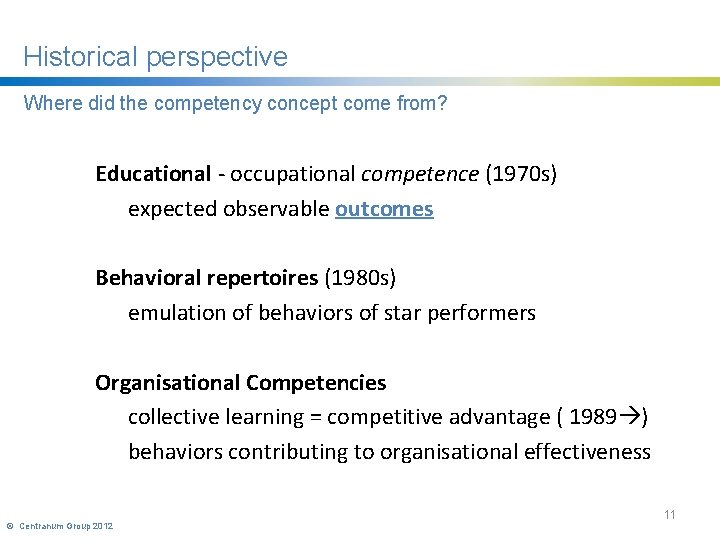
Historical perspective Where did the competency concept come from? Educational - occupational competence (1970 s) expected observable outcomes Behavioral repertoires (1980 s) emulation of behaviors of star performers Organisational Competencies collective learning = competitive advantage ( 1989 ) behaviors contributing to organisational effectiveness © Centranum Group 2012 11
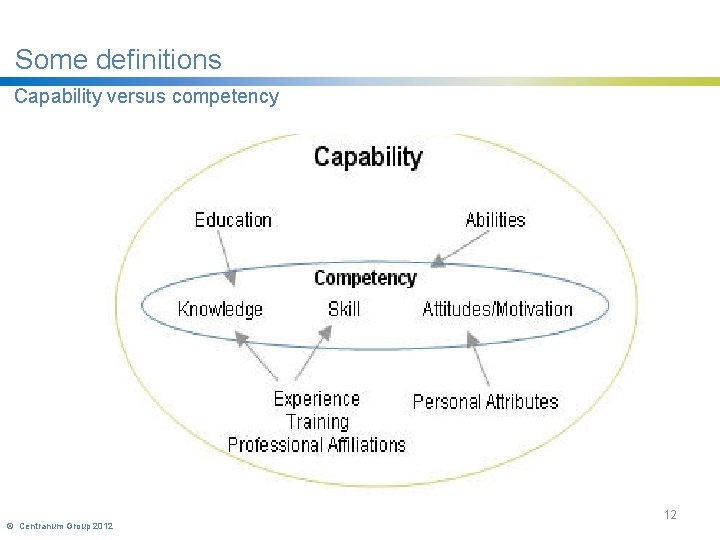
Some definitions Capability versus competency © Centranum Group 2012 12
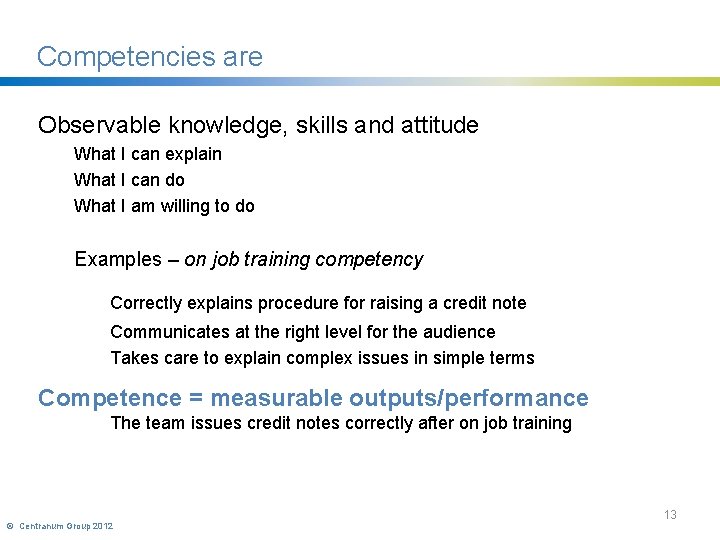
Competencies are Observable knowledge, skills and attitude What I can explain What I can do What I am willing to do Examples – on job training competency Correctly explains procedure for raising a credit note Communicates at the right level for the audience Takes care to explain complex issues in simple terms Competence = measurable outputs/performance The team issues credit notes correctly after on job training © Centranum Group 2012 13
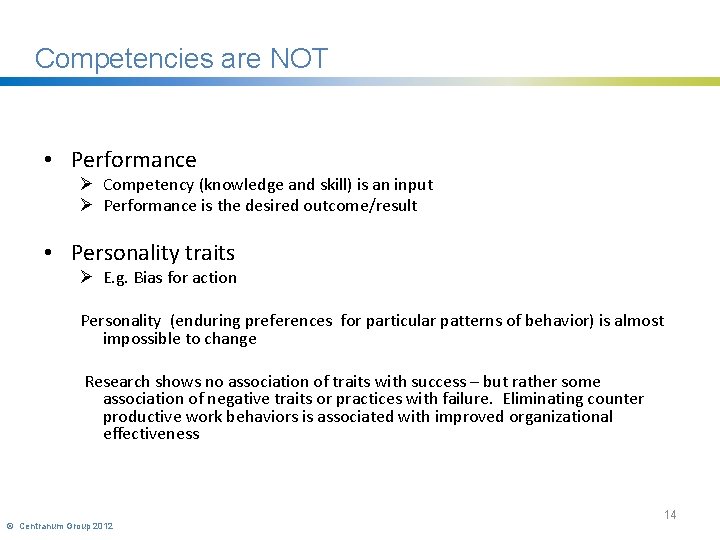
Competencies are NOT • Performance Ø Competency (knowledge and skill) is an input Ø Performance is the desired outcome/result • Personality traits Ø E. g. Bias for action Personality (enduring preferences for particular patterns of behavior) is almost impossible to change Research shows no association of traits with success – but rather some association of negative traits or practices with failure. Eliminating counter productive work behaviors is associated with improved organizational effectiveness © Centranum Group 2012 14
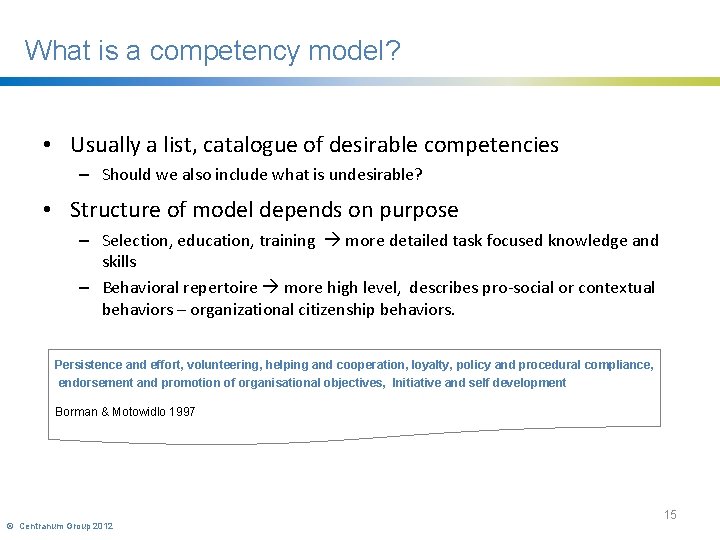
What is a competency model? • Usually a list, catalogue of desirable competencies – Should we also include what is undesirable? • Structure of model depends on purpose – Selection, education, training more detailed task focused knowledge and skills – Behavioral repertoire more high level, describes pro-social or contextual behaviors – organizational citizenship behaviors. Persistence and effort, volunteering, helping and cooperation, loyalty, policy and procedural compliance, endorsement and promotion of organisational objectives, Initiative and self development Borman & Motowidlo 1997 © Centranum Group 2012 15
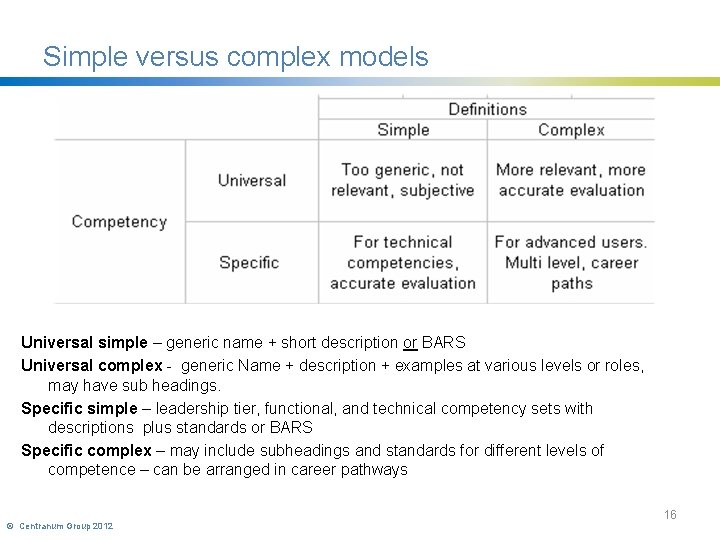
Simple versus complex models Universal simple – generic name + short description or BARS Universal complex - generic Name + description + examples at various levels or roles, may have sub headings. Specific simple – leadership tier, functional, and technical competency sets with descriptions plus standards or BARS Specific complex – may include subheadings and standards for different levels of competence – can be arranged in career pathways © Centranum Group 2012 16
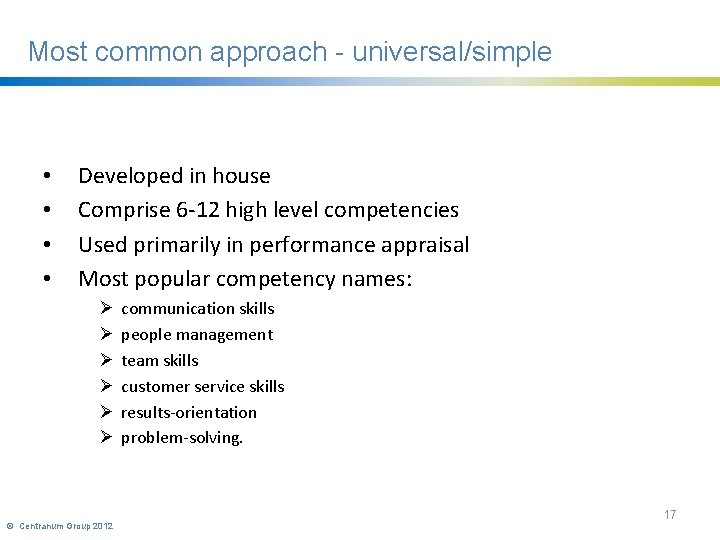
Most common approach - universal/simple • • Developed in house Comprise 6 -12 high level competencies Used primarily in performance appraisal Most popular competency names: Ø Ø Ø © Centranum Group 2012 communication skills people management team skills customer service skills results-orientation problem-solving. 17
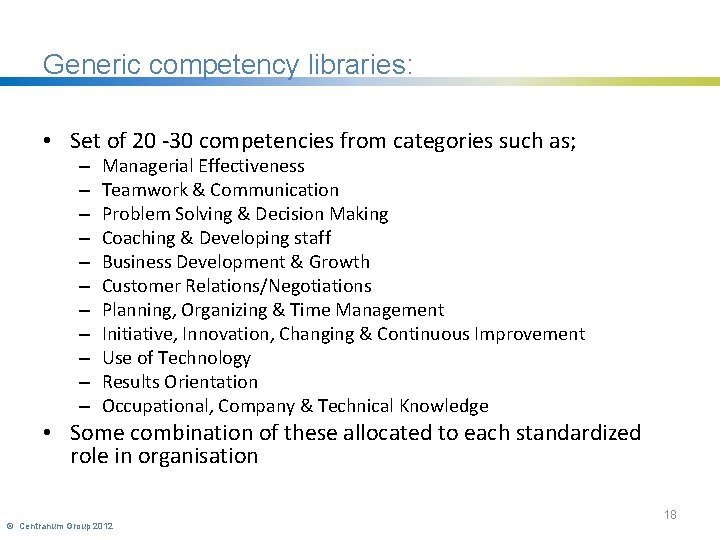
Generic competency libraries: • Set of 20 -30 competencies from categories such as; – – – Managerial Effectiveness Teamwork & Communication Problem Solving & Decision Making Coaching & Developing staff Business Development & Growth Customer Relations/Negotiations Planning, Organizing & Time Management Initiative, Innovation, Changing & Continuous Improvement Use of Technology Results Orientation Occupational, Company & Technical Knowledge • Some combination of these allocated to each standardized role in organisation © Centranum Group 2012 18
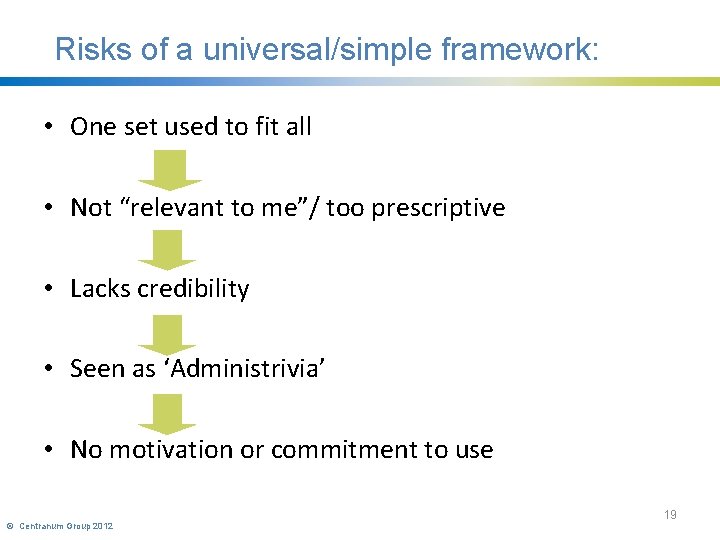
Risks of a universal/simple framework: • One set used to fit all • Not “relevant to me”/ too prescriptive • Lacks credibility • Seen as ‘Administrivia’ • No motivation or commitment to use © Centranum Group 2012 19
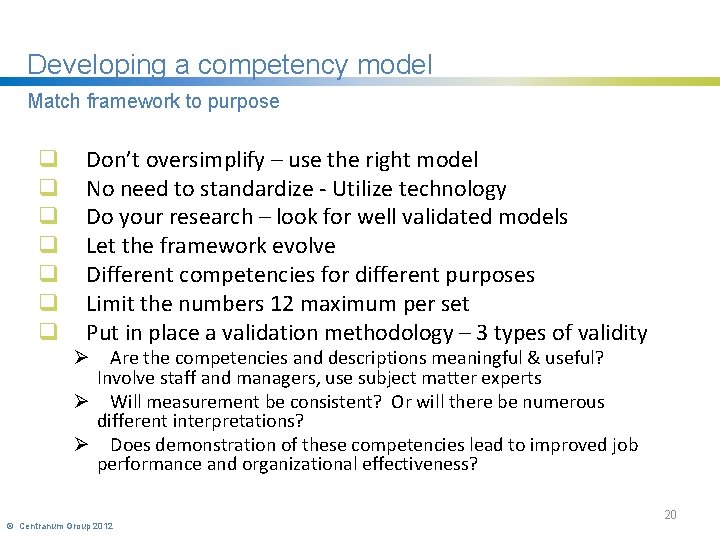
Developing a competency model Match framework to purpose q q q q Don’t oversimplify – use the right model No need to standardize - Utilize technology Do your research – look for well validated models Let the framework evolve Different competencies for different purposes Limit the numbers 12 maximum per set Put in place a validation methodology – 3 types of validity Ø Are the competencies and descriptions meaningful & useful? Involve staff and managers, use subject matter experts Ø Will measurement be consistent? Or will there be numerous different interpretations? Ø Does demonstration of these competencies lead to improved job performance and organizational effectiveness? © Centranum Group 2012 20
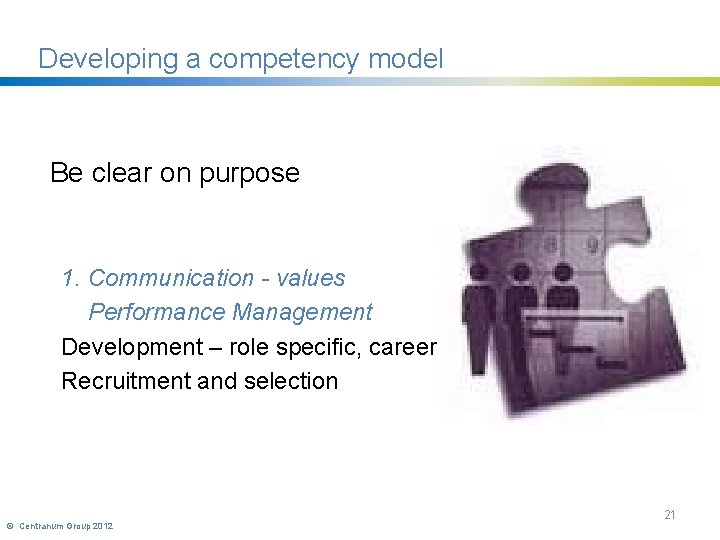
Developing a competency model Be clear on purpose 1. Communication - values Performance Management Development – role specific, career Recruitment and selection © Centranum Group 2012 21
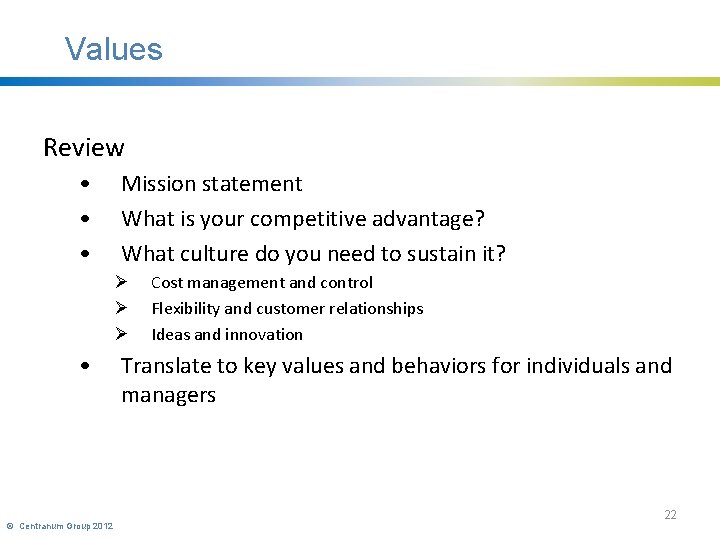
Values Review • • • Mission statement What is your competitive advantage? What culture do you need to sustain it? Ø Ø Ø • © Centranum Group 2012 Cost management and control Flexibility and customer relationships Ideas and innovation Translate to key values and behaviors for individuals and managers 22
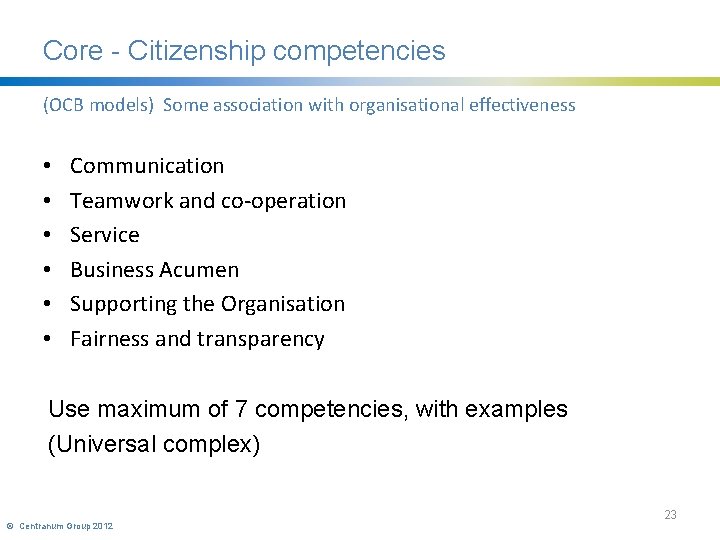
Core - Citizenship competencies (OCB models) Some association with organisational effectiveness • • • Communication Teamwork and co-operation Service Business Acumen Supporting the Organisation Fairness and transparency Use maximum of 7 competencies, with examples (Universal complex) © Centranum Group 2012 23
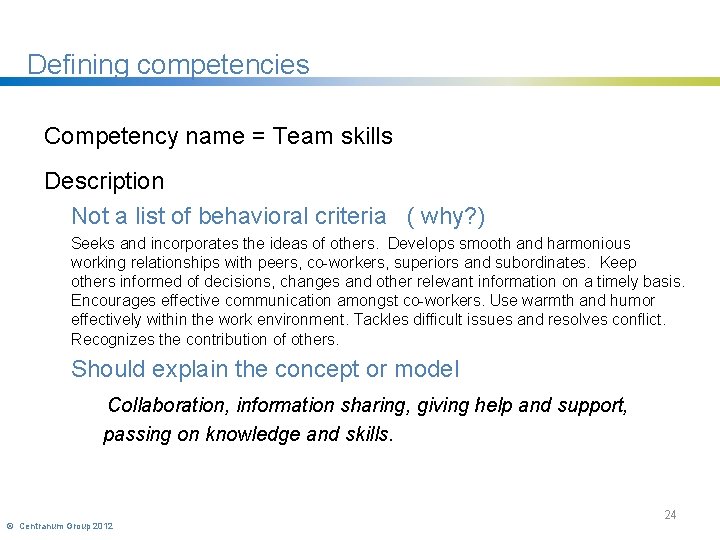
Defining competencies Competency name = Team skills Description Not a list of behavioral criteria ( why? ) Seeks and incorporates the ideas of others. Develops smooth and harmonious working relationships with peers, co-workers, superiors and subordinates. Keep others informed of decisions, changes and other relevant information on a timely basis. Encourages effective communication amongst co-workers. Use warmth and humor effectively within the work environment. Tackles difficult issues and resolves conflict. Recognizes the contribution of others. Should explain the concept or model Collaboration, information sharing, giving help and support, passing on knowledge and skills. © Centranum Group 2012 24
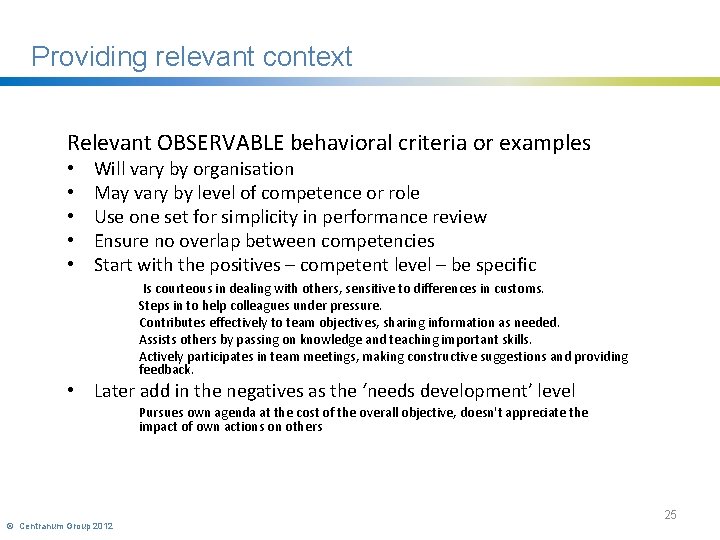
Providing relevant context Relevant OBSERVABLE behavioral criteria or examples • • • Will vary by organisation May vary by level of competence or role Use one set for simplicity in performance review Ensure no overlap between competencies Start with the positives – competent level – be specific Is courteous in dealing with others, sensitive to differences in customs. Steps in to help colleagues under pressure. Contributes effectively to team objectives, sharing information as needed. Assists others by passing on knowledge and teaching important skills. Actively participates in team meetings, making constructive suggestions and providing feedback. • Later add in the negatives as the ‘needs development’ level Pursues own agenda at the cost of the overall objective, doesn't appreciate the impact of own actions on others © Centranum Group 2012 25
Developing a competency model Be clear on purpose 1. Communication - values Performance Management 2. Development – role specific, career Recruitment and selection © Centranum Group 2012 26
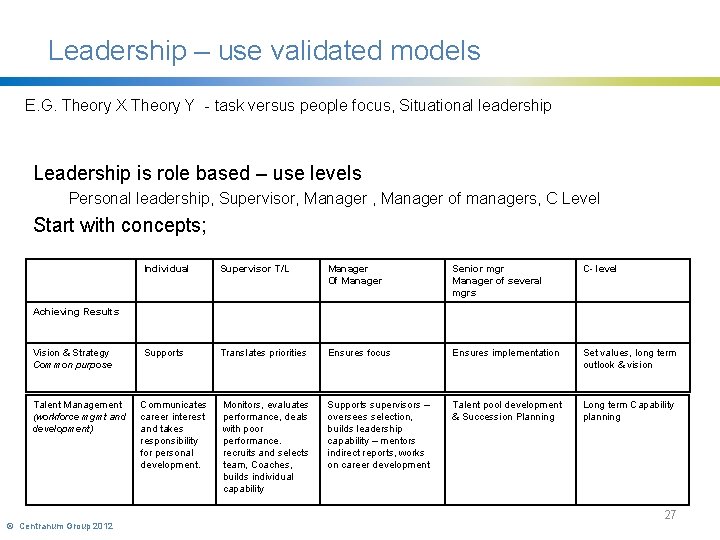
Leadership – use validated models E. G. Theory X Theory Y - task versus people focus, Situational leadership Leadership is role based – use levels Personal leadership, Supervisor, Manager of managers, C Level Start with concepts; Individual Supervisor T/L Manager Of Manager Senior mgr Manager of several mgrs C- level Supports Translates priorities Ensures focus Ensures implementation Set values, long term outlook & vision Monitors, evaluates performance, deals with poor performance. recruits and selects team, Coaches, builds individual capability Supports supervisors – oversees selection, builds leadership capability – mentors indirect reports, works on career development Talent pool development & Succession Planning Long term Capability planning Achieving Results Vision & Strategy Common purpose Talent Management (workforce mgmt and development) © Centranum Group 2012 Communicates career interest and takes responsibility for personal development. 27
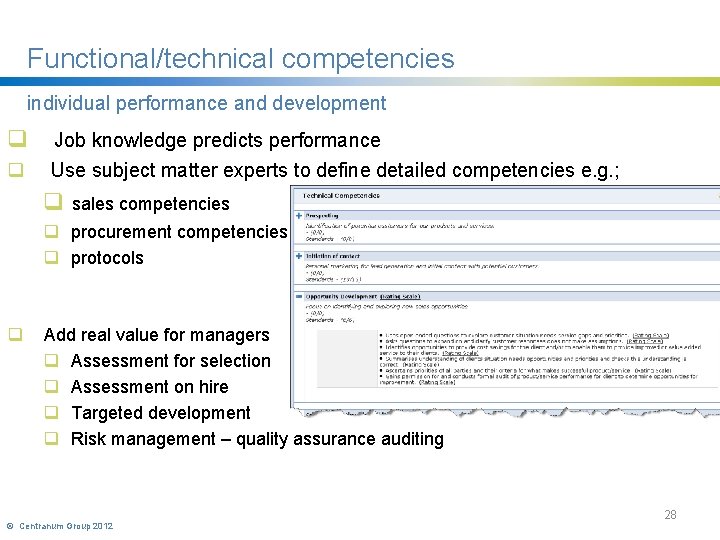
Functional/technical competencies individual performance and development q q Job knowledge predicts performance Use subject matter experts to define detailed competencies e. g. ; q sales competencies q procurement competencies q protocols q Add real value for managers q Assessment for selection q Assessment on hire q Targeted development q Risk management – quality assurance auditing © Centranum Group 2012 28
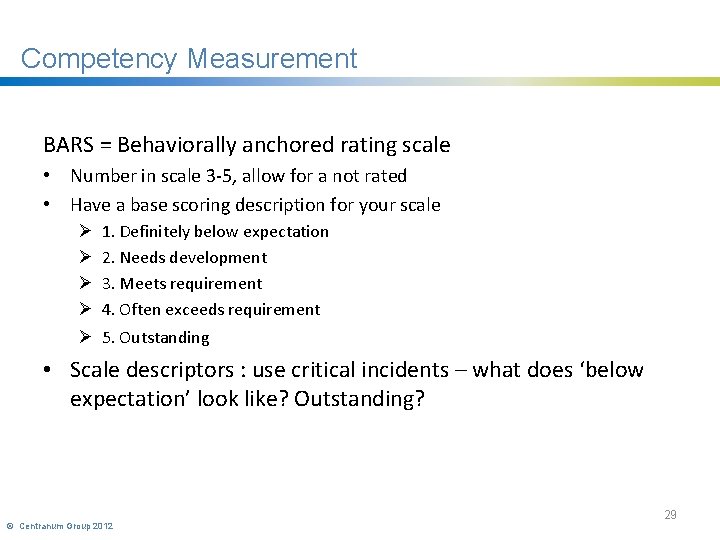
Competency Measurement BARS = Behaviorally anchored rating scale • Number in scale 3 -5, allow for a not rated • Have a base scoring description for your scale Ø Ø 1. Definitely below expectation 2. Needs development 3. Meets requirement 4. Often exceeds requirement Ø 5. Outstanding • Scale descriptors : use critical incidents – what does ‘below expectation’ look like? Outstanding? © Centranum Group 2012 29
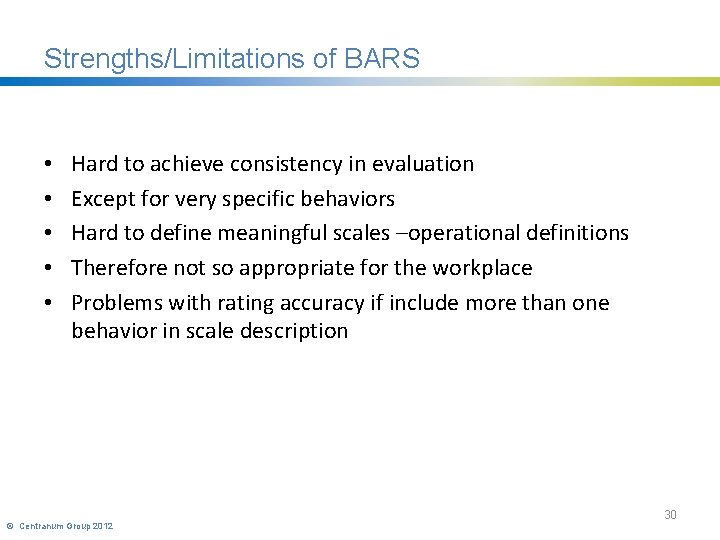
Strengths/Limitations of BARS • • • Hard to achieve consistency in evaluation Except for very specific behaviors Hard to define meaningful scales –operational definitions Therefore not so appropriate for the workplace Problems with rating accuracy if include more than one behavior in scale description © Centranum Group 2012 30
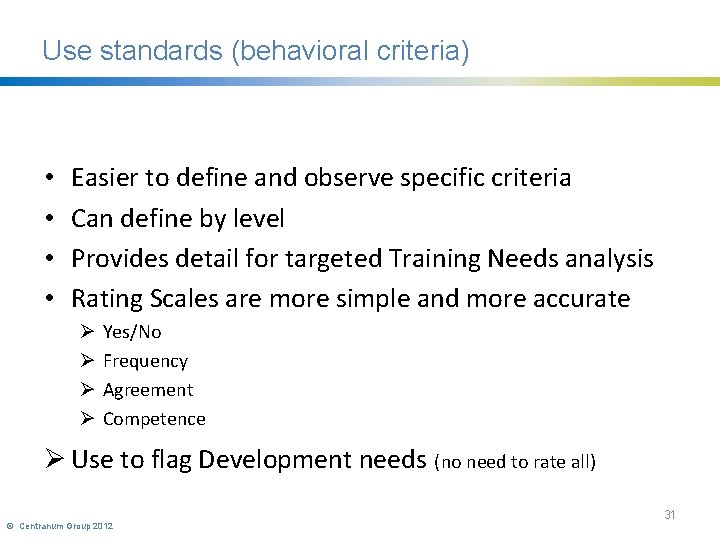
Use standards (behavioral criteria) • • Easier to define and observe specific criteria Can define by level Provides detail for targeted Training Needs analysis Rating Scales are more simple and more accurate Ø Ø Yes/No Frequency Agreement Competence Ø Use to flag Development needs (no need to rate all) © Centranum Group 2012 31
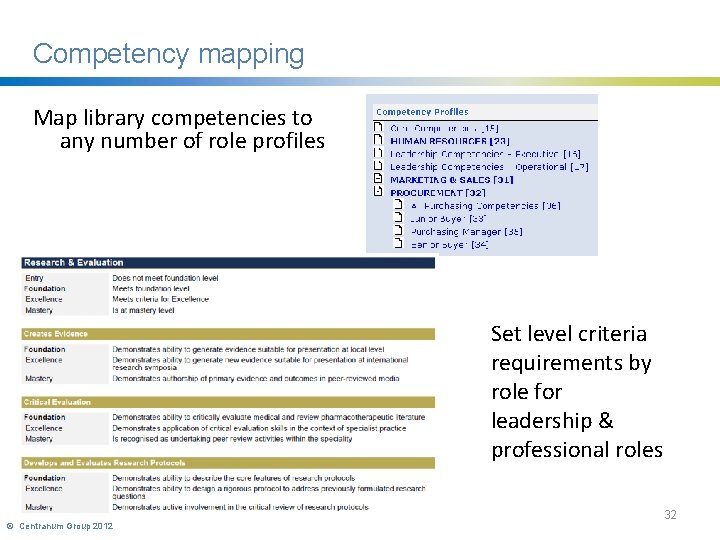
Competency mapping Map library competencies to any number of role profiles Set level criteria requirements by role for leadership & professional roles © Centranum Group 2012 32
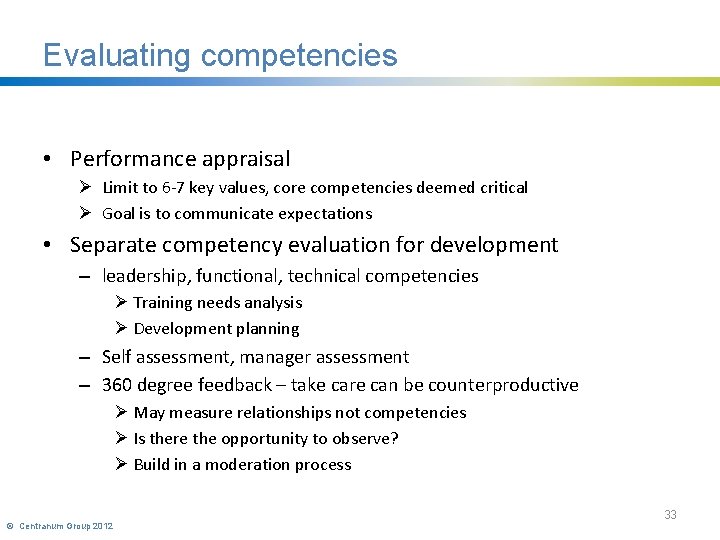
Evaluating competencies • Performance appraisal Ø Limit to 6 -7 key values, core competencies deemed critical Ø Goal is to communicate expectations • Separate competency evaluation for development – leadership, functional, technical competencies Ø Training needs analysis Ø Development planning – Self assessment, manager assessment – 360 degree feedback – take care can be counterproductive Ø May measure relationships not competencies Ø Is there the opportunity to observe? Ø Build in a moderation process © Centranum Group 2012 33
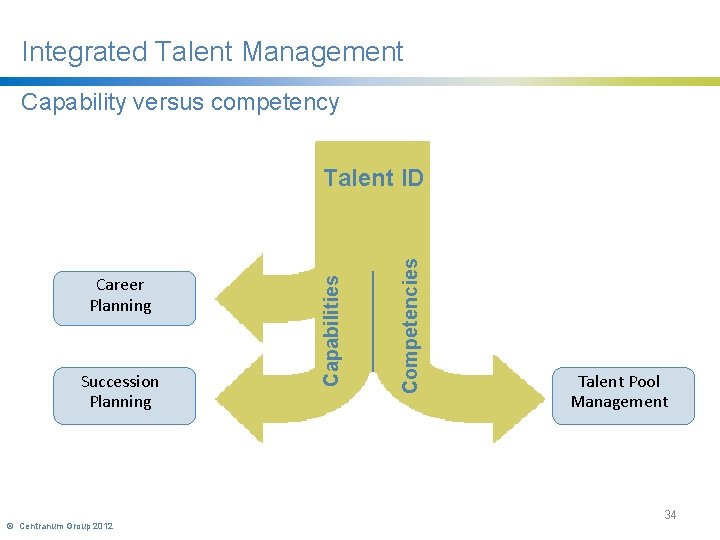
Integrated Talent Management Capability versus competency Succession Planning © Centranum Group 2012 Competencies Career Planning Capabilities Individual Approach Talent ID Group Approach Talent Pool Management 34
Competencies in Talent Management Talent pool - competencies Ø Ø Ø Identify individuals with potential Map role based leadership & technical competency profiles Use Gap analysis for development planning Develop learning experiences by competency Assign as appropriate and track progress Succession Planning – capability Ø Identify key positions Ø Impact of leaving/risk of leaving Ø Develop Succession plans – successors and readiness • Capability gap analysis • Develop capability • Track progress © Centranum Group 2012 35
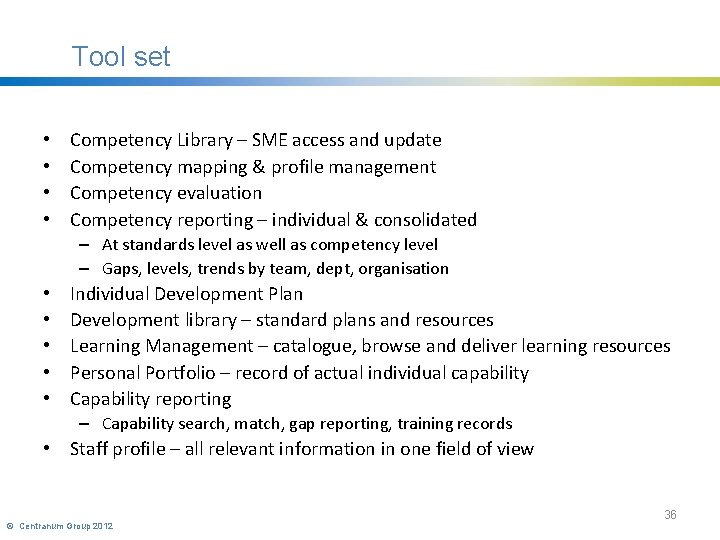
Tool set • • Competency Library – SME access and update Competency mapping & profile management Competency evaluation Competency reporting – individual & consolidated – At standards level as well as competency level – Gaps, levels, trends by team, dept, organisation • • • Individual Development Plan Development library – standard plans and resources Learning Management – catalogue, browse and deliver learning resources Personal Portfolio – record of actual individual capability Capability reporting – Capability search, match, gap reporting, training records • Staff profile – all relevant information in one field of view © Centranum Group 2012 36
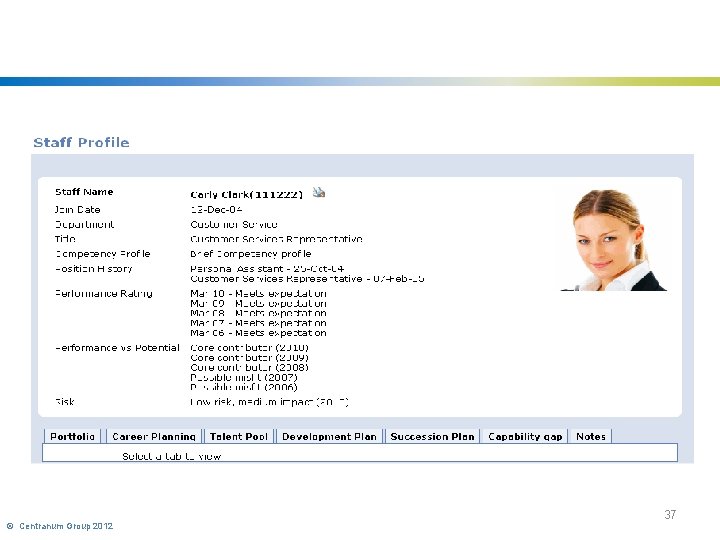
Single screen overview all relevant details for Talent Management decisions © Centranum Group 2012 Individual Profile 37
Centranum HRadvance Specialists in tools and advice on competency development www. centranum. com © Centranum Group 2012 38