
The autonomic nervous system Anatomy Functions The symptoms









- Slides: 44
The autonomic nervous system. Anatomy. Functions. The symptoms of lesion
Autonomic nervous system is a part of nervous system which regulate the activity of internal organs and metabolism
Autonomic nervous system is a part of nervous system that regulates the activity of internal organs, glands, blood and lymphatic vessels, smooth and striated muscles and organs of sensation
Connection between the Autonomic and Somatic nervous system § The morphological and functional unit of both system is a neuron § The main functional unit is a reflex arch § The autonomic nervous fibers go within cranial nerves and spinal nerves
Autonomic nervous system: § Central (all the autonomic structures of the brain and spinal cord) § Peripheral (all the others peripheral structures)
Central autonomic nervous system: Above – segmental level § the limbic system § reticular formation § hypothalamus
Central autonomic nervous system: Segmental level § nuclei of brain stem § autonomic lateral horns of spinal cord (C 8 L 3) § cilium-spinal center C 8 -Th 1 § sympathetic center of urination L 1 -L 2 § parasympathetic center of urination S 3 -S 5
According to the structure and functional peculiarities segmental level is divided into: § sympathetic § parasympathetic
Peripheral autonomic nervous system : § The nodus of Ashof – Towar § The plexus of Meisner and Auerbach § Sympathetic noduses § Solar and hypogastrical plexuses § White and gray fibers
Functions of autonomic nervous system § Ergotropic (homeokinesis) – adjustment to the changes of environment and providing the needs of the organism § Trophotropic (homeostasis) – it supports the constant internal reactions and provides anabolic processes
The limbic system § Bulbus olphactorius, tractus olphactorius, trigonum olphactorii, substantia perforata anterior § Septum pellucidum § Gyrus cinguli § Gyrus hypocampalis § Orbital part of frontal lobe § Corpus amygdaloideum § The pole of temporal lobes
Functions: § Emotional reactions § The reception of afferent impulses from internal organs § It is a memory substratum; it preserves information about previous genetically inherited experience § It provides motivation to thirstiness, hunger, sexual desire § It regulates the state of sleepiness and liveliness § It indirectly regulates the function of internal organs
The symptoms of lesion § Emotional disturbances (euphoria and depression) § Changes of eating (anorexia or bulimia) § Sleeping disorders (insomnia, lethargy) § Sexual disturbances (hypersexuality and hyposexuality) § Memory disorders (especially on current events) § The irritation of some structures leads to aggression
Reticular formation § It is a tonus motor of the brain, which works constantly in the brain stem. It consists of great number of cells, the axons of which are going in different directions and create a reticule. § In spite of the other cells of nervous system the cells of reticular formation accept pain, light, temperature and humeral impulses and send them to the brain cortex.
Functions of reticular formation § To support the brain cortex tonus, its state of liveliness which is necessary for the normal activity. The reticular formation energizes the brain. § It supports the certain level of activity of autonomic centres (the activity is very similar to that of sympathetic nervous system. There is also the same mediator – noradrenalinum) Function § The control of sleepiness and liveliness § To accept the information from the environment § To keep in tonus all the forms of behaviour, those have long – lasting character
The symptoms of lesion § The low activity of RF – the patient is unconscious § Decreased activity of RF – sleepiness § The lower parts of RF have general and long – lasting influence on consciousness and behavior, the upper ones have short – lasting and specific influence
Hypothalamus § Anterior – it is associated with parasympathetic function § Middle – endocrine – trophy § Posterior – has mainly sympathetic influence
The peculiarities of activity: § Motor cortex receives 440 capillaries per 1 mm 3, visual cortex – 900 / mm 3, hypothalamic region – from 1650 to 2600 / mm 3. § Almost all the arterial brain systems give their branches to hypothalamic region. That makes impossible disturbances of its activity. § There is no space of glia between the vessels and gangliocytes. That provides quick reaction to the changes of internal surroundings.
Hypothalamus is closely connected with: § Cortex § Thalamus § Extrapyramidal nervous system § Nuclei of brain stem and spinal cord § Reticular formation § Hypophysis
The function of hypothalamus § § § § § Regulation of heart – vascular activity Regulation of lipid, water, mineral metabolism Thermoregulation Regulation of vessels’ and tissue membranes penetrance Regulation of endocrine glands’ function Constant internal surroundings support Adaptation Biorhythm Emotional behaviour
Hypothalamus rules the internal world by means of three ways: –Through the nervous impulses –Humoral –Hormonal
7 tropic hormones § Corticoliberinum § Tirioliberinum § Luliberinum § Foliliberinum § Somatoliberinum § Prolactoliberinum § Melanocytoliberinum
3 inhibiting hormones: § Prolactostatinum § Melanocytostatinum § Somatostatinum
Hypothalamic syndromes § Autonomic – vascular – visceral § Neuro – endocrine – metabolic § Neuro – trophic § Neuro – muscular § Thermoregulation disturbances § Sleeping disorders § Pseudoneurastenia
Autonomic – vascular – visceral syndrome – is associated with crisis of paroxysmal character. –Sympathetic – adrenal –Vago – insular –Mixed
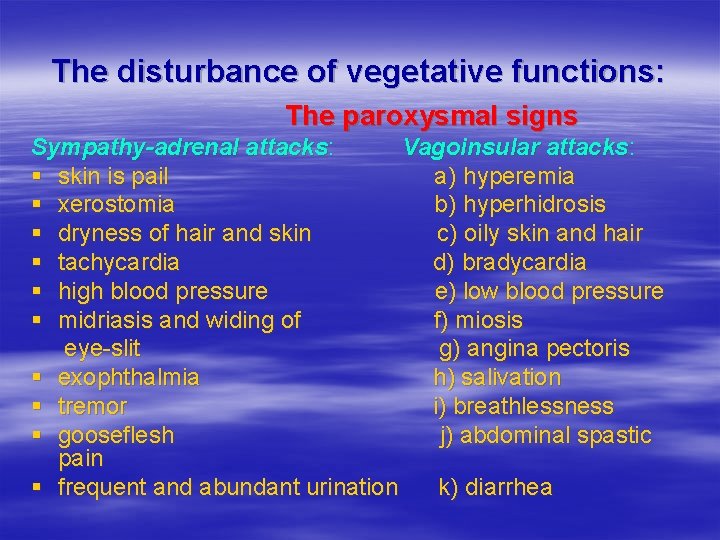
The disturbance of vegetative functions: The paroxysmal signs Sympathy-adrenal attacks: Vagoinsular attacks: § skin is pail a) hyperemia § xerostomia b) hyperhidrosis § dryness of hair and skin c) oily skin and hair § tachycardia d) bradycardia § high blood pressure e) low blood pressure § midriasis and widing of f) miosis eye-slit g) angina pectoris § exophthalmia h) salivation § tremor i) breathlessness § gooseflesh j) abdominal spastic pain § frequent and abundant urination k) diarrhea
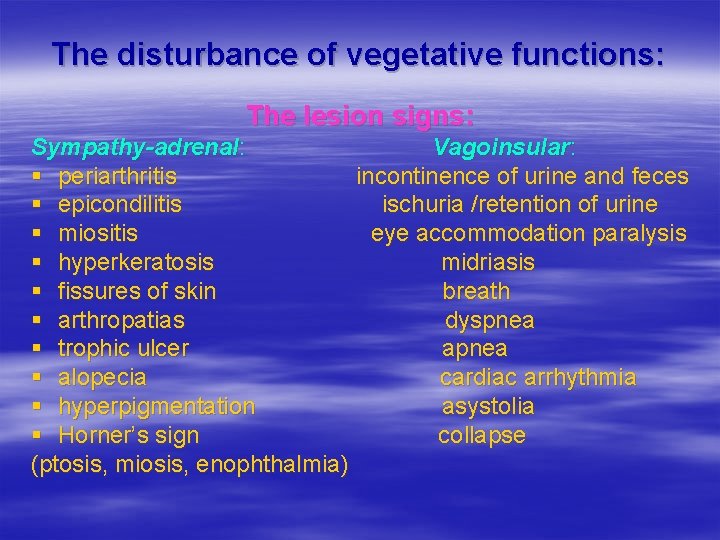
The disturbance of vegetative functions: The lesion signs: Sympathy-adrenal: Vagoinsular: § periarthritis incontinence of urine and feces § epicondilitis ischuria /retention of urine § miositis eye accommodation paralysis § hyperkeratosis midriasis § fissures of skin breath § arthropatias dyspnea § trophic ulcer apnea § alopecia cardiac arrhythmia § hyperpigmentation asystolia § Horner’s sign collapse (ptosis, miosis, enophthalmia)
Neuro – endocrine – metabolic syndrome – is associated with increasing or decreasing of hypophysis function: § Itsenko – Kushing § Acromegaly § Early climax § Impotence § Non sugar diabetes § Tyreotoxicosis
Neuro – trophic syndrome is associated with trophic disturbances: § Dryness § Neurodermitis § Ulcers § Bed sores § Acute perforates of stomach and esophagus
Neuro – muscular syndrome – hypothalamus provides chemical and biochemical activity of extrapyramidal nervous system and cerebellum. § Myasthenia § Myotonia § Paroxysmal myoplegia
Thermoregulation disturbances § Hyperthermia (the temperature is 37, 1 – 37, 5) § Hypothermia (the temperature is 35) § Temperature asymmetry under the arms § Temperature asymmetry in the mouth and in rectum § Sometimes this symptom has paroxysmal character and is associated with trembling
Sleeping disorders § Insomnia § Lethargy (a special form – narcolepsy) – sudden attack of sleepiness that can happen in any place and position of the patient. Sometimes they are associated with catalepsy (the loss of muscle tonus) § Sleeping inversion Pseudoneurastenia
Parasympathetic nervous system § Mesencephalic level (nuclei of Perlea and Yakubovich), the fibers are going within the III CN and provide innervating of m. Sphincter pupillae, m. Ciliaris § Bulbar (n. salivatorius superor et inferior, n. dorsalis nervi Vagi) within VII, IX, X CN’s innervate parotid, sublingual, submandibular glands and internal organs (except the pelvic organs) § Sacral part – the cells of lateral horn S 3 – S 5 – innervating of pelvic organs
Symptoms of lesion on mesencephalic level – Spasm or paralysis of accommodation – Mydriasis – Direct or indirect symptom of Argil – Robertson There is the arch of pupil reflex on mesencephalic level
The symptoms of lesion of bulbar level: § Salivation or kserostomy § Tears or kserophthalmy § Dyspnoe, Biot, Chein – Stocks types of breathing § Tachycardia, arythmia, asystoly § Arterial hypertension
Symptoms of lesion of sacral part: § § § Segments of the spinal cord – S 3 – S 5 Retention of urine Truly urine incontinence Ishuria paradoxa
Sympathetic nervous system § Consists of the cells of lateral horn of spinal cord from C 8 to L 2 § The axons within the anterior roots leave the spinal cord § Some of them are finished in sympathetic trunk (it consists of 20 – 23 noduses) – 3 cervical, 10 – 12 thoracic, 3 – 4 lumbar, 4 pelvic. § The rest fibers are going to the prevertebral noduses or plexuses
Common features: § There are 2 neurons. The second neuron is located in ganglion § Preganglionar fibers are myelin –associated. § Postganglionar fibers are without myelin. Differential features: § Mediator Sympathetic nervous system – adrenalin, noradrenalin Parasympathetic nervous system – acetylcholine § The length of fibers Sympathetic nervous system – short pre- and long postganglionar fibers Parasympathetic nervous system – long pre – and short postganglionar fibers
Symptoms of lesion Lateral horns of spinal cord: Autonomic – vascular (pale, cyanosis) Trophic (edema, arthropaty) Secreting (dryness of the skin, hyperhydrosis) § C 8 – Th 3 – head and neck § Th 4 – Th 7 – shoulders and arms § Th 8 – Th 9 – body § Th 10 – L 3 – pelvis and legs
Symptoms of lesion Upper cervical sympathetic nodes: – Causalgia – Paresthesia, hypesthesia – Vasomotor, secreting, trophic disorders in head and neck region – Horner syndrome
Symptoms of lesion Nodus stellatum: § Causalgia § Paresthesia, hypesthesia § Vasomotor, secreting, trophic disorders in head and neck region
Symptoms of lesion Upper thoracic noduses: § Cardialgia § Tachycardia § Breathing disorders plus all the above named symptoms
Symptoms of lesion § § § § Lower thoracic and lumbar noduses: Visceral and autonomic disorders of the organs of abdominal cavity. Solar plexus: Dull pain in the abdomen Increased aorta pulsation Instable AP Instable stool Poli – oligouria Glucosuria
Symptoms of lesion Posterior neck sympathetic nodus: § Neck pain like “casque putting off” § Photopsia § Vestibular syndrome