
The Automated Discovery of Hybrid Processes Fabrizio M
The Automated Discovery of Hybrid Processes Fabrizio M. Maggi Tijs Slaats* Hajo A. Reijers University of Tartu IT University of Copenhagen VU University of Amsterdam Exformatics
Overview • • Hybrid Process Models Discovering Hybrid Process Models Evaluation Future Work + Conclusion

Imperative Process Models
Imperative Process Models Flow-oriented Well-suited to rigid processes In a model with no flow nothing can happen Adding flow allows for additional possible behaviors • Common in academia and industry • •
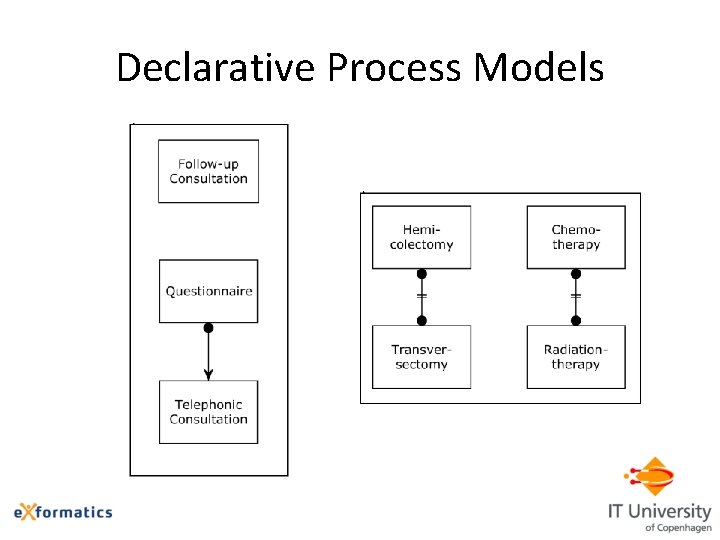
Declarative Process Models
Declarative Process Models • Constraint-oriented • Well-suited to flexible processes • In an unconstrained model anything can happen • Adding constraints limits behavior • Still a novelty in industry
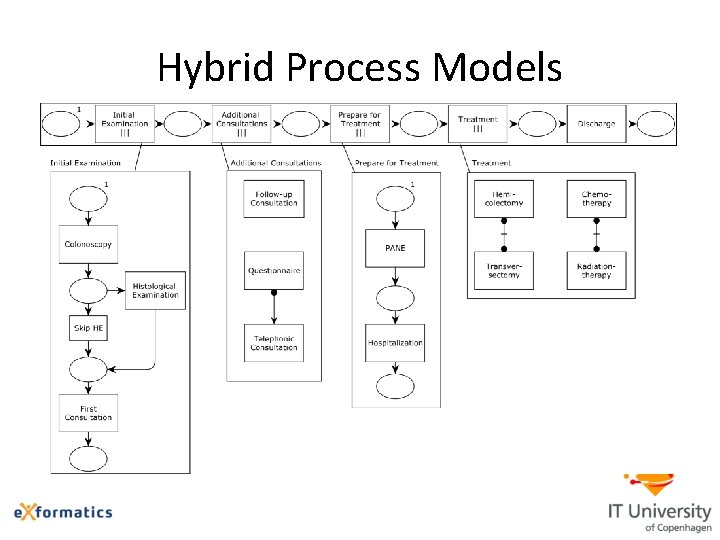
Hybrid Process Models
Hybrid Process Models • Different parts of the same process may be more or less flexible. • Modeling a flexible process imperatively, or a strict process declaratively, often leads to incomprehensible models. • Mixing of paradigms on the sub-process level: – Pockets of flexibility in workflow services [Sadiq et al. ] – Flexibility as a Service (FAAS) [Aalst et al. ]
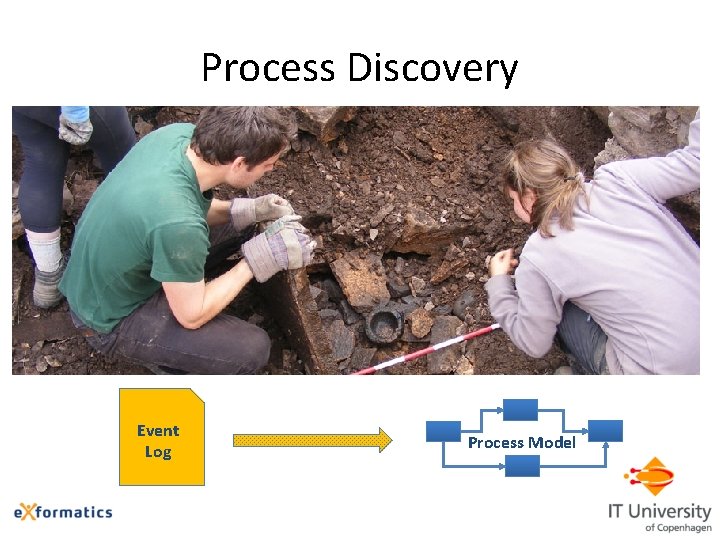
Process Discovery Event Log Process Model
Process Discovery • Current discovery techniques: – Mining Petri-nets / Flowcharts • Alpha miner, Heuristic Miner, ILP miner, … – Mining Declarative constraints • Declare miner • But what if the log contains both flexible and rigid parts? – Imperative miners tend to blow-up on flexible logs – Declarative miners will need to find many constraints to model the strict parts of the process and will often have trouble finding all of them (resulting in processes with low precision) • Solution: Hybrid Process Discovery!
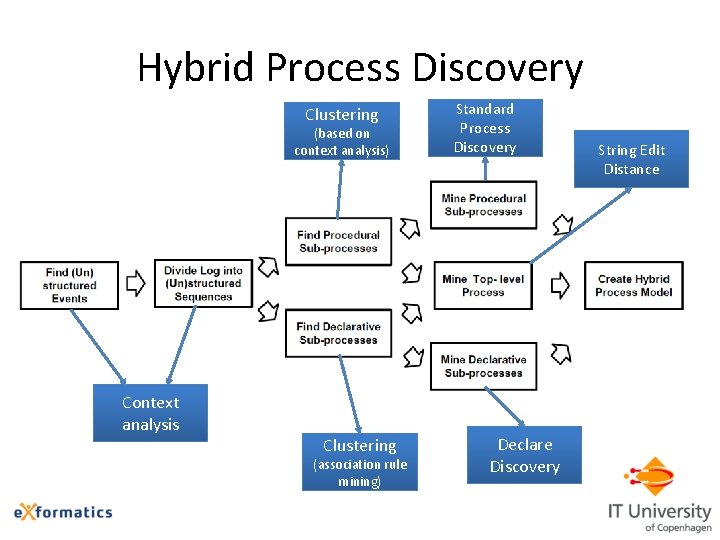
Hybrid Process Discovery Clustering (based on context analysis) Context analysis Clustering (association rule mining) Standard Process Discovery Declare Discovery String Edit Distance
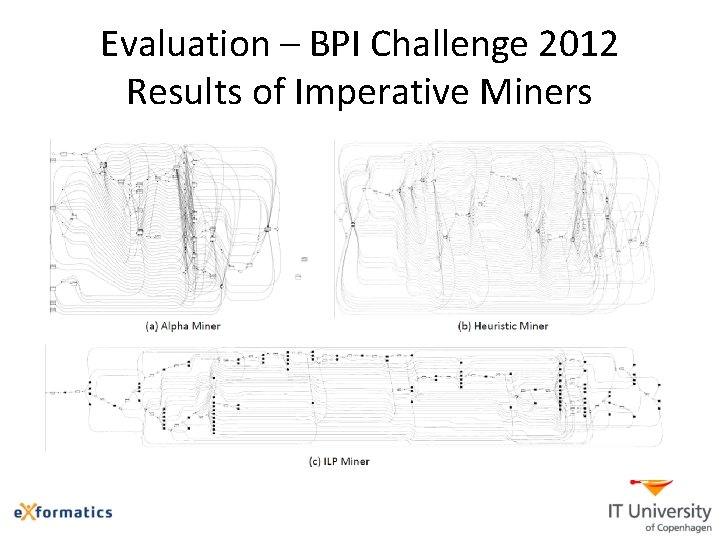
Evaluation – BPI Challenge 2012 Results of Imperative Miners
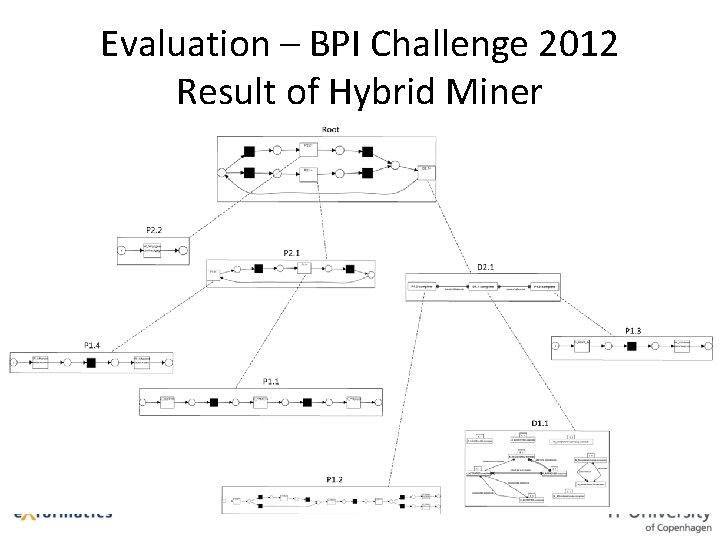
Evaluation – BPI Challenge 2012 Result of Hybrid Miner
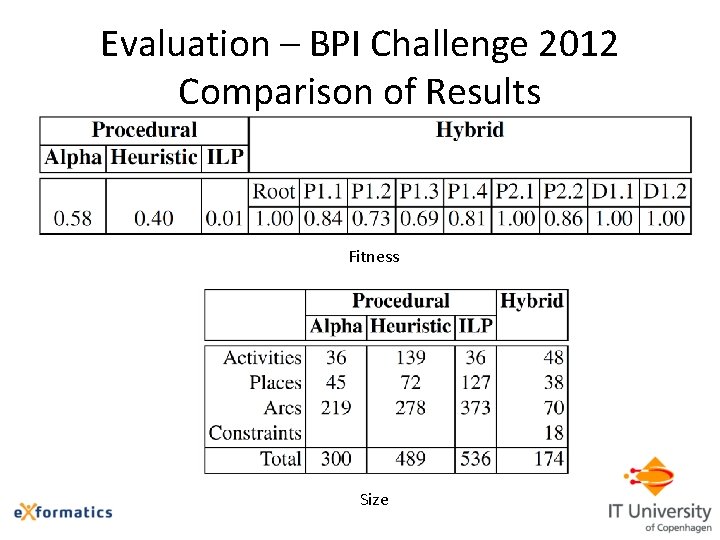
Evaluation – BPI Challenge 2012 Comparison of Results Fitness Size
Future Work • • Proper plugin for Prom. Visualization of resulting hybrid model. Further evaluation on real cases. Further refinement of the heuristics used in the approach, for example thresholds used for determining if an event is structured or unstructured.
Conclusion • We offer the first automated approach for discovering hybrid process models. • Using the approach on existing logs gives encouraging results: in particular for semistructured logs the discovered models become more readable. • Plenty of room for future work in an exciting new angle on process mining.
- Slides: 16