
THE AUTHORITY IN PLUMBING SYSTEM DESIGN AND ENGINEERING

THE AUTHORITY IN PLUMBING SYSTEM DESIGN AND ENGINEERING What is Plumbing Engineering?
THE AUTHORITY IN PLUMBING SYSTEM DESIGN AND ENGINEERING What does an engineer do? • An engineer is someone who: – Makes systems work – Uses science, math, and technology to solve real-life problems in a systemic way – Creates plans for a system, design, or solution to a problem – Builds models and prototypes
THE AUTHORITY IN PLUMBING SYSTEM DESIGN AND ENGINEERING There are many types of engineers: • • • Aerospace Agricultural Biomedical Ceramic Biological Chemical Civil Computer Electrical • • • Environmental Fire Protection Geological Marine Mechanical Mining Nuclear Plumbing Structural

THE AUTHORITY IN PLUMBING SYSTEM DESIGN AND ENGINEERING
THE AUTHORITY IN PLUMBING SYSTEM DESIGN AND ENGINEERING How much does an engineer earn? • Average $80, 000, most common $75, 000 • Bachelors in Engineering $50, 000 • Potential growth through ownership and partnership – $250, 000 and up!
THE AUTHORITY IN PLUMBING SYSTEM DESIGN AND ENGINEERING Where we work… • • Our own firms Engineering and architecture companies Government Universities and colleges Manufacturers Armed services Labs and testing centers Worldwide!

THE AUTHORITY IN PLUMBING SYSTEM DESIGN AND ENGINEERING

THE AUTHORITY IN PLUMBING SYSTEM DESIGN AND ENGINEERING What do plumbing engineers do?
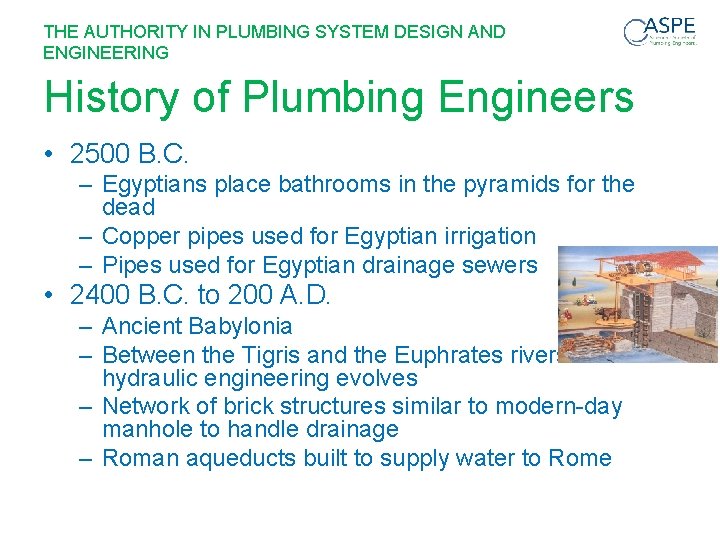
THE AUTHORITY IN PLUMBING SYSTEM DESIGN AND ENGINEERING History of Plumbing Engineers • 2500 B. C. – Egyptians place bathrooms in the pyramids for the dead – Copper pipes used for Egyptian irrigation – Pipes used for Egyptian drainage sewers • 2400 B. C. to 200 A. D. – Ancient Babylonia – Between the Tigris and the Euphrates rivers - hydraulic engineering evolves – Network of brick structures similar to modern-day manhole to handle drainage – Roman aqueducts built to supply water to Rome
THE AUTHORITY IN PLUMBING SYSTEM DESIGN AND ENGINEERING Continued… • 18 th century and 19 th century – Europe starts to install public sewer systems – Early facts: – 1455 – first recorded use of iron pipe, Germany – 1562 – cast iron pipe, Germany – 1664 – first full scale cast Iron soil pipe project. France, King Louis XIV orders a 15 -mile water line to feed a palace fountain. – 1738 – Cast Iron Soil Pipe introduced to England – 1775 – Water closet used in England
THE AUTHORITY IN PLUMBING SYSTEM DESIGN AND ENGINEERING American Codes • Regulations generally follow catastrophes • 1870 – Wash. D. C. first plumbing code separate from health code • 1913 – most U. S. cities have codes • 1921 – U. S. Department of Commerce begins the building code • 1930 – Temperature and pressure relief valve required.
THE AUTHORITY IN PLUMBING SYSTEM DESIGN AND ENGINEERING Today’s Plumbing Engineer: • Plumbing engineers work on designing systems that move liquids, solids, and gases through pipes to ensure the health, safety, and welfare of the public along with in compliance with all applicable codes. • These systems are used in office buildings, industry, institutions, hotels, schools, airports, apartment/condo buildings, hospitals, prisons, petroleum plants, manufacturing plants, etc.
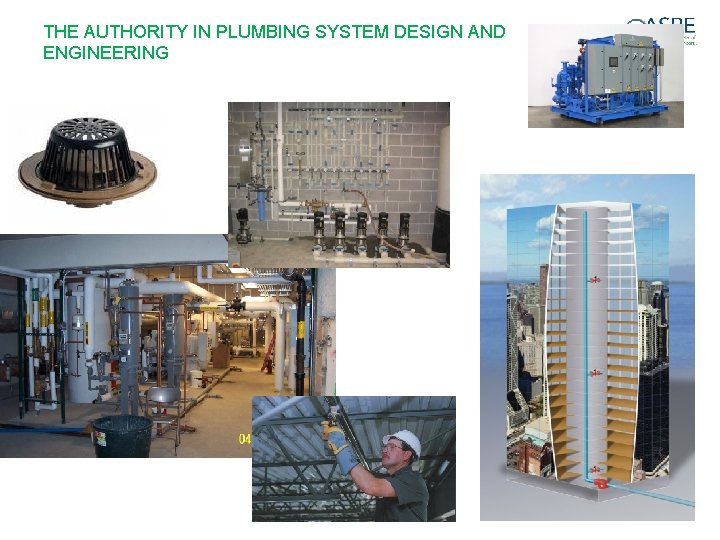
THE AUTHORITY IN PLUMBING SYSTEM DESIGN AND ENGINEERING What do plumbing engineers work on? • Water systems (drinkable, gray, black) • Fire/sprinkler systems • Heating systems (solar, geothermal, hot water) • Storm Drainage Systems • Gas systems (propane, natural gas, air) • Industrial systems • Sanitary Drainage and Vent Systems • Pumping control systems
THE AUTHORITY IN PLUMBING SYSTEM DESIGN AND ENGINEERING
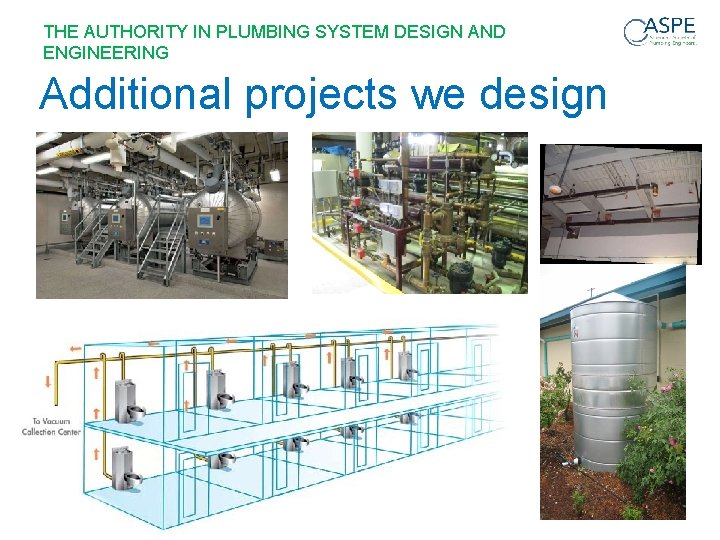
THE AUTHORITY IN PLUMBING SYSTEM DESIGN AND ENGINEERING Additional projects we design
THE AUTHORITY IN PLUMBING SYSTEM DESIGN AND ENGINEERING As a plumbing engineer or designer you will…
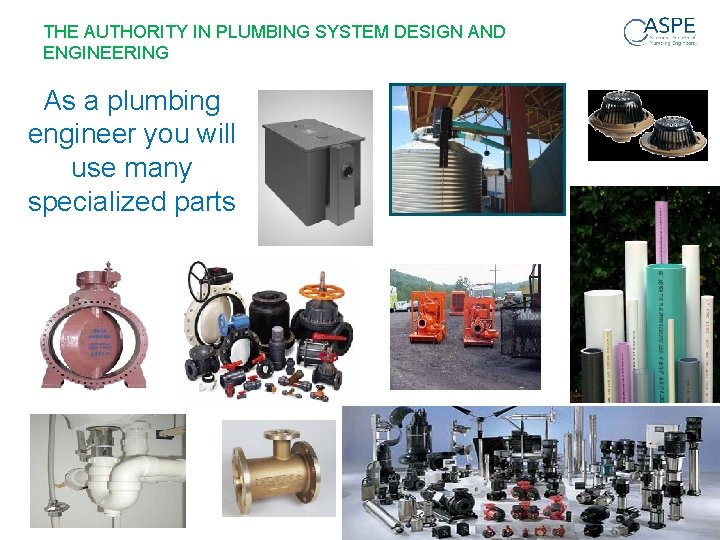
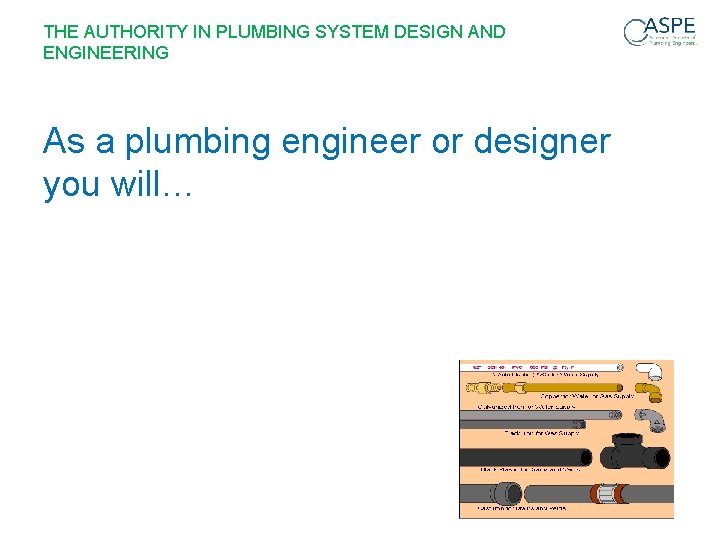
THE AUTHORITY IN PLUMBING SYSTEM DESIGN AND ENGINEERING As a plumbing engineer you will use many specialized parts
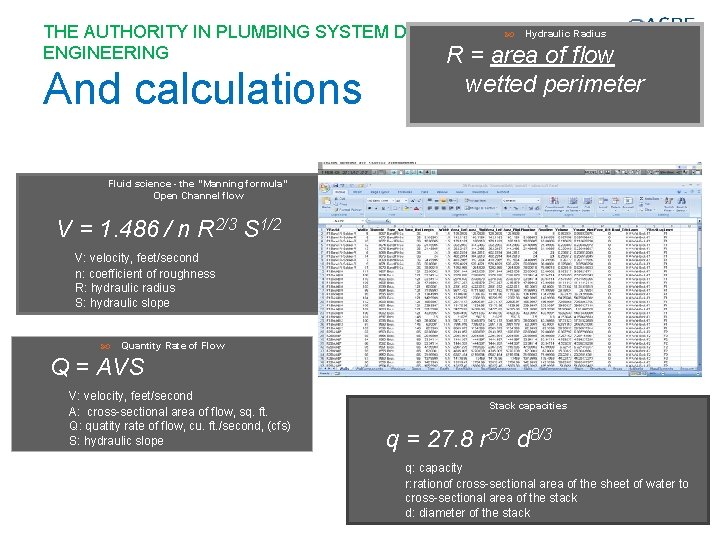
THE AUTHORITY IN PLUMBING SYSTEM DESIGN AND Hydraulic Radius ENGINEERING R = area of flow And calculations wetted perimeter Fluid science - the “Manning formula” Open Channel flow V = 1. 486 / n R 2/3 S 1/2 V: velocity, feet/second n: coefficient of roughness R: hydraulic radius S: hydraulic slope Quantity Rate of Flow Q = AVS V: velocity, feet/second A: cross-sectional area of flow, sq. ft. Q: quatity rate of flow, cu. ft. /second, (cfs) S: hydraulic slope Stack capacities q = 27. 8 r 5/3 d 8/3 q: capacity r: rationof cross-sectional area of the sheet of water to cross-sectional area of the stack d: diameter of the stack
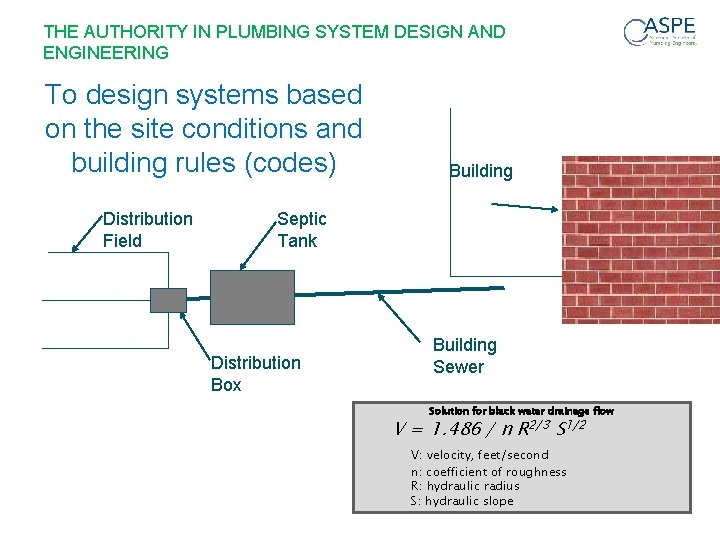
THE AUTHORITY IN PLUMBING SYSTEM DESIGN AND ENGINEERING To design systems based on the site conditions and building rules (codes) Distribution Field Building Septic Tank Distribution Box Building Sewer Solution for black water drainage flow V = 1. 486 / n R 2/3 S 1/2 V: velocity, feet/second n: coefficient of roughness R: hydraulic radius S: hydraulic slope
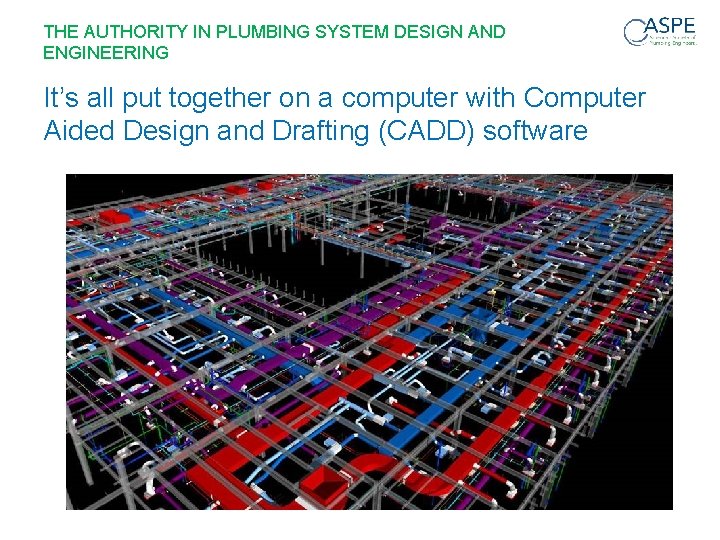
THE AUTHORITY IN PLUMBING SYSTEM DESIGN AND ENGINEERING It’s all put together on a computer with Computer Aided Design and Drafting (CADD) software
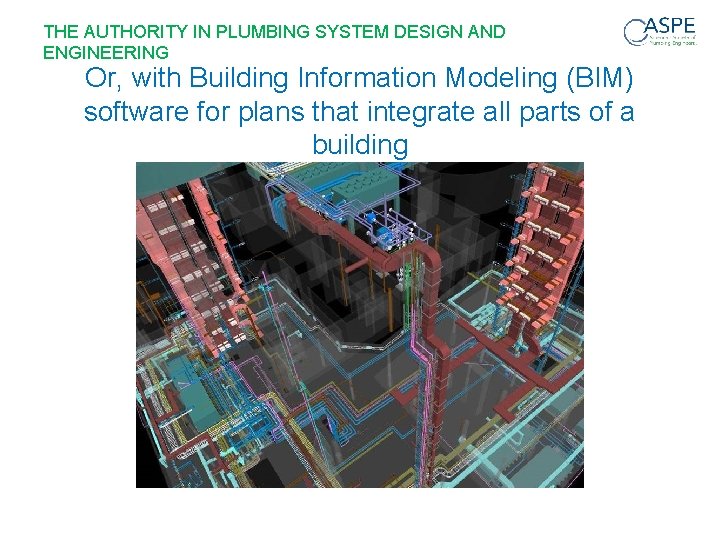
THE AUTHORITY IN PLUMBING SYSTEM DESIGN AND ENGINEERING Or, with Building Information Modeling (BIM) software for plans that integrate all parts of a building
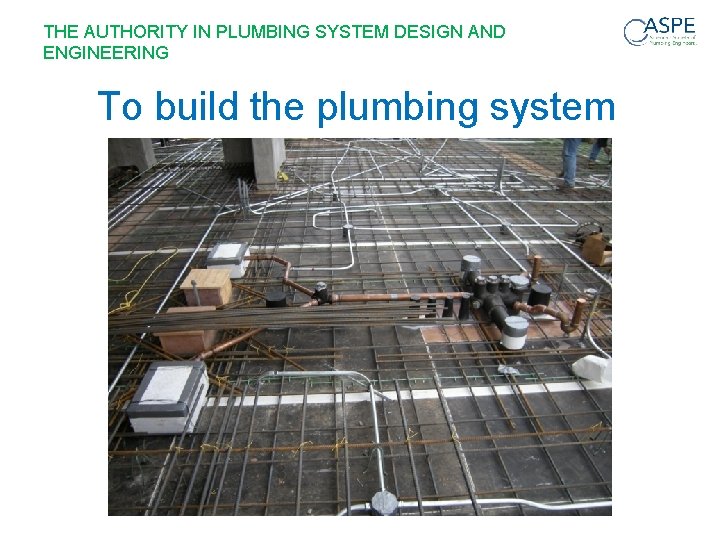
THE AUTHORITY IN PLUMBING SYSTEM DESIGN AND ENGINEERING To build the plumbing system
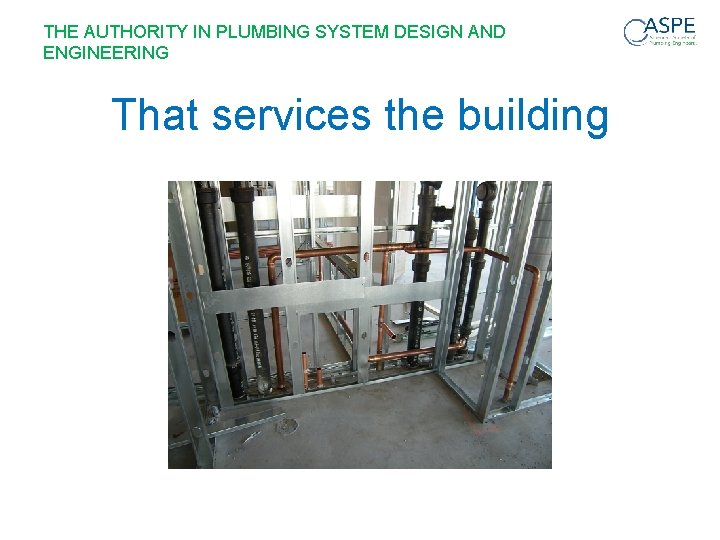
THE AUTHORITY IN PLUMBING SYSTEM DESIGN AND ENGINEERING That services the building
THE AUTHORITY IN PLUMBING SYSTEM DESIGN AND ENGINEERING Using Math in Plumbing Engineering
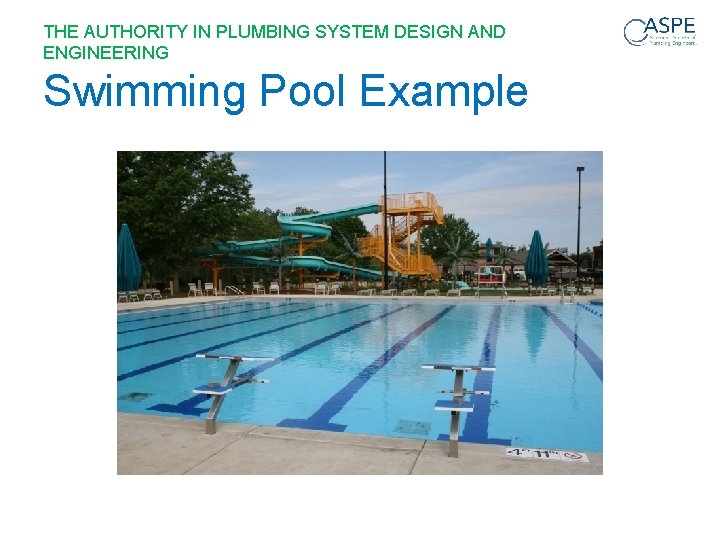
THE AUTHORITY IN PLUMBING SYSTEM DESIGN AND ENGINEERING Swimming Pool Example
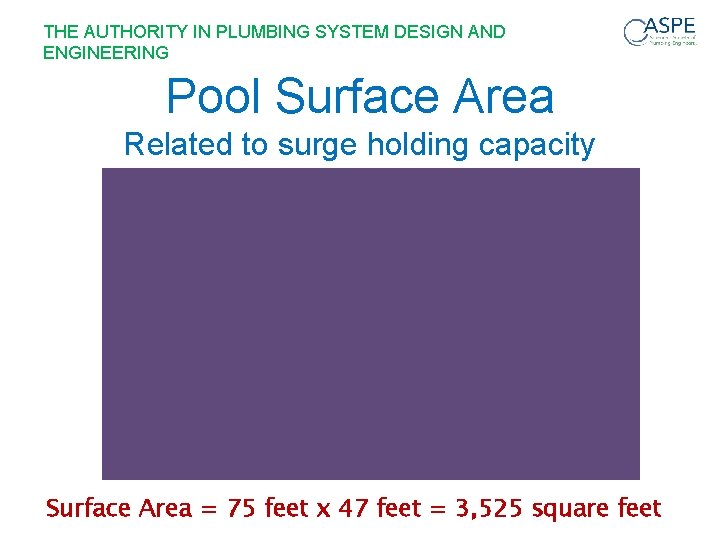
THE AUTHORITY IN PLUMBING SYSTEM DESIGN AND ENGINEERING Pool Surface Area Related to surge holding capacity Surface Area = 75 feet x 47 feet = 3, 525 square feet
THE AUTHORITY IN PLUMBING SYSTEM DESIGN AND ENGINEERING Pool Volume: How is this calculated?
THE AUTHORITY IN PLUMBING SYSTEM DESIGN AND ENGINEERING Pool Math Swimming Volume = L x W x Avg. Depth x 7. 48 gal. /cubic feet Swimming Volume = 60 feet x 47 feet x ([4 feet + 12 feet])/2) x 7. 48 gal. /cubic feet= 168, 749 gallons Diving Volume = 15 feet x 47 feet x 12 feet x 7. 48 gal. /cubic feet = 63, 281 gallons Total Water Volume = 232, 030 gallons
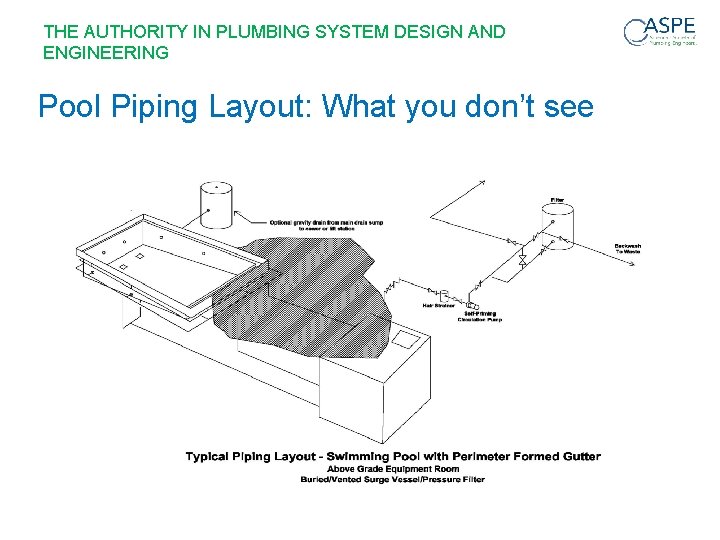
THE AUTHORITY IN PLUMBING SYSTEM DESIGN AND ENGINEERING Pool Piping Layout: What you don’t see
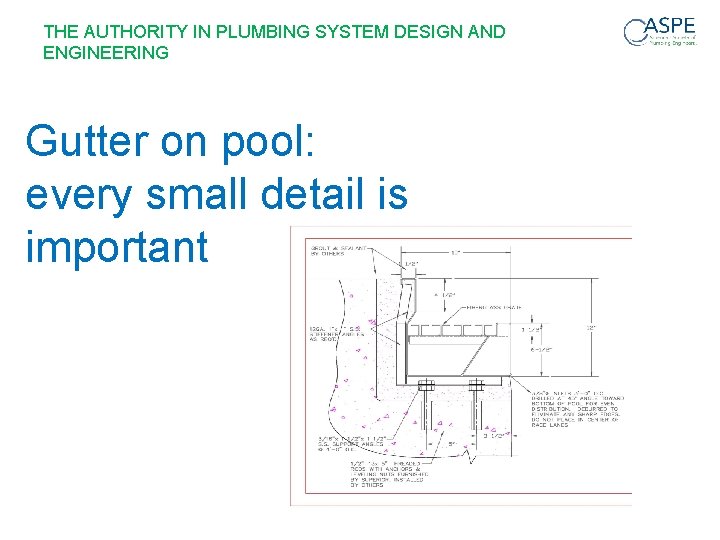
THE AUTHORITY IN PLUMBING SYSTEM DESIGN AND ENGINEERING Gutter on pool: every small detail is important
THE AUTHORITY IN PLUMBING SYSTEM DESIGN AND ENGINEERING Plumbing engineers and designers are leading the sustainable movement
THE AUTHORITY IN PLUMBING SYSTEM DESIGN AND ENGINEERING Green and Sustainable Initiatives in Plumbing Engineering and Design • Water reduction/conservation products and design • Water efficient products and design • Solar and geothermal heating • Water reuse • Low energy usage products and design
THE AUTHORITY IN PLUMBING SYSTEM DESIGN AND ENGINEERING Sustainable/Green Products • • • Low flow fixtures Rainwater catchment systems Solar water heaters Tankless water heaters Hot Water Recirculation Dual flow flush valves Solar Powered Faucets Bathroom Greywater Recycling System ENERGY STAR rated products Water. Sense rated products
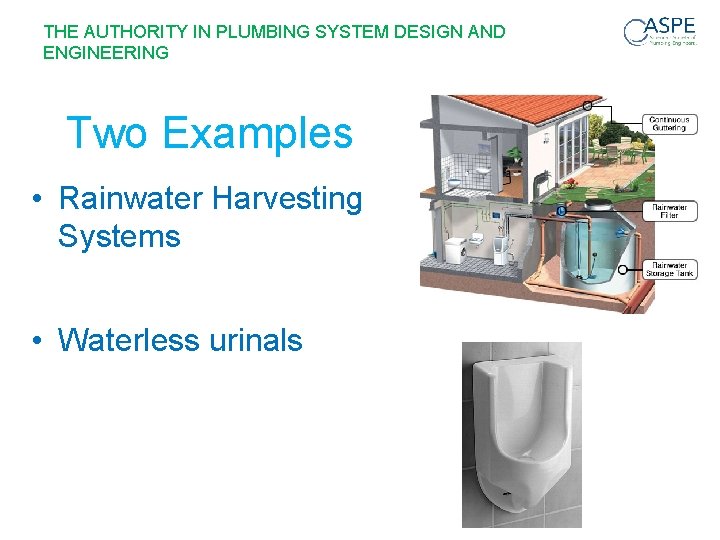
THE AUTHORITY IN PLUMBING SYSTEM DESIGN AND ENGINEERING Two Examples • Rainwater Harvesting Systems • Waterless urinals
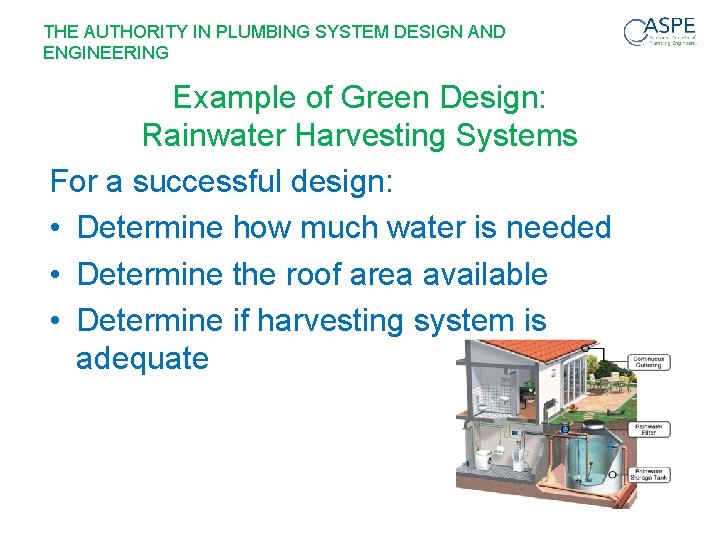
THE AUTHORITY IN PLUMBING SYSTEM DESIGN AND ENGINEERING Example of Green Design: Rainwater Harvesting Systems For a successful design: • Determine how much water is needed • Determine the roof area available • Determine if harvesting system is adequate
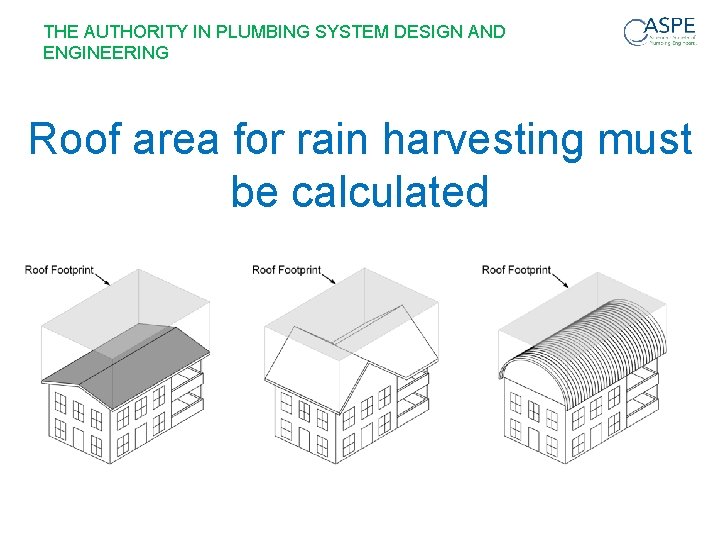
THE AUTHORITY IN PLUMBING SYSTEM DESIGN AND ENGINEERING Roof area for rain harvesting must be calculated
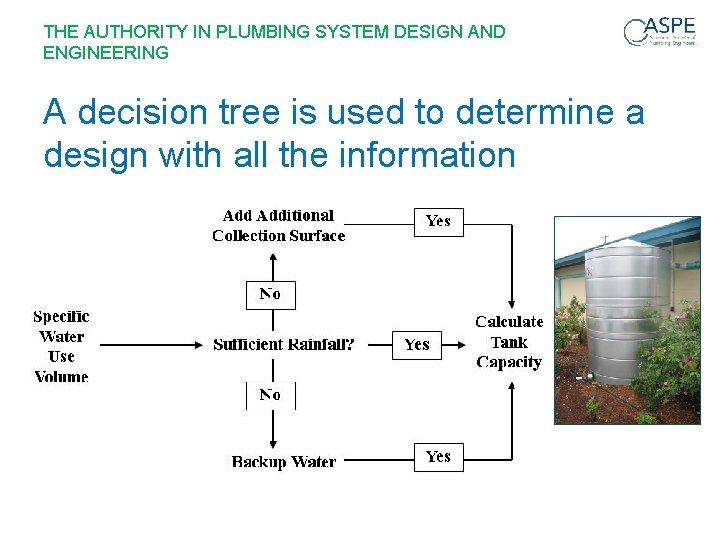
THE AUTHORITY IN PLUMBING SYSTEM DESIGN AND ENGINEERING A decision tree is used to determine a design with all the information
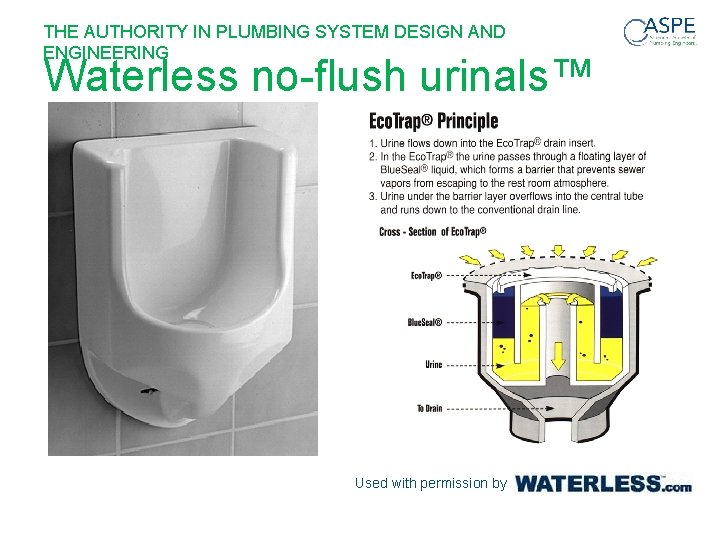
THE AUTHORITY IN PLUMBING SYSTEM DESIGN AND ENGINEERING Waterless no-flush urinals™ Used with permission by
THE AUTHORITY IN PLUMBING SYSTEM DESIGN AND ENGINEERING Design considerations: • A urinal is used three times more often than a toilet. • A urinal uses on average 1. 2 gallons per flush. • Moist surfaces attract bacteria, dry surfaces improve hygiene. • Water usage rates have risen faster than electrical usage rates over the past decade.
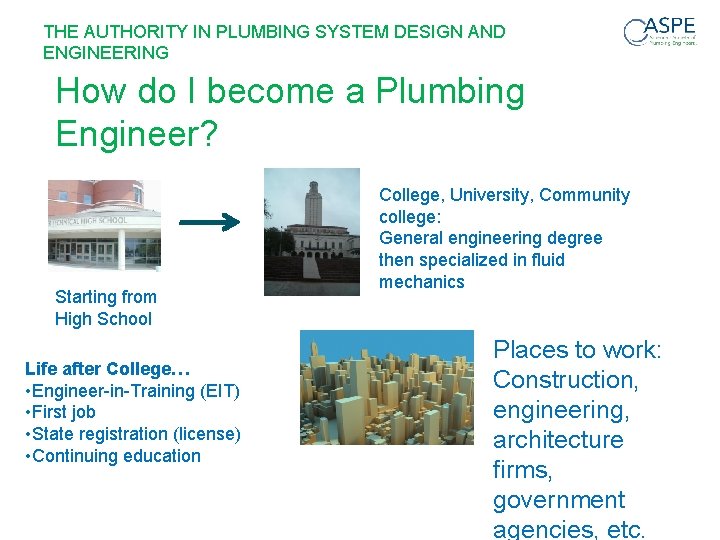
THE AUTHORITY IN PLUMBING SYSTEM DESIGN AND ENGINEERING How do I become a Plumbing Engineer? Starting from High School Life after College… • Engineer-in-Training (EIT) • First job • State registration (license) • Continuing education College, University, Community college: General engineering degree then specialized in fluid mechanics Places to work: Construction, engineering, architecture firms, government agencies, etc.
THE AUTHORITY IN PLUMBING SYSTEM DESIGN AND ENGINEERING What do employers look for if I want to become an engineer? • Communication skills (verbal & written) Teamwork skills – Ability to work well with others • Interpersonal skills – Ability to relate well to others • Strong work ethic • Motivation/initiative
THE AUTHORITY IN PLUMBING SYSTEM DESIGN AND ENGINEERING Continued… • • Flexibility/adaptability Analytical skills Computer skills Organizational skills Detail oriented Leadership skills Self-confidence
THE AUTHORITY IN PLUMBING SYSTEM DESIGN AND ENGINEERING Thanks to Klaus Reichardt Founder and CEO
THE AUTHORITY IN PLUMBING SYSTEM DESIGN AND ENGINEERING Thank you! www. aspe. org
- Slides: 44