
The Australian Regulatory Framework for Building and Plumbing
The Australian Regulatory Framework for Building and Plumbing Insert Corporate logo here © Commonwealth of Australia and the States and Territories of Australia 2020, published by the Australian Building Codes Board.
Table of contents Introduction • What you’ll learn • Related materials. Contents • Why regulate? • Benefits of regulation • The Australian regulatory framework • An overview of the National Construction Code (NCC) • The Australian Building Codes Board (ABCB). Summary
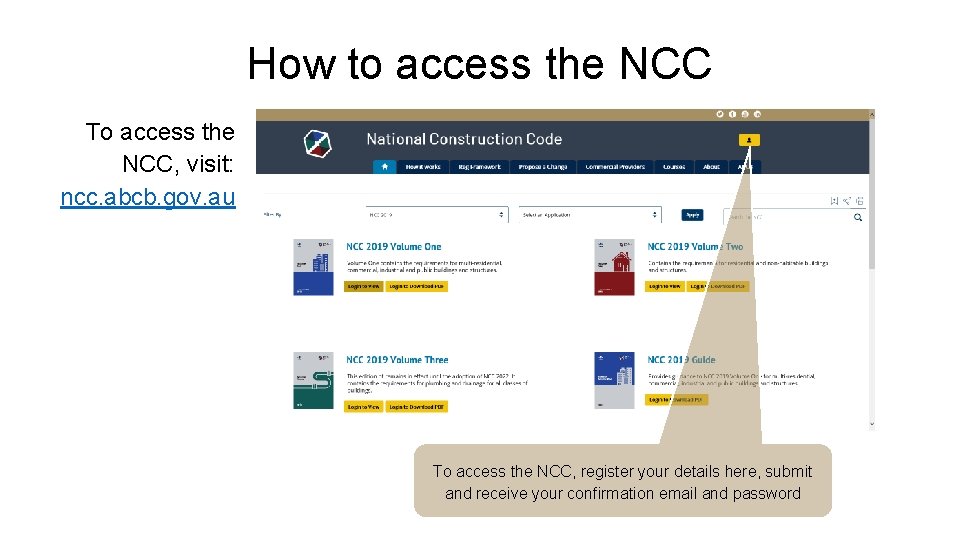
How to access the NCC To access the NCC, visit: ncc. abcb. gov. au To access the NCC, register your details here, submit and receive your confirmation email and password
What you will learn Aims & objectives To acquire a basic knowledge of: • the Australian regulatory framework for building and plumbing; • the National Construction Code (NCC); and • the Australian Building Codes Board (ABCB). Who this material is for • All building and plumbing professionals.
Why regulate? In this section we cover: • Why is building and plumbing work regulated? • How does the Australian regulatory framework? • What is the structure of a typical regulatory framework for building and plumbing?
Why regulate? • The primary reason for regulation is to protect people. • These include building occupants and people outside a building during: • construction; • operational life; and • demolition.
Why regulate? • Mitigation of risks to life, for example: • structural collapse of a building; and • fire in a building. • To address health, amenity and accessibility issues such as: • • • dampness and ventilation; accessibility; lighting; sound transmission; sanitation; and access to and within a building.
Why regulate? To promote sustainable development, including: • reducing greenhouse gas emissions; • increasing energy efficiency of buildings; • resilience to extreme weather events; and • Conserving water.
Why regulate? Governments may choose to regulate to: • facilitate acceptable levels of risk, depending on the issue; and • establish minimum necessary standards, where appropriate.
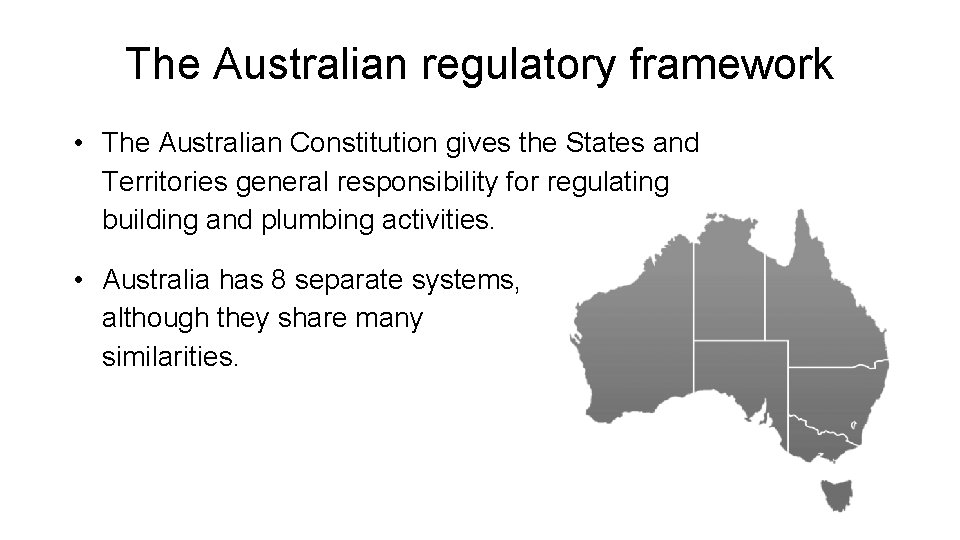
The Australian regulatory framework • The Australian Constitution gives the States and Territories general responsibility for regulating building and plumbing activities. • Australia has 8 separate systems, although they share many similarities.
A typical regulatory framework Generally comprises of two types of regulation: • administrative regulation; and • technical regulation.
Administrative regulations Administrative issues can include: • Powers and responsibilities of parties • Assessment procedures • Referrals, objections and appeals • Inspection and certification processes • Offences and penalties • Registration and licensing of practitioners • Adoption of the NCC.
Technical regulations Technical issues can include: • Building site requirements • protection of adjoining property • hoardings to protect the public • signage for hazardous materials. • Design and construction requirements • For buildings and structures, the NCC is adopted as the primary document for design and construction requirements.
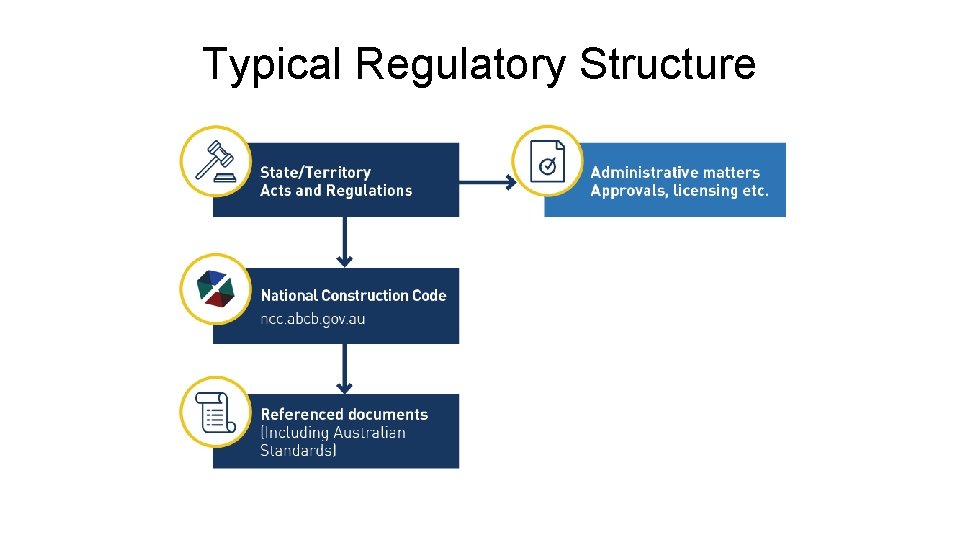
Typical Regulatory Structure
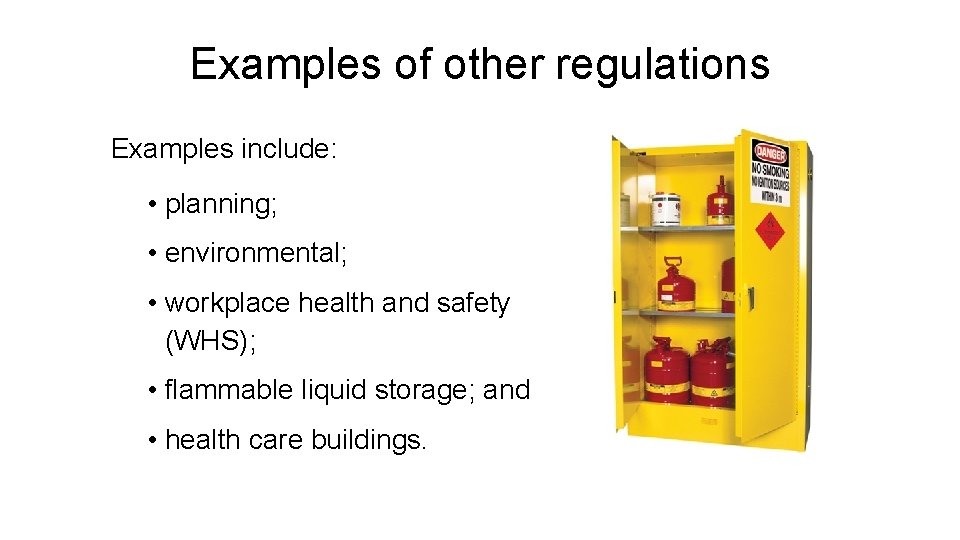
Examples of other regulations Examples include: • planning; • environmental; • workplace health and safety (WHS); • flammable liquid storage; and • health care buildings.
The National Construction Code (NCC) In this section we cover: • an overview of the NCC; • what the NCC applies to; • format of the NCC; • characteristics of the NCC; and • benefits of performance-based regulation.
Overview of the NCC • The NCC is an initiative of the Council of Australian Governments (COAG) to incorporate all on-site construction requirements into a uniform national code. • The role of the NCC is to provide: • nationally consistent minimum necessary regulations; and • a technical base for the design and construction of buildings and certain structures.
Format of the NCC • The NCC is comprised of three Volumes. • The Building Code of Australia (BCA) is Volume One and Volume Two of the NCC. • BCA Volume One pertains primarily to Class 2 to 9 buildings. • BCA Volume Two pertains primarily to Class 1 and 10 buildings. • The Plumbing Code of Australia (PCA) is Volume Three of the NCC (implemented in 2011). • PCA Volume Three pertains primarily to plumbing and drainage associated with all classes of buildings.
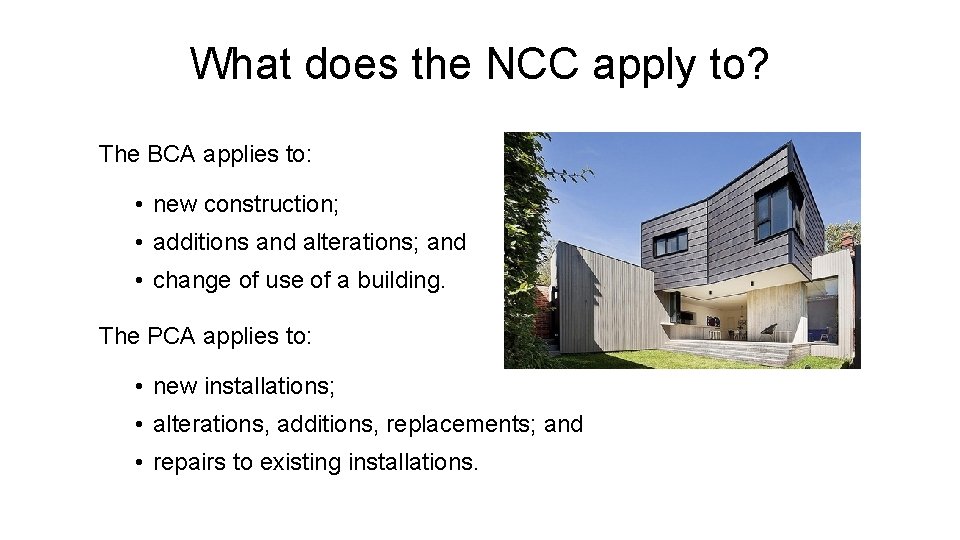
What does the NCC apply to? The BCA applies to: • new construction; • additions and alterations; and • change of use of a building. The PCA applies to: • new installations; • alterations, additions, replacements; and • repairs to existing installations.
When is the NCC amended? • The NCC is amended every three years. • It is adopted on the 1 st of May. • The next NCC edition is due in 2022.
Characteristics of the NCC • The NCC is a performance-based code. • Performance-based codes set mandatory levels of performance. • The NCC allows flexibility in compliance.
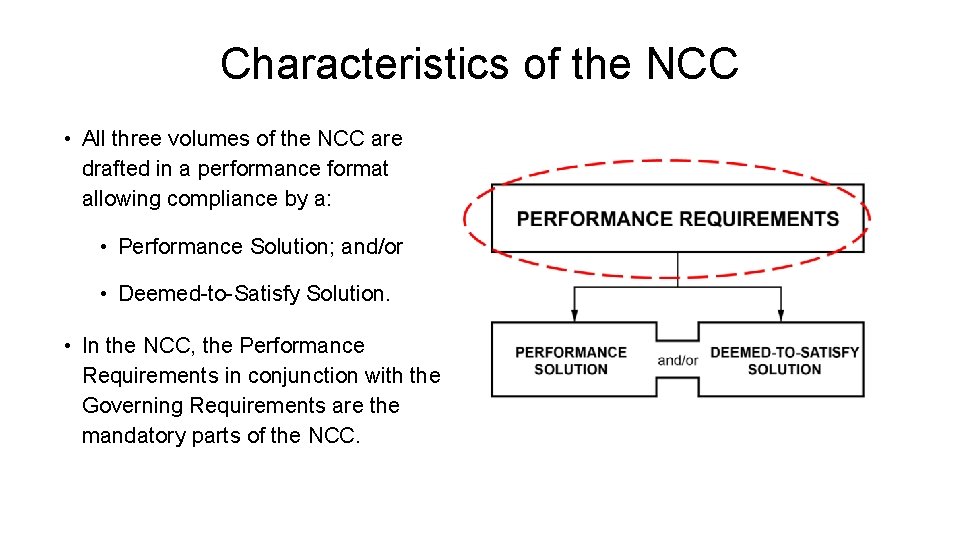
Characteristics of the NCC • All three volumes of the NCC are drafted in a performance format allowing compliance by a: • Performance Solution; and/or • Deemed-to-Satisfy Solution. • In the NCC, the Performance Requirements in conjunction with the Governing Requirements are the mandatory parts of the NCC.
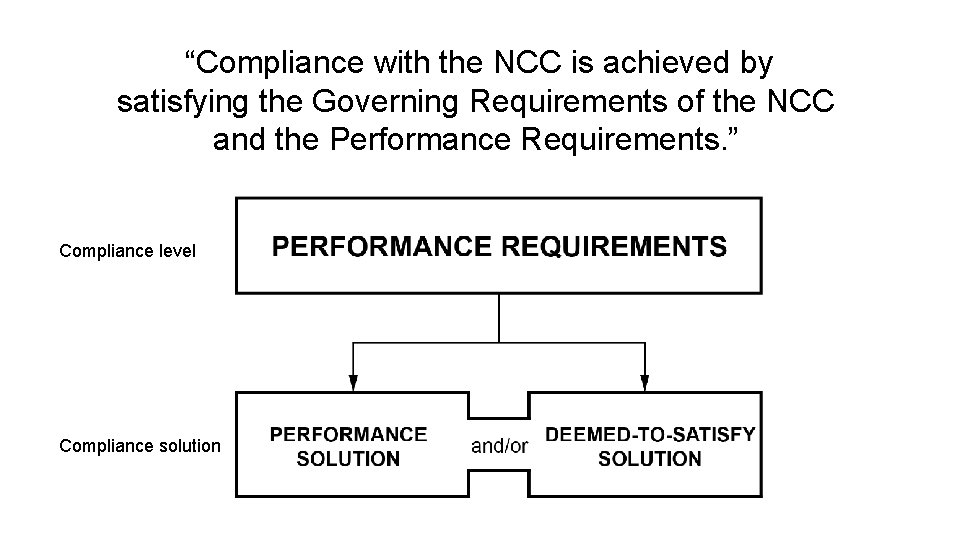
“Compliance NCC is achieved by Characteristics ofwith thethe. NCC satisfying the Governing Requirements of the NCC and the Performance Requirements. ” Compliance level Compliance solution
Benefits of performance-based regulation Performance-based regulations: • provide significant flexibility to industry; • allow the design of tailor made buildings e. g. no “one size fits all” approach; • promote innovation; and • improve cost effectiveness and constructability. Performance-based regulations also reduce the need to: • lodge objections to regulations; • apply for a modification or variation of a code; and • appeal decisions of Certifying Authorities.
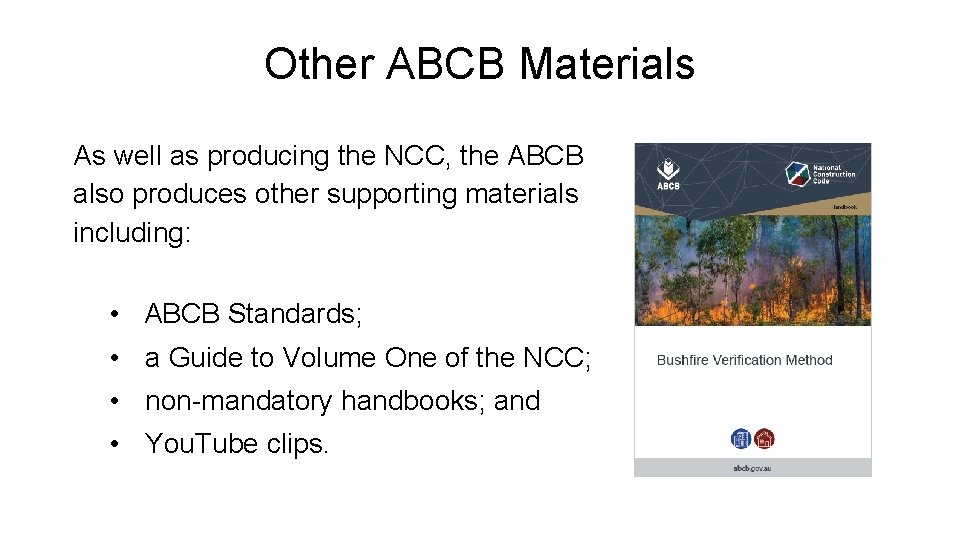
Other ABCB Materials As well as producing the NCC, the ABCB also produces other supporting materials including: • ABCB Standards; • a Guide to Volume One of the NCC; • non-mandatory handbooks; and • You. Tube clips.
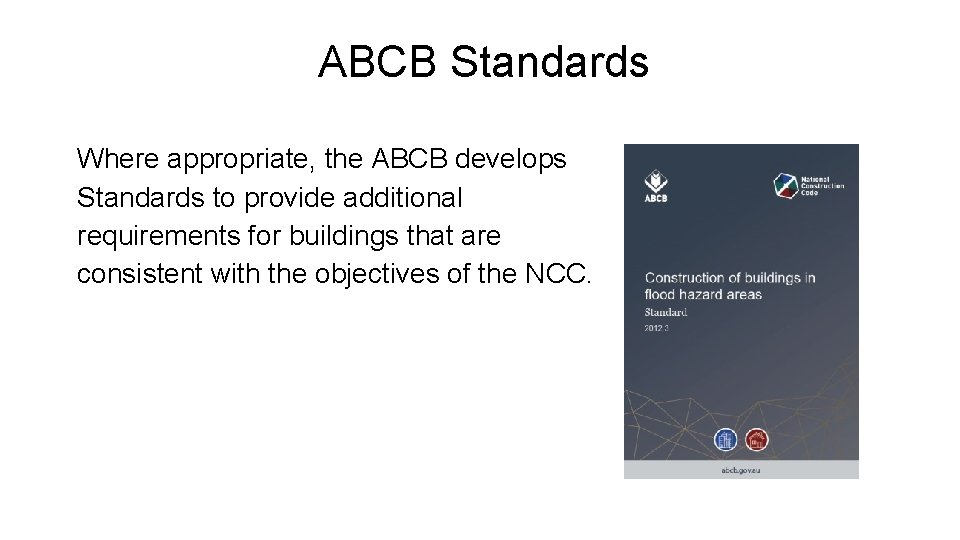
ABCB Standards Where appropriate, the ABCB develops Standards to provide additional requirements for buildings that are consistent with the objectives of the NCC.
Guide to Volume One To accompany NCC Volume One, the ABCB produces a Guide to Volume One, providing: • background and explanatory information; and • valuable assistance in understanding the relationships between Parts of the BCA and is a valuable aid when interpreting provisions. • It is a useful aid when interpreting provisions. • It is integrated into NCC Volume One online.
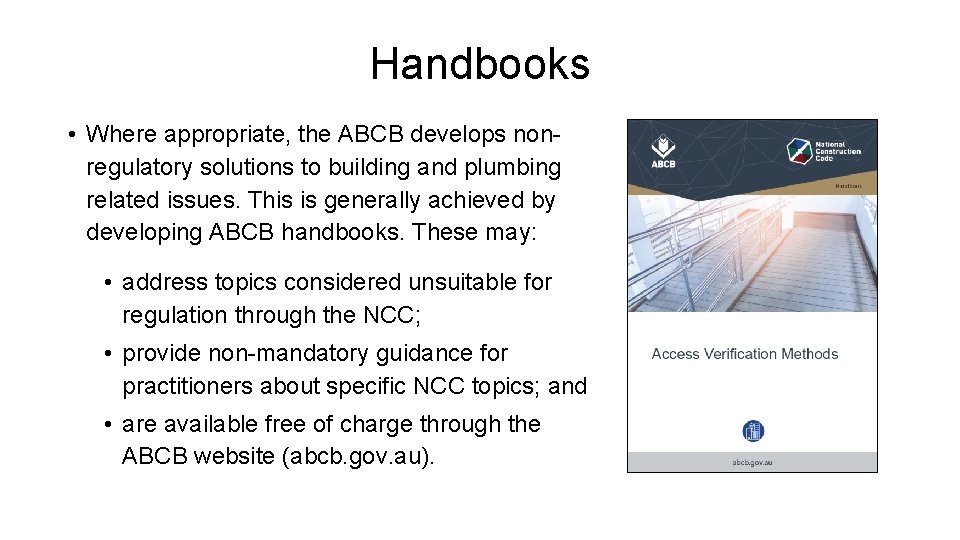
Handbooks • Where appropriate, the ABCB develops nonregulatory solutions to building and plumbing related issues. This is generally achieved by developing ABCB handbooks. These may: • address topics considered unsuitable for regulation through the NCC; • provide non-mandatory guidance for practitioners about specific NCC topics; and • are available free of charge through the ABCB website (abcb. gov. au).
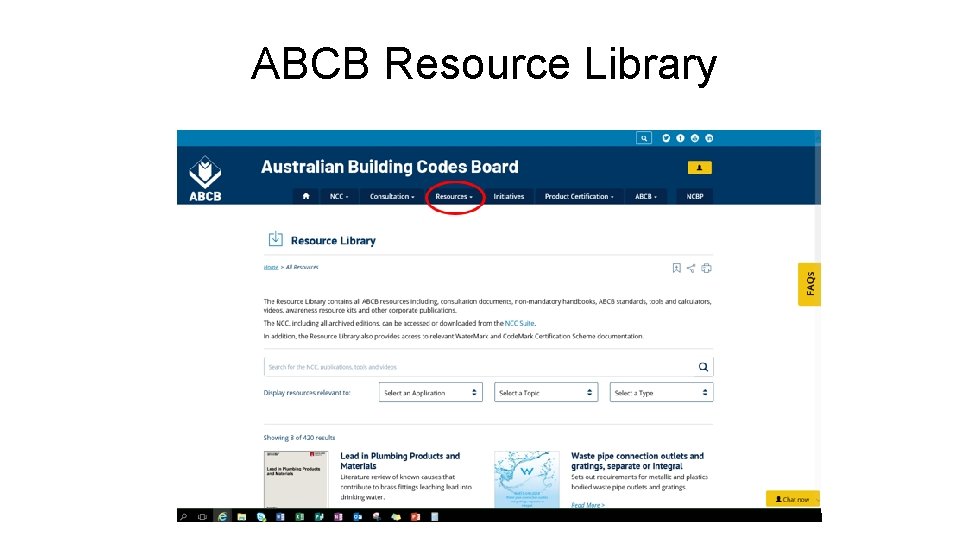
ABCB Resource Library
The Australian Building Codes Board (ABCB) In this section we cover: • an overview of the Australian Building Codes Board; and • the ABCB’s role and mission.
The ABCB: • is an initiative of COAG in co-operation with the construction industry; • is a COAG standards writing body that is responsible for producing the NCC; • establishes minimum necessary standards for the design and construction of buildings throughout Australia; • consists of Government and Industry representative; and • owns Code. Mark and the Water. Mark Product Certification Schemes.
The ABCB Mission The ABCB’s mission is to address issues relating to: • safety; • health; • amenity; • accessibility; and • sustainability in the design, construction and performance of buildings.
Conclusion Upon completion, you will have acquired: • a basic understanding of the regulatory framework for building and plumbing; • an overview of the NCC; and • an understanding of the ABCB.
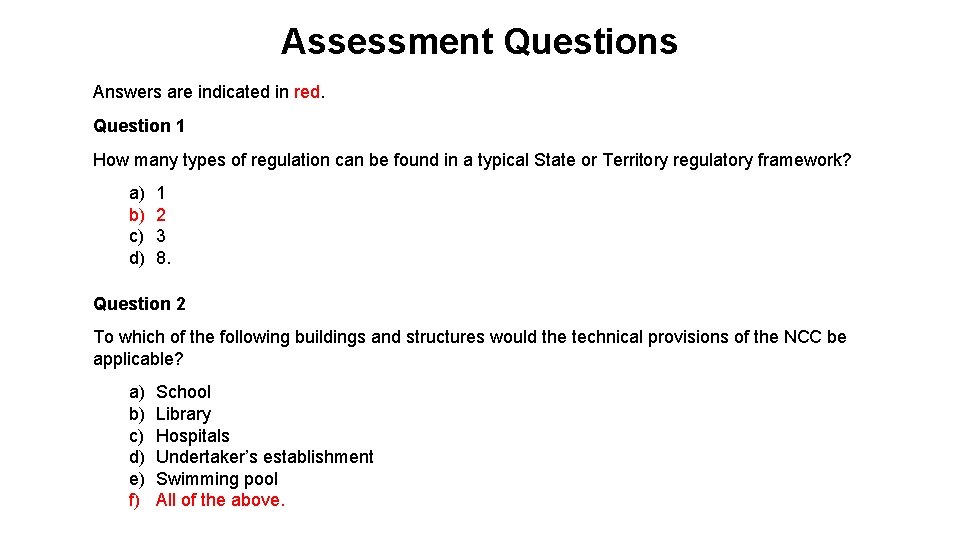
Assessment Questions Answers are indicated in red. Question 1 How many types of regulation can be found in a typical State or Territory regulatory framework? a) b) c) d) 1 2 3 8. Question 2 To which of the following buildings and structures would the technical provisions of the NCC be applicable? a) b) c) d) e) f) School Library Hospitals Undertaker’s establishment Swimming pool All of the above.
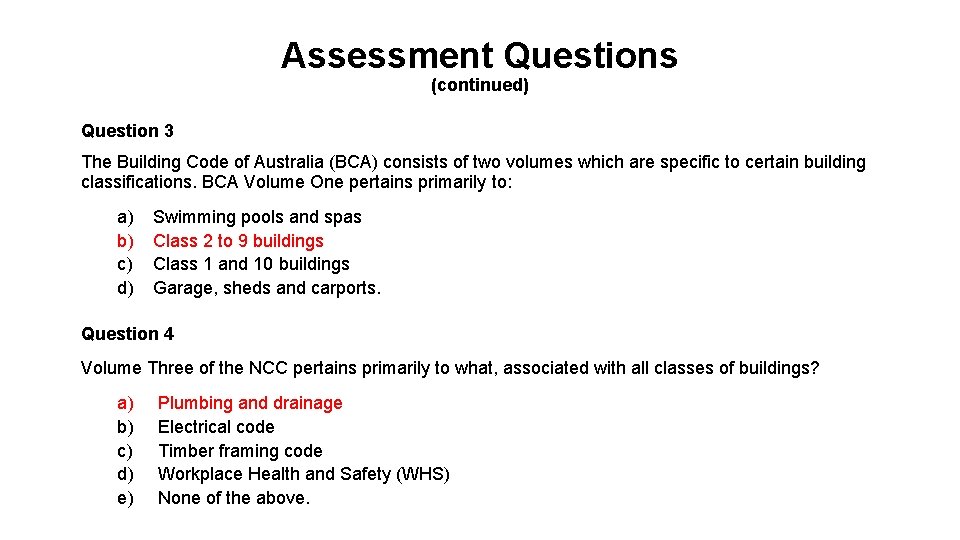
Assessment Questions (continued) Question 3 The Building Code of Australia (BCA) consists of two volumes which are specific to certain building classifications. BCA Volume One pertains primarily to: a) b) c) d) Swimming pools and spas Class 2 to 9 buildings Class 1 and 10 buildings Garage, sheds and carports. Question 4 Volume Three of the NCC pertains primarily to what, associated with all classes of buildings? a) b) c) d) e) Plumbing and drainage Electrical code Timber framing code Workplace Health and Safety (WHS) None of the above.
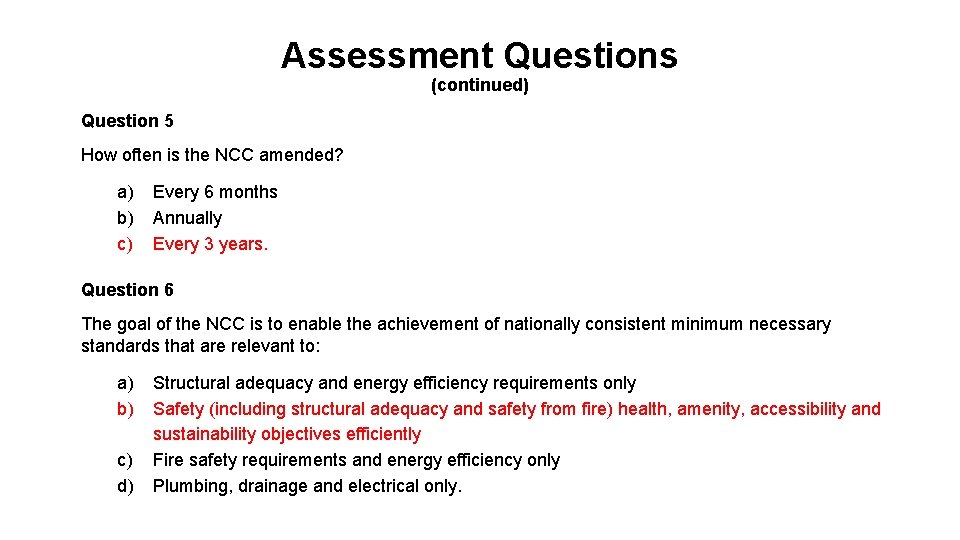
Assessment Questions (continued) Question 5 How often is the NCC amended? a) b) c) Every 6 months Annually Every 3 years. Question 6 The goal of the NCC is to enable the achievement of nationally consistent minimum necessary standards that are relevant to: a) b) c) d) Structural adequacy and energy efficiency requirements only Safety (including structural adequacy and safety from fire) health, amenity, accessibility and sustainability objectives efficiently Fire safety requirements and energy efficiency only Plumbing, drainage and electrical only.
Assessment Questions (continued) Question 7 True or false? The purpose of the Guide to Volume One is to act as a reference for people seeking clarification and a valuable aid for what are sometimes complex BCA provisions. a) True b) False Question 8 True or false? The NCC Volumes are all performance-based documents. a) True b) False.
Assessment Questions (continued) Question 9 True or false? The NCC is given legal effect via adoption in the relevant legislation in each state or territory, which empowers the regulation of certain aspects of buildings and structures, plumbing and drainage. a) True b) False. Question 10 True or false? Performance-based building codes set mandatory levels of performance. a) True b) False.
Assessment Questions (continued) Question 11 The ABCB develops handbooks which address topics that are considered unsuitable for regulation through the NCC. Handbooks are: a) Mandatory b) Non-mandatory. Question 12 The design and construction of buildings are regulated to: a) b) c) d) Mitigate risk of life Address health and amenity issues such as dampness, light and ventilation Promote sustainable development All of the above.
Copyright, Attribution & Disclaimer Copyright © Commonwealth of Australia and the States and Territories of Australia 2020, published by the Australian Building Codes Board. The material in this publication is licensed under a Creative Commons Attribution— 4. 0 International licence, with the exception of: any third party material, any trademarks, and any images or photographs. More information on this CC BY licence is set out at the Creative Commons Website. Enquiries about this publication can be sent to: Australian Building Codes Board , GPO Box 2013, CANBERRA ACT 2601. Phone: 1300 134 631, Email: ncc@abcb. gov. au www. abcb. gov. au. Attribution Use of all or part of this publication must include the following attribution: © Commonwealth of Australia and the States and Territories 2020, published by the Australian Building Codes Board. Disclaimer By accessing or using this publication, you agree to the following: While care has been taken in the preparation of this publication, it may not be complete or up-to-date. You can ensure that you are using a complete and upto-date version by checking the Australian Building Codes Board website (www. abcb. gov. au). The Australian Building Codes Board, the Commonwealth of Australia and States and Territories of Australia do not accept any liability, including liability for negligence, for any loss (howsoever caused), damage, injury, expense or cost incurred by any person as a result of accessing, using or relying upon this publication, to the maximum extent permitted by law. No representation or warranty is made or given as to the currency, accuracy, reliability, merchantability, fitness for any purpose or completeness of this publication or any information which may appear on any linked websites, or in other linked information sources, and all such representations and warranties are excluded to the extent permitted by law. This publication is not legal or professional advice. Persons rely upon this publication entirely at their own risk and must take responsibility for assessing the relevance and accuracy of the information in relation to their particular circumstances.
- Slides: 40