
THE AUSTRALIAN NATIONAL UNIVERSITY OPTIMUM ARRAY DESIGN FOR


- Slides: 26
THE AUSTRALIAN NATIONAL UNIVERSITY OPTIMUM ARRAY DESIGN FOR THE DETECTION OF DISTANT ATMOSPHERIC EXPLOSIONS: INFLUENCE OF THE SPATIAL CORRELATION OF INFRASONIC SIGNALS Douglas R. Christie Research School of Earth Sciences The Australian National University Canberra, ACT 0200 Australia Infrasound Technology Workshop, 13 -16 November 2007, Tokyo, Japan
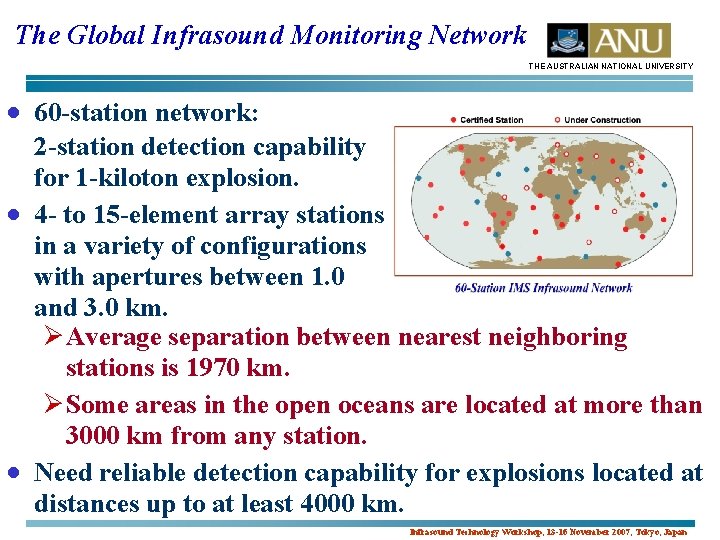
The Global Infrasound Monitoring Network THE AUSTRALIAN NATIONAL UNIVERSITY · 60 -station network: 2 -station detection capability for 1 -kiloton explosion. · 4 - to 15 -element array stations in a variety of configurations with apertures between 1. 0 and 3. 0 km. ØAverage separation between nearest neighboring stations is 1970 km. ØSome areas in the open oceans are located at more than 3000 km from any station. · Need reliable detection capability for explosions located at distances up to at least 4000 km. Infrasound Technology Workshop, 13 -16 November 2007, Tokyo, Japan
Reliable Detection of Infrasound from Regional and Distant Explosions THE AUSTRALIAN NATIONAL UNIVERSITY Monitoring Passbands: a) Primary monitoring passband: 0. 4 to 1. 5 Hz. b) Long-period passband: 0. 05 to 0. 12 Hz. Required for detection of signals from distant explosions when wave propagation is restricted to a thermospheric waveguide. Potential Array Problems: a) Spatial aliasing of higher frequency signals. b) Signal correlation between array elements. Significant problem at higher frequencies. Automatic detection of infrasonic waves is usually based on correlation techniques. Infrasound Technology Workshop, 13 -16 November 2007, Tokyo, Japan
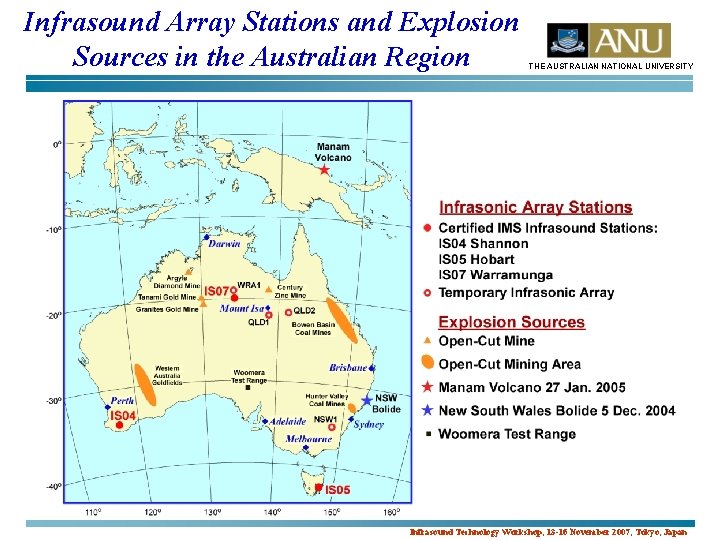
Spatial Correlation of Signals from Atmospheric Explosions: Data THE AUSTRALIAN NATIONAL UNIVERSITY Infrasonic signal data used in this investigation was recorded at IMS stations IS 04, IS 05 and IS 07 located in Australia. Observations include signals from: ØA very large number of open-cut mining explosions located at a variety of azimuths and distances ranging from 300 km to more than 2000 km; Ø Volcanic explosions; Ø Large bolide explosions; Ø Test chemical explosions at the Woomera Test Range. Infrasound Technology Workshop, 13 -16 November 2007, Tokyo, Japan
Infrasound Array Stations and Explosion Sources in the Australian Region THE AUSTRALIAN NATIONAL UNIVERSITY Infrasound Technology Workshop, 13 -16 November 2007, Tokyo, Japan
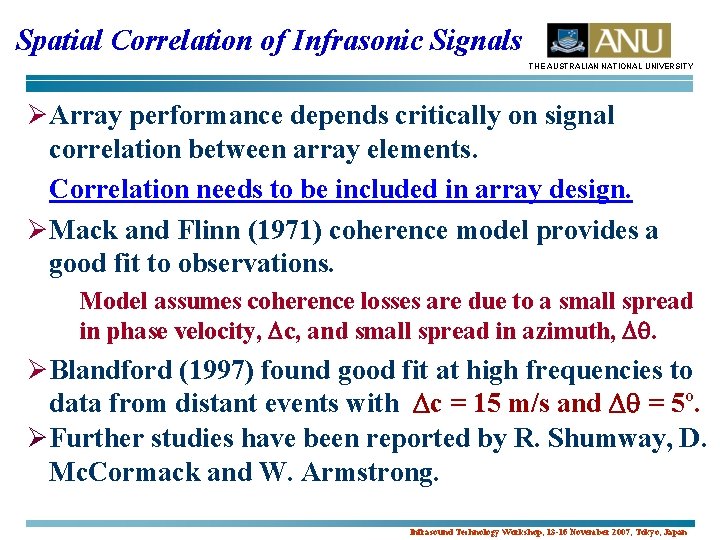
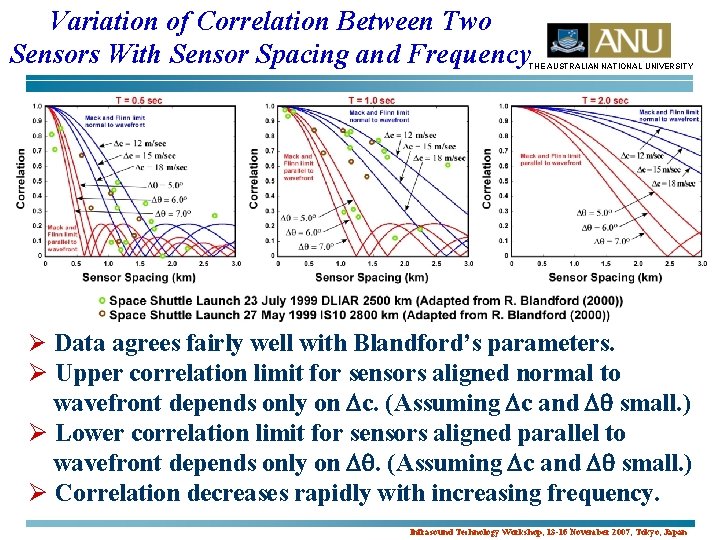
Spatial Correlation of Infrasonic Signals THE AUSTRALIAN NATIONAL UNIVERSITY Ø Array performance depends critically on signal correlation between array elements. Correlation needs to be included in array design. Ø Mack and Flinn (1971) coherence model provides a good fit to observations. Model assumes coherence losses are due to a small spread in phase velocity, c, and small spread in azimuth, . Ø Blandford (1997) found good fit at high frequencies to data from distant events with c = 15 m/s and = 5º. Ø Further studies have been reported by R. Shumway, D. Mc. Cormack and W. Armstrong. Infrasound Technology Workshop, 13 -16 November 2007, Tokyo, Japan
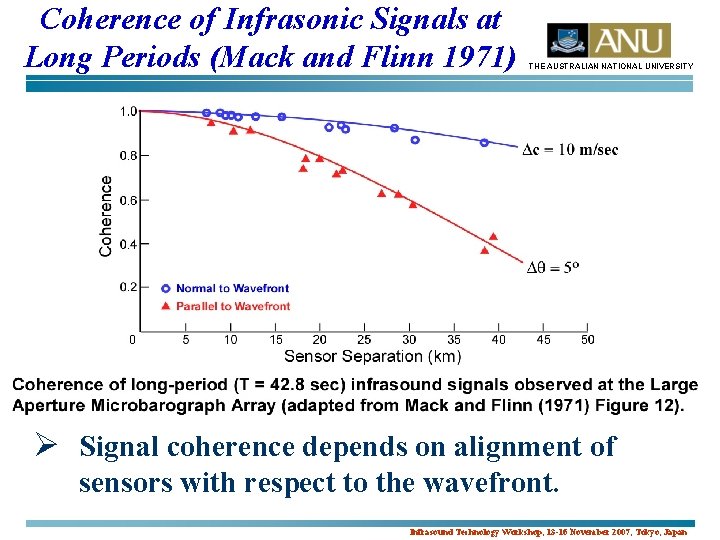
Coherence of Infrasonic Signals at Long Periods (Mack and Flinn 1971) THE AUSTRALIAN NATIONAL UNIVERSITY Ø Signal coherence depends on alignment of sensors with respect to the wavefront. Infrasound Technology Workshop, 13 -16 November 2007, Tokyo, Japan
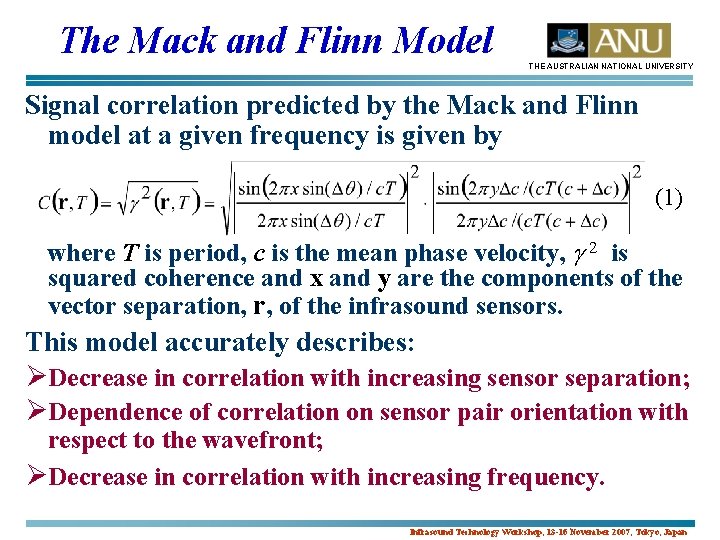
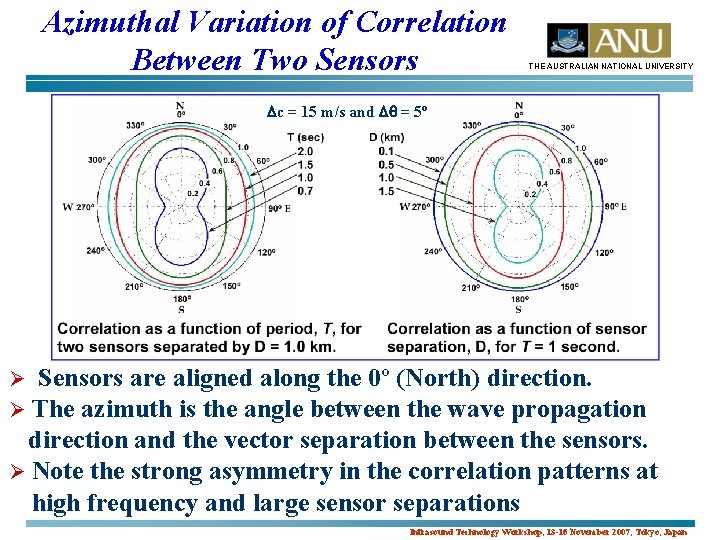
The Mack and Flinn Model THE AUSTRALIAN NATIONAL UNIVERSITY Signal correlation predicted by the Mack and Flinn model at a given frequency is given by (1) where T is period, c is the mean phase velocity, 2 is squared coherence and x and y are the components of the vector separation, r, of the infrasound sensors. This model accurately describes: ØDecrease in correlation with increasing sensor separation; ØDependence of correlation on sensor pair orientation with respect to the wavefront; ØDecrease in correlation with increasing frequency. Infrasound Technology Workshop, 13 -16 November 2007, Tokyo, Japan
Variation of Correlation Between Two Sensors With Sensor Spacing and Frequency THE AUSTRALIAN NATIONAL UNIVERSITY Ø Data agrees fairly well with Blandford’s parameters. Ø Upper correlation limit for sensors aligned normal to wavefront depends only on c. (Assuming c and small. ) Ø Lower correlation limit for sensors aligned parallel to wavefront depends only on . (Assuming c and small. ) Ø Correlation decreases rapidly with increasing frequency. Infrasound Technology Workshop, 13 -16 November 2007, Tokyo, Japan
Azimuthal Variation of Correlation Between Two Sensors THE AUSTRALIAN NATIONAL UNIVERSITY c = 15 m/s and = 5º Ø Sensors are aligned along the 0º (North) direction. Ø The azimuth is the angle between the wave propagation direction and the vector separation between the sensors. Ø Note the strong asymmetry in the correlation patterns at high frequency and large sensor separations Infrasound Technology Workshop, 13 -16 November 2007, Tokyo, Japan
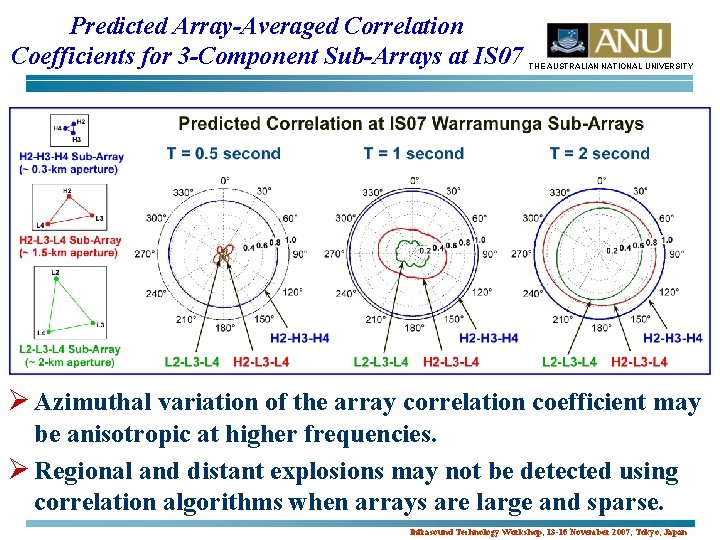
Array-Averaged Correlation Coefficients THE AUSTRALIAN NATIONAL UNIVERSITY Ø The Mack and Flinn model can be used to calculate the azimuthal variation of the array-averaged correlation coefficient for any array configuration. Ø The use of the predicted array-averaged correlation coefficient has a number of advantages: • The array-averaged correlation coefficient provides a robust statistic for the direct comparison of model predictions with correlation observations for waves from any direction. • The predicted azimuthal variation of the array-averaged correlation coefficient provides a unique array characteristic that can be used as a measure of array performance. Provides a measure of both azimuthal asymmetry and overall loss of signal correlation. Infrasound Technology Workshop, 13 -16 November 2007, Tokyo, Japan
Array-Averaged Correlation Coefficients Predicted by the Mack and Flinn Model THE AUSTRALIAN NATIONAL UNIVERSITY Procedure: 1. Compute azimuthal variation of the correlation coefficient at a given frequency for each sensor pair in the array. 2. Rotate each of these distributions to the correct pair alignment in a common geographical coordinate system. 3. Average contributions from all sensor pairs to give the angular distribution of the array-averaged correlation coefficient for all wave back-azimuths. Calculation has been carried out for a variety of arrays including representative 8 -element IMS arrays. Infrasound Technology Workshop, 13 -16 November 2007, Tokyo, Japan
Predicted Array-Averaged Correlation Coefficients for 3 -Component Sub-Arrays at IS 07 THE AUSTRALIAN NATIONAL UNIVERSITY Ø Azimuthal variation of the array correlation coefficient may be anisotropic at higher frequencies. Ø Regional and distant explosions may not be detected using correlation algorithms when arrays are large and sparse. Infrasound Technology Workshop, 13 -16 November 2007, Tokyo, Japan
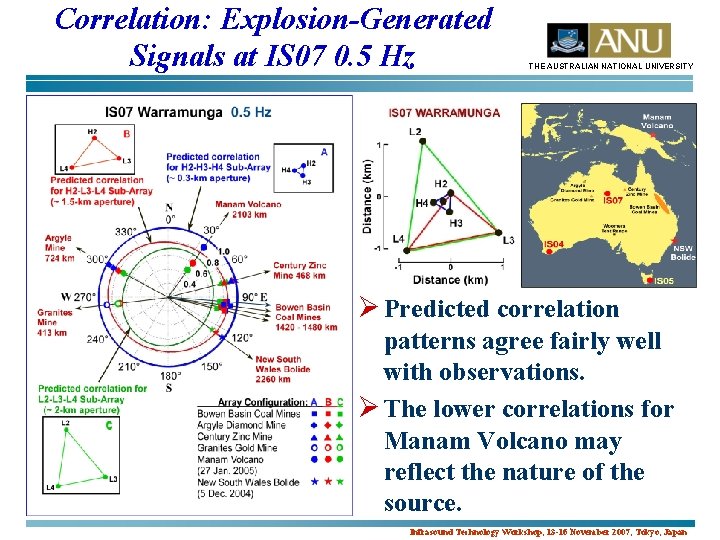
Correlation: Explosion-Generated Signals at IS 07 0. 5 Hz THE AUSTRALIAN NATIONAL UNIVERSITY Ø Predicted correlation patterns agree fairly well with observations. Ø The lower correlations for Manam Volcano may reflect the nature of the source. Infrasound Technology Workshop, 13 -16 November 2007, Tokyo, Japan
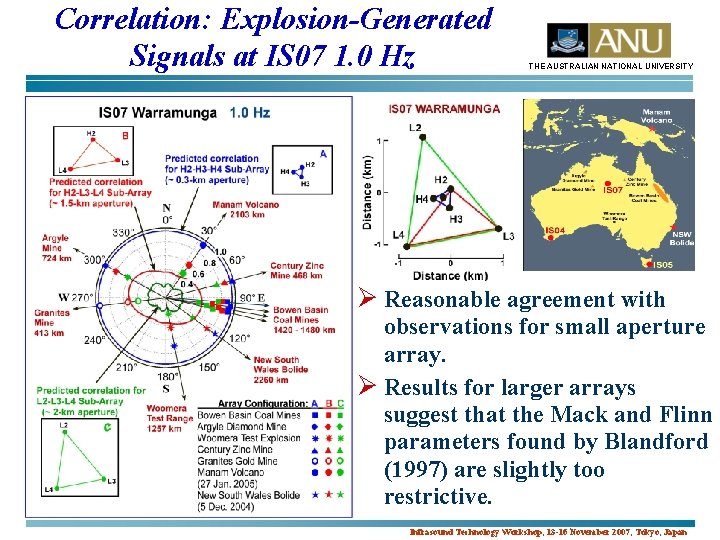
Correlation: Explosion-Generated Signals at IS 07 1. 0 Hz THE AUSTRALIAN NATIONAL UNIVERSITY Ø Reasonable agreement with observations for small aperture array. Ø Results for larger arrays suggest that the Mack and Flinn parameters found by Blandford (1997) are slightly too restrictive. Infrasound Technology Workshop, 13 -16 November 2007, Tokyo, Japan
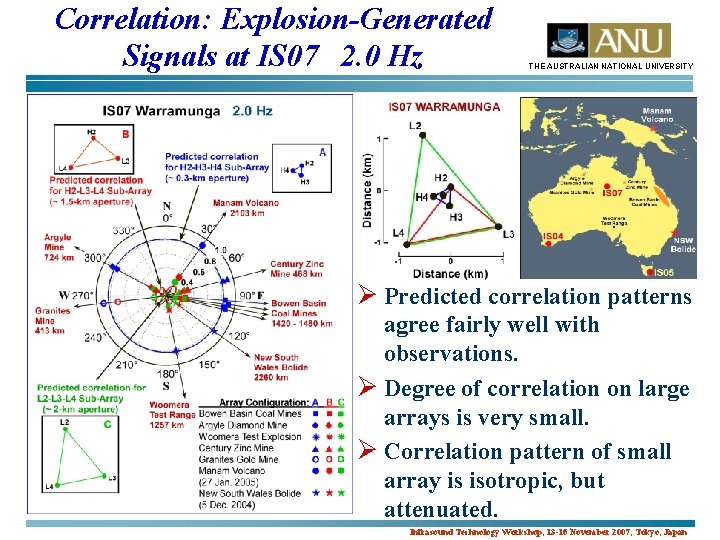
Correlation: Explosion-Generated Signals at IS 07 2. 0 Hz THE AUSTRALIAN NATIONAL UNIVERSITY Ø Predicted correlation patterns agree fairly well with observations. Ø Degree of correlation on large arrays is very small. Ø Correlation pattern of small array is isotropic, but attenuated. Infrasound Technology Workshop, 13 -16 November 2007, Tokyo, Japan
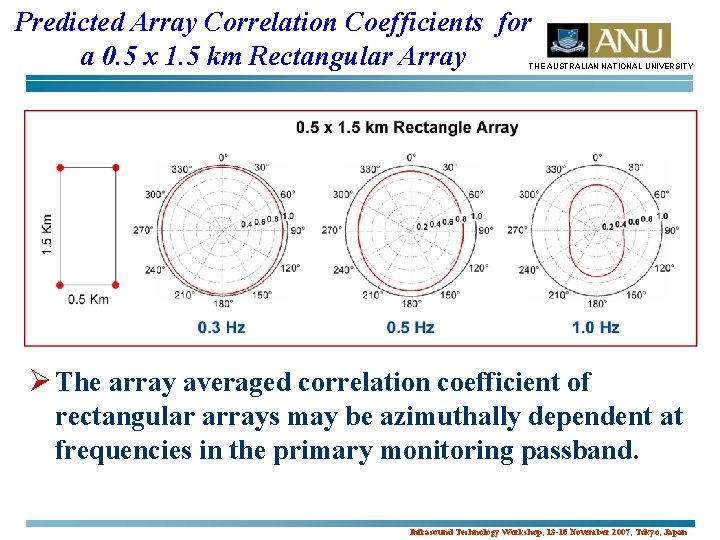
Predicted Array Correlation Coefficients for a 0. 5 x 1. 5 km Rectangular Array THE AUSTRALIAN NATIONAL UNIVERSITY Ø The array averaged correlation coefficient of rectangular arrays may be azimuthally dependent at frequencies in the primary monitoring passband. Infrasound Technology Workshop, 13 -16 November 2007, Tokyo, Japan
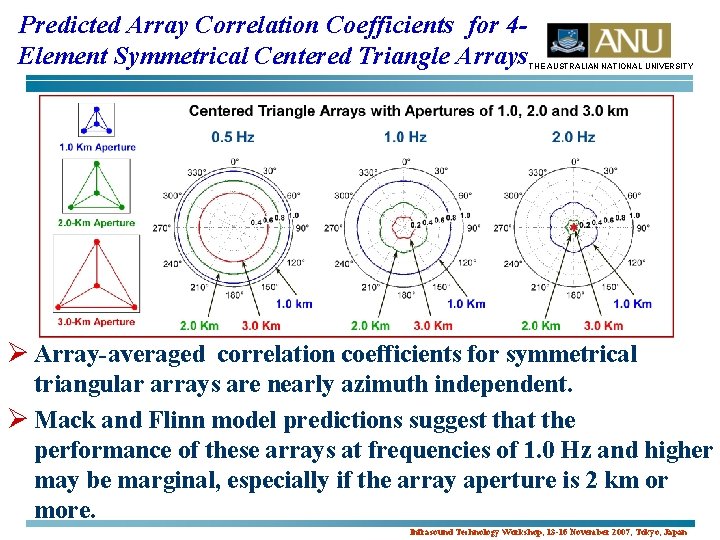
Predicted Array Correlation Coefficients for 4 Element Symmetrical Centered Triangle Arrays THE AUSTRALIAN NATIONAL UNIVERSITY Ø Array-averaged correlation coefficients for symmetrical triangular arrays are nearly azimuth independent. Ø Mack and Flinn model predictions suggest that the performance of these arrays at frequencies of 1. 0 Hz and higher may be marginal, especially if the array aperture is 2 km or more. Infrasound Technology Workshop, 13 -16 November 2007, Tokyo, Japan
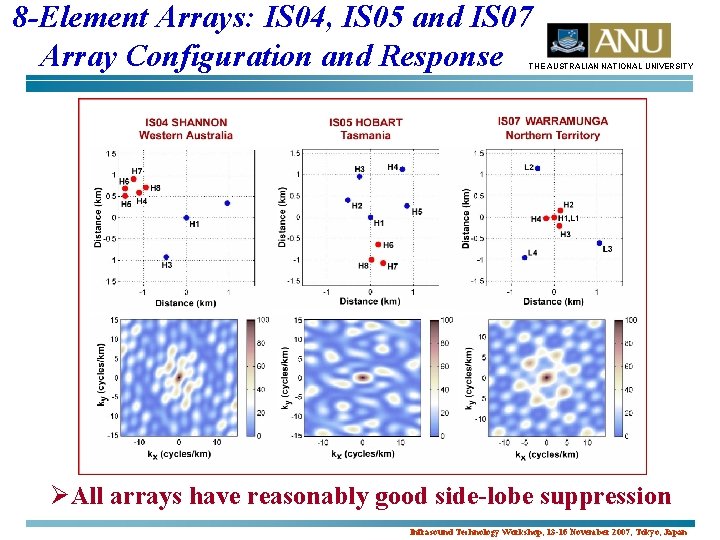
8 -Element Arrays: IS 04, IS 05 and IS 07 Array Configuration and Response THE AUSTRALIAN NATIONAL UNIVERSITY ØAll arrays have reasonably good side-lobe suppression Infrasound Technology Workshop, 13 -16 November 2007, Tokyo, Japan
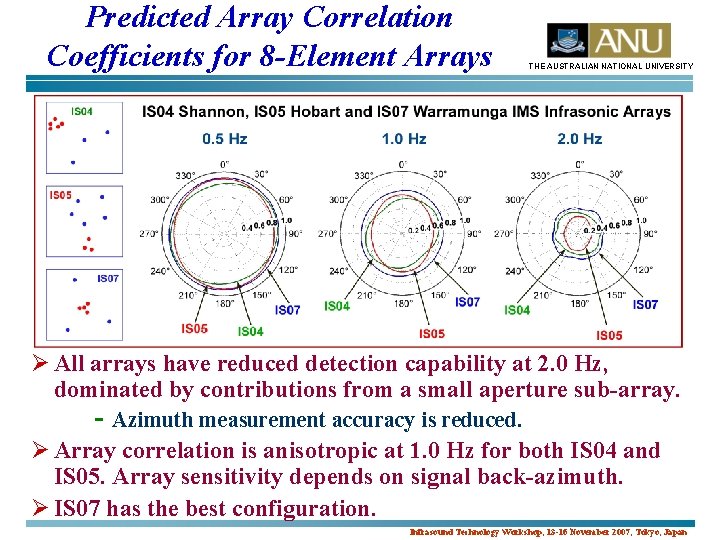
Predicted Array Correlation Coefficients for 8 -Element Arrays THE AUSTRALIAN NATIONAL UNIVERSITY Ø All arrays have reduced detection capability at 2. 0 Hz, dominated by contributions from a small aperture sub-array. - Azimuth measurement accuracy is reduced. Ø Array correlation is anisotropic at 1. 0 Hz for both IS 04 and IS 05. Array sensitivity depends on signal back-azimuth. Ø IS 07 has the best configuration. Infrasound Technology Workshop, 13 -16 November 2007, Tokyo, Japan
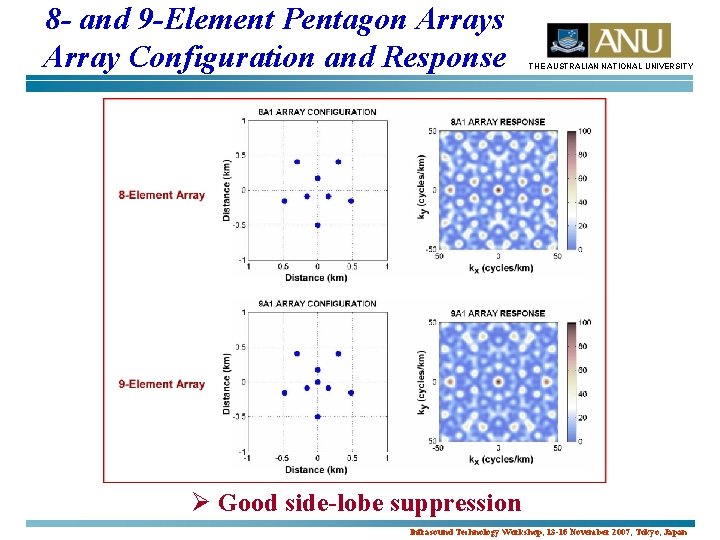
8 - and 9 -Element Pentagon Arrays Array Configuration and Response THE AUSTRALIAN NATIONAL UNIVERSITY Ø Good side-lobe suppression Infrasound Technology Workshop, 13 -16 November 2007, Tokyo, Japan
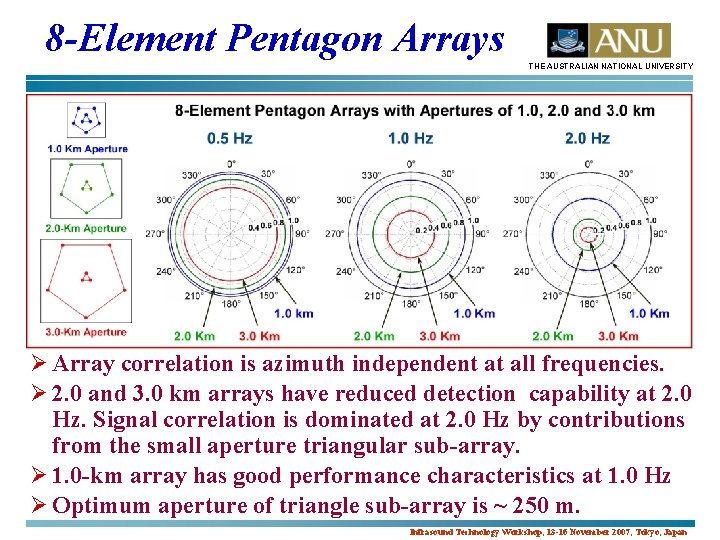
8 -Element Pentagon Arrays THE AUSTRALIAN NATIONAL UNIVERSITY Ø Array correlation is azimuth independent at all frequencies. Ø 2. 0 and 3. 0 km arrays have reduced detection capability at 2. 0 Hz. Signal correlation is dominated at 2. 0 Hz by contributions from the small aperture triangular sub-array. Ø 1. 0 -km array has good performance characteristics at 1. 0 Hz Ø Optimum aperture of triangle sub-array is ~ 250 m. Infrasound Technology Workshop, 13 -16 November 2007, Tokyo, Japan
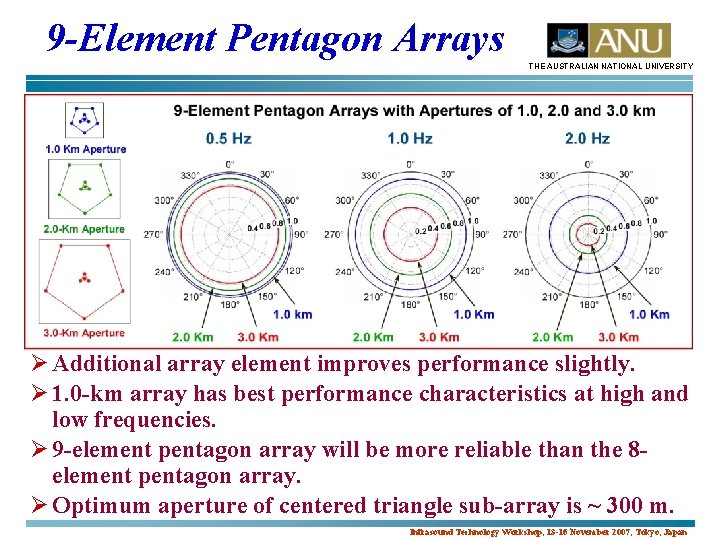
9 -Element Pentagon Arrays THE AUSTRALIAN NATIONAL UNIVERSITY Ø Additional array element improves performance slightly. Ø 1. 0 -km array has best performance characteristics at high and low frequencies. Ø 9 -element pentagon array will be more reliable than the 8 element pentagon array. Ø Optimum aperture of centered triangle sub-array is ~ 300 m. Infrasound Technology Workshop, 13 -16 November 2007, Tokyo, Japan
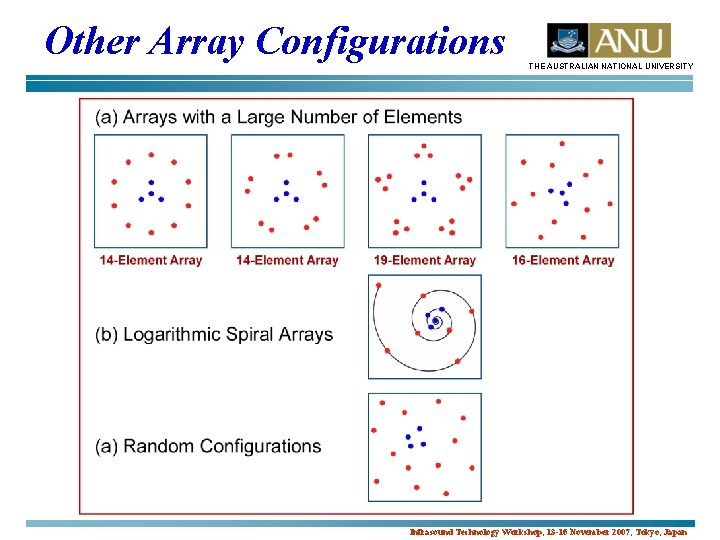
Other Array Configurations THE AUSTRALIAN NATIONAL UNIVERSITY Infrasound Technology Workshop, 13 -16 November 2007, Tokyo, Japan
Conclusions THE AUSTRALIAN NATIONAL UNIVERSITY Ø Observations are in good general agreement with the predictions of the Mack and Flinn coherence model. Ø Arrays with good side-lobe suppression do not necessarily have good signal correlation properties. Ø Array-averaged correlation coefficient may exhibit significant azimuthal variation at frequencies in the monitoring passband. Arrays should be designed to be isotropic. Ø 8 -element and 9 -element pentagon arrays with an aperture of 1 km have good performance characteristics at 1. 0 Hz. Triangle sub-array in 8 -element arrays should have an aperture of about 250 m. Centered triangle in 9 -element arrays should have an aperture of about 300 m. Infrasound Technology Workshop, 13 -16 November 2007, Tokyo, Japan
THE AUSTRALIAN NATIONAL UNIVERSITY Infrasound Technology Workshop, 13 -16 November 2007, Tokyo, Japan