
The Australian Energy Regulator Todays agenda Presentations from
- Slides: 23
The Australian Energy Regulator
Today’s agenda Presentations from: ◦ AER – Chris Pattas, General Manager – Networks ◦ Consumer challenge panel – Ruth Lavery and Hugh Grant ◦ Trans. Grid – Peter Mc. Intyre, Managing Director Time for questions at the end of presentations Close at 2. 30 pm Short recess until presentations on Jemena Gas Networks start at 3. 00 pm 2
The Australian Energy Regulator
About our draft decision: context and framework Changes to the National Electricity ◦ National Electricity Objective ◦ Revenue and pricing principles ◦ A greater role for consumers Consumer engagement Consumer challenge panel Law and Rules in 2012 Our 2013 Better Regulation Program ◦ New guidelines setting out our approach 4
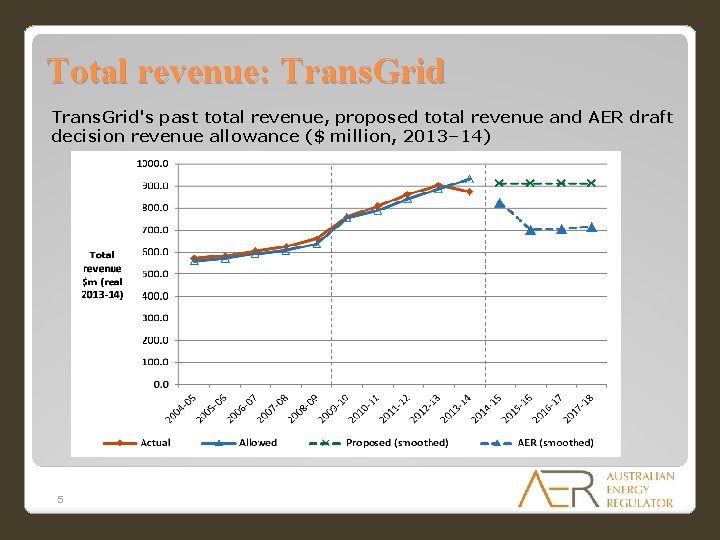
Total revenue: Trans. Grid's past total revenue, proposed total revenue and AER draft decision revenue allowance ($ million, 2013– 14) 5
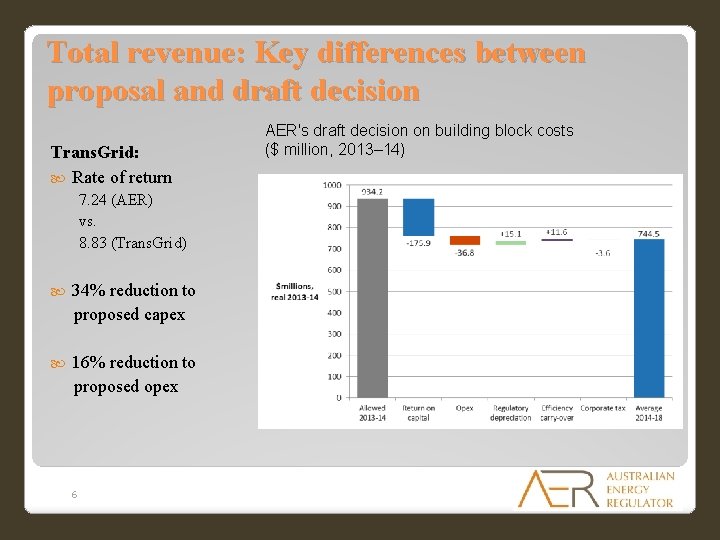
Total revenue: Key differences between proposal and draft decision Trans. Grid: Rate of return 7. 24 (AER) vs. 8. 83 (Trans. Grid) 34% reduction to proposed capex 16% reduction to proposed opex 6 AER's draft decision on building block costs ($ million, 2013– 14)
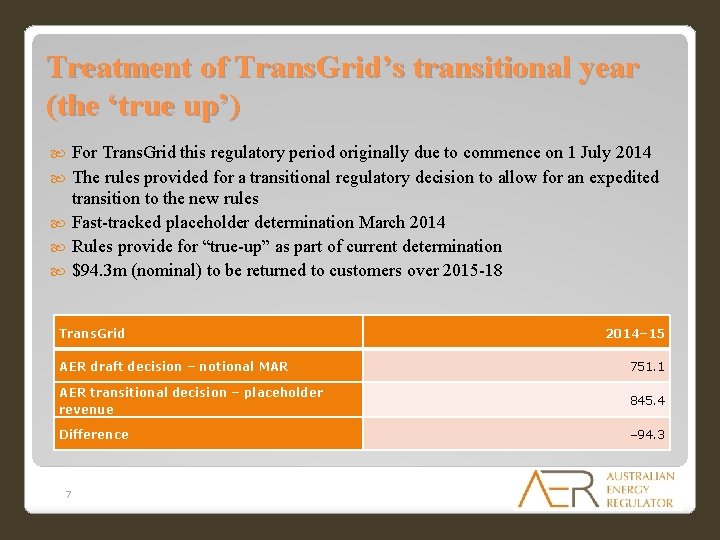
Treatment of Trans. Grid’s transitional year (the ‘true up’) For Trans. Grid this regulatory period originally due to commence on 1 July 2014 The rules provided for a transitional regulatory decision to allow for an expedited transition to the new rules Fast-tracked placeholder determination March 2014 Rules provide for “true-up” as part of current determination $94. 3 m (nominal) to be returned to customers over 2015 -18 Trans. Grid 2014– 15 AER draft decision – notional MAR 751. 1 AER transitional decision – placeholder revenue 845. 4 Difference – 94. 3 7
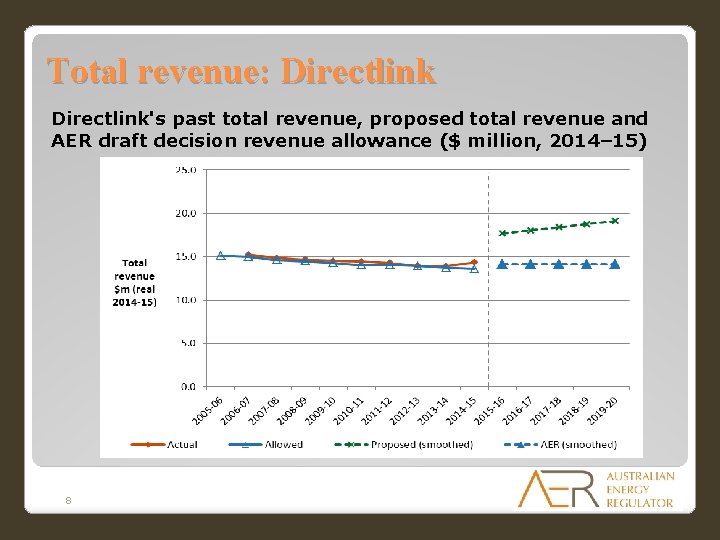
Total revenue: Directlink's past total revenue, proposed total revenue and AER draft decision revenue allowance ($ million, 2014– 15) 8
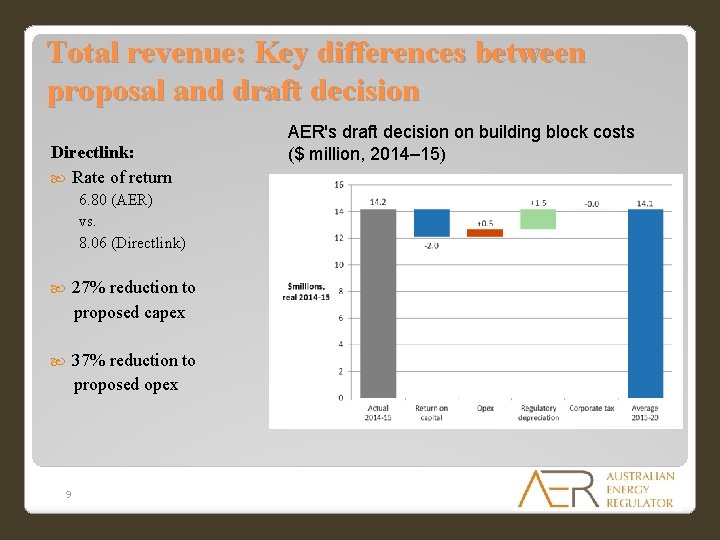
Total revenue: Key differences between proposal and draft decision Directlink: Rate of return 6. 80 (AER) vs. 8. 06 (Directlink) 27% reduction to proposed capex 37% reduction to proposed opex 9 AER's draft decision on building block costs ($ million, 2014– 15)
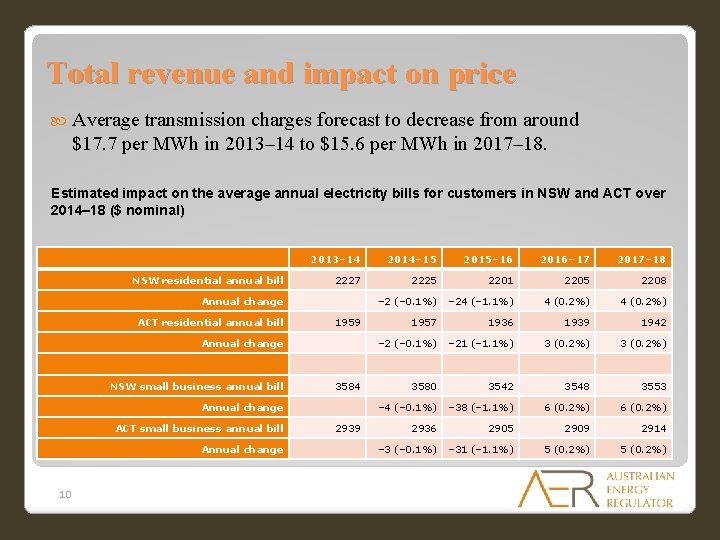
Total revenue and impact on price Average transmission charges forecast to decrease from around $17. 7 per MWh in 2013– 14 to $15. 6 per MWh in 2017– 18. Estimated impact on the average annual electricity bills for customers in NSW and ACT over 2014– 18 ($ nominal) NSW residential annual bill 2013– 14 2014– 15 2015– 16 2016– 17 2017– 18 2227 2225 2201 2205 2208 – 2 (– 0. 1%) – 24 (– 1. 1%) 4 (0. 2%) 1957 1936 1939 1942 – 2 (– 0. 1%) – 21 (– 1. 1%) 3 (0. 2%) 3580 3542 3548 3553 – 4 (– 0. 1%) – 38 (– 1. 1%) 6 (0. 2%) 2936 2905 2909 2914 – 3 (– 0. 1%) – 31 (– 1. 1%) 5 (0. 2%) Annual change ACT residential annual bill 1959 Annual change NSW small business annual bill 3584 Annual change ACT small business annual bill Annual change 10 2939
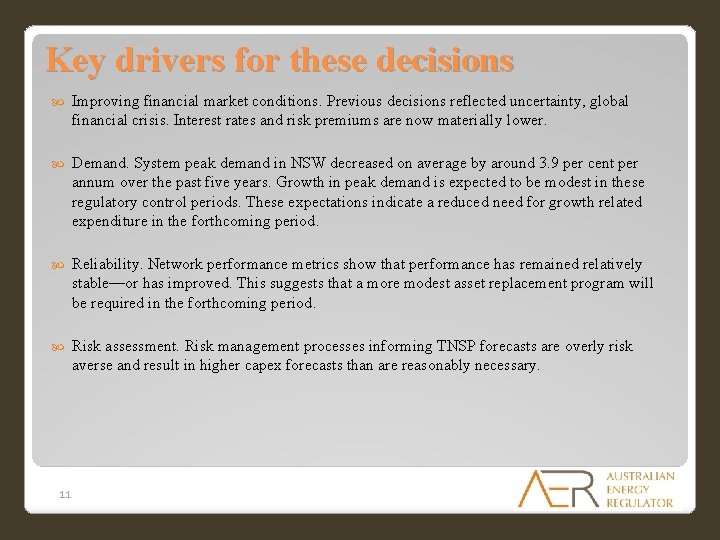
Key drivers for these decisions Improving financial market conditions. Previous decisions reflected uncertainty, global financial crisis. Interest rates and risk premiums are now materially lower. Demand. System peak demand in NSW decreased on average by around 3. 9 per cent per annum over the past five years. Growth in peak demand is expected to be modest in these regulatory control periods. These expectations indicate a reduced need for growth related expenditure in the forthcoming period. Reliability. Network performance metrics show that performance has remained relatively stable—or has improved. This suggests that a more modest asset replacement program will be required in the forthcoming period. Risk assessment. Risk management processes informing TNSP forecasts are overly risk averse and result in higher capex forecasts than are reasonably necessary. 11
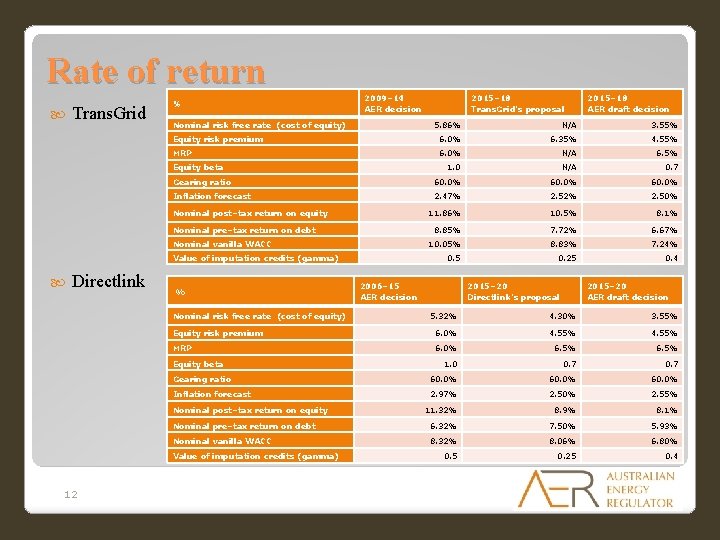
Rate of return Trans. Grid % 2009– 14 AER decision Nominal risk free rate (cost of equity) N/A 3. 55% Equity risk premium 6. 0% 6. 35% 4. 55% MRP 6. 0% N/A 6. 5% 1. 0 N/A 0. 7 Gearing ratio 60. 0% Inflation forecast 2. 47% 2. 52% 2. 50% 11. 86% 10. 5% 8. 1% Nominal post–tax return on equity Nominal pre–tax return on debt Nominal vanilla WACC Value of imputation credits (gamma) Directlink % Nominal risk free rate (cost of equity) 8. 85% 7. 72% 6. 67% 10. 05% 8. 83% 7. 24% 0. 5 0. 25 0. 4 2006– 15 AER decision 2015– 20 Directlink’s proposal 2015– 20 AER draft decision 5. 32% 4. 30% 3. 55% Equity risk premium 6. 0% 4. 55% MRP 6. 0% 6. 5% 1. 0 0. 7 Gearing ratio 60. 0% Inflation forecast 2. 97% 2. 50% 2. 55% 11. 32% 8. 9% 8. 1% Nominal pre–tax return on debt 6. 32% 7. 50% 5. 93% Nominal vanilla WACC 8. 32% 8. 06% 6. 80% 0. 5 0. 25 0. 4 Equity beta Nominal post–tax return on equity Value of imputation credits (gamma) 12 2015– 18 AER draft decision 5. 86% Equity beta 2015– 18 Trans. Grid’s proposal
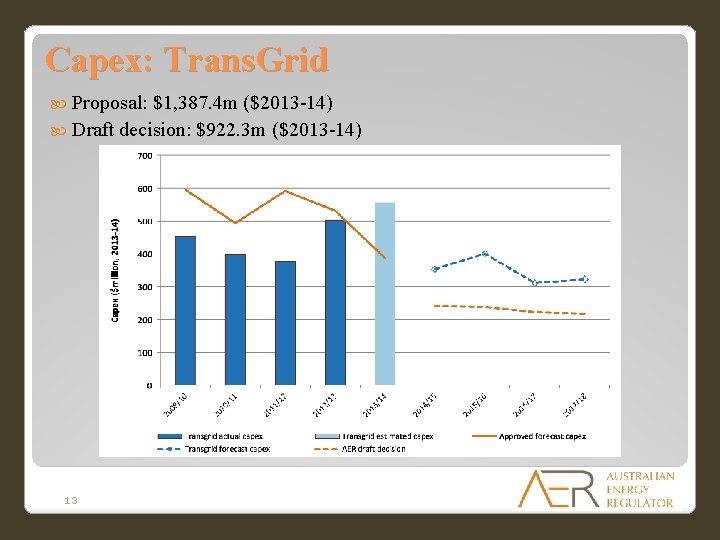
Capex: Trans. Grid Proposal: $1, 387. 4 m ($2013 -14) Draft decision: $922. 3 m ($2013 -14) 13
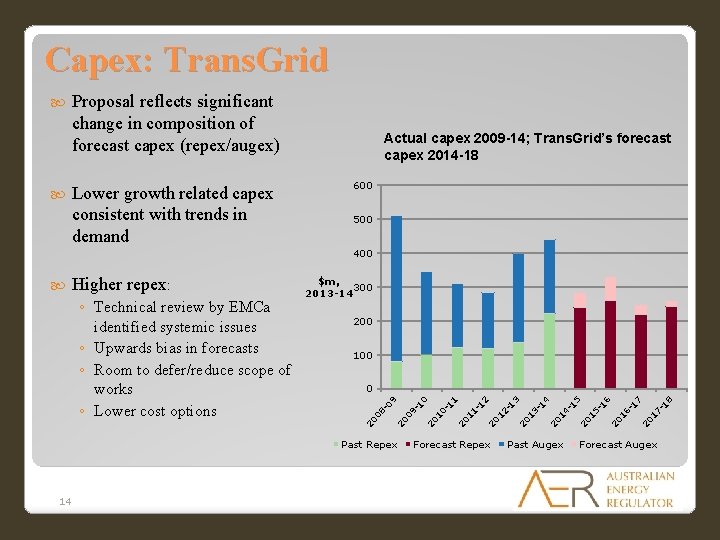
Capex: Trans. Grid Proposal reflects significant change in composition of forecast capex (repex/augex) Lower growth related capex consistent with trends in demand Actual capex 2009 -14; Trans. Grid’s forecast capex 2014 -18 600 500 400 200 14 Forecast Repex 8 17 -1 7 20 16 -1 15 20 -1 14 Past Augex 20 5 4 20 13 -1 3 20 20 12 -1 11 -1 2 1 20 10 -1 09 20 Past Repex 20 9 0 20 ◦ Technical review by EMCa identified systemic issues ◦ Upwards bias in forecasts ◦ Room to defer/reduce scope of works ◦ Lower cost options $m, 300 2013 -14 -0 Higher repex: 08 Forecast Augex
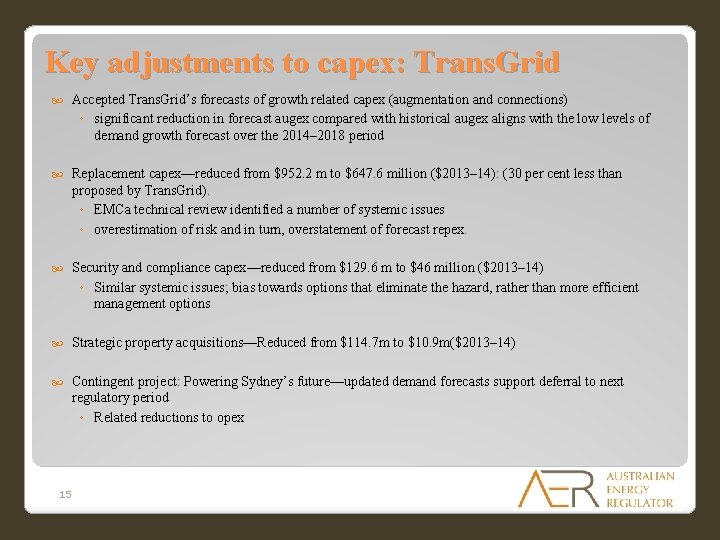
Key adjustments to capex: Trans. Grid Accepted Trans. Grid’s forecasts of growth related capex (augmentation and connections) ◦ significant reduction in forecast augex compared with historical augex aligns with the low levels of demand growth forecast over the 2014– 2018 period Replacement capex—reduced from $952. 2 m to $647. 6 million ($2013– 14): (30 per cent less than proposed by Trans. Grid). ◦ EMCa technical review identified a number of systemic issues ◦ overestimation of risk and in turn, overstatement of forecast repex. Security and compliance capex—reduced from $129. 6 m to $46 million ($2013– 14) ◦ Similar systemic issues; bias towards options that eliminate the hazard, rather than more efficient management options Strategic property acquisitions—Reduced from $114. 7 m to $10. 9 m($2013– 14) Contingent project: Powering Sydney’s future—updated demand forecasts support deferral to next regulatory period ◦ Related reductions to opex 15
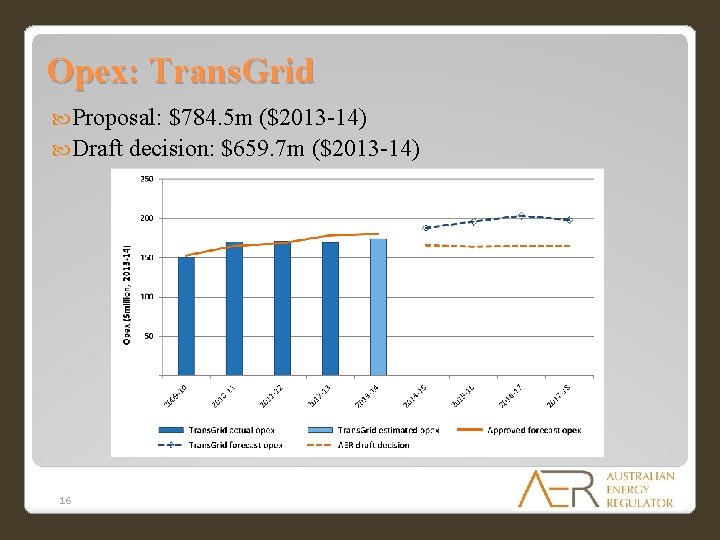
Opex: Trans. Grid Proposal: $784. 5 m ($2013 -14) Draft decision: $659. 7 m ($2013 -14) 16
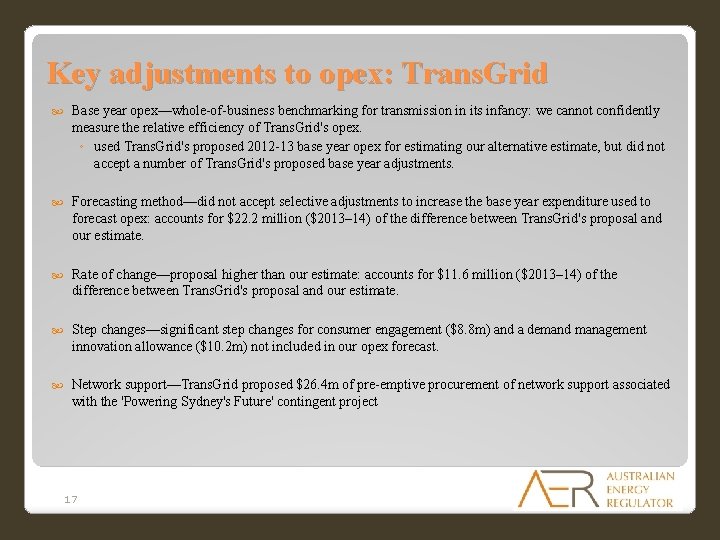
Key adjustments to opex: Trans. Grid Base year opex—whole-of-business benchmarking for transmission in its infancy: we cannot confidently measure the relative efficiency of Trans. Grid's opex. ◦ used Trans. Grid's proposed 2012 -13 base year opex for estimating our alternative estimate, but did not accept a number of Trans. Grid's proposed base year adjustments. Forecasting method—did not accept selective adjustments to increase the base year expenditure used to forecast opex: accounts for $22. 2 million ($2013– 14) of the difference between Trans. Grid's proposal and our estimate. Rate of change—proposal higher than our estimate: accounts for $11. 6 million ($2013– 14) of the difference between Trans. Grid's proposal and our estimate. Step changes—significant step changes for consumer engagement ($8. 8 m) and a demand management innovation allowance ($10. 2 m) not included in our opex forecast. Network support—Trans. Grid proposed $26. 4 m of pre-emptive procurement of network support associated with the 'Powering Sydney's Future' contingent project 17
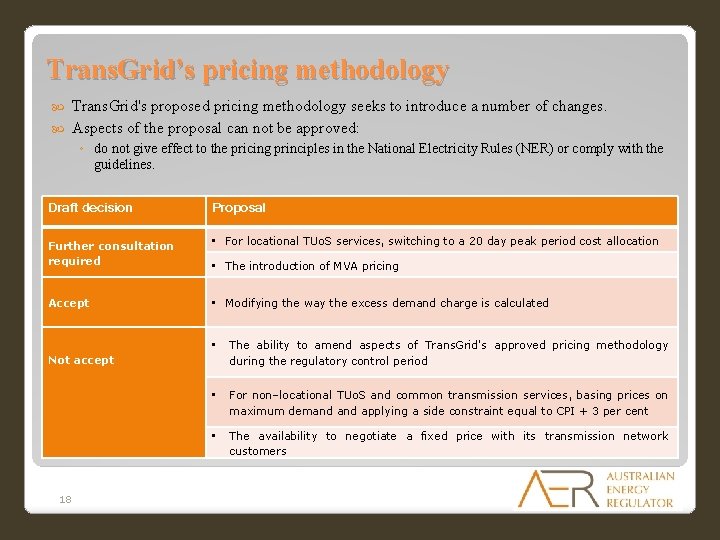
Trans. Grid’s pricing methodology Trans. Grid's proposed pricing methodology seeks to introduce a number of changes. Aspects of the proposal can not be approved: ◦ do not give effect to the pricing principles in the National Electricity Rules (NER) or comply with the guidelines. Draft decision Proposal Further consultation required • For locational TUo. S services, switching to a 20 day peak period cost allocation Accept • Modifying the way the excess demand charge is calculated • The introduction of MVA pricing • The ability to amend aspects of Trans. Grid's approved pricing methodology during the regulatory control period • For non–locational TUo. S and common transmission services, basing prices on maximum demand applying a side constraint equal to CPI + 3 per cent • The availability to negotiate a fixed price with its transmission network customers Not accept 18
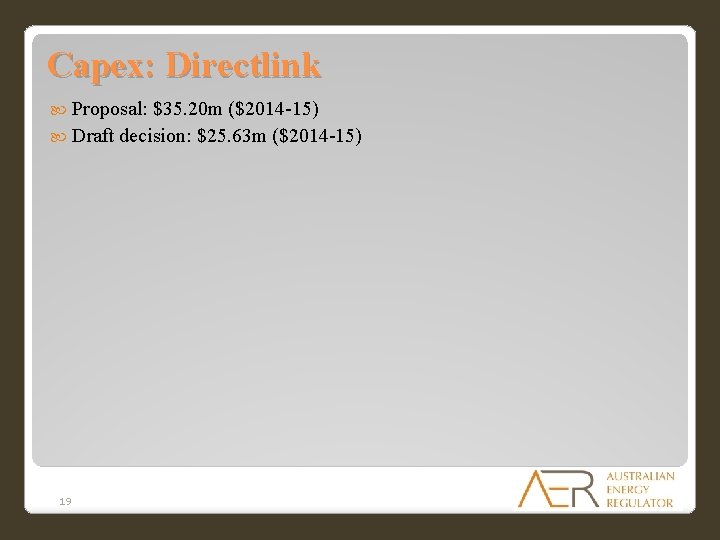
Capex: Directlink Proposal: $35. 20 m ($2014 -15) Draft decision: $25. 63 m ($2014 -15) 19
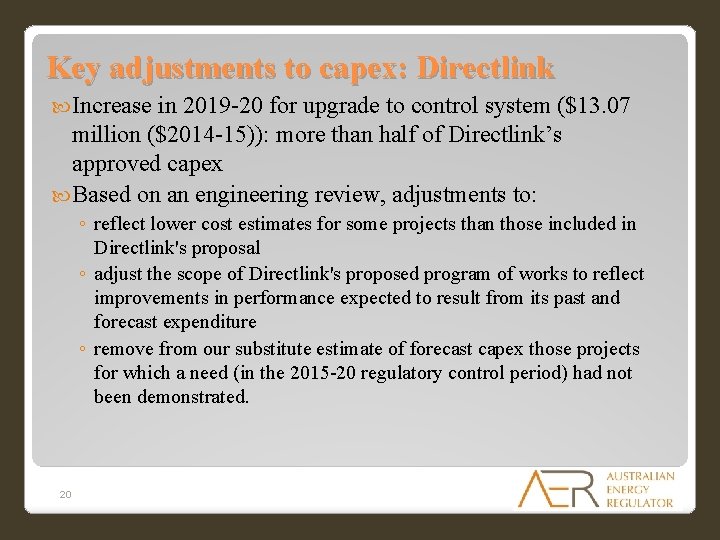
Key adjustments to capex: Directlink Increase in 2019 -20 for upgrade to control system ($13. 07 million ($2014 -15)): more than half of Directlink’s approved capex Based on an engineering review, adjustments to: ◦ reflect lower cost estimates for some projects than those included in Directlink's proposal ◦ adjust the scope of Directlink's proposed program of works to reflect improvements in performance expected to result from its past and forecast expenditure ◦ remove from our substitute estimate of forecast capex those projects for which a need (in the 2015 -20 regulatory control period) had not been demonstrated. 20
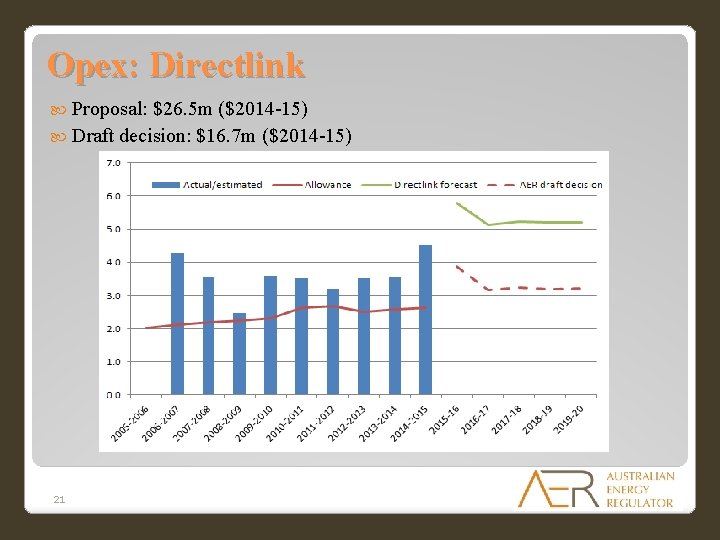
Opex: Directlink Proposal: $26. 5 m ($2014 -15) Draft decision: $16. 7 m ($2014 -15) 21
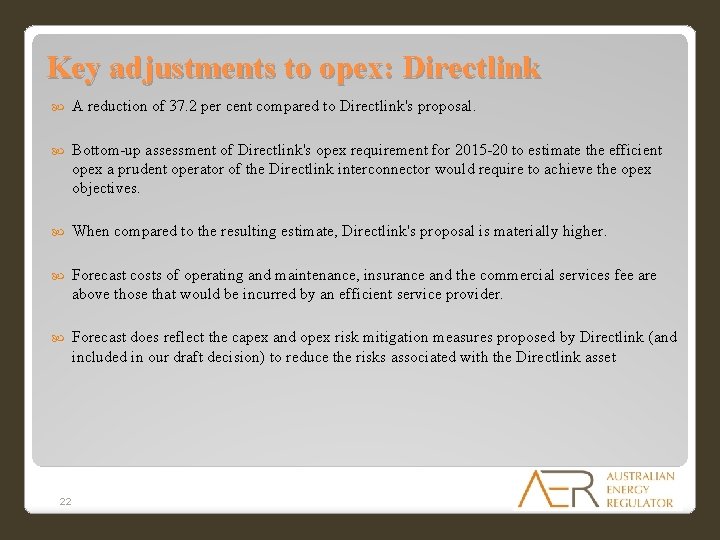
Key adjustments to opex: Directlink A reduction of 37. 2 per cent compared to Directlink's proposal. Bottom-up assessment of Directlink's opex requirement for 2015 -20 to estimate the efficient opex a prudent operator of the Directlink interconnector would require to achieve the opex objectives. When compared to the resulting estimate, Directlink's proposal is materially higher. Forecast costs of operating and maintenance, insurance and the commercial services fee are above those that would be incurred by an efficient service provider. Forecast does reflect the capex and opex risk mitigation measures proposed by Directlink (and included in our draft decision) to reduce the risks associated with the Directlink asset 22
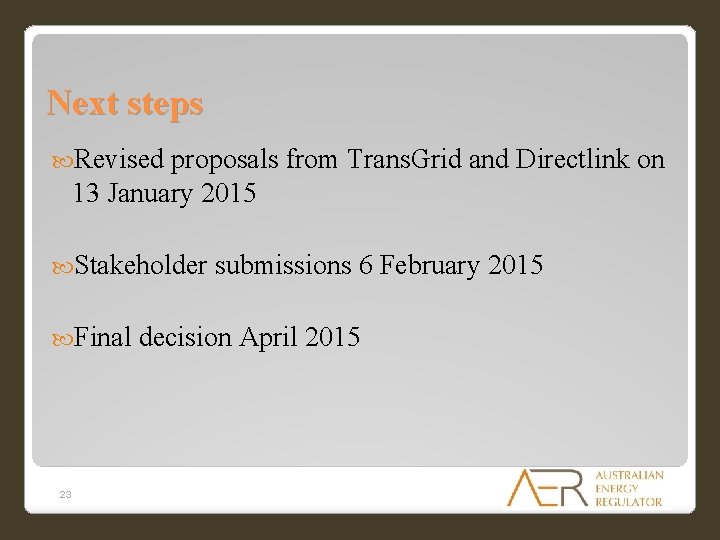
Next steps Revised proposals from Trans. Grid and Directlink on 13 January 2015 Stakeholder Final 23 submissions 6 February 2015 decision April 2015