
The Australian Curriculum Mathematics PRINCIPLES PLANNING PROBLEMSOLVING AIMS
The Australian Curriculum: Mathematics PRINCIPLES, PLANNING & PROBLEMSOLVING
AIMS OF THE AUSTRALIAN CURRICULUM : MATHEMATICS Confident, creative users and communicators of mathematics Able to investigate, represent and interpret situations Understanding, processing, solving problems and reasoning in N&A, M&G, S&P Recognise the connections between areas of mathematics and other disciplines Appreciate maths as accessible and enjoyable
CONTENT STRANDS (WHAT IS TO BE TAUGHT AND LEARNT) Number & Algebra Measurement & Geometry Statistics & Probability
PROFICIENCY STRANDS HOW CONTENT IS EXPLORED OR DEVELOPED Understanding Fluency Problem Solving Reasoning
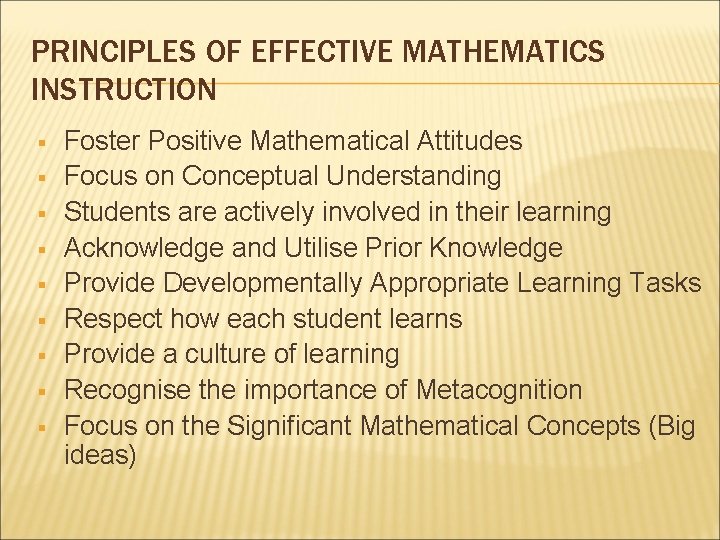
PRINCIPLES OF EFFECTIVE MATHEMATICS INSTRUCTION Foster Positive Mathematical Attitudes Focus on Conceptual Understanding Students are actively involved in their learning Acknowledge and Utilise Prior Knowledge Provide Developmentally Appropriate Learning Tasks Respect how each student learns Provide a culture of learning Recognise the importance of Metacognition Focus on the Significant Mathematical Concepts (Big ideas)
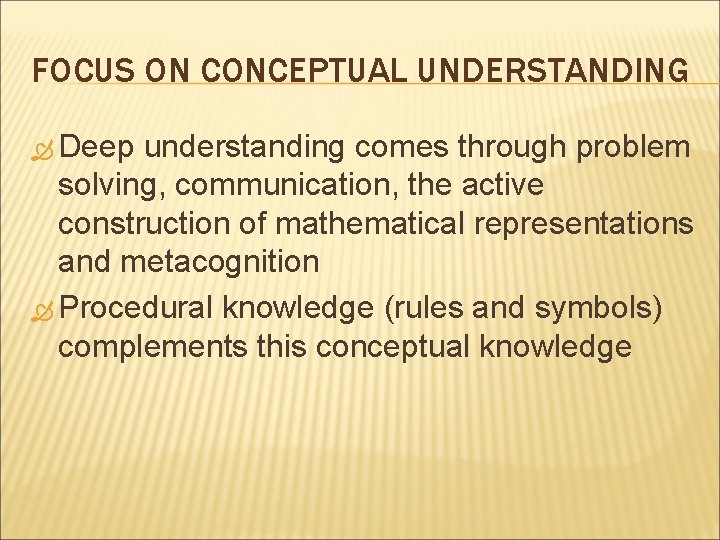
FOCUS ON CONCEPTUAL UNDERSTANDING Deep understanding comes through problem solving, communication, the active construction of mathematical representations and metacognition Procedural knowledge (rules and symbols) complements this conceptual knowledge

WHO IS THE TALLEST? How do you know?
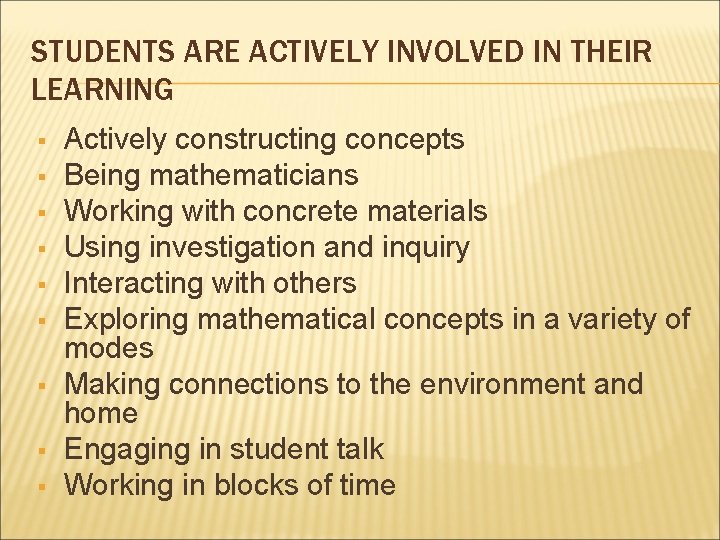
STUDENTS ARE ACTIVELY INVOLVED IN THEIR LEARNING Actively constructing concepts Being mathematicians Working with concrete materials Using investigation and inquiry Interacting with others Exploring mathematical concepts in a variety of modes Making connections to the environment and home Engaging in student talk Working in blocks of time
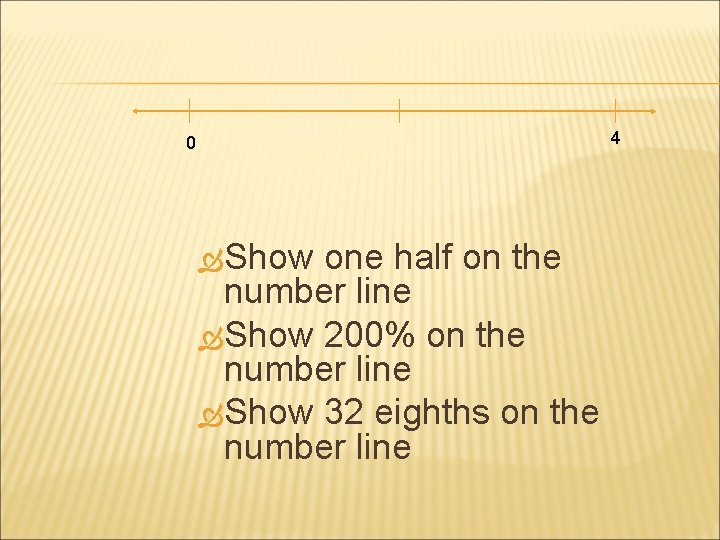
4 0 Show one half on the number line Show 200% on the number line Show 32 eighths on the number line
RECOGNISE THE IMPORTANCE OF METACOGNITION Remind students to think about their thinking “What am I doing? ” “Why am I doing it? ” “How does it help me? ” Model metacognitive techniques Make reflection a critical component of tasks
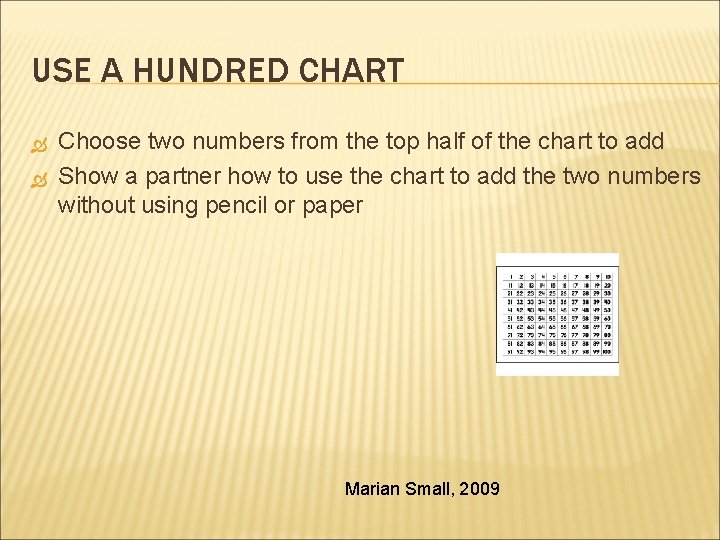
USE A HUNDRED CHART Choose two numbers from the top half of the chart to add Show a partner how to use the chart to add the two numbers without using pencil or paper Marian Small, 2009
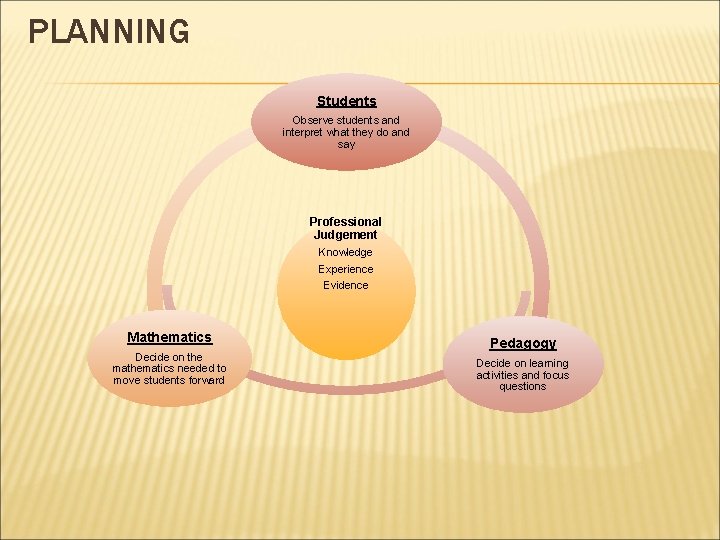
PLANNING Students Observe students and interpret what they do and say Professional Judgement Knowledge Experience Evidence Mathematics Decide on the mathematics needed to move students forward Pedagogy Decide on learning activities and focus questions
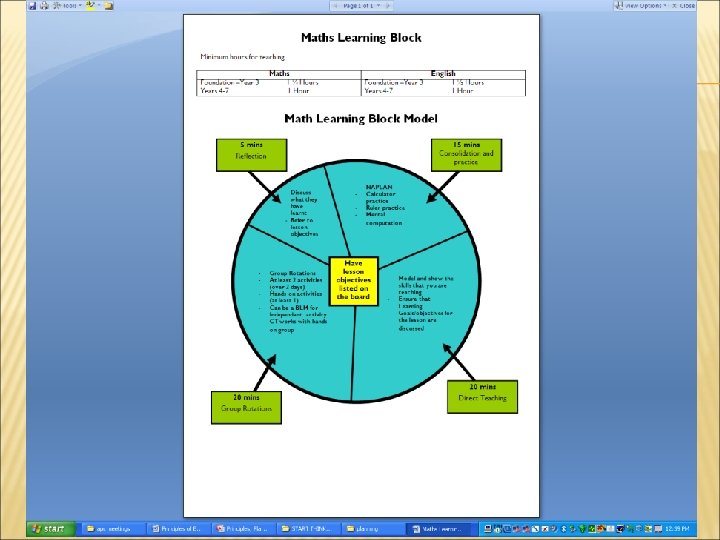
WEEKLY PROGRAM • • • Major Focus – core concept or procedure - approx two thirds of time Minor Focus – regular revision of strands and concepts - two or three 15 minute sessions per week Routine activities – often lesson starters - mental maths, algorithms, hundreds board, number facts,
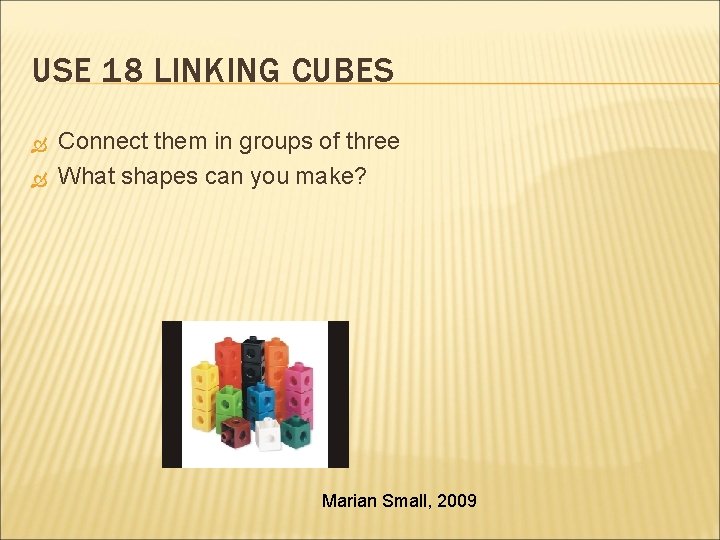
USE 18 LINKING CUBES Connect them in groups of three What shapes can you make? Marian Small, 2009
WHO AM I? Make up your own mystery number clues! I am a 4 -digit whole number. 2. I am smaller than the number of metres in 2. 5 km. 3. I am larger than 100 x 23. 4. The digit in my ten’s place is 5. 5. The digit in the hundred’s place is divisible by 4. 6. I have a zero in the one’s place. From Rich Learning Tasks in Number for Primary Students (2010) by 1. Gary Flewelling, Jane Lind & Ron Sauer
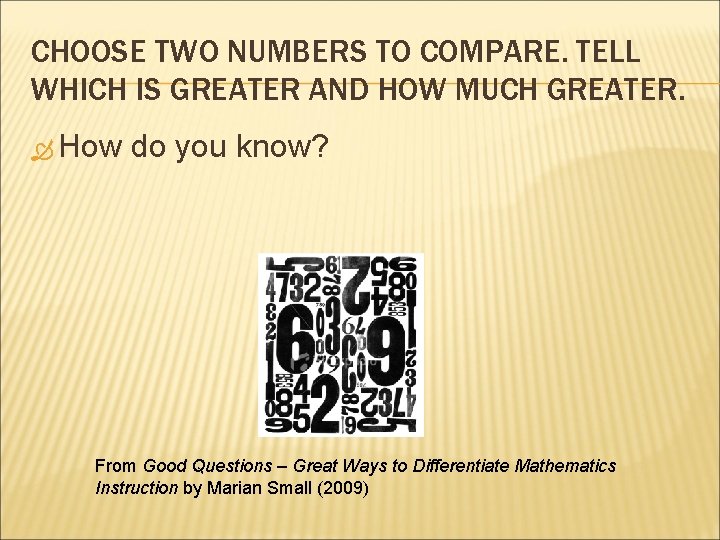
CHOOSE TWO NUMBERS TO COMPARE. TELL WHICH IS GREATER AND HOW MUCH GREATER. How do you know? From Good Questions – Great Ways to Differentiate Mathematics Instruction by Marian Small (2009)
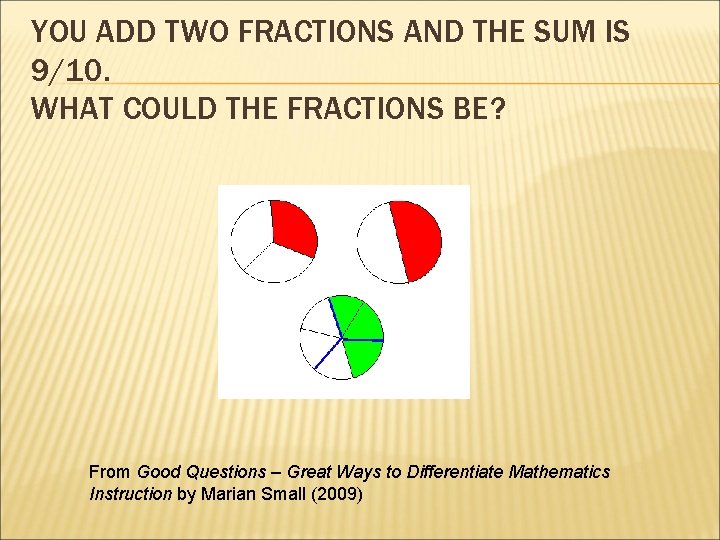
YOU ADD TWO FRACTIONS AND THE SUM IS 9/10. WHAT COULD THE FRACTIONS BE? From Good Questions – Great Ways to Differentiate Mathematics Instruction by Marian Small (2009)
TRY THIS IN YOUR CALCULATOR Any 2 digit number x 7 x 11 x 13 What do you notice? Try it with a 3 digit number Why does this occur?
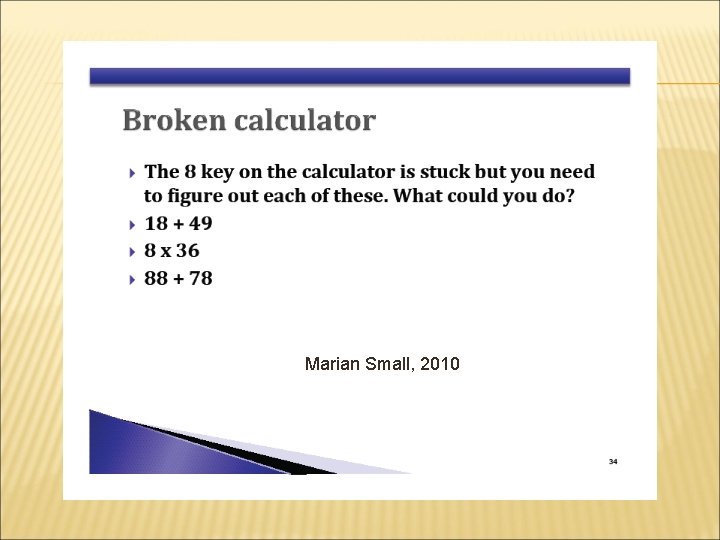
Marian Small, 2010
KEY MESSAGES Active Learning Focus on students’ conceptual understanding Communicating their mathematical thinking Open-ended questions and problem solving tasks Using manipulatives (Prep to Year 7)
AIMS OF THE AUSTRALIAN CURRICULUM : MATHEMATICS Confident, creative users and communicators of mathematics Able to investigate, represent and interpret situations Understanding, processing, solving problems and reasoning in N&A, M&G, S&P Recognise the connections between areas of mathematics and other disciplines Appreciate maths as accessible and enjoyable
- Slides: 22