
The ATOMOS Transactional Programming Language Mehdi Amirijoo Linkpings


- Slides: 18
The ATOMOS Transactional Programming Language Mehdi Amirijoo Linköpings universitet 2007 -03 -16 1
n Background n Transactional memory n Conditional waiting n Transaction Nesting n Evaluation n Conclusion 2007 -03 -16 Mehdi Amirijoo 2
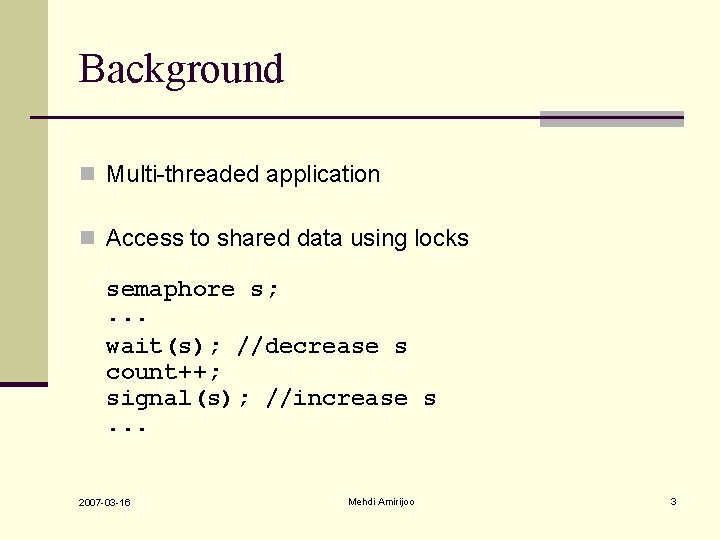
Background n Multi-threaded application n Access to shared data using locks semaphore s; . . . wait(s); //decrease s count++; signal(s); //increase s. . . 2007 -03 -16 Mehdi Amirijoo 3
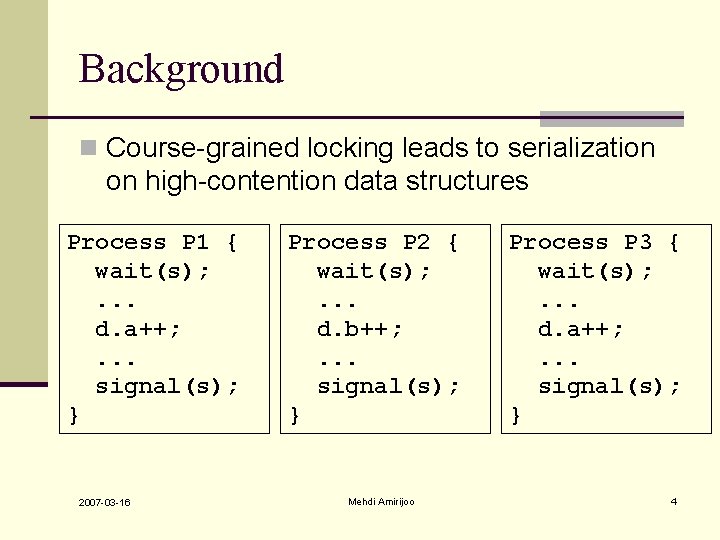
Background n Course-grained locking leads to serialization on high-contention data structures Process P 1 { wait(s); . . . d. a++; . . . signal(s); } 2007 -03 -16 Process P 2 { wait(s); . . . d. b++; . . . signal(s); } Mehdi Amirijoo Process P 3 { wait(s); . . . d. a++; . . . signal(s); } 4
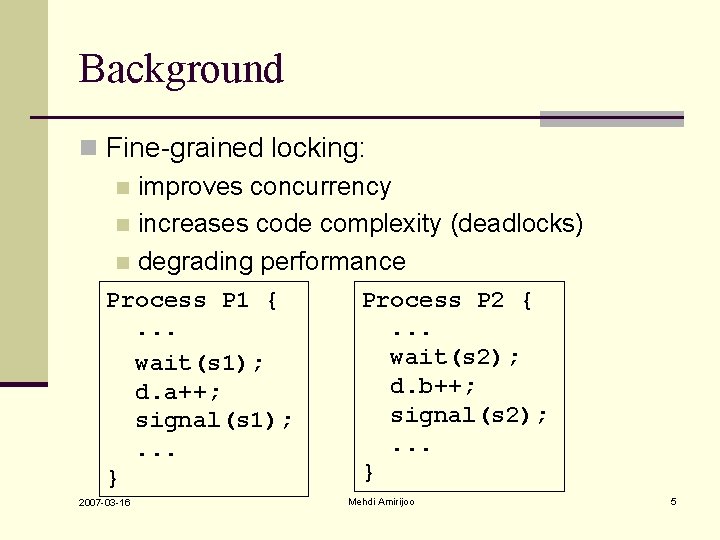
Background n Fine-grained locking: n improves concurrency n increases code complexity (deadlocks) n degrading performance Process P 1 {. . . wait(s 1); d. a++; signal(s 1); . . . } 2007 -03 -16 Process P 2 {. . . wait(s 2); d. b++; signal(s 2); . . . } Mehdi Amirijoo 5
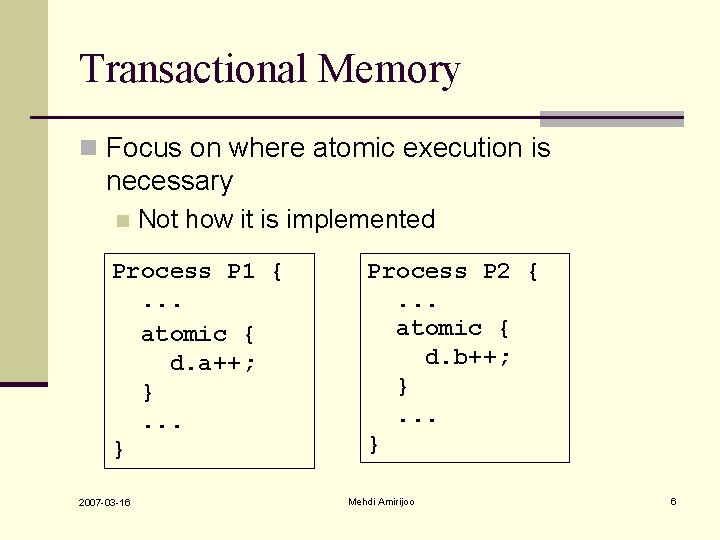
Transactional Memory n Focus on where atomic execution is necessary n Not how it is implemented Process P 1 {. . . atomic { d. a++; }. . . } 2007 -03 -16 Process P 2 {. . . atomic { d. b++; }. . . } Mehdi Amirijoo 6
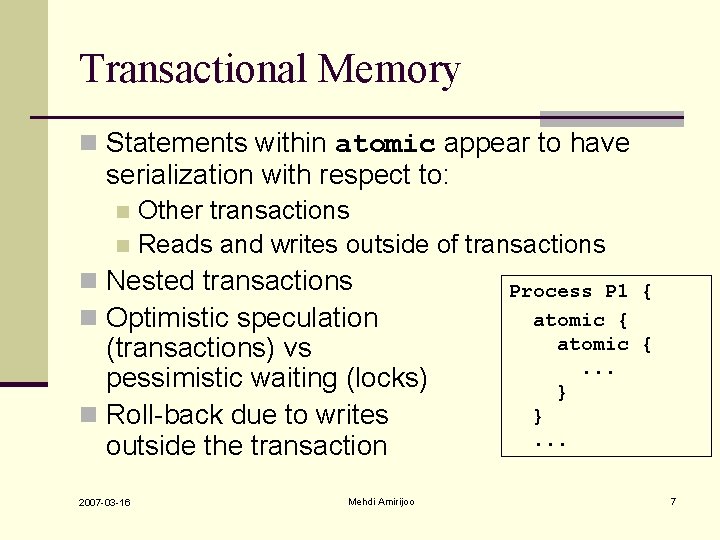
Transactional Memory n Statements within atomic appear to have serialization with respect to: Other transactions n Reads and writes outside of transactions n n Nested transactions n Optimistic speculation (transactions) vs pessimistic waiting (locks) n Roll-back due to writes outside the transaction 2007 -03 -16 Mehdi Amirijoo Process P 1 { atomic {. . . } }. . . 7
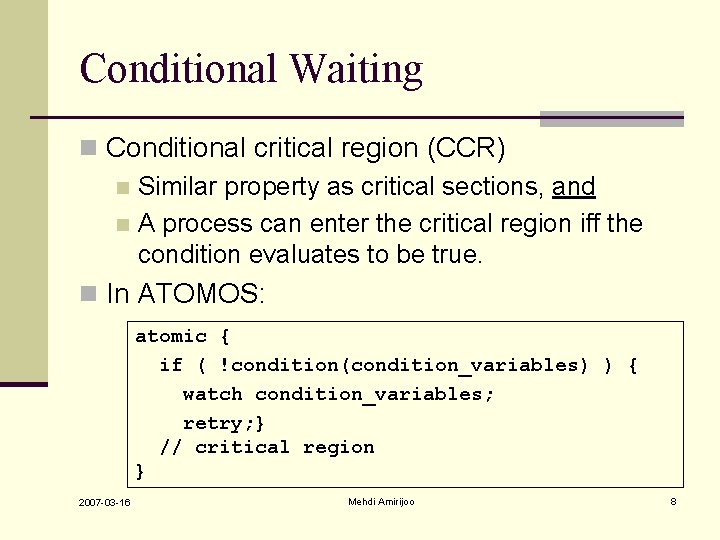
Conditional Waiting n Conditional critical region (CCR) n Similar property as critical sections, and n A process can enter the critical region iff the condition evaluates to be true. n In ATOMOS: atomic { if ( !condition(condition_variables) ) { watch condition_variables; retry; } // critical region } 2007 -03 -16 Mehdi Amirijoo 8
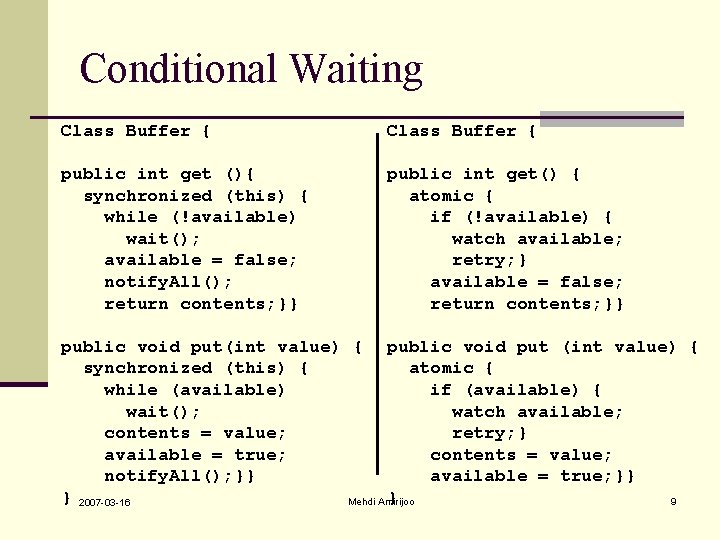
Conditional Waiting Class Buffer { public int get (){ synchronized (this) { while (!available) wait(); available = false; notify. All(); return contents; }} public int get() { atomic { if (!available) { watch available; retry; } available = false; return contents; }} public void put(int value) { public void put (int value) { synchronized (this) { atomic { while (available) if (available) { wait(); watch available; contents = value; retry; } available = true; contents = value; notify. All(); }} available = true; }} } 2007 -03 -16 } Mehdi Amirijoo 9
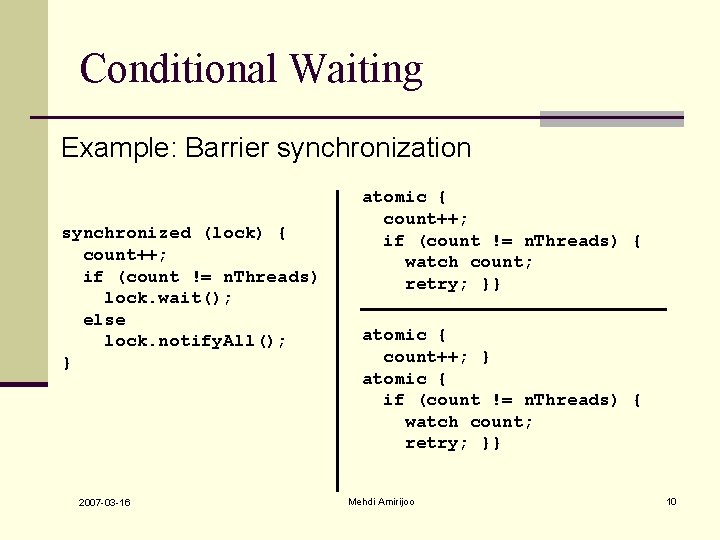
Conditional Waiting Example: Barrier synchronization synchronized (lock) { count++; if (count != n. Threads) lock. wait(); else lock. notify. All(); } 2007 -03 -16 atomic { count++; if (count != n. Threads) { watch count; retry; }} atomic { count++; } atomic { if (count != n. Threads) { watch count; retry; }} Mehdi Amirijoo 10
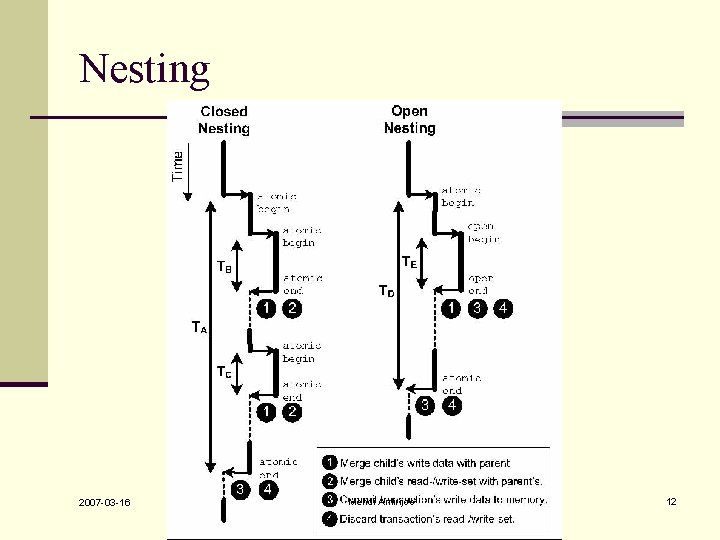
Nesting n In databases transactions usually reduce isolation to improve performance n Communication from within uncommitted transactions! n Closed-nested transaction: Results of children visible only to parent n Open-nested Transaction: Results of children visible globally 2007 -03 -16 Mehdi Amirijoo 11
Nesting 2007 -03 -16 Mehdi Amirijoo 12
Nesting public static int generate. ID { atomic { return id++; } } public static void create. Order (. . . ) { atomic { Order order = new Order(); order. set. ID(generate. ID()); // finish initialization of order. This could // include more calls to generate. ID. orders. put(new Integer(order. get. ID()), order); } } 2007 -03 -16 Mehdi Amirijoo 13
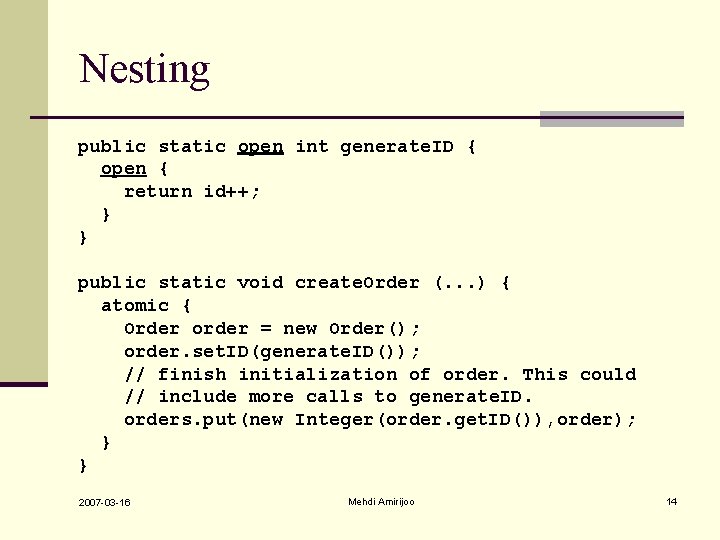
Nesting public static open int generate. ID { open { return id++; } } public static void create. Order (. . . ) { atomic { Order order = new Order(); order. set. ID(generate. ID()); // finish initialization of order. This could // include more calls to generate. ID. orders. put(new Integer(order. get. ID()), order); } } 2007 -03 -16 Mehdi Amirijoo 14
Evaluation n Goal: Compare ATOMOS with Java n Synchronized → atomic n wait(), notify. All() → watch, retry n 1 to 32 CPU: s (no thread migration) n No garbage collection n Measure execution time 2007 -03 -16 Mehdi Amirijoo 15
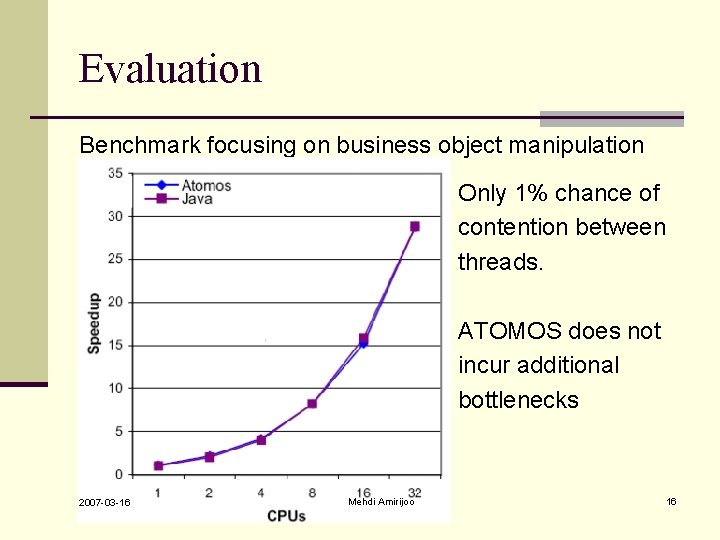
Evaluation Benchmark focusing on business object manipulation Only 1% chance of contention between threads. ATOMOS does not incur additional bottlenecks 2007 -03 -16 Mehdi Amirijoo 16
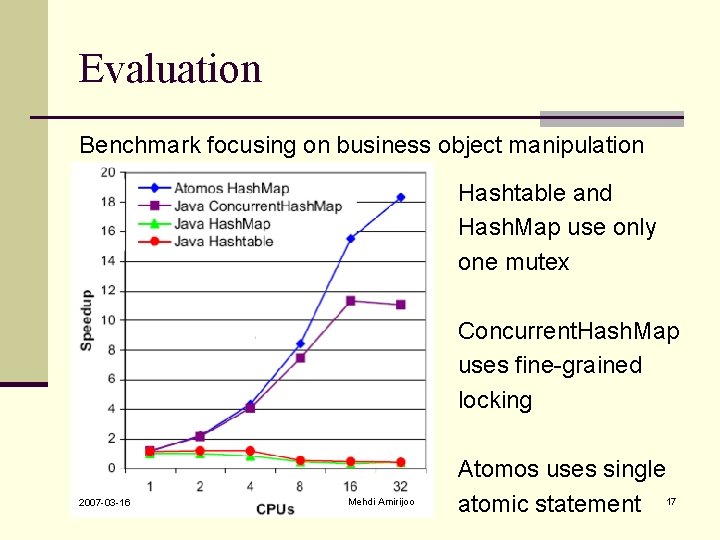
Evaluation Benchmark focusing on business object manipulation Hashtable and Hash. Map use only one mutex Concurrent. Hash. Map uses fine-grained locking 2007 -03 -16 Mehdi Amirijoo Atomos uses single atomic statement 17
Conclusion n Transactional programming simplifies design of programs n Conditional waiting enables CCR n Open nesting increases performance by reducing time to commit n Evaluation shows that the approach is scalable with the number of processors 2007 -03 -16 Mehdi Amirijoo 18