
The Atom Lesson 1 Subatomic particles What is
The Atom Lesson 1 – Subatomic particles
What is an atom? • Atom: the smallest unit of matter that retains the identity of the substance • An atom is made of protons, neutrons, and electrons
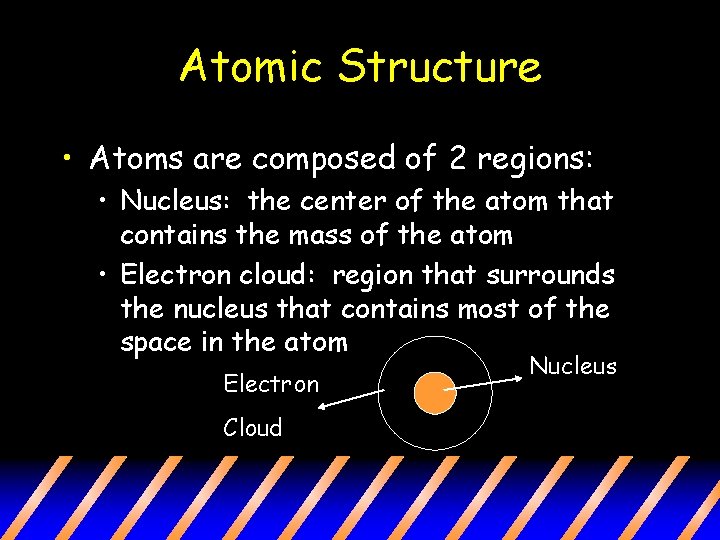
Atomic Structure • Atoms are composed of 2 regions: • Nucleus: the center of the atom that contains the mass of the atom • Electron cloud: region that surrounds the nucleus that contains most of the space in the atom Electron Cloud Nucleus
What’s in the Nucleus? • The nucleus contains 2 of the 3 subatomic particles: • Protons: positively charged subatomic particles( mass of 1 amu) • Neutrons: neutrally charged subatomic particles (mass of 1 amu)
What’s in the Electron Cloud? • The 3 rd subatomic particle resides outside of the nucleus in the electron cloud • Electron: the subatomic particle with a negative charge and relatively no mass
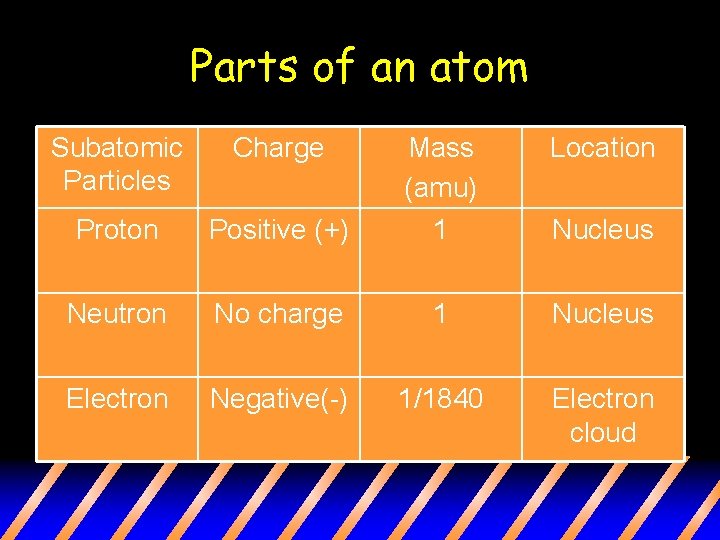
Parts of an atom Subatomic Particles Charge Location Positive (+) Mass (amu) 1 Proton Neutron No charge 1 Nucleus Electron Negative(-) 1/1840 Electron cloud Nucleus
How do these particles interact? • Protons and neutrons are compacted in the tiny positively charged nucleus accounting for most of the mass of the atom but barely any volume. • The negatively charged electrons are small and have a relatively small mass but occupy 99% + of the volume of the atom.
How do the subatomic particles balance each other? • In a neutral atom: • The protons = the electrons • If 20 protons are present in an atom then 20 electrons are there to balance the overall charge of the atom—these atoms are neutral, meaning they have an overall charge of ZERO! • The neutrons have no charge; therefore they do not have to equal the number of protons or electrons
How do we know the number of subatomic particles in an atom? • Atomic number (Z): this number indicates the number of protons in an atom • Ex: Hydrogen’s atomic number is 1 • So hydrogen has 1 proton • Ex: Carbon’s atomic number is 6 • So carbon has 6 protons **The number of protons identifies the atom as a specific element. Ex. 2 protons = He, 29 protons = Cu
How do we know the number of subatomic particles in an atom? • Mass number (A): the number of protons and neutrons in the nucleus • Ex: hydrogen can have a mass number of 3. Since it has 1 proton it must have 2 neutrons • # of neutrons = mass # - atomic # = A - Z
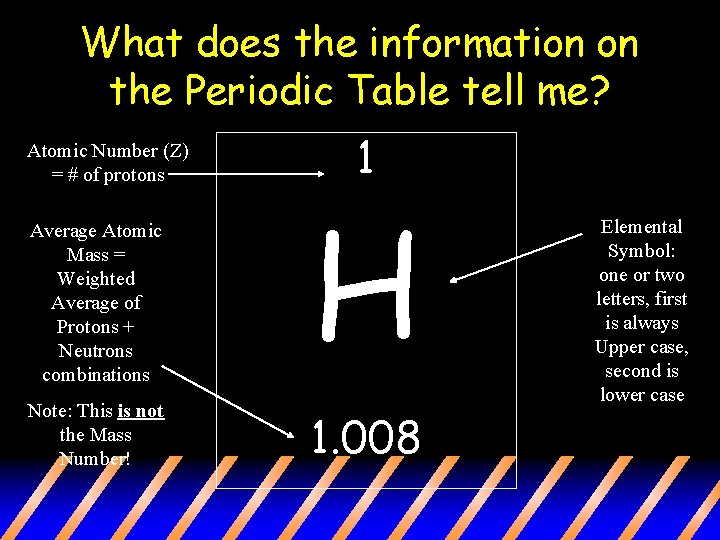
What does the information on the Periodic Table tell me? Atomic Number (Z) = # of protons 1 Average Atomic Mass = Weighted Average of Protons + Neutrons combinations H Note: This is not the Mass Number! 1. 008 Elemental Symbol: one or two letters, first is always Upper case, second is lower case
Determining the number of protons and neutrons • Li has a mass number of 7 and an atomic number of 3 • Protons = 3 (same as atomic #) • Neutrons= 7 -3 = 4 (mass # - atomic #) • Ne has a mass number of 20 and an atomic number of 10 • Protons = 10 • Neutrons = 20 - 10= 10 Mass Number • Other way to write elements: Neon-20
What about the electrons? • In a neutral atom, the electrons are equal to the number of protons • So e- = p = atomic # • Ex: He has a mass # of 4 and an atomic # of 2 =2 • no = 2 • e- = 2 • p+
Determine the number of subatomic particles in the following neutral atoms: • Cl has a mass # of 35 and an atomic # of 17 • p+ = 17, no = 18, e- = 17 • K has a mass # of 39 and an atomic # of 19 • P+ = 19, no = 20 e- = 19
- Slides: 14