
The Atom Develop a mental picture of what

- Slides: 37
The Atom Develop a mental picture of what you think an atom looks like
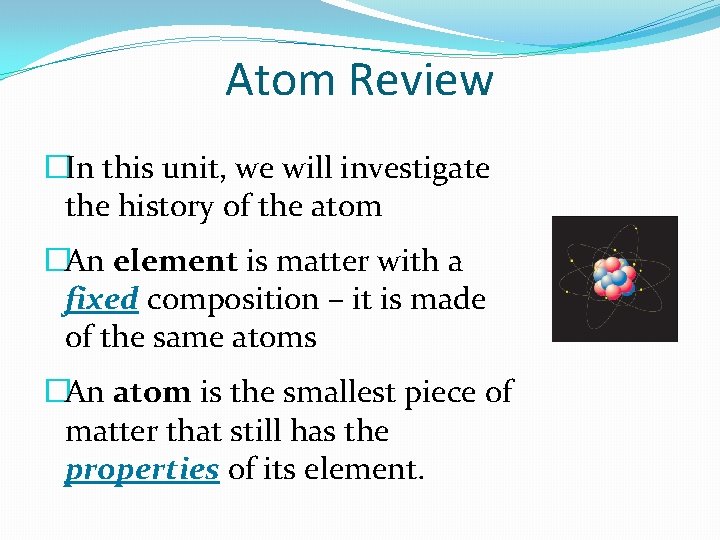
Atom Review �In this unit, we will investigate the history of the atom �An element is matter with a fixed composition – it is made of the same atoms �An atom is the smallest piece of matter that still has the properties of its element.
The Atom Important People and Models
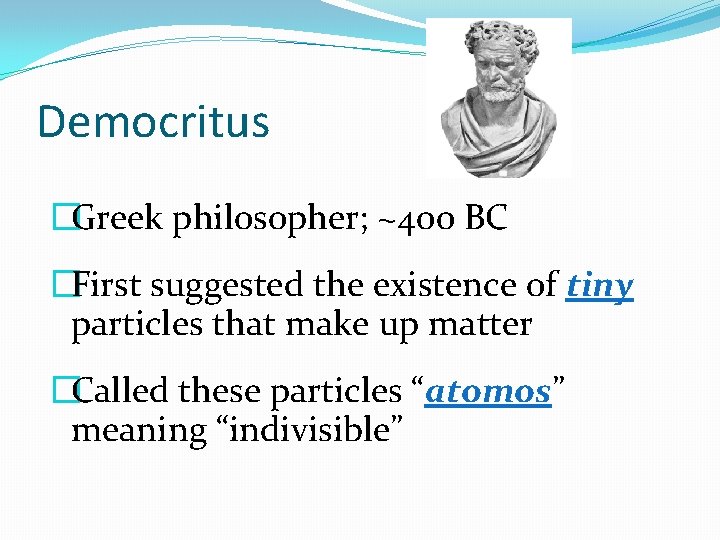
Democritus �Greek philosopher; ~400 BC �First suggested the existence of tiny particles that make up matter �Called these particles “atomos” meaning “indivisible”
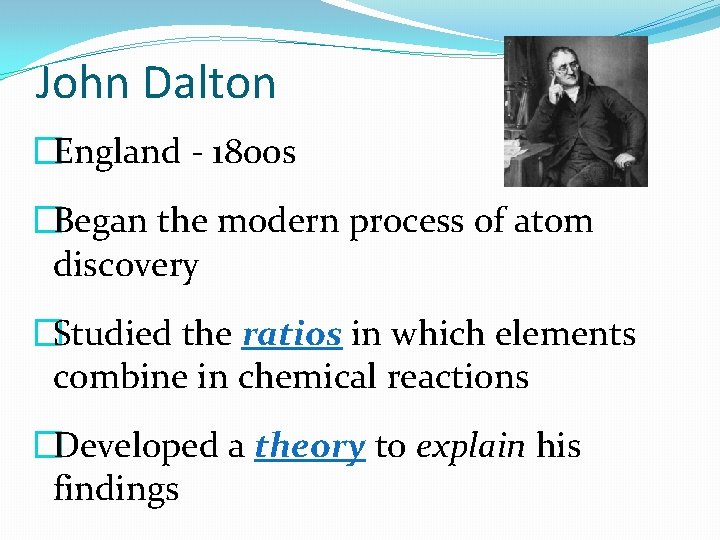
John Dalton �England - 1800 s �Began the modern process of atom discovery �Studied the ratios in which elements combine in chemical reactions �Developed a theory to explain his findings
Dalton’s Atomic Theory 1) All matter is composed of extremely small, indivisible particles called atoms. 2) Atoms cannot be subdivided, created, or destroyed. 3) Atoms of the same element are identical; atoms of different elements are different.
Dalton’s Atomic Theory 4) Atoms of different elements combine in simple whole number ratios to form chemical compounds. 5) In chemical reactions, atoms are combined, separated, or rearranged.
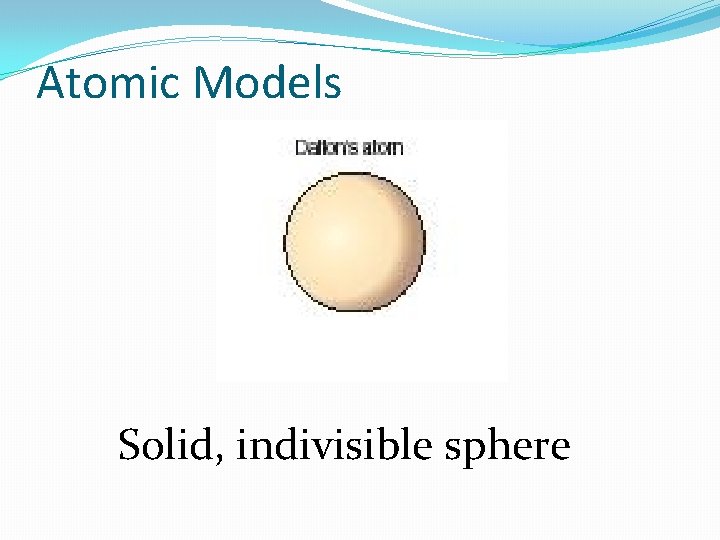
Atomic Models Solid, indivisible sphere
Thomson’s Model (1897) �JJ Thomson discovered that gases have negatively- charged particles using a device called a Cathode Ray Tube. �Thomson called the particles that made up the beam ‘electrons’. �Thomson discovers that all elements have electrons!
Thomson’s Model (1897) �An experiment similar to Thomson’s was used to discover a particle with a positive charge �Scientists knew there had to be something that was positive in the atom: �An atom is neutral �So if there were negative particles (electrons), there must also be positive particles (protons)
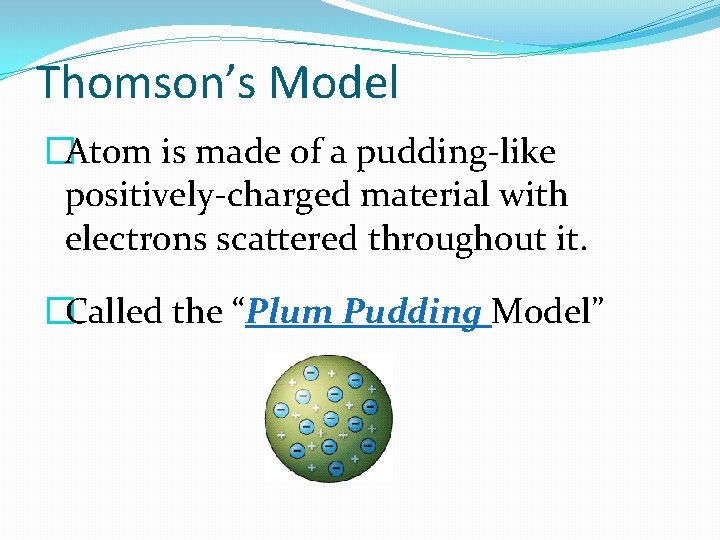
Thomson’s Model �Atom is made of a pudding-like positively-charged material with electrons scattered throughout it. �Called the “Plum Pudding Model”
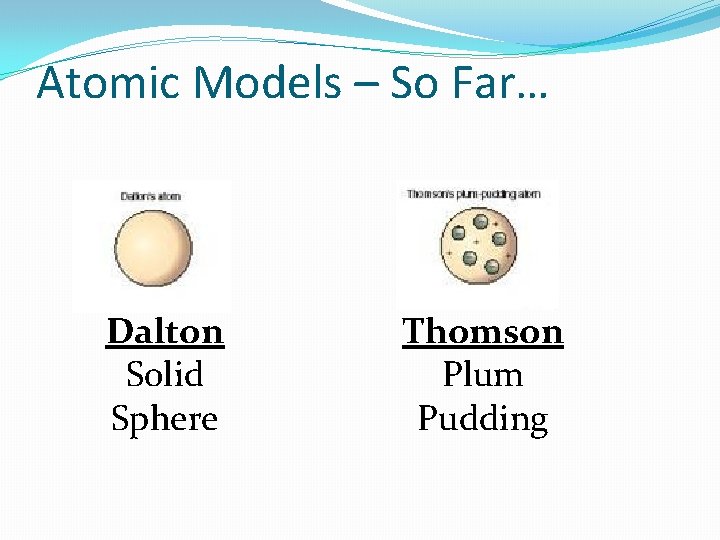
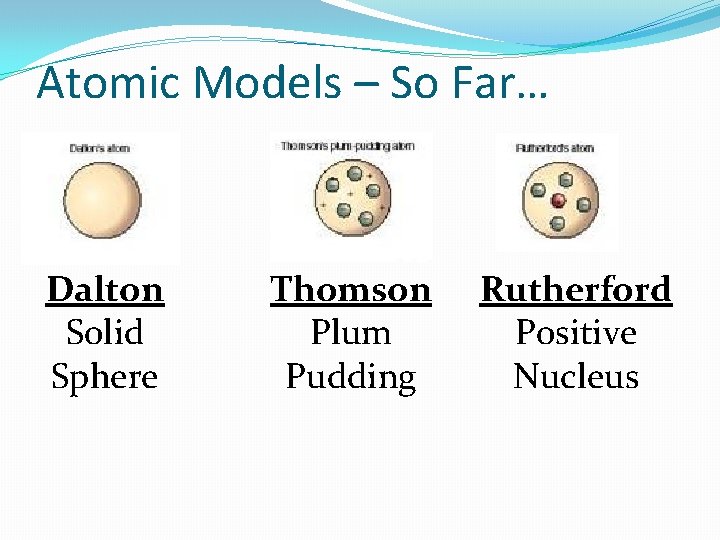
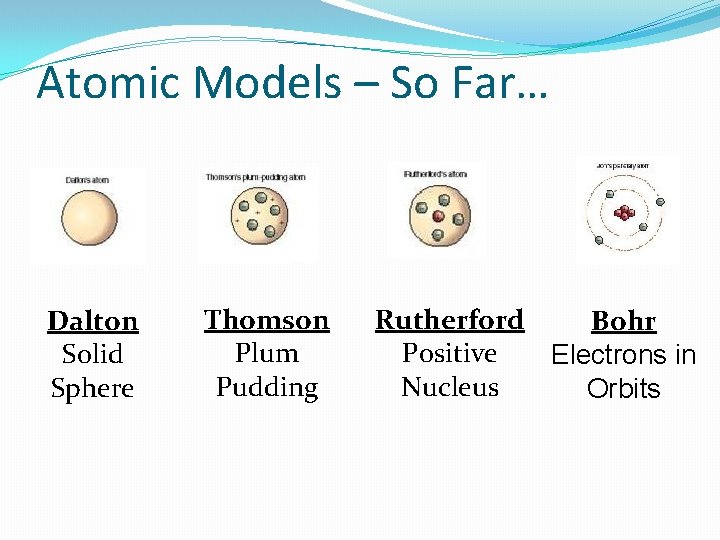
Atomic Models – So Far… Dalton Solid Sphere Thomson Plum Pudding
Ernest Rutherford (1911) �Was conducting a lot of research with radioactive materials �Designed an experiment called the “Gold Foil Experiment” �Bombarded gold foil with positive radioactive particles, called alpha particles
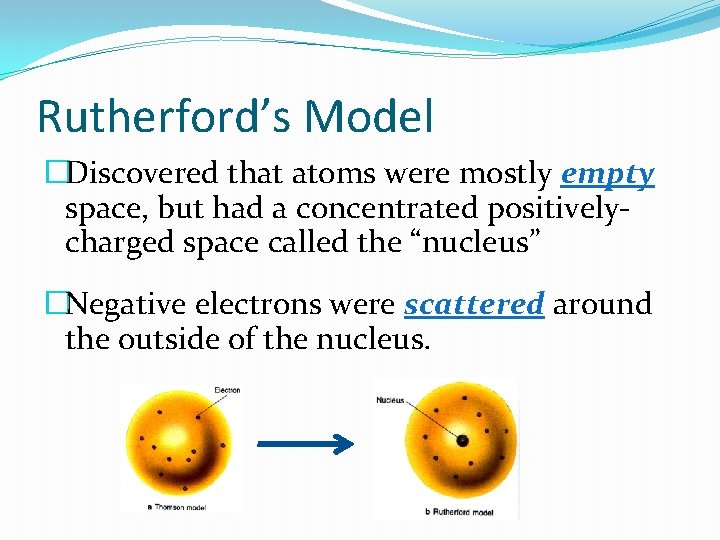
Rutherford’s Model �Discovered that atoms were mostly empty space, but had a concentrated positivelycharged space called the “nucleus” �Negative electrons were scattered around the outside of the nucleus.
Atomic Models – So Far… Dalton Solid Sphere Thomson Plum Pudding Rutherford Positive Nucleus
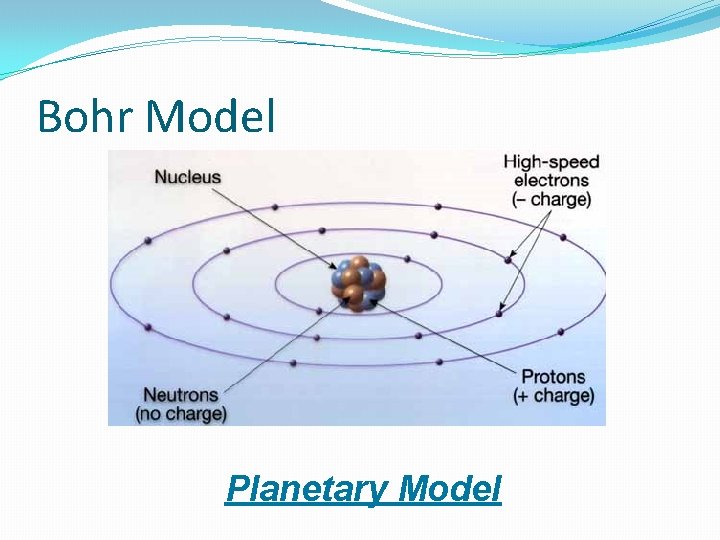
Niels Bohr �Danish physicist; 1913 �Proposed a model of the atom in which the electrons are in fixed orbits �Set paths around the nucleus �Each orbit corresponds to a particular energy level where an electron can exist
Bohr Model Planetary Model
Atomic Models – So Far… Dalton Solid Sphere Thomson Plum Pudding Rutherford Bohr Positive Electrons in Nucleus Orbits
Modern Atomic Theory �Developed by Louis de Broglie and Erwin Schrödinger �Electrons move in indefinite paths, and their exact locations can only be predicted based on their energy level.
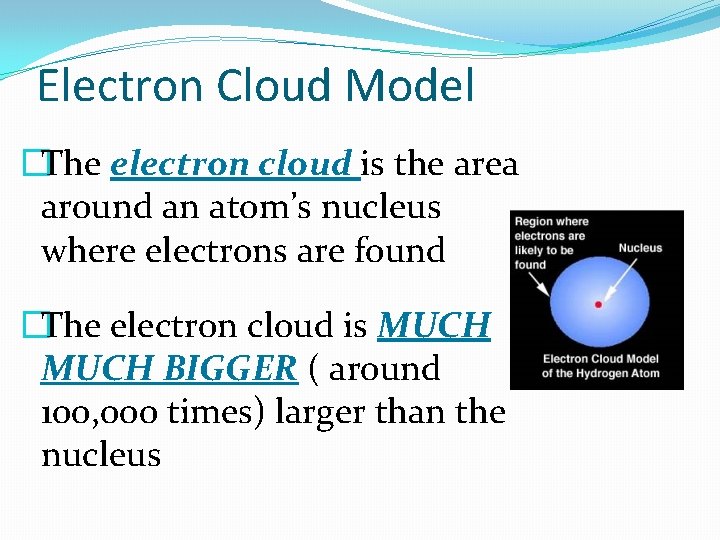
Modern Atomic Theory �Called the “wave model, ” or quantum mechanical model �Simply put, we say the electrons move in “Clouds”
Electron Cloud Model �The electron cloud is the area around an atom’s nucleus where electrons are found �The electron cloud is MUCH BIGGER ( around 100, 000 times) larger than the nucleus
Basic Atom Structure
The Atom �Smallest particles of an element that retains the properties of that element �Three main subatomic particles �Proton �Neutron �Electron
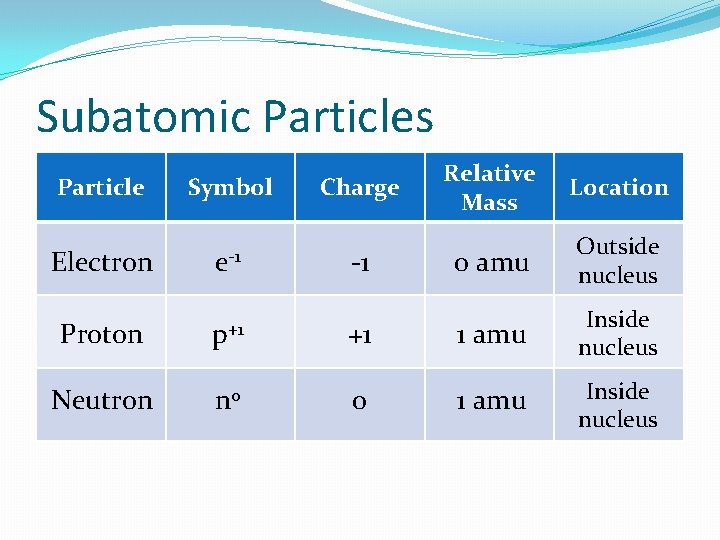
Subatomic Particles Particle Symbol Electron e-1 Proton p+1 Neutron n 0 Relative Mass Location 0 amu Outside nucleus +1 1 amu Inside nucleus 0 1 amu Inside nucleus Charge -1
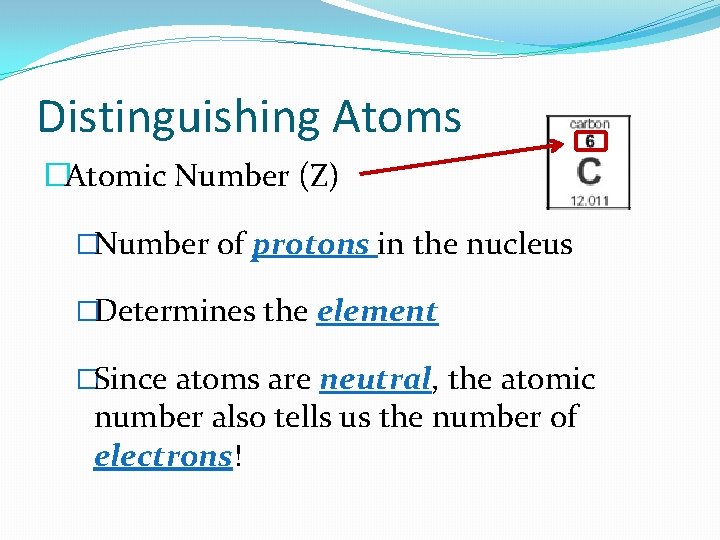
Distinguishing Atoms �Atomic Number (Z) �Number of protons in the nucleus �Determines the element �Since atoms are neutral, the atomic number also tells us the number of electrons!
Distinguishing Atoms �Mass Number (A) �Number of protons plus the number of neutrons �These are the two particles that really make up the mass of the atom
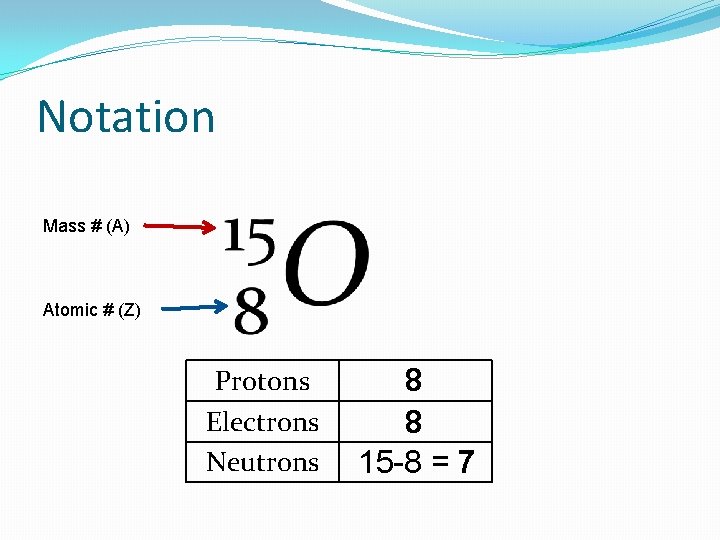
Notation Mass # (A) Atomic # (Z) Protons Electrons Neutrons 8 8 15 -8 = 7
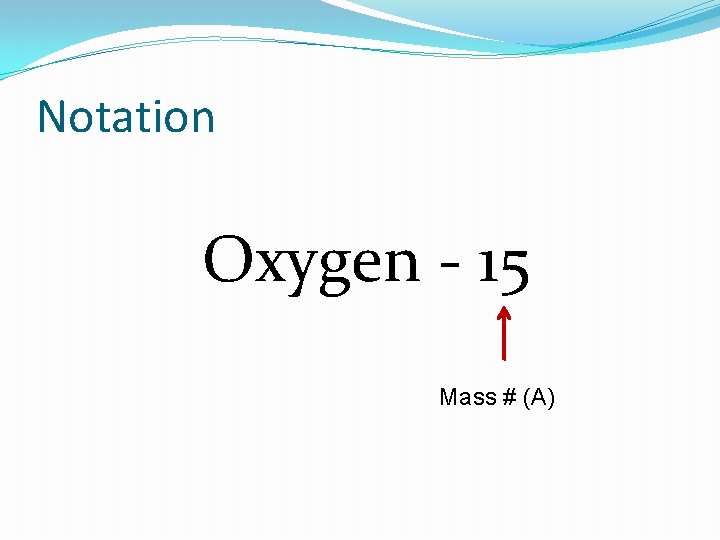
Notation Oxygen - 15 Mass # (A)
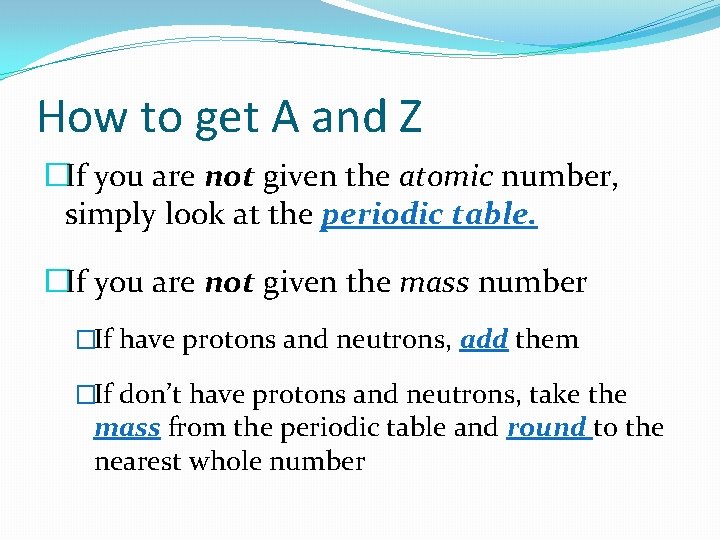
How to get A and Z �If you are not given the atomic number, simply look at the periodic table. �If you are not given the mass number �If have protons and neutrons, add them �If don’t have protons and neutrons, take the mass from the periodic table and round to the nearest whole number
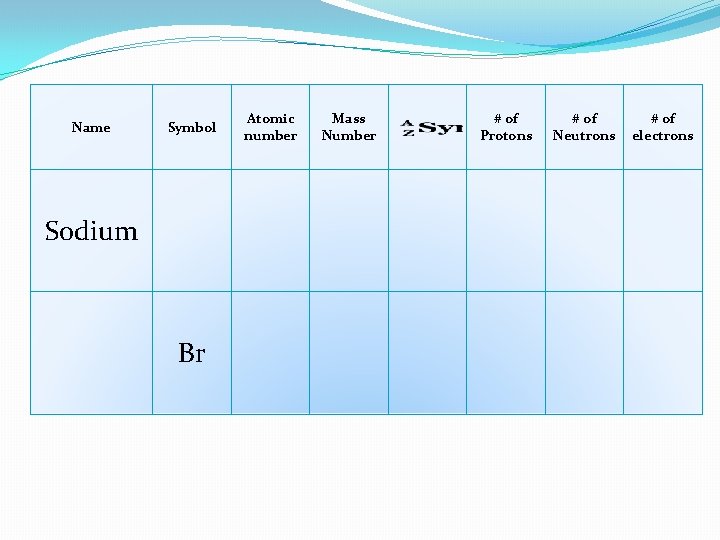
Name Symbol Sodium Br Atomic number Mass Number # of Protons # of Neutrons # of electrons
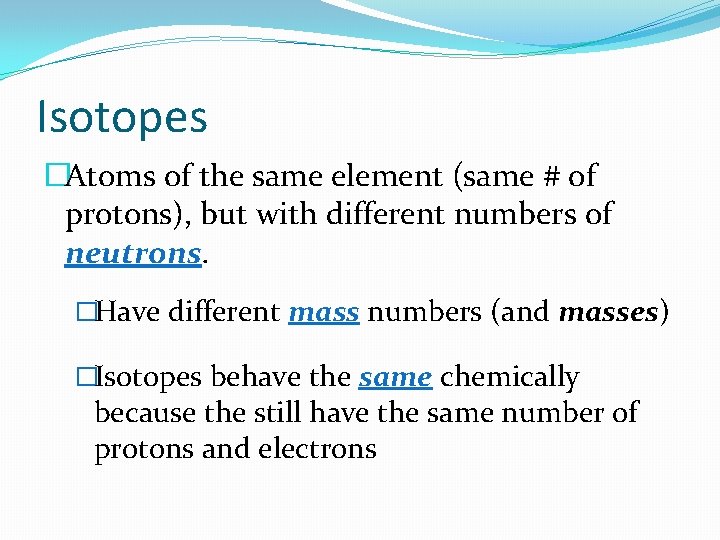
Isotopes �Atoms of the same element (same # of protons), but with different numbers of neutrons. �Have different mass numbers (and masses) �Isotopes behave the same chemically because the still have the same number of protons and electrons
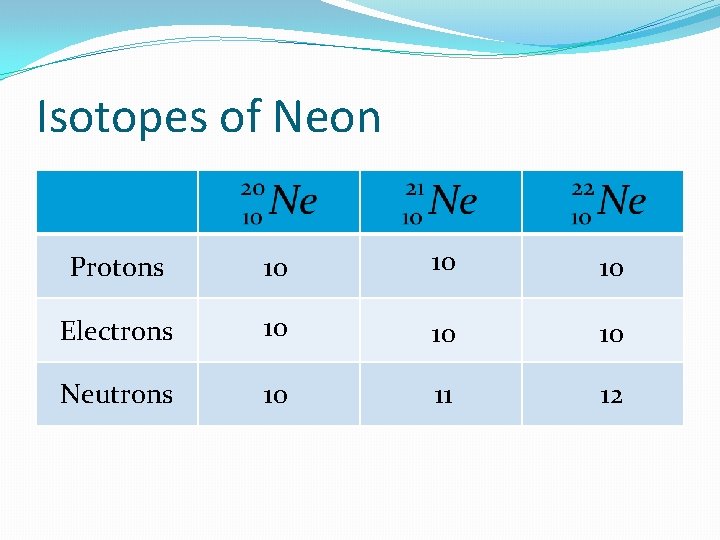
Isotopes of Neon Protons 10 10 10 Electrons 10 10 10 Neutrons 10 11 12
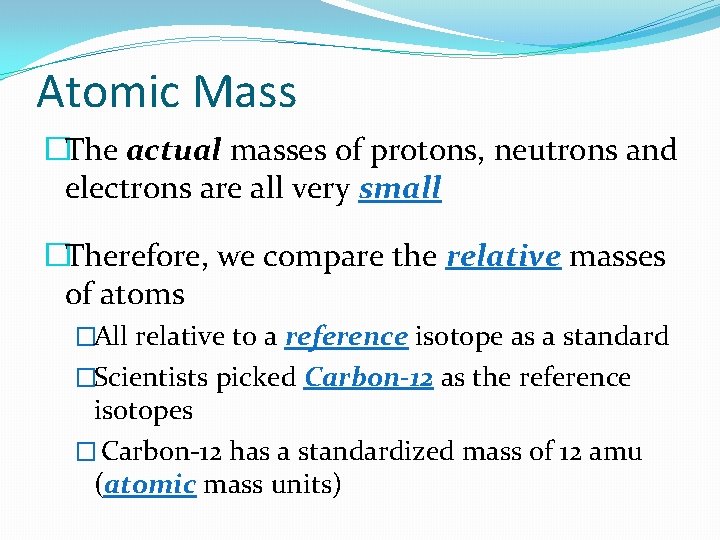
Atomic Mass �The actual masses of protons, neutrons and electrons are all very small �Therefore, we compare the relative masses of atoms �All relative to a reference isotope as a standard �Scientists picked Carbon-12 as the reference isotopes � Carbon-12 has a standardized mass of 12 amu (atomic mass units)
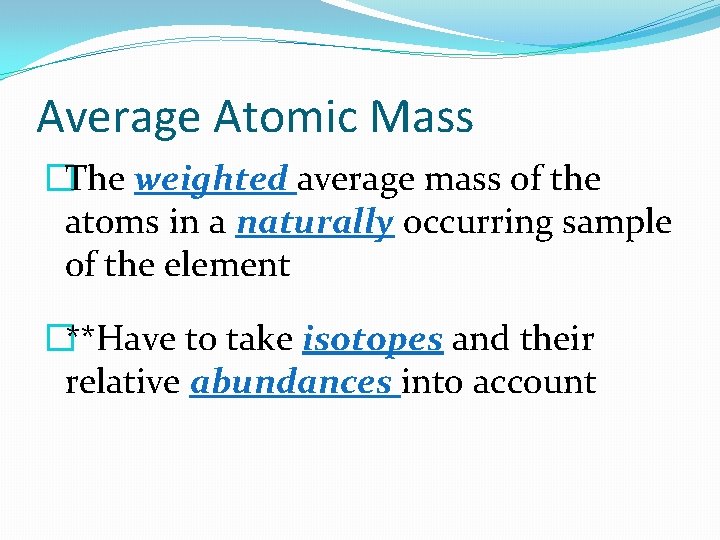
Average Atomic Mass �The weighted average mass of the atoms in a naturally occurring sample of the element �**Have to take isotopes and their relative abundances into account
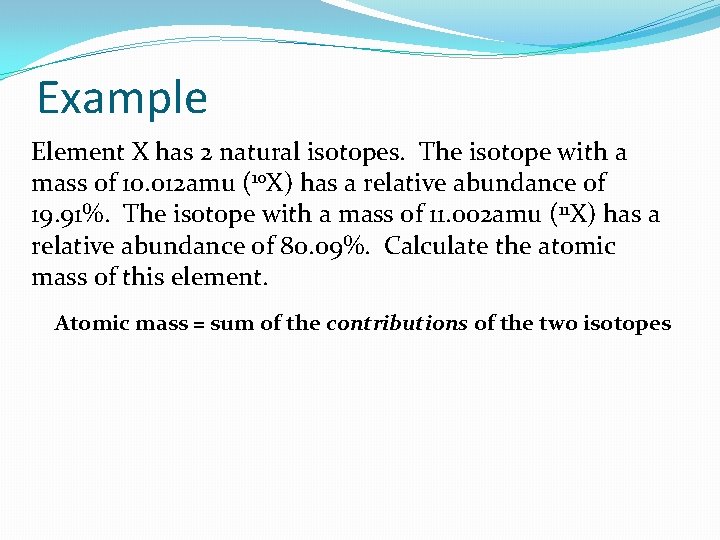
Example Element X has 2 natural isotopes. The isotope with a mass of 10. 012 amu (10 X) has a relative abundance of 19. 91%. The isotope with a mass of 11. 002 amu ( 11 X) has a relative abundance of 80. 09%. Calculate the atomic mass of this element. Atomic mass = sum of the contributions of the two isotopes
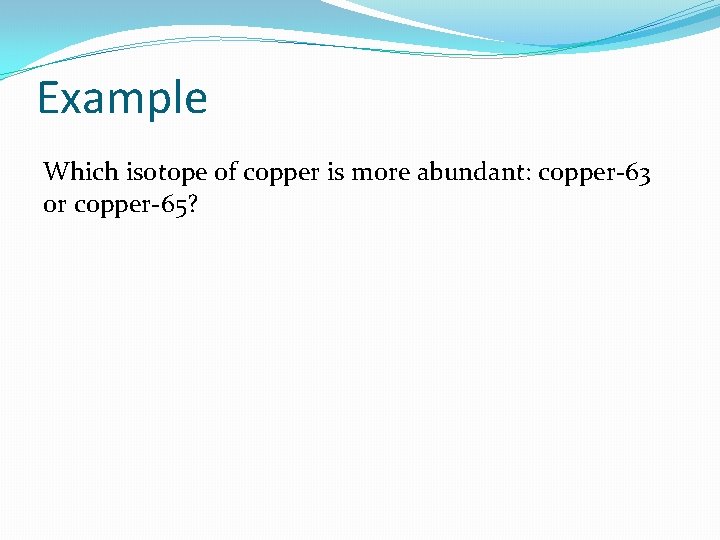
Example Which isotope of copper is more abundant: copper-63 or copper-65?