
The Atom Atoms have a positively charged core

- Slides: 22
The Atom
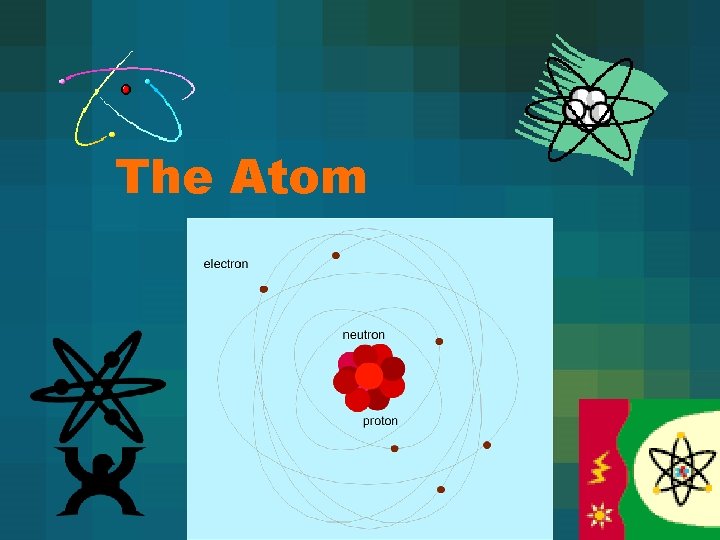
Atoms have a positively charged core called the nucleus. The Nucleus contains 99. 9999% of the mass of an atom. It has 2 parts 1. Protons (+) Mass = 1. 672 × 10 -24 g Mass amu ≈ 1 2. Neutron (No Charge) Mass = 1. 675 × 10 -24 g Mass amu ≈ 1
Electrons • Move around the nucleus in a complex pattern • Behave both like particles and waves. • They are responsible for the properties of elements. • They are what interact when two atoms meet
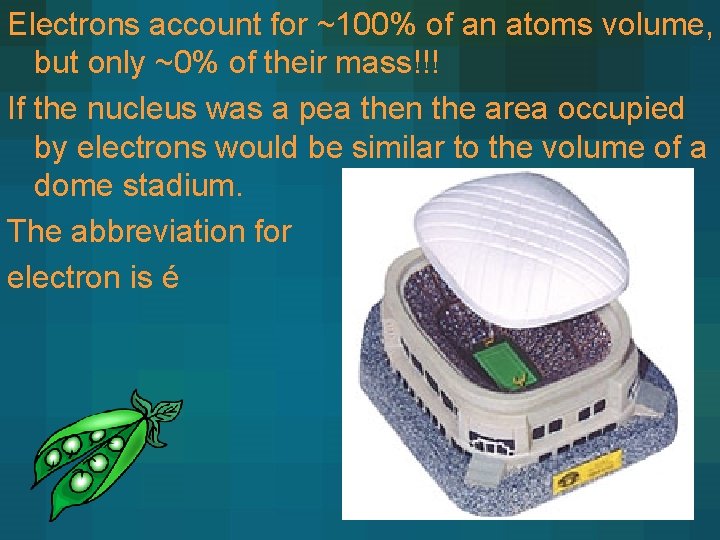
Electrons account for ~100% of an atoms volume, but only ~0% of their mass!!! If the nucleus was a pea then the area occupied by electrons would be similar to the volume of a dome stadium. The abbreviation for electron is é
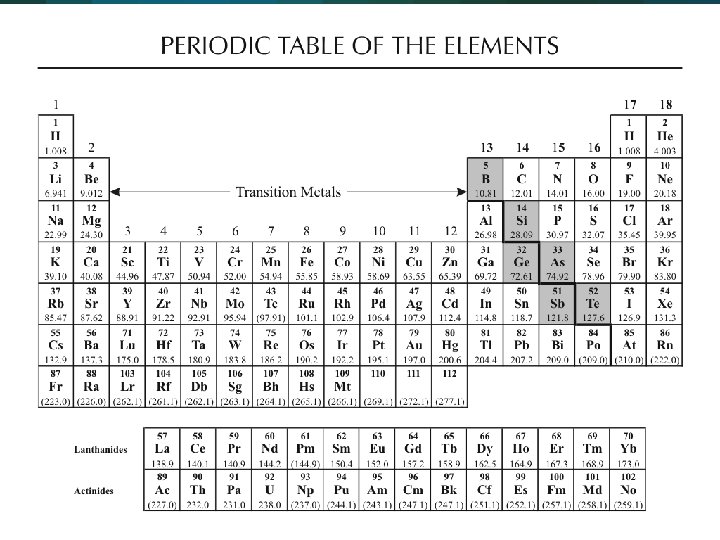
Atomic Numbers = # of protons in an atom & the # of electrons in a neutral atom How many protons does Mg have? How many electrons if its neutral? Tell me how many protons are in the following: 1. Ca 2. V 3. Kr 3. Pb
Ions When an atom gains or loses one or more electrons it is called an ion. Ions have a positive or negative charge. Charge of an ion = # of Protons - # of Electrons An ion walks into a bar… How many protons and electron are in the following: H+ Mg 2+ O 2 -
A cation is an ion with paws-ative charge. An anion is an ion with a negative ion.
Isotopes Atoms that have the same number of protons, but different number of neutrons are isotopes. Ex: Hydrogen has three isotopes. One has no neutrons, one has 1 neutron, and one has 2 neutrons. Do the properties of isotopes of an atom have different properties? How can they be differentiated then? Who cares about isotopes?
What is Atomic Mass? Atomic mass is the number on the bottom. How did they get it? It is the average mass of all the isotopes of that atom.
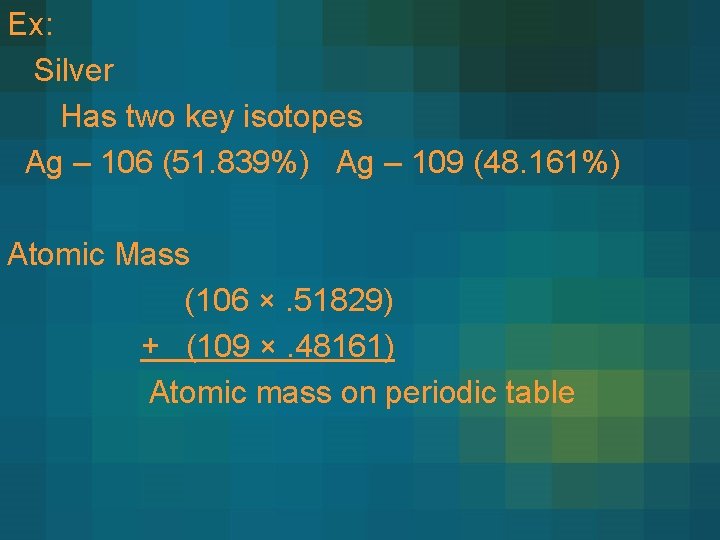
Ex: Silver Has two key isotopes Ag – 106 (51. 839%) Ag – 109 (48. 161%) Atomic Mass (106 ×. 51829) + (109 ×. 48161) Atomic mass on periodic table
By the end of the 1700’s only about 30 elements were known Then in less than 100 years, using atomic spectroscopy scientists doubled the number of know elements. Dmitri Mendeleev, a Russian chemist and teacher, grouped elements by their properties to make the first PERIODIC TABLE of elements (1870’s) His table was arranged so that elements in the same columns had the same properties
What Info Can you get from the modern Periodic Table?
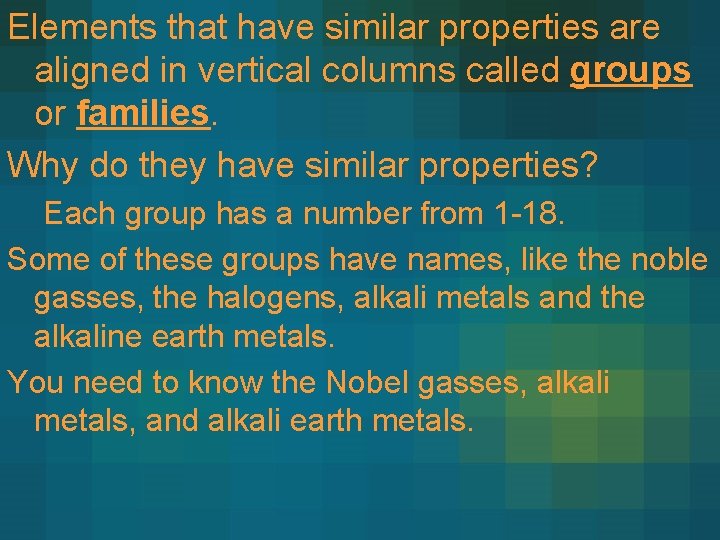
Elements that have similar properties are aligned in vertical columns called groups or families. Why do they have similar properties? Each group has a number from 1 -18. Some of these groups have names, like the noble gasses, the halogens, alkali metals and the alkaline earth metals. You need to know the Nobel gasses, alkali metals, and alkali earth metals.
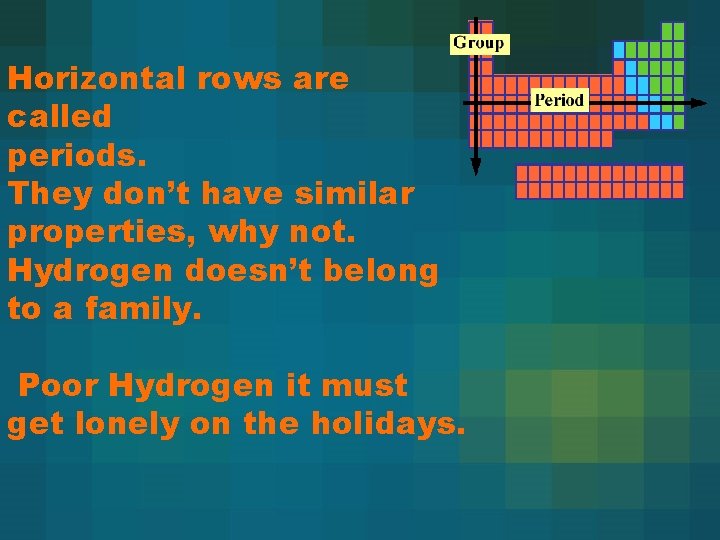
Horizontal rows are called periods. They don’t have similar properties, why not. Hydrogen doesn’t belong to a family. Poor Hydrogen it must get lonely on the holidays.
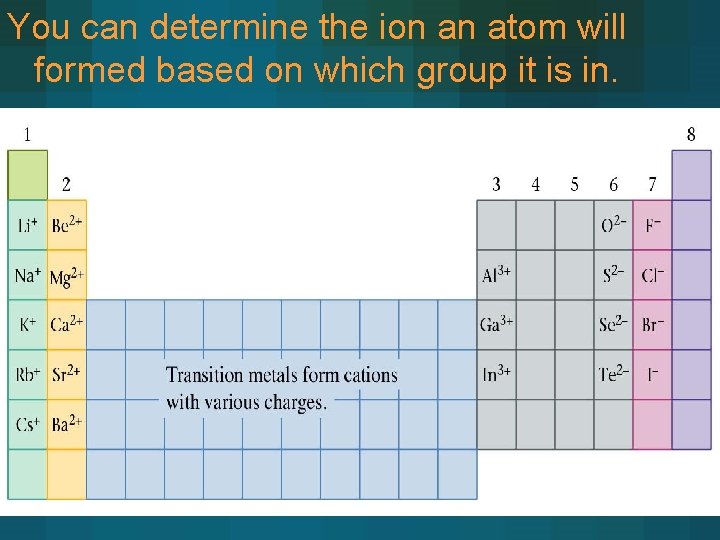
You can determine the ion an atom will formed based on which group it is in.
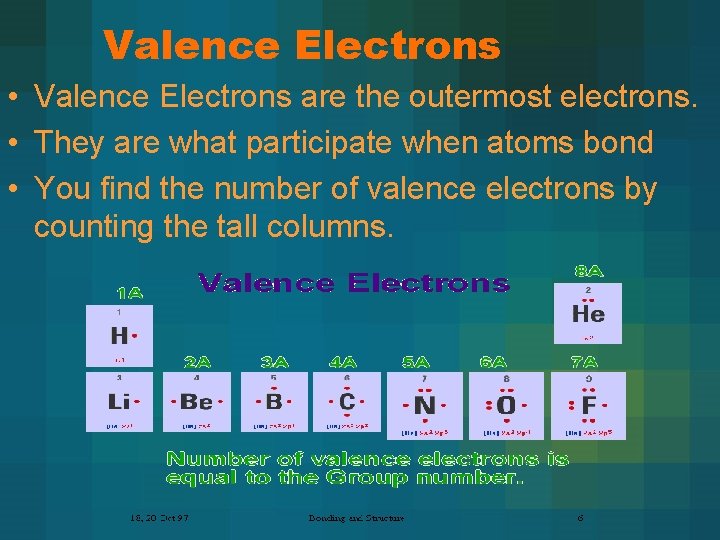
Valence Electrons • Valence Electrons are the outermost electrons. • They are what participate when atoms bond • You find the number of valence electrons by counting the tall columns.
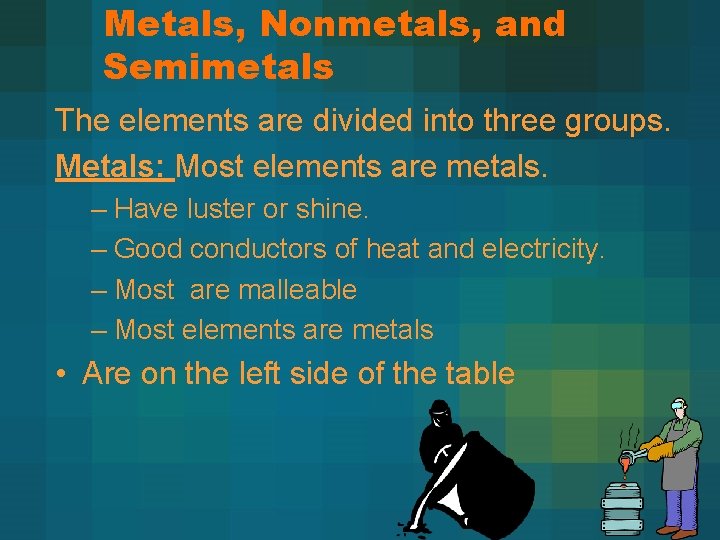
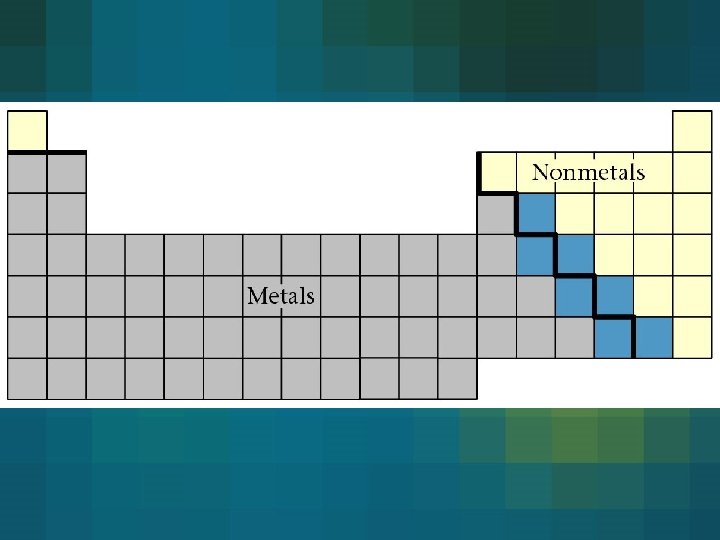
Metals, Nonmetals, and Semimetals The elements are divided into three groups. Metals: Most elements are metals. – Have luster or shine. – Good conductors of heat and electricity. – Most are malleable – Most elements are metals • Are on the left side of the table
Nonmetals – Most are poor conductors of heat and electricity – Do not have luster • Are on the right side of the table
Semimetals (Metalloids): – Can have some properties of a metal and some properties of a nonmetal – Or can have properties in between that of metal and nonmetal properties – Very important for industry • Are located in-between metals and non metals on stairway.
Br. INCl. HOF