
The Atom A walk through the historical development







- Slides: 35
The Atom A walk through the historical development of the atom
THE ANCIENT GREEKS
Democritus 400 B. C. E. The world is made-up of: Empty Space Tiny particles (called atoms)
PROBLEM
Aristotle • He proposed matter was continuous • It was not composed of tiny particles • The concept of earth, wind, air and fire as elements was born
Who did they follow for years? Aristotle
17 TH CENTURY
• People (scientists) began to express doubt about Aristotle’s idea on matter. • Isaac Newton (inventor of calculus) and Robert Boyle began publishing articles in support of an atom centered world. • But, they did not have any experimental evidence to back-up their claim.
Lavoisier He found that the mass of a reaction remains the same in a closed system. This is known as the conservation of mass law
Proust He found that certain substances always contain the same ratios by mass. 2 H = 1 O H 2 O Known as the law of definite proportions
Dalton John Dalton took the information from Lavoiser and Proust to form his 4 part proposal. 1. All matter is composed of atoms that are indivisible.
2. Atoms of the same element are identical; atoms of different elements are dissimilar. 3. Atoms can unite with other atoms in simple numerical ratios to form compounds (law of multiple proportions) 4. A chemical reaction involves only the separation, combination or rearrangement of atoms; it does not result in their reaction or destruction.
Particle Model is Born
Accepted or Ignored? Oh, it was ignored Why? He did not have enough experimental evidence to support all of his claims.
J. L. Gay Lussac • He observed that by keeping temperature and pressure constant, the volume of reacting gases and the products are in small whole numbers.
Ameloe Avagadro He stated: “equal volumes of gases under the same conditions, have the same number of molecules. ”
Getting inside the atom Going beyond the particle model
MIDDLE OF THE 19 TH CENTURY
J. J. Thomson • Used a cathode ray tube to determine the ratio of an electron’s charge to its mass. • He did this by bending the rays and carefully measuring the resulting bend. http: //www. youtube. com/watch? v=7 YHw. MWcx e. X 8
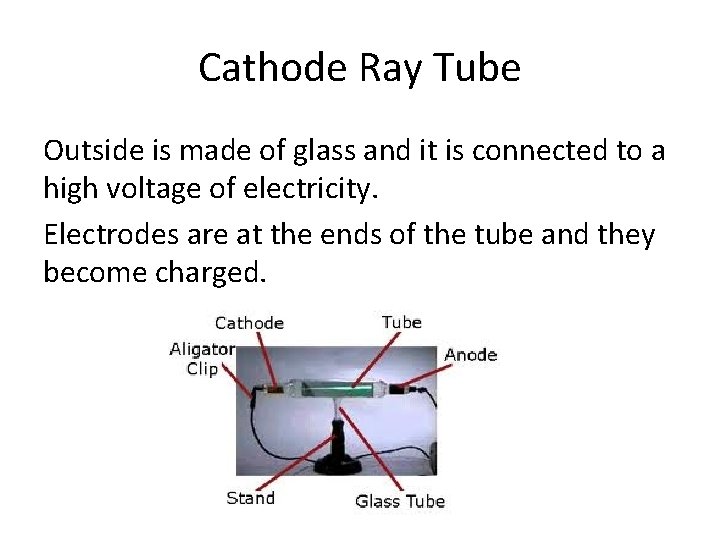
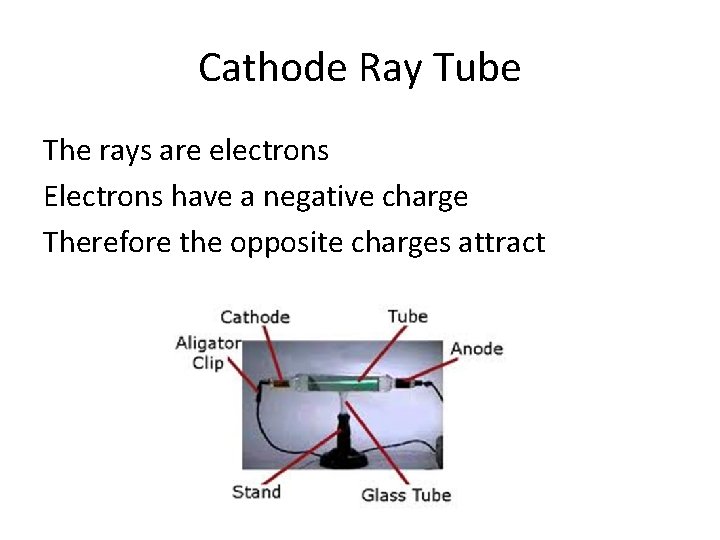
Cathode Ray Tube Outside is made of glass and it is connected to a high voltage of electricity. Electrodes are at the ends of the tube and they become charged.
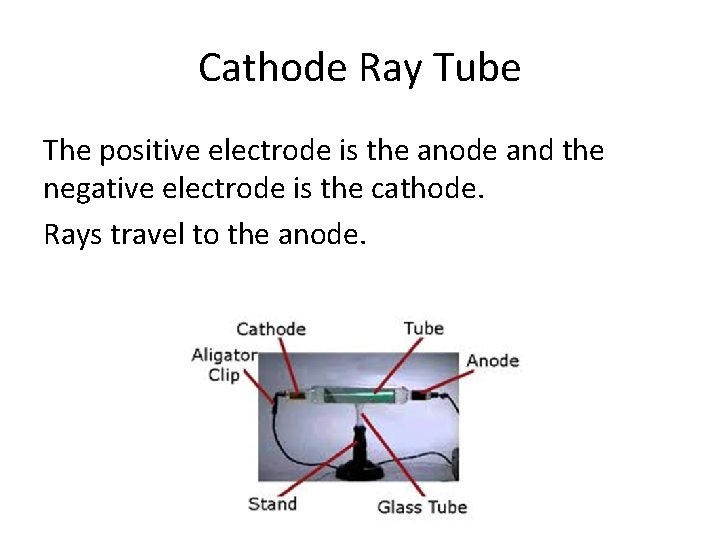
Cathode Ray Tube The positive electrode is the anode and the negative electrode is the cathode. Rays travel to the anode.
Cathode Ray Tube The rays are electrons Electrons have a negative charge Therefore the opposite charges attract
Robert Millikan Obtained the 1 st accurate measurement of an electron’s charge. He used oil drops and charged plates
Oil Drop Using Millikan and Thomson’s discoveries, we know the mass of an electron.
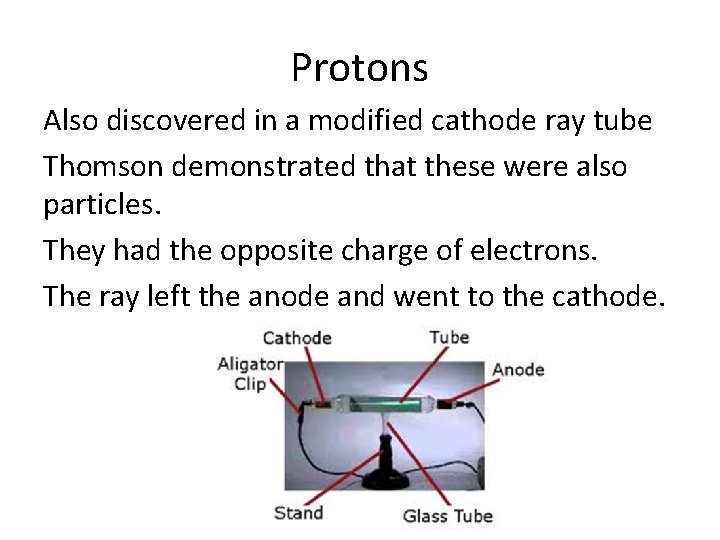
Protons Also discovered in a modified cathode ray tube Thomson demonstrated that these were also particles. They had the opposite charge of electrons. The ray left the anode and went to the cathode.
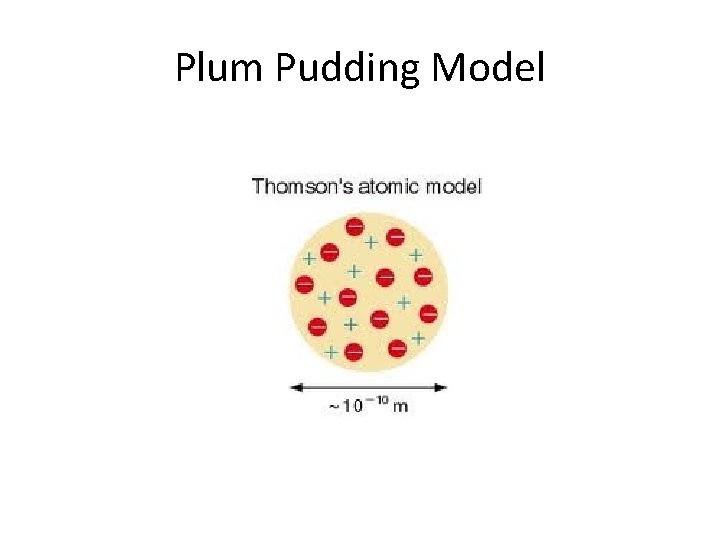
Plum Pudding Model
1920 Lord Rutherford predicted the existence of a third particle This was due to the lack of mass accounted by the total mass of the protons and the electrons 1930 1 st evidence of the 3 rd particle 1932 Chadwick had concrete evidence published which established the existence of the neutron This particle had no charge and it approximately had the same mass as a proton.
Lord Rutherford provided evidence that the plum pudding model might not work based upon faulty predictions. It predicts that if you shoot small particles at the atom, many of these particles will reflect back. Very few will pass through.
What they discovered was that most of the particles passed right through, but some were deflected. A few particles came right back to the point where the particles were shot.
What this suggested: The large particles are not spread out throughout the atom. The alpha particles had a positive charge So…. they needed to revise the plum pudding model.
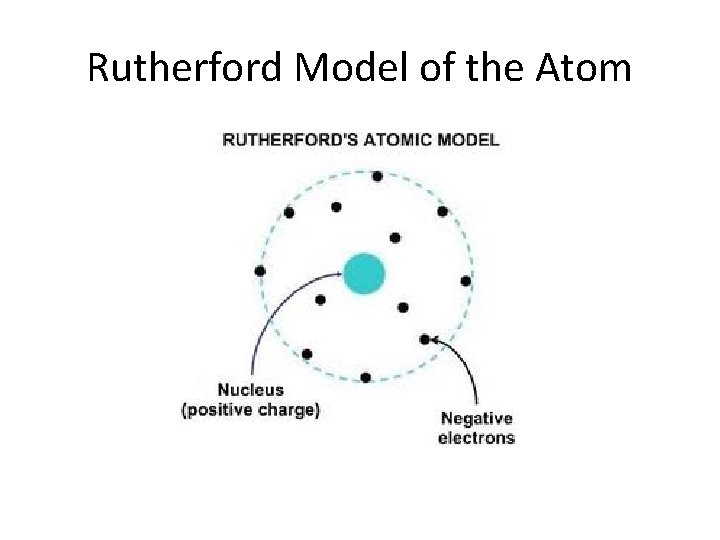
The revision moved the protons to the center with the electrons outside. (at this time they did not have neutrons, since that particle was not discovered until the 1930’s) The protons were moved to the center because they were large and they had a positive charge (like charges repel).
Rutherford Model of the Atom
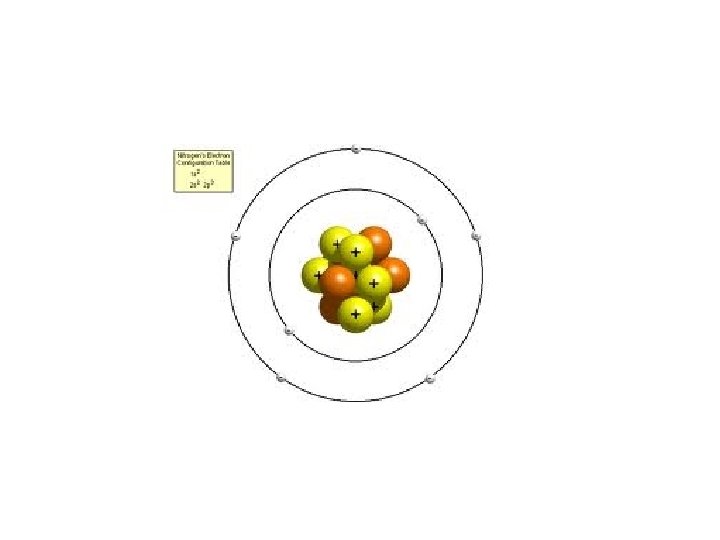
Bohr Model The Bohr Model further refined Rutherford’s proton centered model by have the electrons in concentric circles orbiting the center. The central area was named the nucleus. The Bohr model is sometimes called the planetary atomic model.