
The ATLAS Run 2 Expert System Giuseppe Avolio
- Slides: 21
The ATLAS Run 2 Expert System Giuseppe Avolio - CERN
Outline • Expert Systems in ATLAS TDAQ – Why? – From Run 1 to Run 2 • Introducing a Complex Event Processing engine – ESPER from Esper. Tech • Intelligent systems in Run 2 – The Central Hint and Information Processor (CHIP) – The Shifter Assistant • A different point of view – The Shifter Assistant Replay (SAReplay) • Conclusions and outlook 12/04/2016 Giuseppe Avolio - DAQ@LHC 2
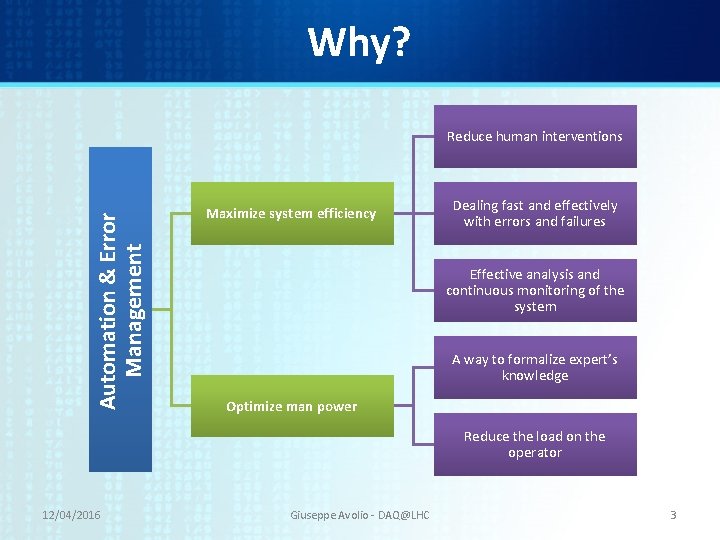
Why? Automation & Error Management Reduce human interventions Maximize system efficiency Dealing fast and effectively with errors and failures Effective analysis and continuous monitoring of the system A way to formalize expert’s knowledge Optimize man power Reduce the load on the operator 12/04/2016 Giuseppe Avolio - DAQ@LHC 3
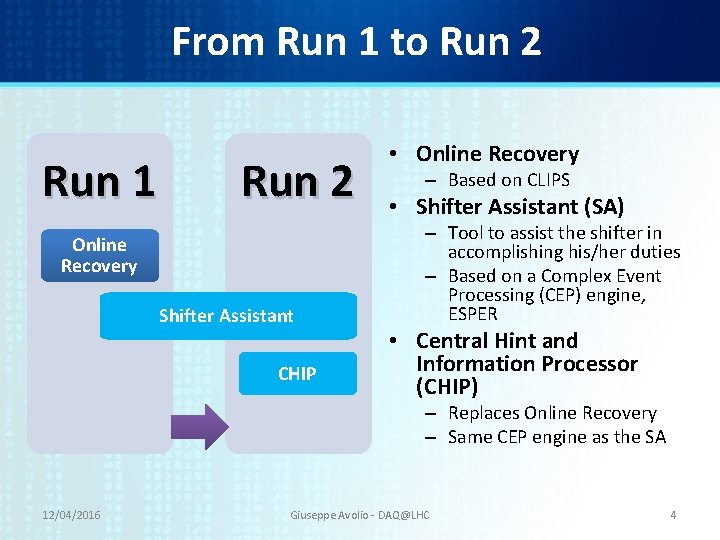
From Run 1 to Run 2 Run 1 Run 2 Online Recovery Shifter Assistant CHIP • Online Recovery – Based on CLIPS • Shifter Assistant (SA) – Tool to assist the shifter in accomplishing his/her duties – Based on a Complex Event Processing (CEP) engine, ESPER • Central Hint and Information Processor (CHIP) – Replaces Online Recovery – Same CEP engine as the SA 12/04/2016 Giuseppe Avolio - DAQ@LHC 4
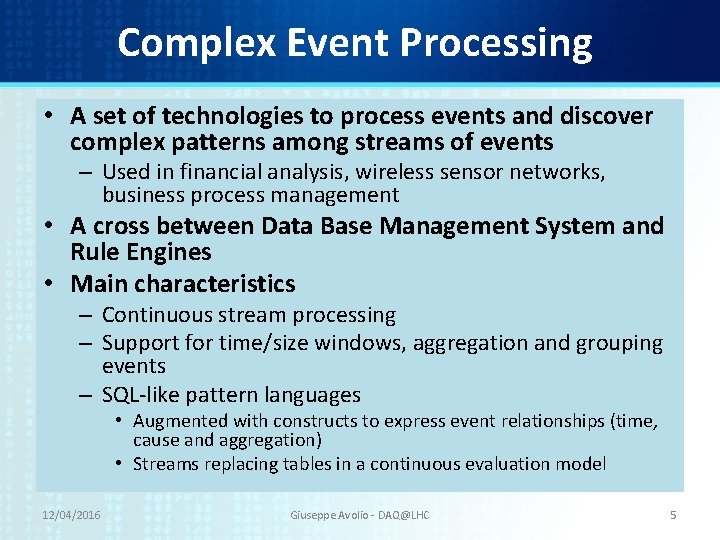
Complex Event Processing • A set of technologies to process events and discover complex patterns among streams of events – Used in financial analysis, wireless sensor networks, business process management • A cross between Data Base Management System and Rule Engines • Main characteristics – Continuous stream processing – Support for time/size windows, aggregation and grouping events – SQL-like pattern languages • Augmented with constructs to express event relationships (time, cause and aggregation) • Streams replacing tables in a continuous evaluation model 12/04/2016 Giuseppe Avolio - DAQ@LHC 5
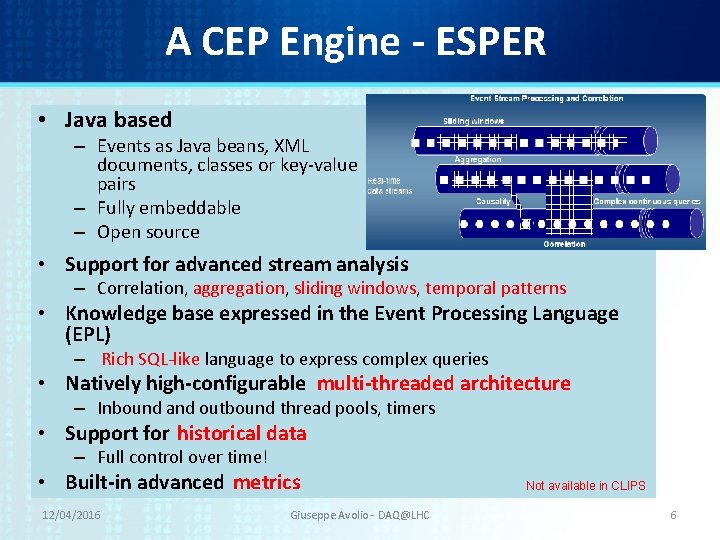
A CEP Engine - ESPER • Java based – Events as Java beans, XML documents, classes or key-value pairs – Fully embeddable – Open source • Support for advanced stream analysis – Correlation, aggregation, sliding windows, temporal patterns • Knowledge base expressed in the Event Processing Language (EPL) – Rich SQL-like language to express complex queries • Natively high-configurable multi-threaded architecture – Inbound and outbound thread pools, timers • Support for historical data – Full control over time! • Built-in advanced metrics 12/04/2016 Giuseppe Avolio - DAQ@LHC Not available in CLIPS 6
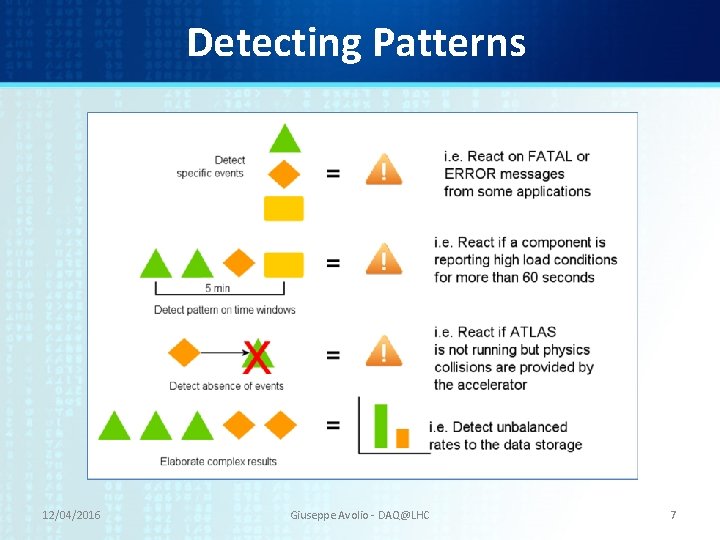
Detecting Patterns 12/04/2016 Giuseppe Avolio - DAQ@LHC 7
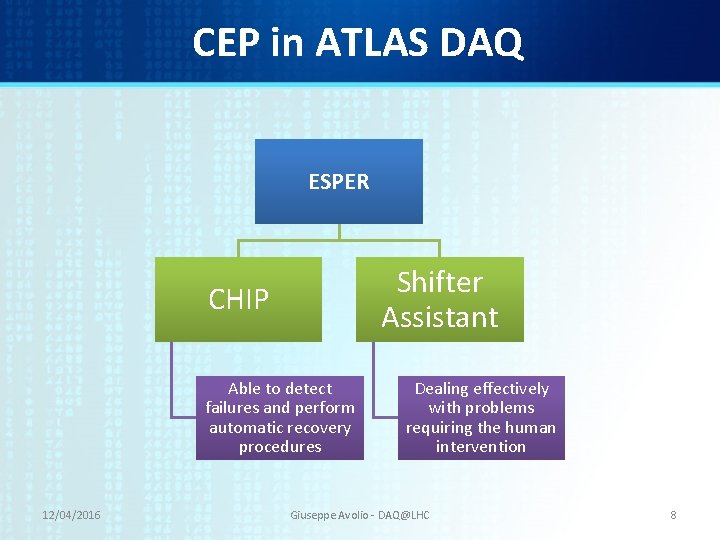
CEP in ATLAS DAQ ESPER Shifter Assistant CHIP Able to detect failures and perform automatic recovery procedures 12/04/2016 Dealing effectively with problems requiring the human intervention Giuseppe Avolio - DAQ@LHC 8
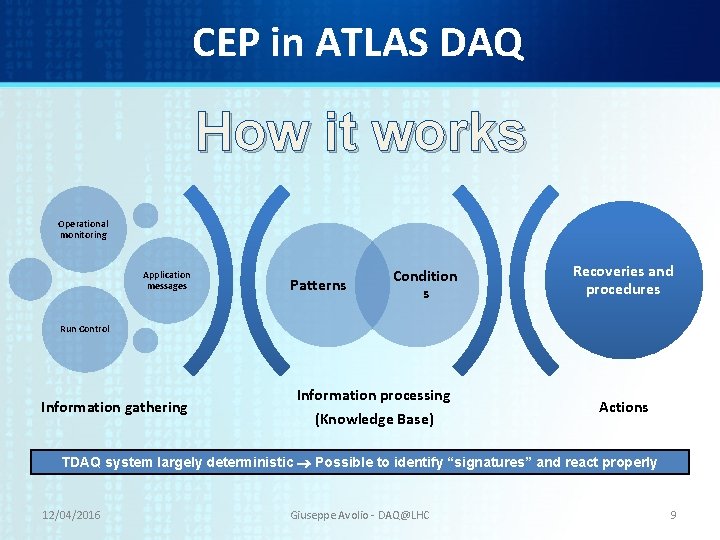
CEP in ATLAS DAQ How it works Operational monitoring Application messages Patterns Condition s Recoveries and procedures Run Control Information gathering Information processing (Knowledge Base) Actions TDAQ system largely deterministic Possible to identify “signatures” and react properly 12/04/2016 Giuseppe Avolio - DAQ@LHC 9
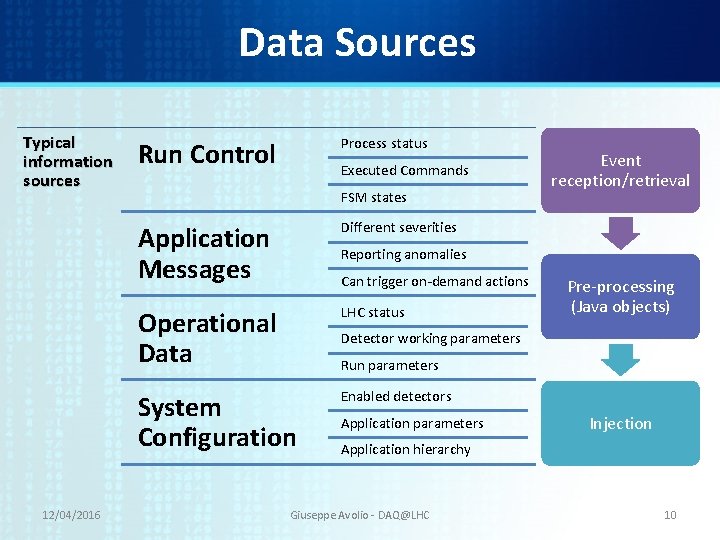
Data Sources Typical information sources 12/04/2016 Process status Run Control Executed Commands FSM states Application Messages Different severities Operational Data LHC status System Configuration Enabled detectors Event reception/retrieval Reporting anomalies Can trigger on-demand actions Pre-processing (Java objects) Detector working parameters Run parameters Application parameters Injection Application hierarchy Giuseppe Avolio - DAQ@LHC 10
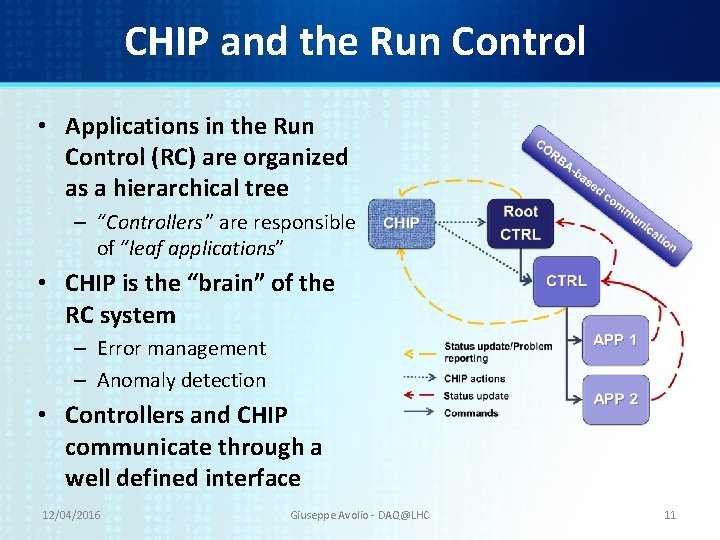
CHIP and the Run Control • Applications in the Run Control (RC) are organized as a hierarchical tree – “Controllers” are responsible of “leaf applications” • CHIP is the “brain” of the RC system – Error management – Anomaly detection • Controllers and CHIP communicate through a well defined interface 12/04/2016 Giuseppe Avolio - DAQ@LHC 11
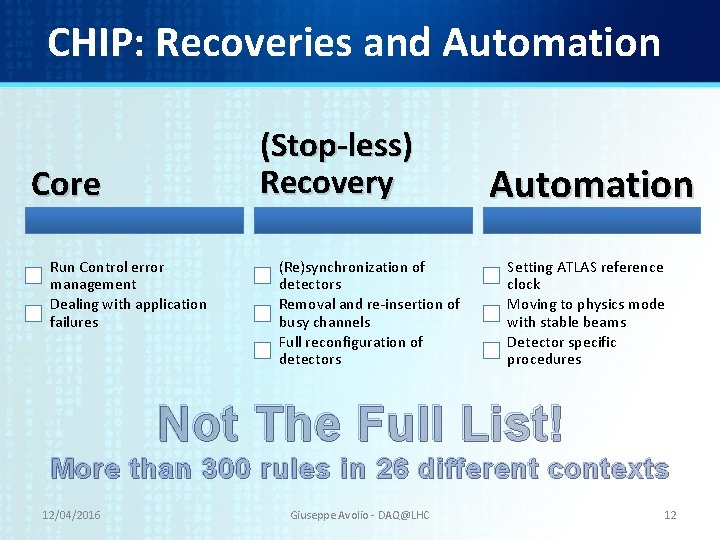
CHIP: Recoveries and Automation (Stop-less) Recovery Core Run Control error management Dealing with application failures (Re)synchronization of detectors Removal and re-insertion of busy channels Full reconfiguration of detectors Automation Setting ATLAS reference clock Moving to physics mode with stable beams Detector specific procedures Not The Full List! More than 300 rules in 26 different contexts 12/04/2016 Giuseppe Avolio - DAQ@LHC 12
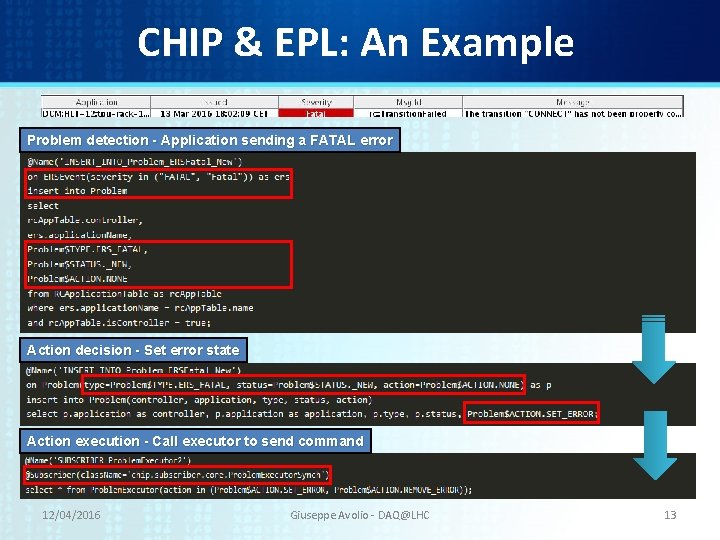
CHIP & EPL: An Example Problem detection - Application sending a FATAL error Action decision - Set error state Action execution - Call executor to send command 12/04/2016 Giuseppe Avolio - DAQ@LHC 13
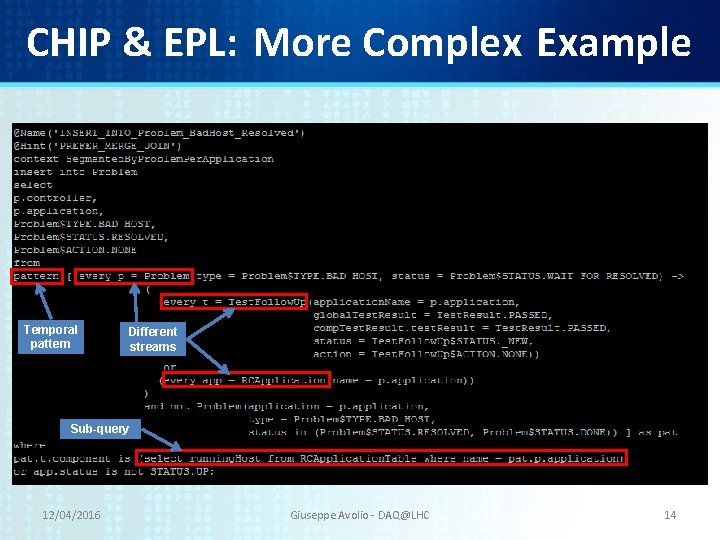
CHIP & EPL: More Complex Example Temporal pattern Different streams Sub-query 12/04/2016 Giuseppe Avolio - DAQ@LHC 14
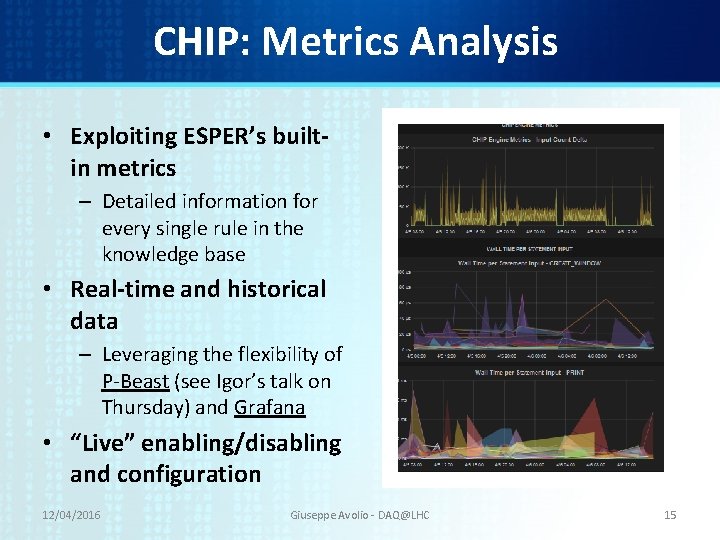
CHIP: Metrics Analysis • Exploiting ESPER’s builtin metrics – Detailed information for every single rule in the knowledge base • Real-time and historical data – Leveraging the flexibility of P-Beast (see Igor’s talk on Thursday) and Grafana • “Live” enabling/disabling and configuration 12/04/2016 Giuseppe Avolio - DAQ@LHC 15
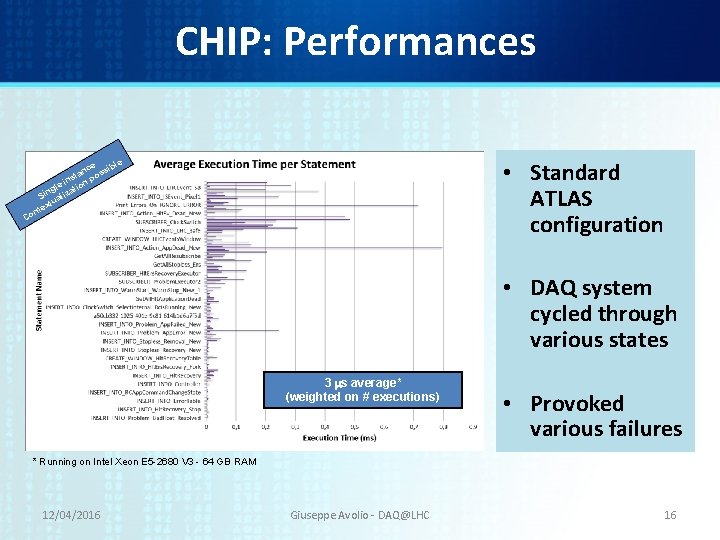
CHIP: Performances • Standard ATLAS configuration le e nc ssib a t o p ins le ation g n Si aliz xtu nte Co • DAQ system cycled through various states 3 s average* (weighted on # executions) • Provoked various failures * Running on Intel Xeon E 5 -2680 V 3 - 64 GB RAM 12/04/2016 Giuseppe Avolio - DAQ@LHC 16
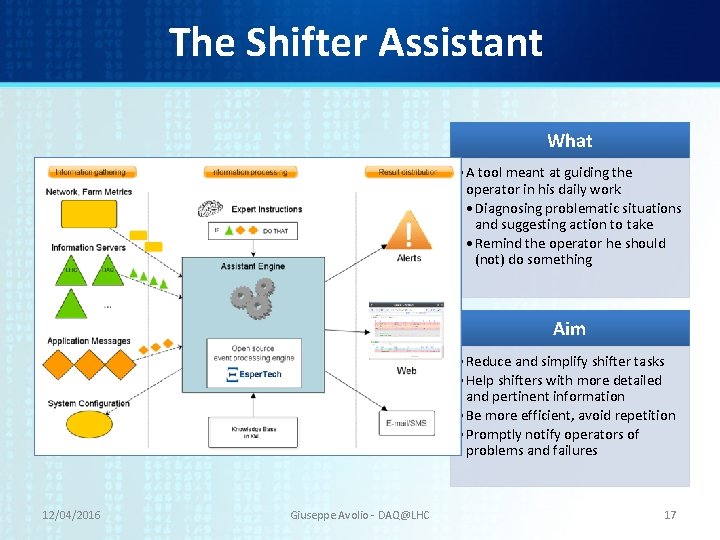
The Shifter Assistant What • A tool meant at guiding the operator in his daily work • Diagnosing problematic situations and suggesting action to take • Remind the operator he should (not) do something Aim • Reduce and simplify shifter tasks • Help shifters with more detailed and pertinent information • Be more efficient, avoid repetition • Promptly notify operators of problems and failures 12/04/2016 Giuseppe Avolio - DAQ@LHC 17
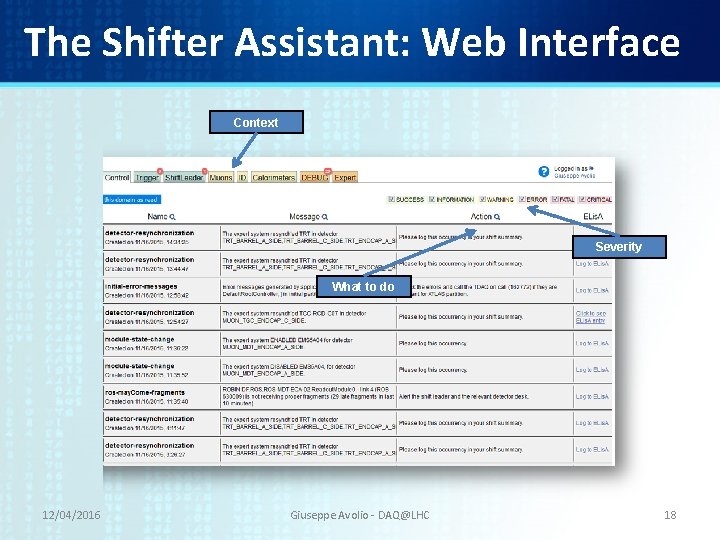
The Shifter Assistant: Web Interface Context Severity What to do 12/04/2016 Giuseppe Avolio - DAQ@LHC 18
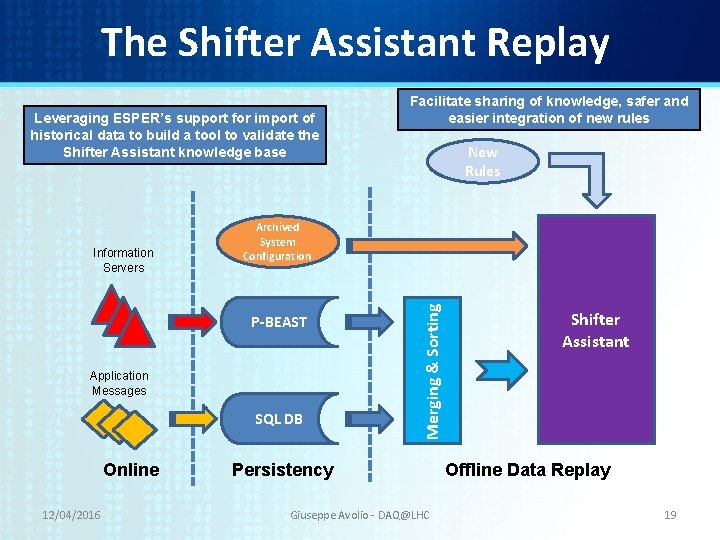
The Shifter Assistant Replay Leveraging ESPER’s support for import of historical data to build a tool to validate the Shifter Assistant knowledge base Archived System Configuration P-BEAST Application Messages SQL DB Online 12/04/2016 New Rules Merging & Sorting Information Servers Facilitate sharing of knowledge, safer and easier integration of new rules Persistency Giuseppe Avolio - DAQ@LHC Shifter Assistant Offline Data Replay 19
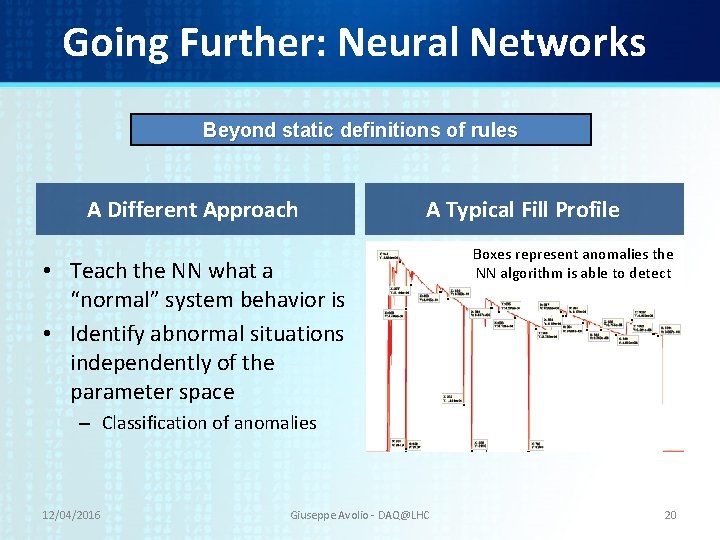
Going Further: Neural Networks Beyond static definitions of rules A Different Approach A Typical Fill Profile • Teach the NN what a “normal” system behavior is • Identify abnormal situations independently of the parameter space Boxes represent anomalies the NN algorithm is able to detect – Classification of anomalies 12/04/2016 Giuseppe Avolio - DAQ@LHC 20
Conclusions & Outlook • In both Run 1 and Run 2 the use of Expert Systems for automation and recovery proved to be a valuable asset – Reduce probability of mistakes – Improve latency (computers are faster than humans…) • The introduction of a CEP engine has added flexibility and simplification – – Improved anomaly detection New complex patterns Re-use of historical data Advanced configuration • Looking forward for more advanced automation and anomaly detection 12/04/2016 Giuseppe Avolio - DAQ@LHC 21