
The ATLAS High Level Trigger Steering Simon George
![Other ATLAS T/DAQ presentations at CHEP 07 • Monday, 03 September 2007 – [421]](https://slidetodoc.com/presentation_image_h2/1ee4c09267a10deda3fc8216ff413b8a/image-16.jpg "Other ATLAS T/DAQ presentations at CHEP 07 • Monday, 03 September 2007 – [421]")
- Slides: 21
The ATLAS High Level Trigger Steering Simon George Royal Holloway, University of London
Authors N. Berger (LAPP Annecy) T. Bold (University of California, Irvine) T. Eifert (Universite de Geneve) G. Fischer (Humboldt-Universitaet zu Berlin) S. George (Royal Holloway, University of London) J. Haller (Universitaet Hamburg) A. Hoecker (CERN) J. Masik (University of Manchester) M. zur Nedden (Humboldt-Universitaet zu Berlin) V. Perez Reale (CERN) C. Risler (Humboldt-Universitaet zu Berlin) C. Schiavi (INFN, Sezione di Genova) J. Stelzer (CERN) X. Wu (Universite de Geneve) With acknowledgement to ATLAS T/DAQ. Simon George CHEP 07 2 -7 Sept Victoria BC Canada The ATLAS High Level Trigger Steering 2
Outline • • Setting the scene: ATLAS trigger Motivation: HLT strategy Solution: HLT Steering details: – – – Trigger Menu Configuration Algorithms Logic Caching • Performance • Monitoring • Conclusions Simon George CHEP 07 2 -7 Sept Victoria BC Canada The ATLAS High Level Trigger Steering 3
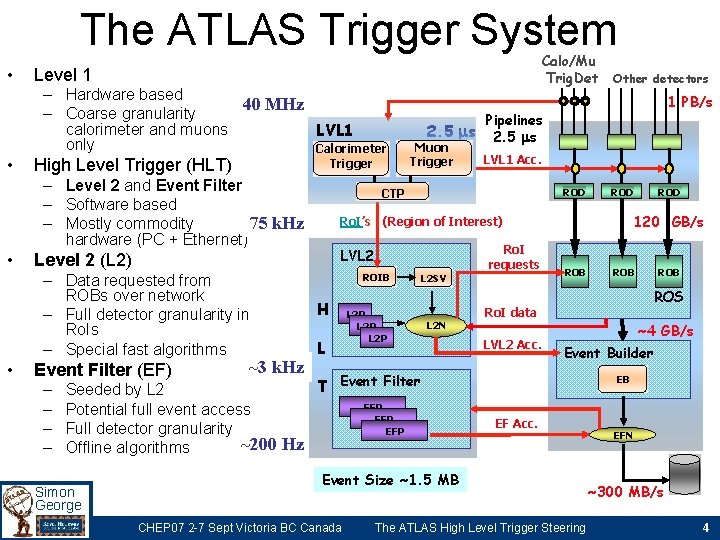
The ATLAS Trigger System • • Level 1 – Hardware based 40 MHz – Coarse granularity calorimeter and muons LVL 1 only Calorimeter High Level Trigger (HLT) Trigger – Level 2 and Event Filter – Software based 75 k. Hz – Mostly commodity hardware (PC + Ethernet) • Event Filter (EF) – – ~3 k. Hz 2. 5 s Muon Trigger 1 PB/s LVL 1 Acc. ROD Ro. I requests LVL 2 ROIB H L L 2 P L 2 SV L 2 N ROB ROB ROS Ro. I data LVL 2 Acc. ~4 GB/s Event Builder EB EF Acc. Event Size ~1. 5 MB CHEP 07 2 -7 Sept Victoria BC Canada ROD 120 GB/s Ro. I’s (Region of Interest) T Event Filter Seeded by L 2 EFP Potential full event access EFP Full detector granularity EFP ~200 Hz Offline algorithms Simon George Other detectors Pipelines 2. 5 s CTP Level 2 (L 2) – Data requested from ROBs over network – Full detector granularity in Ro. Is – Special fast algorithms • Calo/Mu Trig. Det The ATLAS High Level Trigger Steering EFN ~300 MB/s 4
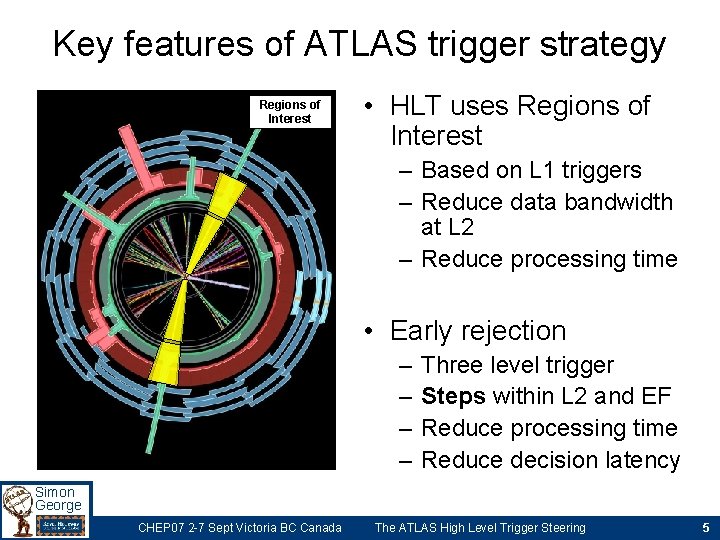
Key features of ATLAS trigger strategy Regions of Interest • HLT uses Regions of Interest – Based on L 1 triggers – Reduce data bandwidth at L 2 – Reduce processing time • Early rejection – – Three level trigger Steps within L 2 and EF Reduce processing time Reduce decision latency Simon George CHEP 07 2 -7 Sept Victoria BC Canada The ATLAS High Level Trigger Steering 5
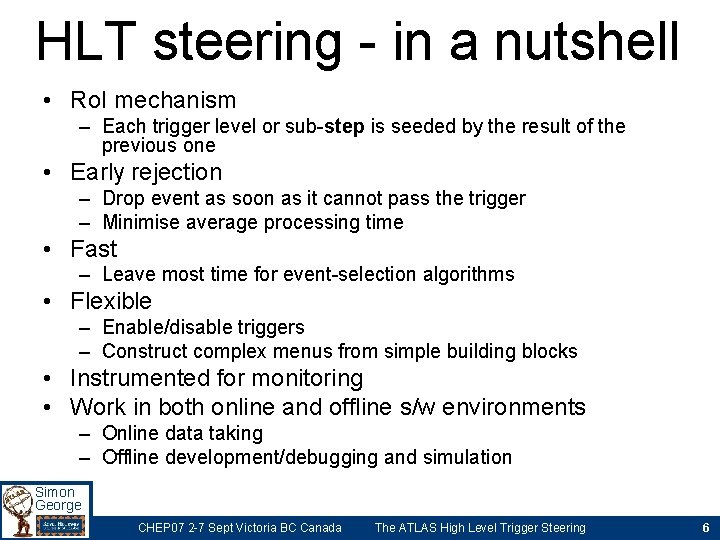
HLT steering - in a nutshell • Ro. I mechanism – Each trigger level or sub-step is seeded by the result of the previous one • Early rejection – Drop event as soon as it cannot pass the trigger – Minimise average processing time • Fast – Leave most time for event-selection algorithms • Flexible – Enable/disable triggers – Construct complex menus from simple building blocks • Instrumented for monitoring • Work in both online and offline s/w environments – Online data taking – Offline development/debugging and simulation Simon George CHEP 07 2 -7 Sept Victoria BC Canada The ATLAS High Level Trigger Steering 6
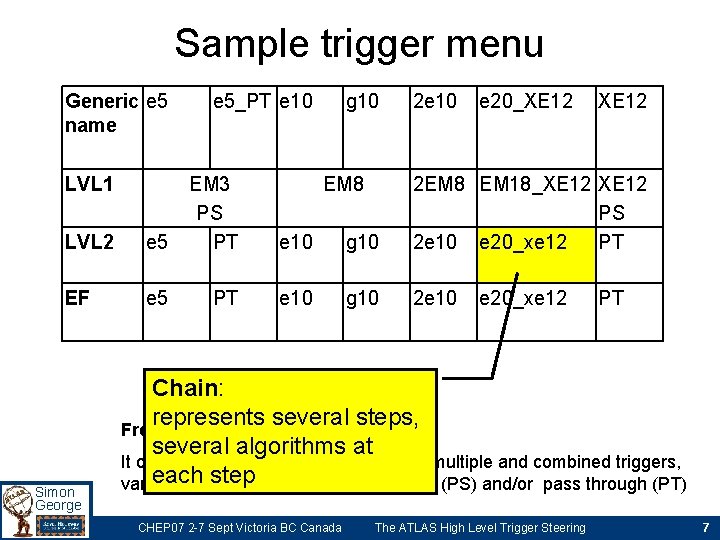
Sample trigger menu Generic e 5 name LVL 1 e 5_PT e 10 LVL 2 e 5 EM 3 PS PT EF e 5 PT Simon George g 10 EM 8 2 e 10 e 20_XE 12 e 10 g 10 2 EM 8 EM 18_XE 12 PS 2 e 10 e 20_xe 12 PT e 10 g 10 2 e 10 e 20_xe 12 PT Chain: represents several steps, From draft 1031 start-up menu. several algorithms at It contains e, g, mu, tau, j, xe, te, je, single, multiple and combined triggers, each step some with pre-scale (PS) and/or pass through (PT) various thresholds, CHEP 07 2 -7 Sept Victoria BC Canada The ATLAS High Level Trigger Steering 7
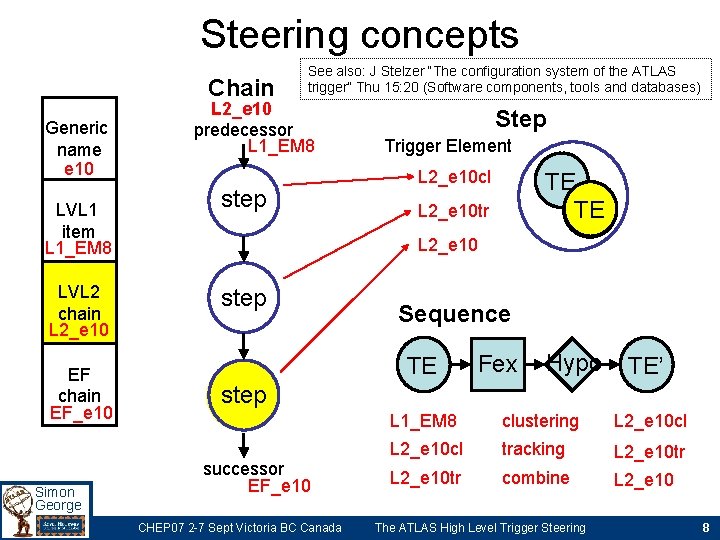
Steering concepts Chain Generic name e 10 LVL 1 item L 1_EM 8 LVL 2 chain L 2_e 10 EF chain EF_e 10 Simon George See also: J Stelzer “The configuration system of the ATLAS trigger” Thu 15: 20 (Software components, tools and databases) L 2_e 10 predecessor L 1_EM 8 step Step Trigger Element L 2_e 10 cl TE TE L 2_e 10 tr L 2_e 10 step Sequence TE Fex Hypo TE’ step successor EF_e 10 CHEP 07 2 -7 Sept Victoria BC Canada L 1_EM 8 clustering L 2_e 10 cl tracking L 2_e 10 tr combine L 2_e 10 The ATLAS High Level Trigger Steering 8
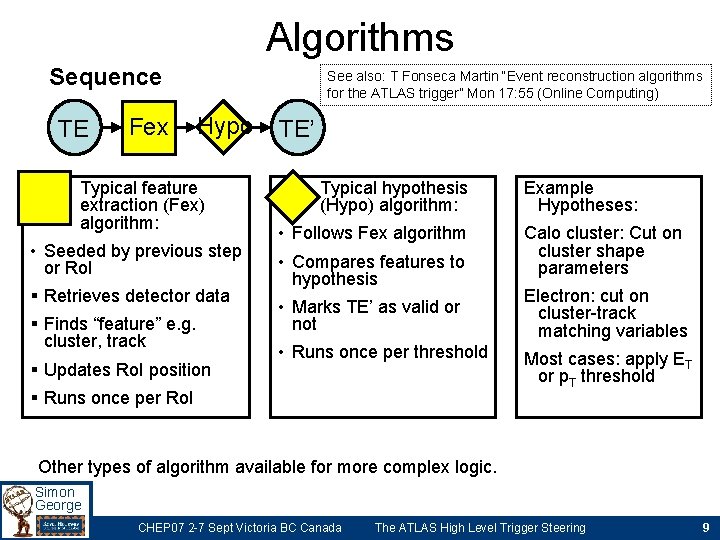
Algorithms Sequence TE Fex See also: T Fonseca Martin “Event reconstruction algorithms for the ATLAS trigger” Mon 17: 55 (Online Computing) Hypo Typical feature extraction (Fex) algorithm: • Seeded by previous step or Ro. I § Retrieves detector data § Finds “feature” e. g. cluster, track § Updates Ro. I position TE’ Typical hypothesis (Hypo) algorithm: • Follows Fex algorithm • Compares features to hypothesis • Marks TE’ as valid or not • Runs once per threshold § Runs once per Ro. I Example Hypotheses: Calo cluster: Cut on cluster shape parameters Electron: cut on cluster-track matching variables Most cases: apply ET or p. T threshold Other types of algorithm available for more complex logic. Simon George CHEP 07 2 -7 Sept Victoria BC Canada The ATLAS High Level Trigger Steering 9
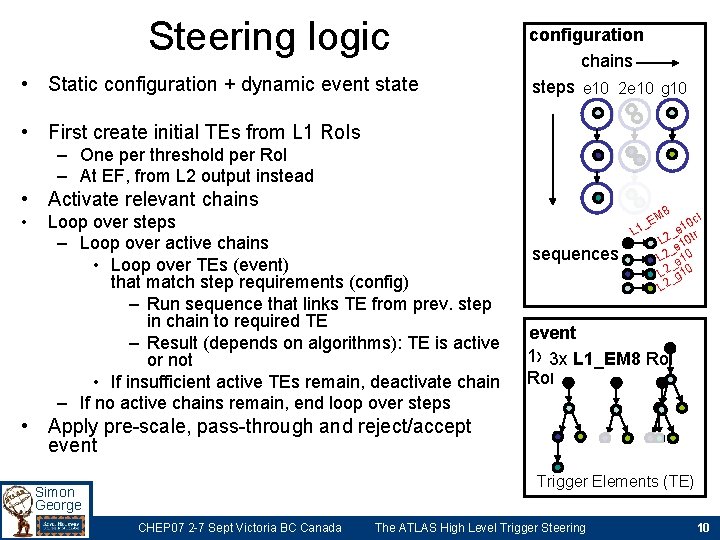
Steering logic • Static configuration + dynamic event state configuration chains steps e 10 2 e 10 g 10 • First create initial TEs from L 1 Ro. Is – One per threshold per Ro. I – At EF, from L 2 output instead • Activate relevant chains • Loop over steps – Loop over active chains • Loop over TEs (event) that match step requirements (config) – Run sequence that links TE from prev. step in chain to required TE – Result (depends on algorithms): TE is active or not • If insufficient active TEs remain, deactivate chain – If no active chains remain, end loop over steps M 8 _E L 1 sequences l 0 c e 1 r _ L 2 10 t _e L 2 e 10 _ L 2 g 10 _ L 2 event 1 x 3 x L 1_EM 8 Ro. I • Apply pre-scale, pass-through and reject/accept event Trigger Elements (TE) Simon George CHEP 07 2 -7 Sept Victoria BC Canada The ATLAS High Level Trigger Steering 10
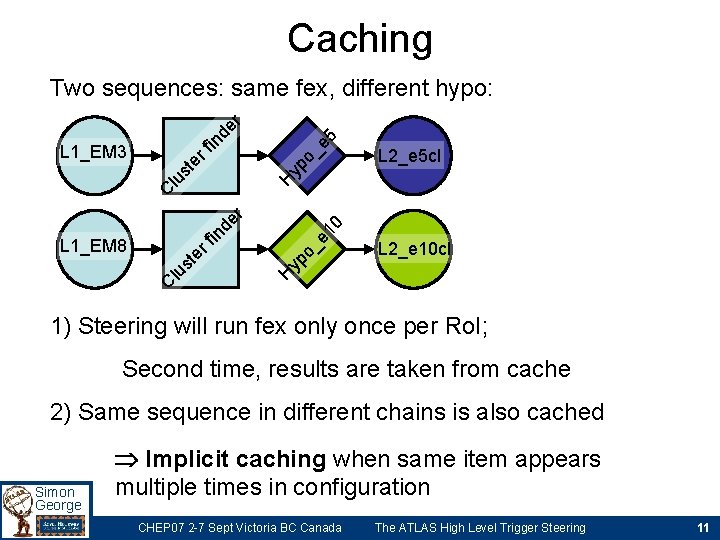
Caching L 2_e 5 cl yp o L 2_e 10 cl H C lu s te rf L 1_EM 8 _e in d 10 er C lu H st yp er L 1_EM 3 o_ fin e 5 de r Two sequences: same fex, different hypo: 1) Steering will run fex only once per Ro. I; Second time, results are taken from cache 2) Same sequence in different chains is also cached Simon George Implicit caching when same item appears multiple times in configuration CHEP 07 2 -7 Sept Victoria BC Canada The ATLAS High Level Trigger Steering 11
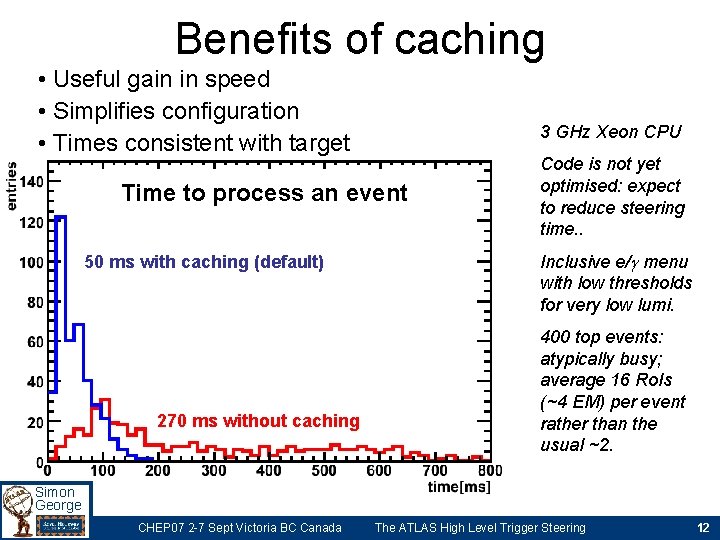
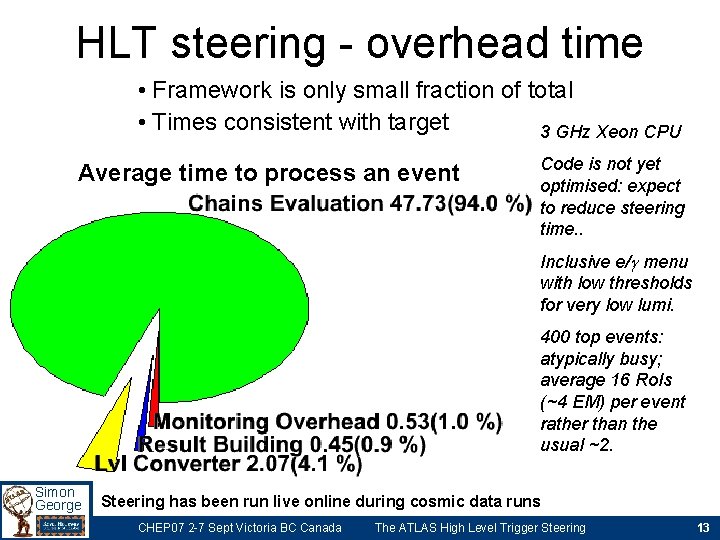
Benefits of caching • Useful gain in speed • Simplifies configuration • Times consistent with target 3 GHz Xeon CPU Time to process an event 50 ms with caching (default) 270 ms without caching Code is not yet optimised: expect to reduce steering time. . Inclusive e/ menu with low thresholds for very low lumi. 400 top events: atypically busy; average 16 Ro. Is (~4 EM) per event rather than the usual ~2. Simon George CHEP 07 2 -7 Sept Victoria BC Canada The ATLAS High Level Trigger Steering 12
HLT steering - overhead time • Framework is only small fraction of total • Times consistent with target 3 GHz Xeon CPU Average time to process an event Code is not yet optimised: expect to reduce steering time. . Inclusive e/ menu with low thresholds for very low lumi. 400 top events: atypically busy; average 16 Ro. Is (~4 EM) per event rather than the usual ~2. Simon George Steering has been run live online during cosmic data runs CHEP 07 2 -7 Sept Victoria BC Canada The ATLAS High Level Trigger Steering 13
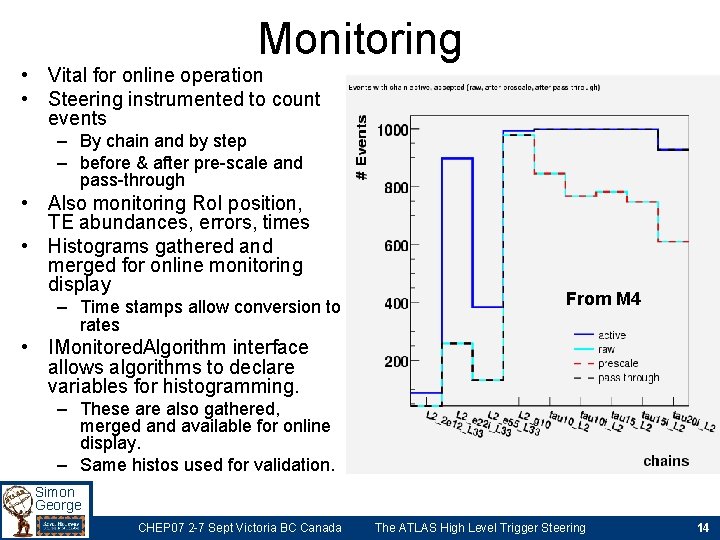
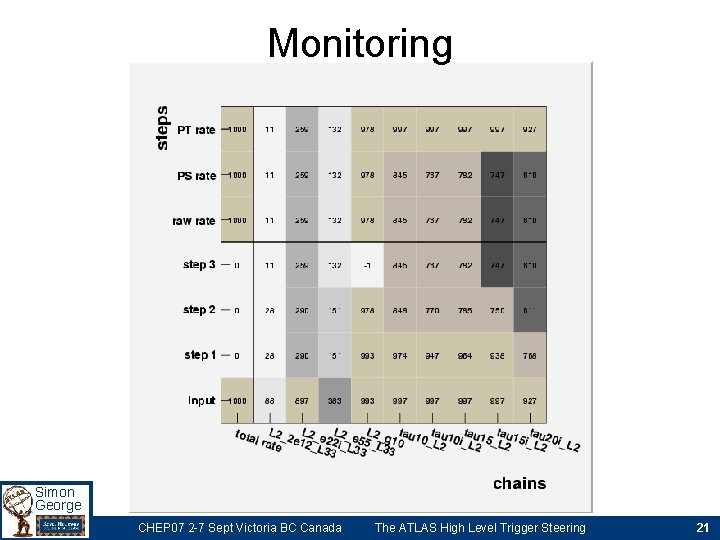
Monitoring • Vital for online operation • Steering instrumented to count events – By chain and by step – before & after pre-scale and pass-through • Also monitoring Ro. I position, TE abundances, errors, times • Histograms gathered and merged for online monitoring display – Time stamps allow conversion to rates From M 4 • IMonitored. Algorithm interface allows algorithms to declare variables for histogramming. – These are also gathered, merged and available for online display. – Same histos used for validation. Simon George CHEP 07 2 -7 Sept Victoria BC Canada The ATLAS High Level Trigger Steering 14
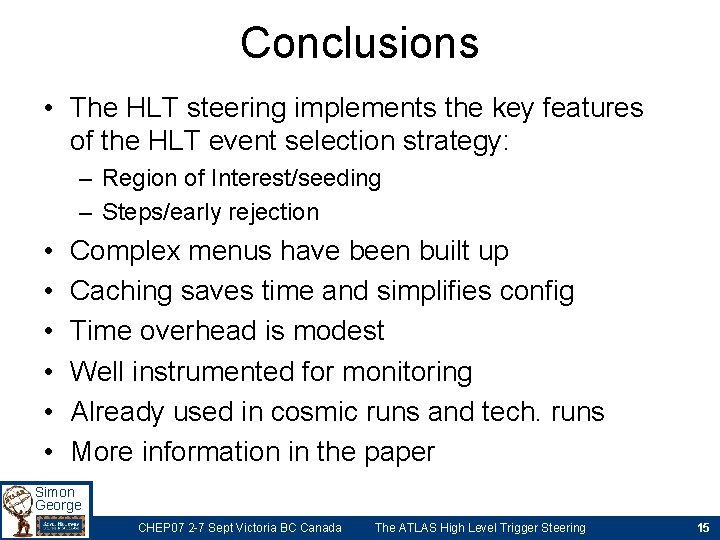
Conclusions • The HLT steering implements the key features of the HLT event selection strategy: – Region of Interest/seeding – Steps/early rejection • • • Complex menus have been built up Caching saves time and simplifies config Time overhead is modest Well instrumented for monitoring Already used in cosmic runs and tech. runs More information in the paper Simon George CHEP 07 2 -7 Sept Victoria BC Canada The ATLAS High Level Trigger Steering 15
Other ATLAS T/DAQ presentations at CHEP 07 • Monday, 03 September 2007 – [421] Implementation and Performance of the ATLAS Second Level Jet Trigger • • – [437] Remote Management of nodes in the ATLAS Online Processing Farms • • – by Dmitry EMELIYANOV (RAL) (Oak Bay: 18: 10 - 18: 25) Wednesday, 05 September 2007 – [112] A software framework for Data Quality Monitoring in ATLAS • • – – by Serguei KOLOS (University of California Irvine) (Oak Bay: 14: 35 - 14: 50) [332] The ATLAS DAQ System Online Configurations Database Service Challenge • • by Igor SOLOVIEV (CERN/PNPI) (Oak Bay: 15: 05 - 15: 20) [45] The ATLAS Trigger: Commissioning with cosmic-rays • • • by Teresa Maria FONSECA MARTIN (CERN) (Oak Bay: 17: 55 - 18: 10) [378] Trigger Selection Software for Beauty physics in ATLAS • • • by Simon GEORGE (Royal Holloway) (Oak Bay: 16: 50 - 17: 05) [339] Event reconstruction algorithms for the ATLAS trigger • • – Marc DOBSON Poster 1 board 21 [143] The ATLAS High Level Trigger Steering • • – Patricia CONDE MUíñO Poster 1 board 19 by Jamie BOYD (CERN) (Lecture Theatre: 17: 30 - 17: 45) Thursday, 06 September 2007 – [28] Integration of the Trigger and Data Acquisition Systems in ATLAS • • – Simon George by Benedetto GORINI (CERN) (Oak Bay: 14: 50 - 15: 05) [50] The configuration system of the ATLAS Trigger • • by Jörg STELZER (CERN, Switzerland) (Lecture Theatre: 15: 20 - 15: 40) CHEP 07 2 -7 Sept Victoria BC Canada The ATLAS High Level Trigger Steering 16
Backup slides
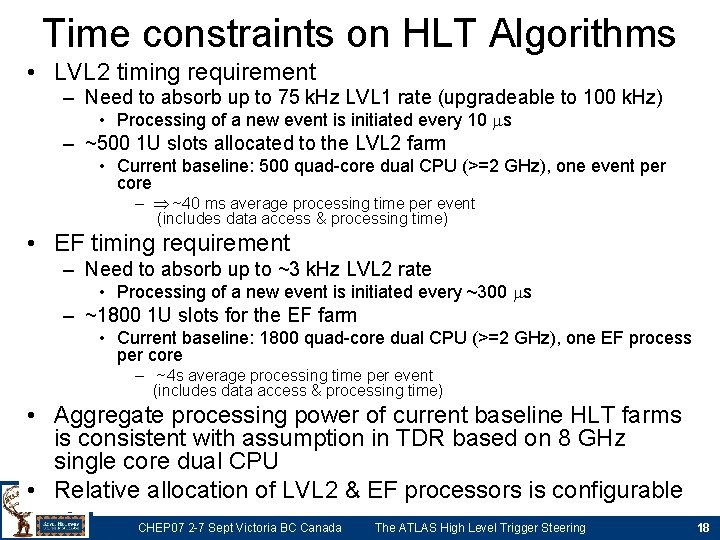
Time constraints on HLT Algorithms • LVL 2 timing requirement – Need to absorb up to 75 k. Hz LVL 1 rate (upgradeable to 100 k. Hz) • Processing of a new event is initiated every 10 s – ~500 1 U slots allocated to the LVL 2 farm • Current baseline: 500 quad-core dual CPU (>=2 GHz), one event per core – ~40 ms average processing time per event (includes data access & processing time) • EF timing requirement – Need to absorb up to ~3 k. Hz LVL 2 rate • Processing of a new event is initiated every ~300 s – ~1800 1 U slots for the EF farm • Current baseline: 1800 quad-core dual CPU (>=2 GHz), one EF process per core – ~4 s average processing time per event (includes data access & processing time) • Aggregate processing power of current baseline HLT farms is consistent with assumption in TDR based on 8 GHz single core dual CPU • Simon Relative allocation of LVL 2 & EF processors is configurable George CHEP 07 2 -7 Sept Victoria BC Canada The ATLAS High Level Trigger Steering 18
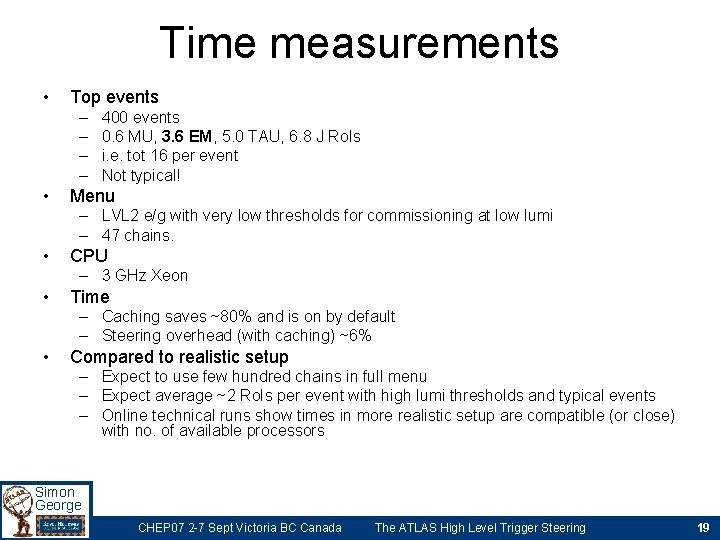
Time measurements • Top events – – • 400 events 0. 6 MU, 3. 6 EM, 5. 0 TAU, 6. 8 J Ro. Is i. e. tot 16 per event Not typical! Menu – LVL 2 e/g with very low thresholds for commissioning at low lumi – 47 chains. • CPU – 3 GHz Xeon • Time – Caching saves ~80% and is on by default – Steering overhead (with caching) ~6% • Compared to realistic setup – Expect to use few hundred chains in full menu – Expect average ~2 Ro. Is per event with high lumi thresholds and typical events – Online technical runs show times in more realistic setup are compatible (or close) with no. of available processors Simon George CHEP 07 2 -7 Sept Victoria BC Canada The ATLAS High Level Trigger Steering 19
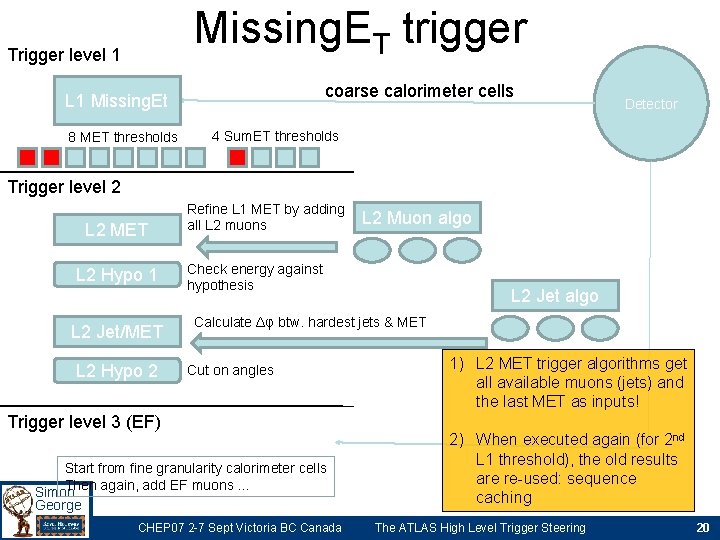
Missing. ET trigger Trigger level 1 coarse calorimeter cells L 1 Missing. Et 8 MET thresholds Detector 4 Sum. ET thresholds Trigger level 2 L 2 MET L 2 Hypo 1 L 2 Jet/MET L 2 Hypo 2 Refine L 1 MET by adding all L 2 muons L 2 Muon algo Check energy against hypothesis L 2 Jet algo Calculate Δφ btw. hardest jets & MET Cut on angles Trigger level 3 (EF) Start from fine granularity calorimeter cells Then again, add EF muons … Simon George CHEP 07 2 -7 Sept Victoria BC Canada 1) L 2 MET trigger algorithms get all available muons (jets) and the last MET as inputs! 2) When executed again (for 2 nd L 1 threshold), the old results are re-used: sequence caching The ATLAS High Level Trigger Steering 20
Monitoring Simon George CHEP 07 2 -7 Sept Victoria BC Canada The ATLAS High Level Trigger Steering 21