
The ATA Certification Examination An Introduction for Translators
- Slides: 30
The ATA Certification Examination An Introduction for Translators Mary C. Maloof, CT
What is ATA certification? ATA certification is one of the industry's most respected and recognized credentials. The ATA Certification Program's goals are to elevate professional standards, enhance individual performance, and identify and recognize translators who possess the professionallevel knowledge and skills necessary to provide quality translation. Certification provides qualified, independent evidence to the client that the translator possesses professional competence in a specific language combination.
Certification is currently available: Ø into English from Arabic, Croatian, Danish, Dutch, French, German, Italian, Japanese, Polish, Portuguese, Russian, Spanish, Swedish, and Ukrainian. Ø from English into Chinese, Croatian, Dutch, Finnish, French, German, Hungarian, Italian, Japanese, Polish, Portuguese, Russian, Spanish, Swedish, and Ukrainian.
How do you get ATA certification? You obtain it by passing the exam for the specific language pair and direction from or into English that you wish to be certified in … … but there are some preliminary steps you must go through before you get to that point!
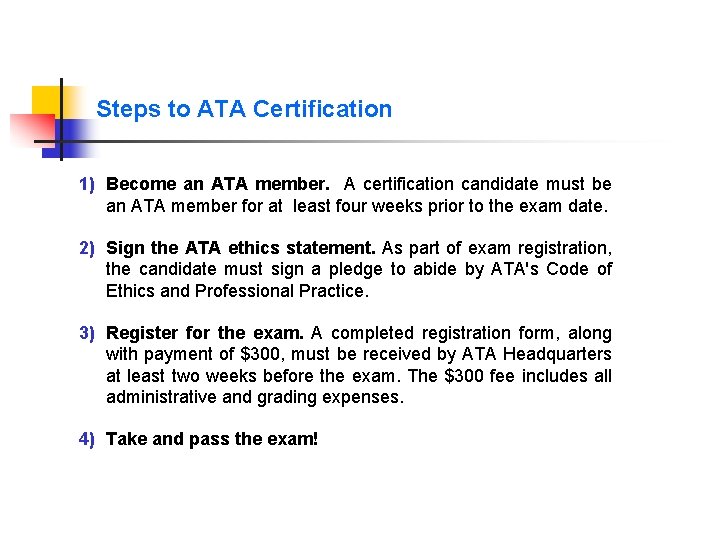
Steps to ATA Certification 1) Become an ATA member. A certification candidate must be an ATA member for at least four weeks prior to the exam date. 2) Sign the ATA ethics statement. As part of exam registration, the candidate must sign a pledge to abide by ATA's Code of Ethics and Professional Practice. 3) Register for the exam. A completed registration form, along with payment of $300, must be received by ATA Headquarters at least two weeks before the exam. The $300 fee includes all administrative and grading expenses. 4) Take and pass the exam!
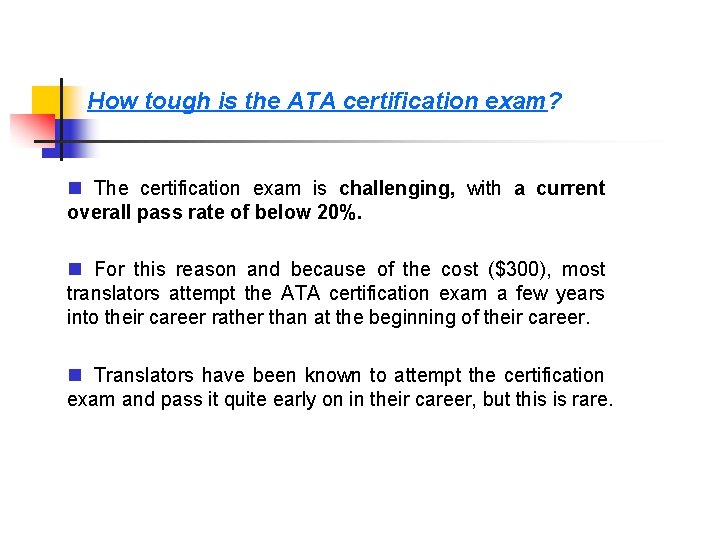
How tough is the ATA certification exam? n The certification exam is challenging, with a current overall pass rate of below 20%. n For this reason and because of the cost ($300), most translators attempt the ATA certification exam a few years into their career rather than at the beginning of their career. n Translators have been known to attempt the certification exam and pass it quite early on in their career, but this is rare.
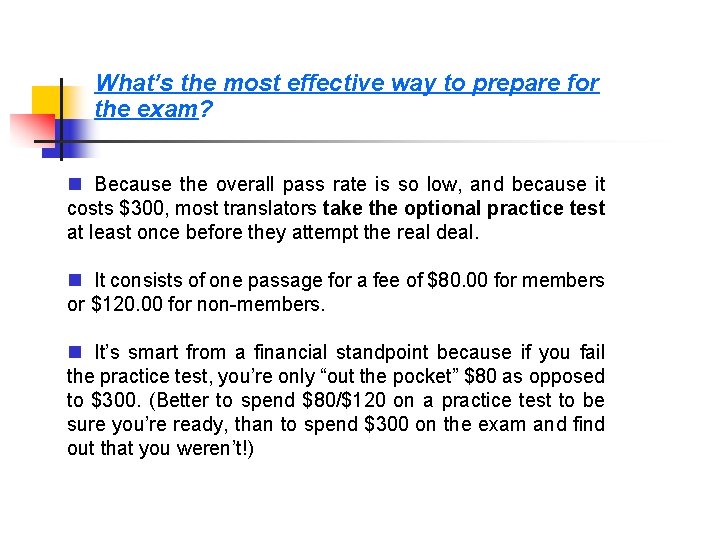
What’s the most effective way to prepare for the exam? n Because the overall pass rate is so low, and because it costs $300, most translators take the optional practice test at least once before they attempt the real deal. n It consists of one passage for a fee of $80. 00 for members or $120. 00 for non-members. n It’s smart from a financial standpoint because if you fail the practice test, you’re only “out the pocket” $80 as opposed to $300. (Better to spend $80/$120 on a practice test to be sure you’re ready, than to spend $300 on the exam and find out that you weren’t!)
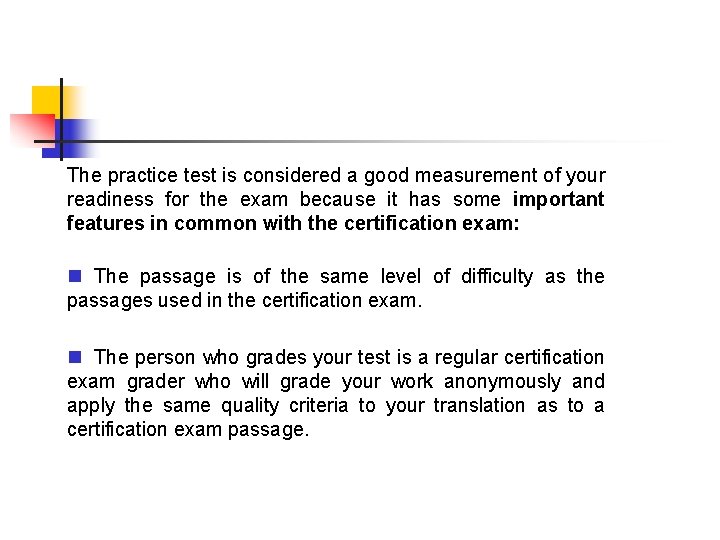
The practice test is considered a good measurement of your readiness for the exam because it has some important features in common with the certification exam: n The passage is of the same level of difficulty as the passages used in the certification exam. n The person who grades your test is a regular certification exam grader who will grade your work anonymously and apply the same quality criteria to your translation as to a certification exam passage.
Where the practice test differs from the certification exam: n You don’t have to be an ATA member to take the practice test. n No time limit is imposed on the practice test. In contrast, the certification exam is strictly limited to three hours, during which you must complete the translation of two passages. If you have decided to take the practice test, and you firmly intend to take the certification exam at some point, you may want to adhere to the same time limits and complete the one passage in 90 minutes.
Where the practice test differs from the certification exam (continued): n The greatest difference between the practice test and the certification exam, and the one that is very advantageous to you, is that whereas a certification exam is not returned to you and you don’t get to see your mistakes, the practice test is a real learning opportunity. It is returned with error markings clearly visible and classified as to type and seriousness. This feedback gives you a reasonable idea of whether you’re ready to take the exam and, if not, where you need more work.
How else can I prepare for the exam? n Learn more about the exam content and grading procedures by consulting the ATA website. Read Tips for Candidates at http: //www. atanet. org/certification/aboutexams_tips. php. n Look for ways to gain more translation experience and improve your language proficiency skills. n Consider enrolling in a translation program or class. n Attend an exam workshop offered by an ATA chapter or affiliate. n Ask translators who have passed the exam for advice.
What should I expect when I take the exam? n The exam is a three-hour, proctored, open book exam. Two out of three passages, 225 to 275 words each, must be translated. n The exam uses actual text lifted from real-world sources for the passages. n Each examination passage is chosen in such a way as to avoid highly specialized terminology challenges requiring research. (There are indeed terminology challenges, but these can be met with one good general bilingual dictionary. )
Translation Instructions In addition to the text to be translated, each examination passage includes Translation Instructions: n They specify the context within which the translation is to be performed (text source and purpose of the translation, target audience, and medium). n They provide specific instructions such as, “This text is intended for educated non-specialists, ” or “Translate xxx as XXX. ” n They can be thought of as reflecting the client's expectations, were the examination a real-life translation assignment. n Follow the Instructions very carefully, as you will be penalized for not following them!
The Computerized Format n While most of the time the ATA certification exam is handwritten, a computerized/keyboarded format is being offered at select sittings. The AAIT will be hosting a computerized sitting on September 16, 2017. n No electronic equipment (i. e. , tablets or smartphones) can be brought in to computerized sittings other than your personal laptop. No personal USB drives either. n You will have Internet access. A limited range of digital resources may be consulted (dictionaries saved on your laptop, online dictionaries, and other reference materials). n NO CAT tools or TMs, e-mail, chat rooms, forums, or MT tools like Google Translate! n Your prep will be more effective if you limit yourself only to the resources that would be available to you during the actual exam.
The Computerized Format (continued) n Candidates taking the computerized format will input their translations using Word. Pad (or Text. Edit for Mac) onto an ATAsupplied USB drive, with grammar and spell check utilities disabled. n They must also sign a statement agreeing to refrain from certain prohibited activities during the sitting (i. e. , use of e-mail and chat rooms, copying the exam passages) and acknowledging the consequences of noncompliance. n These stringent measures are to ensure that the work is the translator's own and that the exam passages are not shared.
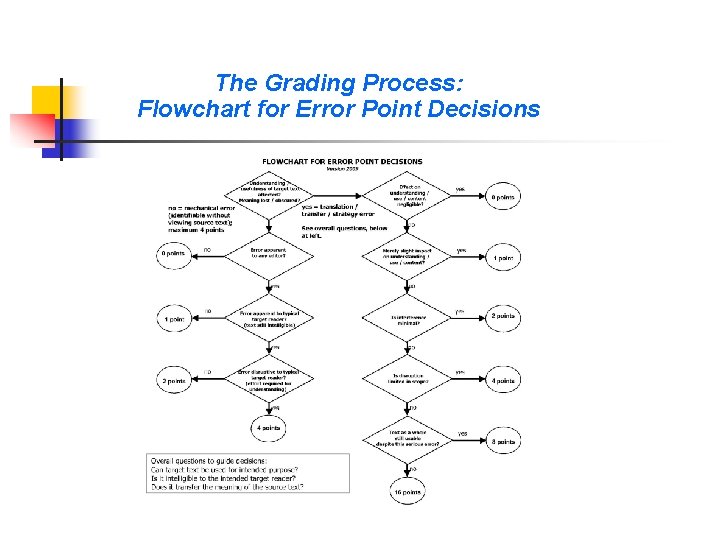
How is the exam graded? n Every exam is independently evaluated by two or more certification program graders to ensure anonymity and objectivity. n The graders will NOT know who you are. n The graders rely on two documents to grade your exam: • • Flowchart for Error Point Decisions Framework for Standardized Error Marking
The Grading Process: Flowchart for Error Point Decisions
The Grading Process (continued) n The Into-English Grading Standards (IEGS) apply to the grading of all ATA certification exams in which English is the target language. It addresses specific points of US English grammar and usage. https: //www. atanet. org/certification/Into_English_Grading_2013. pdf n The exam is pass/fail only. You do not receive a grade, although a point system is used by the graders to rate the seriousness of your errors. n You don’t get your exam back, and you don’t get to see it. You are only notified whether you passed or failed. n You will be notified of the results by letter. Allow at least 16 weeks for the letter to arrive.
What are the benefits of ATA certification? MORE BUSINESS! ATA certification is a voluntary credential; as such, it reflects an individual's strong commitment to the profession and its ethical practice — a distinction that can open doors to new business and higher compensation.
What are the benefits of ATA certification? Voting membership in ATA! If you are an Associate member at the time you pass the certification exam, you are automatically converted to a Voting member. If you are a Student member at the time you pass the exam you must pay an additional $110 in dues to become a Voting members are entitled to be listed as ATA-certified in the Directory of Translators and Interpreters.
What are the benefits of ATA certification? The “CT” Designation! Certified translators may refer to their ATA certification and are entitled to use the “CT” designation after their names in their résumés, online profiles, business stationery, cards, and other related materials, provided they specify the language pair(s) and direction(s) they are certified in. It is a very effective way to telegraph that you are serious about your profession.
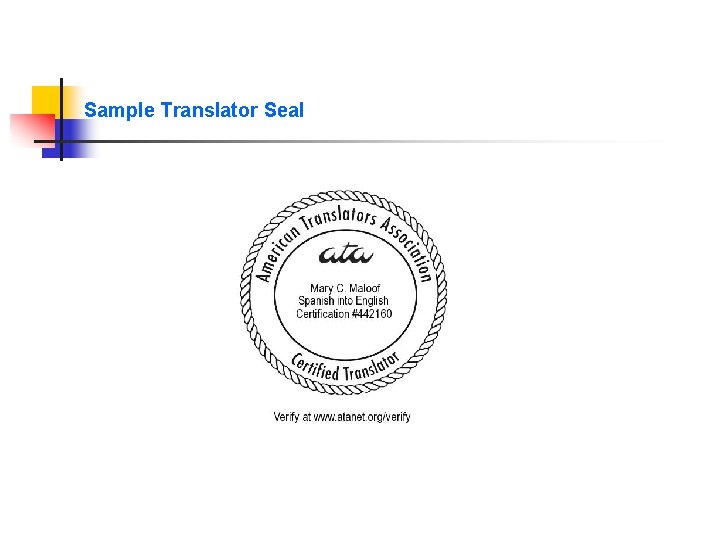
What are the benefits of ATA certification? The Translator Seal! The Seal is a visual representation of your ATA certification. It has your name, language combination, and unique certification number. It also includes a link to an online ATA verification system that allows a client to confirm your certification. It is a. JPG image that can be used to formally attest your ATA certification in documents related to your work. Some translators use the seal in their certification of accuracy statements. Others have had the seal made into an embosser. How you use it is up to you. It is being required more and more often by courts and government agencies for the translation of personal documents such as driver’s licenses, passports, birth certificates, etc. .
Sample Translator Seal
So after I get certified, then what? n ATA certification is not a "been there, done that" credential. It’s part of a program that expects translators to continue to expand their professional knowledge. n Recertification through continuing education is one way ATA-certified translators demonstrate their commitment to that principle. n You must submit 20 hours of continuing education points (CEPs) every three years in order to retain your ATA certification.
Tips n n Bring/use only one good general bilingual dictionary, and maybe one good specialty bilingual dictionary (medical, legal, technical, etc. ), just in case. Bring one monolingual dictionary in your target language if you aren’t a good speller. More than three dictionaries is probably overkill! Read and follow the Translation Instructions for each passage to the letter. Read all three of the passages carefully before deciding which two passages to translate. Do NOT provide alternative translations of a phrase or sentence!! It’s up to you to select a viable translation – the graders won’t do it for you. In fact, alternative translations are considered errors and you will be penalized for providing them!
Tips (continued) n n n Do NOT provide notes or clarifications in brackets unless you’re absolutely sure that readers in the target-language culture will be confused or miss the meaning without it. Do NOT omit an abbreviation, acronym, word or phrase because you can’t find or can’t figure out a good translation for it. Don’t make a notation that it is “not found” or “unknown. ” You will be penalized for doing this. Don’t worry about conversions of measures, distances, currency, etc. You aren’t expected to make conversions. You won’t be penalized if you choose to do conversions, but incorrect conversions WILL be penalized!
Tips (continued) n n Use the same formatting as the original (use boldface where the original uses boldface, underlining or all caps where you see underlining or all caps, reproduce bulleted lists, etc. ). Read through your work carefully when you’re done to ensure it is correct, it flows naturally, and there are no careless omissions of titles, headings, bulleted items, or entire sentences or paragraphs! DON’T STRESS! Do something relaxing (deep breathing, yoga, or something else you enjoy) before the exam. And reward yourself with a little treat after it’s over. If you fail, consider requesting a review.
SOURCES American Translators Association Website: About ATA Certification n https: //www. atanet. org/certification/landing_about_certification. php ATA Certification Program: Frequently Asked Questions n https: //www. atanet. org/certification_FAQ. php
THANK YOU FOR ATTENDING!
Q&A