
The Asthma COPD Overlap Syndrome Artists palette 2003
![The “Dutch” Hypothesis Genetic susceptibility Asthma “bronchitis. Atopy [COPD] and asthma are different patterns](https://slidetodoc.com/presentation_image_h/c42caabba4e31acd24c47f7106447eae/image-3.jpg "The “Dutch” Hypothesis Genetic susceptibility Asthma “bronchitis. Atopy [COPD] and asthma are different patterns")

- Slides: 37
The Asthma COPD Overlap Syndrome “Artist’s palette” 2003 Gordon Hookey (Australia) Branislava Milenkovic Professor of Internal/Respiratory Medicine, University of Belgrade Deputy Director of Clinic for Pulmonary Diseases, Clinical Center of Serbia, Belgrade, Serbia
Disclosures 2010 - 2017 Branislava Milenkovic Lectures: Astra. Zeneca, Boehringer Ingelheim, Chiesi, Glaxo. Smith. Kline, Novartis, Takeda, TEVA Consultancy or national/regional Advisory Boards: Astra. Zeneca, Boehringer Ingelheim, Glaxo. Smith. Kline, Novartis, Educational programmes: no Industry-sponsored grants (Institution): no
The “Dutch” Hypothesis Genetic susceptibility Asthma “bronchitis. Atopy [COPD] and asthma are different patterns of the same. Age Hyperresponsiveness condition” Environmental Factors • Allergen • Infection • Smoking • Air Pollution Chronic Obstructive Pulmonary Disease Orie, Sluter, De. Vries, et al. The Host Factor In Bronchitis, Orie, Sluiter, Eds. Bronchitis, Netherlands, Royal van Gorcumn Press, 1961
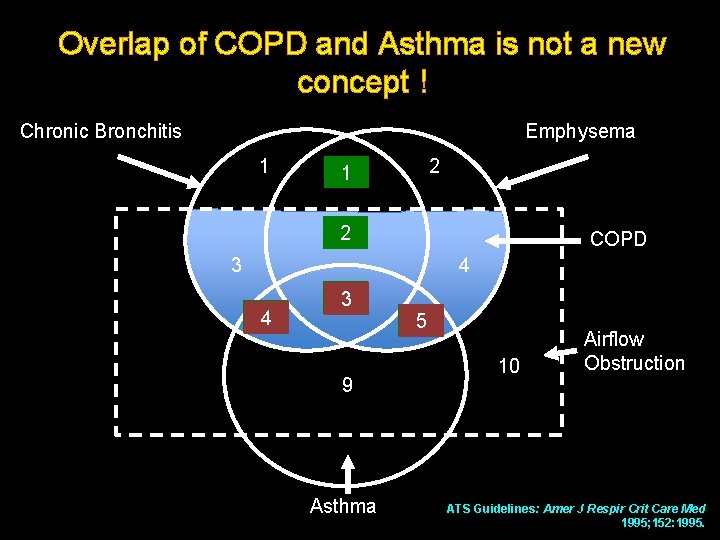
Overlap of COPD and Asthma is not a new concept ! Chronic Bronchitis Emphysema 1 2 11 1 25 COPD 3 4 6 4 38 9 Asthma 75 10 Airflow Obstruction ATS Guidelines: Amer J Respir Crit Care Med 1995; 152: 1995.
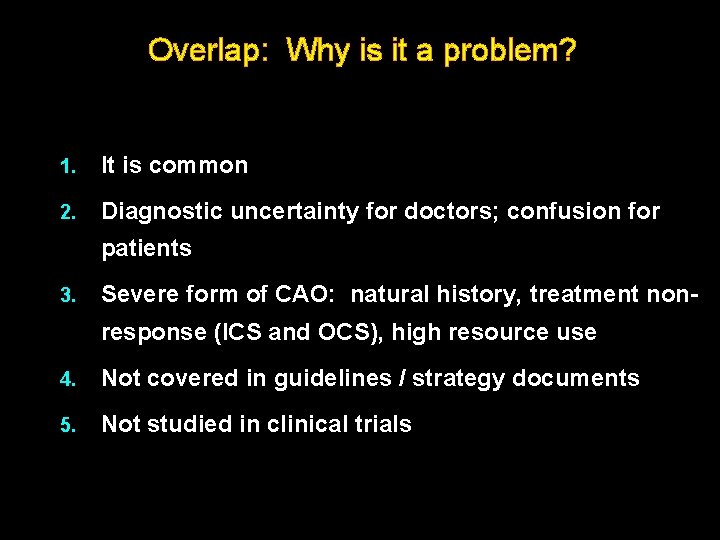
Overlap: Why is it a problem? 1. It is common 2. Diagnostic uncertainty for doctors; confusion for patients 3. Severe form of CAO: natural history, treatment nonresponse (ICS and OCS), high resource use 4. Not covered in guidelines / strategy documents 5. Not studied in clinical trials
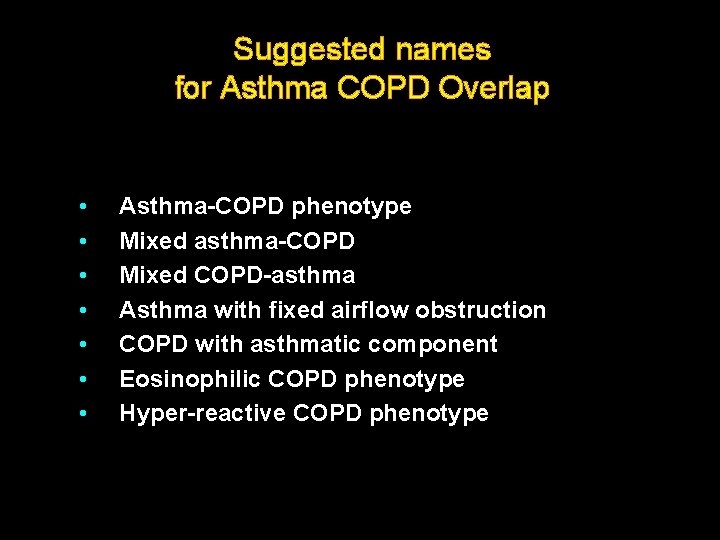
Suggested names for Asthma COPD Overlap • • Asthma-COPD phenotype Mixed asthma-COPD Mixed COPD-asthma Asthma with fixed airflow obstruction COPD with asthmatic component Eosinophilic COPD phenotype Hyper-reactive COPD phenotype
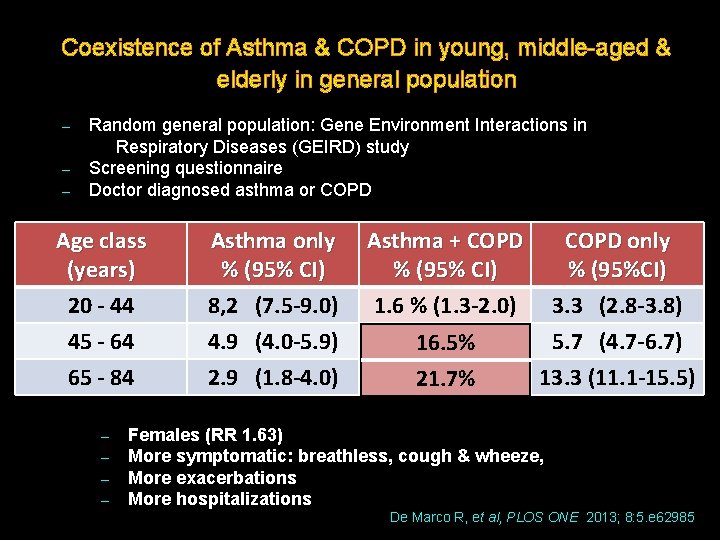
Coexistence of Asthma & COPD in young, middle-aged & elderly in general population Random general population: Gene Environment Interactions in Respiratory Diseases (GEIRD) study – Screening questionnaire – Doctor diagnosed asthma or COPD – Age class (years) 20 - 44 45 - 64 65 - 84 – – Asthma only % (95% CI) 8, 2 (7. 5 -9. 0) 4. 9 (4. 0 -5. 9) 2. 9 (1. 8 -4. 0) Asthma + COPD only % (95% CI) % (95%CI) 1. 6 % (1. 3 -2. 0) 3. 3 (2. 8 -3. 8) 2. 1 16. 5% (1. 5 -2. 8) 5. 7 (4. 7 -6. 7) 4. 5 21. 7% (3. 2 -5. 9) 13. 3 (11. 1 -15. 5) Females (RR 1. 63) More symptomatic: breathless, cough & wheeze, More exacerbations More hospitalizations De Marco R, et al, PLOS ONE 2013; 8: 5. e 62985
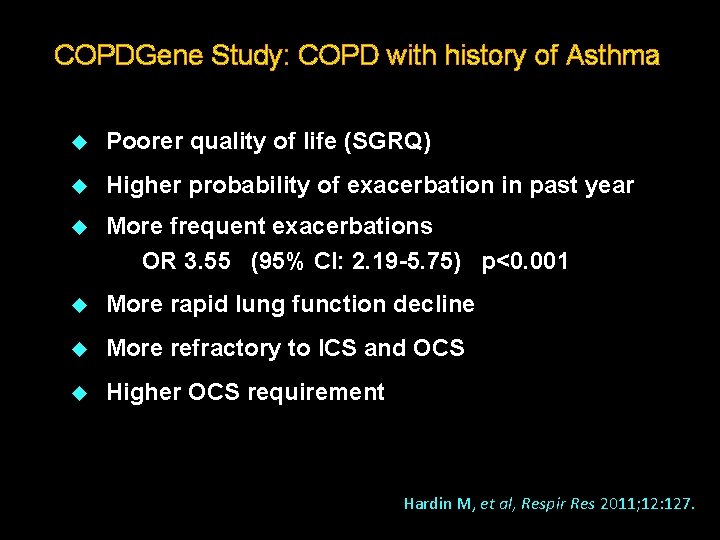
COPDGene Study: COPD with history of Asthma u Poorer quality of life (SGRQ) u Higher probability of exacerbation in past year u More frequent exacerbations OR 3. 55 (95% CI: 2. 19 -5. 75) p<0. 001 u More rapid lung function decline u More refractory to ICS and OCS u Higher OCS requirement Hardin M, et al, Respir Res 2011; 12: 127.
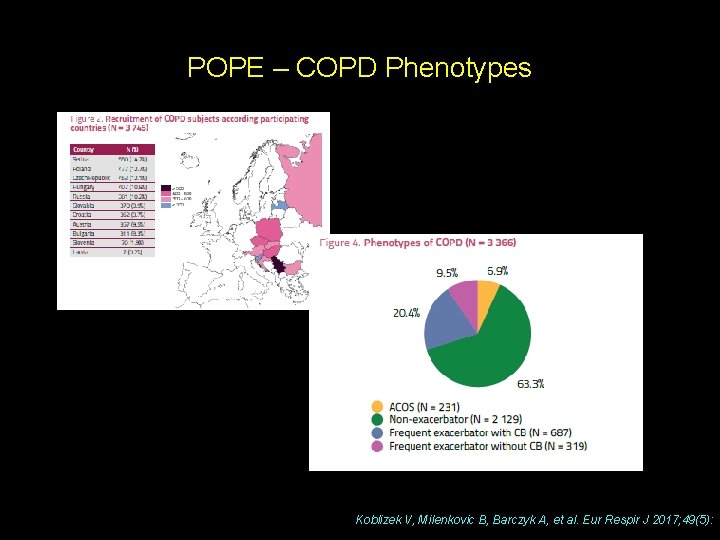
POPE – COPD Phenotypes Koblizek V, Milenkovic B, Barczyk A, et al. Eur Respir J 2017; 49(5):
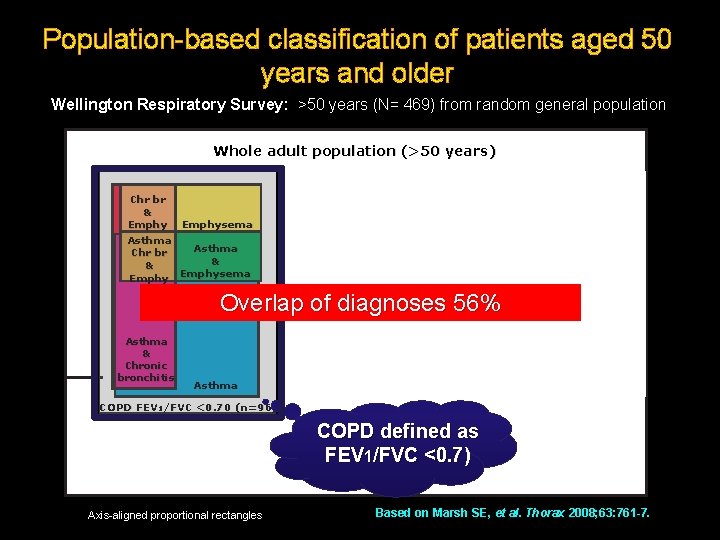
Population-based classification of patients aged 50 years and older Wellington Respiratory Survey: >50 years (N= 469) from random general population Whole adult population (>50 years) Chr br & Emphysema Asthma Chr br & & Emphysema Asthma & Chronic bronchitis Overlap of diagnoses 56% Asthma & Chronic bronchitis FEV 1/FV C >0. 70 Chronic bronchitis Asthma COPD FEV 1/FVC <0. 70 (n=96) COPD defined as FEV 1/FVC <0. 7) Axis-aligned proportional rectangles Based on Marsh SE, et al. Thorax 2008; 63: 761 -7.
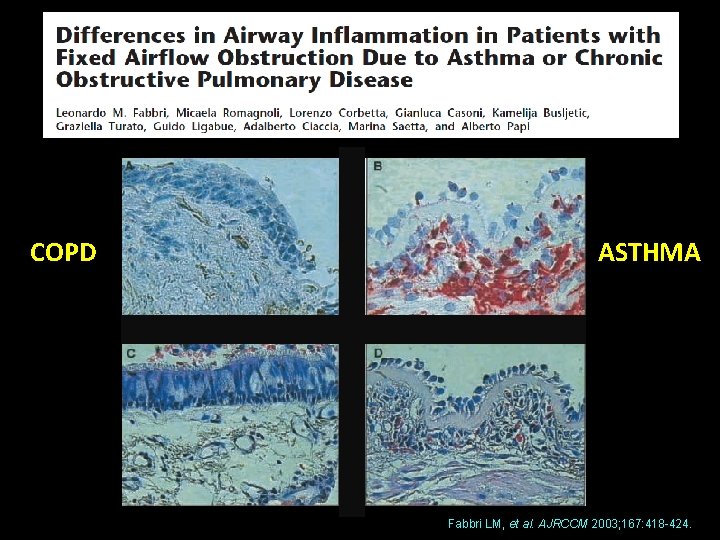
COPD ASTHMA Fabbri LM, et al. AJRCCM 2003; 167: 418 -424.
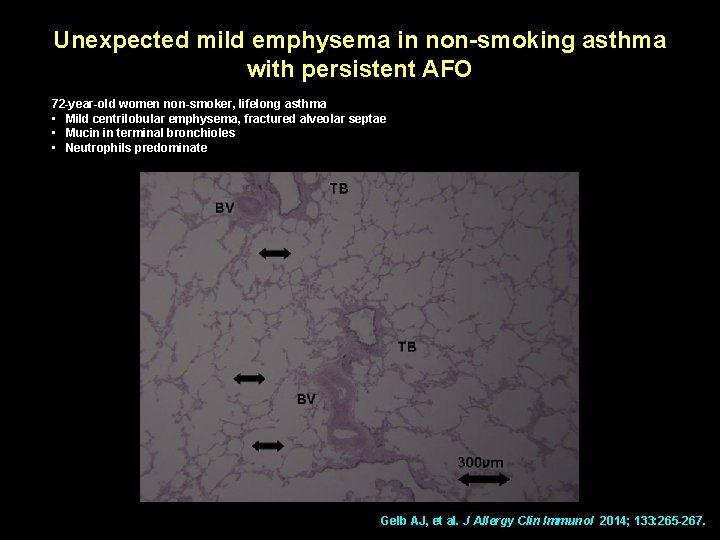
Unexpected mild emphysema in non-smoking asthma with persistent AFO 72 -year-old women non-smoker, lifelong asthma • Mild centrilobular emphysema, fractured alveolar septae • Mucin in terminal bronchioles • Neutrophils predominate Gelb AJ, et al. J Allergy Clin Immunol 2014; 133: 265 -267.
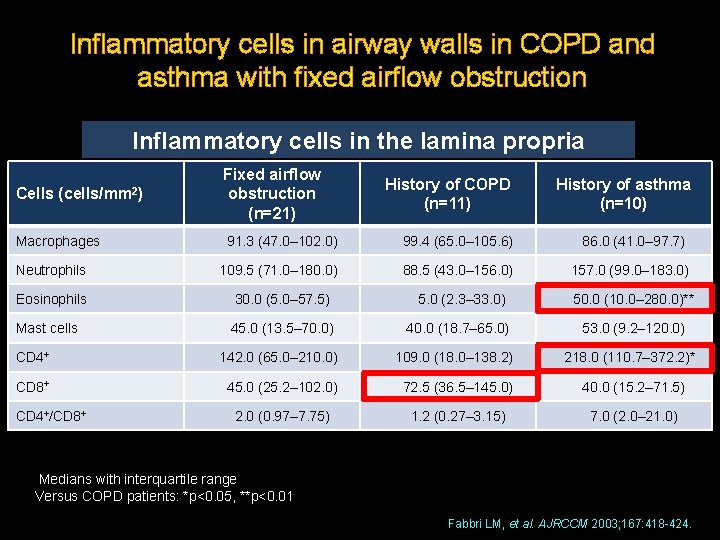
Inflammatory cells in airway walls in COPD and asthma with fixed airflow obstruction Inflammatory cells in the lamina propria Cells (cells/mm 2) Macrophages Fixed airflow obstruction (n=21) History of COPD (n=11) History of asthma (n=10) 91. 3 (47. 0– 102. 0) 99. 4 (65. 0– 105. 6) 86. 0 (41. 0– 97. 7) Neutrophils 109. 5 (71. 0– 180. 0) 88. 5 (43. 0– 156. 0) 157. 0 (99. 0– 183. 0) Eosinophils 30. 0 (5. 0– 57. 5) 5. 0 (2. 3– 33. 0) 50. 0 (10. 0– 280. 0)** Mast cells 45. 0 (13. 5– 70. 0) 40. 0 (18. 7– 65. 0) 53. 0 (9. 2– 120. 0) CD 4+ 142. 0 (65. 0– 210. 0) 109. 0 (18. 0– 138. 2) 218. 0 (110. 7– 372. 2)* CD 8+ 45. 0 (25. 2– 102. 0) 72. 5 (36. 5– 145. 0) 40. 0 (15. 2– 71. 5) 2. 0 (0. 97– 7. 75) 1. 2 (0. 27– 3. 15) 7. 0 (2. 0– 21. 0) CD 4+/CD 8+ Medians with interquartile range Versus COPD patients: *p<0. 05, **p<0. 01 Fabbri LM, et al. AJRCCM 2003; 167: 418 -424.
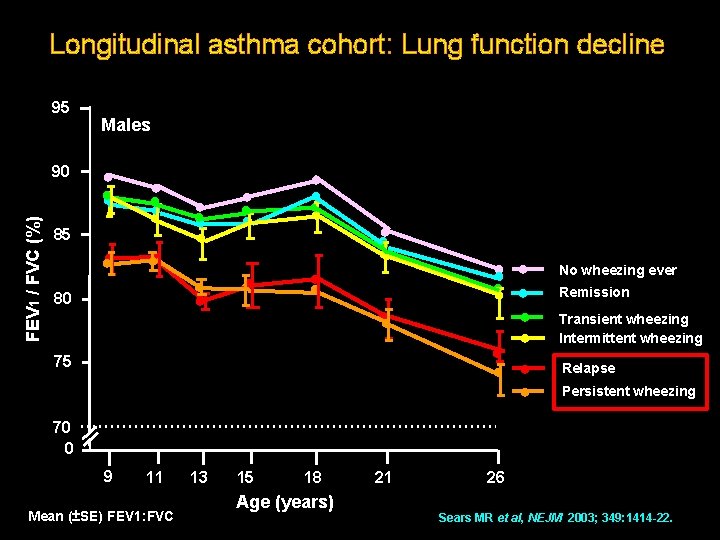
Longitudinal asthma cohort: Lung function decline 95 FEV 1 / FVC (%) 90 Males ● ● ● 85 ●● ● ● ● 80 ● ● ● ●● 75 ● ● ● No wheezing ever Remission Transient wheezing Intermittent wheezing Relapse Persistent wheezing 70 0 9 11 Mean (±SE) FEV 1: FVC 13 15 18 Age (years) 21 26 Sears MR et al, NEJM 2003; 349: 1414 -22.
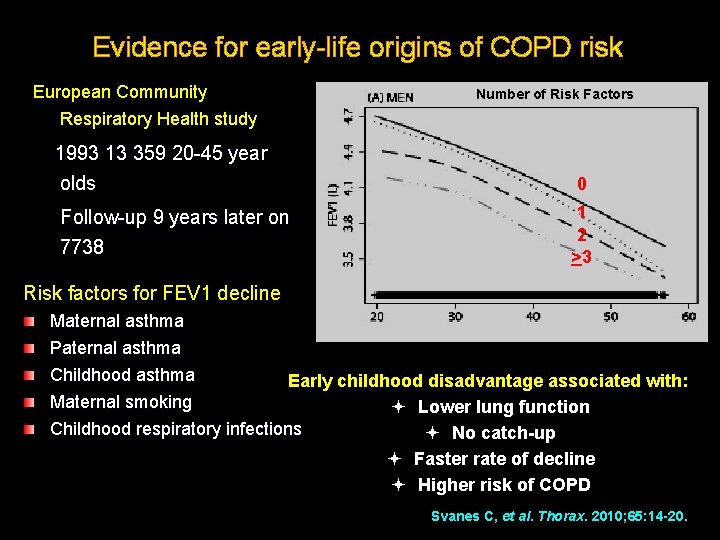
Evidence for early-life origins of COPD risk European Community Respiratory Health study 1993 13 359 20 -45 year olds Follow-up 9 years later on 7738 Number of Risk Factors 0 1 2 >3 Risk factors for FEV 1 decline Maternal asthma Paternal asthma Age (yrs) Childhood asthma Early childhood disadvantage associated with: Maternal smoking Lower lung function Childhood respiratory infections No catch-up Faster rate of decline Higher risk of COPD Svanes C, et al. Thorax. 2010; 65: 14 -20.
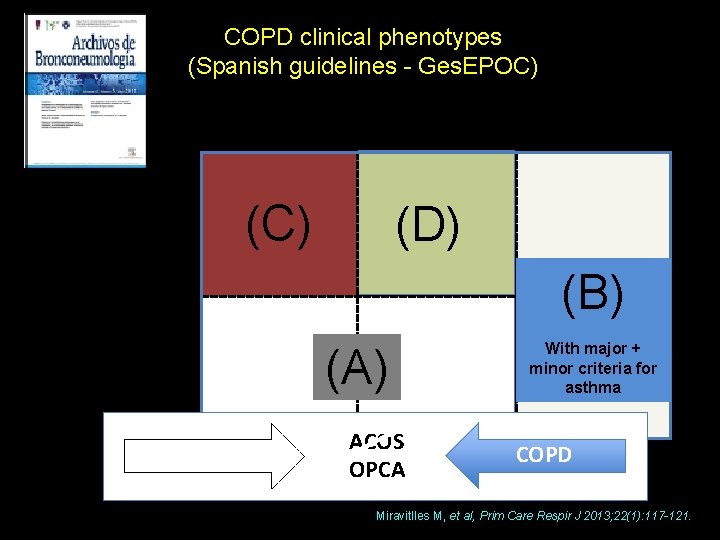
COPD clinical phenotypes (Spanish guidelines - Ges. EPOC) Overlap COPDasthma phenotype Exacerbator (>2/year) (C) (D) (B) Infrequent exacerbator (0 -1/year) With major + minor criteria for asthma (A) Asthma Emphysema phenotype ACOS COPD Chronic bronchitis OPCA phenotype Miravitlles M, et al, Prim Care Respir J 2013; 22(1): 117 -121.
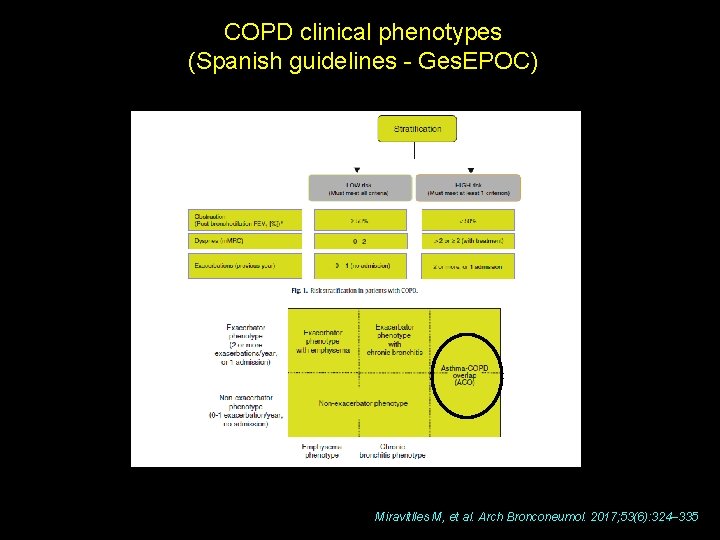
COPD clinical phenotypes (Spanish guidelines - Ges. EPOC) Miravitlles M, et al. Arch Bronconeumol. 2017; 53(6): 324– 335
Stepwise approach to diagnosis and initial treatment *www. ginasthma. org & www. goldcopd. org
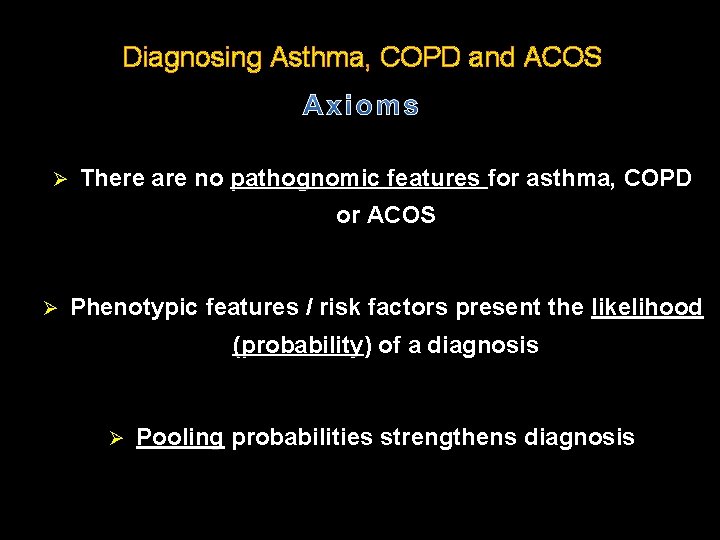
Diagnosing Asthma, COPD and ACOS Ø There are no pathognomic features for asthma, COPD or ACOS Ø Phenotypic features / risk factors present the likelihood (probability) of a diagnosis Ø Pooling probabilities strengthens diagnosis
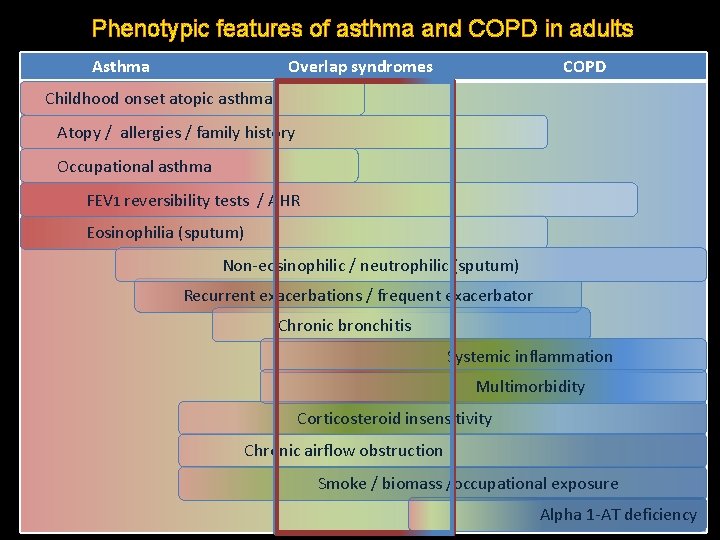
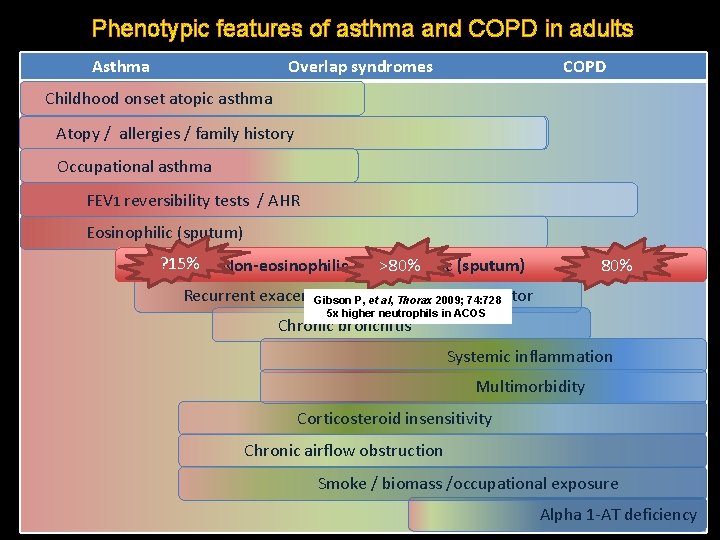
Phenotypic features of asthma and COPD in adults Asthma Overlap syndromes COPD Childhood onset atopic asthma Atopy / allergies / family history Occupational asthma FEV 1 reversibility tests / AHR Eosinophilia (sputum) Non-eosinophilic / neutrophilic (sputum) Recurrent exacerbations / frequent exacerbator Chronic bronchitis Systemic inflammation Multimorbidity Corticosteroid insensitivity Chronic airflow obstruction Smoke / biomass /occupational exposure Alpha 1 -AT deficiency
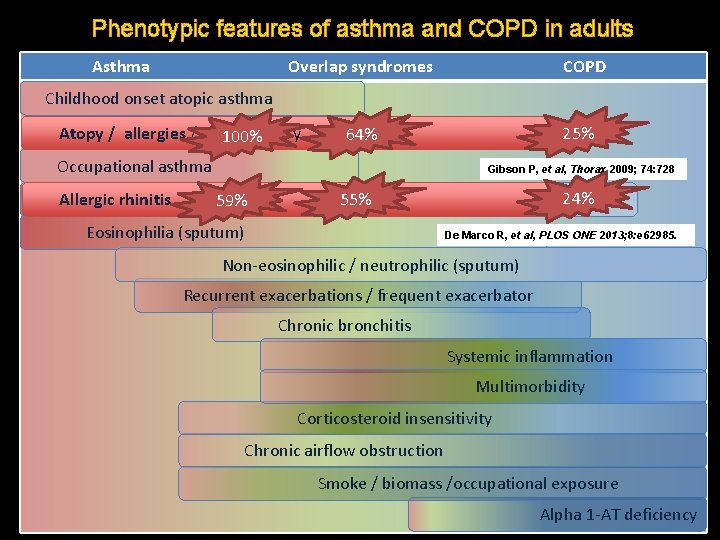
Phenotypic features of asthma and COPD in adults Asthma Overlap syndromes COPD Childhood onset atopic asthma Atopy allergies family history Atopy/// allergies///family history 100% 25% 64% Occupational asthma Gibson P, et al, Thorax 2009; 74: 728 Allergic FEV 1 rhinitis reversibility tests 59% / AHR 24% 55% Eosinophilia (sputum) De Marco R, et al, PLOS ONE 2013; 8: e 62985. Non-eosinophilic / neutrophilic (sputum) Recurrent exacerbations / frequent exacerbator Chronic bronchitis Systemic inflammation Multimorbidity Corticosteroid insensitivity Chronic airflow obstruction Smoke / biomass /occupational exposure Alpha 1 -AT deficiency
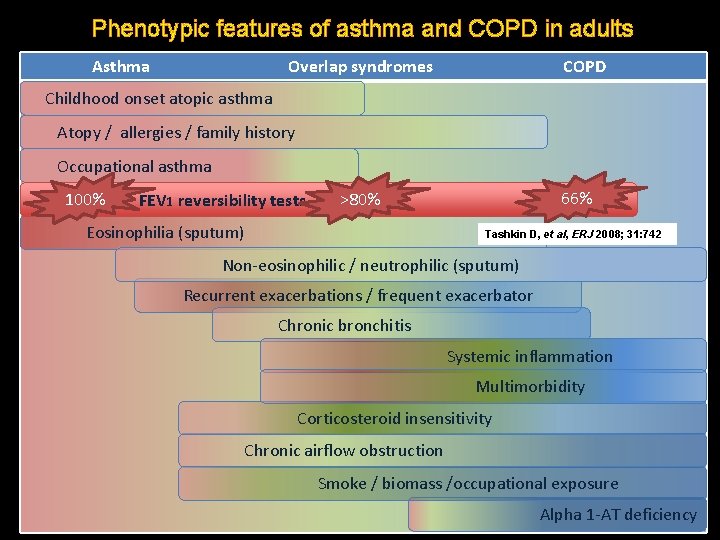
Phenotypic features of asthma and COPD in adults Asthma Overlap syndromes COPD Childhood onset atopic asthma Atopy // allergies // family history Occupational asthma 100% 66% >80% FEV 1 reversibility tests / AHR Eosinophilia (sputum) Tashkin D, et al, ERJ 2008; 31: 742 Non-eosinophilic / neutrophilic (sputum) Recurrent exacerbations / frequent exacerbator Chronic bronchitis Systemic inflammation Multimorbidity Corticosteroid insensitivity Chronic airflow obstruction Smoke / biomass /occupational exposure Alpha 1 -AT deficiency
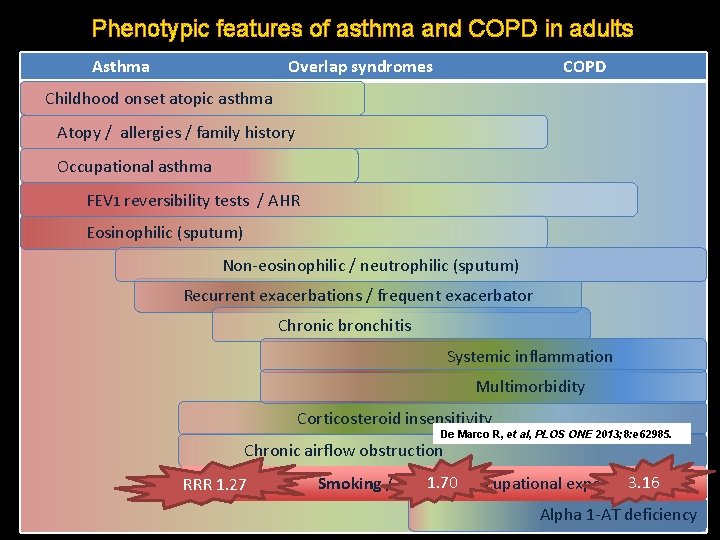
Phenotypic features of asthma and COPD in adults Asthma Overlap syndromes COPD Childhood onset atopic asthma Atopy / allergies / family history Occupational asthma FEV 1 reversibility tests / AHR Eosinophilic (sputum) Non-eosinophilic / neutrophilic (sputum) Recurrent exacerbations / frequent exacerbator Chronic bronchitis Systemic inflammation Multimorbidity Corticosteroid insensitivity De Marco R, et al, PLOS ONE 2013; 8: e 62985. Chronic airflow obstruction RRR 1. 27 1. 70 /occupational exposure 3. 16 Smoking / biomass Alpha 1 -AT deficiency
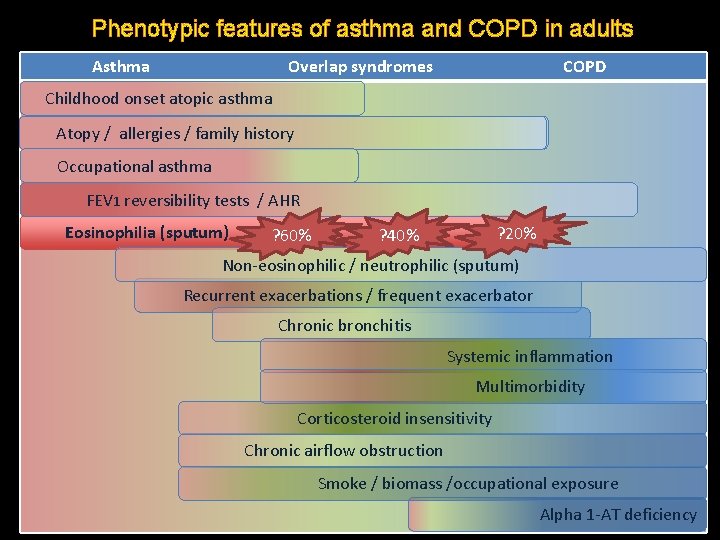
Phenotypic features of asthma and COPD in adults Asthma Overlap syndromes COPD Childhood onset atopic asthma Atopy // allergies // family history Occupational asthma FEV 1 reversibility tests / AHR Eosinophilia (sputum) ? 60% ? 20% ? 40% Non-eosinophilic / neutrophilic (sputum) Recurrent exacerbations / frequent exacerbator Chronic bronchitis Systemic inflammation Multimorbidity Corticosteroid insensitivity Chronic airflow obstruction Smoke / biomass /occupational exposure Alpha 1 -AT deficiency
Phenotypic features of asthma and COPD in adults Asthma Overlap syndromes COPD Childhood onset atopic asthma Atopy // allergies // family history Occupational asthma FEV 1 reversibility tests / AHR Eosinophilic (sputum) ? 15% Non-eosinophilic / neutrophilic (sputum) >80% Recurrent exacerbations exacerbator Gibson P, /etfrequent al, Thorax 2009; 74: 728 5 x higher neutrophils in ACOS Chronic bronchitis Systemic inflammation Multimorbidity Corticosteroid insensitivity Chronic airflow obstruction Smoke / biomass /occupational exposure Alpha 1 -AT deficiency
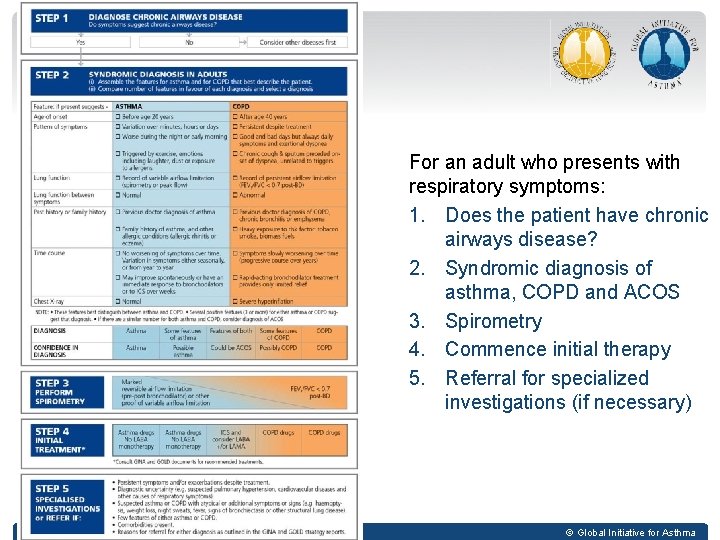
For an adult who presents with respiratory symptoms: 1. Does the patient have chronic airways disease? 2. Syndromic diagnosis of asthma, COPD and ACOS 3. Spirometry 4. Commence initial therapy 5. Referral for specialized investigations (if necessary) GINA 2014, Box 5 -4 © Global Initiative for Asthma
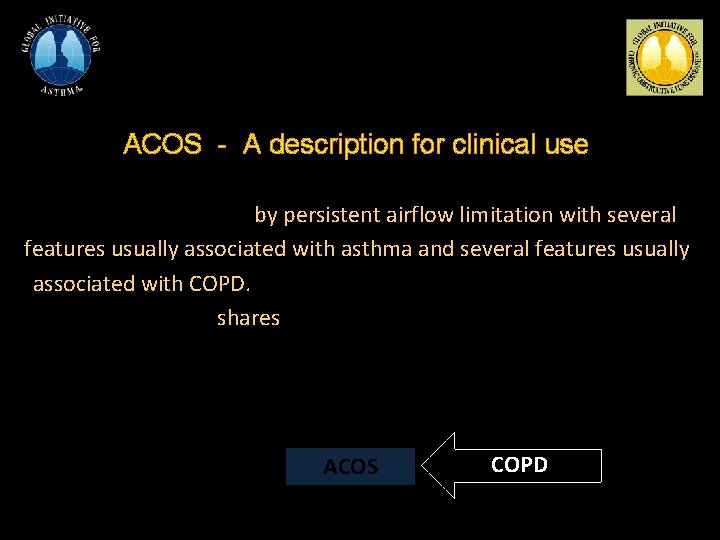
ACOS - A description for clinical use ACOS is characterized by persistent airflow limitation with several features usually associated with asthma and several features usually associated with COPD. ACOS is therefore identified by the features that it shares with both asthma and COPD. Asthma ACOS COPD
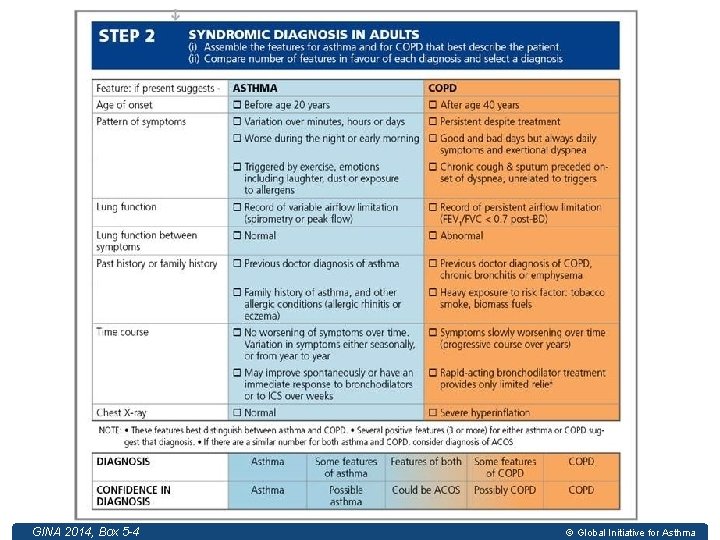
GINA 2014, Box 5 -4 GINA 2014 © Global Initiative for Asthma
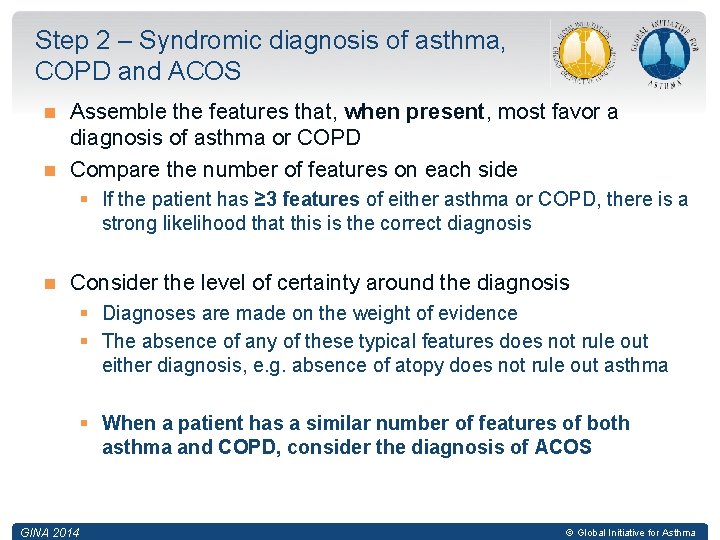
Step 2 – Syndromic diagnosis of asthma, COPD and ACOS Assemble the features that, when present, most favor a diagnosis of asthma or COPD Compare the number of features on each side § If the patient has ≥ 3 features of either asthma or COPD, there is a strong likelihood that this is the correct diagnosis Consider the level of certainty around the diagnosis § Diagnoses are made on the weight of evidence § The absence of any of these typical features does not rule out either diagnosis, e. g. absence of atopy does not rule out asthma § When a patient has a similar number of features of both asthma and COPD, consider the diagnosis of ACOS GINA 2014 © Global Initiative for Asthma
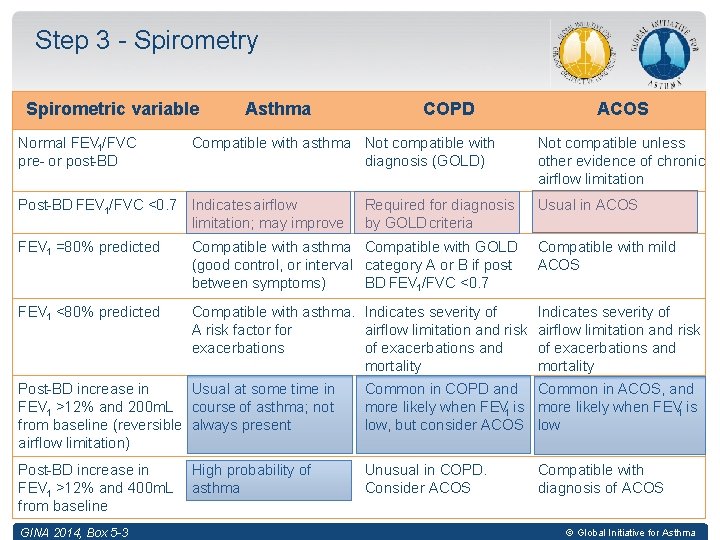
Step 3 - Spirometry Spirometric variable Normal FEV 1/FVC pre- or post-BD Asthma COPD Compatible with asthma Not compatible with diagnosis (GOLD) Post-BD FEV 1/FVC <0. 7 Indicates airflow limitation; may improve Required for diagnosis by GOLD criteria ACOS Not compatible unless other evidence of chronic airflow limitation Usual in ACOS FEV 1 =80% predicted Compatible with asthma Compatible with GOLD (good control, or interval category A or B if postbetween symptoms) BD FEV 1/FVC <0. 7 Compatible with mild ACOS FEV 1 <80% predicted Compatible with asthma. Indicates severity of A risk factor for airflow limitation and risk exacerbations of exacerbations and mortality Indicates severity of airflow limitation and risk of exacerbations and mortality Post-BD increase in Usual at some time in FEV 1 >12% and 200 m. L course of asthma; not from baseline (reversible always present airflow limitation) Common in COPD and Common in ACOS, and more likely when FEV 1 is low, but consider ACOS low Post-BD increase in FEV 1 >12% and 400 m. L from baseline Unusual in COPD. Consider ACOS GINA 2014, Box 5 -3 High probability of asthma Compatible with diagnosis of ACOS © Global Initiative for Asthma
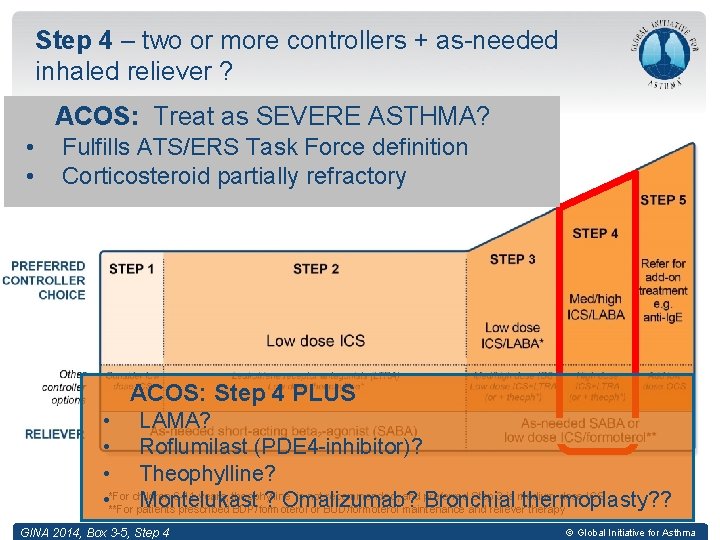
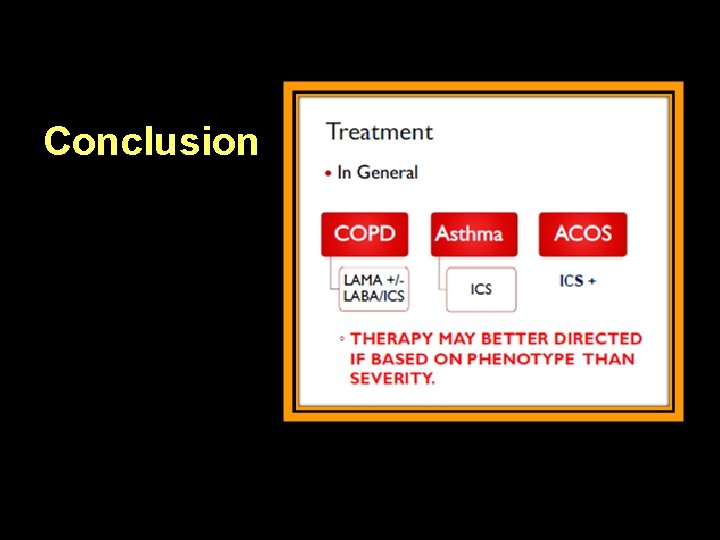
Step 4 – two or more controllers + as-needed inhaled reliever ? ACOS: Treat as SEVERE ASTHMA? • • Fulfills ATS/ERS Task Force definition Corticosteroid partially refractory ACOS: Step 4 PLUS • LAMA? • Roflumilast (PDE 4 -inhibitor)? • Theophylline? children 6 -11 years, theophylline is not recommended, and preferred Step 3 is medium dose ICS • *For Montelukast ? Omalizumab? Bronchial thermoplasty? ? **For patients prescribed BDP/formoterol or BUD/formoterol maintenance and reliever therapy GINA 2014, Box 3 -5, Step 4 © Global Initiative for Asthma
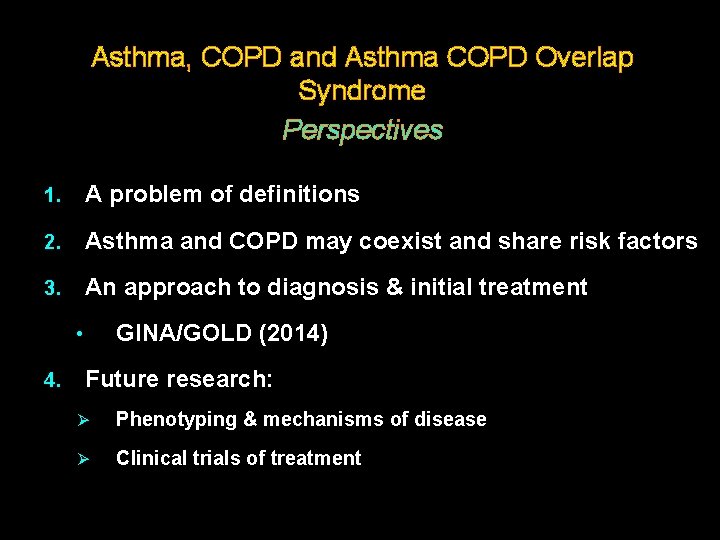
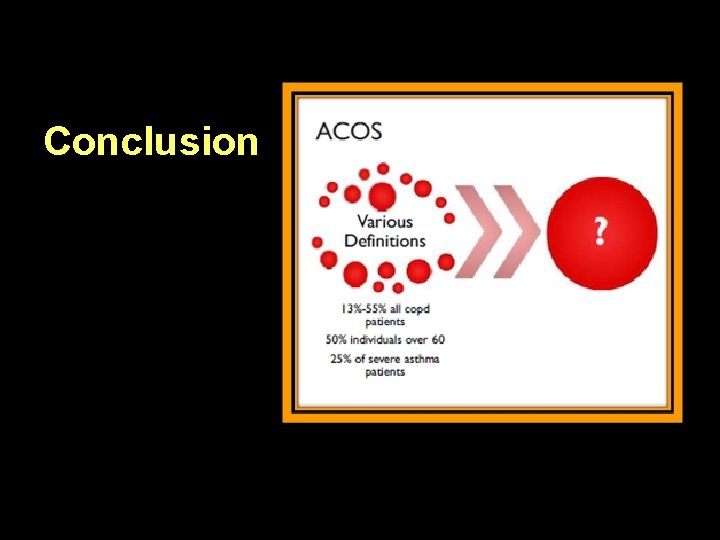
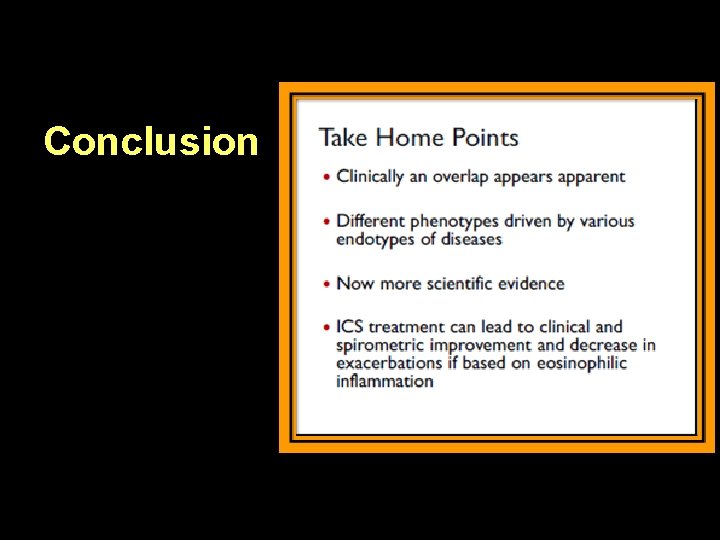
Asthma, COPD and Asthma COPD Overlap Syndrome Perspectives 1. A problem of definitions 2. Asthma and COPD may coexist and share risk factors 3. An approach to diagnosis & initial treatment GINA/GOLD (2014) • 4. Future research: Ø Phenotyping & mechanisms of disease Ø Clinical trials of treatment
Conclusion
Conclusion
Conclusion