
The Assessment Process in Child Welfare Practice Agencies
- Slides: 33
The Assessment Process in Child Welfare Practice Agencies and Courts Conference Washington, DC August 3 -6, 2009
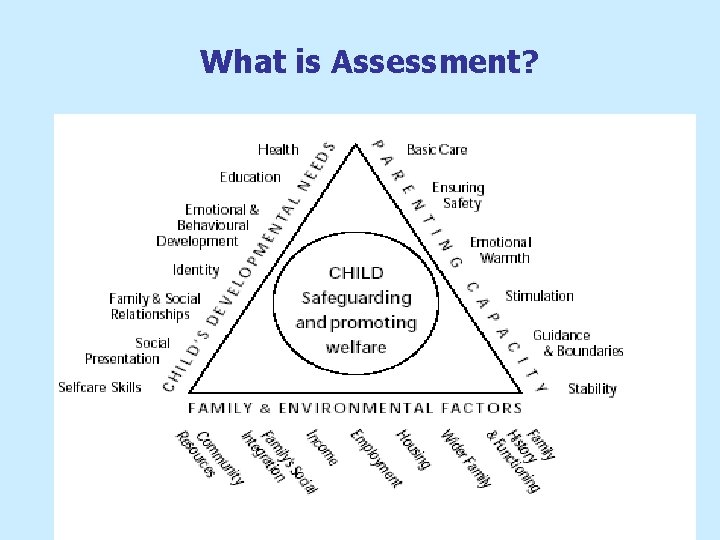
What is Assessment?
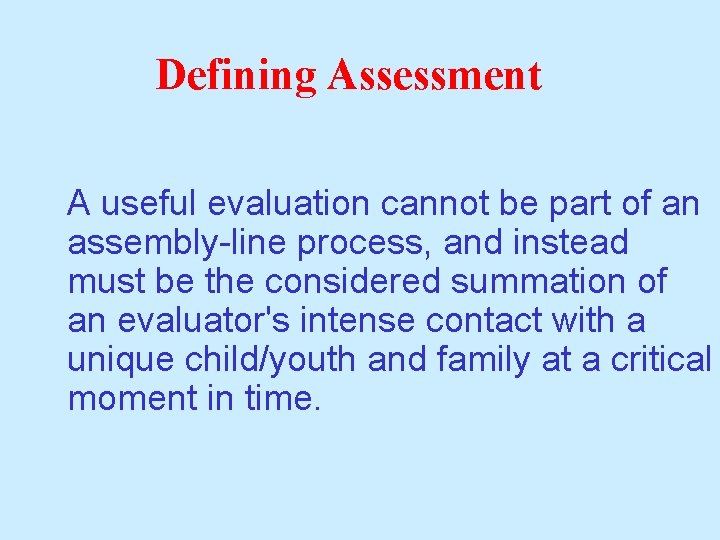
Defining Assessment A useful evaluation cannot be part of an assembly-line process, and instead must be the considered summation of an evaluator's intense contact with a unique child/youth and family at a critical moment in time.
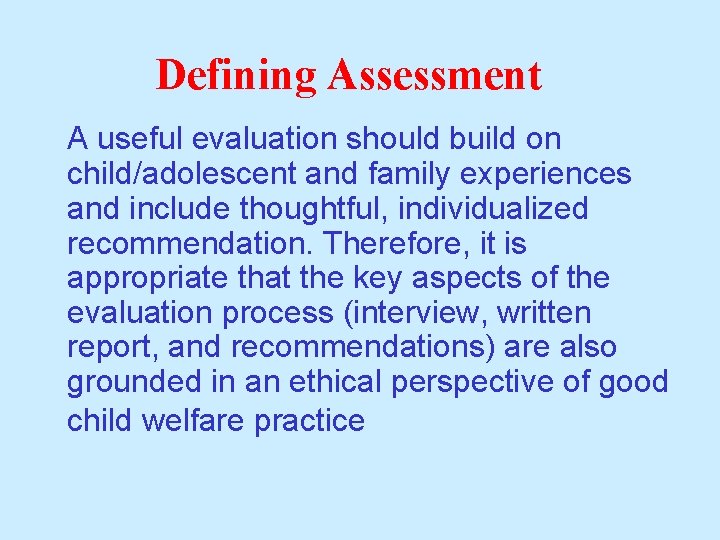
Defining Assessment A useful evaluation should build on child/adolescent and family experiences and include thoughtful, individualized recommendation. Therefore, it is appropriate that the key aspects of the evaluation process (interview, written report, and recommendations) are also grounded in an ethical perspective of good child welfare practice
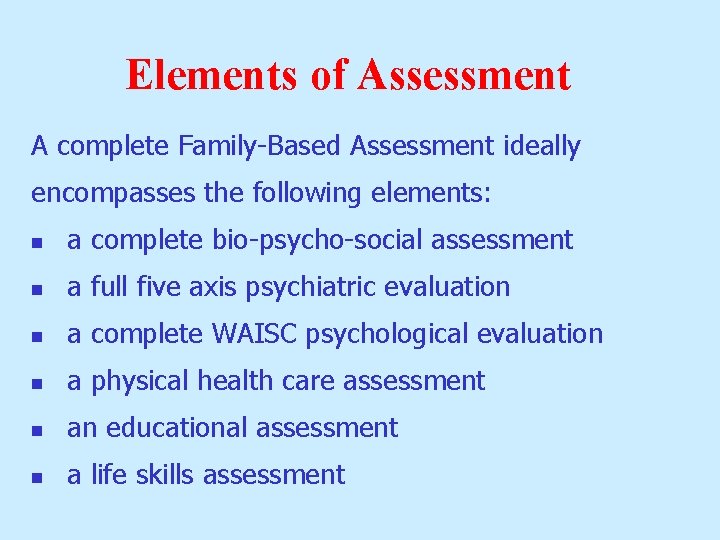
Elements of Assessment A complete Family-Based Assessment ideally encompasses the following elements: n a complete bio-psycho-social assessment n a full five axis psychiatric evaluation n a complete WAISC psychological evaluation n a physical health care assessment n an educational assessment n a life skills assessment
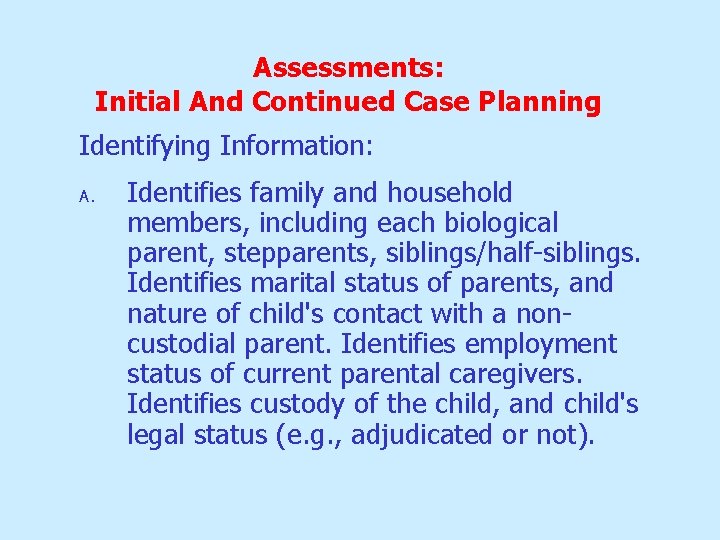
Assessments: Initial And Continued Case Planning Identifying Information: A. Identifies family and household members, including each biological parent, stepparents, siblings/half-siblings. Identifies marital status of parents, and nature of child's contact with a noncustodial parent. Identifies employment status of current parental caregivers. Identifies custody of the child, and child's legal status (e. g. , adjudicated or not).
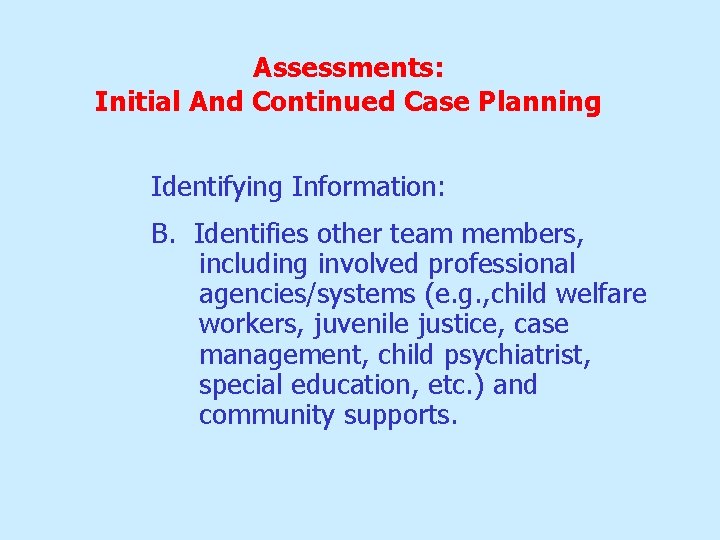
Assessments: Initial And Continued Case Planning Identifying Information: B. Identifies other team members, including involved professional agencies/systems (e. g. , child welfare workers, juvenile justice, case management, child psychiatrist, special education, etc. ) and community supports.
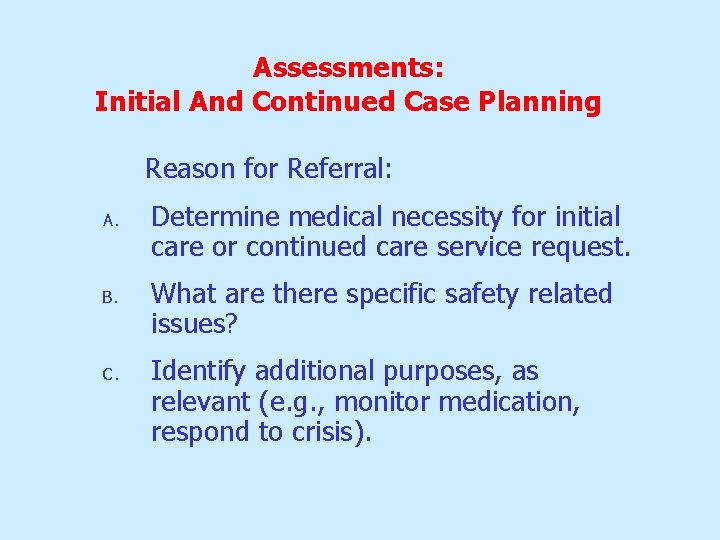
Assessments: Initial And Continued Case Planning Reason for Referral: A. B. C. Determine medical necessity for initial care or continued care service request. What are there specific safety related issues? Identify additional purposes, as relevant (e. g. , monitor medication, respond to crisis).
Assessments: Initial And Continued Case Planning Relevant Information: (begin with Brief Update, if a continued care request) A. Strengths: Child/adolescent strengths, in multiple domains. Special attention to motivation and ability to form relationships and use support. Areas of greatest competence and independence. Family (including birth family) and community strengths.
Assessments: Initial And Continued Case Planning Relevant Information: B. Concerns: Clinical basis for current service request and recommended treatment. Nature, frequency, severity, and history of the child's behaviors/symptoms Identification of both externalized behaviors and internalized symptoms, comparing present to past. Other identified needs and concerns.
Assessments: Initial And Continued Case Planning Relevant Information: C. Family: Family composition (including relevant extended family and birth family), family relationships, strengths/concerns. For child in substitute care, foster family and natural family included. Family cultural and spiritual beliefs and practices, as relevant. Family history of psychiatric disorder, as relevant.
Assessments: Initial And Continued Case Planning Relevant Information: D. School/Vocational: The child's academic, social, and behavioral adaptations, including relationships with school peers and with teachers and/or level of functioning. Efforts to date of school to address current problems. Characteristics of current class setting Current or past use of school-based services, if relevant. Current or past educational testing, and IEP. Prior school placements.
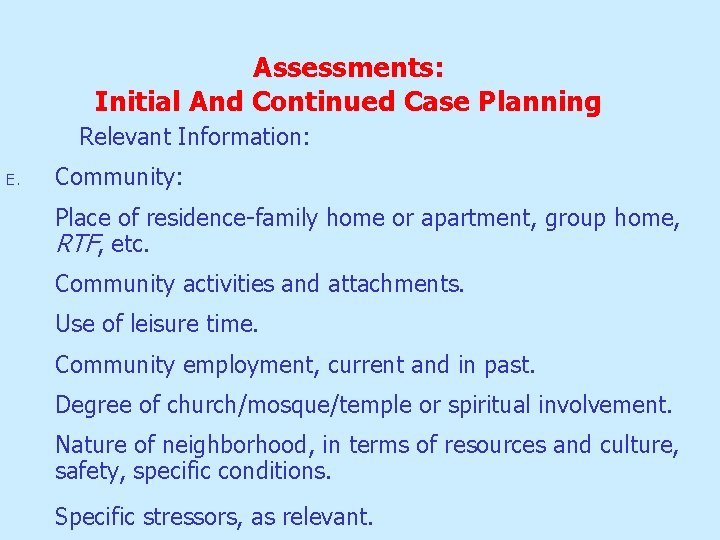
Assessments: Initial And Continued Case Planning Relevant Information: E. Community: Place of residence-family home or apartment, group home, RTF, etc. Community activities and attachments. Use of leisure time. Community employment, current and in past. Degree of church/mosque/temple or spiritual involvement. Nature of neighborhood, in terms of resources and culture, safety, specific conditions. Specific stressors, as relevant.
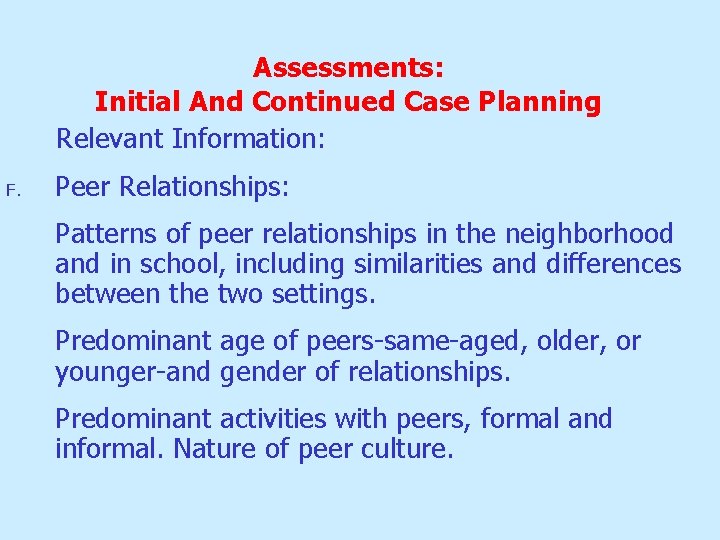
Assessments: Initial And Continued Case Planning Relevant Information: F. Peer Relationships: Patterns of peer relationships in the neighborhood and in school, including similarities and differences between the two settings. Predominant age of peers-same-aged, older, or younger-and gender of relationships. Predominant activities with peers, formal and informal. Nature of peer culture.
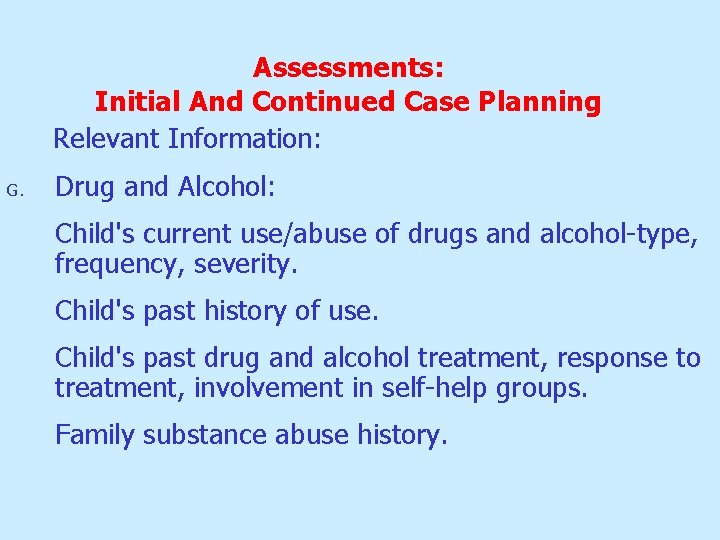
Assessments: Initial And Continued Case Planning Relevant Information: G. Drug and Alcohol: Child's current use/abuse of drugs and alcohol-type, frequency, severity. Child's past history of use. Child's past drug and alcohol treatment, response to treatment, involvement in self-help groups. Family substance abuse history.
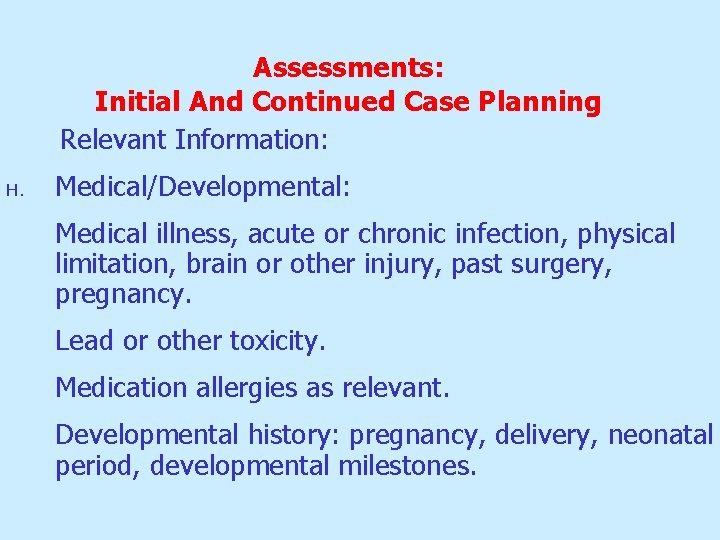
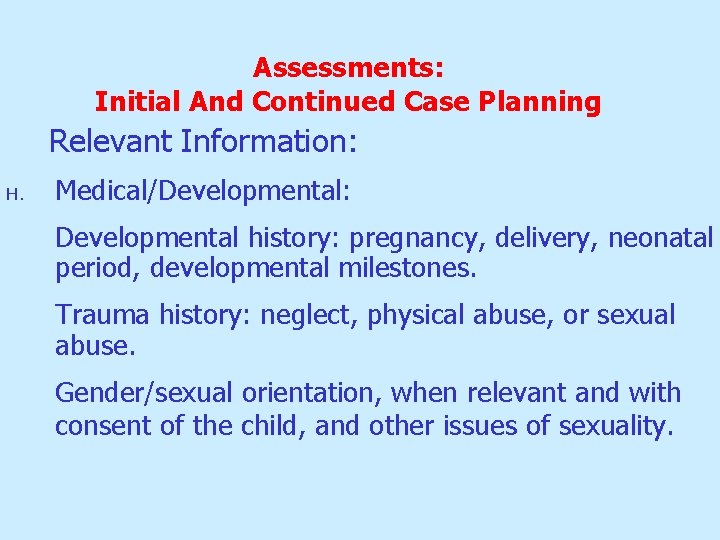
Assessments: Initial And Continued Case Planning Relevant Information: H. Medical/Developmental: Medical illness, acute or chronic infection, physical limitation, brain or other injury, past surgery, pregnancy. Lead or other toxicity. Medication allergies as relevant. Developmental history: pregnancy, delivery, neonatal period, developmental milestones.
Assessments: Initial And Continued Case Planning Relevant Information: H. Medical/Developmental: Developmental history: pregnancy, delivery, neonatal period, developmental milestones. Trauma history: neglect, physical abuse, or sexual abuse. Gender/sexual orientation, when relevant and with consent of the child, and other issues of sexuality.
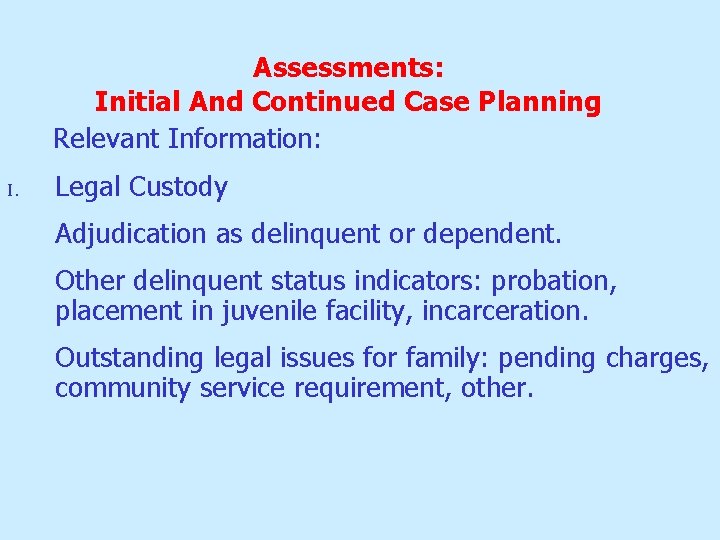
Assessments: Initial And Continued Case Planning Relevant Information: I. Legal Custody Adjudication as delinquent or dependent. Other delinquent status indicators: probation, placement in juvenile facility, incarceration. Outstanding legal issues for family: pending charges, community service requirement, other.
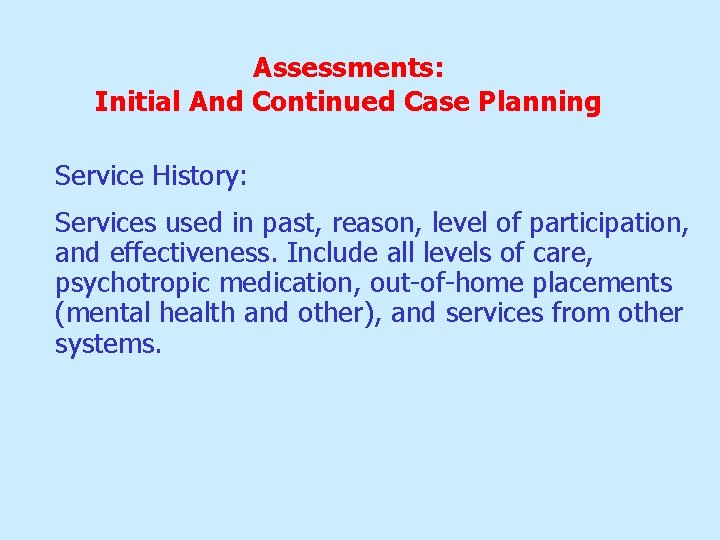
Assessments: Initial And Continued Case Planning Service History: Services used in past, reason, level of participation, and effectiveness. Include all levels of care, psychotropic medication, out-of-home placements (mental health and other), and services from other systems.
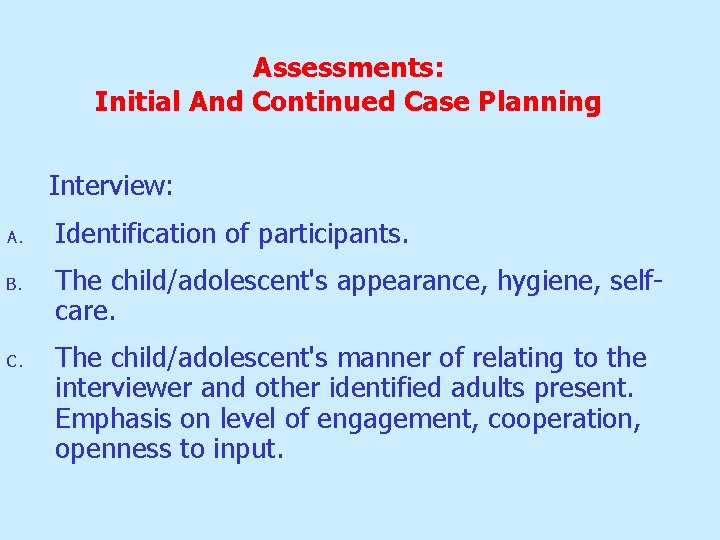
Assessments: Initial And Continued Case Planning Interview: A. B. C. Identification of participants. The child/adolescent's appearance, hygiene, selfcare. The child/adolescent's manner of relating to the interviewer and other identified adults present. Emphasis on level of engagement, cooperation, openness to input.
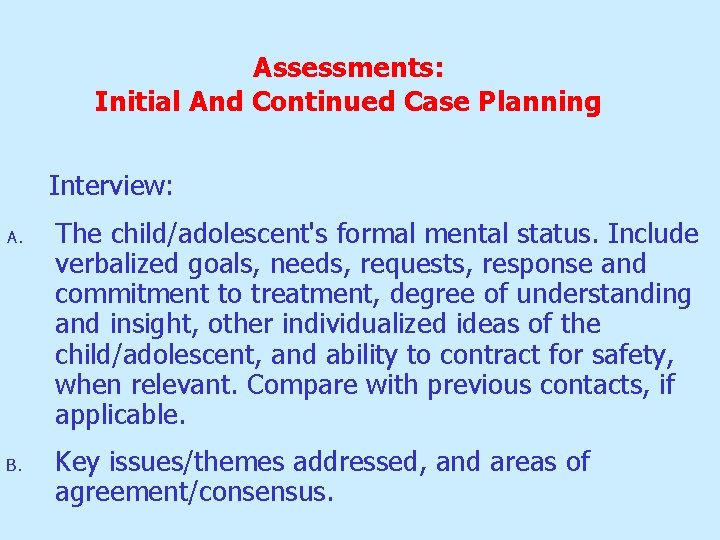
Assessments: Initial And Continued Case Planning Interview: A. B. The child/adolescent's formal mental status. Include verbalized goals, needs, requests, response and commitment to treatment, degree of understanding and insight, other individualized ideas of the child/adolescent, and ability to contract for safety, when relevant. Compare with previous contacts, if applicable. Key issues/themes addressed, and areas of agreement/consensus.
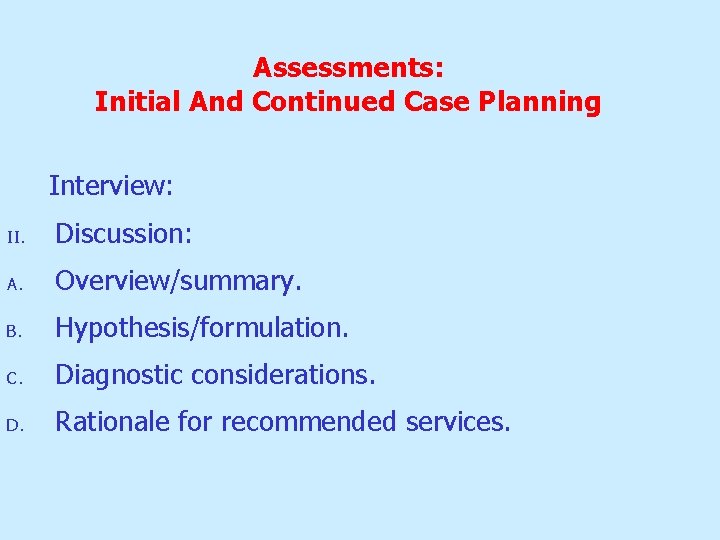
Assessments: Initial And Continued Case Planning Interview: II. Discussion: A. Overview/summary. B. Hypothesis/formulation. C. Diagnostic considerations. D. Rationale for recommended services.
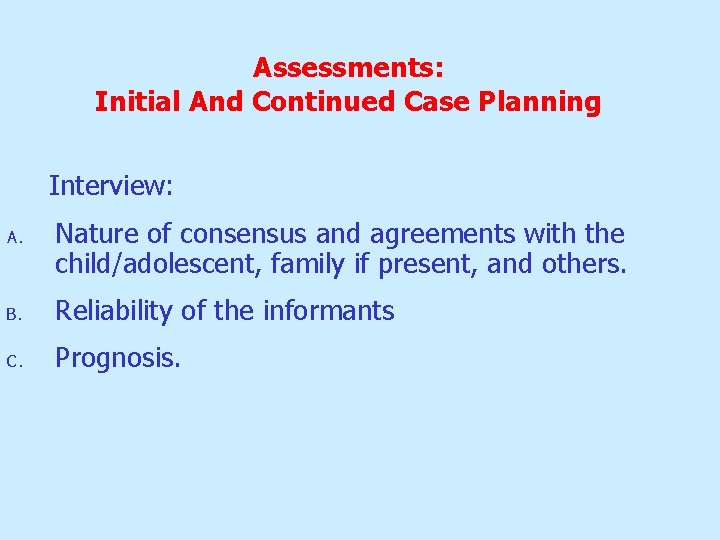
Assessments: Initial And Continued Case Planning Interview: A. Nature of consensus and agreements with the child/adolescent, family if present, and others. B. Reliability of the informants C. Prognosis.
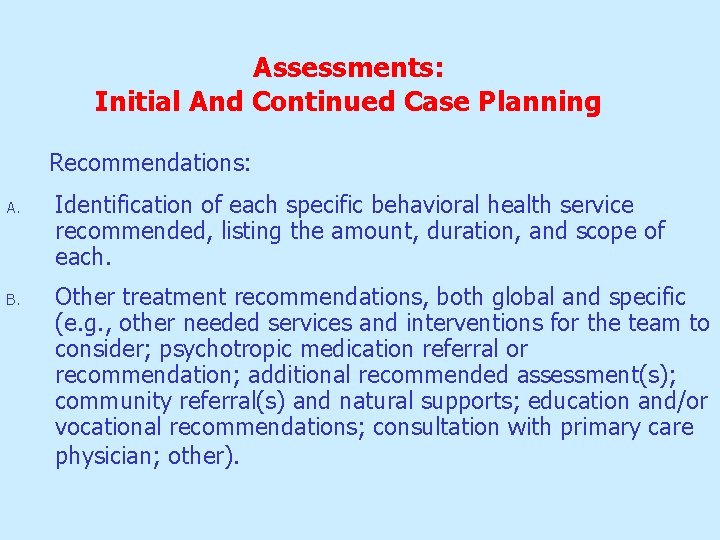
Assessments: Initial And Continued Case Planning Recommendations: A. B. Identification of each specific behavioral health service recommended, listing the amount, duration, and scope of each. Other treatment recommendations, both global and specific (e. g. , other needed services and interventions for the team to consider; psychotropic medication referral or recommendation; additional recommended assessment(s); community referral(s) and natural supports; education and/or vocational recommendations; consultation with primary care physician; other).
Assessments: Initial And Continued Case Planning Recommendations: A. B. For continued care requests, criteria for service tapering or modification of level of care, and recommendations to increase natural supports. How to link recommendations with treatment goals and then evaluate treatment goals.
Louisiana’s Approach to Comprehensive Assessment What prompted this initiative? New Administration Consultant help following hurricanes Comprehensive system review Our state put into place many new and improved services, but this was the most important “service” of all.
Louisiana’s Approach to Comprehensive Assessment We recognized two important things: (1) Due to increase in worker turnover, we had much less experienced staff, and staff with less relevant education and preparation for this work; and (2) Even among those who had been in the system awhile, we had created a compliance mentality rather than one of critical thinking
Louisiana’s Approach to Comprehensive Assessment Goal: Increase staff education and skill in core practice areas Increase reliance on evidence supported tools and practices
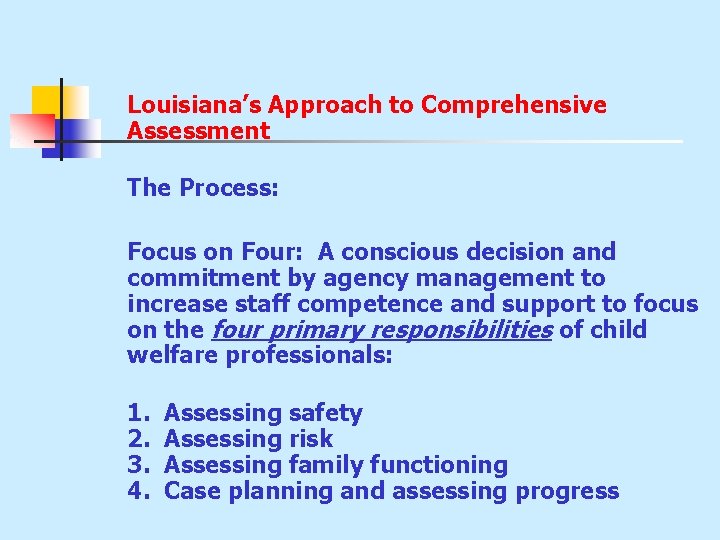
Louisiana’s Approach to Comprehensive Assessment The Process: Focus on Four: A conscious decision and commitment by agency management to increase staff competence and support to focus on the four primary responsibilities of child welfare professionals: 1. Assessing safety 2. Assessing risk 3. Assessing family functioning 4. Case planning and assessing progress
Louisiana’s Approach to Comprehensive Assessment Implementation Plan Strategically planned to follow AR rollout Established partnerships (NRC’s, court improvement personnel, SDM) Communication plan: field staff, stakeholders
Louisiana’s Approach to Comprehensive Assessment Policy: IT: Training: Initial and on-going Looking back: What worked well? What we would do differently. QA
Rhenda H. Hodnett, MSW, LCSW Director Prevention & Protection Services Department of Social Services Office of Community Services 627 N. Fourth Street, P. O. Box 3318 Baton Rouge, Louisiana 70821 225 -342 -4013 rhodnett@dss. state. la. us
Gerald P. Mallon, DSW Professor and Executive Director The National Resource Center for Family Centered Practice and Permanency Planning Hunter College School of Social Work A Service of the Children’s Bureau 129 East 79 th Street New York, New York 10075 (212) 452 -7043 Gmallon@hunter. cuny. edu www. nrcfcppp. org